
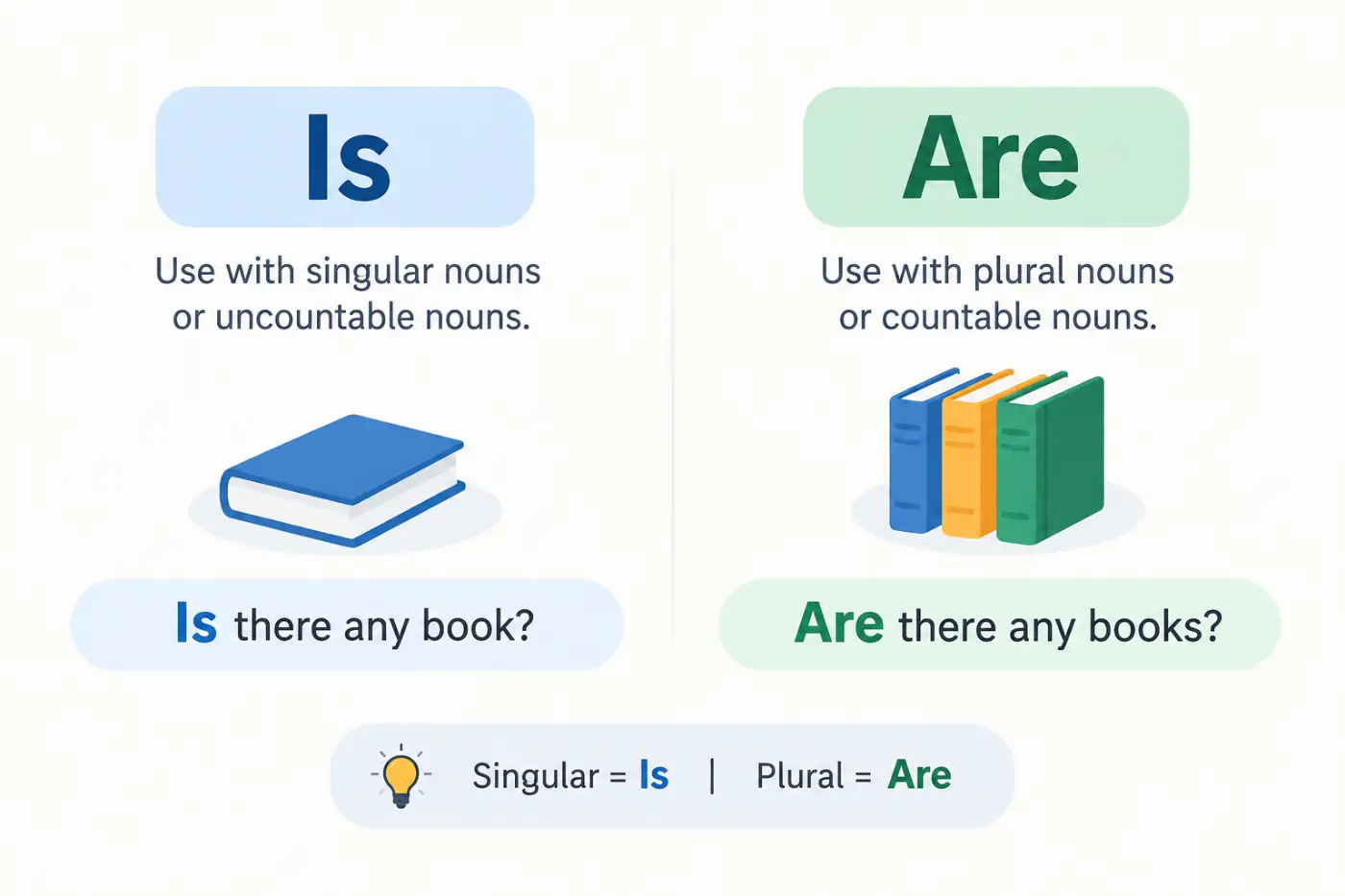
If you’re unsure about is there any vs are there any you’re dealing with a common English grammar question. Both forms are correct. The choice depends on the noun that comes after any.
Use is there any with an uncountable noun or with a singular noun. Use are there any with a plural countable noun. Once you understand that simple difference the choice becomes much easier.
For example you can ask Is there any milk in the fridge? because milk is uncountable. But you’d ask Are there any eggs in the fridge? because eggs are countable and plural.
This guide explains the difference in plain English. You’ll learn the basic grammar rule how any works with countable and uncountable nouns common mistakes to avoid and plenty of natural examples you can use in everyday speech and writing.
Quick Definition
Is there any is used when the noun is singular or uncountable. Are there any is used when the noun is plural and countable. The verb is agrees with a singular or uncountable noun while are agrees with a plural noun.
Direct Answer
Both forms are correct. Use is there any with singular or uncountable nouns and are there any with plural countable nouns.
Comparison Table
| Phrase | Meaning | Example Sentence | When to Use It |
|---|---|---|---|
| Is there any | Asks about the presence or existence of one thing or an uncountable amount. | Is there any water left? | Use it with uncountable nouns or singular nouns. |
| Are there any | Asks about the presence or existence of multiple things. | Are there any clean glasses? | Use it with plural countable nouns. |
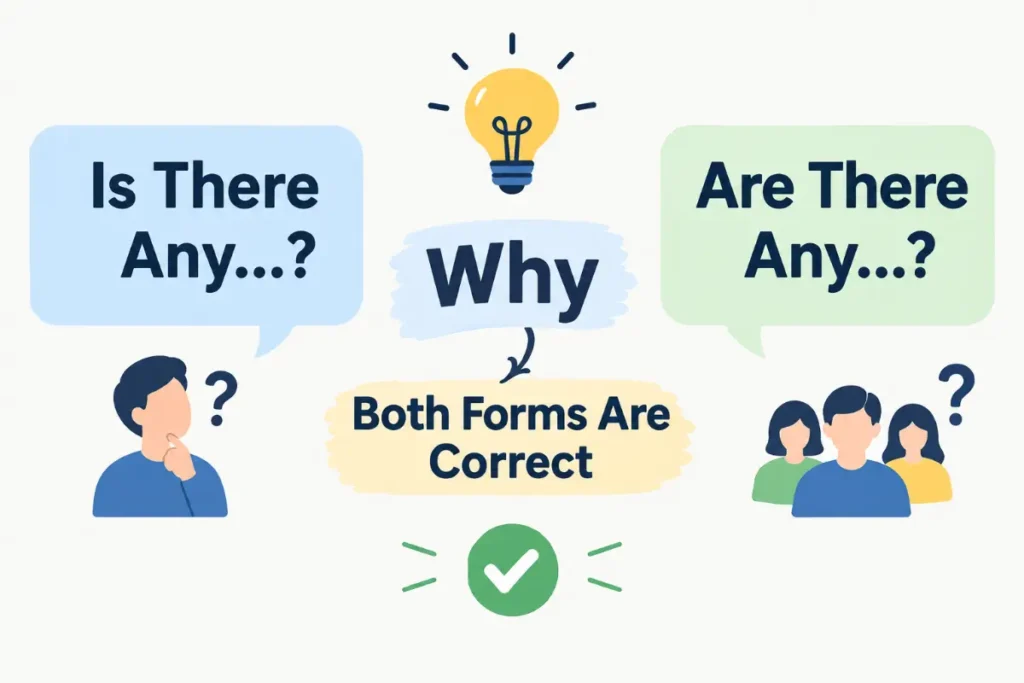
Why Both Forms Are Correct
The confusion often comes from the word any. Some people think any always requires are because it can refer to more than one thing. That isn’t how English grammar works.
The verb must agree with the noun that follows any. The word any does not decide the verb by itself.
Look at these examples.
Is there any coffee left?
Here coffee is an uncountable noun. You don’t normally say one coffee two coffees three coffees when talking about the substance itself. Because the noun is uncountable the correct verb is is.
Now compare it with this question.
Are there any coffee cups left?
Here cups is a plural countable noun. You can count one cup two cups or ten cups. That is why the correct verb is are.
The difference becomes clear when you stop focusing on any and look at the noun after it.
The Basic Grammar Rule
The easiest rule to remember is simple.
Use is with a singular noun or an uncountable noun. Use are with a plural noun.
You can apply that rule to questions with there.
Singular Nouns Use Is
A singular countable noun refers to one person place animal thing or idea.
For example:
- Is there any problem with the computer?
- Is there any reason to leave early?
- Is there any seat available?
- Is there any restaurant nearby?
- Is there any chance of rain tonight?
In each sentence the noun is singular.
You can say one problem. You can say one reason.
That makes is the correct choice.
Uncountable Nouns Use Is
Uncountable nouns are different. You can’t normally count them as separate individual units without adding another word.
Common examples include water milk rice sugar money information advice furniture and traffic.
For example:
- Is there any water in the bottle?
- Is there any milk in the fridge?
- Is there any rice left?
- Is there any money in your account?
- Is there any information about the event?
- Is there any advice you can give me?
Notice that these nouns don’t become plural in the usual way.
You don’t normally say informations or advices in standard American English. You say information and advice.
Because these nouns are uncountable the singular verb is works with them.
When To Use Are There Any
Use are there any when you are asking about two or more countable things.
For example:
- Are there any books on the table?
- Are there any students in the classroom?
- Are there any tickets left?
- Are there any clean towels?
- Are there any stores open right now?
- Are there any messages for me?
Each noun is plural and countable.
You can count books. You can count students.
That is why are is required.
Look At The Noun After Any
A useful habit is to ignore any for a moment and look at the noun that follows it.
Take this question:
Are there any apples in the kitchen?
The important word is apples. It is plural. You can count apples. One apple two apples three apples.
Now change the noun.
Is there any apple juice in the kitchen?
The noun is now apple juice. You’re talking about a drink rather than individual apples. Apple juice is normally uncountable in this sense. So the verb changes from are to is.
The word any stayed exactly the same. The noun changed and the verb changed with it.
Countable And Uncountable Nouns
Understanding countable and uncountable nouns will make this grammar point much easier.
A countable noun is something you can count as separate units. You can have one book two books or ten books.
An uncountable noun refers to something treated as a substance mass idea or general amount. You don’t normally count it directly.
Consider the difference between chairs and furniture.
You can say:
Are there any chairs in the room?
You can count chairs.
But you would normally say:
Is there any furniture in the room?
Furniture is uncountable. You can count individual pieces of furniture but you don’t normally say one furniture or two furnitures.
The same pattern appears with many everyday words.
| Countable Noun | Question | Uncountable Noun | Question |
|---|---|---|---|
| Books | Are there any books here? | Information | Is there any information here? |
| Chairs | Are there any chairs available? | Furniture | Is there any furniture available? |
| Questions | Are there any questions? | Advice | Is there any advice? |
| Bottles | Are there any bottles left? | Water | Is there any water left? |
| Apples | Are there any apples? | Rice | Is there any rice? |
Once you know the noun type the correct verb usually becomes obvious.
Why Any Can Work With Both
The word any has several uses in English. In these questions it usually means an unspecified amount or an unspecified number.
That makes it useful with both countable and uncountable nouns.
With an uncountable noun you might ask:
Is there any sugar?
You aren’t asking for a specific amount. You simply want to know if some sugar exists or is available.
With a plural countable noun you might ask:
Are there any cookies?
Again you’re not asking for a specific number. You want to know if one or more cookies are available.
So any doesn’t tell you to use is or are. The noun does.
This is one of the most useful points to remember because it prevents a common mistake. Don’t look at any and automatically choose are. Look at the noun instead.
Examples From Everyday Conversations
You can hear this structure in many normal situations. People use it when asking about food shopping plans work school travel and simple household matters.
At Home
Imagine you’re checking the kitchen before making breakfast.
Is there any bread left?
The word bread is uncountable here. You aren’t counting individual loaves. You’re asking about the general amount of bread available.
Now imagine you’re checking the same kitchen for eggs.
Are there any eggs left?
Eggs are countable and plural. You can easily say one egg two eggs or six eggs.
The same idea works with other foods.
- Is there any cheese in the fridge?
- Are there any tomatoes in the fridge?
- Is there any juice left?
- Are there any oranges left?
The noun controls the verb.
At Work
You might ask a coworker:
Is there any information about the meeting?
Information is uncountable so is is correct.
But you could also ask:
Are there any updates about the meeting?
Updates are countable and plural so are is correct.
Both questions sound natural. The only difference is the noun.
At School
A teacher might ask:
Are there any questions about the homework?
The noun questions is plural. That calls for are.
A student might then ask:
Is there any extra information in the textbook?
Information is uncountable so is fits.
While Shopping
You might ask a store employee:
Are there any larger sizes available?
The noun sizes is plural and countable.
But you could ask:
Is there any stock left in the back?
Here stock is being used as an uncountable noun. The correct verb is is.
This shows why meaning matters too. The same general idea can take a different verb depending on the noun and how that noun is being used.
The Difference In Short Answers
The same subject and verb agreement appears in short answers.
If someone asks:
Is there any coffee left?
You can answer:
Yes there is.
Or:
No there isn’t.
If someone asks:
Are there any clean cups?
You can answer:
Yes there are.
Or:
No there aren’t.
The short answer follows the verb from the original question.
This gives you another useful way to check your grammar. If there is sounds right in the answer use is there in the question. If there are sounds right use are there.
A Simple Test You Can Use
When you’re unsure which form to choose ask yourself one question.
Can I count the noun as individual things?
If the answer is yes and you’re talking about more than one then use are there any.
For example:
Are there any pencils?
You can count pencils.
If you’re talking about one singular item use is there any.
Is there any pencil I can borrow?
Here you’re asking about one possible pencil.
If the noun is uncountable use is there any.
Is there any ink in the printer?
You don’t normally count ink directly.
This quick test won’t solve every grammar question in English but it works very well for this particular pattern.
Common Mistakes With These Questions
The biggest mistake is choosing are just because the question contains any. That shortcut doesn’t work. The word any can go with both singular and plural nouns so you need to check the noun that comes after it.
For example you might say Is there any water in the bottle? but Are there any bottles in the kitchen? The first noun is uncountable while the second is plural and countable. The change in the noun causes the change in the verb.
Another common mistake is treating every noun as countable. English has many nouns that describe things as a general amount rather than separate items. Words such as money information advice furniture and equipment usually take is in this structure.
Mistake With Information
A common sentence is:
Are there any information about the event?
That sentence is incorrect in standard American English.
The natural form is:
Is there any information about the event?
Information is an uncountable noun. You can have a piece of information or several pieces of information but you don’t normally count information itself.
The same rule applies to similar sentences.
- Is there any information I should know before the meeting?
- Is there any new information about the case?
- Is there any useful information on the website?
Mistake With Advice
Advice works in the same way.
You wouldn’t normally say:
Are there any advice for new students?
Instead say:
Is there any advice for new students?
If you need to count advice you can use a phrase such as a piece of advice.
For example:
Are there any pieces of advice from previous students?
Now pieces is plural and countable. That’s why are works.
Mistake With Furniture
Furniture can cause the same problem.
You should say:
Is there any furniture in the apartment?
Not:
Are there any furniture in the apartment?
If you’re asking about individual items you can change the noun.
Are there any pieces of furniture in the garage?
The word pieces is countable. That makes the plural form work naturally.
When A Singular Countable Noun Works
Many learners understand the plural rule but forget that is there any can also appear with a singular countable noun.
Consider this question:
Is there any restaurant nearby?
Restaurant is a singular countable noun. You’re asking if there is at least one restaurant in the area.
You could also ask:
Are there any restaurants nearby?
Both questions are grammatical but they have a slightly different focus.
The singular version asks if there is at least one restaurant.
The plural version asks about restaurants in general and can suggest that you expect more than one possibility.
Here are some more examples.
- Is there any doctor available?
- Is there any seat left?
- Is there any reason to worry?
- Is there any solution to this problem?
- Is there any bus that goes downtown?
The noun stays singular so is fits.
Singular And Plural Questions Can Both Be Correct
Sometimes both forms are correct because the speaker chooses a different noun form.
Look at these two questions.
Is there any student in the classroom?
Are there any students in the classroom?
The first question focuses on the possibility of one student. The second asks about one or more students as a group.
In everyday conversation the plural version may sound more natural when you are checking for people or things in a place. Still the singular form isn’t automatically wrong.
Another pair makes the difference clearer.
Is there any apple in the bag?
Are there any apples in the bag?
The first asks about at least one apple. The second asks about apples generally and sounds more natural if you’re checking how many might be there.
So grammar and meaning work together. The verb must agree with the noun but the speaker also chooses singular or plural based on what they want to ask.
Questions With Uncountable Nouns
Uncountable nouns deserve extra attention because they don’t behave like ordinary plural nouns.
You can say:
Is there any water in the glass?
You can also say:
Is there any coffee left?
But you don’t normally say:
Are there any water in the glass?
Or:
Are there any coffee left?
The reason is simple. Water and coffee are being treated as substances rather than individual countable objects.
You can make them countable by adding a unit.
Are there any bottles of water in the fridge?
Are there any cups of coffee on the table?
Now bottles and cups are plural countable nouns. The verb changes because the noun controlling the agreement has changed.
Common Uncountable Nouns
Here are some everyday nouns that usually take is in this structure.
- Water.
- Milk.
- Coffee.
- Sugar.
- Rice.
- Money.
- Advice.
- Information.
- Furniture.
- Equipment.
- Traffic.
- Homework.
- Weather.
- News.
- Luggage.
For example:
- Is there any money in your wallet?
- Is there any homework tonight?
- Is there any traffic on the highway?
- Is there any luggage in the hallway?
These sentences all use is because the nouns are uncountable in these meanings.
When The Meaning Changes The Grammar
Some English nouns can be countable in one situation and uncountable in another. This can make the rule look more complicated than it really is.
Take chicken as an example.
If you’re talking about chicken as food you can say:
Is there any chicken left?
Here you’re talking about the food in general.
But if you’re talking about live birds you can say:
Are there any chickens in the yard?
Now chickens refers to individual birds. The noun is plural and countable so are is correct.
The same thing happens with several other nouns.
Coffee
If you mean coffee as a drink or substance:
Is there any coffee left?
If you’re talking about cups or servings in a casual restaurant setting you might hear:
Are there any coffees available?
That usage is less common in everyday American English and usually means individual servings or orders rather than the substance itself.
Experience
When experience means general knowledge gained over time it is usually uncountable.
Is there any experience required for this job?
When experiences means separate events or things someone has lived through it becomes countable.
Are there any experiences you want to share with the group?
The noun’s meaning changes and the grammar changes with it.
Questions With Places And Locations
This structure appears constantly when people ask about places.
You might ask:
Is there any gas station nearby?
This asks if at least one gas station exists nearby.
You might also ask:
Are there any gas stations nearby?
This asks about multiple possible gas stations.
The plural version often sounds more natural when you’re looking for choices.
The same pattern works with stores restaurants banks hotels and other locations.
- Is there any pharmacy around here?
- Are there any pharmacies around here?
- Is there any hotel near the airport?
- Are there any hotels near the airport?
- Is there any bank open today?
- Are there any banks open today?
None of these forms is automatically better. Your choice depends on the noun and the meaning you want to express.
Questions About People
When asking about people the plural form is often the natural choice because you’re usually asking about a group.
For example:
- Are there any doctors available?
- Are there any teachers in the building?
- Are there any students who need help?
The nouns doctors teachers and students are plural countable nouns.
But a singular question can also work.
Is there any doctor available?
This can mean you need at least one doctor and don’t care how many are available.
The difference is small but useful. The singular form often focuses on finding one suitable person. The plural form opens the question to several people.
Questions About Things
The same idea applies to objects.
Imagine you’re packing for a trip.
Are there any clean shirts in the closet?
You’re looking for one or more shirts.
But if you’re looking for one specific type of item you could say:
Is there any shirt I can wear to the dinner?
Here shirt is singular because you’re asking about one possible shirt.
You can also ask:
Is there any jacket that would work for this weather?
The word jacket is singular. The question asks if at least one suitable jacket exists.
This is why simply memorizing a phrase isn’t enough. You need to look at the noun and understand what you’re asking.
Negative Questions And Short Answers
The same subject and verb agreement applies when you use negative forms.
For example:
Isn’t there any food left?
This asks about an uncountable noun.
For a plural countable noun you can say:
Aren’t there any clean plates?
The negative forms are isn’t for is and aren’t for are.
These questions can sound slightly different depending on context. A negative question often shows surprise or an expectation that something exists.
For example:
Isn’t there any milk left?
The speaker may have expected to find milk in the fridge.
Likewise:
Aren’t there any tickets left?
The speaker may be surprised that all the tickets are gone.
Formal And Informal Usage
These question forms work in both casual and formal English.
In casual conversation you might say:
Is there any coffee?
At work you might write:
Is there any additional information available?
Both sentences follow the same grammar rule.
The difference comes from vocabulary and context rather than the choice between is and are.
You can also make these questions more polite.
- Is there any chance you could help me?
- Are there any other options available?
- Is there any way we can change the appointment?
These forms are common in natural American English and don’t sound overly formal.
A Quick Way To Choose The Right Form
When you’re writing or speaking and you aren’t sure which form to use take one second to look at the noun.
- If the noun is singular use is.
- Is there any reason?
- If the noun is uncountable use is.
- Is there any reason for concern?
- If the noun is plural and countable use are.
- Are there any reasons for concern?
That last pair is especially useful because it shows the difference clearly. Reason is singular so it takes is. Reasons is plural so it takes are.
The word any doesn’t change. The noun does.
Once you train yourself to check the noun instead of guessing from the word any the correct choice becomes much more automatic.
A Useful Memory Trick
Think of is as working with one or with a mass.
- One book means is.
- A mass of water means is.
- Several books mean are.
- So you can remember the pattern like this:
- One or uncountable means is.
- More than one countable thing means are.
This isn’t a complicated grammar rule. It is simply subject and verb agreement applied to questions with there.
If you remember that the verb agrees with the noun rather than the word any you’ll avoid most mistakes.
More Real Examples
Here are some examples from situations you might actually encounter.
At a restaurant:
- Is there any soup left?
- Are there any sandwiches left?
A hotel:
- Is there any parking available?
- Are there any rooms available?
At an office:
- Is there any paper in the printer?
- Are there any documents on the desk?
At home:
- Is there any laundry in the dryer?
- Are there any clean towels?
The school:
- Is there any homework tonight?
- Are there any tests this week?
Each pair follows the same rule. The noun determines the verb.
Why The Plural Form Often Sounds More Natural
You may notice that people often use the plural form when they are asking about available choices.
For example:
Are there any restaurants open right now?
That sounds very natural when you’re looking for somewhere to eat.
You could say:
Is there any restaurant open right now?
That sentence is also possible. It focuses on finding at least one restaurant.
The plural form can feel more open because the speaker isn’t focused on one particular item. They are asking what options exist.
Compare these:
- Is there any doctor available?
- Are there any doctors available?
The first can sound like you’re looking for one doctor. The second can suggest that you want to know about all available doctors or several possible choices.
The grammar remains correct in both cases. The difference is mainly in focus and context.
The Role Of There In These Questions
The word there can make these sentences look more complicated than they really are. In this structure there introduces the existence or presence of something.
Compare:
- There is a problem.
- There are problems.
Turn those statements into questions and you get:
- Is there a problem?
- Are there problems?
Add any and the pattern becomes:
- Is there any problem?
- Are there any problems?
The structure is consistent. The verb changes because the noun changes.
This is why understanding basic subject and verb agreement makes the entire topic much easier.
What About There Is Any
A common mistake is putting the words in the wrong order.
You should not normally ask:
There is any milk?
In standard English you need the question structure:
Is there any milk?
The same applies to plural nouns.
Instead of:
There are any tickets?
Say:
Are there any tickets?
The helping verb moves before there to form the question.
This pattern is worth learning because you’ll use it constantly in everyday English.
What About There Are Any
The same rule applies here. There are any is not the normal question structure by itself.
Use:
Are there any books?
Not:
There are any books?
The first sentence uses normal question word order. The second may appear in casual speech with a rising tone in some contexts but it isn’t the standard form you should use in careful writing.
For school work professional emails and polished writing stick with the standard question structure.
A Final Check Before You Write
If you’re still unsure which form sounds right take the noun out of the sentence and look at it alone.
Suppose your sentence is:
___ there any information about the flight?
The key noun is information. It is uncountable. So you need is.
Now try:
___ there any flights from Chicago tonight?
The key noun is flights. It is plural and countable. So you need are.
This small habit can prevent a surprising number of grammar mistakes. You don’t need to memorize dozens of examples. Just identify the noun and let it guide your choice.
Tricky Cases You Should Know
The basic rule works most of the time. Still, a few nouns can make the choice less obvious because their form or meaning can change in different situations.
The key is to focus on what the noun means in the sentence. Don’t judge it only by how it looks. A noun can sometimes be countable in one sentence and uncountable in another. When that happens the verb can change too.
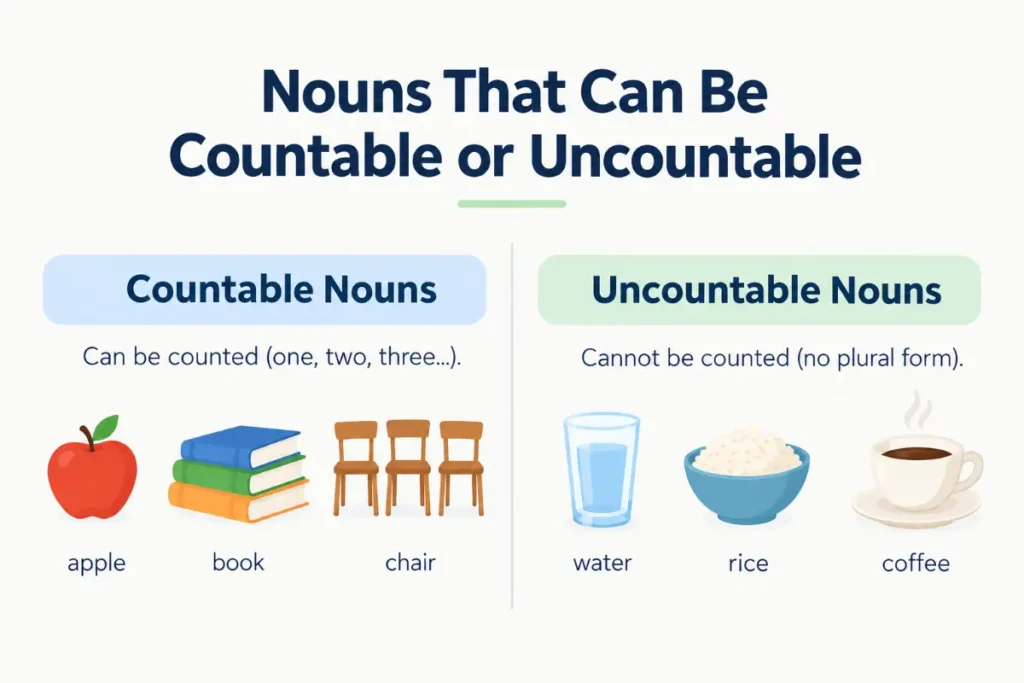
Nouns That Can Be Countable Or Uncountable
Some English nouns have two common uses. One use treats the noun as a general substance or idea. Another use treats it as separate items or events.
That difference affects the verb in an existence question.
Experience
When experience means knowledge gained from doing something it is usually uncountable.
Is there any experience required for this position?
Here the question asks about a person’s background or skill. Experience isn’t being treated as a group of separate events.
But experiences can mean separate events that happened to someone.
Are there any experiences from your trip that you want to share?
Now the noun is plural and countable. Each experience is treated as a separate event.
Time
Time is often uncountable when it means the general idea of time.
Is there any time left before the meeting?
But you can talk about separate periods or occasions using a countable form.
Are there any times that work for you next week?
Here times means specific appointment options. Each one can be counted as a separate possibility.
Room
The word room can mean physical space or an individual room in a building.
When you mean space:
Is there any room in the car for another bag?
Here room means available space.
When you mean separate rooms:
Are there any rooms available at the hotel?
Now you’re talking about individual rooms that can be counted.
This is a good example of why meaning matters. The spelling of the noun isn’t enough to tell you which verb to use.
Nouns That Look Plural But Are Usually Uncountable
Some words end in s but don’t behave like ordinary plural nouns. This can catch learners off guard.
One of the best known examples is news.
You say:
Is there any news about the accident?
Not:
Are there any news about the accident?
The word news ends in s but it is normally treated as singular and uncountable in standard American English.
You can also say:
There is some good news.
The verb is is because news is treated as a singular uncountable noun.
Mathematics And Other School Subjects
Some subjects also end in s but take a singular verb.
For example:
Is there any mathematics homework tonight?
The subject mathematics is treated as singular.
You wouldn’t normally say:
Are there any mathematics?
However, you can ask:
Are there any math classes tomorrow?
Now classes is the noun controlling the verb. It is plural and countable.
Nouns That Are Usually Uncountable In American English
A few nouns cause repeated problems because learners try to make them plural.
These include advice information furniture equipment and luggage.
You would normally say:
- Is there any advice for new employees?
- Is there any information about the application?
- Is there any furniture in the apartment?
- Is there any equipment we can use?
- Is there any luggage in the lobby?
These forms are standard in American English.
If you need to talk about separate items you can add a countable noun.
- Are there any pieces of furniture in the garage?
- Are there any pieces of equipment we can borrow?
- Are there any bags of luggage in the storage room?
The added noun gives you something you can count.
Questions With Amounts And Numbers
Another useful point comes up when a question includes a quantity.
Consider this sentence:
Is there any water left?
The noun is water so is is correct.
Now change the sentence:
Are there any bottles of water left?
The noun controlling the verb is bottles. Since bottles are plural and countable you need are.
The same pattern appears with many other expressions.
- Is there any coffee left?
- Are there any cups of coffee left?
- Is there any sugar in the cupboard?
- Are there any bags of sugar in the cupboard?
- Is there any paper in the printer?
- Are there any sheets of paper in the printer?
The important word isn’t always the last word in the noun phrase. Look for the main noun that tells you what you’re counting.
Using Any In Negative Statements
The word any isn’t limited to questions. It also appears in negative statements.
For example:
- There isn’t any milk left.
- There aren’t any eggs left.
- The same noun rule applies.
- Milk is uncountable so use isn’t.
- Eggs is plural and countable so use aren’t.
This connection can help you remember the question forms. If you can correctly change a statement into a negative statement you can often build the question correctly too.
Compare these pairs.
- There isn’t any food left.
- Is there any food left?
And:
- There aren’t any clean dishes.
- Are there any clean dishes?
The structure changes from a statement to a question but the noun and verb agreement stay connected.
Using Any In Positive Statements
In positive statements some is often more natural than any when you mean an unspecified amount or number.
For example:
- There is some coffee in the kitchen.
- There are some cookies on the table.
If you turn these into questions you can use any.
- Is there any coffee in the kitchen?
- Are there any cookies on the table?
This is a useful pattern because it shows how some and any often work as partners.
In general English commonly uses some in positive statements and any in questions and negative statements.
There are exceptions. You might use any in a positive sentence when you mean no limits or it doesn’t matter which one.
For example:
You can choose any seat.
Here any means one seat of your choice. It doesn’t ask if seats exist.
That meaning is different from the existence questions discussed in this article.
Questions That Start With Can
You may also see these phrases after modal verbs such as can.
For example:
- Is there any way I can help?
- Are there any ways we can improve the plan?
The first sentence uses singular way. The second uses plural ways.
You might also ask:
Are there any seats I can take?
Or:
Is there any seat I can use?
Again the noun determines the form.
Questions With Will
The same idea works when you ask about something expected in the future.
- Will there be any food at the event?
- Will there be any activities for children?
In these sentences will controls the verb structure so you don’t use is or are directly after there.
This is worth remembering because some learners try to carry the basic pattern into every tense.
Compare:
- Is there any food?
- Will there be any food?
And:
- Are there any activities?
- Will there be any activities?
The meaning changes from present existence to future expectation but the noun still affects the form in related constructions.
Questions With Was And Were
You can also ask about something that existed in the past.
- With a singular or uncountable noun use was.
- Was there any food left after the party?
- Was there any reason for the delay?
- With a plural countable noun use were.
- Were there any guests at the party?
- Were there any problems during the trip?
This follows the same agreement principle. The tense changes but the relationship between the verb and noun remains.
Questions About Availability
One of the most common uses of these forms is asking if something is available.
For example:
- Is there any parking available?
- Is there any water available?
- Are there any tickets available?
- Are there any seats available?
This wording appears often in stores restaurants hotels offices airports and event venues.
The noun gives you the answer to the grammar question. Parking and water are uncountable in these examples. Tickets and seats are plural countable nouns.
Is There Any Vs Are There Any In Polite Requests
These forms can also make requests sound softer and more natural.
Suppose you’re at a restaurant and want more water.
Is there any more water available?
That sounds polite and normal.
If you’re looking for more napkins you could say:
Are there any more napkins available?
The same structure works at work.
- Is there any more information you can send me?
- Are there any other documents I need to complete?
These questions don’t sound stiff. They’re common in everyday American English.
The Meaning Of Any More
The phrase any more deserves attention because it appears often in these questions.
When any more means an additional amount you usually use is with an uncountable noun.
- Is there any more coffee?
- Is there any more rice?
- Is there any more time?
But use are with plural countable nouns.
- Are there any more cookies?
- Are there any more chairs?
- Are there any more questions?
The word more doesn’t decide the verb. The noun does.
The Meaning Of Any Other
You may also see any other in questions.
For example:
- Is there any other option?
- The noun option is singular.
- If you use the plural:
- Are there any other options?
- The noun options is plural.
This distinction is especially useful in workplace and customer service conversations.
You might say:
Is there any other way to solve this problem?
Or:
Are there any other ways to solve this problem?
Both are grammatical. Your choice depends on the number of options you have in mind.
Questions About Problems And Issues
The words problem and issue are countable nouns. That means singular and plural forms can create different question structures.
- Is there any problem with the computer?
- Are there any problems with the computer?
Both sentences can work.
The singular form can ask if at least one problem exists. The plural form sounds natural when you’re checking for several possible problems.
The same applies to issue.
- Is there any issue with my account?
- Are there any issues with my account?
In casual American English the plural version is often common when someone is asking for a general check. Still the singular version remains correct when the question focuses on one possible issue.
Questions About Chances And Possibilities
Some abstract nouns are uncountable while others are countable. This matters in questions about possibilities.
- Is there any chance of getting a refund?
- Here chance is singular.
- You can also say:
- Are there any chances of getting a refund?
That plural version is grammatically possible but it can change the meaning. In many everyday situations is there any chance sounds more natural because the speaker is asking about the possibility as a general idea.
This shows an important point. Grammar tells you which verb agrees with the noun. Natural usage also depends on the meaning you want to express.
A Few Pairs Worth Memorizing
If you want a quick set of examples to study these patterns use pairs that differ only in the noun.
- Is there any water?
- Are there any bottles?
- Is there any money?
- Are there any coins?
- Is there any information?
- Are there any details?
- Is there any furniture?
- Are there any chairs?
- Is there any traffic?
- Are there any cars?
These pairs make the pattern easy to see. The first question uses a singular or uncountable noun. The second uses a plural countable noun.
A Simple Editing Trick
When you’re proofreading your own writing don’t read the entire question first. Find the noun that comes after any and ask what kind of noun it is.
Suppose you wrote:
- Are there any equipment available?
- Look at equipment.
You can’t normally count equipment directly. You can count pieces of equipment. So the corrected sentence is:
Is there any equipment available?
Now suppose you wrote:
Is there any documents attached to the email?
Look at documents.
Documents are individual items that you can count. The corrected version is:
Are there any documents attached to the email?
This editing method takes only a few seconds. It also works much better than trying to memorize a long list of phrases.
How Native Speakers Think About The Difference
Native speakers usually don’t stop and name the grammar rule in their heads. They hear the noun and the verb together as a natural pattern.
A learner might consciously think:
Any means are.
That leads to mistakes.
A better habit is to hear the complete phrase.
- Is there any water?
- Are there any bottles?
After enough exposure the correct forms start to feel natural.
Reading helps. So does listening to real conversations. Pay attention to the words that follow is there and are there. You’ll start noticing the pattern everywhere.
When The Singular Form Sounds More Natural
Grammar isn’t only about what is technically possible. Good writing also depends on what sounds natural in context.
Suppose you’re calling a hotel.
Is there any room available tonight?
This can sound natural when you’re simply looking for one available room.
You could also ask:
Are there any rooms available tonight?
That version can suggest that you’re asking about available rooms as a group or looking for choices.
Both forms can be correct. The difference is the focus.
The same thing happens with stores.
- Is there any store open right now?
- Are there any stores open right now?
The plural version may sound more natural if you’re asking for options. The singular version can work when you only need to know if at least one place is open.
When The Plural Form Is The Better Choice
If you’re clearly asking about several things you should use the plural form.
For example:
Are there any questions before we finish?
You’re inviting people to ask questions. The plural form makes sense because multiple questions are possible.
Likewise:
Are there any changes to the schedule?
You’re checking for possible changes.
And:
Are there any mistakes in this report?
You’re asking about mistakes in general and more than one could exist.
Using the singular form in these situations can sound less natural even when the basic grammar might allow it. Good speakers choose the form that best matches the intended meaning.
A Practical Rule For Fast Decisions
When you need to make the choice quickly use this three step check.
First find the noun.
Next decide if it is singular uncountable or plural and countable.
Then choose the matching verb.
For example:
___ there any sugar left?
Sugar is uncountable. Use is.
___ there any cookies left?
Cookies are plural and countable. Use are.
___ there any doctor available?
Doctor is singular. Use is.
___ there any doctors available?
Doctors are plural and countable. Use are.
This method is simple enough to use while you’re speaking. You don’t need to stop and think about complex grammar terms.
The Most Important Point To Remember
The word any isn’t the deciding factor. The noun is.
That single idea clears up most of the confusion around these questions. If the noun is singular or uncountable use is. If the noun is plural and countable use are.
So when you see a sentence like Is there any information available? don’t think that any requires is. Think about information.
Likewise when you see Are there any questions? don’t think that any requires are. Think about questions.
Once you make that small mental shift the pattern becomes much easier to use correctly.
Is There Any Vs Are There Any In Real Speech
In everyday English, both forms sound natural when you match the verb to the noun that follows. Native speakers do not usually stop to think about the grammar rule. They simply hear the noun in their head and choose the form that fits.
For example, someone might ask, “Is there any coffee left?” The noun coffee is uncountable, so is sounds right. In another conversation, someone might ask, “Are there any cookies left?” Cookies can be counted, and the noun is plural, so are fits naturally.
You can also hear these questions in very short conversations. A person at home might ask, “Is there any food?” Someone at work might ask, “Are there any meetings today?” At a store, a customer might ask, “Are there any larger sizes?” These questions are simple, but they show how useful this grammar pattern is in real life.
The same rule works in writing, too. Emails, messages, school assignments, reports, and formal documents all follow the same basic agreement rule. The style may change, but the relationship between the verb and noun stays the same.
Why Spoken English Can Feel Confusing
Spoken English can make these questions harder because people often speak quickly. Words can blend together, and the noun may not sound as clear as it does on a page.
Imagine hearing someone say, “Are there any left?” You may not immediately know what they mean. The missing noun could be cookies, chairs, tickets, or several other plural things. The grammar still depends on the noun that the speaker has in mind.
The same thing happens with “Is there any left?” The hidden noun could be milk, water, food, or another uncountable thing. You understand the sentence from the conversation even though the noun is not spoken.
This is why context matters. English speakers often leave out words that everyone already understands. The grammar does not disappear just because the noun is unstated.
Short Answers In Everyday English
Questions using these forms often receive short answers. You do not need to repeat the whole question.
For example:
- “Is there any milk?”
- “Yes, there is.”
- “No, there isn’t.”
- “Are there any eggs?”
- “Yes, there are.”
- “No, there aren’t.”
Notice how the short answer matches the verb in the question. Is goes with there is and are goes with there are.
This pattern gives you another useful way to check your grammar. If the natural short answer is “Yes, there is,” the question normally begins with “Is there.” If the natural answer is “Yes, there are,” the question normally begins with “Are there.”
Questions With No
Negative questions can sometimes make the choice feel harder.
For example:
- “Isn’t there any coffee?”
- “Aren’t there any clean cups?”
- “Isn’t there any food left?”
- “Aren’t there any seats available?”
The same noun rule still applies. Coffee and food are uncountable, so the singular form works. Cups and seats are plural countable nouns, so the plural form works.
Negative questions often show surprise, concern, or an expectation that something exists. If someone expected coffee to be available, they might say, “Isn’t there any coffee?” If they expected several clean cups, they might say, “Aren’t there any clean cups?”
Questions About Future Situations
The same idea appears when you ask about something that will happen later.
You might ask:
- “Will there be any food at the event?”
- “Will there be any students in the classroom?”
- “Will there be any parking nearby?”
- “Will there be any available rooms?”
Notice that the future form uses will there be rather than is there or are there. The noun still matters for meaning, but the future auxiliary does not change between singular and plural in this structure.
This is useful because English does not always use the same verb pattern for every tense. The present forms show the difference between is and are, while future questions use will.
Questions About The Past
Past questions work in a similar way.
For example:
- “Was there any food left?”
- “Were there any cookies left?”
- “Was there any damage?”
- “Were there any problems?”
Use was with a singular or uncountable noun. Use were with a plural noun.
This gives you a simple family of patterns:
- “Is there any water?”
- “Was there any water?”
- “Are there any bottles?”
- “Were there any bottles?”
Once you recognize the noun, the verb becomes much easier to choose.
Questions With Can
You may also use can when asking about availability or possibility.
For example:
- “Can there be any problems with this plan?”
- “Can there be any extra charges?”
- “Can there be any delays?”
Here, can does not change to match the noun. The phrase there be stays the same.
You can also use can in questions about finding or getting something:
- “Can I get any information?”
- “Can we get any tickets?”
- “Can you provide any advice?”
These examples show that any is not limited to one question pattern. Its meaning depends on the sentence around it.
Is There Any Vs Are There Any For Availability
Questions about availability are one of the most common places where learners use these forms.
- At a hotel, you might ask:
- “Is there any availability for tonight?”
- Here, availability is uncountable, so is works naturally.
- If you are asking about rooms, you would say:
- “Are there any rooms available tonight?”
- Rooms is a plural countable noun, so are works.
- At a restaurant, you might ask:
- “Is there any outdoor seating?”
- But you could ask:
- “Are there any outdoor tables?”
The meaning is close, but the noun changes the grammar.
This is a useful lesson. You can often express the same general idea with different nouns, and the correct verb may change with that noun.
How To Sound More Natural
Correct grammar is only part of natural English. The question should also fit the situation.
For example, “Is there any water?” is natural when you want to know if water is available. You might ask this at home, at a restaurant, or during a trip.
“Are there any bottles of water?” is also natural, but now you are asking about individual bottles. The speaker is thinking about countable objects rather than the liquid itself.
That small change gives the listener a different picture.
The same idea works with coffee. “Is there any coffee?” asks about coffee as a drink or substance. “Are there any cups of coffee?” asks about separate servings.
Good English often depends on these small choices. Once you notice them, many grammar questions become easier.
A Useful Editing Trick
If you are editing your own sentence, do not focus on any first. Find the noun.
Take this sentence:
“Are there any information about the course?”
The problem is information. It is normally uncountable in English, so the sentence should be:
“Is there any information about the course?”
Now consider:
“Is there any students in the room?”
The noun students is plural and countable, so the sentence should be:
“Are there any students in the room?”
This editing method works quickly. Circle or mentally identify the noun after any, then choose the verb that agrees with it.
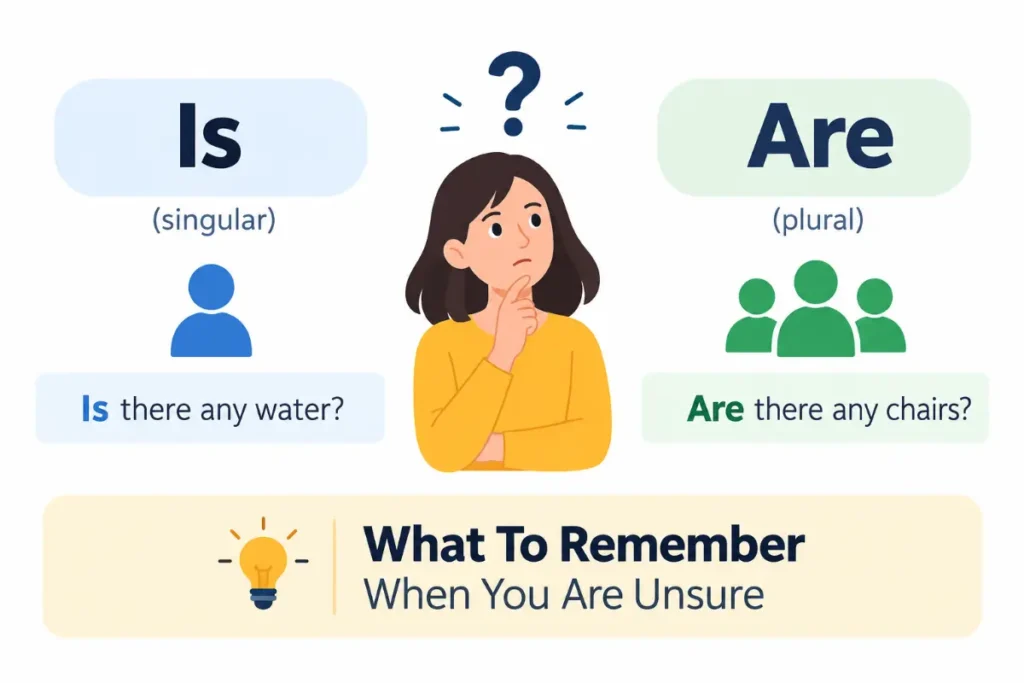
What To Remember When You Are Unsure
If you forget the rule during a conversation, do not panic. Ask yourself one simple question.
“What am I asking about?”
If you are asking about one thing or an uncountable substance, use is. If you are asking about several countable things, use are.
Think of the noun as the boss of the verb in this pattern. Any does not make the final decision. The noun does.
That one idea can prevent most mistakes.
FAQs
Which is correct is there any vs are there any?
Both forms are correct, but they are used with different nouns. Use is there any with a singular or uncountable noun, and use are there any with a plural countable noun.
Can I use is there any with plural nouns?
No, not in standard English when the plural noun directly follows the phrase. For example, “Is there any books?” is incorrect. Say “Are there any books?” instead.
Can I use are there any with uncountable nouns?
Normally, no. Uncountable nouns take the singular form in this structure. Say “Is there any information?” rather than “Are there any information?”
Is there any singular or plural?
The phrase itself is neither simply singular nor plural. The verb changes based on the noun that follows. Is agrees with a singular or uncountable noun, while are agrees with a plural noun.
Are there any questions correct?
Yes. “Are there any questions?” is completely correct because questions is a plural countable noun. This is a common phrase used by teachers, speakers, presenters, and writers.
Why do we say is there any information?
Information is an uncountable noun in standard English. Even though it refers to many possible facts or details, English normally treats information as a mass noun, so it takes is.
Can both forms be correct with the same idea?
Yes, but the noun may change. For example, “Is there any coffee?” and “Are there any cups of coffee?” can refer to the same general situation, but coffee is uncountable while cups is plural and countable.
What is the easiest way to remember the difference?
Look at the noun after any. If the noun is singular or uncountable, choose is. If the noun is plural and countable, choose are.
Conclusion
Choosing between is there any and are there any becomes much easier once you stop treating any as the deciding word. The real choice comes from the noun that follows. Singular and uncountable nouns take is, while plural countable nouns take are.
Use questions such as “Is there any water?” and “Is there any information?” for uncountable nouns. Use questions such as “Are there any bottles?” and “Are there any students?” for plural countable nouns.
When you are unsure, find the noun first. Ask yourself if you are talking about one thing, an uncountable substance or idea, or several countable things. That quick check will usually give you the right answer.
With a little practice, these questions start to feel automatic. Listen for the noun, match the verb to it, and keep the sentence simple. Once that habit becomes natural, this common grammar problem is much easier to avoid.

Dr. Elena Vance holds a Ph.D. in Linguistics from Columbia University and has spent over 15 years analyzing the evolution of the English language. A former university professor turned full-time writer and editor, Elena specializes in breaking down high-level grammatical concepts, punctuation nuances, and style guides (APA, Chicago, MLA) into clear, actionable advice. When she isn’t hunting down dangling modifiers, she can be found collecting vintage dictionaries and reading classic literature.