
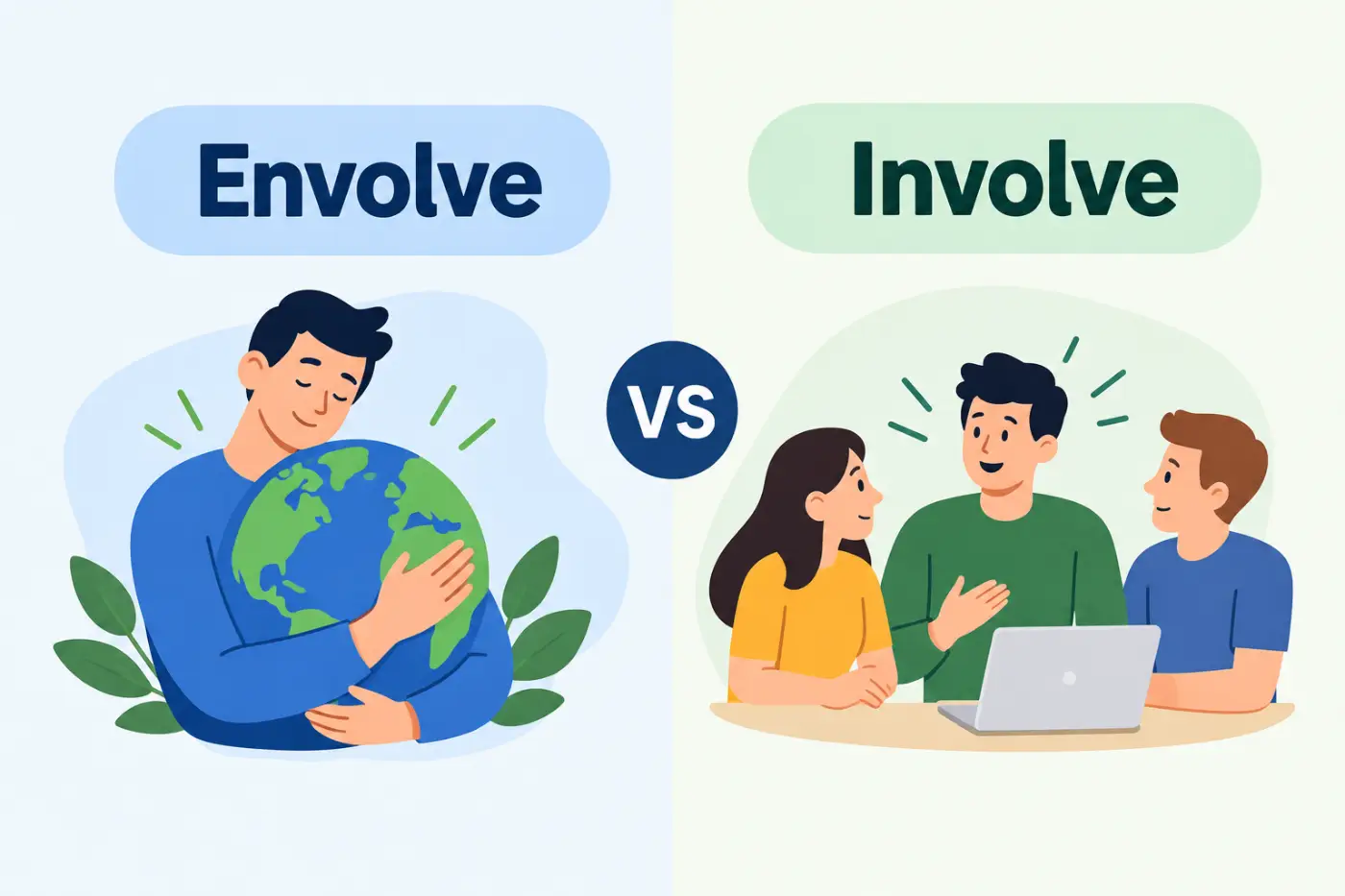
If you’re searching for envolve vs involve you probably want to know which spelling is correct. The answer is simple. Involve is the correct English word. Envolve is not the standard spelling of this word.
The confusion often comes from pronunciation. When people say involve quickly the first vowel can sound less clear. That can make envolve look reasonable when you write it down. It also doesn’t help that English has many words that begin with en and in.
Once you know the meaning and spelling of involve the difference becomes much easier to spot. This guide explains what involve means how to use it in a sentence why envolve is incorrect and how to remember the correct spelling.
Quick Definition
Involve is a verb that means to include someone or something in an activity situation or process. It can also mean to require something as part of a task or situation.
Envolve is not the standard English spelling. If you want to say that someone is included in something or that something requires another thing you should use involve.
Direct Answer
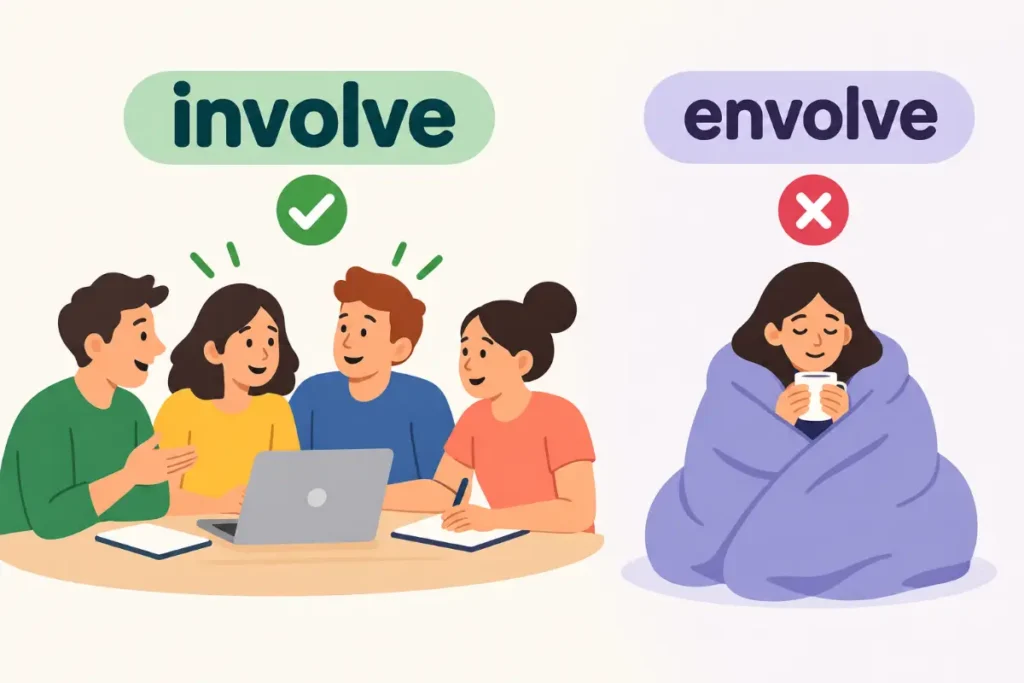
Involve is the correct spelling. Envolve is an incorrect spelling and should not be used in standard English.
Comparison Table
| Word | Meaning | Example Sentence | When To Use It |
|---|---|---|---|
| Involve | To include someone or something or require something. | The project will involve several teachers. | Use this spelling in standard English. |
| Envolve | Not a standard English word for this meaning. | This spelling is incorrect. | Do not use it when you mean involve. |
What Does Involve Mean
The word involve has several closely related meanings. The basic idea is connection or inclusion. When you involve someone you make that person part of an activity or situation. When something involves a task or feature it means that task or feature forms part of the situation.
For example you might involve your family in an important decision. You might also say that a new job involves working with customers. In the first sentence a person becomes part of an activity. In the second sentence a duty forms part of the job.
That basic idea stays the same even when the situation changes. Involve can describe people plans work decisions relationships activities and many other things.
Involve Someone In Something
One common use is to describe including another person in an activity.
For example you might say:
I want to involve my daughter in the planning.
This means you want your daughter to take part in the planning. You don’t want to make the decision completely on your own.
Another example is:
- The teacher involved the students in the discussion.
- The students became active participants in the discussion. They were not simply sitting and listening.
- You can use this structure in many everyday situations.
- My parents involved me in the family business.
- The coach involved every player in the practice.
- We should involve the whole team before making a final decision.
- The manager involved her staff in the planning process.
In each example the word shows that someone has been included in something.
Involve Something In Something
The word can also describe an object or idea that becomes part of an activity.
For example:
The project involves several computer programs.
This tells us that the programs are part of the project. The project cannot be fully described without mentioning them.
You might also say:
The repair will involve replacing the old pipes.
Here the replacement of the pipes is one part of the repair work.
This use appears often in work instructions and everyday explanations. It helps readers understand what a task requires before they begin.
Why People Write Envolve
The spelling mistake usually comes from sound rather than meaning. English speakers often pronounce unstressed vowels in a softer way. As a result the first vowel in involve may not sound as clear as it looks when written.
People can also connect the word with other English words that begin with en. Words such as engage and enable are spelled with en. That can make envolve seem familiar even though it is not the correct spelling for this word.
Another reason is simple memory. If someone has seen the incorrect spelling many times they may start to recognize it as a possible word. Familiarity can make a spelling mistake look right.
Typing quickly can make the problem worse. A person may know the correct word but still type the wrong vowel without noticing. This happens often with words that have similar sounds.
The best way to avoid the mistake is to connect the spelling with the meaning. When you mean include or require something remember the word as involve.
The Correct Spelling Of Involve
The correct spelling starts with in.
Involve
It has seven letters.
I N V O L V E
The first two letters are in. This is the spelling you should remember whenever you want to describe inclusion participation or something that forms part of a situation.
The word does not change to envolve based on the meaning. You always use involve for the standard English meanings discussed here.
For example:
- The job involves working with children.
- The event involves several local businesses.
- She wants to involve her friends in the project.
- The decision may involve a large amount of money.
All four sentences use the same spelling because they all describe some form of connection or inclusion.
Involve In Everyday Sentences
A good way to learn a word is to see it in situations you already understand. Involve is common in ordinary conversation so you don’t need complicated examples to understand it.
Talking About Family
Parents often involve children in family decisions or activities.
For example:
We involve our children in simple household chores.
This means the children take part in those chores. The sentence doesn’t suggest that they handle every responsibility. It simply says they are included.
You could also write:
She involved her son in preparing dinner.
The son became part of the activity. He may have helped prepare ingredients set the table or complete another small task.
Talking About Work
Involve appears often when people talk about jobs and responsibilities.
For example:
- My new position involves meeting customers every day.
- This means meeting customers is part of the job.
Another example is:
The project involves working with three different departments.
The sentence tells the reader that several departments will take part in the project.
You can use the same pattern to describe almost any job duty.
The role involves answering customer questions.
The position involves regular travel.
The job involves using basic computer software.
The training involves several hours of practice.
These sentences sound natural because involve is commonly used to explain what a role or task requires.
Talking About Plans
The word is also useful when discussing events and plans.
For example:
- The wedding will involve about one hundred guests.
- This tells us that the guests form part of the event.
You might also say:
Our vacation will involve a lot of walking.
Here the meaning is slightly different. Walking is not a person being included. Instead it is an activity that will form a major part of the vacation.
That shows why context matters. Involve can describe people taking part in something or activities and tasks that form part of a situation.
Involve Can Mean Require
One meaning that often surprises learners is the idea of requiring something.
Consider this sentence:
The repair will involve replacing the entire roof.
The sentence doesn’t mean that the roof will take part in the repair. It means replacing the roof will be necessary as part of the repair.
Here are some more examples:
- Moving to a new house involves careful planning.
- Learning a new language involves regular practice.
- Starting a business involves taking some risks.
- Cooking a large meal involves good preparation.
In these examples involve means that something is an expected or necessary part of an activity.
This meaning is especially common in explanations. If you want to tell someone what a task will require you can often use involve.
Involve Can Describe Complicated Situations
The word can also describe situations that include several people or problems.
For example:
The accident involved three cars.
This means three cars were part of the accident.
You might also hear:
The investigation involves several witnesses.
Several witnesses are connected to the investigation and may provide useful information.
Another example is:
- The case involves a dispute between two neighbors.
- Here involve shows that the dispute is part of the case.
This use is common in news reports and legal discussions. It also appears in ordinary speech when people describe complicated situations.
For example:
I don’t want to get involved in their argument.
This means the speaker does not want to become part of the argument.
That brings us to another useful form of the word.
The Difference Between Involve And Involved
Involve is the base verb. Involved is its past tense and past participle form. It can also work as an adjective.
For example:
- The project involves five people.
- This describes the present situation.
Now compare it with:
- The project involved five people.
- This describes a past situation.
- The spelling changes by adding d to the base form.
- You can also use involved as an adjective.
- She is deeply involved in the project.
Here involved means actively connected to or taking part in something.
Another example is:
- He became involved in the community program.
- The phrase means he started taking part in the program.
These forms are closely related but they serve different grammatical roles. Knowing the base word makes the other forms much easier to understand.
The Difference Between Involve And Involving
The form involving uses the same base word with ing added.
For example:
The course involves several practical exercises.
The course is involving several practical exercises.
The second sentence has a different grammatical structure and may sound unnatural depending on the intended meaning. More often you will see involving used to describe something that includes a person or thing.
For example:
They created a plan involving local businesses.
This means local businesses are included in the plan.
Another example is:
We need a solution involving everyone on the team.
The solution should include everyone on the team.
The form involving is especially useful when you want to add extra information about a person thing or activity.
A Simple Memory Trick
If you often type the wrong first vowel try this simple trick.
Think of involve as in plus volve.
The first part is in. That is the part you need to remember.
You can also connect the word with its common meaning. When someone is involved they are in something. The word itself begins with in.
For example:
She is involved in the project.
The word involved starts with the same in as involve.
This connection can make the spelling easier to recall. You don’t need to memorize a complicated rule. Just remember that the correct word starts with in.
Common Mistakes With Involve
The most common mistake is changing the first two letters from in to en. People may write envolve because the spelling looks close to the correct word. The problem is that English does not use that spelling for the meaning of include or require.
Another mistake happens when people add the wrong ending. For example some writers may type involv or involvve when writing quickly. These errors are less common but they can still appear when someone is unsure of the word.
The good news is that the standard spelling stays the same across its main forms. You use involve as the base verb. You use involves when the subject is singular in the present tense.
Here are some common examples.
| Incorrect Form | Correct Form | Example |
|---|---|---|
| Envolve | Involve | The job will involve travel. |
| Envolves | Involves | The work involves careful planning. |
| Envolved | Involved | She was involved in the project. |
| Envolving | Involving | We need a plan involving everyone. |
Seeing the forms together makes the spelling easier to recognize. The beginning stays in throughout the word family.
How To Use Involve Correctly
The meaning of involve changes slightly based on the sentence. Still the central idea remains the same. Something or someone becomes connected to an activity situation process or result.
Understanding these uses will help you choose the word naturally instead of simply memorizing its spelling.
Include Someone In An Activity
The most familiar use means to include someone in an activity or decision.
For example:
Please involve me in the discussion.
The speaker wants to take part in the discussion. They don’t want others to make the decision without them.
You can also say:
The coach involved every player in the training session.
This tells us that all the players took part in the session.
Another natural example is:
We should involve the children in planning the family trip.
The children may help choose activities or decide where to go. They become part of the planning process.
This use often appears with the preposition in.
Common patterns include:
- Involve someone in something.
- Be involved in something.
- Get involved in something.
These patterns are worth learning because they appear frequently in everyday English.
Require Something As Part Of A Task
Involve can also mean that something requires a particular action.
For example:
The repair involves replacing the damaged part.
The repair requires that action as one part of the work.
You could also say:
The application process involves several steps.
This means several steps are required to complete the process.
Other examples include:
- Learning to drive involves regular practice.
- Moving to another state involves careful planning.
- Cooking for fifty people involves a lot of preparation.
- Starting a new job involves learning new routines.
In each sentence the word describes something that forms part of the process.
Connect Someone To A Situation
Involve can also describe a person’s connection to an event or situation.
For example:
The police said the investigation involved several people.
This means several people had some connection to the investigation.
You might also hear:
Two vehicles were involved in the accident.
Here the vehicles were part of the accident.
Another example is:
I don’t want to get involved in their disagreement.
The speaker wants to stay out of the disagreement instead of becoming part of it.
This meaning appears often when people talk about arguments conflicts accidents investigations and other events.
Involve In Different Tenses
Knowing the basic forms of the verb can help you avoid spelling mistakes and grammar errors at the same time.
Present Tense
Use involve with I you we and they.
For example:
- I involve my team in important decisions.
- They involve local residents in the planning.
- Use involves with he she it and singular nouns.
For example:
- She involves her team in important decisions.
- The project involves several departments.
The extra s changes the form but not the basic spelling pattern.
Past Tense
The past tense is involved.
For example:
- The teacher involved the students in the activity.
- The project involved several outside experts.
- The accident involved two cars.
The spelling begins with the same in as the base verb.
Present Participle
The ing form is involving.
For example:
- We are involving more people in the decision.
- The plan is involving several local groups.
- You can also use involving as a describing word.
- They proposed a new plan involving local businesses.
The phrase tells us that local businesses are included in the plan.
Past Participle
The past participle is also involved.
You often see it after forms of be.
For example:
- She is involved in the project.
- They were involved in the discussion.
- He has been involved in the program for years.
- The word can also act as an adjective.
- She is an involved parent.
In this sentence involved describes the parent. It suggests that she takes an active interest in her child’s life or activities.
Involve And Participate
These two words can appear in similar sentences but they aren’t exactly the same.
Participate means to take part in an activity. Involve can mean to include someone in that activity.
Compare these sentences:
I participated in the meeting.
My manager involved me in the meeting.
The first sentence focuses on the person’s action. The second focuses on someone including that person.
You can also use both ideas in one sentence.
The teacher involved all the students so they could participate in the discussion.
This sentence makes the difference clear. The teacher includes the students. The students then take part.
Involve And Include
Include is another close synonym. In many situations you can use either word but the focus can be slightly different.
Include often means that something is part of a group list or set.
- The price includes breakfast.
- The package includes a charger.
- The report includes three charts.
Involve often focuses on participation connection or a process.
- The project involves three engineers.
- The job involves working with customers.
- The decision involved several departments.
Think of include as showing what is part of something. Think of involve as showing who or what takes part or what a process requires.
The distinction isn’t always strict. Still this simple guide can help you choose the more natural word.
Involve And Engage
Engage can also mean to get someone to take part in something. The two words overlap but they often carry different shades of meaning.
For example:
- The teacher involved the students in the project.
- The teacher engaged the students with an interesting activity.
The first sentence focuses on participation. The second focuses more on capturing attention and interest.
A person can be involved without being highly engaged. Someone might take part in a meeting but spend most of the time quietly listening. They are involved in the meeting but may not be very engaged.
This difference matters in education work and communication.
When Involved Means Interested
The word involved can sometimes mean that someone takes an active interest in something.
For example:
She is very involved in her children’s education.
This doesn’t simply mean that she is present. It suggests that she actively takes part and pays attention.
You might also say:
He is heavily involved in local community work.
The sentence suggests that community work takes up a meaningful part of his time and attention.
This use is common when describing family activities volunteer work school events community groups and professional projects.
When Involved Means Complicated
There is another meaning worth knowing. Involved can describe something that is complicated or difficult to understand.
For example:
The instructions are too involved for a beginner.
Here involved doesn’t mean included. It means complicated or detailed.
You might also say:
The process is more involved than I expected.
This means the process has more steps or details than the speaker originally thought.
This meaning can cause confusion because the word looks the same but the context changes the meaning.
- Compare these sentences:
- She is involved in the project.
- The project is quite involved.
In the first sentence she takes part in the project. In the second sentence the project itself is complicated.
Context tells you which meaning applies.
Real World Examples
The best way to build confidence with a word is to see it working in normal situations. These examples show how people use involve in conversations and everyday writing.
Family Decisions
Parents often want children to take part in age appropriate decisions.
We involved our kids in choosing the new family pet.
The sentence shows that the children became part of the decision.
Workplace Projects
Work often requires people from different roles to work together.
The new project involves the sales and marketing teams.
Here the teams are connected to the project.
School Activities
Teachers use the word when students take part in activities.
The science experiment involved every student in the class.
The sentence tells us that everyone had a role.
Community Work
Volunteer projects often involve many people.
The cleanup involved dozens of local volunteers.
The volunteers were part of the activity.
Personal Decisions
The word also works when people discuss important choices.
I don’t want to involve my parents in this personal matter.
The speaker doesn’t want their parents to become part of the situation.
These examples show how flexible the word can be. You can use it for simple daily activities as well as serious situations.
How To Know When To Use Involve
Once you understand the main meaning of involve the word becomes much easier to use. The key is to look at what the sentence is trying to say. If someone becomes part of an activity or situation then involve may be the right choice. It can also describe something that requires a certain action or includes a particular part.
A useful question to ask is this. Is someone or something becoming connected to the activity. If the answer is yes then involve often fits naturally.
For example:
- The manager involved the entire team in the decision.
- The word shows that the team became part of the decision making process.
Now look at this sentence:
The decision involves several legal issues.
Here the legal issues aren’t people taking part. They are part of the situation itself.
That small difference covers many everyday uses of the word.
Common Expressions With Involve
Learning common phrases can make the word easier to remember. These expressions appear often in everyday speech writing school work and professional communication.
Involve Someone In Something
This is one of the most useful patterns.
For example:
The teacher involved the students in the discussion.
The sentence means the teacher gave the students a chance to take part.
- You can use the same structure with many different situations.
- She involved her brother in the project.
- We involved our neighbors in the fundraiser.
- The company involved customers in the product testing.
- The coach involved every player in the training session.
- The basic structure stays the same.
- Involve someone in something.
The person comes after involve. The activity or situation usually follows the preposition in.
Be Involved In Something
This form describes someone who takes part in an activity or has a connection to it.
For example:
- She is involved in several community projects.
- This means she actively takes part in those projects.
You might also say:
- He is involved in the school music program.
- They are involved in the planning process.
- I was involved in the discussion yesterday.
This expression is very common because it works in both casual and formal English.
Get Involved In Something
This phrase means to start taking part in something or become connected to it.
For example:
- I decided to get involved in the local food drive.
- The speaker decided to participate in the activity.
- You could also say:
- She got involved in the school fundraiser.
- He doesn’t want to get involved in the argument.
The phrase can describe positive activities as well as situations someone wants to avoid.
Involve In Positive And Negative Situations
The word itself doesn’t tell you if the situation is good or bad. Context gives it that meaning.
For example:
- The project involved many talented people.
- This sounds positive.
- Now consider:
- The accident involved several vehicles.
- This describes a serious event.
- You might also hear:
- He became involved in a heated argument.
Here the phrase suggests that he became part of an unpleasant situation.
The same verb works in all three cases because the basic idea is connection. The surrounding words tell the reader how to understand that connection.
Involve And Include In More Detail
The words involve and include are close enough to confuse learners. A simple comparison can make the difference clearer.
Include often tells you that something is part of a group or collection.
For example:
- The meal includes dessert.
- The price includes delivery.
- The package includes a user guide.
In each sentence one thing forms part of something larger.
Involve often suggests participation connection or a required part of a process.
For example:
- The event involves several local artists.
- The job involves regular travel.
- The project involves careful research.
The first example focuses on people taking part. The other two describe activities that form part of the work.
Sometimes both words can work but they may create a slightly different focus.
- The program includes ten students.
- The program involves ten students.
The first sentence simply tells us that the students are part of the program. The second suggests that the students are actively connected to the program or taking part in it.
Involve And Contain
Contain usually means that something has another thing inside it.
For example:
- The box contains several books.
- The bottle contains water.
- The report contains useful information.
Involve does not normally describe physical contents. It focuses on connection participation or required actions.
For example:
The project involves several researchers.
It would sound odd to say the project contains several researchers because people aren’t physical contents of a project.
This distinction can help you choose the right verb when you’re writing clear explanations.
Involve And Affect
These words can also appear in similar discussions but they have different meanings.
Affect usually means to influence something.
For example:
Lack of sleep can affect your concentration.
This means poor sleep can change or influence how well you concentrate.
Involve means to include or connect someone or something to a situation.
For example:
- The project involves several experts.
- The experts are part of the project.
Compare the ideas carefully. Something can affect you without involving you directly. A loud noise may affect your concentration even though you have no active role in the event.
How To Use Involve In Questions
The word works naturally in questions.
For example:
- Does the job involve travel.
- Will the project involve outside contractors.
- Does this process involve any fees.
- Who will be involved in the decision.
- How many people are involved in the event.
These questions are useful because they ask about participation requirements or connections.
- You can also use the word in everyday conversation.
- Does this job involve working weekends.
- Will I need to involve my parents.
- Who else is involved in the plan.
- Does the repair involve replacing the whole system.
These are natural questions that native English speakers use regularly.
How To Use Involve In Negative Sentences
You can easily make negative sentences with do not does not or did not.
For example:
- I don’t want to involve anyone else.
- The project doesn’t involve outside funding.
- The repair didn’t involve replacing the entire system.
- She doesn’t want to get involved in the dispute.
The meaning remains clear even in negative sentences. The speaker is simply saying that someone or something isn’t part of the activity or situation.
How To Use Involve In Professional Writing
Involve is especially useful when you need to explain duties responsibilities processes or people connected to a project.
For example:
- The position involves managing customer accounts.
- The role involves regular communication with clients.
- The training program involves classroom instruction and practical work.
- The project involves teams from several departments.
- These sentences are clear and direct. They tell the reader what the job project or process requires without adding unnecessary words.
- You may also see the word in instructions.
- The application process involves submitting two documents.
- The procedure involves checking the equipment before use.
- The review process involves several stages.
This style is useful because involve quickly tells readers that the following action or detail forms part of the process.
How To Use Involve In Academic Writing
Students can also use involve when explaining ideas and processes.
For example:
- Learning a new skill involves practice.
- Good research involves checking reliable sources.
- The experiment involved testing three different materials.
- The study involved more than one hundred participants.
These sentences work because the word gives a clear connection between the subject and the activity.
Still you don’t need to use involve in every explanation. Simple words such as include require or contain may sometimes express the idea more clearly. Good writing isn’t about choosing the most formal word. It’s about choosing the word that says exactly what you mean.
Pronunciation And Spelling
The pronunciation of involve can contribute to the spelling mistake. In normal speech people don’t always pronounce every vowel with equal strength. The first syllable can sound quick and unstressed.
That means the spoken word may not give you a strong clue about its first two letters. You might hear something closer to an unstressed in sound and then try to spell it based on what you think you heard.
This is a common issue in English. Pronunciation and spelling don’t always match perfectly.
The best solution is to remember the written form.
Involve begins with in.
The related forms keep that same beginning.
- Involved.
- Involving.
- Involvement.
Seeing these words as a family gives you another useful memory aid.
The Noun Form Is Involvement
The noun form of involve is involvement.
It refers to the act or level of taking part in something.
For example:
- Her involvement in the project helped the team succeed.
- The word can also describe participation in a larger situation.
- The community showed strong involvement in the cleanup effort.
- His involvement in the organization lasted for many years.
Notice that the noun keeps the same invol beginning. This makes it easier to remember the spelling of the entire word family.
You may also see phrases such as:
- Community involvement.
- Employee involvement.
- Parent involvement.
- Public involvement.
These phrases are common in education business community work and public programs.
A Useful Spelling Family
Putting the main forms together gives you a simple pattern.
- Involve is the base verb.
- Involves is the present tense form used with singular subjects.
- Involved is the past tense and past participle.
- Involving is the form ending in ing.
- Involvement is the noun.
All of them begin with invol.
That shared beginning can be more useful than trying to memorize each spelling separately. If you know one form well the others become easier to recognize.
A Quick Test For Your Sentence
When you’re unsure about the spelling check the meaning first. If you mean include take part connect or require then the standard word is involve.
- Next check the first two letters. They should be in.
- Then look at the rest of the word.
Involve.
If you’ve written envolve stop and change the first vowel. That quick check can prevent the most common spelling mistake.
You can also replace the word with a close synonym. If include or require fits the sentence then involve may be the word you’re trying to use.
For example:
- The job involves travel.
- The job requires travel.
Both sentences make sense and have a similar meaning.
Another example:
- The teacher involved the students in the activity.
- The teacher included the students in the activity.
Again the meanings are close. This kind of substitution can help you confirm that you have the right word before you finish writing.
FAQs
Is involve the correct spelling?
Yes. Involve is the correct spelling for the standard English verb. Envolve isn’t the correct spelling when you mean to include someone or something or make something part of a situation.
Is envolve a real English word?
No. Envolve isn’t recognized as the standard spelling of the verb that means include or require. If you see this form in an email article or other piece of writing it is almost certainly a spelling mistake.
What does involve mean?
Involve means to include someone or something in an activity situation or process. It can also mean that something requires a particular action as part of a task.
For example you can say that a project involves several people. You can also say that a job involves working with customers.
Why do people spell involve as envolve?
The mistake usually comes from the way the word sounds. The first vowel can sound soft and quick in normal speech which makes the spelling harder to identify by sound alone.
People may also compare it with familiar words that begin with en. Once you remember that the correct word starts with in the spelling becomes much easier.
How do you use involve in a sentence?
Use involve when you mean include connect or require. For example you can say The project involves several teachers or The job involves working with customers.
You can also use the common pattern involve someone in something. For example The manager involved the staff in the decision.
What is the past tense of involve?
The past tense is involved. For example you can say She involved her friends in the project.
The same form also works as a past participle. For example He was involved in the discussion.
What is the noun form of involve?
The noun form is involvement. It means participation or connection with something.
For example Her involvement in the community project made a big difference.
Is involve the same as include?
The meanings overlap but they aren’t always identical. Include usually tells you that something forms part of a group or collection while involve often focuses on participation connection or something required by a process.
For example The price includes breakfast tells you that breakfast is part of the price. The job involves travel tells you that travel is part of the job.
Conclusion
If you’re stuck on envolve vs involve the answer is clear. Involve is the correct spelling. The other form is a common spelling mistake caused mainly by the sound of the word and confusion over its first vowel.
Remember that involve starts with in. The same beginning appears in involved involving and involvement. Keeping these related forms together can make the spelling much easier to recall.
The word itself has several useful meanings. It can describe including someone in an activity connecting someone or something to a situation or requiring an action as part of a process. Once you understand these meanings you can use the word naturally in conversations school work emails and professional writing.
When you pause over envolve vs involve check the first two letters. If you mean include take part connect or require use involve. That simple check will help you avoid the most common mistake.

Dr. Elena Vance holds a Ph.D. in Linguistics from Columbia University and has spent over 15 years analyzing the evolution of the English language. A former university professor turned full-time writer and editor, Elena specializes in breaking down high-level grammatical concepts, punctuation nuances, and style guides (APA, Chicago, MLA) into clear, actionable advice. When she isn’t hunting down dangling modifiers, she can be found collecting vintage dictionaries and reading classic literature.