

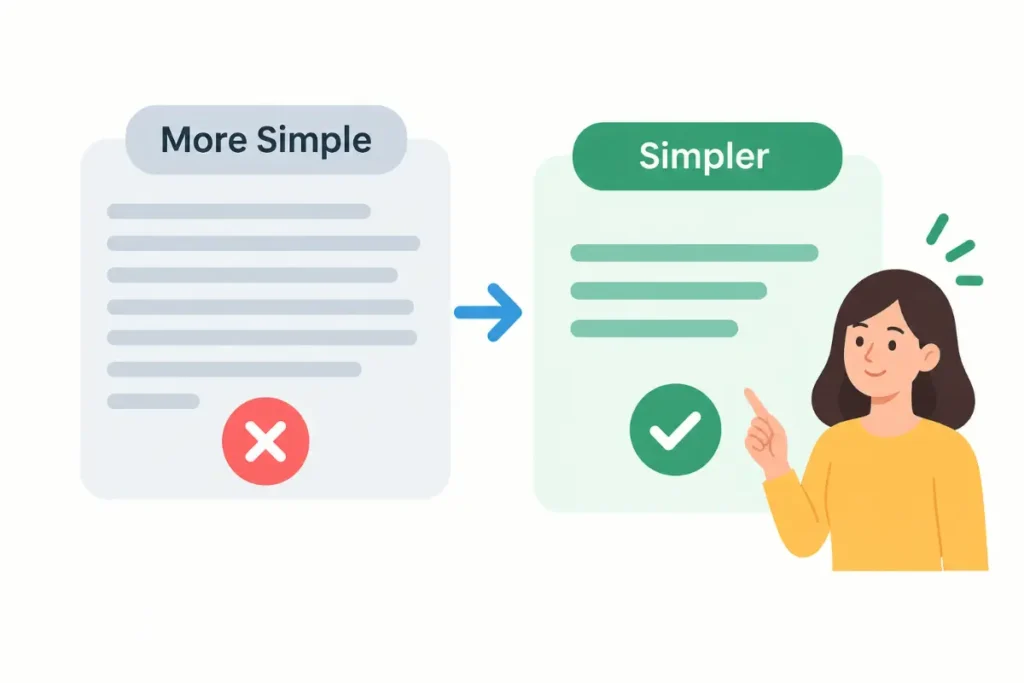
When you compare simpler or more simple, both forms are grammatically correct. However, simpler is usually the better choice in everyday American English. It’s shorter, sounds more natural, and works well in most sentences.
For example, you would normally say, “Can you explain this in simpler words?” rather than “Can you explain this in more simple words?”
The reason comes down to how English forms comparisons. We usually add er to short adjectives to compare two things. Since simple is a short adjective, simpler is the usual comparative form.
Still, you may see more simple in books, formal writing, or sentences where the writer wants a certain rhythm or emphasis. It isn’t automatically wrong. The best choice depends on the sentence and the effect you want.
This guide explains the difference, shows you how to use both forms, and covers common mistakes so you can choose the right wording with confidence.
Quick Definition
Simpler is the standard comparative form of simple. It means easier to understand, use, or do than something else.
More simple has the same basic meaning. It’s grammatically acceptable in some contexts, but it usually sounds less natural than simpler in everyday American English.
Direct Answer
Use simpler in most cases. Although more simple can be correct, simpler is the more common and natural choice in everyday speech and writing.
Simpler vs More Simple at a Glance
| Word or Phrase | Meaning | Example Sentence | When to Use It |
|---|---|---|---|
| Simpler | Easier than something else | This method is simpler than the old one. | Everyday speech and most writing. |
| More simple | Also means easier or less complex | The design is more simple than the original. | Occasional use for emphasis or a particular style. |
| Simplest | Easier or less complex than all others in a group | This is the simplest way to solve the problem. | Comparing three or more options or identifying the easiest option. |
| Most simple | A less common alternative to simplest | This is the most simple version of the design. | Rare cases where the wording serves a specific purpose. |
The main point is easy to remember. Choose simpler when you compare two things, and choose simplest when you identify the easiest or least complex option in a group.
Why Simpler Is Usually the Better Choice
English has several ways to compare things. We can add er to an adjective, or we can place more before it. The right choice often depends on the length and sound of the adjective.
For short adjectives, English speakers usually add er. For longer adjectives, they often use more. This pattern helps words flow naturally when we speak or read.
Consider these examples.
- Small becomes smaller.
- Fast becomes faster.
- Cheap becomes cheaper.
- Simple becomes simpler.
- Beautiful becomes more beautiful.
- Complicated becomes more complicated.
Notice that simple follows the same pattern as small and fast. Adding er creates a natural comparison without adding another word.
That’s why most American English speakers prefer simpler in common sentences.
For example, imagine a teacher explaining a difficult math problem. The teacher might say, “Let me show you a simpler way to solve it.” That sounds direct and natural.
The teacher could also say, “Let me show you a more simple way to solve it.” The meaning remains clear, but the sentence may sound slightly awkward to many readers.
This difference matters most in everyday conversation, school assignments, work emails, and online articles. When two forms express the same idea, the more natural one usually makes your writing stronger.
How English Forms Comparative Adjectives
A comparative adjective describes a difference between two people, things, places, or ideas.
For instance, if one task takes less time than another, you can call it easier. If one room has less space than another, you can call it smaller. If one explanation takes less effort to understand, you can call it simpler.
English has two common ways to form these comparisons.
The first method adds er to the adjective.
- Tall becomes taller.
- Bright becomes brighter.
- Clean becomes cleaner.
- Simple becomes simpler.
The second method places more before the adjective.
- More useful.
- More careful.
- More expensive.
- More difficult.
The first method is common with short adjectives. The second method is common with longer adjectives.
However, English doesn’t follow one perfect rule for every word. Some adjectives have irregular forms, and others allow more than one comparative form.
For example, good becomes better, not gooder. The adjective bad becomes worse, not badder in standard usage.
The word simple follows a familiar pattern. Its usual comparative form is simpler.
Does the Word Simple Follow the Short Adjective Rule
Yes. Simple is a two syllable adjective that commonly takes the ending er in its comparative form.
A syllable is a unit of sound in a word. You can hear two syllables when you say sim ple. Although the word has two syllables, English speakers still commonly use simpler.
Other two syllable adjectives also take er.
- Happy becomes happier.
- Easy becomes easier.
- Narrow becomes narrower.
- Gentle becomes gentler.
- Quiet becomes quieter.
These examples show why you shouldn’t assume that every adjective with two syllables needs more to form a comparison.
The ending and sound of a word often help determine the natural form. Words ending in y often change that y to i before adding er. Words such as simple usually keep their existing spelling and add r.
The result is simpler.
You don’t need to memorize every detail of comparative grammar to write well. Start with the form that native speakers use most often, then check a trusted dictionary if a word seems unusual.
When More Simple Can Be Correct
Although simpler is the usual choice, more simple isn’t always a grammatical error.
English sometimes allows both a form ending in er and a form using more. Writers may choose the longer form to create a certain tone, highlight a contrast, or match the rhythm of a sentence.
Still, these cases are less common. If you’re writing a school paper, a work email, or a general information article, the shorter comparative form is usually the safer option.
When a Writer Wants to Emphasize a Contrast
A writer may use more simple when comparing two ideas in a particular way. The phrase can place extra weight on the word more, although the effect depends on the sentence.
For example.
“The first design looks more simple than the second, but the second offers more features.”
The sentence is understandable, but many American readers would prefer this version.
“The first design looks simpler than the second, but the second offers more features.”
The second version is more natural and direct. It also avoids an extra word without changing the meaning.
In most cases, you don’t need the longer form to make a contrast clear. The surrounding sentence can do that work.
When the Rhythm of a Sentence Matters
Writers sometimes choose words based on how a sentence sounds. A phrase that seems less common on its own may fit a particular line or passage.
For example, a writer might use more simple to create a deliberate contrast between something simple and something more complex. This choice may suit a certain voice or style.
However, this isn’t a special grammar rule that requires you to use the longer form. It’s a matter of style.
If you aren’t trying to create a specific effect, choose simpler. It tends to sound smoother in ordinary American English.
When the Writer Wants a Particular Tone
The word more can sometimes give a comparison extra weight. A writer might want to slow the sentence down or draw attention to the comparison itself.
Even then, the longer phrase may not be the strongest option.
Compare these sentences.
- The new policy is simpler than the old one.
- The new policy is more simple than the old one.
Both communicate the same basic idea. The first sounds more natural to most readers. The second may sound stiff or overly formal.
Formal writing doesn’t automatically require longer words or phrases. In fact, clear professional writing often favors short and familiar language.
If your goal is to help readers understand your point quickly, the shorter form usually works better.
How to Use Simpler in Everyday Sentences
The easiest way to learn a grammar rule is to see it in real situations. The following examples show how the comparative form works in daily conversation and writing.
In School and Learning
Students often need explanations that make hard topics easier to understand. Teachers also look for ways to present complex ideas in plain language.
Here are some natural examples.
- This explanation is simpler than the one in the textbook.
- Can you give me a simpler example.
- My teacher showed us a simpler way to solve the equation.
- The new lesson makes the topic simpler for beginners.
- I need a simpler definition of this word.
In each sentence, simpler means easier to understand or use. It compares one explanation, example, lesson, or definition with another.
Notice that the word doesn’t always mean something is easy. It means that one option is less difficult than the option used for comparison.
A math problem can still be hard even when it has a simpler solution. A textbook definition can still contain new ideas even when a teacher provides a simpler explanation.
At Work
People often use the comparative form when discussing plans, tools, instructions, or processes.
For example.
- We need a simpler way to track our expenses.
- The updated form has a simpler layout.
- This process is simpler than the one we used last year.
- Can you write a simpler set of instructions.
- The new software makes this task simpler for our team.
These sentences sound natural in American workplaces. They get the point across without making the writing feel stiff.
The word can also help you give feedback politely. Instead of saying that a coworker’s instructions are confusing, you could ask for a simpler version.
That approach focuses on improving the work rather than criticizing the person who created it.
In Daily Conversation
You don’t need formal language to use comparative adjectives correctly. In fact, the word often appears in ordinary conversations.
Imagine a friend trying to explain how to use a new phone app.
You might say, “Is there a simpler way to do this.”
You could also ask, “Can you explain it in simpler terms.”
Both sentences sound natural. They tell your friend that you need a clearer or easier explanation.
Here are more examples.
- Cooking dinner is simpler when I prepare everything ahead of time.
- This recipe is simpler than the one I tried yesterday.
- We found a simpler route to the park.
- My new alarm makes my morning routine simpler.
- I want a simpler plan for the weekend.
The comparison doesn’t need to involve school or work. You can use the word for almost any task or idea that becomes easier to handle.
In Technology and Design
Technology often gives users several ways to complete the same task. A simpler interface can help people find what they need without wasting time.
For example.
- The website has a simpler menu.
- This version offers a simpler setup process.
- The updated dashboard is simpler to use.
- A simpler design can help new users learn the system.
- We created a simpler checkout process for customers.
In these examples, the word may refer to fewer steps, fewer choices, a clearer layout, or less effort.
However, simpler doesn’t always mean better. A design with fewer features may be easier to use, but it may not meet every user’s needs.
Good writing should make that distinction clear. Use the comparative form to describe the difference, then explain why that difference matters.
In Writing and Communication
Writers often revise sentences to make their meaning easier to follow. They may remove extra words, replace difficult terms, or divide a long sentence into smaller parts.
For example.
- This paragraph needs a simpler opening.
- A simpler sentence can make your point clearer.
- The editor suggested a simpler word.
- I rewrote the email in simpler language.
- The second draft uses a simpler structure.
These examples show how the word applies to language itself.
A simpler sentence isn’t necessarily shorter in every case. It may use more familiar words or present ideas in a clearer order. The goal is to reduce the effort required to understand the message.
That principle is useful for students, business writers, bloggers, and anyone who wants to communicate clearly.
Common Mistakes to Avoid
Even though the rule is simple, a few common mistakes can make your writing sound unnatural. Learning to spot them will help you choose the right form more quickly.
Using More Before Every Adjective
One common mistake is assuming that every comparative adjective needs the word more.
For example, a learner might write, “This road is more short than the other one.” The meaning is clear, but the standard form is shorter.
The same pattern applies to simple.
Incorrect or awkward: “This answer is more simple than that one.”
Better: “This answer is simpler than that one.”
Here are a few more examples.
| Less Natural or Incorrect | Better Choice |
|---|---|
| More small | Smaller |
| More fast | Faster |
| More cheap | Cheaper |
| More simple | Simpler |
| More easy | Easier |
| More happy | Happier |
The first column contains forms that are generally unnecessary or incorrect in standard everyday English. The second column shows the usual comparative forms.
There can be exceptions to general comparative patterns, but you don’t need to worry about them every time you write. For simple, the normal choice is clear.
Using Simpler Without a Clear Comparison
Comparative adjectives often compare one thing with another. Sometimes the second item appears directly in the sentence. In other cases, readers understand the comparison from the context.
For example, consider this sentence.
“This method is simpler than the old method.”
The comparison is clear because the sentence names both methods.
Now consider this sentence.
“This is a simpler method.”
This sentence is also correct. The writer doesn’t name the other method because the reader may already know which method they’re discussing.
You can also use the word when the comparison is understood.
“Can you make the instructions simpler.”
The speaker doesn’t need to explain every detail. The request suggests that the current instructions are too hard to follow.
The key is to give readers enough information to understand the comparison. Don’t add unnecessary details, but don’t leave them guessing about your meaning.
Confusing Simpler With Simplest
These two forms look alike, but they serve different purposes.
Simpler is the comparative form. It usually compares two things or options.
Simplest is the superlative form. It identifies the option that is easiest or least complex among a group.
Compare these examples.
- This route is simpler than the other route.
- This is the simplest route of all three.
The first sentence compares two routes. The second identifies one route as the easiest of three.
Here are more examples.
- This explanation is simpler than mine.
- Your explanation is the simplest in the class.
- The new process is simpler than the old process.
- This is the simplest process we have tested.
Choosing the correct form helps readers understand the number of options being compared.
Using Double Comparatives
A double comparative happens when a writer uses two comparative markers for one adjective. In standard English, this is often unnecessary.
For example, avoid writing “more simpler” when you mean that something is easier than another thing.
The word simpler already expresses comparison. Adding more usually creates an error.
Use these forms instead.
- More simpler becomes simpler.
- More faster becomes faster.
- More easier becomes easier.
- More smaller becomes smaller.
The same principle applies to many common adjectives. When the ending already marks a comparison, you generally don’t need to add more.
There are special expressions in English that repeat words for emphasis, but those expressions follow different patterns. They don’t make more simpler the standard choice.
Assuming Longer Phrases Sound More Professional
Some writers believe that longer phrases make their work sound more formal or intelligent. This belief can lead to sentences that feel stiff or awkward.
For example.
“The revised instructions provide a more simple method for completing the task.”
A clearer version would be:
“The revised instructions provide a simpler way to complete the task.”
The second sentence is shorter and easier to read. It also sounds more natural in American English.
Professional writing isn’t about using the longest phrase available. It’s about choosing words that communicate the intended meaning accurately.
When a short word does the job, you usually don’t need to replace it with a longer phrase.
Is Simpler Always Better Than More Simple
In most everyday situations, yes. However, that doesn’t mean the longer form is always wrong or that you must replace it in every sentence.
Language depends on context. A phrase can be grammatically possible but less common, less smooth, or less suitable for a particular audience.
For general American English writing, simpler is the strongest default. It sounds natural in conversation and works well in school assignments, emails, articles, reports, and instructions.
Still, grammar isn’t only about choosing between a correct form and an incorrect form. It also involves tone, meaning, and readability.
Grammar and Natural Usage Are Not Exactly the Same
A phrase can be grammatically acceptable without being the most natural choice.
For example, a reader can understand “The instructions are more simple now.” The sentence communicates the intended comparison. Yet “The instructions are simpler now” is usually the smoother option.
This distinction appears throughout English. Speakers sometimes use different forms to express the same idea, but one form may be much more common in ordinary speech.
That doesn’t mean the less common form is always an error. It means you should consider how people typically use the language.
For writing aimed at a broad American audience, familiar wording is usually the best starting point.
When You Should Keep the Longer Form
You might keep more simple if it fits a direct quotation, a character’s voice, a particular rhythm, or a deliberate stylistic choice. You might also retain it when editing a text that needs to preserve the original author’s voice.
For example, a writer may use the phrase several times as part of a character’s distinct way of speaking. Replacing every instance could change the voice of the dialogue.
However, if you’re writing a new sentence and have no special reason to choose the longer phrase, use simpler.
The aim isn’t to ban every uncommon expression. It’s to choose wording that fits your purpose.
A Simple Way to Remember the Rule
You don’t need a long grammar lesson every time you face this choice. A quick memory trick can help you decide.
Think of simple as a word that usually takes the ending er when you compare two things.
Simple becomes simpler.
Then use simplest when you identify the easiest or least complex option in a group.
Simple becomes simplest.
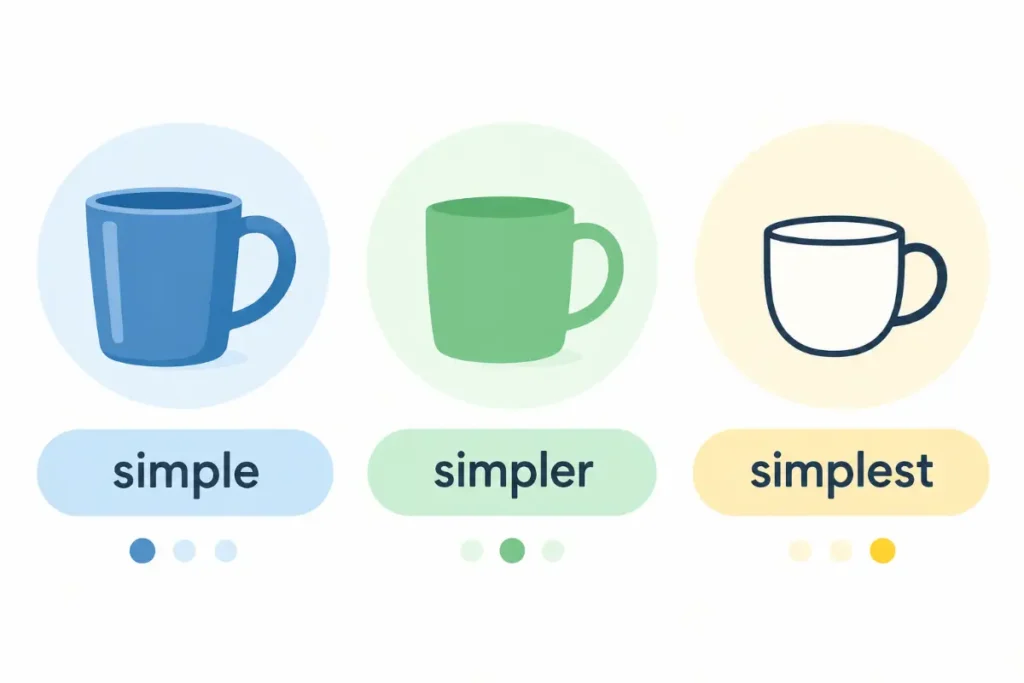
You can remember the pattern through three everyday sentences.
- This explanation is simple.
- This explanation is simpler than the last one.
- This is the simplest explanation in the book.
Each sentence builds on the one before it. The first describes something. The second compares it with another thing. The third identifies the option that ranks highest for simplicity.
Try the Substitution Test
If you’re unsure about a comparative form, replace it with another familiar adjective.
For example, suppose you’re writing this sentence.
“This app is more simple than the old one.”
Now try replacing simple with fast.
“This app is more fast than the old one.”
That version sounds awkward because English speakers normally say faster. The same pattern suggests that simpler is the better choice in your original sentence.
This test won’t solve every comparative adjective question. English has exceptions, and some words allow more than one form. Still, it can help you recognize common patterns.
Read the Sentence Out Loud
Another useful trick is to read both versions aloud.
“This explanation is simpler.”
“This explanation is more simple.”
Both are understandable, but the first will usually sound smoother in everyday American English.
Reading aloud helps you notice extra words, awkward phrasing, and sentences that don’t flow naturally. It’s especially useful when you’re editing an article, school assignment, or work email.
You don’t need to trust your ear alone. Use dictionaries and grammar references when a word has an unusual comparative form. However, for this particular adjective, the everyday choice is straightforward.
Related Words and Comparative Forms
Understanding how simple works can help you with other adjectives. English uses several patterns to compare things, and recognizing them can make your writing more natural.
Simple and Simpler
Simple describes something that isn’t difficult or complicated. Simpler compares it with another thing that requires more effort or thought.
For example.
“The instructions are simple.”
“The instructions are simpler than the ones we received yesterday.”
The first sentence describes the instructions. The second says that one set is easier to follow than another.
The comparison can refer to many things. A simple recipe may have few steps. A simpler recipe may have fewer steps than another recipe. A simple explanation may be easy to understand. A simpler explanation may make a difficult idea easier to grasp.
Simpler and Easier
These words often appear in similar situations, but they don’t always mean exactly the same thing.
Simpler usually refers to something with less complexity. Easier usually refers to something that requires less effort or skill.
For example.
“This app has a simpler layout.”
“This app is easier to use.”
The first sentence focuses on the design. The second focuses on the experience of using the app.
Of course, the meanings can overlap. A simpler layout may make an app easier to use. Still, choosing the more precise adjective helps you express your point clearly.
Here are a few more examples.
- The new recipe is simpler because it uses fewer ingredients.
- The new recipe is easier because it requires less cooking skill.
- This explanation is simpler because it uses familiar words.
- This lesson is easier because it includes helpful examples.
Use the word that best matches the idea you want to express.
Simpler and Less Complicated
Less complicated is another common alternative. It has a meaning close to simpler, although it uses more words.
For example.
“The new system is less complicated than the old one.”
“The new system is simpler than the old one.”
Both sentences are correct. The second is shorter and often more direct.
However, less complicated can be useful when you want to emphasize the lack of complexity. It may also fit better in a sentence where the word simpler would sound repetitive.
Good writing doesn’t require you to use the shortest possible word every time. It requires you to choose wording that is clear and fits the context.
Simpler and Simplest
Remember that simpler compares options, while simplest identifies the option with the least complexity in a group.
For example.
“This plan is simpler than the original plan.”
“This is the simplest plan we have considered.”
You can use both forms in the same paragraph if the meaning calls for it.
“We tested three designs. The second design was simpler than the first. The third design was the simplest of all.”
This passage shows how comparative and superlative forms work together. The first comparison looks at two designs. The final sentence identifies the design that ranks highest for simplicity among all three.
FAQs
Is simpler or more simple grammatically correct?
Both forms can be grammatically correct. However, simpler is the standard and more natural choice in most everyday American English sentences. Use the longer form only when it serves a clear stylistic purpose.
Is more simple ever correct?
Yes. The phrase can work in certain contexts, especially when a writer wants a particular emphasis or rhythm. Still, it often sounds less natural than the usual comparative form. For general writing, simpler is the safer choice.
What is the comparative form of simple?
The comparative form of simple is simpler. It describes something that is easier to understand, use, or do than another thing. For example, “This method is simpler than the old one.”
What is the superlative form of simple?
The usual superlative form is simplest. Use it to identify the easiest or least complex option among three or more choices. For example, “This is the simplest solution to the problem.”
Can I write more simpler?
No. In standard English, more simpler is generally incorrect because simpler already expresses comparison. Write simpler instead. You can also use more simple in some contexts, but you usually don’t need it.
Is simpler the same as easier?
Not exactly. Simpler usually refers to less complexity, while easier usually refers to less effort or difficulty. The meanings overlap in many sentences, but the best choice depends on what you want to describe.
Should I use simpler in formal writing?
Yes. Simpler works well in formal writing, including reports, essays, professional emails, and academic explanations. You don’t need to use a longer phrase to sound professional. Clear and precise language is usually the better choice.
What is the difference between simple and simplest?
Simple describes something that isn’t complicated. Simplest identifies the option with the least complexity in a group. For example, “This is a simple solution” describes one solution, while “This is the simplest solution” compares it with other possible solutions.
Conclusion
When choosing between simpler or more simple, remember that simpler is usually the better choice. Both forms can communicate the same idea, but the shorter form sounds more natural in everyday American English.
The rule is easy to remember. Use simpler to compare two things and simplest to identify the least complex option in a group. Avoid more simpler because it adds an unnecessary comparative marker.
You can apply this rule to almost any kind of writing. Use simpler when discussing instructions, explanations, designs, plans, recipes, or ways to solve a problem. Choose easier when you want to focus on effort or difficulty, and use less complicated when that phrase fits your sentence better.
Before you finish your next sentence, read it aloud. If you wrote more simple without a specific reason, try replacing it with simpler. In most cases, your sentence will sound clearer and more natural.

Sienna Watson is a veteran copywriter and communications coach who has helped startup founders, marketers, and professionals polish their writing for over a decade. Realizing that most people don’t need a degree in linguistics—just clear, impactful communication—Sienna focuses on practical grammar, business writing etiquette, and eliminating wordiness. She advocates for plain language, strong verbs, and persuasive prose that gets results.