
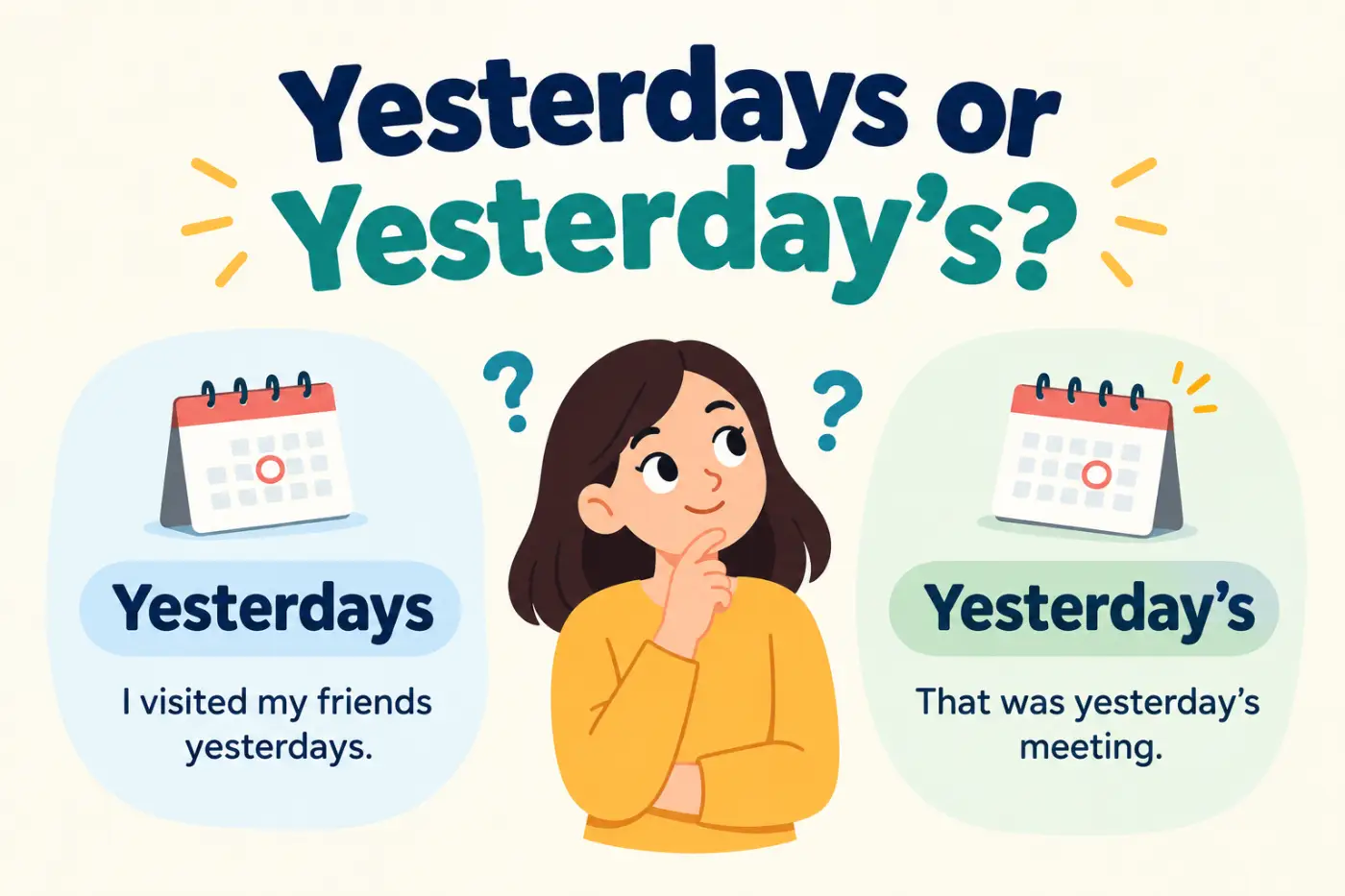
Have you ever wondered if you should write yesterdays or yesterday’s? The answer depends on what you want to say. One spelling refers to something that belongs to yesterday. The other can appear when someone uses the word incorrectly or leaves out a necessary apostrophe.
In American English, yesterday’s is the correct form when you want to show ownership or describe something connected to the previous day. For example, you can write “yesterday’s meeting” or “yesterday’s weather.” The apostrophe shows that the meeting or weather relates to yesterday.
The word yesterday already tells readers that something happened on the day before today. You do not need to add an s to make it plural. However, you can add an apostrophe and an s to show that something belongs to or relates to that day.
This guide explains the difference between these spellings, how to use the apostrophe, and why the mistake happens. You’ll also find practical examples, common errors, and simple tips to help you choose the right form in your writing.
Quick Definition
Yesterday’s is the possessive form of yesterday. It shows that something belongs to, happened during, or relates to the previous day. For example, “Yesterday’s game was exciting” means the game took place yesterday.
Yesterdays is not the standard spelling for the ordinary possessive use. In rare cases, writers may use yesterdays as a creative plural to refer to several past days or periods. In everyday American English, however, most sentences need yesterday or yesterday’s.
Direct Answer
Use yesterday’s when describing something connected to the previous day, as in “yesterday’s news.” Do not use yesterdays for this meaning. The apostrophe is necessary to show the relationship between yesterday and the noun that follows.
Comparison Table
| Word or Phrase | Meaning | Example Sentence | When to Use It |
|---|---|---|---|
| Yesterday | The day before today | I finished the report yesterday. | When talking about a past day or action. |
| Yesterday’s | Belonging to or connected to the previous day | Yesterday’s report was helpful. | When describing something from the previous day. |
| Yesterdays | A rare creative plural referring to several past days or periods | The poem brings back the yesterdays of childhood. | Only in a clear creative or literary context. |
| The day before | A phrase that refers to the previous day in a particular context | I called her the day before. | When you want to describe the timing without using yesterday. |

Why Yesterday’s Is Usually Correct
The main difference comes down to the apostrophe. In English, an apostrophe followed by s often shows possession or a close relationship between two things. You can use this pattern to describe a person’s belongings, a place’s features, or something linked to a particular day.
For example, consider these sentences.
- Yesterday’s rain flooded the street.
- Yesterday’s lesson was easy to understand.
- Yesterday’s dinner tasted great.
- Yesterday’s announcement surprised everyone.
In each sentence, the word yesterday’s describes a noun. The rain fell yesterday. The lesson took place yesterday. The dinner was served yesterday. The announcement was made yesterday.
The apostrophe helps readers understand this connection. Without it, the spelling looks incorrect in ordinary writing.
The Role of the Apostrophe
An apostrophe is a punctuation mark that can show possession, form contractions, and serve a few other purposes. In the word yesterday’s, it appears before the final s.
The same pattern appears in many common expressions.
- Today’s schedule.
- Tomorrow’s plans.
- Monday’s class.
- Friday’s deadline.
- Last night’s movie.
Each expression connects a noun to a day or time. The apostrophe and s make that connection clear.
For example, “Today’s schedule is full” means the schedule for today is full. Similarly, “Tomorrow’s plans may change” refers to plans for tomorrow.
The word yesterday follows this same pattern. When you want to describe something connected to the previous day, write yesterday’s.
Does Yesterday’s Always Show Ownership
Not exactly. The apostrophe often shows possession, but it can also describe a connection that is not literal ownership.
Consider the sentence “Yesterday’s temperature reached 90 degrees.”
Yesterday does not own the temperature. Instead, yesterday’s identifies the time when that temperature was recorded.
The same idea applies to sentences such as “Yesterday’s headlines were surprising” and “Yesterday’s practice went well.” The headlines belong to the news from that day, and the practice session took place on that day.
This use is common in English. People often use possessive forms to describe time, events, and other relationships.
Here are a few more examples.
- The company’s profits increased last year.
- Sunday’s concert lasted two hours.
- This morning’s traffic was terrible.
- Yesterday’s interview went better than expected.
The apostrophe helps link the time or person to the noun. It does not always mean that one thing physically owns another.
Understanding the Word Yesterday
Before choosing the correct spelling, it helps to understand how yesterday works in a sentence.
Yesterday is an adverb when it tells readers when an action happened. It can also function as a noun when you talk about the day itself.
Yesterday as an Adverb
An adverb can explain when an action happens. In the sentence “We visited the museum yesterday,” the word yesterday tells you when the visit took place.
Here are some more examples.
- I sent the email yesterday.
- She arrived yesterday.
- We watched a movie yesterday.
- They finished the project yesterday.
- He called his parents yesterday.
In these sentences, yesterday describes the timing of an action. You do not need an apostrophe because the word does not describe a noun through possession.
A common mistake is adding an apostrophe every time yesterday appears. That is not necessary. Use the plain form when you are simply telling someone when something happened.
For example, write “I saw him yesterday,” not “I saw him yesterday’s.”
The second sentence is incorrect because the apostrophe does not belong in that position.
Yesterday as a Noun
Yesterday can also refer to the previous day as a thing or period of time.
For example, someone might say, “Yesterday was exhausting.” Here, yesterday is the subject of the sentence. It refers to the day that came before today.
Other examples include these sentences.
- Yesterday was my busiest day this week.
- Yesterday felt much longer than usual.
- I still remember yesterday.
- Yesterday brought some unexpected news.
Notice that none of these sentences needs an apostrophe. The word yesterday stands alone as a noun.
However, when you use it to describe another noun, the possessive form may be appropriate.
Compare these two sentences.
“Yesterday was busy.”
“Yesterday’s schedule was busy.”
The first sentence talks about the day itself. The second describes the schedule connected to that day.
That is the key distinction. The correct spelling depends on the job the word does in the sentence.
How to Use Yesterday’s in Everyday Writing
The possessive form appears in daily conversations, emails, school assignments, news stories, and workplace messages. Once you understand the pattern, using it becomes easy.
Talking About Events
Use yesterday’s when describing an event that happened on the previous day.
Examples include the following.
- Yesterday’s concert attracted a large crowd.
- Yesterday’s meeting lasted almost two hours.
- Yesterday’s game ended in a tie.
- Yesterday’s interview gave me more confidence.
- Yesterday’s party was a lot of fun.
Each sentence refers to an event associated with yesterday. The apostrophe and s connect the day to the event.
You can use this form when writing about both formal and informal events. It works in a school essay, a text message, a work email, or a news report.
For instance, you could write, “Yesterday’s meeting helped us settle the main questions.” That sentence is clear and grammatically correct.
Talking About News and Information
People often use yesterday’s to describe information released or reported on the previous day.
Examples include these sentences.
- Yesterday’s news covered the local election.
- Yesterday’s report included several useful details.
- Yesterday’s announcement changed our plans.
- Yesterday’s results surprised the team.
- Yesterday’s article explained the issue clearly.
This form works well because it gives readers a quick sense of time. Instead of writing “the report that came out yesterday,” you can write “yesterday’s report.”
Both versions can be correct. The shorter form often sounds more natural when the context is clear.
Talking About Weather
Weather is another common topic that uses the possessive form.
For example, you might write, “Yesterday’s weather was warmer than today’s.”
Other natural examples include the following.
- Yesterday’s storm damaged several trees.
- Yesterday’s sunshine made the walk enjoyable.
- Yesterday’s cold weather caught us off guard.
- Yesterday’s rain left puddles across the yard.
In each sentence, the word yesterday’s describes the weather or an event linked to the previous day.
You can also compare weather across several days.
“Yesterday’s forecast predicted rain, but today’s forecast calls for sunshine.”
The apostrophe makes the sentence clear and keeps the time reference easy to follow.
Talking About Work and School
The same rule applies to schoolwork and workplace tasks.
Examples include these sentences.
- Yesterday’s homework took an hour to finish.
- Yesterday’s class covered fractions.
- Yesterday’s presentation went smoothly.
- Yesterday’s deadline was moved to Friday.
- Yesterday’s discussion helped me understand the topic.
These expressions are useful because they keep sentences short. You do not have to write “the homework assigned yesterday” every time. You can simply say “yesterday’s homework.”
Still, context matters. If a reader does not know which day you mean, include a date or a more specific time reference.
For example, “Yesterday’s meeting on October 18 covered the new budget” gives readers more detail than the possessive form alone.
Talking About Personal Experiences
You can also use yesterday’s when describing memories, conversations, and personal events.
Examples include these sentences.
- Yesterday’s conversation made me think.
- Yesterday’s visit was a pleasant surprise.
- Yesterday’s argument left both of us upset.
- Yesterday’s trip was worth the long drive.
- Yesterday’s experience taught me a valuable lesson.
The form works for positive and negative experiences. The apostrophe rule stays the same, regardless of the meaning of the sentence.
You can use it in personal writing, journal entries, messages, and stories. It sounds natural when the reader already knows which day you mean.
When to Use Yesterday Without an Apostrophe
Not every sentence about the previous day needs yesterday’s. In many cases, the plain word yesterday is the correct choice.
Use yesterday when it tells readers when something happened or when it refers to the day itself.
When Describing an Action
If yesterday answers the question “When did it happen?” you usually need the plain form.
Examples include the following.
- We went shopping yesterday.
- She submitted her application yesterday.
- I cleaned the kitchen yesterday.
- He learned the news yesterday.
- They moved into their new house yesterday.
None of these sentences needs an apostrophe. The word yesterday tells you when the action took place.
Adding an s would make the sentence incorrect in standard everyday English.
For example, “We went shopping yesterdays” is not correct. The proper sentence is “We went shopping yesterday.”
When Yesterday Is the Subject
You also use the plain form when talking about yesterday as a day.
Consider these examples.
- Yesterday was unusually quiet.
- Yesterday seemed to last forever.
- Yesterday brought good news.
- Yesterday was the first day of our vacation.
- Yesterday changed how I saw the situation.
In each sentence, yesterday is the subject. It does not describe a separate noun, so the possessive form is not needed.
Compare “Yesterday was wonderful” with “Yesterday’s weather was wonderful.” The first sentence describes the day. The second describes the weather associated with that day.
When Using Prepositions
The plain word yesterday can also appear in sentences with prepositions or other time expressions.
For example, you can write “I spoke to her before yesterday’s meeting” or “We talked about the problem yesterday.”
In the first sentence, yesterday’s describes the meeting. In the second, yesterday tells you when the conversation happened.
Here are more examples.
- I received the package yesterday.
- We talked about the results yesterday.
- The manager called me yesterday.
- I finished the assignment before yesterday’s class.
- She left her notebook at yesterday’s workshop.
Pay attention to the role of the word in each sentence. The apostrophe belongs to the possessive form, not to the time expression itself.
Why People Confuse Yesterdays and Yesterday’s
The confusion is understandable. Both forms contain the same letters, and the difference comes down to a small punctuation mark. Still, that mark changes how the word works.
Confusion About Plural Nouns
One reason for the mistake is that English often adds s to make a noun plural.
For example, one book becomes two books. One apple becomes three apples. One day becomes several days.
Because yesterday ends in a similar way, some writers assume that yesterdays must mean several previous days.
That idea may make sense at first, but yesterday does not normally work like an ordinary count noun in everyday English. When you mean several days before today, use a clear phrase such as “the days before today” or “the previous days.”
For example, write “I remember the last few days” rather than “I remember the last few yesterdays” in ordinary writing.
Creative writers may use yesterdays to suggest memories or past periods. That choice can work in poetry or expressive prose, but it is not the usual form for a simple grammar question.
Confusion About Possessive Forms
Another common problem is forgetting the apostrophe in possessive expressions.
Writers often know that yesterday’s meeting is correct but type yesterdays meeting by mistake. This can happen when typing quickly or editing a sentence without reading it again.
The fix is simple. Look at the noun that follows yesterday.
If you mean a meeting, report, game, or event connected to the previous day, use yesterday’s.
For example.
- Incorrect: Yesterdays report was helpful.
- Correct: Yesterday’s report was helpful.
- Incorrect: I enjoyed yesterdays game.
- Correct: I enjoyed yesterday’s game.
The apostrophe is part of the standard spelling in both corrected sentences.
Confusion Caused by Spellcheck
Spellcheck tools can help, but they do not always catch every grammar mistake. A program may accept a word because it appears in a dictionary or because the spelling is possible in a special context.
That does not mean the word fits your sentence.
For example, a spellchecker might not flag yesterdays in a creative passage. It may also miss the missing apostrophe in a phrase if the program does not understand the full sentence.
Always check the meaning as well as the spelling. Ask yourself what you are trying to express.
If you mean something related to the previous day, use yesterday’s. If you mean the day before today as a time reference, use yesterday.
Confusion About Today’s and Tomorrow’s
Writers may also compare yesterday with today and tomorrow.
These words follow a similar pattern when they describe a noun.
- Today’s lesson was useful.
- Tomorrow’s appointment starts at noon.
- Yesterday’s lesson was useful.
Each possessive form uses an apostrophe followed by s. The time word changes, but the basic rule stays the same.
However, when you use the words to describe an action, you do not need the apostrophe.
- I studied today.
- I will travel tomorrow.
- I studied yesterday.
The difference depends on how the word functions in the sentence, not simply on the day it names.
Common Mistakes to Avoid
A few small errors can make an otherwise clear sentence look unpolished. These examples show what to watch for.
Leaving Out the Apostrophe
Incorrect: Yesterdays weather was beautiful.
Correct: Yesterday’s weather was beautiful.
The sentence describes weather from the previous day, so the possessive form needs an apostrophe.
Adding an Apostrophe to the Wrong Sentence
Incorrect: I finished my work yesterday’s.
Correct: I finished my work yesterday.
The word describes when the work was completed. It does not show possession, so no apostrophe belongs there.
Adding an Unnecessary S
Incorrect: I visited my grandmother yesterdays.
Correct: I visited my grandmother yesterday.
The plain word already refers to the previous day. Adding s does not make it more correct.
Using the Possessive Form Before a Verb
Incorrect: Yesterday’s I went to the store.
Correct: Yesterday I went to the store.
In the corrected sentence, yesterday tells the reader when the action happened. It does not describe a noun.
Using Yesterday’s With an Unrelated Noun
A possessive form should have a clear relationship with the noun it describes.
For example, “Yesterday’s book was interesting” can be correct if you mean the book you read or discussed yesterday. But it may be unclear if the reader does not know which book you mean.
A more specific sentence can help.
“Yesterday’s reading assignment was interesting.”
This version makes the connection easier to understand.
A Simple Trick to Remember the Correct Spelling
The easiest way to remember the rule is to ask one question. Are you describing something connected to yesterday, or are you simply saying when something happened?
If you are describing a noun, yesterday’s is often the right choice.
For example, yesterday’s lunch, yesterday’s news, and yesterday’s meeting all connect a noun to the previous day.
If you are describing an action, use yesterday.
For example, “I ate lunch yesterday,” “I read the news yesterday,” and “We met yesterday” all use the plain form.
You can also remember the pattern by comparing it with today’s and tomorrow’s.
Today’s homework.
Tomorrow’s appointment.
Yesterday’s meeting.
All three use the same apostrophe pattern when they describe a noun.
One final trick is to read the sentence aloud. If you can replace yesterday’s with “from yesterday” or “connected to yesterday” without changing the main meaning, the possessive form is likely appropriate.
For example, “Yesterday’s news was surprising” means “The news from yesterday was surprising.”
That substitution will not work in the same way for “I called her yesterday.” In that sentence, yesterday tells you when the call happened.
Is Yesterdays Ever Correct
Although yesterday’s is the standard form for possession, yesterdays can appear in some types of writing. The key is understanding that this use is uncommon and often creative.
Yesterdays in Poetry and Creative Writing
A writer may use yesterdays as a plural noun to refer to several past days, old memories, or earlier periods of life.
For example, a poem might include the line “We spent our yesterdays dreaming of tomorrow.”
Here, yesterdays is a creative way to refer to past days or memories. The writer uses the plural for a particular effect.
Another example might be “Those yesterdays seem so far away.” In a reflective story or poem, this phrase can suggest a collection of past experiences.
Such uses can sound natural in a literary context. They are less common in everyday conversation and practical writing.
Yesterdays in Ordinary American English
In standard American English, most people do not use yesterdays as a regular plural noun.
If you are writing an email, school assignment, news article, or workplace report, choose a clearer expression when you mean several past days.
For example.
Less natural: I miss those yesterdays.
Clearer: I miss those days.
Less natural: The yesterdays were full of surprises.
Clearer: The days that followed were full of surprises.
The creative forms are not automatically wrong in every setting. However, the simpler alternatives are more natural for most readers.
If your goal is clear everyday writing, stick with yesterday or yesterday’s unless you have a specific reason to use the plural form.
Can Yesterdays Mean Several Previous Days
It can carry that meaning in a creative or figurative context. However, it is not the usual way to refer to several days in ordinary English.
If you want to describe more than one day, consider these alternatives.
- The past few days.
- The previous days.
- The days before today.
- Recent days.
- The last several days.
For example, “The past few days have been busy” is clearer than “The yesterdays have been busy.”
These phrases are also easier for readers to understand on the first try. They work well in everyday speech, articles, reports, and personal messages.
Related Words That Follow the Same Rule
Learning the pattern for yesterday’s can help you with several other time expressions. Many words that name days or periods can take an apostrophe and s when they describe a noun.
Today’s or Today
Use today’s when a noun relates to the current day.
Examples.
- Today’s weather looks pleasant.
- Today’s meeting starts at ten.
- Today’s assignment is shorter than yesterday’s.
Use today without an apostrophe when it tells readers when an action happens.
- I feel better today.
- We have a meeting today.
- She sent the message today.
The distinction is the same as the one between yesterday and yesterday’s.
Tomorrow’s or Tomorrow
Use tomorrow’s to describe something connected to the next day.
Examples.
- Tomorrow’s test covers two chapters.
- Tomorrow’s schedule looks busy.
- Tomorrow’s forecast predicts rain.
Use tomorrow without an apostrophe when talking about a future time.
- I will call you tomorrow.
- We leave tomorrow.
- She starts her new job tomorrow.
The apostrophe is needed only when the word takes the possessive form.
Monday’s or Monday
The same rule applies to the names of weekdays.
Examples.
- Monday’s meeting was canceled.
- Monday’s weather was unusually warm.
- Monday’s class starts at nine.
However, write “I will see you Monday” when Monday simply tells the reader when the event will happen.
You can also write “I saw you on Monday.” The preposition on is optional in some American English time expressions, depending on the sentence and context.
Last Night’s or Last Night
Last night’s follows the same possessive pattern.
Examples.
- Last night’s game was exciting.
- Last night’s storm damaged the roof.
- Last night’s dinner was delicious.
Use last night without an apostrophe when describing an action.
- I watched the game last night.
- The storm arrived last night.
- We had dinner last night.
Notice that the apostrophe appears in last night’s because the phrase describes a noun. It does not appear when the phrase tells you when something happened.
This Morning’s or This Morning
Use this morning’s when describing something connected to the morning.
Examples.
- This morning’s meeting ran late.
- This morning’s coffee tasted great.
- This morning’s news was unexpected.
Use this morning without an apostrophe when it tells you when an action happened.
- I made coffee this morning.
- We met this morning.
- I heard the news this morning.
These examples reinforce the same useful rule. A time expression can describe a noun or tell readers when an action took place. The punctuation depends on its role.
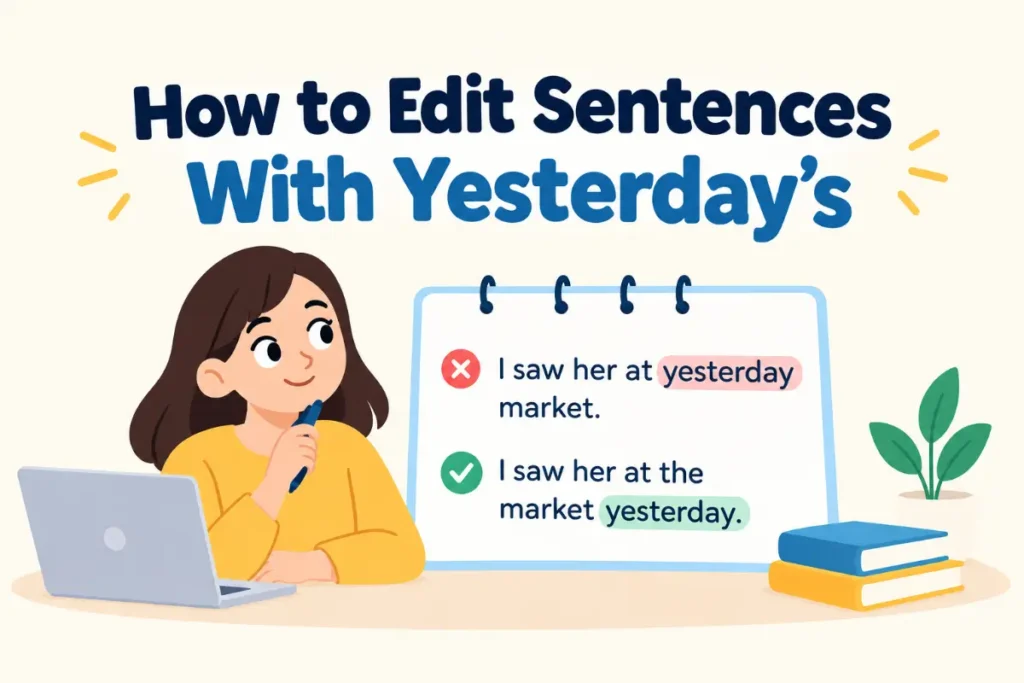
How to Edit Sentences With Yesterday’s
When editing your writing, do not rely on memory alone. Follow a short process to check the sentence.
Find the Noun
Look for the noun connected to yesterday.
In “Yesterday’s report was accurate,” the noun is report. The possessive form tells readers that the report relates to the previous day.
In “I reviewed the report yesterday,” the noun is report, but yesterday does not describe it. Instead, it tells you when the review happened.
Check the Meaning
Ask yourself what the sentence is saying.
- “Yesterday’s class was difficult” describes a class from the previous day.
- “I attended class yesterday” tells you when you attended.
Both sentences are correct, but they use different forms because the words do different jobs.
Remove Unnecessary Apostrophes
Some writers add apostrophes to words simply because they end in s. That is not how English punctuation works.
An apostrophe is not a general marker for a time reference. It has a specific grammatical role.
For example, write “We talked yesterday,” not “We talked yesterday’s.”
Write “Yesterday’s conversation was helpful” when describing the conversation associated with the previous day.
Read the Final Sentence
After checking the grammar, read the sentence once more. Make sure the meaning is clear and the time reference makes sense.
If the sentence sounds awkward, try a simpler version.
Instead of “The discussion from yesterday’s was useful,” write “Yesterday’s discussion was useful.”
A clean sentence usually makes the grammar easier to check.
Examples of Correct Usage
The following examples show how these forms work in real sentences.
| Sentence | Correct Form | Reason |
|---|---|---|
| Yesterday’s meeting was productive. | Yesterday’s | It describes a meeting connected to the previous day. |
| I called my friend yesterday. | Yesterday | It tells the reader when the call happened. |
| Yesterday was a long day. | Yesterday | It refers to the day itself. |
| Yesterday’s weather was sunny. | Yesterday’s | It describes the weather from the previous day. |
| We finished the work yesterday. | Yesterday | It tells when the work was completed. |
| Yesterday’s announcement surprised us. | Yesterday’s | It describes an announcement associated with that day. |
| I enjoyed yesterday’s class. | Yesterday’s | It describes a class that took place yesterday. |
| She arrived yesterday afternoon. | Yesterday | It identifies the time of arrival. |
| Yesterday’s lunch was delicious. | Yesterday’s | It describes lunch from the previous day. |
| We talked about it yesterday. | Yesterday | It tells when the conversation happened. |
These examples cover the most common situations. When the word describes a noun, the possessive form is often correct. When it tells you when an action happened or refers to the day itself, use yesterday.
FAQs
Is yesterdays or yesterday’s correct?
Yesterday’s is correct when you mean something belongs to or relates to the previous day. For example, “Yesterday’s game was exciting” uses the apostrophe correctly. Yesterdays is uncommon in ordinary writing and is usually reserved for creative uses.
Why does yesterday’s have an apostrophe?
The apostrophe marks a possessive relationship between yesterday and the noun that follows. In “yesterday’s news,” it means the news from the previous day. The apostrophe helps readers understand that connection.
Is yesterday’s grammatically correct?
Yes. Yesterday’s is grammatically correct when it describes something connected to the previous day. You can use it with words such as meeting, weather, report, game, and lesson.
Can yesterdays ever be used?
Yes, but the plural form is rare in standard everyday English. A writer may use yesterdays creatively to describe past days, memories, or earlier periods of life. In most ordinary sentences, phrases such as “the past few days” are clearer.
Should I write yesterday or yesterday’s?
Use yesterday when you are saying when an action happened, as in “I finished the task yesterday.” Use yesterday’s when describing a noun, as in “Yesterday’s task was difficult.” The sentence’s meaning determines the correct form.
Is yesterday’s possessive or plural?
Yesterday’s is a possessive form, not a plural. It connects yesterday to a noun that belongs to or relates to that day. The s after the apostrophe is part of the possessive spelling.
What is the difference between yesterday’s and today’s?
Yesterday’s refers to the previous day, while today’s refers to the current day. Both use an apostrophe and s when they describe a noun. For example, “Yesterday’s meeting was short, but today’s meeting is longer.”
What is another way to say yesterday’s?
You can often replace yesterday’s with “from yesterday” or “that took place yesterday.” For example, “yesterday’s meeting” can become “the meeting from yesterday.” The best choice depends on the sentence and how much detail you want to include.
Conclusion
The correct form for ordinary possessive use is yesterday’s. Use it to describe something connected to the previous day, such as yesterday’s meeting, yesterday’s weather, or yesterday’s news. The apostrophe is part of the standard spelling.
Use yesterday without an apostrophe when you tell someone when an action happened or refer to the day itself. For example, “I visited my friend yesterday” and “Yesterday was exhausting” are both correct.
Although yesterdays can appear in poetry or creative writing as a plural form, it is not the normal choice for everyday American English. When you mean several past days, phrases such as “the past few days” or “those earlier days” usually sound clearer.
Remember one simple rule. If yesterday describes a noun, consider yesterday’s. If it tells you when something happened, use yesterday. Keep that distinction in mind, and you’ll choose the right form with confidence.

Dr. Elena Vance holds a Ph.D. in Linguistics from Columbia University and has spent over 15 years analyzing the evolution of the English language. A former university professor turned full-time writer and editor, Elena specializes in breaking down high-level grammatical concepts, punctuation nuances, and style guides (APA, Chicago, MLA) into clear, actionable advice. When she isn’t hunting down dangling modifiers, she can be found collecting vintage dictionaries and reading classic literature.