
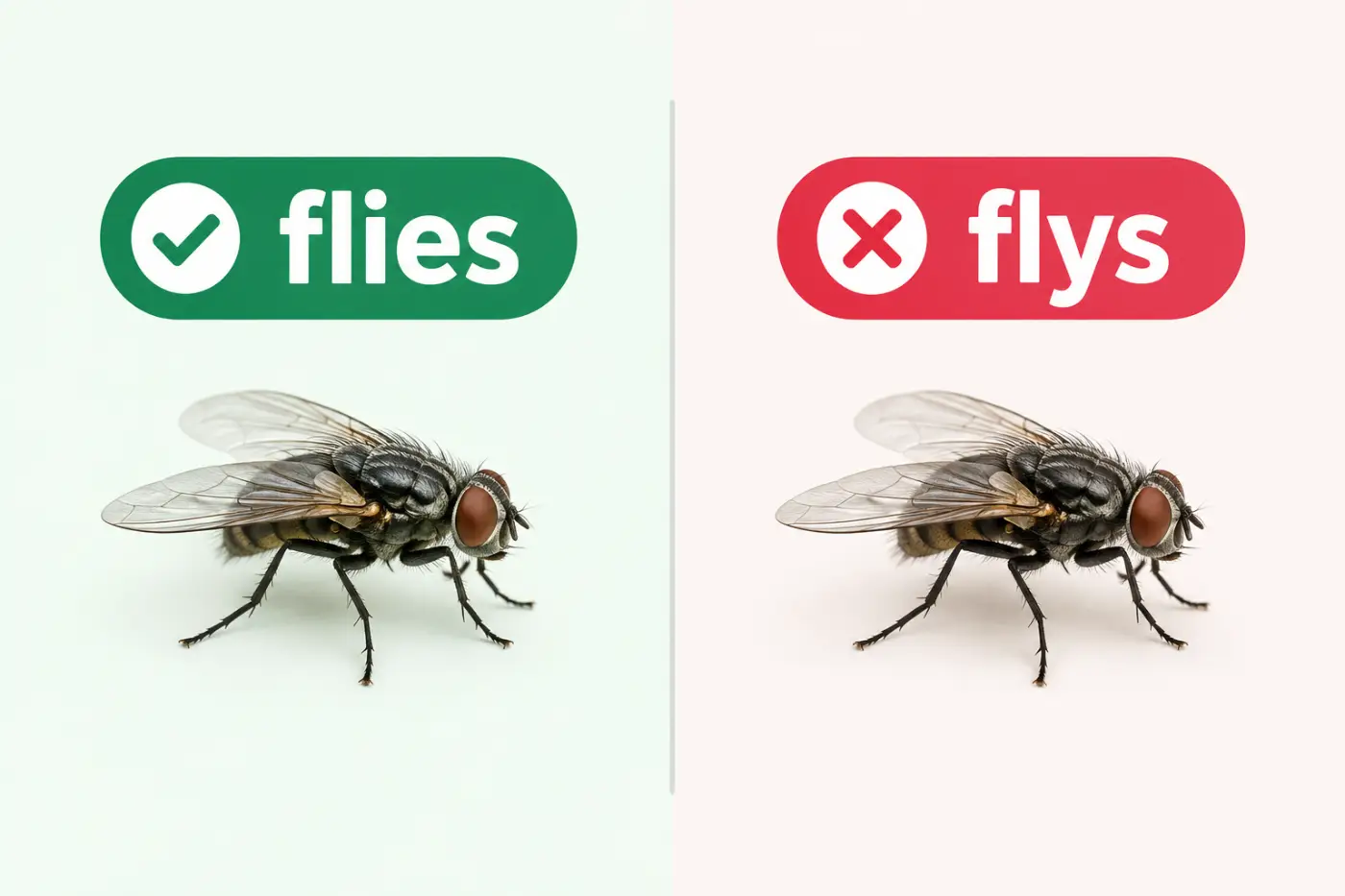
Have you ever stopped while writing because you could not decide between flies and flys? You are not alone. The two spellings look similar, but only one is correct in standard English.
Flies is the correct spelling. It can refer to more than one flying insect or describe someone or something moving through the air. Flys is not the standard plural of fly and is not the correct spelling of the verb in the third person singular.
The confusion comes from a common spelling rule. Most nouns ending in a consonant followed by y change the y to ies when they become plural. The same rule applies to verbs when you describe an action performed by he, she, it, or a singular noun.
In this guide, you will learn when to use flies, why flys is incorrect in ordinary writing, and how to apply the same spelling rule to other words. You will also find clear examples, common mistakes, memory tips, and answers to frequently asked questions.
Quick Definition
Flies is the correct plural form of the noun fly. It also serves as the third person singular form of the verb fly. For example, you can say that two flies landed on your window or that a bird flies over your house.
Flys is not a standard spelling for either of these uses. In ordinary American English, write flies when you mean insects or describe someone or something flying.
Direct Answer
The correct spelling is flies, not flys. Use flies for more than one flying insect and for a verb with he, she, it, or a singular subject, as in She flies to Chicago every month.
Flies vs Flys
| Word | Meaning | Example Sentence | When to Use It |
|---|---|---|---|
| Flies | The plural of the insect called a fly | Two flies are sitting on the screen. | When talking about more than one fly. |
| Flies | The verb form of fly used with a singular subject | My brother flies to Texas for work. | When a singular subject performs the action of flying. |
| Flys | A nonstandard spelling in ordinary English | He flys to work every week. | Avoid this spelling in standard writing. |
The difference is simple. Flies follows the standard spelling rules for nouns and verbs that end in a consonant followed by y. Flys does not follow those rules.

Why Flies Is the Correct Spelling
English spelling can seem confusing because a small change in a word can affect its correctness. In this case, the rule is easy to understand once you know how words ending in y form plurals and verb forms.
The Rule for Nouns Ending in Y
When a noun ends in a consonant followed by y, you usually change the y to ies to form the plural.
For example, one fly becomes two flies. The same pattern appears in words such as baby, city, and puppy.
Here are a few examples.
- One baby becomes two babies.
- One city becomes several cities.
- One puppy becomes three puppies.
- One fly becomes several flies.
The rule helps you spell the plural correctly without adding an s directly to the end of the original word.
Consider this sentence.
A fly landed on my sandwich, but two more flies soon joined it.
The singular form fly refers to one insect. The plural form flies refers to more than one. The spelling changes because the word ends in a consonant followed by y.
The Rule for Verbs Ending in Y
The same basic spelling pattern applies to many verbs when you use the third person singular in the simple present tense.
The simple present tense describes habits, regular actions, facts, and things that happen repeatedly. When the subject is he, she, it, or a singular noun, the verb usually takes an s or es ending.
For a verb that ends in a consonant followed by y, change the y to ies.
For example, the verb fly becomes flies.
Look at these sentences.
- I fly to Denver every summer.
- You fly to Denver every summer.
- They fly to Denver every summer.
- She flies to Denver every summer.
- My father flies to Denver every summer.
Notice how the verb changes when the subject changes from I, you, or they to she or my father.
The action stays the same. The subject determines the correct verb form.
This is why you write She flies home every Friday instead of She flys home every Friday.
Why Flys Does Not Follow the Rule
The spelling flys keeps the original y and adds an s. That pattern is incorrect for the standard plural of the noun fly and for the third person singular form of the verb.
English has several common spelling rules that explain this difference. One of the most useful is the consonant and vowel rule.
When a word ends in a consonant followed by y, the y usually changes to ies in a plural noun or a third person singular verb form.
When a word ends in a vowel followed by y, you usually keep the y and add s.
Compare these words.
| Singular or Base Form | Correct Form | Reason |
|---|---|---|
| Fly | Flies | The letter before y is a consonant. |
| Baby | Babies | The letter before y is a consonant. |
| City | Cities | The letter before y is a consonant. |
| Boy | Boys | The letter before y is a vowel. |
| Toy | Toys | The letter before y is a vowel. |
| Play | Plays | The letter before y is a vowel. |
The difference between fly and play explains the rule well. The word fly ends in y with a consonant before it. The word play ends in y with a vowel before it.
As a result, the plural of fly is flies, but the plural of toy is toys.
What Happens When You Use Fly in a Sentence
The word fly can work as both a noun and a verb. Its role in a sentence determines how you use it.
As a noun, fly often refers to a small insect. It can also refer to a type of fastener on clothing, such as the opening on a pair of pants.
As a verb, fly describes movement through the air. It can refer to birds, insects, airplanes, or people traveling by plane.
Here are examples of both uses.
Fly as a noun
- A fly is buzzing near the kitchen light.
- I saw a fly on the window.
- The fly landed on a piece of fruit.
Flies as a plural noun
- Several flies gathered near the trash can.
- The flies disappeared when I opened the window.
- We cleaned the table to keep the flies away.
Fly as a verb
- I fly to Boston twice a year.
- Birds fly south when the weather gets colder.
- Planes fly over our neighborhood every morning.
Flies as a verb
- My sister flies to Boston for business.
- A small bird flies across the garden.
- The pilot flies the plane carefully.
These examples show that the correct form depends on the meaning and grammar of the sentence. However, flys is not the standard form for any of these common uses.
How to Remember the Correct Spelling
Spelling rules are easier to remember when you connect them to familiar words. You do not need to memorize a long list of exceptions to understand this one.
Use the Consonant Before Y Trick
Look at the letter immediately before the final y.
If that letter is a consonant, the word will usually change from y to ies when you form a plural noun or a third person singular verb.
For example, the word fly has l before y. The letter l is a consonant, so fly becomes flies.
Try the same method with these words.
- Cry becomes cries.
- Try becomes tries.
- Study becomes studies.
- Carry becomes carries.
- Fly becomes flies.
This trick also works with many other familiar words.
The key is to check the letter before the y rather than focusing only on the final letter.
Remember the Word Baby
The word baby is a useful example because most people already know how to spell its plural form.
You would write two babies rather than two babys. The y changes to ies because the letter before it is a consonant.
Apply the same pattern to fly.
One fly becomes two flies.
You can use the same memory trick for city and cities, puppy and puppies, or party and parties. Once you recognize the pattern, it becomes easier to spell new words correctly.
Read the Sentence Aloud
Reading a sentence aloud can help you notice grammar mistakes, especially when the subject and verb do not agree.
Compare these examples.
- She flys to Florida every month.
- She flies to Florida every month.
Both sentences may sound similar when spoken, but only the second uses the standard spelling.
You cannot always hear a spelling mistake. Still, reading aloud can help you check the subject and verb. Then you can apply the spelling rule to the written word.
Build a Small List of Similar Words
If you often confuse words that end in y, keep a short list of common examples.
| Base Word | Correct Plural or Verb Form |
|---|---|
| Fly | Flies |
| Baby | Babies |
| Story | Stories |
| Party | Parties |
| Country | Countries |
| Family | Families |
| Study | Studies |
| Reply | Replies |
| Worry | Worries |
| Carry | Carries |
Reviewing this list will help you recognize the pattern more quickly. You can also use the words in short sentences to practice.
For example, The baby cries when she gets tired. The student studies every evening. The bird flies over the trees.
Each sentence reinforces the same spelling rule.
How to Use Flies in Different Sentences
Understanding the rule is a good start. The next step is learning how the word works in everyday writing.
The spelling remains the same, but the meaning changes based on how you use it. The examples below cover common situations involving insects, movement, travel, time, and everyday expressions.
Using Flies to Talk About Insects
The most familiar use of flies is the plural form of the insect fly.
Flies often appear around food, garbage, windows, and outdoor spaces. When you refer to more than one of these insects, use flies.
For example.
- Flies gathered around the picnic table.
- We closed the kitchen window to keep the flies out.
- Several flies were buzzing near the fruit bowl.
- The screen door helps prevent flies from entering the house.
- I used a paper towel to remove the flies from the windowsill.
In each sentence, flies refers to multiple insects.
If you are talking about just one insect, use fly instead.
For example, A fly landed on my arm.
If you are talking about several insects, write Flies landed on my arms.
This distinction is simple, but it matters in clear writing. Using the singular and plural forms correctly helps readers understand how many insects you mean.
Using Flies to Describe Movement
Flies can also describe an action. It is the simple present form of the verb fly used with a third person singular subject.
You can use it to describe birds, insects, aircraft, and other things that move through the air.
For example.
- The eagle flies above the mountains.
- A butterfly flies from flower to flower.
- The airplane flies over the ocean.
- My kite flies high on windy days.
- The helicopter flies over the stadium.
In each example, the subject is singular. The verb takes the ies ending because fly ends in a consonant followed by y.
If the subject changes to I, you, we, or they, use fly instead.
Compare these sentences.
- The bird flies over the lake.
- The birds fly over the lake.
The first sentence refers to one bird. The second refers to more than one bird.
The verb changes to match the subject. This is a basic part of subject and verb agreement.
Using Flies to Talk About Air Travel
People often use fly and flies when discussing trips and travel plans.
The correct form depends on the subject of the sentence.
For example.
- I fly to New York every December.
- My mother flies to New York every December.
- We fly to California during the summer.
- My brother flies to California for work.
- The airline flies to several cities in the United States.
Notice that the word flies appears with my mother, my brother, and the airline. Each is a singular subject.
The word fly appears with I and we.
This rule applies to other forms of travel writing too. If you are writing a travel blog, a personal story, or a work email, choose the verb form that matches the subject.
For instance, you might write The company flies its employees to the annual meeting. You would not write The company flys its employees to the annual meeting.
Using Flies in Everyday Expressions
The verb fly appears in several common expressions. These phrases often describe time passing quickly, something moving through the air, or a person moving fast.
One common expression is time flies.
People use it to say that time seems to pass quickly.
For example.
- Time flies when you are having fun.
- Time flies when I spend the weekend with my family.
- It feels like time flies whenever we take a vacation.
The subject in the expression is time. Since time is singular, the verb takes the s ending. The y changes to ies because time flies uses the verb fly in the third person singular form.
Another expression is fly off the shelf. People sometimes use it to describe products that sell very quickly.
For example, The new toys fly off the shelves before the holidays.
The subject toys is plural, so the sentence uses fly rather than flies.
You may also hear someone say that a rumor flies around the office. In this case, flies describes how quickly the rumor spreads.
These expressions show how a single word can carry different meanings in daily conversation.
Using Flies in School Writing
Students often need to choose the right spelling in essays, homework, grammar exercises, and tests.
The safest method is to identify the role of the word in the sentence.
If it is a noun, ask how many insects you mean. Use fly for one and flies for more than one.
If it is a verb, identify the subject. Use flies with he, she, it, or a singular noun in the simple present tense. Use fly with I, you, we, or they.
Here are some school related examples.
- The fly landed on the teacher’s desk.
- Three flies entered the classroom.
- A bird flies past the school every morning.
- The birds fly toward the trees.
- She flies to another city during school breaks.
These examples cover both noun and verb uses. They also show how the subject affects the spelling.
When editing your work, check each sentence instead of relying on how the word looks on its own. A spelling that works in one sentence may be incorrect in another because the subject has changed.
Common Mistakes With Flies and Fly
Many spelling mistakes happen because writers apply a familiar pattern to a word without checking the rule. The examples below explain the errors you are most likely to see.
Adding S Without Changing Y
One common mistake is writing flys instead of flies.
For example.
- Incorrect: The flys are sitting on the wall.
- Correct: The flies are sitting on the wall.
The mistake happens because the writer adds s directly to the base word. However, the plural spelling rule requires a change from y to ies.
The same correction applies when you use the verb with a singular subject.
- Incorrect: My dog flys after butterflies.
- Correct: My dog flies after butterflies.
The second sentence follows the standard rule for the third person singular form of fly.
Confusing Singular and Plural Forms
Another common mistake is using flies when you mean one insect or using fly when you mean several insects.
For example.
- Incorrect: A flies landed on the table.
- Correct: A fly landed on the table.
The article a refers to one thing, so the noun must be singular.
Now look at this example.
- Incorrect: Three fly landed on the table.
- Correct: Three flies landed on the table.
The number three tells the reader that more than one insect is present. The noun must be plural.
Always check the words around the noun. Articles and numbers can help you decide which form to use.
Using the Wrong Verb Form
Writers sometimes forget to change the verb when the subject is singular.
For example.
- Incorrect: She fly to work every morning.
- Correct: She flies to work every morning.
The subject she requires the third person singular form in the simple present tense.
Now compare it with this sentence.
- Incorrect: They flies to work every morning.
- Correct: They fly to work every morning.
The subject they is plural. Therefore, the base verb fly is correct.
This is not just a spelling issue. It is also a matter of subject and verb agreement.
Confusing Flys With Other Words
Some people assume that all words ending in y form plurals by adding s. That assumption leads to errors in words such as baby, city, and story.
The correct forms are babies, cities, and stories.
However, the rule changes when a vowel comes before y.
For example, boy becomes boys, and key becomes keys.
You should not change the y in these words because the letter before y is a vowel.
The best approach is to check the word itself. Do not assume that every word ending in y follows the same pattern.
Correcting Mistakes During Editing
If you find flys in an essay, email, report, or article, replace it with the correct form when it refers to insects or the usual verb form.
Then read the full sentence again.
For example, changing Flys are common in summer to Flies are common in summer fixes the spelling and preserves the meaning.
However, do not replace every instance of fly with flies. The base form is still correct in sentences such as I fly every month and They fly south in winter.
Good editing involves more than changing letters. It requires checking how the word functions in the sentence.
Related Words That Follow the Same Rule
Learning the spelling of fly becomes easier when you compare it with other words that use the same pattern. These related examples can help you avoid mistakes in many types of writing.
Cry and Cries
The verb cry means to shed tears or make a crying sound.
When the subject is singular and the verb is in the simple present tense, cry becomes cries.
For example.
- Babies cry when they are hungry.
- The baby cries when she is hungry.
- The children cry during the sad movie.
- The child cries during the sad movie.
The change follows the same rule as fly and flies.
Try and Tries
The verb try means to make an effort or attempt something.
Use tries with a third person singular subject in the simple present tense.
For example.
- I try to exercise every morning.
- She tries to exercise every morning.
- They try to solve the puzzle.
- He tries to solve the puzzle.
The spelling changes because try ends in a consonant followed by y.
Study and Studies
Study can work as both a noun and a verb. As a verb, it means to learn about a subject or examine something carefully.
When the subject is singular, the verb becomes studies in the simple present tense.
For example.
- I study English after dinner.
- She studies English after dinner.
- They study for the test together.
- He studies for the test alone.
The same pattern appears in the plural noun studies, as in The student read several studies about sleep.
Carry and Carries
The verb carry means to hold something and move it from one place to another.
When a singular subject performs the action in the simple present tense, carry becomes carries.
For example.
- I carry my lunch to work.
- She carries her lunch to work.
- They carry heavy bags.
- He carries a heavy bag.
The final y changes to ies because the letter before it is a consonant.
Play and Plays
Play is different because the letter before y is a vowel.
You keep the y and add s when forming the third person singular verb.
For example.
- I play tennis on Saturdays.
- She plays tennis on Saturdays.
- They play music after school.
- He plays music after school.
This example helps explain why you should not apply the y to ies rule to every word that ends in y.
Boy and Boys
Boy is a noun that follows the vowel rule.
The letter o comes before the final y. Since o is a vowel, the plural form is boys.
For example.
- The boy is playing outside.
- The boys are playing outside.
The y stays in place. You add s to form the plural.
City and Cities
City follows the consonant rule.
The letter t comes before y, so the plural form changes to cities.
For example.
- The city has a busy downtown area.
- The cities have busy downtown areas.
The same spelling pattern appears in many common nouns, including family and families, party and parties, and country and countries.
A Simple Comparison
These examples can be grouped into two main patterns.
| Pattern | Base Word | Correct Form |
|---|---|---|
| Consonant plus y | Fly | Flies |
| Consonant plus y | Cry | Cries |
| Consonant plus y | Study | Studies |
| Consonant plus y | Baby | Babies |
| Vowel plus y | Play | Plays |
| Vowel plus y | Boy | Boys |
| Vowel plus y | Toy | Toys |
| Vowel plus y | Key | Keys |
This table gives you a quick way to review the rule. Check the letter before y, then choose the correct ending.
Are There Any Exceptions to the Rule
English has some spelling patterns that depend on how a word is used. The fly and flies rule is reliable for standard nouns and verbs, but it helps to understand a few related details.
When Fly Is Used as a Noun
The noun fly does not always refer to an insect.
It can also describe an opening in a piece of clothing. For example, the fly of a pair of pants is the part that covers the zipper or buttons at the front.
The plural form is still flies when you mean more than one such opening.
For example, The flies on these pants are fastened with buttons.
This use is less common than the insect meaning, but the spelling rule remains the same.
When Fly Is Used as a Verb
Fly can describe physical movement, travel by plane, or movement through the air.
It can also appear in figurative expressions. For example, a person might say that a rumor flies around a school or that time flies during a vacation.
In each case, the basic verb spelling rules still apply.
- I fly to work meetings when needed.
- She flies to work meetings when needed.
- Rumors fly around the office.
- A rumor flies around the office.
The subject determines the form in the simple present tense.
Past Tense Forms
The past tense of fly is flew. Its past participle is flown.
These forms are different from flies, so you should not use them interchangeably.
Use flew when describing a completed action in the past.
For example.
- The bird flew over the fence.
- She flew to Seattle last weekend.
- The plane flew through thick clouds.
Use flown with helping verbs such as has, have, or had.
For example.
- The bird has flown away.
- She has flown to Seattle many times.
- The plane had flown for several hours before landing.
These forms help you describe different times and actions. They also show why it is useful to learn the main forms of an irregular verb.
The Difference Between Fly and Flies in General Statements
General statements often use fly or flies depending on the subject.
For example, Birds fly south during the winter describes birds as a group. The plural subject birds takes fly.
A bird flies south during the winter describes one bird. The singular subject takes flies.
Both sentences are correct. They simply describe the subject in different ways.
The same idea applies to other statements.
- Dogs run through the park.
- A dog runs through the park.
- Children play outside.
- A child plays outside.
The spelling changes to match the subject. Once you understand this pattern, it becomes easier to use flies correctly.
Practice Exercises
The best way to remember a spelling rule is to use it. Try the exercises below before checking the answers.
Choose the Correct Word
Fill in each blank with fly, flies, flys, or another form of the verb when needed.
- A small bird _____ over our backyard every morning.
- Three _____ landed on the picnic table.
- My parents _____ to Florida every winter.
- The airplane _____ above the clouds.
- She _____ to work twice a month.
- The children watch the birds _____ across the field.
- Time _____ when you are having fun.
- The _____ near the window disappeared after I opened the screen.
- He _____ to Chicago every Monday.
- The birds _____ south when the weather gets colder.
Answers and Explanations
1. Flies. The subject is a small bird. It is singular, so the verb takes the third person singular form.
2. Flies. The number three tells us that more than one insect is present. Use the plural noun flies.
3. Fly. The subject is my parents, which is plural. Use the base verb fly.
4. Flies. The subject is the airplane. It is singular, so flies is correct.
5. Flies. The subject is she. The verb must use the third person singular form.
6. Fly. The verb watch is followed by the base form fly in this sentence. The birds are the objects of watch, not the subject of a separate simple present verb.
7. Flies. The subject is time, which is singular. The correct expression is time flies.
8. Flies. The sentence refers to more than one insect. Use the plural noun.
9. Flies. The subject is he. Use the third person singular form of fly.
10. Fly. The subject is the birds, which is plural. The correct verb is fly.
Practice With Your Own Sentences
You can also make up a few sentences using fly and flies. Try writing one sentence about a single insect, one about several insects, and one about someone traveling by plane.
For example.
- A fly landed on my notebook.
- Flies gathered near the open window.
- My cousin flies to California every summer.
Then check each sentence. Ask yourself if the noun is singular or plural. If the word is a verb, identify the subject and make sure the verb agrees with it.
A few minutes of practice can help you recognize the pattern quickly.
FAQs
Is flies or flys correct?
Flies is correct in standard English. Use it as the plural of fly or as the third person singular form of the verb. Flys is not the standard spelling for these uses.
Why does fly become flies?
Fly becomes flies because it ends in a consonant followed by y. In standard English, many nouns and verbs with this ending change y to ies when forming a plural noun or a third person singular verb form.
Is flys ever a correct word?
Flys is not the standard spelling of the plural noun or the usual verb form. In ordinary writing, use flies instead. A specialized name or unusual proper noun may use a different spelling, but that does not change the standard grammar rule.
What is the plural of fly?
The plural of fly is flies. For example, you can write Two flies landed on the window. The spelling changes from y to ies because the letter before y is a consonant.
What is the third person singular of fly?
The third person singular form is flies. Use it with he, she, it, or a singular noun in the simple present tense. For example, She flies to work every Monday.
Is it time flys or time flies?
The correct expression is time flies. Time is a singular subject, so the verb takes the third person singular form. The expression means that time seems to pass quickly.
What is the past tense of fly?
The past tense of fly is flew. Its past participle is flown. For example, She flew to Dallas yesterday, and She has flown to Dallas before.
Do all words ending in y change to ies?
No. The rule depends on the letter before y. Words that end in a consonant followed by y usually change y to ies, as in baby and babies. Words that end in a vowel followed by y usually keep the y and add s, as in boy and boys.
Conclusion
The correct spelling is flies, not flys. Use flies when you mean more than one insect or when you use the verb fly with a singular subject in the simple present tense.
The easiest way to remember the rule is to check the letter before the final y. If a consonant comes before y, you usually change y to ies. That is why fly becomes flies, cry becomes cries, and study becomes studies.
Remember that words ending in a vowel followed by y follow a different pattern. For example, boy becomes boys and play becomes plays. The y stays in place because a vowel comes before it.
The next time you pause over this spelling, check the meaning and the subject of the sentence. If you are writing about several insects, use flies. If you are describing an action performed by he, she, or a singular noun, use flies as well. This simple rule will help you write with greater confidence.

Sienna Watson is a veteran copywriter and communications coach who has helped startup founders, marketers, and professionals polish their writing for over a decade. Realizing that most people don’t need a degree in linguistics—just clear, impactful communication—Sienna focuses on practical grammar, business writing etiquette, and eliminating wordiness. She advocates for plain language, strong verbs, and persuasive prose that gets results.