

If you’ve searched for acceptions vs exceptions, you’re probably trying to figure out which spelling is correct and what each word means. The two words look similar, but they have very different meanings. One is a rare word used in discussions about language and meaning. The other is a common word used in everyday English.
The correct word for most everyday situations is exceptions. An exception is something that doesn’t follow a general rule. For example, if a store closes at 9 p.m. every day but stays open until 11 p.m. on Friday, Friday is an exception to its usual schedule.
The word acception also exists. It refers to a particular meaning or sense of a word. However, it’s rare in modern English. Most people use meaning, sense, or definition instead.
Knowing the difference will help you choose the right spelling in emails, school assignments, articles, and everyday conversations. Let’s look at the definitions, examples, common mistakes, and simple ways to remember which word to use.
Quick Definition
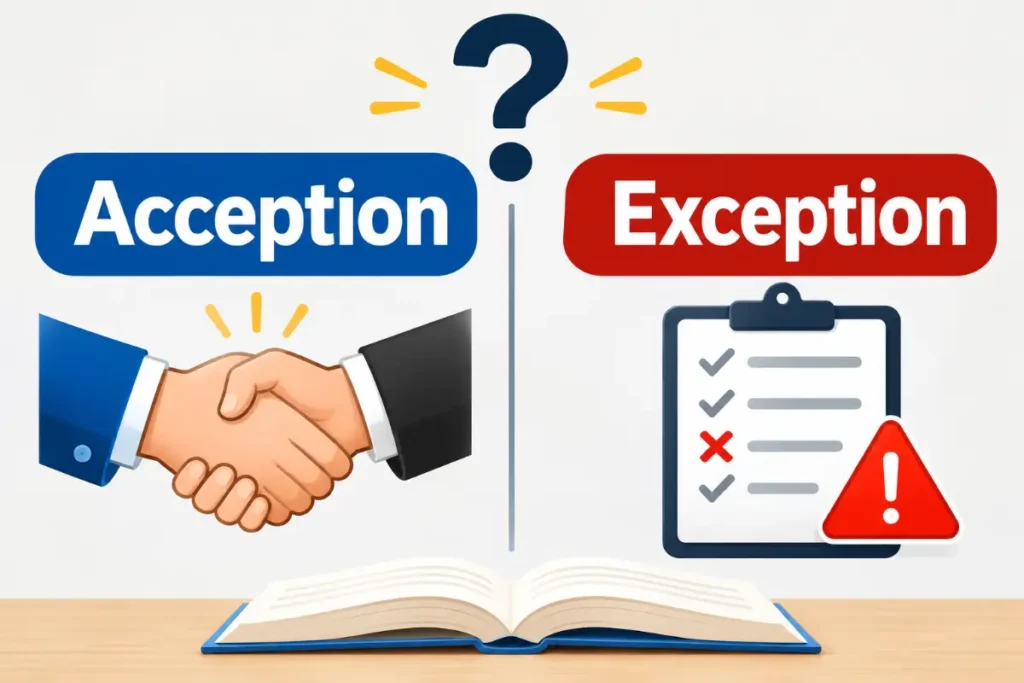
Acception is a rare noun that refers to a particular meaning or sense of a word. Exception is a noun that describes a person, thing, or situation that doesn’t follow a general rule. The plural forms are acceptions and exceptions. Although both spellings are valid, they aren’t interchangeable.
Direct Answer
Exceptions is the correct choice when you mean things that don’t follow a rule or general pattern. Use acceptions only when you specifically mean different senses or meanings of a word, a specialized and uncommon use in modern English.
Acceptions vs Exceptions at a Glance
The easiest way to tell these words apart is to focus on what you’re trying to say. One relates to the meaning of a word. The other relates to a rule or situation that has an unusual case.
| Word | Meaning | Example Sentence | When to Use It |
|---|---|---|---|
| Acception | A particular meaning or sense of a word. | The older text uses an uncommon acception of the term. | In rare or specialized discussions of word meanings. |
| Exception | A person or thing that doesn’t follow a general rule. | Every student passed the test with one exception. | In everyday writing and speech when a rule has a special case. |
| Acceptions | More than one particular sense of a word. | The scholar discussed several historical acceptions of the term. | In specialized discussions of language and word history. |
| Exceptions | More than one person, thing, or case that falls outside a rule. | The policy allows no exceptions. | In everyday situations involving rules, limits, and unusual cases. |
Remember this simple rule. If you’re talking about a rule, choose exception. If you’re discussing a particular sense of a word, acception may fit, but meaning or sense will usually sound more natural.
What Does Acception Mean
Acception is a noun that refers to a particular meaning or sense assigned to a word or expression. It appears mainly in older texts and specialized discussions of language. You won’t see it often in everyday American English.
Think of a word that has more than one meaning. For example, the word bright can describe strong light, a smart person, or a promising future. Each use represents a different sense of the word. In a specialized discussion, someone might use acception to refer to one of those senses.
However, most modern readers would find meaning or sense easier to understand. These words express the same general idea without sounding old fashioned or overly technical.
How Acception Is Used in English
The word appears most naturally when a writer discusses language, historical texts, or the different senses of a term.
Consider these examples.
- The dictionary records an unusual acception of the word.
- The author used an older acception that modern readers may not recognize.
- The researcher examined several acceptions of the term in historical documents.
- This acception of the expression appears mainly in older writing.
These sentences demonstrate how the word can work. Still, they don’t reflect the way most Americans speak or write today.
For instance, you could replace the first sentence with this one.
The dictionary records an unusual meaning of the word.
The revised version is shorter and easier to understand. It also avoids a rare term that might distract readers from the main point.
Is Acception a Real Word
Yes. Acception is a real English word. Its rarity doesn’t make it incorrect.
However, a word can exist in English without being useful in most situations. Many readers may never encounter acception outside an older book, a historical dictionary, or a specialized discussion of language.
If you’re writing a school essay, a business email, a blog post, or a social media update, you probably don’t need it. Choose meaning or sense unless your subject specifically calls for the less common term.
What Is the Plural of Acception
The plural of acception is acceptions. It follows the usual rule for forming the plural of a noun that ends in a consonant followed by n. Add s to the end.
Here are a few examples.
- The writer explored two different acceptions of the term.
- Older dictionaries sometimes record acceptions that have fallen out of use.
- The article compares several acceptions found in historical sources.
The spelling is straightforward. The main challenge is deciding when the word is appropriate.
In most cases, meanings or senses will be more familiar to your readers. Use acceptions only when its specialized meaning adds value to your explanation.
What Does Exception Mean
An exception is a person, thing, or situation that doesn’t follow a general rule. It can also refer to something that differs from what people usually expect.
This word appears in everyday conversations, workplace policies, school rules, legal documents, and many other settings.
For example, imagine that a school requires all students to wear uniforms. One student receives permission to wear different clothing for a special event. That student has an exception to the usual rule.
The same idea applies to ordinary situations.
- Everyone must attend the meeting, with one exception.
- The store is open every day except Sunday.
- The teacher made an exception to the late submission rule.
- This product is available to all customers without exception.
In each sentence, the word describes a case that differs from a general rule or expectation.
How to Use Exception in a Sentence
The word exception works in several common sentence patterns. Learning these patterns can help you use it naturally.
An exception to a rule.
Use this pattern when a person or situation doesn’t follow an established rule.
Example. The manager made an exception to the company policy.
This sentence means the manager allowed something that the policy would not normally permit.
With one exception.
Use this phrase when nearly everyone or everything fits a description, but one case differs.
Example. All the guests arrived on time, with one exception.
The phrase tells readers that one guest arrived late or otherwise failed to meet the expected condition.
Without exception.
Use this phrase when a statement applies to every person or thing in the group.
Example. All applicants must complete the form without exception.
This means nobody is exempt from the requirement.
Make an exception.
This common expression means to allow a special case that differs from the usual rule.
Example. My parents usually don’t allow late nights, but they made an exception for my graduation party.
These patterns are useful in both spoken and written English. They also show why exception is much more common than acception.
What Is the Plural of Exception
The plural of exception is exceptions. Simply add s to the singular form.
Here are some examples.
- The school allows exceptions for certain medical needs.
- There are a few exceptions to the general rule.
- The company reviewed the requests for special exceptions.
- Most stores follow the same policy, with minor exceptions.
The plural form works just like other regular nouns. Use exception when referring to one special case and exceptions when referring to two or more.
Common Expressions With Exception
Some expressions with exception appear so often that they’re worth learning as complete phrases.
| Expression | Meaning | Example |
|---|---|---|
| Make an exception | Allow a special case. | The coach made an exception for the injured player. |
| Take exception to | Feel offended or object to something. | She took exception to his rude comment. |
| Without exception | In every case. | All employees must follow the rule without exception. |
| With the exception of | Excluding a person or thing. | With the exception of Jake, everyone agreed. |
| A notable exception | A case that stands out from the rest. | The book was excellent, with one notable exception. |
| The exception proves the rule | A traditional expression suggesting that a stated exception can point to a general rule. | The sign says parking is allowed on weekends, an exception that suggests a weekday restriction. |
Pay special attention to take exception to. It doesn’t mean that someone has received permission to break a rule. It means that the person objects to something or feels offended by it.
For example, I took exception to his accusation means that I strongly objected to what he said.
This expression is common in formal and informal English, so it’s useful to recognize it.
Why Acception and Exception Get Confused
These words are easy to mix up because they look and sound similar. Both contain nearly the same letters, and both can appear in discussions about language. Their meanings, however, point in different directions.
The key difference is the letter c in acception and the letter x in exception. That small change creates two different words with separate uses.
Similar Spellings Can Cause Mistakes
English has many words that look almost alike but mean different things. Sometimes a single letter changes the meaning completely.
Consider these examples.
- Accept means to receive or agree to something.
- Except means to leave something or someone out.
- Acception refers to a particular meaning or sense of a word.
- Exception refers to a case that doesn’t follow a general rule.
The first two words help explain the spelling confusion. Accept and except are common words, and people sometimes mix them up when writing quickly. Their similar appearance can also make acception and exception harder to distinguish.
Still, the best way to avoid mistakes is to learn each word on its own terms rather than relying on spelling alone.
The Difference Between Accept and Except
The words accept and except are closely related to this spelling problem, but they serve different purposes.
Accept is a verb. It means to receive something willingly, agree to an offer, or recognize something as true.
Examples.
- I accept your invitation.
- She accepted the job offer.
- He accepted responsibility for the mistake.
Except usually works as a preposition or conjunction. It means excluding someone or something.
Examples.
- Everyone came except Mark.
- The store opens every day except Sunday.
- I like all the flavors except lemon.
A quick memory trick can help. You accept an offer, but you leave something excepted from a group. When you can replace the word with excluding, you probably need except.
This distinction matters because accept and except appear much more often than acception. Knowing their meanings can help you recognize the correct spelling of exception as well.
Why Exception Is More Common in Everyday English
People often need to talk about rules, special cases, and situations that don’t follow the usual pattern. That’s why exception appears in everyday conversations and written instructions.
Think about a return policy at a store. Most items might be returnable within 30 days, but certain sale items might not qualify. Those excluded items fall under an exception to the general return policy.
Now think about a word with several meanings. A writer might discuss how a word changed over time or how people used it in an old document. In that context, acception could appear, but meaning or sense would usually communicate the idea more clearly.
The difference comes down to the subject. Rules and unusual cases call for exception. Specialized discussions about the senses of words may call for acception.
How to Remember the Difference
You don’t need to memorize a long definition to choose the right word. A simple mental shortcut can help you make the right choice in seconds.
Connect Exception With Excluding Something
The word exception is closely related in meaning to except, which often means excluding someone or something.
For example, imagine a teacher saying, “Everyone passed except one student.”
That one student is an exception to the general statement that everyone passed.
You can use the same idea in many situations.
- Everyone is invited except Daniel.
- All orders shipped today except one.
- The rule applies to every room except the kitchen.
In each case, something falls outside the general group or pattern.
When you think about excluding a person, object, or situation, remember exception.
Connect Acception With Meaning
For acception, focus on the idea of meaning or sense. This association is useful in the rare situations where the word is appropriate.
Imagine that you’re studying an old poem. A word in the poem has a meaning that differs from the way people use it today. A scholar might describe that historical sense as an acception of the word.
In everyday writing, though, you can usually replace the term with meaning or sense.
For example.
Less familiar. The writer used an unusual acception of the word.
More natural. The writer used an unusual meaning of the word.
The second sentence is easier for most readers to understand. It conveys the idea without making the reader stop to think about an unfamiliar term.
Ask Yourself One Simple Question
Before choosing between these words, ask yourself what you’re describing.
Are you talking about a rule that has a special case? Use exception.
Are you discussing a particular sense of a word in a specialized language context? Acception may be suitable.
For example, consider these two sentences.
There are no exceptions to the attendance policy.
The researcher studied an older acception of the word.
The first sentence concerns a rule. The second concerns language and meaning.
If you still feel unsure, replace acception with meaning. If the sentence becomes clearer and keeps the same intended idea, the more familiar word is probably the better choice.
Common Mistakes to Avoid
Even when you understand the definitions, it’s easy to make mistakes with similar words. A few simple checks can help you avoid them.
Using Acceptions When You Mean Exceptions
This is the most common mistake to watch for. A writer may choose acceptions simply because it looks similar to exceptions.
Incorrect. The school allows no acception to its safety rules.
Correct. The school allows no exceptions to its safety rules.
The first sentence uses a word related to meaning when the writer needs a word about rules. The second sentence communicates the intended idea.
Remember that the spelling alone doesn’t determine the correct choice. You must match the word to the meaning.
Treating Acception as a Common Alternative
Some writers assume that acception is simply another spelling of exception. It isn’t.
The words have different definitions, so you can’t swap them freely. In modern English, acception is also much less familiar to readers.
If you want to describe a special case, use exception. If you want to describe a word’s meaning, choose meaning or sense in most situations.
Confusing Exception With Exemption
Exception and exemption are related, but they aren’t always interchangeable.
An exception is a case that doesn’t follow a general rule. An exemption is permission or a status that frees someone from a requirement, duty, or rule.
For example.
The policy has an exception for emergency situations.
The student received an exemption from the language requirement.
The first sentence describes a special case in the policy. The second says that the student doesn’t have to meet a particular requirement.
The distinction can be subtle, but it matters in school policies, workplace rules, taxes, and legal writing.
Using Exception When You Mean Accept
Another common error involves accept and exception.
Incorrect. I will exception your invitation.
Correct. I will accept your invitation.
The verb accept means to receive or agree to something. Exception is a noun that refers to a special case or departure from a rule.
If you’re agreeing to an invitation, an offer, or a proposal, use accept.
Forgetting the Correct Plural Form
Both nouns form their plurals by adding s.
- One acception becomes two acceptions.
- One exception becomes two exceptions.
The spelling of the plural forms is simple. The more important question is choosing the right noun in the first place.
For example, The dictionary lists several acceptions of the word can work in a specialized discussion. However, The policy includes several exceptions is the correct form when describing special cases.
Assuming the Rarer Word Sounds More Professional
Using an uncommon word doesn’t automatically make writing more accurate or impressive. In fact, it can make a clear idea harder to understand.
If you write for a general audience, choose words your readers are likely to know. Meaning is usually better than acception. Exception is the natural choice when you describe a special case.
Good writing isn’t about using the most unusual word available. It’s about choosing the clearest word for the job.
Real Life Examples of Acception and Exception
The easiest way to understand these words is to see how they work in different situations. The following examples show the difference in school, work, daily conversations, and discussions about language.
Examples From School and Education
Students often encounter exceptions in classroom rules, assignment deadlines, and exam instructions.
Here are some natural examples.
- The teacher made an exception and allowed me to submit my homework late.
- All students must attend the assembly, with the exception of those who are sick.
- The school has a few exceptions to its uniform policy.
- Every student passed the test without exception.
Each sentence describes a special case or a rule that applies to a group.
Now consider a discussion about language.
- The student found an unusual acception of the word in an old dictionary.
- The class explored different meanings of a word used in a poem.
The first sentence uses a rare term. The second uses the more familiar word meanings. For most school assignments, the second approach will be easier for readers to understand.
Examples From Work and Business
Exceptions appear frequently in workplace policies, customer service, and business agreements.
For example.
- The manager approved an exception to the usual vacation policy.
- All employees must complete the training, without exception.
- The company offers refunds within 14 days, with a few exceptions.
- The supervisor made an exception for an employee who had a family emergency.
These sentences show how the word applies to real situations. A general rule exists, but a particular case doesn’t follow it.
By contrast, acception might appear in a discussion about the meaning of a term used in a contract or historical business document. Even then, meaning or sense would usually be clearer.
Examples From Everyday Conversations
You don’t need formal writing to use exception correctly. It fits naturally into ordinary conversations.
Consider these examples.
- I like every pizza topping except olives.
- My dad rarely lets us stay up late, but he made an exception last night.
- Everyone agreed with the plan, with one exception.
- There are no exceptions to the rule.
- She took exception to his comment because it sounded rude.
Notice that the final sentence uses the expression take exception to. It means to object to something or feel offended by it.
These expressions are common in American English. Learning them can help you sound more natural in conversations and written messages.
Examples From Dictionaries and Language Studies
The word acception fits best in discussions about language and word history.
For example.
- The researcher examined an older acception of the term.
- The historical text contains an acception that differs from its modern meaning.
- The scholar compared several acceptions recorded in older sources.
These examples show the specialized use of the word. However, acception isn’t the usual choice for modern dictionary definitions or everyday explanations.
A clearer version of the second example would be this.
The historical text uses the word in a sense that differs from its modern meaning.
That sentence conveys the same basic idea in language most readers will understand immediately.

Related Words You Should Know
Understanding a few related words can help you avoid spelling mistakes and express your ideas more precisely.
Accept and Acceptance
Accept is a verb that means to receive, agree to, or recognize something.
Examples.
- I accept your apology.
- She accepted the invitation.
- They accepted the new rules.
Acceptance is the noun form. It describes the act of accepting something or the state of being accepted.
Examples.
- His acceptance of the offer surprised us.
- She received an acceptance letter from the college.
- The team showed acceptance of the new plan.
Don’t confuse acceptance with acception. Although the words look similar, they have different meanings and uses.
Except and Exception
Except usually means excluding someone or something.
Example. Everyone attended the meeting except Sarah.
Exception is a noun that refers to the person, thing, or situation that doesn’t follow the general rule.
Example. Sarah was the only exception to the attendance rule.
The words often appear together, but they don’t serve the same grammatical role. Except commonly introduces an exclusion. Exception names the special case.
Exceptional and Exceptionally
Exceptional is an adjective that means unusually good or different from the norm.
Example. She did an exceptional job on the project.
Exceptionally is an adverb that describes how something happens or the degree to which a quality is present.
Example. The weather was exceptionally warm for October.
Both words come from the same word family as exception. Neither one refers to the specialized meaning of acception.
Exempt and Exemption
Exempt means free from a duty or requirement.
Example. Some students are exempt from the final exam.
Exemption is the noun that describes this status or permission.
Example. The student received an exemption from the final exam.
These words are especially useful when discussing official rules, school requirements, workplace policies, and legal obligations.
When to Use Each Word
Choosing the right word becomes easier when you match it to your purpose.
Use exception when you describe something that falls outside a general rule, pattern, or expectation. It’s the right choice for most everyday situations.
For example, if a store normally closes at 8 p.m. but stays open until 10 p.m. on a holiday, the holiday schedule is an exception to the usual hours.
Use acception only when you need its specialized meaning of a particular sense of a word. Even in this context, consider using meaning or sense if those words communicate your idea more clearly.
For example, a researcher studying an old book might examine a historical acception of a term. A general reader would probably understand the sentence more easily if the writer said historical meaning instead.
The goal isn’t to avoid rare words at all costs. It’s to use them only when they serve a clear purpose.
FAQs
What Is the Difference Between Acceptions and Exceptions?
Acceptions refers to particular meanings or senses of a word in a rare and specialized use. Exceptions refers to cases that don’t follow a general rule. For everyday writing, exceptions is the word you’ll need most often.
Is Acception a Correct English Word?
Yes. Acception is a valid but uncommon English word that refers to a particular meaning or sense of a word. Most modern writers use meaning or sense instead because these words are easier for readers to understand.
Is Exceptions the Correct Spelling?
Yes. Exceptions is the correct plural spelling of exception. Use it when referring to special cases that don’t follow a rule or general pattern.
What Is the Plural of Acception?
The plural of acception is acceptions. The plural of exception is exceptions. Both forms are spelled correctly, but they have different meanings.
Can I Use Acception Instead of Exception?
No. The two words aren’t interchangeable because they have different meanings. Use exception for a special case and reserve acception for its rare sense related to word meaning.
How Do I Remember the Correct Word?
Think of exception as a case that stands apart from a general rule. For acception, think about the meaning or sense of a word. When you’re unsure, remember that exception is the usual choice for everyday writing about rules.
What Is the Difference Between Accept and Except?
Accept means to receive or agree to something. Except means excluding someone or something. For example, you can accept an invitation but attend the party with everyone except your brother.
What Is the Difference Between an Exception and an Exemption?
An exception is a special case that doesn’t follow a general rule. An exemption means someone is officially free from a requirement or duty. A school might make an exception to its attendance policy or grant a student an exemption from a required course.
Conclusion
The main difference between acceptions vs exceptions comes down to meaning and use. Acception is a rare word for a particular sense of a word. Exception is the common word for a special case that doesn’t follow a general rule.
For most everyday writing, choose exception or exceptions. You’ll use these words when discussing school policies, workplace rules, special permissions, and situations that differ from the norm.
If you’re writing about language or studying an older text, acception may be appropriate. Still, meaning or sense will usually make your point clearer.
Before you choose a spelling, ask yourself what you want to describe. If you’re talking about a rule, use exception. If you’re talking about a word’s meaning, consider meaning or sense. That small check can help you write with confidence and avoid a common spelling mistake.

Sienna Watson is a veteran copywriter and communications coach who has helped startup founders, marketers, and professionals polish their writing for over a decade. Realizing that most people don’t need a degree in linguistics—just clear, impactful communication—Sienna focuses on practical grammar, business writing etiquette, and eliminating wordiness. She advocates for plain language, strong verbs, and persuasive prose that gets results.