

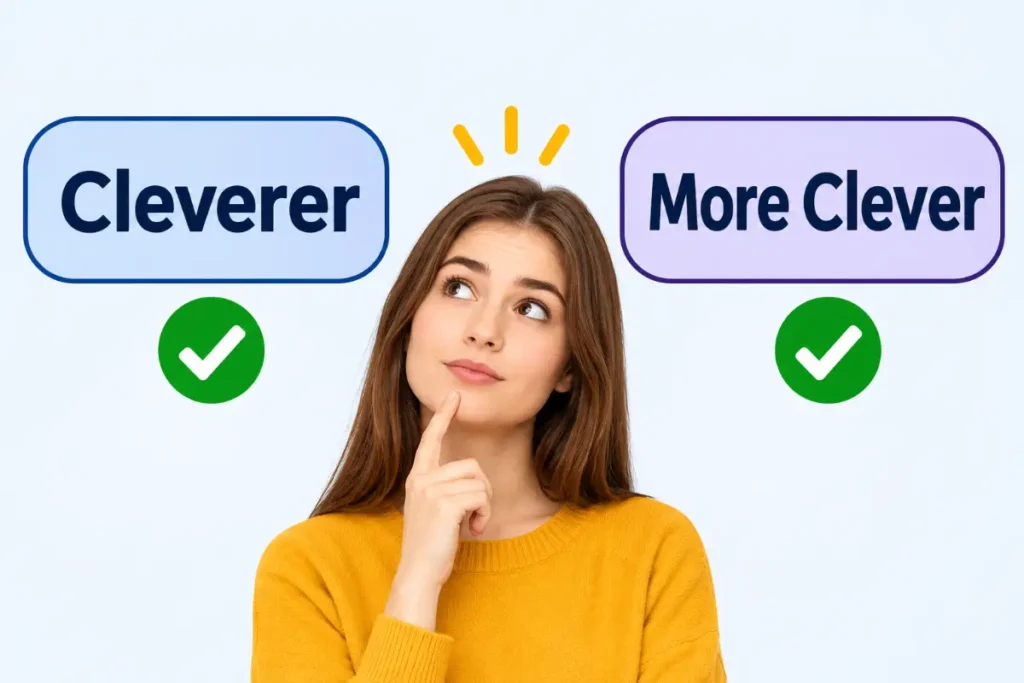
If you’re unsure about cleverer vs more clever, both forms are correct in English. However, cleverer is usually the more natural choice in everyday American English when you want to compare two people or things. More clever is also acceptable and can sound more deliberate or place extra emphasis on the comparison.
For example, you could say, “Mia is cleverer than Jake,” or “Mia is more clever than Jake.” Both sentences express the same basic idea.
So why do we have two ways to make this comparison? English uses different patterns to compare qualities. Short adjectives often take the ending -er, while longer adjectives usually use more. The word clever sits in a group where both patterns work.
The best choice depends on the sentence and the tone you want. This guide explains the grammar rule, shows natural examples, and clears up common mistakes so you can choose the right form with confidence.
Quick Definition
Cleverer is the comparative form of the adjective clever. It means more clever than another person or thing.
More clever expresses the same comparison by placing more before the adjective. Both forms are grammatically correct, although cleverer is often shorter and more natural in ordinary conversation.
Direct Answer
Both cleverer and more clever are correct. In American English, cleverer is a good default choice for everyday writing, but more clever is also acceptable when it fits your sentence or gives the comparison the emphasis you want.
Cleverer vs More Clever at a Glance
| Word or phrase | Meaning | Example sentence | When to use it |
|---|---|---|---|
| Cleverer | Having more cleverness than someone or something else | Ava is cleverer than her brother. | A concise and natural comparison. |
| More clever | Having a greater degree of cleverness | That was a more clever solution. | A valid alternative when the wording suits the sentence. |
| Clever | Quick to understand or good at finding smart solutions | He is a clever student. | When describing one person or thing without making a comparison. |
| The cleverest | Having the highest degree of cleverness in a group | She is the cleverest person on our team. | When comparing three or more people or things and identifying the highest degree. |
| The most clever | Expressing the highest degree of cleverness | That was the most clever answer of all. | An alternative superlative form that is grammatically acceptable. |
Why Both Forms Are Correct
English has more than one way to compare some adjectives. The ending -er is common with short adjectives. The word more usually comes before longer adjectives.
For example, we normally say taller instead of more tall. We also usually say more interesting instead of interestinger. These patterns help us form comparisons that sound natural.
However, English has exceptions and flexible patterns. Some adjectives can use either form without changing their basic meaning. Clever is one of them.
How Comparative Adjectives Work
A comparative adjective describes a difference between two people or things. It tells the reader that one has a greater degree of a quality than the other.
Consider these examples.
- Jordan is taller than Alex.
- This puzzle is more difficult than the last one.
- My new phone is lighter than my old phone.
- Her explanation is more helpful than mine.
- This plan is cleverer than the original plan.
Each sentence compares one person or thing with another. The comparative form helps show the difference.
The choice between cleverer and more clever follows the same general idea. Both forms describe a greater degree of cleverness. Neither one changes the basic meaning of the adjective.
Why Clever Allows Two Forms
The adjective clever has two syllables. It is pronounced CLEVER, with the main stress on the first syllable.
Many two syllable adjectives can take the ending -er. For example, English speakers commonly use faster, quieter, narrower, and cleverer.
Other two syllable adjectives usually take more. We normally say more careful, more useful, and more honest.
The rules are not based on syllable count alone. The sound of the adjective and common usage also matter. That is why some two syllable words allow both comparative patterns.
For clever, adding -er creates a standard comparative form. Placing more before the adjective also creates a correct comparison.
Here are two examples.
- Sam is cleverer than I expected.
- Sam is more clever than I expected.
Both sentences tell us that Sam showed a higher level of cleverness than the speaker expected.
The first version is more compact. The second puts a little more weight on the degree of cleverness. The difference is subtle rather than a firm rule.
The Grammar Rule for Cleverer
The basic rule is simple. Add -er to clever to form its comparative.
Clever + er = cleverer.
Use cleverer when comparing two people, animals, objects, ideas, or actions. The word can describe intelligence, quick thinking, or the ability to find a smart solution.
Use Than to Make a Direct Comparison
The word than often follows a comparative adjective. It introduces the person or thing used for comparison.
For example.
- Ella is cleverer than her cousin.
- This method is cleverer than the one we tried yesterday.
- The fox seemed cleverer than the other animals.
- His second answer was cleverer than his first.
- That was a cleverer way to solve the problem.
In each sentence, cleverer tells us that one person or thing shows more cleverness than another.
You do not always need to include than if the comparison is clear from the context.
For example, a teacher might say, “You have become much cleverer.” The sentence compares the student’s current ability with their earlier ability. The other point of comparison is understood.
Add More Before Clever When It Fits
You can also form the comparative by placing more before clever.
The pattern is simple.
More + clever = more clever.
For example.
- Her new idea is more clever than the first one.
- The detective came up with a more clever plan.
- We need a more clever way to save time.
- His response was more clever than I expected.
- The team found a more clever way to use its budget.
These sentences are grammatically correct. They do not need to be rewritten just because cleverer is available.
Still, pay attention to the full sentence. Sometimes more clever sounds slightly more deliberate or emphatic. In other sentences, it may sound less natural than the shorter form.
The goal is not to force one pattern into every situation. Choose the form that sounds clear and natural in context.
Do Not Use Both Comparative Forms Together
One common grammar mistake is to use more and -er together with the same adjective.
For example, avoid this sentence.
“She is more cleverer than her sister.”
The word more already marks the comparison, and the ending -er does the same job. Using both forms together is unnecessary in standard English.
Use one of these instead.
- She is cleverer than her sister.
- She is more clever than her sister.
The same rule applies to other adjectives that take the ending -er. For instance, write taller rather than more taller, and faster rather than more faster.
This mistake often happens when writers know that more forms comparisons but have not learned that the adjective already has a comparative ending.
A useful habit is to check the word after more. If it already ends in -er as a comparative, you probably do not need more.
When to Use Cleverer in American English
American English accepts both forms. However, cleverer is often a strong choice when you want a short and direct sentence.
It works well in conversation, school assignments, stories, and general writing. It also keeps a sentence from becoming longer than necessary.
In Everyday Conversation
People often choose words that are quick and easy to say. Cleverer fits that pattern.
Imagine two friends discussing a puzzle.
“Your answer was clever, but Liam’s was cleverer.”
The sentence is short and easy to follow. It clearly shows that Liam found a better solution.
Here are more everyday examples.
- My little sister is cleverer than people think.
- You are cleverer than you give yourself credit for.
- That trick is cleverer than it looks.
- I think your first idea was cleverer.
- The second player made a cleverer move.
These sentences sound natural because the comparative form carries the meaning without adding extra words.
In School and Academic Writing
You can use cleverer in school essays and other formal writing. It is a standard English word, not slang.
For example.
“The student developed a cleverer method for solving the equation.”
This sentence is clear and grammatically sound. It describes an improved approach without using complicated language.
However, academic writing sometimes benefits from a more precise adjective. If you mean that a method uses fewer steps, more efficient may be clearer than cleverer. If you mean that an argument shows careful thought, more thoughtful or better reasoned may express the idea more accurately.
Choose the word that matches the point you want to make. A comparative form can be correct while still being less precise than another option.
In Stories and Creative Writing
Writers can use cleverer to show a change in a character’s thinking or to compare the skills of different characters.
For example.
“The young detective grew cleverer with every case.”
The sentence suggests that the detective keeps learning and solving problems more effectively.
A writer might also use the word to build tension.
“Rosa knew the thief was cleverer than she had first believed.”
Here, the comparison adds to the reader’s sense that Rosa faces a difficult challenge.
Creative writing allows more freedom with rhythm and emphasis. If more clever fits the voice of a character or the flow of a sentence, it can work just as well.
In Headlines and Short Text
Shorter wording can help when space is limited. Cleverer uses fewer words than more clever, so it may fit a headline, caption, or short description more easily.
For example.
- A Cleverer Way to Organize Your Desk.
- Build a Cleverer Budget.
- Find a Cleverer Solution to the Problem.
These examples use the comparative to suggest improvement. They do not claim that the solution is perfect. They simply say that it offers more cleverness than an earlier option.
Keep the claim honest. If a method is actually faster, cheaper, or easier, one of those words may tell readers more than cleverer does.
When More Clever Is the Better Choice
Although cleverer is a natural default, more clever has its place. It can work well when you want to stress the quality being compared or when it creates a smoother sentence.
There is no rule that makes the longer form wrong. The important point is to use it correctly and make sure the reader understands the comparison.
When You Want to Emphasize Cleverness
Sometimes you want the reader to focus on how clever an idea is rather than simply compare two things.
For example.
“Her solution was more clever than practical.”
This sentence contrasts cleverness with practicality. The speaker suggests that the solution showed imagination but may not have worked well in real life.
Another example is “The ending was more clever than satisfying.” Here, the writer says that the ending was smart or surprising but did not provide a satisfying result.
In these sentences, more clever helps build a contrast. It allows the writer to focus on the degree of a quality before introducing another idea.
You could use cleverer in some similar sentences, but the longer form may fit the rhythm or emphasis better.
When the Sentence Sounds More Natural
Good writing depends on more than a grammar rule. Word choice, sentence rhythm, and the surrounding words all play a part.
Compare these sentences.
- The second plan is cleverer than the first.
- The second plan is more clever than the first.
Both are correct. Many American readers will find the first sentence more direct. Others may prefer the second because it flows better with the words around it.
Now consider this example.
“That was a more clever than careful response.”
This wording is awkward because it leaves out a structure that would make the comparison clear. A better version would be “That response was more clever than careful.”
The issue is not that more clever is wrong. The problem is how the phrase works in the sentence.
Read your sentence aloud if you are unsure. If one version sounds easier to follow, use it. Then check that it says exactly what you mean.
When You Want to Avoid Repeating Similar Endings
Sometimes a sentence contains several comparative adjectives. Repeating the ending -er can make the wording sound clumsy.
For example.
“The plan was cleverer, faster, and cheaper than the old one.”
This sentence is perfectly acceptable. Still, a writer may want to change the rhythm.
“The plan was more clever, faster, and cheaper than the old one.”
This version is also understandable, though the mixed patterns may sound uneven to some readers. A cleaner alternative could be “The plan was smarter, faster, and cheaper than the old one.”
The best choice depends on the meaning. Do not change a correct word just to avoid repetition if the new word changes the message.
Cleverer vs More Clever in Real Sentences
Examples are one of the easiest ways to understand a grammar rule. They show how a word works in different situations rather than leaving you to memorize a definition.
The following examples use both forms in everyday American English.
Comparing Two People
Use either form to compare how quickly two people understand a problem or find a solution.
- Ava is cleverer than her older brother.
- Ava is more clever than her older brother.
- My new coworker is cleverer than I expected.
- The coach thought Ben was more clever than the other players.
- Although both students are clever, Nina is cleverer at solving puzzles.
All five sentences make a comparison. None of them suggests that the person with less cleverness lacks intelligence. The comparison only describes a difference in degree.
Also, clever does not always mean academically smart. A clever person might be good at solving practical problems, finding shortcuts, or thinking of original ideas.
Comparing Ideas and Solutions
The adjective can describe a plan or idea as well as a person.
- Her cleverer design saved us time.
- We need a more clever way to explain the rule.
- This is a cleverer solution to the parking problem.
- The engineer suggested a more clever use of the available space.
- Their second proposal was cleverer but more expensive.
Notice that cleverness and usefulness are not always the same. An idea may be clever but costly. A solution may be original but difficult to use.
For that reason, consider the quality you want to highlight. If the solution works better, better may be enough. If it saves time, more efficient may be clearer. If it shows creative thinking, cleverer or more clever can fit well.
Comparing Actions
You can also compare how people act or respond.
- Maya handled the problem in a cleverer way.
- He came up with a more clever answer during the interview.
- The second player made a cleverer move.
- She found a more clever way to avoid wasting food.
- The lawyer used a cleverer argument to explain the evidence.
These examples show that the adjective can describe the thinking behind an action. It does not have to describe a permanent trait.
Someone who makes a clever decision in one situation may struggle with a different problem later. The word describes the action in context rather than proving that one person is always smarter than another.
Comparing Objects and Designs
People often use clever to describe something that has been designed with care or imagination.
- This is a cleverer design for a small kitchen.
- The new toy has a more clever locking system.
- We found a cleverer way to store the tools.
- That was a more clever use of the empty space.
- The updated app has a cleverer search feature.
In these examples, the adjective describes a feature that solves a problem in an inventive way. It does not automatically mean that the object is more durable, more useful, or better in every respect.
For example, a clever storage system might save space but take longer to use. If you want to make a fair comparison, state the exact advantage rather than relying on the word cleverer alone.
Comparing Past and Present Performance
Both comparative forms can describe change over time.
- You are cleverer at solving these problems now.
- I have become more clever about spending money.
- His latest work shows a cleverer approach.
- She found a more clever way to manage her time.
- The team is getting cleverer at handling customer questions.
These sentences compare current performance with an earlier stage. You do not always need to name the earlier point in time because words like now, latest, and getting make the comparison clear.
However, if you want to describe a measurable improvement, a more specific word may help. For example, “She now solves the puzzles faster” tells readers exactly what has changed.
Common Mistakes to Avoid
The main rule is easy, but a few mistakes can make a sentence unclear or ungrammatical.
Using More Cleverer
Do not combine more with cleverer when you intend to make a standard comparison.
- Incorrect: “This idea is more cleverer than mine.”
- Correct: “This idea is cleverer than mine.”
- Also correct: “This idea is more clever than mine.”
Choose one comparative pattern. You do not need both.
Forgetting the Comparison
A comparative adjective usually suggests that two things are being compared. The other item may be stated directly or understood from the context.
For example, “This plan is cleverer” can work if everyone knows which plan you are comparing it with.
Without context, the sentence may leave readers asking, “Cleverer than what?”
A clearer sentence would be “This plan is cleverer than our original idea.”
Adding the point of comparison often makes your writing more useful.
Confusing Clever With Intelligent
Clever and intelligent overlap in meaning, but they are not always interchangeable.
Clever often describes quick thinking, ingenuity, or an inventive solution. Intelligent usually refers to a broader ability to learn, understand, and reason.
For example, “She is cleverer at finding shortcuts” describes a particular skill. “She is more intelligent” makes a broader comparison about mental ability.
Use the word that best matches your meaning. Do not assume that a person who comes up with a clever idea must be more intelligent in every area.
Treating Cleverer as Informal or Incorrect
Some writers avoid cleverer because they think it sounds casual. Others believe that more clever is the only correct form.
Neither belief is accurate. Cleverer is a standard comparative adjective, and more clever is also accepted.
The choice is mainly about natural phrasing, tone, and context. You can use either form in ordinary writing as long as the sentence is clear.
Choosing a Comparative When You Need a Superlative
A comparative normally compares two people or things. A superlative identifies the highest degree within a group.
For example.
- Liam is cleverer than Noah.
- Liam is the cleverest student in the class.
- Liam is more clever than Noah.
- Liam is the most clever student in the class.
The first and third sentences compare Liam with Noah. The second and fourth describe Liam as having the highest degree of cleverness in the group.
Do not use cleverer when your sentence needs to identify the top person or thing in a group. In that case, use a superlative form such as the cleverest or the most clever.
The Superlative Forms of Clever
The comparative form is only one part of the picture. You may also need a superlative when comparing three or more people or things.
The two common superlative forms are cleverest and most clever. Both express the highest degree of cleverness.
When to Use Cleverest
Cleverest is the superlative form made by adding -est to clever.
For example.
- She is the cleverest student in the class.
- That was the cleverest answer in the competition.
- Of all our ideas, this one is the cleverest.
- He came up with the cleverest solution to the problem.
This form is short and direct. It works well in conversation and general writing.
When to Use Most Clever
You can also put most before clever to form the superlative.
For example.
- She is the most clever student in the class.
- That was the most clever answer I heard.
- This is the most clever design in the collection.
- He came up with the most clever solution.
These sentences are grammatically acceptable. Still, the cleverest is often the more natural choice in everyday American English.
Use the most clever when it fits the rhythm of your sentence or gives the quality extra emphasis. Do not add most before cleverest. In standard usage, write the cleverest or the most clever, not the most cleverest.
How to Remember the Correct Form
You do not need to memorize a long list of grammar rules to choose between the two forms. A few simple habits can help you make the right decision.
Start With Cleverer
When you need to compare two people or things, try cleverer first. It is concise and usually sounds natural in American English.
For example, if you want to compare two ideas, write “This idea is cleverer than the first one.”
If the sentence sounds awkward in context, try more clever. Both forms are correct, so you can choose the one that makes the sentence flow better.
Keep the Comparative Patterns Separate
Remember these two patterns.
- Cleverer than.
- More clever than.
Both patterns work. Just do not combine them into more cleverer than.
This simple check can help you catch one of the most common mistakes before you publish or submit your writing.
Check the Meaning Before You Choose
Ask yourself what you want to say. Are you describing quick thinking, a creative idea, or a better result?
If you mean that someone thinks of original solutions, cleverer may fit. If you mean that a solution produces a better outcome, better or more effective may be more precise.
A good grammar choice should do more than follow a rule. It should also communicate your meaning clearly.
Related Comparative Adjectives
The word clever is part of a larger group of adjectives that can have flexible comparative forms. Learning a few related words can help you understand the pattern.
| Adjective | Common comparative | Example |
|---|---|---|
| Clever | Cleverer or more clever | This is a cleverer idea. |
| Simple | Simpler | This method is simpler. |
| Quiet | Quieter | The library is quieter today. |
| Narrow | Narrower | This street is narrower than the next one. |
| Friendly | Friendlier or more friendly | Our new neighbor is friendlier. |
| Polite | More polite | That response was more polite. |
| Careful | More careful | Be more careful with the glass. |
| Useful | More useful | This guide is more useful for beginners. |
| Honest | More honest | His second answer was more honest. |
These examples show why you should not rely on syllable count alone. Many short adjectives take -er, and many longer adjectives use more. Some two syllable adjectives allow both patterns.
The most natural form can depend on common usage and the sentence itself. Reading examples from reliable dictionaries and edited writing can help you recognize these patterns.
Is Cleverer the Same as Smarter
Cleverer and smarter often express similar ideas, but their meanings can differ slightly.
Smarter is the comparative form of smart. It can describe general intelligence, good judgment, or a practical decision. Cleverer often highlights ingenuity or the ability to think of an inventive solution.
For example, “She is smarter than I am” may suggest a broad difference in intelligence. “She found a cleverer way to fix the problem” focuses on the solution she created.
In casual conversation, people sometimes use the words in similar ways. In careful writing, choose the word that best describes the quality you mean.
Is Cleverer the Same as More Intelligent
Not exactly. More intelligent usually makes a broader claim about someone’s ability to understand, learn, or reason. Cleverer can focus on quick thinking or a specific act of ingenuity.
For instance, a person might be cleverer at solving a puzzle because they spot an unusual pattern. That does not prove they are more intelligent in every area.
The distinction matters when you want to describe someone fairly. A single clever action is not enough to measure a person’s overall intelligence.
FAQs
Is cleverer or more clever correct?
Both forms are grammatically correct. Cleverer is often the more natural choice in everyday American English. More clever is also acceptable and can suit the tone of a particular sentence.
Is cleverer vs more clever a difference in meaning?
There is usually no major difference in meaning. Both forms describe a greater degree of cleverness. The choice mainly depends on sentence rhythm, emphasis, and personal preference.
Do Americans say cleverer?
Yes. American English speakers use cleverer, and the word is standard English. Some speakers may prefer more clever in certain sentences, but the shorter form is not incorrect or unprofessional.
Can I write more cleverer in a sentence?
No. In standard English, avoid using more and the comparative ending -er together with the same adjective. Write cleverer or more clever instead.
What is the comparative form of clever?
The comparative form of clever is cleverer. You can also use more clever. Both forms are accepted in standard English.
What is the superlative form of clever?
The two common superlative forms are cleverest and most clever. For example, you can write “She is the cleverest student in the class” or “She is the most clever student in the class.”
Is cleverer more formal than more clever?
Neither form is automatically more formal. Both work in standard writing. Cleverer is shorter and often sounds more direct, while more clever may suit a sentence that calls for extra emphasis.
Can I use cleverer in academic writing?
Yes. Cleverer is grammatically correct and suitable for academic writing when it expresses your intended meaning. However, words such as more effective, more efficient, or better reasoned may be more precise when you are describing a specific advantage.
Conclusion
Both cleverer and more clever are correct English. They express the same basic comparison, so you do not need to worry about using the longer form when it fits your sentence.
For everyday American English, cleverer is a good first choice. It is short, clear, and natural. Still, more clever works when it creates better flow or puts more emphasis on the quality being described.
Remember to keep the comparative patterns separate. Write “She is cleverer than her brother” or “She is more clever than her brother.” Avoid more cleverer because it combines two comparative forms unnecessarily.
The next time you face the choice, start with cleverer. Read the full sentence aloud and switch to more clever if it sounds better. Clear writing is the goal, and both forms give you a correct way to express the comparison.

Sienna Watson is a veteran copywriter and communications coach who has helped startup founders, marketers, and professionals polish their writing for over a decade. Realizing that most people don’t need a degree in linguistics—just clear, impactful communication—Sienna focuses on practical grammar, business writing etiquette, and eliminating wordiness. She advocates for plain language, strong verbs, and persuasive prose that gets results.