
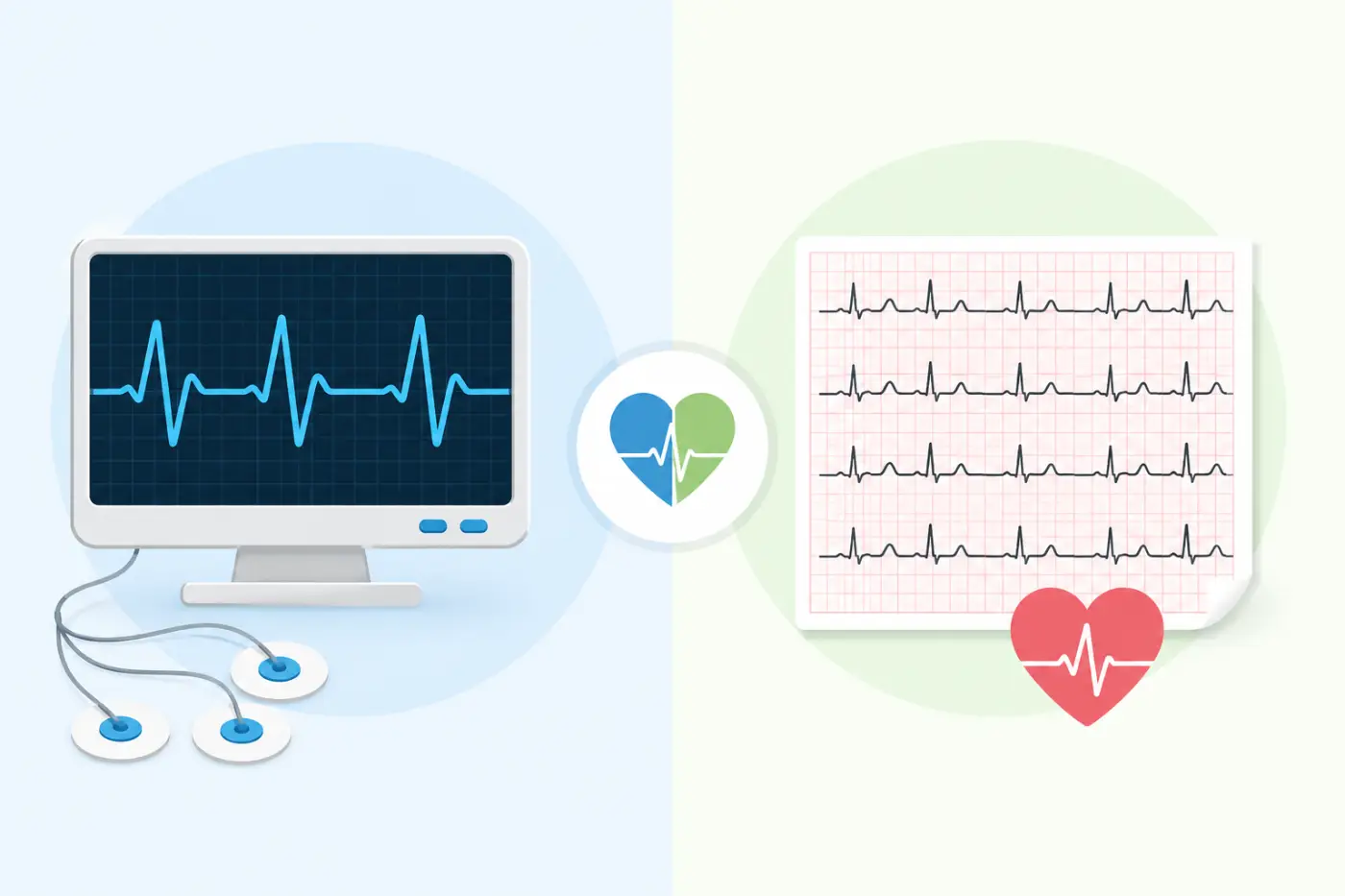
If you’ve searched for EKG vs ECG because you weren’t sure if they mean different heart tests, you can relax. They mean the same test. Both terms refer to an electrocardiogram, which records the electrical activity of your heart.
The difference is mainly the name people use. ECG comes from the word electrocardiogram. EKG comes from the German spelling elektrokardiogramm. Both names describe a test that uses small electrodes placed on the skin to record the heart’s electrical signals.
So why do medical records, doctors, hospitals, and websites use both names? The answer has more to do with language and medical history than with two different tests. You’ll also see ECG used more often in many parts of the world, while EKG remains very common in the United States.
This guide explains the difference between the two terms, what the test measures, why a doctor may order one, what happens during the test, and how to understand some of the basic information it can show. It also clears up a few common mix ups, especially the difference between an electrocardiogram and an echocardiogram.
Quick Definition
An ECG and an EKG are two names for the same heart test. The test records the electrical activity of the heart and can show information about heart rate, heart rhythm, and the timing of electrical signals.
Direct Answer
There is no medical difference between an ECG and an EKG. Both names refer to an electrocardiogram that records the heart’s electrical activity.
Comparison Table
| Term | Meaning | Example | When It Is Used |
|---|---|---|---|
| ECG | Short form of electrocardiogram | Your doctor ordered an ECG. | Common in many countries and medical settings. |
| EKG | Another short form of electrocardiogram | The nurse performed an EKG. | Very common in the United States. |
| Electrocardiogram | The full name of the test | The electrocardiogram recorded your heart rhythm. | Used in formal medical writing and explanations. |
| Echocardiogram | An ultrasound test that creates images of the heart | The doctor ordered an echocardiogram to look at the heart valves. | Used to examine the heart’s structure and movement. |
Why ECG And EKG Mean The Same Thing
The easiest way to understand the two names is to start with the full medical term. An electrocardiogram is a test that records the electrical signals produced by your heart. Those signals create a pattern that healthcare professionals can examine for signs of abnormal heart activity.
ECG is simply an abbreviation of electrocardiogram. The letters come from the English spelling of the word. EKG comes from the German spelling elektrokardiogramm. The K helps make the abbreviation different from the English initials while still pointing to the same test.
That distinction can seem strange at first, but it isn’t unusual in medicine. Medical terms often have roots in several languages, especially Greek, Latin, German, and English. The name changed slightly depending on the language while the test itself stayed the same.
Think of ECG and EKG as two labels on the same box. The label changes, but the contents do not.
If your doctor says you need an EKG and another doctor calls the same test an ECG, neither doctor is referring to a different procedure. You do not need two separate tests simply because you see both abbreviations.
Why The Letter K Appears In EKG
The letter K is the part that usually catches people’s attention.
The word electrocardiogram has roots in Greek and Latin, while the German form uses the spelling elektrokardiogramm. In German, the sound represented by the English letter C is represented by K in this word. That gives us EKG rather than ECG.
Doctors and medical organizations have continued using both forms. The American Heart Association uses EKG and ECG in its patient information and describes both as names for an electrocardiogram. Mayo Clinic also uses ECG or EKG when describing the test.
So the K isn’t a sign of a different machine or a different method. It is simply part of the alternative abbreviation.
This is also why you may see one term in a hospital document and the other in a medical article. Both can be correct.
What An Electrocardiogram Actually Measures
An electrocardiogram measures electrical activity in the heart. Your heart does not beat randomly. Each heartbeat is controlled by electrical signals that move through the heart in a coordinated pattern.
Those signals tell different parts of the heart when to contract. The electrical activity can be picked up through electrodes placed on the skin. The machine then turns those signals into a tracing that healthcare professionals can review.
A standard test can provide information about how fast your heart is beating and how regularly it is beating. It can also show the timing and pattern of the electrical signals as they move through the heart.
That information can help a healthcare professional look for signs of problems such as an irregular heartbeat or a heart attack. An ECG can also provide clues about other heart conditions and changes in the heart’s electrical activity.
The test does not take a picture of your heart. Instead, it creates a record of the electrical signals that control your heartbeat.
That difference matters because people sometimes confuse an electrocardiogram with an echocardiogram.
ECG And Echocardiogram Are Not The Same
- The words look similar, so this mix up is understandable. An electrocardiogram and an echocardiogram are different tests.
- An electrocardiogram records electrical activity. An echocardiogram uses sound waves to create images of the heart. The images can show structures such as the heart chambers and valves and can help doctors assess how the heart is moving and working.
- You can think of the two tests as answering different questions.
- An electrocardiogram asks, “What is the heart’s electrical activity doing?”
- An echocardiogram asks, “What does the heart look like and how is it moving?”
- A doctor may order one test or both depending on the symptoms and the information needed.
- For example, someone with an irregular heartbeat may need an electrocardiogram to examine the heart’s rhythm. Someone with suspected valve disease may need an echocardiogram to look at the valves and heart structures.
- An echocardiogram does not replace an ECG. An ECG does not replace an echocardiogram. They provide different types of information.
What An ECG Can Show
An electrocardiogram can reveal several useful details about how the heart is working. It gives healthcare professionals a quick look at the heart’s electrical pattern at the time the test is recorded.
Heart Rate
Heart rate tells you how many times the heart beats in a minute. An ECG can help determine if the heart is beating unusually fast or unusually slowly.
A fast heart rate is called tachycardia. A slow heart rate is called bradycardia. These terms describe heart rate patterns and do not automatically tell you why the rate is fast or slow.
Many things can affect heart rate, including exercise, stress, medications, illness, and other factors. A healthcare professional looks at the ECG along with your symptoms and medical history.
Heart Rhythm
- The test can also show if the heartbeat is regular or irregular. An abnormal rhythm is called an arrhythmia.
- Some arrhythmias are harmless. Others can require medical care. A common example is atrial fibrillation, often called AFib.
- An ECG can help identify abnormal rhythms when they are happening during the test.
Electrical Timing
The tracing also provides information about how electrical signals move through the heart. Healthcare professionals can examine the timing and shape of the waves on the tracing.
Changes in these patterns can provide clues about certain heart problems. An ECG may also help doctors assess the effects of some medicines or check how an implanted device such as a pacemaker is working.
Signs Of A Heart Attack
An ECG can help doctors identify signs of a current or previous heart attack. The pattern can sometimes provide information about the part of the heart affected.
This is one reason an ECG is often used when someone has symptoms that could be related to a heart problem.
An ECG does not answer every heart related question by itself. Doctors may use blood tests, imaging, physical exams, and other information to make a diagnosis.
Why A Doctor Might Order This Test
A healthcare professional may recommend an electrocardiogram for several reasons. The test is quick and can provide useful information without putting electricity into the body.
Common reasons include chest pain, dizziness, fainting, shortness of breath, unusual tiredness, a fast pulse, or a feeling that the heart is pounding, fluttering, or skipping beats.
A doctor may also order one as part of an evaluation before surgery or another medical procedure. It can provide a baseline record that can be compared with future tests.
People with known heart conditions may have ECG testing to monitor changes over time. It can also help assess certain treatments and implanted devices.
The reason for the test depends on the person’s symptoms, age, medical history, risk factors, and other findings. One person’s ECG may be ordered for a completely different reason from another person’s.
What Happens During The Test
An ECG is usually quick and simple. You normally lie down while small sticky patches called electrodes are placed on your skin. The electrodes connect to a machine through wires and pick up the electrical signals from your heart.
A standard ECG can use electrodes on the chest and sometimes on the arms and legs. The exact placement depends on the type of test being performed.
Once the electrodes are attached, you usually need to stay still and avoid talking for a short time. Movement can interfere with the recording and make the tracing harder to read.
The machine does not send electricity into your body. It only records electrical activity that your heart is already producing.
The procedure itself is generally painless. Removing the sticky patches may cause a little discomfort, much like removing an adhesive bandage. Some people may also develop minor skin irritation where the patches were placed.
Once the recording is finished, the electrodes are removed. Most people can return to normal activities unless they need additional care for another reason.
How Long Does An ECG Take
A standard resting electrocardiogram is usually a quick test. The actual recording takes only a short time, although the full appointment can take longer because the electrodes must be placed correctly and the healthcare professional needs time to review the situation.
The test gives a snapshot of the heart’s electrical activity. That is useful when a rhythm problem is happening during the recording.
But what happens if your symptoms come and go?
That is where longer forms of heart monitoring can help.
When A Standard ECG May Not Catch A Problem
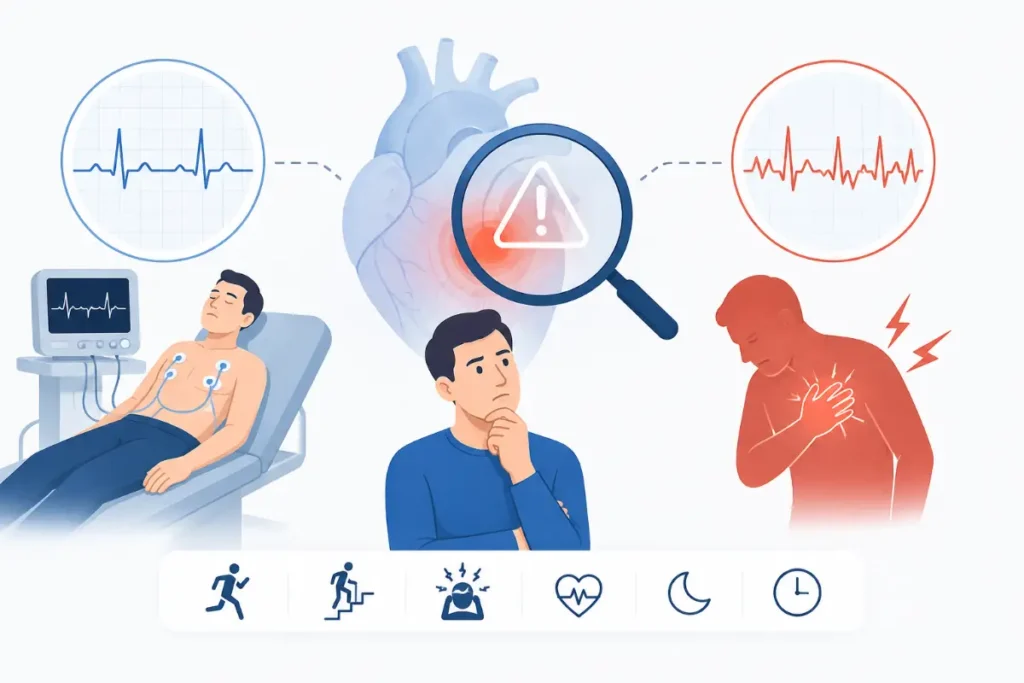
A regular ECG records the heart for a short period. If an irregular rhythm happens only once in a while, it may not occur during those few minutes.
Imagine trying to photograph a bird that only appears once every few hours. A quick snapshot might miss it completely. The same basic problem can happen with an intermittent heart rhythm.
When symptoms are occasional, a healthcare professional may recommend a longer monitoring device. A Holter monitor can continuously record heart activity for a day or longer. An event monitor can be used for less frequent symptoms and may record when an event occurs.
These devices use the same basic idea of recording the heart’s electrical activity but allow doctors to collect information for a much longer period.
The right monitor depends on how often symptoms happen and what your healthcare professional is trying to find.
What The Lines On An ECG Mean
An ECG tracing contains waves and intervals that represent different parts of the heart’s electrical activity. You may have seen the familiar line with peaks and dips on a hospital monitor or medical diagram.
Those shapes are not random. They represent electrical events during a heartbeat.
The P wave is associated with electrical activity in the upper chambers of the heart. The QRS complex represents electrical activity linked to the main pumping chambers. The T wave represents another part of the electrical recovery process.
Healthcare professionals also examine intervals between these waves. These measurements can provide information about how electrical signals are moving through the heart.
You do not need to memorize every wave to understand your test result. ECG interpretation is a medical skill that requires training and context. A computer generated interpretation can be useful, but healthcare professionals still need to review the tracing and consider the whole clinical picture.
Does An ECG Hurt
An ECG itself does not normally hurt. The electrodes sit on the skin and record the heart’s natural electrical signals. No electricity is sent into the body during the test.
The only part that some people find uncomfortable is removing the adhesive patches. If the patches stick firmly to the skin, taking them off can feel similar to removing a bandage.
Some people may experience mild skin irritation afterward. This usually occurs where the electrodes were attached.
If you have sensitive skin or a known reaction to medical adhesives, tell the healthcare professional before the test.
Is An ECG Safe
For most people, an ECG is considered a very low risk test. The electrodes only detect electrical signals from the heart. They do not deliver electricity into the body.
There is also no radiation involved in a standard ECG. The test is simply a way to record the heart’s electrical activity.
That makes it useful in many settings, including doctors’ offices, hospitals, operating rooms, and emergency vehicles. ECG machines can also be used with certain portable heart monitoring devices.
Can A Smartwatch Perform An ECG
Some smartwatches and personal devices can record a simple ECG. These devices can be useful for collecting information about heart rhythm, especially for certain irregular rhythm concerns.
However, a smartwatch ECG is not automatically the same as a full clinical ECG evaluation. Many consumer devices record from fewer electrical viewpoints than a standard clinical test.
If your device reports an unusual result or you have symptoms such as chest pain, fainting, severe shortness of breath, or a racing or irregular heartbeat, talk with a healthcare professional. A consumer device should not be used as a substitute for medical evaluation.
Mayo Clinic notes that some personal devices such as smartwatches can perform simple ECG recordings and recommends discussing their use with a healthcare professional.
Resting ECG And Exercise ECG
Not every electrocardiogram is recorded under the same conditions.
A resting ECG is taken while you are relaxed and usually lying down. It provides information about your heart’s electrical activity at rest.
An exercise ECG records the heart’s electrical activity while you exercise. It may be performed while you walk on a treadmill or ride a stationary bike. The goal is to see how the heart responds as the body’s demand for oxygen and blood increases.
An exercise ECG may be part of a stress test. During the test, healthcare professionals monitor your heart and symptoms as the level of exercise increases.
These are not two different meanings of ECG. They are different ways of using the same basic heart recording method.
Common Mistakes About ECG And EKG
The most common mistake is assuming that the two terms refer to different tests. They do not.
Another mistake is confusing an electrocardiogram with an echocardiogram. The names sound similar, but the tests measure different things.
Some people also assume that an ECG can show everything about the heart. It cannot. The test focuses on electrical activity. Other tests may be needed to look at heart structure, blood flow, valves, pumping function, or other problems.
A third mistake is assuming that a normal ECG means a person can never have a heart problem. A normal result is useful information, but it does not rule out every possible heart condition. The test only captures a particular period and provides a particular type of information.
That is why doctors consider symptoms, physical findings, medical history, risk factors, and other test results along with the ECG.
How Doctors Read An ECG
Reading an ECG involves more than looking for a single unusual spike. Healthcare professionals assess several features of the tracing and compare them with expected patterns.
They may look at the heart rate, rhythm, electrical axis, wave shapes, intervals, and other features. They also consider the person’s symptoms and medical history.
For example, a person with chest pain may need urgent evaluation if the ECG shows patterns that suggest a heart attack. Someone with occasional palpitations may need a different kind of monitoring if the standard test does not capture the rhythm.
This is why you should not try to diagnose yourself from an ECG image found online. Two tracings can look similar to an untrained eye while having very different meanings in context.
What A Normal ECG Means
- A normal ECG generally means the electrical activity recorded during the test does not show an obvious abnormal pattern that the interpreting professional considers significant.
- That is reassuring, but it is not a guarantee that every part of the heart is normal.
- For example, an ECG does not create detailed pictures of the heart’s valves. An echocardiogram is better suited for that kind of structural information.
- Also, some rhythm problems happen only occasionally. A short ECG may look normal if the abnormal rhythm is not happening during the recording.
- Your healthcare professional can explain what your specific result means in light of your symptoms and reason for testing.
What An Abnormal ECG Means
An abnormal ECG does not always mean you have a serious heart condition. It means the tracing contains a pattern that differs from what is expected and may need more evaluation.
Sometimes an abnormal finding is caused by a known condition. In other cases, it may lead to additional tests to understand what is happening.
The next step depends on the type of abnormality and the rest of the clinical picture. Your healthcare professional may recommend another ECG, longer heart monitoring, blood tests, an echocardiogram, a stress test, or another type of evaluation.
It is better to think of an ECG as one piece of a larger puzzle. It can provide valuable clues, but doctors do not usually make every diagnosis from one tracing alone.
When To Seek Urgent Medical Care
An article about ECGs should not replace medical care. If you have severe or new chest pain, severe shortness of breath, fainting, or other symptoms that could signal a serious heart problem, seek urgent medical attention.
An ECG can be an important part of evaluating heart symptoms, but you should not wait for a home device or try to interpret a tracing yourself when serious symptoms are present.
The American Heart Association notes that an EKG can help diagnose heart attacks and other heart conditions.
If you already have an ECG result that concerns you, ask the healthcare professional who ordered the test to explain it. They can interpret the result in the context of your symptoms and medical history.
Why You May See Both Terms In Medical Records
Medical language can vary from one hospital, clinic, country, or healthcare professional to another. One record may say ECG while another says EKG.
That difference does not mean your medical history contains two different heart tests.
For example, a medical record might say that you had an ECG during a physical exam. Another document might list an EKG under diagnostic testing. If both describe an electrocardiogram, they refer to the same basic test.
This is especially useful to know when reading your own health records. You do not need to worry that two abbreviations automatically mean two procedures.
EKG vs ECG In Everyday Medical Writing
In the United States, you will often see EKG used by doctors, nurses, hospitals, and patient education websites. ECG is also widely understood and commonly used.
The American Heart Association uses both terms and labels its patient information as Electrocardiogram EKG or ECG. Mayo Clinic likewise describes the test as an electrocardiogram ECG or EKG.
If you’re writing about the test for a general US audience, either abbreviation is understandable. If you’re writing for a medical publication, follow the style guide or terminology used by the publication.
For patient education, it can be helpful to introduce both terms the first time. For example, you could write electrocardiogram ECG or EKG. After that, choose one abbreviation and use it consistently.
Which Term Should You Use
There is no medical rule saying that you must use one abbreviation instead of the other.
If you live in the United States, EKG may sound more familiar in everyday medical conversation. ECG is also correct and widely recognized.
If you’re reading a report, use the term that appears in your document when discussing it with your healthcare team. If someone says ECG while you usually say EKG, you can be confident that you’re talking about the same test.
The key point is not which abbreviation sounds better. The key point is understanding what the test measures and why it was ordered.
A Simple Way To Remember The Difference
- There is actually no difference to memorize between the two tests.
- Just remember this sentence.
- ECG and EKG are two names for an electrocardiogram.
- The E in both terms points to electrocardiogram. The difference is the letter used in the abbreviation after the E. ECG follows the English spelling. EKG reflects the German spelling.
- If you remember that, the whole issue becomes much easier.
- You don’t need to wonder if one test is stronger, newer, faster, or more accurate. The names do not describe different levels of testing.
FAQs
Is an EKG the same as an ECG?
Yes. EKG and ECG are two abbreviations for the same medical test. Both refer to an electrocardiogram that records the electrical activity of the heart.
Why do doctors say EKG instead of ECG?
EKG comes from the German spelling elektrokardiogramm. ECG comes from the English word electrocardiogram. Both terms are still used in medicine, including in the United States.
Is an ECG better than an EKG?
No. Neither is better because they are the same test. The difference is only in the abbreviation used to name the electrocardiogram.
What does an EKG or ECG detect?
An electrocardiogram records the heart’s electrical activity. It can show heart rate and rhythm and can provide clues about certain heart conditions, including some arrhythmias and signs of a heart attack.
Is an ECG the same as an echocardiogram?
No. An ECG records electrical activity from the heart. An echocardiogram uses sound waves to create images of the heart and can show its structures and movement.
Does an ECG hurt?
An ECG is usually painless. Sticky electrodes are placed on the skin to record the heart’s electrical signals, and the machine does not send electricity into your body. Removing the adhesive patches can cause minor discomfort for some people.
How long does an ECG take?
A standard resting ECG is a quick test. The recording itself takes only a short time, although the full appointment may take longer because the electrodes need to be placed correctly and the result needs to be reviewed.
Can an ECG detect every heart problem?
No. An ECG provides important information about the heart’s electrical activity, but it cannot detect every possible heart condition. Doctors may use other tests such as an echocardiogram, blood tests, stress testing, or longer heart monitoring when they need more information.
Conclusion
If you were confused by EKG vs ECG, the answer is simple. They are two names for the same test. Both refer to an electrocardiogram that records the electrical activity of your heart.
The name ECG comes from the English spelling of electrocardiogram. EKG comes from the German spelling elektrokardiogramm. The different abbreviation does not mean that one test uses different equipment or provides a different type of heart reading.
The test itself can give healthcare professionals useful information about heart rate, heart rhythm, and electrical activity. It can also help identify signs linked to conditions such as arrhythmias and heart attacks.
The easiest takeaway is this: ECG and EKG mean the same thing. If you see either term in a medical record, don’t assume you have been given two different heart tests. Look at why the test was ordered and ask your healthcare professional to explain your specific result if you have questions.

Dr. Elena Vance holds a Ph.D. in Linguistics from Columbia University and has spent over 15 years analyzing the evolution of the English language. A former university professor turned full-time writer and editor, Elena specializes in breaking down high-level grammatical concepts, punctuation nuances, and style guides (APA, Chicago, MLA) into clear, actionable advice. When she isn’t hunting down dangling modifiers, she can be found collecting vintage dictionaries and reading classic literature.