
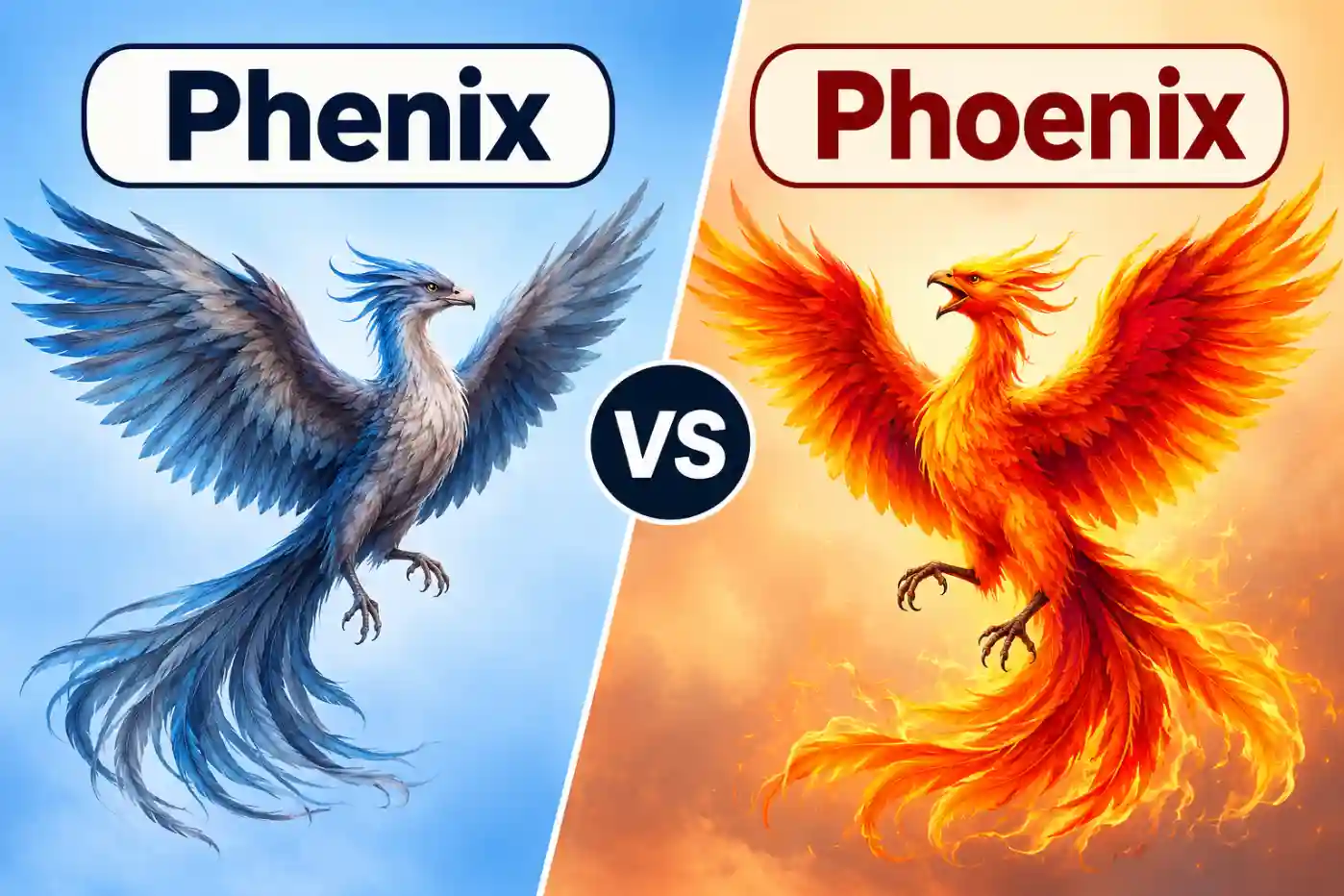
The correct spelling of the mythical bird and the U.S. city is Phoenix. The spelling Phenix is not the standard modern spelling. However, you may still see it in family names, business names, place names, and older historical records.
The confusion makes sense. Both spellings look almost identical. They also sound the same in English. If you hear someone say the word aloud, you won’t know which spelling they mean.
The main difference comes down to usage. Phoenix is the accepted spelling in standard American English. It refers to the legendary bird that rises from its ashes. It also names the capital of Arizona and appears in many other proper names.
In this guide, you’ll learn the difference between the two spellings, why people mix them up, and how to use the correct form in everyday writing. You’ll also see real examples, spelling tips, and answers to common questions.
Quick Definition
Phoenix is the standard spelling of the mythical bird and the name of Phoenix, Arizona. It can also refer to something that rises again after destruction or failure.
Phenix is a less common spelling. It appears mainly in certain proper names, historical references, and older texts. It isn’t the standard spelling for the mythical bird or the Arizona city.
Direct Answer
Use Phoenix in standard American English. Use Phenix only when it is part of an official name or when you’re reproducing a historical spelling.
Phenix vs Phoenix at a Glance
| Word | Meaning | Example Sentence | When to Use It |
|---|---|---|---|
| Phoenix | The mythical bird, the Arizona capital, or something that rises again. | The phoenix rose from its ashes. | Use it in standard English. |
| Phenix | A less common spelling found in some names and historical records. | The family name was spelled Phenix. | Use it when the official name requires it. |
Why These Spellings Cause Confusion
The two forms create confusion because they share almost the same letters and have the same pronunciation. Only one letter separates them. That small change can make people wonder if one form is incorrect or simply less common.
There is also a historical reason behind the confusion. English has used different forms of this word for centuries. The spelling changed as the word passed through several languages.
Both Spellings Have a Place in English
You might expect one form to be completely wrong. However, dictionaries recognize Phenix as a variant of Phoenix.
The American Heritage Dictionary lists both forms. Dictionary.com also identifies Phenix as a variant spelling. Collins includes it as an alternative form in its English dictionary entries. American Heritage Dictionary+2
Still, that doesn’t mean both forms appear equally often in modern writing.
Phoenix is the familiar and widely preferred spelling. You’ll find it in school books, newspapers, novels, dictionaries, and everyday writing. Phenix is much less common and may look unusual to many readers.
For that reason, Phoenix is the safest choice when you write for a general American audience.
The Difference Is in the Letters
Look closely at both forms.
- Phoenix contains seven letters.
- Phenix contains six letters.
- Phoenix includes the letter O after PH.
- Phenix leaves out that O.
The difference is small, but it matters when you want to follow common modern spelling.
For example:
- The phoenix rose from the ashes.
- The old family used Phenix as its surname.
- Phoenix is the capital of Arizona.
Notice how the first and third examples use the familiar spelling. The second uses the less common form as part of a family name.
They Have the Same Pronunciation
Both spellings sound like FEE-niks in American English.
The opening PH makes an F sound. The remaining letters create the familiar ending.
This explains why people sometimes confuse the spellings. You can hear the word clearly and still have trouble choosing the correct letters.
For instance, imagine someone telling you about the mythical bird. You hear the name but don’t see it written down. You might remember the sound without remembering the exact spelling.
That is a common problem with English words. Pronunciation doesn’t always give you enough clues to spell a word correctly.
The History Behind the Two Spellings
The history of this word helps explain why both forms exist. Its spelling didn’t appear in modern English all at once. It developed through several languages over many centuries.
The Ancient Greek Connection
The modern English spelling comes from the Latin phoenix. Latin borrowed the word from the ancient Greek phoinix.
The Greek word had several meanings. It could refer to the legendary bird, a reddish purple color, or a date palm. Its connection to the Phoenicians also appears in historical discussions of the word’s origin. Etymology, Origin & Meaning+1
The mythical bird became known for its unusual life cycle. According to ancient stories, it lived for hundreds of years. When its life came to an end, it burned in a fire and rose again from its ashes.
This story gave the bird a strong connection with life, death, renewal, and immortality.
How the Word Entered English
English adopted earlier forms of the word from Latin and French.
Old English used fenix. Old French also had a form close to fenix. Over time, English writers began using spellings that more closely reflected the Greek and Latin forms.
The spelling Phoenix became established in English. Older records also show forms such as Phenix and Fenix. Etymology, Origin & Meaning+1
This history explains why Phenix isn’t simply a random spelling mistake. It has a real place in the development of the English language.
However, historical use doesn’t always make a spelling the best choice today. Modern readers generally expect Phoenix.
Why the Letter O Appears in Phoenix
The letter O connects the modern English spelling more closely to its Greek and Latin roots.
Writers eventually adopted the PH and OE combination seen in the modern form. The spelling became more stable as English spelling conventions developed.
You can still find older spellings in historical books and documents. They show how English spelling changed over time.
Think of it like an old family photograph. It gives you a glimpse of the past, but it doesn’t mean you should copy every detail into modern writing.
The same idea applies here. Phenix has historical value, but Phoenix remains the familiar spelling for most modern readers.
When to Use Phenix vs Phoenix
Choosing the right form depends on what you’re writing. In most everyday situations, Phoenix is the better option. However, there are cases where Phenix is perfectly acceptable.
Use Phoenix in Everyday Writing
Choose Phoenix when you mean the legendary bird or use the word as a symbol of recovery and renewal.
It is also the spelling used for the Arizona capital and the southern constellation.
Here are some natural examples.
- The phoenix became a symbol of hope in the story.
- The city of Phoenix attracts visitors from around the world.
- Her business rose like a phoenix after the financial crisis.
- The artist painted a bright phoenix with golden wings.
- We booked a hotel in Phoenix for our summer trip.
These examples use the spelling most readers recognize.
Use Phenix in an Official Name
Some people, businesses, and places use Phenix as part of their official names.
In these cases, you should preserve the original spelling. Changing it to Phoenix could create an error.
For example, Phenix City is a real place in Alabama. Its official name uses the less common spelling.
You may also come across Phenix in family names, company names, and historical documents.
The same rule applies to any proper name. If a person spells their surname Phenix, don’t change it to Phoenix just because the latter form is more familiar.
Names follow their official spelling, even when they look unusual.
Use Phenix When Quoting Historical Texts
Older books and documents may use Phenix when referring to the mythical bird.
If you’re quoting an original passage, keep the spelling as it appears in the source. This helps preserve the author’s wording and the historical character of the text.
For example:
A historical book might describe a phenix rising from its ashes.
You can retain that spelling inside the quotation. However, if you’re explaining the same idea in your own modern writing, Phoenix is usually the better choice.
This distinction matters in academic work, historical research, and literary discussions.
What Does Phoenix Mean
Phoenix has several related meanings. Most people know it as the name of a mythical bird. However, the word also describes a person or thing that makes a strong comeback after a major setback.
Understanding these meanings can help you use the word naturally.
The Phoenix in Ancient Mythology
The phoenix is a legendary bird from ancient stories. It was known for its long life and ability to rise again after death.
According to the popular legend, the bird lived for hundreds of years. As it reached the end of its life, it built a nest from fragrant branches and spices. The nest caught fire, and the bird died in the flames.
A new phoenix then rose from the ashes.
Different versions of the story describe this process in different ways. Some say a young bird emerged from the ashes. Others describe the phoenix as being reborn with a fresh body and renewed strength. marilenabeltramini.it+1
The central idea stays the same. The bird represents life returning after destruction.
Phoenix as a Symbol of Rebirth
People often use phoenix as a symbol of a fresh start.
Imagine a small business that loses most of its customers. The owner works hard, changes the business plan, and slowly builds the company again.
You might describe that business as a phoenix.
The word can also describe someone who recovers after a difficult experience.
Consider these examples.
- After losing his job, Mark rebuilt his career like a phoenix.
- The town became a phoenix after the devastating fire.
- Her new book marked a phoenix moment in her writing career.
- The company rose from its financial troubles like a phoenix.
- Their friendship became a phoenix after years of disagreement.
In each example, the word suggests recovery and renewal. It gives the idea of coming back stronger after a difficult period.
Phoenix as a Proper Noun
Phoenix also appears as a proper noun. This means it names a specific person, place, or thing.
The best known example is Phoenix.
Phoenix is the capital of Arizona in the United States. The city was founded in the 1860s near the site of an older Hohokam settlement. Its name reflects the idea of a new community rising from the remains of an earlier civilization. American Heritage Dictionary+1
You may also see Phoenix used as:
- A person’s first or last name.
- A business or organization name.
- A fictional character’s name.
- The name of a sports team.
- The name of a star system or constellation.
When Phoenix forms part of an official name, follow the spelling used by the person or organization.
How to Spell Phoenix Correctly
The word has an unusual letter combination. That’s one reason people sometimes struggle to remember it.
The easiest way to get it right is to learn its letter order.
Break the Word Into Smaller Parts
The word Phoenix has seven letters.
You can divide it into three simple parts.
- PH.
- OE.
- NIX.
Put them together to get PHOENIX.
The most important part to remember is the order of O and E. The O comes first.
A common mistake is to reverse these two letters and write Pheonix. That form is not the standard spelling.
Remember the PH Sound
The letters PH often make the same sound as F.
You can see this pattern in familiar English words.
- Phone.
- Photo.
- Phrase.
- Physics.
- Phoenix.
This connection can help you remember the opening letters.
When you write the word, think of the opening sound in phone. Both words begin with PH.
Remember the OE Combination
The OE combination is the part that needs the most attention.
Many people remember the sound of the word but forget the order of its vowels. They may put E before O or leave out the O.
A useful memory trick is to remember that the phoenix needs both vowels in the correct order.
Write this pattern a few times:
PHO + ENIX = PHOENIX.
Once you remember the pattern, spelling the word becomes much easier.
Avoid the Common Misspelling Pheonix
Pheonix is a common spelling mistake. It happens when writers place E before O.
Compare the forms.
| Spelling | Status |
|---|---|
| Phoenix | Standard modern spelling. |
| Phenix | Recognized alternative spelling. |
| Pheonix | Common misspelling. |
| Fenix | Historical form or spelling used in some names. |
The key difference is that Phenix is a recognized variant, while Pheonix is not the accepted modern spelling of the mythical bird.
If you’re writing an article, school assignment, email, or professional document, choose Phoenix unless you have a specific reason to use another form.
Common Mistakes People Make
Even a familiar word can cause spelling problems. These mistakes often happen because people rely on sound instead of checking the written form.
Mistaking Phenix for a Completely Incorrect Word
Some writers assume Phenix is always wrong.
That isn’t quite accurate. Several dictionaries recognize it as a variant of Phoenix. It also appears in older English writing and in modern proper names. American Heritage Dictionary+1
The better approach is to understand the difference between a recognized variant and the most common modern spelling.
If you’re writing for a broad American audience, Phoenix is the clearer choice.
Writing Pheonix Instead of Phoenix
This is a different kind of mistake.
Pheonix reverses the O and E. The correct order is PHO followed by ENIX.
For example:
Incorrect: The pheonix rose from the flames.
Correct: The phoenix rose from the flames.
The sentence becomes correct as soon as you restore the proper letter order.
Using the Wrong Capitalization
Another common mistake involves capital letters.
Use lowercase phoenix when you refer to the mythical bird in a general sense.
For example:
- The phoenix is a symbol of rebirth.
- A phoenix appeared in the ancient story.
- She compared her recovery to the life of a phoenix.
Use uppercase Phoenix when you refer to a specific name.
For example:
- My sister lives in Phoenix.
- Phoenix is a popular name for pets.
- The Phoenix constellation appears in the southern sky.
Proper capitalization makes your writing easier to read and understand.
Changing an Official Name
Never change Phenix to Phoenix when the original name uses Phenix.
For example, Phenix City in Alabama keeps its official spelling. The same applies to a person whose legal surname is Phenix.
A name isn’t a general vocabulary choice. It identifies a specific person or place.
Even if another spelling looks more familiar, keep the official form.
Assuming Both Forms Are Equally Common
Dictionaries may recognize both spellings, but that doesn’t make them equally common.
Phoenix is the form most readers expect. It also appears in the names of well-known places and in most modern references to the mythical bird.
Phenix is a less familiar alternative. Using it in ordinary writing may distract readers or make them think you’ve made a spelling mistake.
The practical solution is simple. Use Phoenix by default and save Phenix for situations where the alternative spelling is required.
Example Sentences With Phoenix and Phenix
Examples make spelling rules easier to understand. They also show how a word works in everyday conversation.
Examples With Phoenix
Here are some natural sentences using the standard spelling.
- The phoenix rose from the ashes and began a new life.
- My family plans to visit Phoenix during the winter.
- The writer used a phoenix to represent hope and renewal.
- Her small business became a phoenix after a difficult year.
- The children enjoyed reading a story about a magical phoenix.
- Phoenix is known for its hot desert climate.
- The painting showed a colorful phoenix with wide wings.
- After the accident, he rebuilt his life like a phoenix.
- The ancient legend describes a bird that returns after death.
- She chose Phoenix as the name for her new project.
Each sentence uses the familiar spelling in a clear context.
Examples With Phenix
The less common spelling also has valid uses.
- The family name was recorded as Phenix in the old document.
- Phenix City is located in Alabama.
- The historical text used Phenix to describe the legendary bird.
- The company kept Phenix as part of its official name.
- The author used the older spelling Phenix in the original edition.
- Her surname is Phenix, not Phoenix.
- The old dictionary included Phenix as a variant spelling.
- The family preserved the spelling Phenix across several generations.
These examples show why context matters. The spelling can be valid even though it isn’t the usual choice in modern everyday writing.
Examples of Incorrect Usage
The following examples show mistakes to avoid.
| Incorrect Sentence | Correct Sentence |
|---|---|
| The pheonix rose from the ashes. | The phoenix rose from the ashes. |
| We traveled to Pheonix last summer. | We traveled to Phoenix last summer. |
| The Phenix bird symbolizes rebirth. | The phoenix bird symbolizes rebirth. |
| The city is called Pheonix. | The city is called Phoenix. |
Remember that an official name can have its own spelling. Don’t change a real person’s or place’s name just to match the more common word.
The Difference Between Phoenix and Other Similar Words
People sometimes mix up Phoenix with other words that look or sound similar. Some are genuine spelling variants. Others are simple typing errors.
Knowing the difference can help you avoid mistakes in your writing.
Phoenix vs Pheonix
Phoenix is the correct standard spelling. Pheonix is a misspelling caused by reversing the O and E.
The mistake is easy to make because the two forms look nearly identical. However, only Phoenix follows the accepted modern spelling.
Examples:
- Correct: The phoenix appeared in the old legend.
- Incorrect: The pheonix appeared in the old legend.
- Correct: We are flying to Phoenix tomorrow.
- Incorrect: We are flying to Pheonix tomorrow.
Remember that the O comes before the E.
Phoenix vs Fenix
Fenix is another form you may come across. It has appeared in older versions of English and is also used in some modern names and brands.
However, Phoenix is the standard spelling for the mythical bird in modern general writing.
For example:
- The phoenix rose from the ashes.
- Fenix appeared in the historical record.
- The company chose Fenix as its official brand name.
The last two examples show how a less familiar spelling can still appear in a proper name or historical source.
Phoenix vs Phoenician
These words look related because they share several letters. However, they have different meanings.
A phoenix is a mythical bird associated with rebirth.
A Phoenician was a member of an ancient civilization that lived along the eastern Mediterranean coast.
Examples:
- The phoenix represents renewal and hope.
- The Phoenicians were known for their seafaring and trade.
- The museum displayed an ancient Phoenician artifact.
- The story described a phoenix rising from a fire.
Although the Greek forms of these words are connected in their history, you shouldn’t use them as replacements for each other. Etymology, Origin & Meaning+1
Phoenix vs Phoenixes
Phoenixes is the plural form of phoenix.
Use it when you’re talking about two or more mythical birds.
For example:
- The book features several phoenixes.
- The artist painted three golden phoenixes.
- The children imagined a world filled with phoenixes.
The plural doesn’t require you to change the spelling of the original word. Simply add ES.
You may also see phoenix used in a general sense when talking about the bird as a symbol. However, phoenixes is the usual plural form when you mean multiple birds.

Grammar Rules for Using Phoenix
Correct spelling is only one part of good writing. You should also know how to capitalize the word, form its plural, and use it naturally in a sentence.
Is Phoenix a Noun
Yes. Phoenix is mainly used as a noun.
A noun names a person, place, thing, animal, or idea. In this case, the word can name a mythical bird, a city, a constellation, or something that represents renewal.
Consider these examples.
- The phoenix flew across the sky.
- Phoenix is the capital of Arizona.
- The phoenix became a symbol of hope.
- The constellation Phoenix is visible in the southern sky.
The word can also describe a person or thing that makes an impressive comeback.
For example, you might say that a struggling company became a phoenix after recovering from a major loss.
Should Phoenix Be Capitalized
Capitalization depends on how you use the word.
Use lowercase phoenix when you mean the mythical bird or use it as a general symbol.
Use uppercase Phoenix when it forms part of a proper name.
| Usage | Correct Form | Example |
|---|---|---|
| Mythical bird | phoenix | The phoenix rose from the flames. |
| General symbol | phoenix | She made a phoenix like comeback. |
| Arizona city | Phoenix | My uncle lives in Phoenix. |
| Constellation | Phoenix | Phoenix is a southern constellation. |
| Personal name | Phoenix | Phoenix joined the team. |
| Official brand | Follow its official spelling. | The product is named Phoenix. |
There is one useful detail to remember. Some style guides may capitalize the name when discussing the specific mythical bird as a named figure. In ordinary writing, lowercase is a common choice when referring to the bird as a general mythical creature.
What Is the Plural of Phoenix
The standard plural is phoenixes.
You form it by adding ES to the singular word.
Here are some examples.
- The story describes two phoenixes.
- Several phoenixes appeared in the fantasy novel.
- The artist created a collection of colorful phoenixes.
- The children drew pictures of magical phoenixes.
Avoid writing phoenixs. That form doesn’t follow the standard plural pattern.
Can Phoenix Be Used as an Adjective
Phoenix is mainly a noun. However, it can appear before another noun to describe a related person, place, or thing.
For example:
- Phoenix airport.
- Phoenix residents.
- Phoenix history.
- Phoenix culture.
- Phoenix business community.
In these examples, Phoenix helps identify the place connected to the following noun.
You can also use phoenix in figurative expressions.
For example, a phoenix story describes someone or something that returns after a major setback.
Why Phoenix Is So Common in Modern English
Phoenix has become a familiar word far beyond ancient mythology. It appears in books, movies, business names, popular expressions, and everyday conversations.
Its meaning makes it useful in many situations.
Its Meaning Is Easy to Connect With
The idea of rising from ashes is powerful. People use it to describe recovery after failure, loss, or destruction.
For example, a person who loses everything and builds a successful life again may be described as a phoenix.
A community that rebuilds after a natural disaster may also be compared to the mythical bird.
This symbolic meaning gives the word more depth than a simple description of a fictional creature.
It Appears in Books and Movies
Writers often use the phoenix in fantasy stories because it represents life, magic, and renewal.
One familiar example is Fawkes, the phoenix in the Harry Potter series. The bird has the ability to regenerate after reaching the end of its life.
This kind of fictional use has helped keep the mythical creature familiar to modern readers.
You may also find phoenix characters in video games, comics, television shows, and other fantasy stories.
It Works Well in Business and Branding
Many businesses choose Phoenix as a name because of its positive meaning.
The word suggests a fresh start, strength, and the ability to recover from difficulties.
For example, a company that has gone through major changes may choose a name connected to the idea of rebirth.
However, business names don’t always follow standard dictionary spelling. Some companies use Phenix or another variation to create a unique identity.
Always check the official spelling before writing about a particular brand.
Phenix vs Phoenix in Modern American English
American readers usually recognize Phoenix as the standard form. It is the spelling you’ll see most often in general writing.
However, Phenix isn’t automatically incorrect. Major dictionaries recognize it as an alternative form. Its use is simply less familiar to many readers.
This difference matters when you’re writing content for a general audience.
What American Dictionaries Say
The American Heritage Dictionary lists Phenix as a variant of Phoenix. Dictionary.com also identifies it as an alternative spelling. Collins includes Phenix in its dictionary entries as well. American Heritage Dictionary+2
These dictionary entries show that the shorter form has a recognized place in English.
Still, dictionary recognition doesn’t mean you should use both forms freely in every situation.
A writer should consider the audience and the purpose of the text.
Which Form Should Students Use
Students should generally use Phoenix in essays, homework, spelling tests, and classroom assignments.
It is the most familiar spelling and the safest choice for standard written English.
If a teacher asks about historical spelling variants, you can explain that Phenix is also recognized in some dictionaries.
However, don’t use the alternative form in a regular school assignment unless the task specifically calls for it.
Which Form Should Professional Writers Use
Professional writers should use Phoenix in most general content.
This includes:
- Blog articles.
- Educational content.
- News stories.
- Business reports.
- Marketing materials.
- General emails.
- Academic writing.
There are exceptions. If you’re writing about a person, place, business, or historical source that officially uses Phenix, preserve that spelling.
Accuracy matters more than changing every unusual name to match a common dictionary form.
FAQs
Is Phenix vs Phoenix a spelling difference or a word difference?
The two forms have the same basic meaning when they refer to the mythical bird. Phenix is a recognized alternative spelling, while Phoenix is the more familiar modern form. The choice usually depends on the context and the spelling used in an official name.
Is Phenix a real English word?
Yes. Phenix is a recognized spelling variant of Phoenix. You can find it in several English dictionaries and older written records. However, Phoenix is the form most people use in modern everyday writing.
Is Phoenix the correct spelling in American English?
Yes. Phoenix is the standard and widely preferred spelling in American English. It is used for the mythical bird, the Arizona capital, and the idea of rising again after a difficult experience.
Is Pheonix ever correct?
No. Pheonix is a common misspelling of Phoenix. The correct letter order is PH followed by OENIX. Remember that the O comes before the E.
Do Phoenix and Phenix sound the same?
Yes. Both forms have the same pronunciation in American English. They sound like FEE-niks. The difference appears in writing rather than speech.
What is the plural of Phoenix?
The standard plural is phoenixes. Add ES to the end of the singular form. For example, you can write that three phoenixes appeared in the story.
Should I capitalize the word phoenix?
Use lowercase phoenix when referring to the mythical bird in a general sense. Use uppercase Phoenix for proper names such as the city in Arizona or a person’s name. Always follow the official spelling and capitalization of a brand or organization.
Is Phenix an old spelling of Phoenix?
Yes. Phenix has historical use as an alternative spelling of the mythical bird’s name. Older English texts contain several forms of the word. Phoenix later became the familiar modern spelling.
Conclusion
The main difference in Phenix vs Phoenix comes down to spelling preference and usage. Phoenix is the standard modern form and the best choice for everyday American English. Phenix is also recognized as a spelling variant, although it appears much less often.
Use Phoenix when writing about the mythical bird, its symbolic meaning, or the capital of Arizona. Keep Phenix when it belongs to an official family name, business, place, or historical text.
Also, don’t confuse Phenix with Pheonix. The latter is a common spelling mistake. The correct modern spelling places O before E.
The easiest way to remember the word is to break it into three parts: PHO, E, and NIX. Keep the O before the E, and you’ll have the spelling right. When in doubt, choose Phoenix.

Sienna Watson is a veteran copywriter and communications coach who has helped startup founders, marketers, and professionals polish their writing for over a decade. Realizing that most people don’t need a degree in linguistics—just clear, impactful communication—Sienna focuses on practical grammar, business writing etiquette, and eliminating wordiness. She advocates for plain language, strong verbs, and persuasive prose that gets results.