
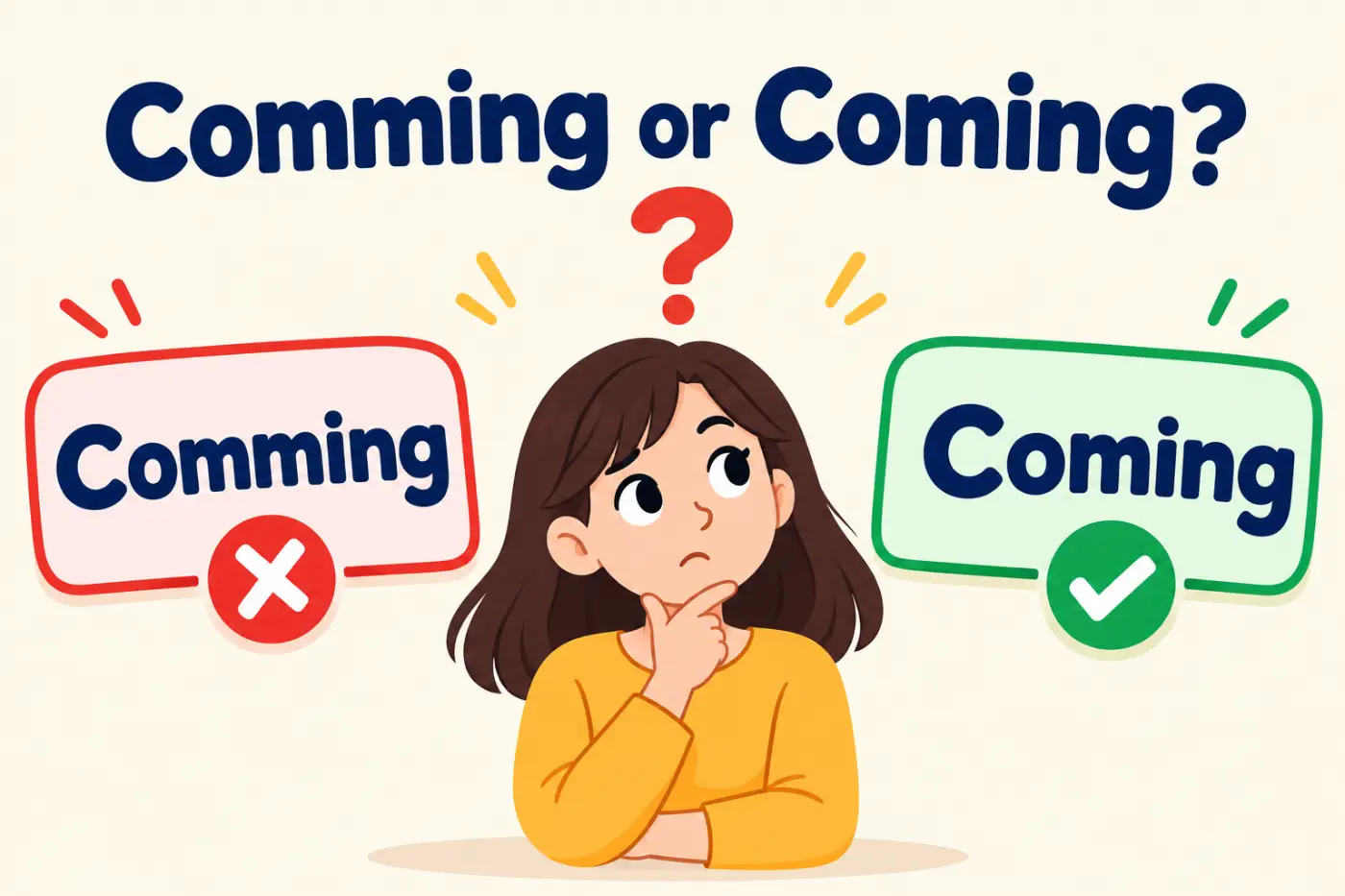
English spelling can be tricky. Sometimes two words look almost identical but only one has the correct spelling. Comming or coming is a good example. Both spellings look reasonable at first glance. However, only one follows the standard spelling rules of English.
The correct spelling is coming. The word has only one M. The spelling comming is incorrect in standard English. You should write coming when you talk about someone arriving somewhere or something happening soon.
For example, you might say, My friends are coming to dinner tonight. You could also write, Summer is coming soon. In both sentences, coming describes an arrival or an event that will happen in the future.
So why do people sometimes write an extra M? The confusion usually comes from the way we form the present participle of certain verbs. Many English verbs double their final consonant before adding ING. However, come follows a different spelling pattern.
In this guide, you’ll learn the correct spelling, the rule behind it, and how to use the word in everyday sentences. You’ll also find common mistakes, helpful memory tricks, related spelling patterns, and answers to frequently asked questions.
Quick Definition
Coming is the correct spelling of the ING form of the verb come. It describes someone or something moving toward a place or an event that will happen soon. The spelling comming is incorrect.
Direct Answer
Coming is correct. Always use one M when writing this word. Comming is a common spelling mistake and isn’t accepted in standard English.
Coming vs Comming Comparison
| Word | Meaning | Example Sentence | When to Use It |
|---|---|---|---|
| Coming | The ING form of come. It describes arrival or an approaching event. | My brother is coming home tonight. | Use this spelling in standard English. |
| Comming | An incorrect spelling of coming. | Comming home late is not correct. | Avoid this spelling. |
The difference is simple. Coming has one M while comming has two. Only the first spelling is correct.
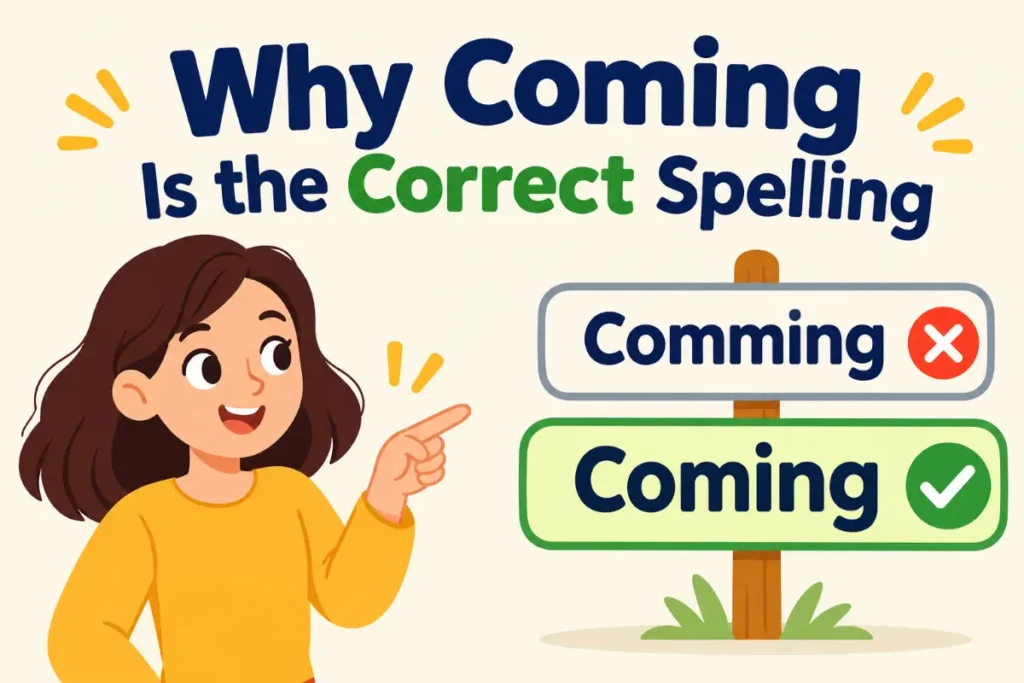
Why Coming Is the Correct Spelling
The word coming comes from the verb come. When you add ING to this verb, you remove the final silent E and add ING.
The spelling changes like this.
Come + ING = Coming
You don’t keep the final E. You also don’t double the M.
This spelling follows a common English rule. When a verb ends in a silent E, you usually drop that E before adding ING.
For example.
- Make becomes making.
- Write becomes writing.
- Take becomes taking.
- Dance becomes dancing.
- Hope becomes hoping.
- Come becomes coming.
Notice that each word loses its final E before ING appears. The same pattern applies to come.
Why You Don’t Double the M
Some English verbs double their final consonant before adding ING. This rule can make the spelling confusing.
For example.
- Run becomes running.
- Sit becomes sitting.
- Swim becomes swimming.
- Stop becomes stopping.
- Plan becomes planning.
These words follow a different spelling pattern. Their final consonants double because they meet a specific set of spelling conditions.
Come doesn’t follow that pattern. It ends with a silent E. You remove the E and add ING instead.
That’s why coming has one M rather than two.
The Role of the Silent E
The silent E plays a key role in English spelling. It often changes the sound of a word without making a sound itself.
In come, the final E helps create the short U sound. When you add ING, you remove the E but keep the original sound pattern.
Here are a few more examples.
- Come becomes coming.
- Give becomes giving.
- Live becomes living.
- Have becomes having.
- Drive becomes driving.
- Move becomes moving.
These examples show why removing the final E is important. Keeping it would create an incorrect spelling in these ING forms.
However, English has some exceptions. For example, the word see becomes seeing. You keep both Es because removing one would change the spelling pattern.
The main point is easy to remember. Come becomes coming, not comming.
Understanding the Spelling Rule for ING Words
The spelling of ING words depends on how the original verb ends. English uses several patterns when forming present participles and gerunds.
Learning these patterns can help you spell coming correctly and avoid similar mistakes with other words.
Rule One Drop the Final E
When a verb ends in a silent E, you usually remove the E before adding ING.
The formula looks like this.
Verb ending in E + ING = Remove E + ING
Examples include.
| Base Verb | ING Form |
|---|---|
| Come | Coming |
| Make | Making |
| Bake | Baking |
| Write | Writing |
| Drive | Driving |
| Smile | Smiling |
| Dance | Dancing |
| Hope | Hoping |
| Take | Taking |
| Give | Giving |
For example.
- She is making a birthday cake.
- I am writing an email to my teacher.
- They are driving to the beach.
- He is smiling at the camera.
- We are coming home after lunch.
Each example follows the same basic pattern. The final silent E disappears before ING is added.
Rule Two Double the Final Consonant
Some short verbs double their final consonant before adding ING.
This usually happens when a verb ends in a consonant and has a short vowel sound before that final consonant. In many common cases the final syllable carries the main stress.
Examples include.
| Base Verb | ING Form |
|---|---|
| Run | Running |
| Sit | Sitting |
| Swim | Swimming |
| Stop | Stopping |
| Plan | Planning |
| Get | Getting |
| Begin | Beginning |
| Forget | Forgetting |
For example.
- The children are running across the yard.
- I am sitting near the window.
- She is swimming in the pool.
- We are planning a family trip.
- He is getting ready for work.
The extra consonant helps preserve the short vowel sound.
However, don’t apply this rule to every verb. Come already has a silent E at the end. It follows the silent E rule instead.
Rule Three Keep the Final Y
When a verb ends in Y, you usually keep the Y before adding ING.
You don’t need to remove it or change it to another letter.
Examples include.
| Base Verb | ING Form |
|---|---|
| Cry | Crying |
| Play | Playing |
| Study | Studying |
| Enjoy | Enjoying |
| Carry | Carrying |
| Try | Trying |
| Worry | Worrying |
For example.
- The baby is crying.
- The kids are playing outside.
- She is studying for her exam.
- We are enjoying the warm weather.
The Y stays in place because this spelling pattern doesn’t require a change.
Rule Four Keep Both Vowels When Needed
Some verbs end in two vowels or have spelling patterns that require both letters to stay.
For example.
| Base Verb | ING Form |
|---|---|
| See | Seeing |
| Agree | Agreeing |
| Flee | Fleeing |
| Free | Freeing |
For example.
- I am seeing my doctor tomorrow.
- They are agreeing on the final price.
- The bird is fleeing from the noise.
These words show that you shouldn’t remove a final E without checking the spelling pattern.
English spelling has patterns rather than one rule that works for every word. Learning common examples makes these patterns easier to recognize.
How to Use Coming in Everyday English
Coming is a common word in American English. People use it in conversations, text messages, emails, books, and everyday writing.
It can describe a person arriving at a place. It can also describe an event that will happen soon. In some sentences, it describes the movement of something toward the speaker.
Understanding these uses will help you choose the right words and build natural sentences.
Coming to Describe Someone Arriving
One of the most common uses of coming is to talk about someone traveling toward a place.
The person may be walking, driving, flying, or using another form of transportation. The word simply tells you that the person is on the way or plans to arrive.
Here are some examples.
- My parents are coming to visit us this weekend.
- Are you coming to the party tonight?
- Sarah is coming over after work.
- My cousins are coming from Texas.
- The teacher is coming to our classroom.
- Please tell your friends that I’m coming too.
- We are coming home after the game.
In each sentence, coming describes an arrival or planned movement toward a place.
You don’t need to explain how someone travels. The word works for many different types of movement.
For example, My uncle is coming to town next week sounds natural. You can use the same word when someone plans to arrive by car, bus, train, or plane.
Coming to Talk About Future Events
Coming can also describe something that will happen soon.
People often use it when talking about holidays, birthdays, seasons, meetings, deadlines, and other upcoming events.
For example.
- Christmas is coming soon.
- My birthday is coming next month.
- The school holidays are coming.
- A big change is coming to our neighborhood.
- The weekend is coming, and I can’t wait.
- The final exam is coming up next week.
- Spring is coming earlier this year.
In these examples, coming doesn’t describe a person traveling. Instead, it tells the reader that an event or period of time is approaching.
This use is especially common in everyday American English.
You might also hear someone say, The big day is coming. This expression means that an important event will happen soon.
Coming in Invitations and Questions
Coming often appears in questions and invitations. It’s a natural way to ask someone about their plans.
For example.
- Are you coming to dinner?
- Is your sister coming with you?
- Are they coming to the wedding?
- Who is coming to the meeting?
- Are you coming over this evening?
- What time are your guests coming?
These questions sound friendly and direct.
You can also use coming in a positive response.
For example.
- Yes, I’m coming.
- I’ll be coming around six.
- We’re coming with our children.
- Don’t worry. I’ll be coming soon.
Notice how coming helps make these sentences sound natural. It tells the other person about an expected arrival or plan.
Coming to Describe Movement Toward the Speaker
Another useful meaning of coming involves movement toward the person speaking.
For example.
- The dog is coming toward me.
- Here comes the bus.
- Someone is coming up the stairs.
- The children are coming down the street.
- The train is coming toward the station.
The word can also appear in short instructions.
For example, someone might shout, I’m coming! when another person calls them from a different room.
This expression means that the speaker is moving toward the person who called.
It’s a common phrase in American homes and everyday conversations.
Coming in Informal Expressions
English speakers also use coming in several common expressions.
These phrases can have meanings that go beyond simple physical movement.
Coming soon
This phrase tells people that something will be available or happen in the near future.
Example. The new movie is coming soon.
Coming up
This expression refers to something that will happen shortly.
Example. Your favorite song is coming up next.
Coming along
This phrase can describe progress or improvement.
Example. Your English skills are coming along nicely.
Coming back
This means returning to a place or situation.
Example. My brother is coming back from college tomorrow.
Coming through
This expression can mean successfully reaching someone or delivering something.
Example. Your hard work is finally coming through.
Coming around
This can mean visiting someone or gradually changing an opinion.
Example. I think my parents are coming around to the idea.
These expressions show how one simple word can work in many different situations.
Common Reasons People Write Comming Instead of Coming
If coming is the correct spelling, why do so many people add another M?
There are a few reasons behind this mistake. Most of them come from confusion about English spelling rules.
Confusion With Words That Double Their Final Letter
The biggest reason is the consonant doubling rule.
English has many verbs that double their final consonant before adding ING. People learn examples such as running, sitting, swimming, and stopping.
After seeing these words, they may assume that every verb ending in a similar way needs an extra consonant.
That assumption causes trouble.
Come becomes coming because it ends in a silent E. The final E disappears before ING is added. The M doesn’t double.
Compare these examples.
- Run becomes running.
- Sit becomes sitting.
- Come becomes coming.
- Swim becomes swimming.
- Make becomes making.
- Stop becomes stopping.
The spelling differences become easier to understand when you look at the original verbs.
Pronunciation Can Cause Confusion
Sometimes people spell words based on how they sound.
The word coming has a short and simple pronunciation. The sound doesn’t clearly tell you how many Ms to write.
You might also hear the word spoken quickly in everyday conversations. This can make the spelling feel less obvious.
However, pronunciation doesn’t always reveal the correct spelling in English.
For example, the words write and right sound the same but have different meanings and spellings. Similarly, knowing how to pronounce coming doesn’t automatically tell you how to spell it.
That’s why learning the spelling pattern matters.
Typing Too Quickly
Another common reason is simple typing mistakes.
People often write messages quickly. They may add an extra letter without noticing it.
For example, someone might type.
- I’m comming home now.
- Are you comming to dinner?
- She is comming over later.
The intended meaning is clear. However, the spelling is still incorrect.
Spellcheck tools may catch this mistake, but you shouldn’t depend on them every time.
A quick review before sending an important message can help you catch small errors.
Learning English as a Second Language
People who learn English as a second language may find this spelling confusing.
English has several ways to form ING words. Some verbs lose their final E. Others double their final consonant. Some keep their original spelling almost unchanged.
These patterns can take time to learn.
For example, a learner who knows that run becomes running might apply the same idea to come. That produces the incorrect form comming.
The solution is to learn each spelling pattern with common examples.
You don’t need to memorize hundreds of unrelated words. Start with a few basic rules and practice them in real sentences.
Common Mistakes to Avoid When Using Coming
Knowing the correct spelling is only part of good writing. You should also understand how to use coming correctly in a sentence.
Here are some mistakes that can make your writing less clear.
Adding an Extra M
This is the main spelling mistake.
Incorrect. My friends are comming to my house.
Correct. My friends are coming to my house.
The word needs only one M. Remember to remove the final E from come before adding ING.
Keeping the Final E
Some writers may try to keep the original E.
Incorrect. She is comeing home.
Correct. She is coming home.
You should remove the silent E before adding ING. This gives you the correct spelling.
Using Coming When You Need Come
Coming and come are related forms of the same verb. However, they don’t always work in the same sentence.
For example.
Incorrect. I want coming with you.
Correct. I want to come with you.
The verb after want usually takes the form to come in this sentence.
Here are more examples.
- I want to come to your house.
- She plans to come tomorrow.
- They need to come early.
- We hope to come again soon.
Use coming when the sentence calls for the ING form. Use come in sentences that require the base form.
Confusing Coming With Going
Coming and going describe movement, but they often express different directions.
Coming usually describes movement toward the speaker or the place being discussed as the destination.
Going usually describes movement away from the speaker or toward another destination.
Compare these sentences.
- I am coming to your house.
- I am going to the store.
- She is coming here after work.
- She is going home now.
The exact meaning can depend on the speaker’s point of view.
For example, if your friend is waiting at a restaurant, you might say, I’m coming to the restaurant now. If you are leaving the restaurant to visit another place, you might say, I’m going to the store.
Understanding this difference helps you choose the right word.
Using Coming With the Wrong Helping Verb
Coming often appears with helping verbs such as am, is, and are.
These words help create the present progressive tense. This tense describes an action happening now or around the present time.
For example.
- I am coming home.
- She is coming to school.
- They are coming for dinner.
The helping verb must match the subject.
Compare these examples.
| Subject | Correct Form | Example |
|---|---|---|
| I | Am coming | I am coming soon. |
| He | Is coming | He is coming home. |
| She | Is coming | She is coming tomorrow. |
| It | Is coming | The bus is coming. |
| We | Are coming | We are coming together. |
| They | Are coming | They are coming tonight. |
Avoid mixing these forms.
For example, She are coming is incorrect. The correct sentence is She is coming.
Coming in Different Verb Forms
Understanding the other forms of come can make it easier to use coming correctly.
The verb come is irregular. This means its past forms don’t follow the usual pattern of adding ED.
Here are its main forms.
| Verb Form | Word | Example |
|---|---|---|
| Base Form | Come | I come here every day. |
| Third Person Singular | Comes | She comes here often. |
| Past Tense | Came | He came home late. |
| Past Participle | Come | They have come to help. |
| Present Participle | Coming | We are coming now. |
Each form has a different purpose.
Come as the Base Form
Come is the basic form of the verb.
You use it after certain verbs and modal helping verbs.
Examples.
- I want to come with you.
- Please come inside.
- You should come early.
- They can come tomorrow.
- We may come back later.
Comes in the Present Tense
Comes is used with singular third person subjects such as he, she, and it.
Examples.
- My brother comes home at six.
- She comes to work by bus.
- The mail comes every morning.
- He comes here on weekends.
Remember that comes has an S at the end. You don’t use coming in these sentences because they describe regular actions rather than an action in progress.
Came in the Past Tense
Came is the simple past form of come.
Use it when an arrival or movement happened in the past.
Examples.
- My aunt came to visit last week.
- He came home after midnight.
- We came here by train.
- They came to the party together.
You don’t write comed. Came is the correct past tense.
Come as the Past Participle
Come also works as the past participle.
It usually appears with helping verbs such as has, have, and had.
Examples.
- She has come to help us.
- They have come a long way.
- He had come home before sunset.
- We have come to an agreement.
This form is different from both came and coming.
Coming as the Present Participle
Coming is the present participle of come.
It often appears with am, is, or are to describe an action in progress or a planned arrangement.
Examples.
- I am coming to your office.
- He is coming with us.
- They are coming to visit.
- We are coming home soon.
The spelling stays the same in every sentence. It always has one M.
Helpful Ways to Remember the Correct Spelling
Spelling mistakes are easier to avoid when you have a simple way to remember the correct form.
You don’t need to think about complicated grammar rules every time you write a sentence. A few small tricks can help you remember that coming has one M.
Remember the Original Verb
Start with the original verb come.
Now remove the final E and add ING.
COME → COM + ING → COMING
This simple trick helps you see why the word doesn’t need another M.
Whenever you feel unsure about the spelling, return to the original verb. It will remind you that coming has only one M.
Compare Coming With Making
Another useful trick is to compare coming with making.
Both words follow the same basic spelling rule.
- Come becomes coming.
- Make becomes making.
You remove the final E from both words before adding ING.
This comparison is easy to remember because both words are common in everyday English.
Read the Word in a Sentence
Reading the word in a complete sentence can also help you remember it.
Try these examples.
- I am coming home.
- She is coming to visit.
- The weekend is coming soon.
- We are coming with you.
Read each sentence aloud. Pay attention to the correct spelling when you see it.
Repeated exposure helps you recognize the word without having to stop and think about it.
Practice With Short Writing Exercises
Writing a few sentences can strengthen your memory.
For example, complete these sentences with the correct form.
- My parents are ______ to visit tomorrow.
- The bus is ______ down the street.
- Are you ______ to the party?
- Christmas is ______ soon.
- She is ______ home after work.
The correct answers are coming in every sentence.
Try writing your own examples too. You could write about your family, friends, work, school, or weekend plans.
The more you use the correct spelling, the easier it becomes to remember.
Related Words That Follow Similar Spelling Rules
Learning related words can help you understand the spelling pattern behind coming.
Many English verbs end in a silent E. They lose that final letter before ING is added.
Here are some common examples.
| Base Verb | Correct ING Form | Example Sentence |
|---|---|---|
| Become | Becoming | She is becoming more confident. |
| Receive | Receiving | I am receiving your messages. |
| Believe | Believing | He is believing in himself again. |
| Leave | Leaving | They are leaving tomorrow. |
| Give | Giving | She is giving a speech. |
| Save | Saving | We are saving money. |
| Love | Loving | I am loving this new book. |
| Use | Using | He is using my computer. |
| Change | Changing | The weather is changing. |
| Close | Closing | The store is closing soon. |
| Choose | Choosing | They are choosing a new name. |
| Share | Sharing | We are sharing our ideas. |
These examples follow the same basic pattern as coming.
However, remember that English has exceptions. Some verbs keep their final E when adding ING.
For example, see becomes seeing and agree becomes agreeing.
The best approach is to learn the main rules and recognize common exceptions through practice.
Coming or Comming in American English
American English uses coming as the standard spelling.
There isn’t a different American spelling that allows an extra M. The same spelling also applies in British English, Canadian English, and Australian English.
For example.
- My family is coming to visit.
- The new restaurant is coming soon.
- Are you coming to the office today?
- A new opportunity is coming your way.
All these sentences use the standard spelling.
The spelling doesn’t change based on the country or the type of English you use.
If you’re writing an American English article, school assignment, email, or social media post, use coming.
Is Comming an Old or Alternative Spelling?
No. Comming isn’t a standard alternative spelling of coming.
You may find it in old online posts, informal messages, or writing that contains spelling errors. However, that doesn’t make it an accepted spelling.
Standard dictionaries recognize coming as the correct form.
If you see comming in a sentence, treat it as a spelling mistake unless it’s part of a proper name, brand name, or intentionally unusual spelling.
For normal English writing, stick with coming.
FAQs
Is comming or coming correct?
Coming is the correct spelling. It has one M and comes from the verb come. Comming with two Ms is a spelling mistake.
Why does coming have one M?
Coming has one M because come ends in a silent E. You remove the final E and add ING. You don’t double the M.
Is coming a real word?
Yes. Coming is a standard English word. It’s the present participle of come and can also work as a gerund.
What is the past tense of coming?
The past tense of come is came. For example, She came home early yesterday. Coming isn’t the simple past tense.
What is the difference between come and coming?
Come is the base form of the verb. Coming is its ING form. For example, I want to come home uses the base form while I am coming home uses the ING form.
Is coming a noun or a verb?
Coming can work as both a verb form and a noun. In She is coming home, it forms part of the verb phrase. In The coming of spring brings warmer weather, it works as a noun.
Can I write comming in informal messages?
You should avoid it even in informal messages. Although people may understand what you mean, coming is the accepted spelling. Correct spelling makes your messages easier to read and understand.
Does coming have the same spelling in British and American English?
Yes. Coming has the same spelling in both varieties of English. You don’t need to change it based on your audience or location.
Conclusion
The correct spelling is coming, not comming. The word has only one M because it comes from come. You remove the final silent E before adding ING.
Remember the simple pattern. Come becomes coming, just as make becomes making and take becomes taking. You don’t need to double the final consonant.
If you ever feel confused about comming or coming, return to the original verb. That small trick will help you avoid the extra M and keep your writing correct.
Use coming when you describe someone arriving, an event approaching, or an action happening around the present time. With a little practice, you’ll remember the correct spelling without a second thought.

Dr. Elena Vance holds a Ph.D. in Linguistics from Columbia University and has spent over 15 years analyzing the evolution of the English language. A former university professor turned full-time writer and editor, Elena specializes in breaking down high-level grammatical concepts, punctuation nuances, and style guides (APA, Chicago, MLA) into clear, actionable advice. When she isn’t hunting down dangling modifiers, she can be found collecting vintage dictionaries and reading classic literature.