
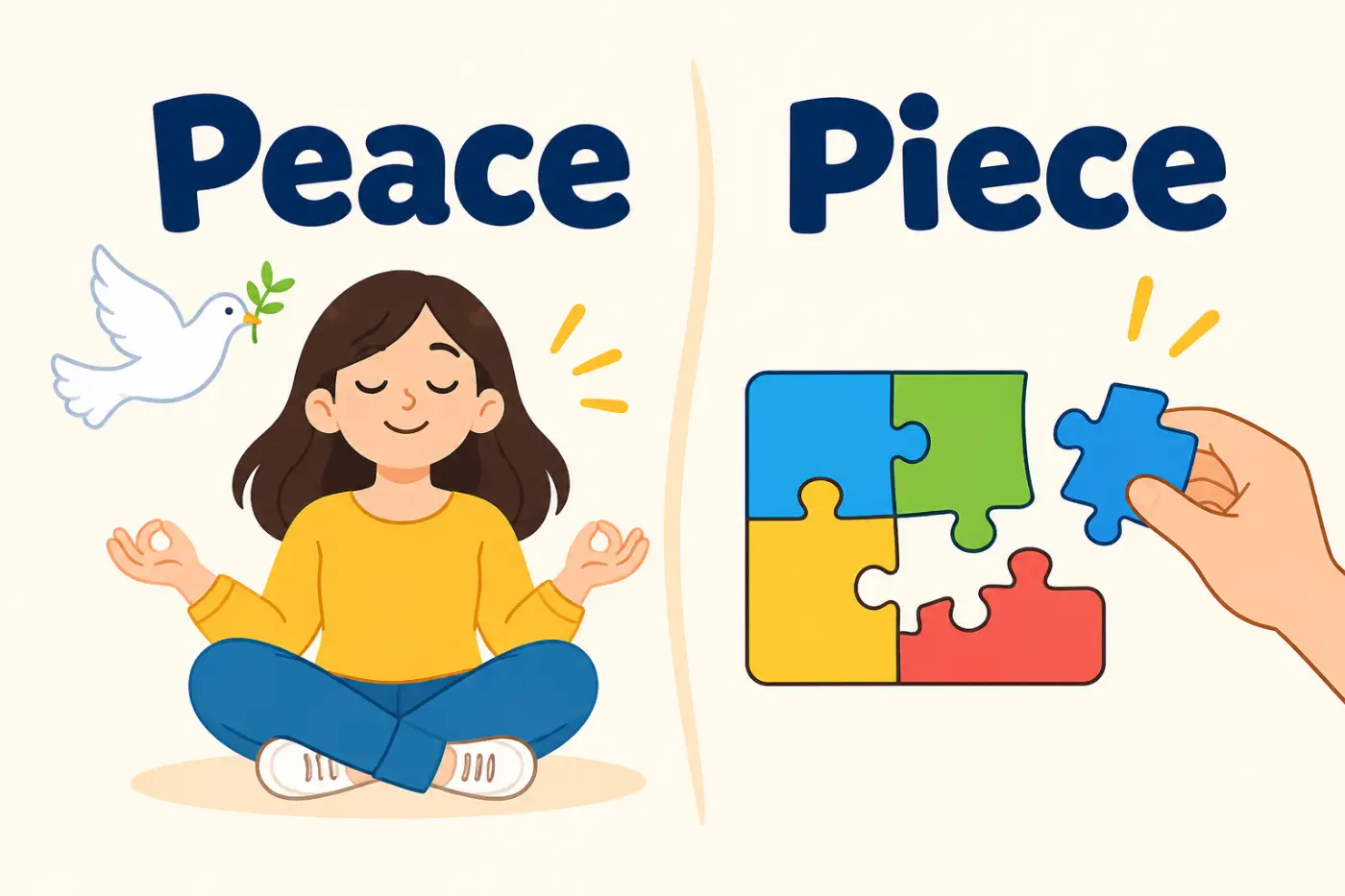
The words peace vs piece sound exactly the same, but they have very different meanings. If you’ve ever stopped while writing to wonder which spelling to use, you’re not alone. These two words confuse many English learners and native speakers because they share the same pronunciation.
The difference is simple. Peace means calm, quiet, or freedom from conflict. Piece means a part of something or a single item. Both words sound like the word peas, but their meanings and uses are not the same.
For example, you might hope for peace after a long argument. However, you might ask for a piece of cake after dinner. The first word describes a state of calm. The second refers to a part of something larger.
In this guide, you’ll learn the meaning of each word, how to use it in everyday sentences, and how to avoid common spelling mistakes. You’ll also find practical examples, easy memory tricks, related expressions, and answers to common questions.
Quick Definition
Peace is a noun that means freedom from war, fighting, trouble, or worry. It can also describe a calm and quiet state of mind.
Piece is a noun that means a part of something larger or one item from a group. It can refer to food, objects, artwork, music, writing, and many other things.
Direct Answer
Peace refers to calm, harmony, or freedom from conflict. Piece refers to a part of something or a single item. Use peace when you talk about calmness and piece when you talk about a portion or part.
Peace and Piece Comparison Table
| Word | Meaning | Example Sentence | When to Use It |
|---|---|---|---|
| Peace | Calmness or freedom from conflict | Everyone deserves peace and happiness. | When discussing calm, harmony, or the absence of fighting. |
| Piece | A part of something or an individual item | Can I have a piece of chocolate? | When referring to a portion, section, or single object. |
Although these words sound alike, you can tell them apart by looking at the meaning of the sentence. If the sentence talks about calmness or harmony, choose peace. If it talks about a part of something, choose piece.
Understanding the Meaning of Peace
Peace is a noun that describes a state of calm, safety, and freedom from conflict. It can refer to a peaceful relationship between people, a quiet place, or a relaxed feeling inside your mind.
People often use this word when they talk about personal happiness, family relationships, communities, and world events. It can describe something as simple as enjoying a quiet morning or something as serious as ending a war between two countries.
Peace as Freedom From Conflict
One of the most common meanings of peace is the absence of fighting or war. When two people stop arguing and begin treating each other with respect, they may reach peace. The same idea applies to countries that agree to stop fighting.
For example:
- The two countries signed an agreement to maintain peace.
- The neighbors finally made peace after their long argument.
- Everyone hopes for peace in regions affected by war.
- The community worked together to bring peace to the area.
- The leaders promised to protect peace and stability.
In each sentence, peace describes a situation without fighting or serious disagreement.
This meaning also appears in news reports, history books, political speeches, and everyday conversations. You may hear people talk about peace talks, peace agreements, peace treaties, and peace efforts.
A peace agreement is a formal deal between groups or countries that agree to stop fighting or settle a conflict. A peace treaty is a written agreement that officially ends a war or establishes peaceful relations.
Peace as Inner Calm
Peace doesn’t always involve countries or arguments. It can also describe how you feel inside.
When your mind feels relaxed and free from stress, you may say that you feel at peace. This expression describes emotional calm and comfort.
Consider these examples:
- I feel at peace when I spend time in nature.
- She finally found peace after a difficult year.
- Reading before bed gives me peace.
- He wants to live a life filled with peace and happiness.
- A quiet walk helps me find peace of mind.
Notice the expression peace of mind. It refers to a feeling of comfort that comes from knowing things are safe, settled, or under control.
For example, parents may feel peace of mind when they know their children have arrived home safely. Similarly, a person who pays off a debt may feel more relaxed because they no longer have to worry about that financial burden.
Peace as Quiet and Stillness
Imagine sitting beside a lake early in the morning. The water is still, the birds are singing, and nobody is disturbing you. You might describe that moment as peaceful.
Here are some natural examples:
- I enjoy the peace of the countryside.
- The garden offers peace away from the busy streets.
- We spent the afternoon enjoying the peace of the mountains.
- She moved to a small town to find peace and quiet.
- The house was filled with peace after the children went to bed.
The phrase peace and quiet is especially common in American English. People use it when they want a break from noise, stress, or interruptions.
For instance, a parent might say, “I just need a little peace and quiet.” They aren’t asking for a piece of an object. They simply want some time without distractions.
Peace in Relationships
Peace also plays a major role in relationships. Friends, family members, coworkers, and couples may disagree from time to time. However, they often try to restore peace by talking openly and finding a solution.
For example:
- My sister and I made peace after our disagreement.
- He apologized because he wanted peace in the family.
- They agreed to settle the matter peacefully.
- A kind conversation helped restore peace between them.
- She prefers peace over unnecessary arguments.
The expression make peace means to end a disagreement and restore friendly relations.
You can also use keep the peace. This means preventing arguments or trouble from starting.
For example, a parent may step in to keep the peace when two children start arguing over a toy. A manager may help coworkers settle a disagreement to maintain a friendly workplace.
Common Expressions With Peace
Several everyday expressions use this word. Learning them will help you understand natural English and use the word correctly.
| Expression | Meaning | Example |
|---|---|---|
| Peace of mind | A calm feeling without worry | Knowing the door is locked gives me peace of mind. |
| Peace and quiet | A place or moment without noise | I need some peace and quiet to study. |
| At peace | Feeling calm and relaxed | She feels at peace in her new home. |
| Make peace | End a disagreement | The brothers decided to make peace. |
| Keep the peace | Prevent conflict | He tried to keep the peace during the meeting. |
| Rest in peace | A respectful phrase used after someone’s death | We will always remember him. May he rest in peace. |
| World peace | A world without war or major conflict | Many people work toward world peace. |
| Peace offering | Something given to show that you want to end a disagreement | He brought flowers as a peace offering. |
These expressions have slightly different uses, but they all connect to the main idea of calmness, harmony, or freedom from conflict.
Understanding the Meaning of Piece
Piece is a noun that refers to a part of something larger. It can describe a small amount of food, a section of an object, a part of a story, or an individual item.
For example, if you cut a pizza into eight slices, each slice is a piece of the pizza. If you break a plate, each broken section is a piece of that plate.
The word has several uses in everyday English. Let’s look at the most common ones.
Piece as a Part of Something
The most basic meaning of piece is a portion or section of a larger whole.
You can use it when something has been divided into smaller parts or when you want to describe one section of an object.
For example:
- I found a piece of glass on the floor.
- Please cut a piece of paper for me.
- There is a missing piece in this puzzle.
- He broke a piece of the wooden chair.
- She picked up a piece of the broken plate.
- We need one more piece to finish the model.
In these examples, each piece belongs to something bigger. It may be a section of paper, glass, wood, or another object.
You don’t need to physically break something to use this word. A piece can also be a section that naturally belongs to a larger item.
For instance, a piece of land is a section of a larger area. A piece of cloth is a portion of fabric. A piece of furniture is an individual item that belongs to the larger category of furniture.
Piece as a Portion of Food
One of the most common uses of piece appears when people talk about food.
You might ask for a piece of cake, offer someone a piece of fruit, or eat a piece of bread. In each case, the word describes an amount or portion of food.
Consider these examples:
- Can I have a piece of chocolate?
- She ate a piece of birthday cake.
- Would you like a piece of apple pie?
- He gave me a piece of his sandwich.
- I bought a piece of cheese from the store.
- Please save a piece of pizza for me.
This use is common in restaurants, homes, parties, and casual conversations.
The word can describe food that you cut into portions. It can also refer to a single item from a larger amount.
For example, you can eat a piece of candy even if nobody has cut it. The candy itself is one item, so the word still works.
Piece as an Individual Item
Piece can also refer to one item from a collection or group.
For example, you might buy a piece of furniture, collect a piece of jewelry, or choose a piece of clothing. The word identifies one individual item rather than a part that someone has broken off.
Here are some examples:
- She bought a beautiful piece of jewelry.
- This is my favorite piece of clothing.
- We need another piece of furniture for the living room.
- He owns a rare piece of antique furniture.
- I found an interesting piece of artwork at the market.
In these sentences, piece refers to a complete item.
This is a useful detail because many people think the word only describes a broken or divided object. That’s not true. A piece can be a complete item within a larger collection.
Piece in Art and Music
Artists, musicians, and writers often use piece to describe a complete creative work.
A painting can be a piece of art. A song can be a musical piece. A written composition can also be called a piece of writing.
For example:
- She created a beautiful piece of art.
- The orchestra performed a famous musical piece.
- I read an interesting piece about American history.
- His latest piece of writing explores family relationships.
- The museum displayed a rare piece by a famous artist.
You may also hear the expression a piece of work. This can refer to a creative product or something that requires effort and skill.
However, the expression can have another meaning in casual speech. When someone says, “He’s a real piece of work,” they may mean that the person behaves in a difficult, strange, or unpleasant way. The meaning depends on the situation and the speaker’s tone.
Piece as Part of a Story or Argument
You can use piece when discussing information, ideas, or sections of a larger subject.
For example, a journalist may write a piece about education. A student may discuss a piece of evidence in an essay. A detective may search for one missing piece of information.
Consider these sentences:
- I read a useful piece about healthy eating.
- The report contains an important piece of information.
- We still need one piece of evidence.
- That article is an interesting piece of research.
- The final chapter provides the missing piece of the story.
This meaning is common in schools, workplaces, newspapers, and online articles.
Common Expressions With Piece
Piece appears in many everyday expressions. Some describe an amount of time, while others refer to effort, information, or a part of a larger situation.
| Expression | Meaning | Example |
|---|---|---|
| A piece of cake | Something very easy | The math test was a piece of cake. |
| Piece by piece | One part at a time | We assembled the table piece by piece. |
| A piece of advice | One suggestion or recommendation | Let me give you a piece of advice. |
| A piece of information | One fact or detail | I have an important piece of information. |
| A piece of work | A creative or completed task | She finished a wonderful piece of work. |
| A piece of the puzzle | One part of a larger problem or answer | This clue is a key piece of the puzzle. |
| Go to pieces | Become very upset or lose emotional control | He went to pieces after hearing the news. |
| Give someone a piece of your mind | Speak angrily and tell someone what you think | She gave him a piece of her mind after the rude comment. |
| A piece of land | A section of land | They bought a small piece of land near the river. |
| A piece of equipment | One individual item of equipment | We need another piece of equipment for the workshop. |
These phrases show how flexible the word is. You can use it in casual conversations, formal writing, school assignments, and professional discussions.
Why Peace and Piece Are Often Confused
The main reason people confuse these words is their pronunciation. Peace and piece are homophones. Homophones are words that sound the same but have different meanings and spellings.
Both words are pronounced /piːs/. The final sound is the same as the sound at the end of rice or nice.
When you hear someone say either word, you cannot identify the correct spelling from pronunciation alone. You need to understand the meaning of the sentence.
They Have the Same Pronunciation
English has many words that share the same pronunciation but have different spellings. Peace and piece are a common example.
For instance, imagine someone says:
“I need some peace.”
Now imagine someone says:
“I need a piece.”
The words sound the same, but the messages are different. In the first sentence, the person wants calmness. In the second sentence, the person wants a part or item. The second sentence usually needs more context to explain which item they want.
This is why listening alone may not help you choose the right spelling. Context gives you the answer.
Their Spellings Are Almost Identical
Both words contain the letters p, e, and c. They also have the same final sound.
The main spelling difference appears in the middle. Peace uses ea, while piece uses ie.
That small difference can cause mistakes, especially when you’re writing quickly or relying on memory.
You may know the meaning of both words but still type the wrong spelling. This happens because your brain may focus on how the word sounds instead of what it means.
They Both Work as Nouns
Another reason for confusion is that both words usually function as nouns.
A noun names a person, place, thing, idea, or feeling.
Peace names an idea or state of mind. Piece names an item, object, portion, or section.
For example:
- Peace makes people feel safe.
- I dropped a piece of bread.
Both sentences use a noun, but each word has a different job.
Understanding the meaning behind each noun makes the correct spelling much easier to remember.
How to Choose the Correct Word
The easiest way to choose the right spelling is to look at the message you want to express.
If you’re talking about calmness, harmony, or freedom from trouble, use peace. If you’re talking about a part, portion, or individual item, use piece.
You can follow a few simple steps whenever you feel unsure.
Step One Identify the Meaning
Before choosing a spelling, ask yourself what you’re trying to say.
Are you describing a calm feeling? Are you talking about the absence of conflict? Or are you referring to an object or a portion of something?
For example:
“I want some ___ after a stressful day.”
The sentence describes a feeling of calm. Therefore, peace is the correct choice.
Now consider this sentence:
“Can I have a ___ of bread?”
The sentence refers to food. Therefore, piece is correct.
Step Two Look at the Words Around It
The words around the confusing term often provide useful clues.
Words such as calm, quiet, harmony, and conflict often appear with peace.
Words such as cake, bread, paper, furniture, and puzzle often appear with piece.
These are helpful patterns, not strict rules. You should still read the full sentence to understand its meaning.
For example:
- We hope for peace after the conflict.
- She wants a piece of the chocolate cake.
- The family enjoys peace and quiet.
- I found a piece of the missing puzzle.
The surrounding words make the intended meaning clear.
Step Three Replace the Word With a Simple Meaning
Another helpful method is to replace the confusing word with a word that has a similar meaning.
If calmness or harmony fits the sentence, choose peace.
If part, portion, or item fits the sentence, choose piece.
For example:
“I need a little ___ before the meeting.”
Try replacing the blank with calmness. The sentence makes sense. Therefore, use peace.
Now try:
“I need a small ___ of paper.”
Replace the blank with portion. The sentence still makes sense. Therefore, use piece.
This method works well because it focuses on meaning rather than spelling.
Step Four Read the Sentence Again
After choosing the word, read the complete sentence.
Ask yourself if the sentence communicates the message you intended. If the meaning sounds wrong, check the spelling again.
For example:
“I hope you find a piece of mind.”
This sentence contains a common spelling mistake. The correct expression is peace of mind because it refers to emotional calm.
Now consider:
“Please give me a peace of cake.”
This is also incorrect. The correct phrase is a piece of cake because it refers to a portion of food.
A quick review can prevent both mistakes.
Common Mistakes to Avoid
Even though the meanings are different, people often mix these words in familiar expressions. Some mistakes happen because a phrase sounds right when spoken, even though the spelling is wrong.
Here are some common errors and their corrections.
| Incorrect Sentence | Correct Sentence | Reason |
|---|---|---|
| I need a piece of mind. | I need peace of mind. | The expression refers to a calm state of mind. |
| Give me a peace of cake. | Give me a piece of cake. | Cake is divided into portions. |
| We should live in piece. | We should live in peace. | The sentence refers to harmony. |
| She wants a peace of paper. | She wants a piece of paper. | Paper can be divided into sections. |
| I just need some piece and quiet. | I just need some peace and quiet. | The expression refers to calmness. |
| They signed a piece treaty. | They signed a peace treaty. | A peace treaty is an agreement to end conflict. |
| He gave me a peace of advice. | He gave me a piece of advice. | Advice is expressed as a piece. |
| The two friends made piece. | The two friends made peace. | Making peace means ending a disagreement. |
Mistaking Peace of Mind for Piece of Mind
This is one of the most common spelling errors.
The correct expression peace of mind describes a relaxed feeling. It means you aren’t worried about something.
For example:
“Knowing that my family is safe gives me peace of mind.”
However, give someone a piece of your mind is also a correct expression. It means telling someone exactly what you think, usually because you’re angry or upset.
For example:
“I gave him a piece of my mind after he damaged my car.”
These expressions look similar, but they have very different meanings. Remember that peace describes calmness, while piece refers to an individual part or item.
Writing Peace Instead of Piece of Cake
The expression a piece of cake means something is very easy.
For example:
“The homework was a piece of cake.”
You can also use the phrase literally when talking about food.
For example:
“Would you like a piece of cake?”
Both uses need piece because the phrase refers to a portion or item. Writing peace of cake changes the meaning and creates a spelling error.
Confusing Peace and Piece in Formal Writing
These mistakes can also appear in school assignments, work emails, articles, and reports.
A writer may type the wrong spelling because both words sound identical. A spelling checker may not catch the error because both are valid English words.
For example, a computer may accept this sentence:
“The agreement helped bring piece to the region.”
However, the intended sentence should use peace.
This is why proofreading matters. Don’t rely only on automatic spelling tools. Read your work and check the meaning of each sentence.
Easy Ways to Remember the Difference
Remembering the correct spelling becomes much easier when you connect each word with a simple idea. You don’t need to memorize complicated grammar rules. A few small tricks can help you choose the right word every time.
Remember Peace With Calmness
Think of peace as a quiet and calm situation.
You can connect it with words such as:
- Calmness.
- Harmony.
- Safety.
- Quiet.
- Happiness.
- Freedom from conflict.
For example, if you’re writing about a family that lives happily without arguments, use peace.
You can also remember the common phrase peace and quiet. Both words describe a calm situation.
Try this example:
“After a busy week, I enjoy the peace of my home.”
The sentence talks about a calm environment, so peace is correct.
Remember Piece With Part
Think of piece as one part of something larger.
You can connect it with words such as:
- Portion.
- Section.
- Part.
- Item.
- Slice.
- Fragment.
For example, if you divide a pizza into slices, each slice is a piece.
Try this sentence:
“Please give me a piece of that chocolate bar.”
The word refers to a portion of chocolate, so piece is correct.
Use the Pie Trick
Here’s a simple memory trick that can help you remember the spelling.
The word piece contains the letters pie. Think about a pie cut into smaller portions. Each portion is a piece of pie.
For example:
“I ate a piece of pie after dinner.”
This connection makes it easier to remember that piece refers to a part or portion.
It isn’t a formal spelling rule. It’s just a quick way to remember the correct word.
Use Two Simple Questions
You can also remember both words by asking yourself two questions.
Question one. Am I talking about calmness or harmony?
If the answer is yes, use peace.
Question two. Am I talking about a part or item?
If the answer is yes, use piece.
These questions work in most everyday situations. They also help when you’re editing an email, writing a school assignment, or creating online content.
Peace vs Piece in Everyday English
Both words appear in daily conversations, but they usually belong to different situations.
Understanding these situations will help you use the correct spelling naturally.
At Home
You might use peace when talking about a quiet home or a happy family.
For example:
- I love the peace of my home.
- The children finally gave their parents some peace and quiet.
- My family wants to live in peace.
You might use piece when talking about household objects or food.
For example:
- Please give me a piece of bread.
- I found a piece of paper under the table.
- We need one more piece of furniture.
At School
Students often use peace when discussing history, relationships, and social issues.
For example:
- Our teacher explained the importance of world peace.
- The lesson focused on peace between different communities.
- Everyone deserves to study in peace.
Piece often appears in schoolwork when students discuss parts of a subject or assignment.
For example:
- I need a piece of information for my project.
- This paragraph is an important piece of the essay.
- The teacher asked us to write a short piece about nature.
At Work
In professional settings, peace may describe a friendly workplace or a calm working environment.
For example:
- The manager wants to maintain peace among the employees.
- A respectful conversation helped restore peace in the office.
- Everyone works better in a peaceful environment.
Piece can describe a task, document, or item of equipment.
For example:
- I finished the last piece of work.
- Please send me that piece of information.
- We need another piece of equipment for the office.
In Social Media and Online Writing
You may also see both words in social media posts, captions, blogs, and online discussions.
People often write about finding peace, protecting their peace, or enjoying a peaceful life.
For example:
- Protect your peace and spend time with people who support you.
- Sometimes, a quiet evening is all you need.
- Choose peace instead of unnecessary arguments.
Piece appears in posts about food, art, fashion, and creative work.
For example:
- This is my favorite piece of artwork.
- Just one more piece of pizza, please.
- I finally completed the last piece of my project.
The meaning of the sentence should guide your spelling. Don’t choose a word just because it sounds right.
Other Words That Sound Like Peace and Piece
English contains many words that sound the same but have different meanings and spellings. These words are called homophones.
Learning a few common examples can improve your spelling and help you avoid mistakes in everyday writing.
| Word Pair | Meaning | Example |
|---|---|---|
| Sea and See | A large body of salt water and the act of looking | I can see the sea from my window. |
| Right and Write | Correct or a direction and the act of forming words | Please write the right answer. |
| Their and There | Belonging to them and referring to a place | Their house is over there. |
| Flower and Flour | A plant bloom and a powder used in baking | She put a flower beside the bag of flour. |
| Sun and Son | The star that gives Earth light and a male child | Her son loves playing in the sun. |
| Break and Brake | To damage something and a device used to slow a vehicle | The driver pressed the brake to avoid a break in the fence. |
| Pair and Pear | Two matching items and a type of fruit | I bought a pair of shoes and a pear. |
| Mail and Male | Letters or packages and the sex of a person or animal | The male employee delivered the mail. |
These examples follow the same basic idea as the two words discussed in this article. Their sounds may match, but their meanings are different.
The best way to learn homophones is to study them in complete sentences. This helps you understand how context changes the meaning and spelling.
Practice Using Peace and Piece
Reading examples helps, but trying the words yourself makes the difference easier to remember.
Complete the following sentences by choosing the correct word. Think about the meaning before checking the answers.
Fill in the Blanks
- I need some ______ after a long day at work.
- Can you give me a ______ of chocolate?
- The two friends finally made ______.
- She found a missing ______ of the puzzle.
- Everyone deserves to live in ______.
- He bought a beautiful ______ of artwork.
- I enjoy the ______ and quiet of the countryside.
- Please cut a small ______ of paper.
- The leaders worked together to bring ______ to the country.
- Would you like another ______ of cake?
Answers and Explanations
| Number | Correct Answer | Explanation |
|---|---|---|
| 1 | Peace | The sentence describes calmness. |
| 2 | Piece | Chocolate can be divided into portions. |
| 3 | Peace | Making peace means ending a disagreement. |
| 4 | Piece | A puzzle contains individual parts. |
| 5 | Peace | The sentence refers to harmony and safety. |
| 6 | Piece | It refers to one complete artwork. |
| 7 | Peace | Peace and quiet is a common expression. |
| 8 | Piece | Paper can be divided into sections. |
| 9 | Peace | The sentence refers to freedom from conflict. |
| 10 | Piece | Cake is served in portions. |
If you got most of these answers right, you’ve understood the main difference. If you missed a few, review the memory tricks and try the exercise again.
Write Your Own Sentences
Another useful way to improve is to write your own examples.
Try writing three sentences with peace and three sentences with piece.
For peace, you might describe a quiet place, a happy family, or a relaxed feeling.
For piece, you might describe a portion of food, a part of an object, or an individual item.
When you create your own examples, you learn to connect the spelling with the meaning. This skill will help you beyond these two words.
Proofread Before You Publish
If you write articles, emails, school assignments, or social media posts, take a moment to check these words before publishing.
A spelling tool can identify many typing mistakes, but it may not recognize the wrong word in a sentence. Both spellings are correct English words, so a basic spell checker may accept either one.
For example, a spelling checker may not flag I need a piece of mind. The sentence still contains a real English word, but it uses the wrong one.
Read the full sentence instead of checking the word by itself. Ask yourself if you’re describing calmness or a portion of something.
This small habit can improve the accuracy of your writing.
FAQs
What Is the Main Difference Between Peace and Piece?
Peace means calmness, harmony, or freedom from conflict. Piece means a part of something larger or one individual item. Both words sound the same, but their meanings and spellings are different.
Are Peace and Piece Pronounced the Same?
Yes. Both words have the same pronunciation, /piːs/. They are homophones, which means they sound alike but have different meanings and spellings.
Is It Peace of Mind or Piece of Mind?
The correct expression is peace of mind when you mean a feeling of calmness or freedom from worry. However, give someone a piece of your mind is also correct. It means telling someone exactly what you think, often in an angry way.
Is It a Piece of Cake or a Peace of Cake?
The correct expression is a piece of cake. It can refer to a portion of cake or describe something very easy. For example, you can say, “The test was a piece of cake.”
Can Piece Mean a Complete Object?
Yes. Piece doesn’t always mean a broken part of something. It can also describe one complete item from a collection. For example, a piece of jewelry, a piece of furniture, or a piece of artwork can be a complete object.
Is Peace a Noun or a Verb?
Peace is a noun. It describes a state of calmness, harmony, or freedom from conflict. You can use related words such as pacify and appease as verbs, but peace itself isn’t a standard verb.
What Is the Plural of Piece?
The plural of piece is pieces. You can say three pieces of chocolate, several pieces of paper, or two pieces of furniture. Peace is generally used as an uncountable noun, so it doesn’t normally take a plural form.
How Can I Remember the Correct Spelling?
Connect peace with calmness and harmony. Connect piece with a part or portion of something. You can also remember that the word piece contains the word pie, and a pie can be cut into pieces.
Conclusion
The difference between peace and piece comes down to meaning. Peace describes calmness, harmony, and freedom from conflict. Piece refers to a portion, section, or individual item.
Both words sound exactly the same, so pronunciation won’t help you choose the correct spelling. Instead, pay attention to the message you’re trying to express.
Remember these two simple connections. Peace means calm. Piece means part. If you’re writing about a quiet mind, a peaceful relationship, or freedom from fighting, use peace. If you’re talking about a slice of cake, a section of paper, or an item of furniture, use piece.
The next time you face the peace vs piece spelling question, think about the meaning before typing. That one small habit will help you choose the right word and write with more confidence.

Sienna Watson is a veteran copywriter and communications coach who has helped startup founders, marketers, and professionals polish their writing for over a decade. Realizing that most people don’t need a degree in linguistics—just clear, impactful communication—Sienna focuses on practical grammar, business writing etiquette, and eliminating wordiness. She advocates for plain language, strong verbs, and persuasive prose that gets results.