
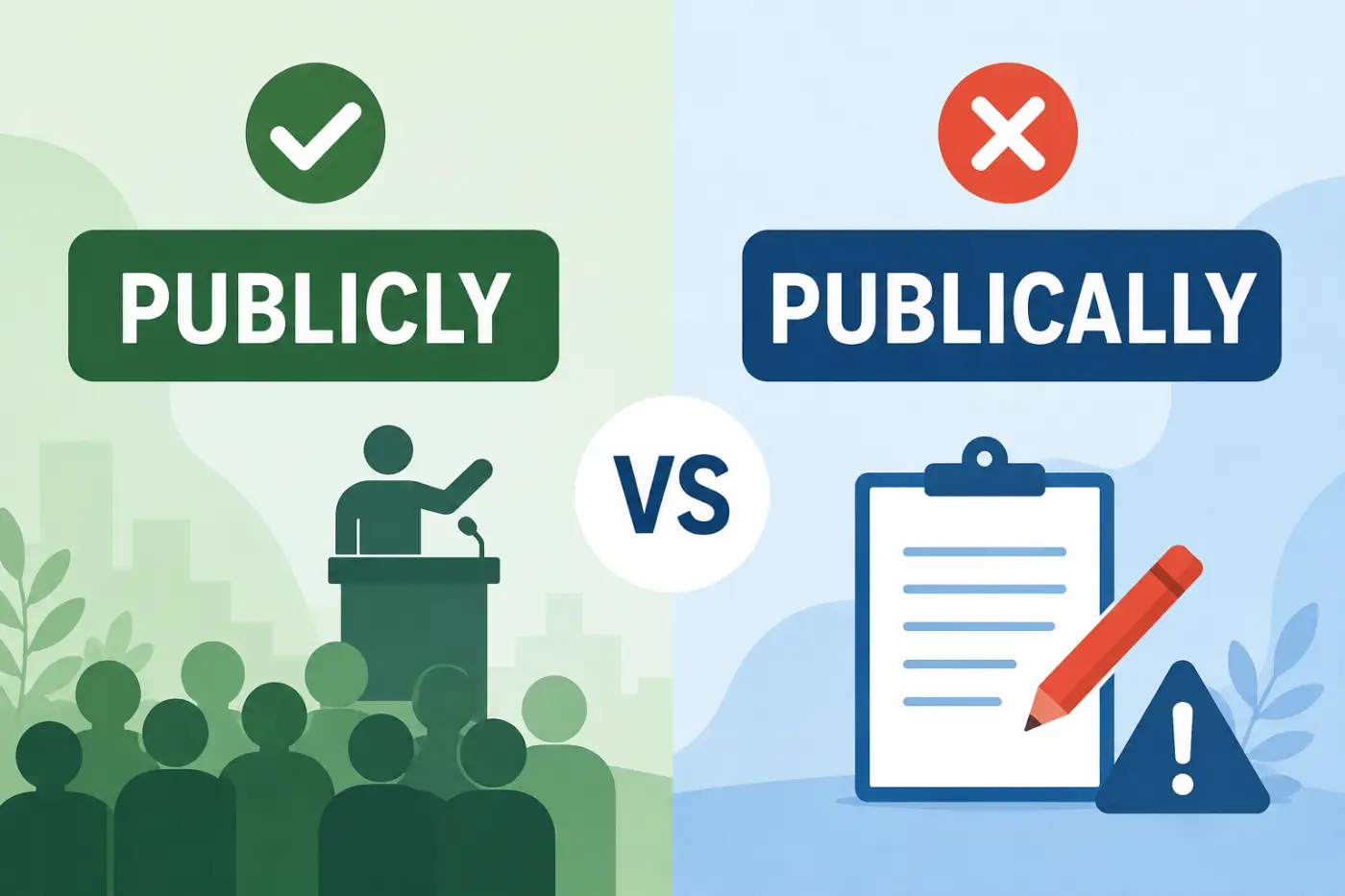
If you’re wondering about publically or publicly the correct spelling is publicly. The word publically is widely seen but it’s generally treated as a misspelling in standard American English.
The confusion makes sense because the adjective is public and many people naturally add ly to the full word. That gives them publicly. So why does the extra al appear in the common mistake? The answer comes from the way English forms adverbs and the fact that some similar words do keep their al before ly.
This guide explains the spelling difference in plain English. You’ll learn why publicly is preferred how to use it in real sentences why the longer form causes confusion and how to remember the correct version without relying on guesswork.
Quick Definition
Publicly is an adverb that means something is done in a way that is open to the public or known by other people. For example someone can publicly support a cause publicly apologize or publicly share an opinion.
Publically is generally considered a nonstandard spelling. In careful American English writing use publicly.
Direct Answer
The correct spelling is publicly. Use publicly in standard American English and avoid publically in formal writing.
Comparison Table
| Word | Meaning | Example Sentence | When to Use It |
|---|---|---|---|
| Publicly | In a way that is open to the public or known openly. | She publicly thanked the volunteers. | Use this standard spelling. |
| Publically | A less accepted spelling of publicly. | The company publically apologized. | Avoid it in standard writing. |
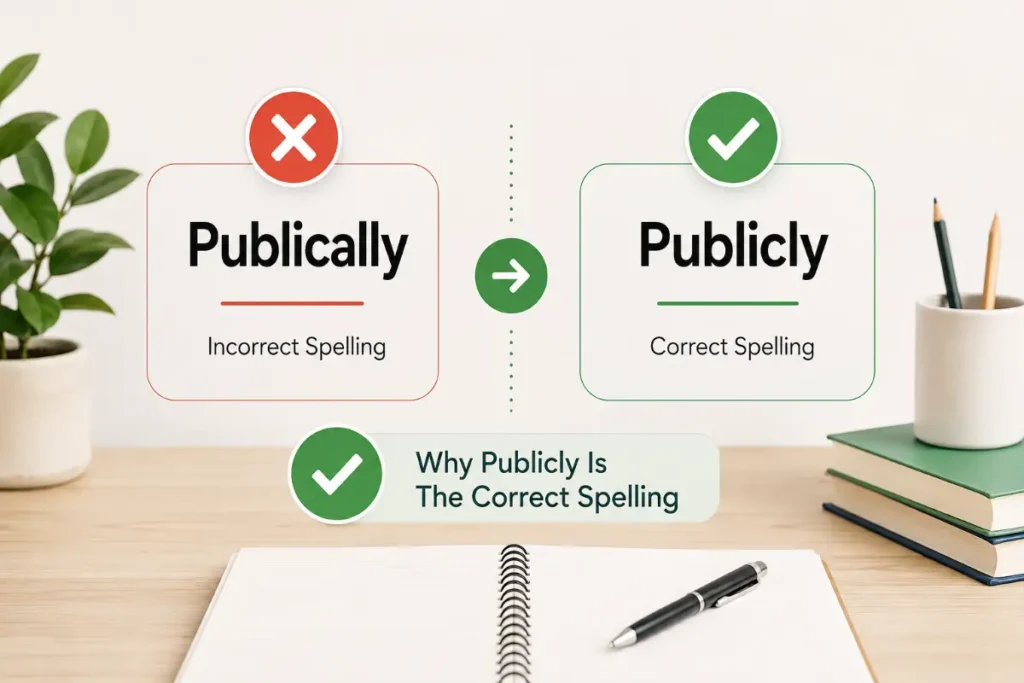
Why Publicly Is The Correct Spelling
The easiest way to understand the spelling is to start with the adjective public.
Public describes something connected with the general population or something that people can see or access. For example you might talk about a public park a public meeting or a public statement.
When you turn the adjective into an adverb you normally add ly.
Public becomes publicly.
That gives you the standard spelling without adding another syllable or another set of letters before the ending.
The word can describe an action that happens openly or something that becomes known to other people. If a person publicly announces a decision the announcement is made openly. If someone publicly apologizes the apology is made where other people can hear or see it.
This pattern is worth remembering because it also explains why the spelling can look unusual at first. The final c in public stays in place. Then ly is added directly to the word.
Where The Confusion Comes From
The mistake usually comes from a very reasonable spelling habit.
English has many adjectives ending in al that form adverbs by adding ly. For example normal becomes normally and final becomes finally. The al stays in the word.
That pattern can make people expect the same thing from public. Since public sounds a little like a word ending in ic or ical it can feel natural to write publically.
There is another reason the mistake sticks around. Some dictionaries and style resources have recorded publically as a variant. That means you may encounter it in published material. Seeing it in print can make the spelling seem fully standard even though publicly is the safer and more widely accepted choice for modern American writing.
The important point is simple. You may see both forms but they do not have equal status in standard usage. If you’re writing an article an email a school assignment a report or professional content publicly is the better choice.
How Publicly Is Formed
A useful way to remember the spelling is to look at the word in two parts.
- Public plus ly becomes publicly.
- You don’t need to insert al between the base word and the adverb ending.
- Compare these forms.
- Public becomes publicly.
- Private becomes privately.
- Open becomes openly.
- Quiet becomes quietly.
The pattern is straightforward. Start with the adjective and add the adverb ending ly. There are spelling changes in some English words but public does not need one here. The final c remains part of the word.
This is why publicly may look slightly strange when you first see it. The sequence icly is not as familiar to many readers as ically. Still the shorter form is the standard spelling.
What Publicly Means
- Publicly means openly or in a way that can be seen heard or known by the public.
- The exact meaning depends on the sentence.
- Consider this example.
- She publicly supported the new policy.
- This means she showed her support openly. Her support was not kept private.
- Now consider this sentence.
- The actor publicly apologized for the mistake.
- The apology was made openly rather than in a private conversation.
- Here is another example.
- The company publicly announced the change.
- The company made the information known to people instead of keeping it internal.
- In each sentence the word tells us how something happened. That makes publicly an adverb.
Public And Publicly Are Different Parts Of Speech
Understanding the difference between public and publicly can make the spelling easier to remember. Public is usually an adjective when it describes a noun.
For example.
- The mayor held a public meeting.
- The word public describes the meeting.
- Publicly is an adverb because it describes an action.
For example.
- The mayor publicly discussed the issue.
- The word publicly describes how the mayor discussed the issue.
This small grammar difference matters because it shows how the word changes when you use it in a sentence. The adjective describes a thing. The adverb describes an action or behavior.
Real Examples Of Publicly
The word appears in many everyday situations. You’ll often see it in news stories workplace writing social media posts interviews and formal statements.
Publicly Supporting Someone
A person can publicly support another person by expressing that support where others can see or hear it.
For example.
- The coach publicly supported the young player after the difficult game.
- The sentence tells us that the coach did not keep the support private.
Publicly Sharing Information
People and organizations often release information publicly.
For example.
- The company publicly shared its new safety guidelines.
- The information became available to people outside the company.
Publicly Apologizing
An apology can happen privately or publicly.
For example.
- The manager publicly apologized to the customers.
- This suggests that the apology was made in front of customers or through a public statement.
Publicly Announcing A Decision
Organizations often make major decisions public.
For example.
- The school publicly announced the new attendance policy.
- The word publicly tells us that the announcement was open and available to the wider group.
Publicly Criticizing Someone
The word can also describe negative comments.
For example.
- She publicly criticized the proposal during the meeting.
- The criticism was not private. Other people heard it.
Publicly In Everyday Writing
You don’t need to use the word only in formal writing. It can appear naturally in everyday sentences too.
Someone might say that a friend publicly thanked them after an event. A student might write that a teacher publicly praised the class. A business owner might say that the company publicly shared its plans.
The word is useful whenever you need to show that something happened openly.
For example.
- I don’t usually talk about personal matters publicly.
- He publicly admitted that he had made a mistake.
- They publicly thanked everyone who helped.
- The artist publicly responded to the criticism.
- The organization publicly released its report.
These sentences sound natural because the word clearly adds information about how the action happened.
When To Use Publicly
Use publicly when an action is open to other people or becomes known in a public setting. It often appears with verbs such as announce support criticize praise apologize admit deny discuss share release and confirm.
Here are some natural combinations.
Publicly Announce
The company publicly announced the new product.
Publicly Support
Several leaders publicly supported the plan.
Publicly Apologize
The organization publicly apologized for the error.
Publicly Admit
He publicly admitted that the decision was a mistake.
Publicly Criticize
The senator publicly criticized the proposal.
Publicly Share
The researchers publicly shared their findings.
These combinations are useful because they appear often in news writing and everyday discussion. Learning them as phrases can help you remember the spelling without having to think about the rule every time.
Publicly Or Publically In American English
For American English the safest choice is publicly.
You may still encounter publically from time to time. It appears in some older writing and in material produced by people who treat it as an acceptable variant. You may also find it in online content where spelling standards are inconsistent.
That does not mean you should use it.
When you want your writing to look polished and standard choose publicly. This is especially useful for school papers professional emails business documents websites reports and published articles.
A reader may not stop to complain about the alternate spelling. Still standard spelling removes a possible distraction. Good editing often means choosing the form that creates the least friction for the reader.
Why Publically Looks Natural
- There is nothing strange about the way people arrive at the longer spelling.
- Take the word public.
- Then imagine adding al to make a form that looks like other familiar adjectives.
- Public becomes publical.
- Then add ly.
- Publically.
The problem is that English does not require that extra step for this word. The standard adverb is formed directly from public. Public becomes publicly.
This is a good example of why spelling by sound or visual pattern can sometimes lead you astray. English often rewards familiarity with the actual word rather than a rule that seems logical at first glance.
A Simple Memory Trick
- Think of the phrase public eye.
- When something happens publicly it happens in the public eye. The word publicly keeps the same basic spelling as public and simply adds ly.
- Public.
- Publicly.
- You can also remember this sentence.
- The public sees it publicly.
- The sentence is a little repetitive but that’s exactly why it can work as a memory aid. It connects the adjective and adverb in your mind.
- Another useful trick is to picture the word without the extra al.
- Publicly.
- If you type or write publically pause and look at the middle of the word. Ask yourself if the base word is simply public. If it is then add ly.
- Public plus ly.
- That is enough.
Common Mistakes With Publicly
The most common mistake is adding al before ly. But spelling is not the only area where people can misuse this word.
Some writers also use publicly when they really mean openly or officially. The word can work in those situations but the context needs to support the meaning.
For example.
- The company publicly released its report.
- This works because the report was made available to the public.
- But consider this sentence.
- The company publicly edited the report.
The sentence is grammatically possible but the meaning is less clear. Editing is not automatically a public action. The writer might need to explain that the editing happened in front of an audience or that the changes were made openly.
Good word choice depends on meaning as well as spelling.
Publicly Compared With Openly
These two words are close but not identical.
- Publicly focuses on something being known or visible to the public.
- Openly focuses more on a lack of secrecy.
For example.
- She publicly criticized the decision.
- This tells us other people could see or hear her criticism.
- She openly criticized the decision.
- This emphasizes that she did not hide her criticism.
- Sometimes both words fit.
The difference becomes clearer when you look at the reason for using the adverb. Choose publicly when the public setting matters. Choose openly when the lack of secrecy matters.
Publicly Compared With Privately
These words are direct opposites in many situations.
- If you do something publicly other people can know about it.
- If you do something privately you keep it away from public view.
For example.
- The two leaders discussed the issue publicly.
- The two leaders discussed the issue privately.
- The first sentence suggests the discussion was open to others. The second suggests the conversation happened away from public attention.
- This contrast is another useful way to remember the meaning of publicly.
Publicly Compared With Officially
Publicly and officially can sometimes appear in the same sentence but they do not mean the same thing.
- Publicly means openly or in a way known to the public.
- Officially means in an authorized or formal way.
For example.
- The company publicly announced the decision.
- The company officially approved the decision.
- The first sentence focuses on the announcement. The second focuses on formal approval.
- A decision can be official without being publicly announced. Likewise a person can publicly discuss something before it becomes an official decision.
- Knowing this difference helps you choose the word that says exactly what you mean.
Publicly In Professional Writing
Professional writing often uses this word when describing announcements statements responses or actions that are visible to a wider audience.
For example.
- The organization publicly confirmed the report.
- The executive publicly addressed the concerns.
- The company publicly responded to the complaint.
- The board publicly announced its decision.
These sentences are clear because publicly tells the reader that the action was not kept internal.
If you work with business writing you may see this word often in press releases reports news articles and public statements. Keeping the standard spelling makes your writing look clean and dependable.
Publicly In Academic Writing
Students may also use this word in essays and research papers.
For example.
- The study publicly released its findings.
- The researcher publicly discussed the results.
- The university publicly acknowledged the issue.
In academic writing clarity matters more than fancy wording. You don’t need to replace publicly with a complicated phrase. The simple word is often the strongest choice when it expresses the idea clearly.
Publicly In News Writing
News writers use the word frequently because public actions and statements are central to many news stories.
- You might read sentences such as these.
- The mayor publicly rejected the claim.
- The company publicly denied the allegations.
- The athlete publicly thanked the fans.
- The organization publicly released a statement.
In each example the adverb helps readers understand that the action or statement was available to a wider audience.
This is also why the standard spelling matters. News writing reaches a large audience. A familiar and accepted spelling keeps the sentence easy to read.
The Role Of The Suffix Ly
The ending ly often turns an adjective into an adverb.
For example.
- Quick becomes quickly.
- Careful becomes carefully.
- Quiet becomes quietly.
- Public becomes publicly.
- The adverb usually tells us how an action happens.
- She spoke quietly.
- He answered carefully.
- They acted quickly.
- The company responded publicly.
This pattern gives you a useful grammar clue. When you need to describe an action connected to public visibility you can use publicly.
The spelling still needs to be learned as a whole word because English has many exceptions and changes. But understanding the basic role of ly makes the word easier to understand.
Why Some Words Keep Al
You may still wonder why words like normally and finally keep their al while publicly does not.
The answer is that public is not formed by taking a base word that ends in al. Its ending is part of the spelling of the word itself and the standard adverb form has developed as publicly.
- Compare the base words.
- Normal becomes normally.
- Final becomes finally.
- Public becomes publicly.
The first two words already end in al. Public does not. That difference is easy to miss because the words look somewhat similar.
Once you separate the base words it becomes much clearer.
A Useful Spelling Check
When you aren’t sure how to spell the adverb ask yourself one question.
- What is the base word?
- For publicly the base word is public.
- Now add ly.
- Public plus ly becomes publicly.
- You don’t need to invent another form between the adjective and the adverb.
This method can help with many other spelling questions too. Start with the word you know and then see what ending it needs. Don’t add letters simply because another word seems to use them.
How To Proofread For This Mistake
If you edit your own writing you can catch this error quickly.
Search your document for publically. If you find it replace it with publicly unless you have a specific reason to reproduce a historical or quoted spelling.
This is especially useful in long articles because small spelling mistakes can hide among hundreds or thousands of words.
- A second method is to read the sentence slowly.
- The company publicly announced the change.
- The word should look familiar because it keeps the original spelling of public.
A final check is to read your work aloud. Pronunciation won’t tell you the spelling but hearing the full sentence can help you notice awkward wording or unclear meaning.
Is Publically Ever Used
Yes. You can find publically in real writing.
That fact causes some confusion because people often assume that anything appearing in a dictionary or published source must be equally standard today. Language is more complicated than that.
Some dictionaries have included the longer spelling as a variant or have noted its use. Historical sources may also contain it. However standard modern American English strongly favors publicly.
So if your goal is clear professional writing there is little reason to choose the less common form. Use the standard spelling and move on.
Does Publicly Have The Same Meaning As Publically
When the longer form is used it is generally intended to mean the same thing as publicly. The difference is mainly one of standard spelling and usage rather than meaning.
Still the safest choice is publicly. It is the form most readers expect and the form you should use in edited American English.
That distinction is useful because you don’t need to learn two separate definitions. You only need to remember which spelling is preferred.
Examples Of Correct Usage
Here are more examples that show how naturally the word fits into different types of writing.
- The author publicly thanked her editor after the book won the award.
- The company publicly confirmed that the service would continue.
- He publicly defended his decision during the interview.
- The school publicly recognized the students for their work.
- The team publicly apologized to its supporters.
- The organization publicly shared the results of the survey.
- She publicly rejected the accusation.
- The actor publicly discussed the experience for the first time.
- The mayor publicly addressed concerns from local residents.
- The group publicly announced its plans for the next year.
Each sentence uses publicly to show that an action statement or response happened in front of or for a wider audience.
Examples Of Incorrect Usage
The following examples show the spelling to avoid.
- The company publically announced the change.
- She publically apologized for the mistake.
- The actor publically discussed the issue.
- The organization publically shared the report.
- The school publically praised the students.
- In standard American English replace the longer spelling with publicly.
- The corrected versions are simple.
- The company publicly announced the change.
- She publicly apologized for the mistake.
- The actor publicly discussed the issue.
- The organization publicly shared the report.
- The school publicly praised the students.
A Quick Test You Can Use
- If you see a word that looks like publically stop before accepting it.
- Ask yourself if the base word is simply public.
- If yes then add ly.
- Public plus ly.
- Publicly.
That small check takes only a second. It can prevent an error in an email essay article report or social media post.
The same habit works beyond this word. When English spelling feels uncertain don’t automatically add letters because they sound natural. Look at the base word first.
Why Good Spelling Still Matters
A single spelling mistake isn’t a disaster. Everyone makes them. Fast typing tiredness and autocorrect can all cause errors.
Still spelling affects how readers experience your writing. A clean sentence feels easier to trust and understand. A repeated spelling error can distract readers and make them question the care behind the rest of the content.
This matters even more in professional writing. A customer email job application business report website article or school paper represents the writer. Standard spelling shows that you took the time to check your work.
That doesn’t mean every sentence needs to sound formal. Clear writing can still sound friendly and natural. In fact simple words and standard spelling often make writing feel more confident.
FAQs
Is publically or publicly correct?
Publicly is the standard spelling in modern American English. Publically is a less accepted variant and is best avoided in standard writing.
Why is publicly spelled without al?
The base word is public and the standard adverb is formed by adding ly. That gives you publicly. The extra al in publically is not needed.
Is publically a real word?
You may find publically in dictionaries and published material. It has been used as a variant over time. However publicly is the standard choice for modern American English.
What does publicly mean?
Publicly means openly or in a way that is known or visible to the public. For example a person can publicly apologize or publicly support an idea.
Is publicly an adjective or an adverb?
Publicly is an adverb. It describes how an action happens. Public is usually the adjective.
What is the difference between public and publicly?
Public usually describes a noun while publicly describes an action. You can attend a public meeting or publicly discuss a meeting.
Can I use publically in formal writing?
It is better to avoid it. Use publicly in formal and professional writing because it is the standard and more widely accepted spelling.
How can I remember the spelling of publicly?
Start with the base word public and add ly. Think public plus ly equals publicly. The key is to avoid inserting al between the base word and the adverb ending.
Conclusion
If you came here wondering about publically or publicly the answer is straightforward. Use publicly in standard American English. It means openly or in a way that is known or visible to the public.
The confusion comes from familiar spelling patterns. Words such as normal and final keep their al when they become normally and finally. Public works differently because the standard adverb is formed by adding ly directly to public.
The easiest way to remember the word is to keep the base word intact. Start with public then add ly. Public plus ly gives you publicly. That simple habit can save you from the extra al that creates the common spelling mistake.
The next time you need this word in an email article essay report or professional document don’t stop to guess. Write publicly and keep going. It is the clear standard choice.

Dr. Elena Vance holds a Ph.D. in Linguistics from Columbia University and has spent over 15 years analyzing the evolution of the English language. A former university professor turned full-time writer and editor, Elena specializes in breaking down high-level grammatical concepts, punctuation nuances, and style guides (APA, Chicago, MLA) into clear, actionable advice. When she isn’t hunting down dangling modifiers, she can be found collecting vintage dictionaries and reading classic literature.