

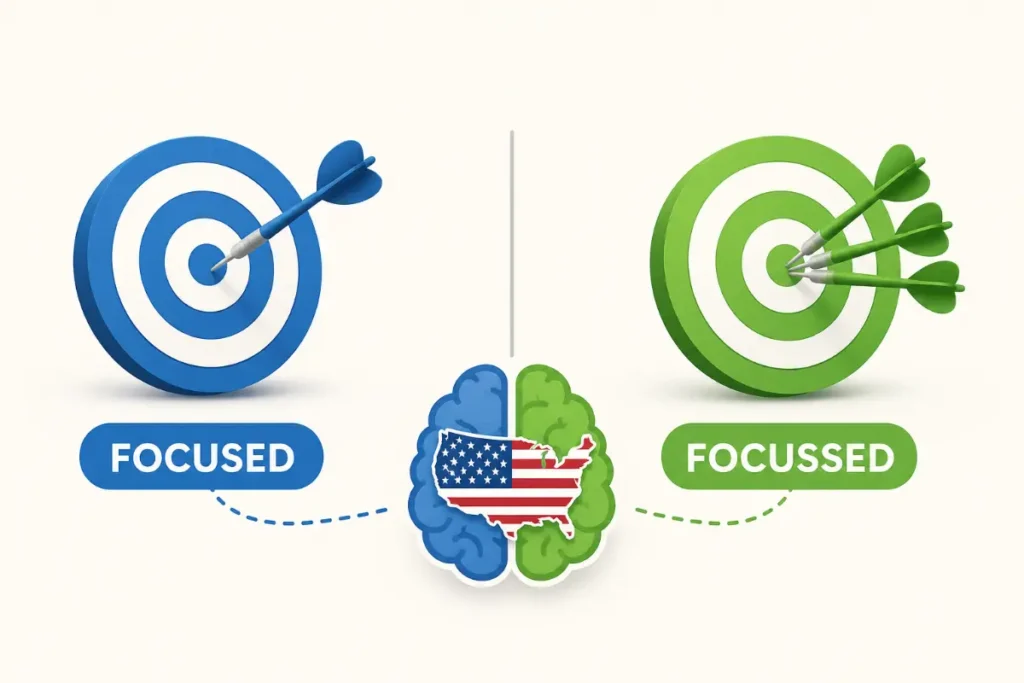
If you’re unsure about focussed or focused you’re dealing with two spellings that are both used in English. The difference comes down to the variety of English you’re using. Focused is the standard spelling in American English while focussed is also accepted in British English and some other varieties.
For readers in the United States the choice is simple. Use focused in your schoolwork emails articles reports and everyday writing. It follows the spelling style most commonly expected in American English.
The extra s in the other version can make things confusing. You may see it in British books websites and publications and wonder if you’ve been spelling the word incorrectly. You haven’t. The two forms are spelling variants rather than two words with different meanings.
This guide explains the difference clearly. You’ll learn which form to use in American English how British English handles the word why both spellings exist and how related words such as focusing and refocus are written.
Quick Definition
Focused and focussed have the same meaning. Both are forms of the verb focus and describe giving your attention to something or directing attention toward a particular point.
The main difference is regional spelling. American English normally uses focused while British English commonly accepts focussed.
Direct Answer
Focused is the preferred spelling in American English. Focussed is a valid British English spelling, so the extra s isn’t automatically a spelling error.
Comparing The Two Spellings
The meaning does not change when you add the extra s. The choice mainly depends on the style of English you’re writing.
Why Focused Is Preferred In American English
American English tends to favor the shorter form when verbs ending in a single vowel and consonant are changed into their past forms or participles. In this case the base verb is focus and the common American form is focused.
You can see this spelling throughout American books newspapers websites and professional writing.
For example:
- The teacher focused on the main problem.
- I stayed focused during the presentation.
- The company has focused on customer service.
- She focused her attention on the final question.
All of these sentences use the spelling most readers in the United States expect.
That doesn’t mean the version with two s letters is wrong everywhere. It simply follows a different regional spelling convention. If you’re writing for an American audience the shorter form is the safer and more natural choice.

Why British English Uses Focussed
British English often uses a double consonant when adding an ending to certain words. That pattern can produce forms such as focussed and focussing.
You may see this spelling in British newspapers books university materials and government publications. It is also found in some other English varieties that follow British spelling conventions.
For example:
- She remained focussed on the task.
- The team is focussed on improving customer service.
- He was fully focussed during the interview.
A British reader will understand this spelling without any problem. It doesn’t change the meaning of the sentence.
The important point is consistency. If you’re writing an article in American English use focused. If you’re following British English style use the spelling preferred by that style guide.
The Meaning Of Focus
Before looking at the spelling rules it helps to understand the word itself. Focus can work as both a verb and a noun.
As a verb it means to direct your attention toward something.
- Please focus on the instructions.
- I need to focus on my work.
- She focused on the most important detail.
As a noun it refers to the main point of attention or interest.
- The main focus of the meeting was safety.
- Education is the focus of the new program.
- The camera lost focus for a moment.
The forms focused and focussed come from the verb. They describe something that received attention or someone who gave close attention to something.
Focused In Everyday American English
You probably use this word often without thinking about its spelling. It appears in conversations about work school sports study health business and personal goals.
At Work
People often talk about staying focused when they need to finish an important task.
- I need a quiet room so I can stay focused.
- The team stayed focused on the project.
- We focused our efforts on improving the website.
Here the word describes attention and effort. It tells the reader that someone is directing energy toward a specific goal.
At School
Students also use the word when talking about concentration.
- I couldn’t stay focused during the long lecture.
- She focused on the hardest questions first.
- The teacher asked everyone to remain focused.
In these examples the word relates to mental attention. It means keeping your mind on the task instead of allowing distractions to pull you away.
In Sports
Athletes often need strong concentration during training and competition.
- The player stayed focused until the final whistle.
- Our coach told us to stay focused.
- She focused on improving her technique.
The word can describe mental discipline as well as physical effort.
In Business Writing
The term also appears frequently in reports and professional communication.
- Our strategy is focused on customer needs.
- The new plan focuses on reducing costs.
- The company remains focused on quality.
American business writing normally uses focused in these sentences.
Focused And Focus
A common question is how the spelling changes when you add endings to the base word.
The base word is focus. When you use it as a past tense or past participle in American English you normally write focused.
For example:
- We focus on the problem every Monday.
- We focused on the problem yesterday.
- We have focused on the problem for several weeks.
The basic meaning stays connected across all three forms. The verb simply changes to show time or grammar.
The same pattern appears when the word works as an adjective.
- She is focused on her goals.
- He is a focused student.
- They are focused workers.
The spelling remains focused in American English.
Focused And Focusing
The form focusing can cause another spelling question.
In American English the usual form is focusing with one s.
For example:
- She is focusing on her studies.
- We are focusing on the most urgent issue.
- The team is focusing on customer feedback.
- British English can use focussing with two s letters.
- That gives you a useful regional pattern.
- American English commonly uses focused and focusing.
- British English commonly uses focussed and focussing.
- The meaning remains the same. The spelling changes with the English variety.
Why The Extra S Causes Confusion
The confusion comes from a larger spelling pattern in English. Many writers expect a consonant to double when a suffix is added. That expectation can make focussed look more natural.
You may also have learned words such as stopped, planned, and running. Those words use doubled consonants in certain forms. It is easy to assume that the same rule must apply to every verb.
English doesn’t work quite that neatly.
The spelling of verbs depends on the letters in the base word and the spelling conventions used by a particular variety of English. Focus is one of those words where American and British usage developed different common forms.
So don’t treat the extra s as a simple mistake. First look at the type of English you’re writing.
Common Mistakes With This Word
The biggest mistake is using both forms randomly in the same piece of writing.
For example an American article might use focused in one paragraph and focussed in another. That isn’t a major grammar problem but it makes the writing look inconsistent.
A reader may wonder if the change was intentional or simply a typo.
Choose one spelling style and stay with it.
If your audience is mainly in the United States use focused throughout your article. If you’re writing for a British audience follow the spelling style expected by that audience.
Mistake One
- Incorrect for standard American style: The team remained focussed on the goal.
- Better for American readers: The team remained focused on the goal.
Mistake Two
- Incorrect for standard American style: She is focussing on her studies.
- Better for American readers: She is focusing on her studies.
Mistake Three
Switching between regional forms can make a document look poorly edited.
For example:
- The company is focused on growth.
- The company is focussed on customer service.
Both sentences are understandable but the spelling style has changed. Pick one regional form and use it consistently.
Is Focussed A Spelling Error
Not always.
This is one of the most useful points to remember. Focussed is recognized as a standard spelling in British English. So calling it simply wrong would give readers an incomplete answer.
For an American audience the preferred form is focused. For British English the double s form is commonly used.
Think of it like other regional spelling differences. American English writes color while British English often writes colour. American English writes center while British English often writes centre.
The words have the same meaning. The spelling reflects the variety of English. The same basic idea applies here.
American English And British English
Regional spelling differences can seem small but they matter in polished writing. Editors often choose a style before working on a book article website or publication.
American English has its own common spelling patterns. British English has others.
Here are a few familiar examples.
| American English | British English |
|---|---|
| Color | Colour |
| Center | Centre |
| Favorite | Favourite |
| Organize | Organise |
| Focused | Focussed |
These differences don’t mean one variety is more correct than the other. They show that English has developed different conventions in different places.
If your website serves American readers use the American spelling consistently. If your publication follows British English use its preferred style.
How To Remember The American Spelling
If you mainly write for people in the United States there’s an easy answer to remember.
- Use focused with one s.
- You can connect the spelling with the base word focus. The American form adds ed without adding another s.
- Think of it this way.
- Focus + ed = focused.
- That simple visual reminder can help when you’re writing quickly.
- You can also remember the related form.
- Focus + ing = focusing.
- Once you remember those two forms the pattern becomes easier to recognize.
Focused As An Adjective
The word isn’t limited to verb forms. It often works as an adjective that describes a person or thing with a clear purpose or strong attention.
For example:
- She is a focused student.
- He gave a focused response.
- The team took a focused approach.
- We need a more focused plan.
In these sentences the word describes something rather than simply showing an action.
- A focused student pays close attention.
- A focused response stays on the main point.
- A focused plan has a clear goal.
This use is especially common in professional and academic writing.
Focused On Something
One of the most common patterns is focused on.
Use it when someone directs attention effort or activity toward a particular thing.
- The lesson is focused on grammar.
- She is focused on improving her writing.
- The business is focused on serving local customers.
- Our discussion focused on the main issue.
The phrase is simple but useful. It appears in both everyday speech and formal writing. You can also use focus on with the base verb.
- Try to focus on the positive.
- We need to focus on the facts.
- Please focus on the question.
The difference comes from grammar rather than meaning.
Focused On A Goal
People often use this word when talking about goals.
- She is focused on becoming a better writer.
- He stayed focused on his goal.
- The team is focused on winning the next game.
- I’m focused on finishing this project today.
The phrase suggests clear attention. It often carries the idea of avoiding distractions. That makes it useful in conversations about work habits study plans fitness and personal growth.
Focused Attention
The phrase focused attention means giving strong and deliberate attention to one thing.
For example:
- Focused attention can help students understand difficult material.
- The doctor listened with focused attention.
- The child needed focused attention during the lesson.
This phrase is common in education psychology and everyday discussions about concentration.
It also shows how the word connects naturally with other terms such as concentration attention effort goals and priorities.
Focused Effort
Focused effort means putting your energy into a specific task or goal instead of spreading it across too many things.
For example:
- A little focused effort can improve your writing.
- The team made a focused effort to fix the problem.
- She achieved her goal through steady and focused effort.
The phrase works well because it combines the idea of attention with action. You aren’t just thinking about something. You’re putting effort into it.
Focused Study
Students often talk about focused study when they want to describe a period of serious concentration.
For example:
- Thirty minutes of focused study can be more useful than two hours of distracted work.
- I need some quiet time for focused study.
- Focused study helped her prepare for the exam.
The word doesn’t mean studying for a long time. It means giving your attention to the material during the time you spend studying.
That distinction matters. A short period of concentrated work can be productive even if it lasts only a few minutes.
Focused Writing
Writers use the word to describe clear writing that stays on the main topic. A focused article doesn’t wander from one unrelated idea to another. Each paragraph supports the main point.
For example:
- The introduction is focused on the reader’s main question.
- Her essay is clear and focused.
- The report needs a more focused structure.
This use is especially helpful for editors because it connects spelling with good writing habits. A correctly spelled word matters but so does the clarity of the message around it.
When To Use Each Form
- The choice becomes easy once you know your audience.
- If you’re writing for a US audience use focused. This is the spelling most American readers expect in standard writing.
- If you’re writing for a British audience you may use focussed. Many British publications and style systems accept or prefer that form.
- If you’re writing for a mixed international audience choose one style based on your publication’s main standard. Then use it consistently.
- For a US website that means focused is usually the best choice.
Does The Spelling Change The Meaning
No.
The two forms have the same meaning. They both describe directing attention toward something or concentrating on a particular point. The difference is spelling style rather than meaning. For example an American writer might say:
- The team stayed focused on the project.
A British writer might write:
- The team stayed focussed on the project.
The message is identical.
This is why context matters when you see the double s form. If you’re reading British English it may be completely normal.
Is Focused Always Better
For American English yes.
- That doesn’t mean the British form has no place. It simply means you should match your spelling to your audience.
- If you’re writing a US college essay focused is the natural choice. The same goes for an American business report blog post resume or website.
- If you’re editing a British publication don’t automatically change every instance of focussed to focused. First check the publication’s style guide.
Good editing isn’t about changing every difference into one preferred form. It’s about making sure the writing follows a consistent standard.
Related Words And Their Spelling
Understanding related forms gives you a stronger grasp of the whole word family.
Focus
This is the base form.
- Please focus on your work.
Focuses
This is the third person singular present form.
- The article focuses on common spelling mistakes.
Focused
This is the common American past tense and past participle.
- She focused on the main issue.
Focusing
This is the present participle and gerund form in American English.
- He is focusing on his studies.
Refocus
This means to focus again or direct attention toward something new.
- I need to refocus after the interruption.
Refocused
This is the past form.
- The team refocused its efforts after the first attempt failed.
Refocusing
This describes the action of focusing again.
- She is refocusing her attention on the main goal.
These forms help show how the base word works in different grammatical situations.
A Simple Editing Test
When you’re proofreading an American English article and see the double s form ask yourself one question.
Are you following American spelling.
If the answer is yes change the spelling to focused.
Then check related forms. If you wrote focussed you may also have written focussing. In standard American style you would normally use focused and focusing.
This quick check can help keep an entire article consistent.
Why Consistency Matters In SEO Writing
Search engines can understand both spelling variants. The bigger concern for a writer is the reader’s expectations and the language style of the website.
If your site targets US readers then American spelling makes the content feel natural. Readers shouldn’t have to stop and wonder why one sentence suddenly uses a British spelling.
Consistency also makes editing easier. When the same style appears throughout a website the content feels like it came from one clear editorial voice.
You don’t need to repeat the spelling variant just to target a search query. A strong article can explain the difference once and then use natural language throughout.
That gives readers a better experience and keeps the writing from sounding forced.
Examples Of Correct American Usage
Here are several natural sentences you can use as models.
- I stayed focused until I finished the report.
- She focused on the most important details.
- The teacher asked the class to remain focused.
- Our team is focused on improving customer service.
- He has focused his attention on the new project.
- The article focuses on common grammar mistakes.
- I’m focusing on one task at a time.
- The company remains focused on its long term goals.
- She gave a focused answer during the interview.
- We need a more focused approach to the problem.
These examples cover several common uses. You can see how the word works as a verb and as an adjective.
A Few Examples From British English
If you read British English you’ll likely come across the other spelling.
- She remained focussed throughout the meeting.
- The report is focussed on public safety.
- He stayed focussed on his studies.
- The team is focussed on improving performance.
Don’t assume the writer made a mistake simply because the spelling differs from American usage.
Instead identify the variety of English being used. That small habit will prevent a lot of unnecessary corrections.
How Editors Handle Regional Spelling
Professional editors usually follow a style guide. A style guide is a set of rules that tells writers how to handle spelling punctuation capitalization and other choices.
An American publication may follow a US based style guide. A British publication may follow a British style guide.
The goal isn’t to make every English speaker use the same spelling. The goal is consistency within a particular publication.
For example an American editor may change focussed to focused because the publication uses American English. A British editor may keep focussed because it matches the publication’s house style.
This is why both forms can appear in professionally edited material.

When A Spelling Checker Flags The Word
- Your spell checker may prefer one form depending on its language settings.
- If your software is set to US English it will usually favor focused. If it is set to UK English it may accept focussed.
- This can be useful when proofreading. Just make sure the language setting matches your intended audience.
- A US English document checked with UK English settings can produce confusing suggestions. The same problem can happen in reverse.
- Before changing a word because your software marks it as unusual check the language setting first.
A Useful Way To Think About The Difference
Think of the two spellings as regional cousins.
They mean the same thing but they come from different spelling traditions. One isn’t a different vocabulary word and neither changes the grammar of the sentence.
- For American readers the natural choice is focused.
- For British readers focussed may be the expected choice.
Once you see the difference this way the confusion becomes much smaller. You don’t need to memorize a complicated rule. You simply need to know which English variety you’re using.
FAQs
Is focussed or focused correct?
Both spellings are accepted in English but they follow different regional conventions. American English normally uses focused while British English commonly uses focussed.
Which spelling should I use in the United States?
Use focused. It is the standard spelling expected by most American readers and is the best choice for US school work professional writing websites and general communication.
Is focussed wrong in American English?
It isn’t meaningless or unintelligible but it is not the usual American spelling. If you’re writing for a US audience focused is the better choice.
Why does British English use focussed?
British English commonly doubles the s in this form. The spelling developed as part of British spelling conventions and remains common in British writing.
Is focusing spelled with one s or two?
American English normally uses focusing with one s. British English commonly uses focussing with two s.
What is the past tense of focus?
The common American form is focused. For example you can say I focused on the problem yesterday.
Does focussed have a different meaning?
No. The two forms have the same meaning. The difference is regional spelling rather than a difference in definition.
Should I change focussed to focused when editing a US article?
Yes if the article is meant to follow standard American English. You should also check related forms such as focussing and use the American versions consistently.
Conclusion
If you’ve been wondering about focussed or focused the answer depends on the type of English you’re using. For American English focused is the preferred spelling. British English commonly uses focussed.
The meaning stays the same in both forms. Both describe directing attention toward something or concentrating on a particular point. The extra s reflects a regional spelling difference rather than a change in meaning.
For US readers the easiest rule is simple. Write focused and focusing. If you’re writing for British readers follow their spelling convention and keep the style consistent across the entire piece.
So when you’re writing an American article or email and you stop to check the spelling remember the shorter form. Choose focused and move on with confidence.

Dr. Elena Vance holds a Ph.D. in Linguistics from Columbia University and has spent over 15 years analyzing the evolution of the English language. A former university professor turned full-time writer and editor, Elena specializes in breaking down high-level grammatical concepts, punctuation nuances, and style guides (APA, Chicago, MLA) into clear, actionable advice. When she isn’t hunting down dangling modifiers, she can be found collecting vintage dictionaries and reading classic literature.