
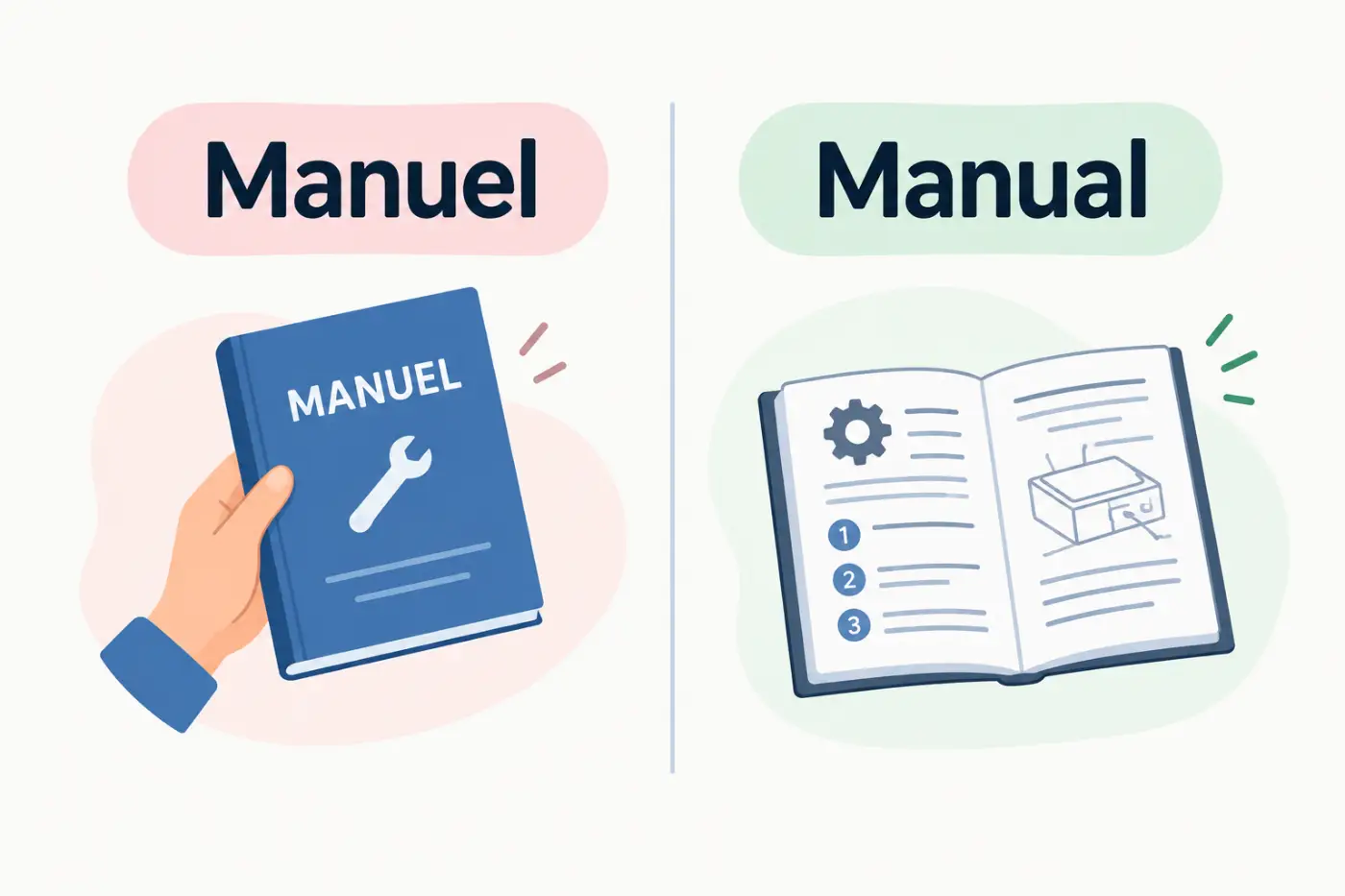
If you’re searching for manuel vs manual you may be wondering which spelling is correct. The answer depends on what you’re trying to say. Manual is the standard English word for something done by hand or a book that gives instructions. Manuel is usually a person’s name.
That one letter makes a big difference. If you’re talking about a guide that explains how to use a machine you need manual. If you’re talking about someone named Manuel you need the name Manuel.
The confusion often comes from the fact that the two words look almost identical. They also sound similar in some accents. A quick typo can easily turn one into the other. This guide explains the difference in plain English and shows you how to use each word correctly.
You’ll also see examples from everyday writing along with common mistakes and simple ways to remember the difference. By the end you’ll know exactly which word belongs in your sentence.
Quick Definition
Manual is an English word that can describe something done by hand or a book of instructions. Manuel is most often a male given name used in several Spanish and Portuguese speaking communities. The two words can look similar but they don’t have the same meaning or function.
Direct Answer
Manual is the correct English word for a guide or something done by hand. Manuel is normally a person’s name.
Comparison Table
| Word | Meaning | Example Sentence | When to Use It |
|---|---|---|---|
| Manual | Done by hand or a book of instructions. | Please read the manual before using the device. | Use it for instructions or actions done by hand. |
| Manuel | A male given name. | Manuel called me after work. | Use it when referring to a person with this name. |
Why These Two Words Get Confused
The confusion is easy to understand. Both words contain the same six letters except for the position of the e and a. That small difference changes the word completely.
Think about these two sentences.
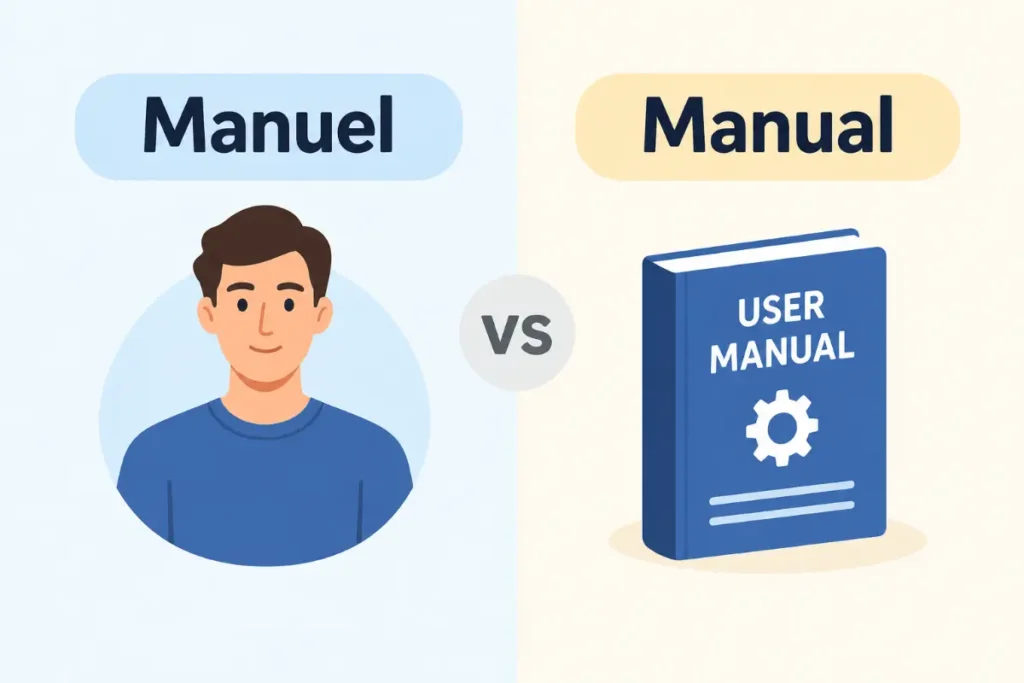
- Manuel bought a new car.
- I read the car manual.
The first sentence talks about a person. The second talks about a book that explains how to use or care for something. The words may look alike at a glance but their jobs in the sentence are completely different.
Spelling errors can make the problem worse. If someone types manuel instead of manual in a sentence about instructions the meaning may become unclear. A reader might think you’re referring to a person instead of a guide.
Capitalization gives you another useful clue. Manuel is normally capitalized because it is a proper name. Manual is normally lowercase because it is a common English word.
Compare these examples.
- Manuel works at the front desk.
- The employee manual is on the table.
The capital letter in Manuel signals that you’re dealing with a name. The lowercase manual tells you that you’re dealing with an ordinary English word.
What Does Manual Mean
Manual has two main uses in English. It can describe something done with your hands instead of automatically or by a machine. It can also mean a book or document that gives instructions.
These meanings are connected by the idea of human action and control.
Manual As An Adjective
As an adjective manual describes something done by hand.
For example you might hear someone talk about manual work. This means work that requires physical effort and is done largely with the hands.
- The workers perform manual tasks every morning.
- The machine requires manual control.
- She has experience with manual assembly.
- The doctor used a manual technique during the examination.
The word can also describe a process that a person must control instead of a computer or machine doing it automatically.
For example a company might have a manual process for checking applications. An employee reviews each application instead of letting software handle the entire task.
Another common example is a manual transmission. In a vehicle with a manual transmission the driver changes gears instead of relying on an automatic transmission to do it.
Manual As A Noun
As a noun manual usually means an instruction book or guide.
You may get a manual when you buy a television phone washing machine car appliance or piece of equipment. The manual explains how the product works and how to use it safely.
For example.
- I lost the manual for my printer.
- The manual explains how to install the software.
- Check the manual before changing the settings.
- The repair shop ordered a new service manual.
In this use the word is short for something like an instruction manual or user manual.
What Does Manuel Mean
Manuel is generally a male first name. It is especially common in Spanish and Portuguese speaking cultures and also appears in other parts of the world.
For example.
- Manuel lives next door.
- I spoke with Manuel yesterday.
- Manuel sent the documents this morning.
- Our new manager is named Manuel.
Because it is a person’s name Manuel is normally written with a capital M.
The name has a long history and is related to Emmanuel. You don’t need to know its history to use it correctly though. The main point for everyday writing is simple. When Manuel refers to a person it functions as a proper noun and should be capitalized.
Manual In Everyday English
You’ll see manual in many common phrases. Learning these phrases helps you understand the word naturally instead of treating it as a spelling rule you have to memorize.
User Manual
A user manual explains how to use a product or service.
- The user manual is inside the box.
- I checked the user manual before setting up the printer.
This is probably the most familiar use of the word.
Instruction Manual
An instruction manual gives directions for using or assembling something.
- The instruction manual shows how to put the desk together.
- Read the instruction manual before operating the equipment.
You might see user manual and instruction manual used for similar documents. Both refer to material that helps someone understand how to use something.
Employee Manual
An employee manual gives workers information about company rules policies and procedures.
- New employees receive an employee manual during orientation.
- The employee manual explains the company’s leave policy.
This type of manual isn’t usually about a physical product. Instead it provides information that employees need for their jobs.
Service Manual
A service manual provides detailed information about maintaining or repairing equipment.
- The mechanic checked the service manual before starting the repair.
- The service manual lists the recommended maintenance steps.
Service manuals often contain more technical information than a basic user manual.
Manual Labor
Manual labor means physical work that uses the hands and body.
- He spent several years doing manual labor.
- The farm needs workers for manual labor during harvest season.
The phrase doesn’t mean that every action is done entirely by hand. It generally refers to work that requires significant physical effort.
Manual Can Mean Done By Hand
One of the easiest ways to understand manual is to connect it with the idea of using your hands.
A manual task requires a person to perform the action instead of an automated system doing everything.
For example a website might automatically send confirmation emails. If an employee has to send each email personally the company might call that a manual process.
Consider these examples.
- The system updates the records automatically.
- The assistant updates the records manually.
The first process happens through automation. The second requires a person to do the work.
You can also describe controls this way.
- The lights turn on automatically.
- You can also operate the lights manually.
This meaning appears often in technology manufacturing transportation healthcare and office work.
Manual Can Also Mean A Guide
The second major meaning has nothing to do with physical labor in a direct sense. A manual can be a book or document that explains how something works.
Imagine buying a new coffee maker. The box may contain a manual that tells you how to fill the water tank choose a setting clean the machine and solve simple problems.
You might say.
- I can’t find the manual.
- The manual says to clean the filter every month.
- Did you read the manual before using the machine.
In each sentence manual means an instructional guide.
The same idea applies to software and online systems. A company might publish a software manual that explains how users can perform different tasks. A workplace might create a safety manual that explains rules and procedures.
The Capital Letter Trick
Capitalization can help you remember the difference.
Manuel is a name. Names begin with capital letters.
Manual is a regular English word. It normally stays lowercase unless it begins a sentence or appears in a title that uses title capitalization.
Look at the contrast.
- Manuel picked up the manual.
- I asked Manuel to find the manual.
- The manual belongs to Manuel.
The third sentence is especially useful because both words appear together. Manuel identifies a person while manual identifies a guide.
This simple visual clue can help you catch mistakes during proofreading. If you see Manuel in a sentence about an instruction book you probably need to check the spelling and meaning.
Likewise if you’re writing about a person named Manuel you shouldn’t replace the name with manual just because the two words look similar.
A Simple Way To Remember The Difference
Think of Manuel as a person and manual as a thing or action.
- If someone can have the word as their first name use Manuel.
- If you’re talking about a guide or something done by hand use manual.
You can make the distinction even clearer with one sentence.
Manuel read the manual.
That sentence gives you both words side by side. Manuel is the person. The manual is the guide.
Another useful sentence is this.
Manuel completed the manual task.
Here Manuel is the person’s name and manual describes the task. The sentence shows how different their roles are even though the spellings are close.
Once you connect the spelling to the meaning the confusion becomes much easier to avoid.
Common Uses Of Manual In Real Life
The word manual appears in far more places than instruction books. You can use it to describe work done by hand. You can also use it when talking about systems that need human action instead of automatic control.
Understanding these different uses helps you recognize the word quickly. It also prevents a common mistake where people assume that manual always means a book.
Manual Work
Manual work involves physical effort and often requires the use of your hands. Construction workers factory employees gardeners and warehouse workers may all perform manual work.
For example.
- The job involves several hours of manual work each day.
- The company hired extra workers for manual tasks.
- Manual work can require strength and careful attention.
The word doesn’t mean that machines are completely absent. A worker may use tools while still performing manual work. The key idea is that a person does much of the physical work.
Manual Process
A manual process requires a person to complete an action instead of software or machinery doing it automatically.
For example a business might have a system that automatically sends receipts to customers. If an employee has to prepare and send each receipt by hand the company may describe that as a manual process.
You might see sentences such as these.
- The old system required manual data entry.
- We still use a manual approval process for large purchases.
- The staff checks each application manually.
This use has become especially common in offices and technology related writing.
Manual Control
Manual control means a person controls something directly.
For example a machine may have an automatic mode and a manual mode. Automatic mode lets the system make certain decisions on its own. Manual mode gives the person more direct control.
You might read an instruction such as this.
- Switch the device to manual control before adjusting the settings.
The exact meaning can change depending on the machine or system but the basic idea remains the same. A person takes control instead of allowing the system to operate automatically.
Manual And Automatic
One of the most useful comparisons is manual and automatic. These words often appear together because they describe opposite ways of handling a task.
An automatic process happens with little or no direct human action. A manual process requires someone to perform the action.
Consider an online store. The system might automatically send an order confirmation after a customer makes a purchase. If an employee has to create and send the confirmation personally the process becomes manual.
The same contrast appears in vehicles.
An automatic transmission changes gears for the driver. A manual transmission requires the driver to select gears using the vehicle’s controls.
You might also see this distinction in household equipment.
- The washing machine has an automatic cycle.
- The operator selected the settings manually.
The words don’t always mean that one method is better than the other. Manual control can give people more flexibility. Automatic systems can save time. The right choice depends on the task.
Manual And Handbook
A manual and a handbook can both provide information but they aren’t always the same thing.
A manual often gives instructions for using a product system or process. A handbook is usually a broader reference guide that provides information about a subject or group.
For example a new camera might come with a user manual. A school might give students a handbook that explains rules schedules and expectations.
These terms can overlap. A company might even call its employee guide an employee manual or employee handbook.
The important point is that manual can refer to an instructional document. The surrounding words usually tell you exactly what kind of guide it is.
Manual And Guide
Guide is a broader word than manual.
A guide can explain almost anything. It might show you how to visit a city how to start a garden or how to use an app.
A manual usually has a more specific purpose. It often provides detailed instructions for using maintaining operating or understanding something.
Compare these examples.
- I downloaded a guide to visiting Chicago.
- I downloaded the printer manual.
The first document may offer tips and suggestions. The second is specifically connected to the printer and explains how to use it.
Still there are cases where guide and manual can describe similar documents. The exact word depends on the purpose and style of the document.
Common Spelling Mistakes
The most obvious error is switching the last two vowels and writing manuel when you mean the English word for a guide or something done by hand.
Another mistake involves capitalization. Writers sometimes capitalize the common noun for no reason.
For example.
- Please read the Manual before using the machine.
Unless Manual begins a sentence or appears in a title that requires that capitalization it should normally be lowercase.
There is also another kind of error that comes from confusing the noun and adjective meanings. A person might think manual only refers to a book and fail to recognize it in phrases such as manual labor or manual control.
Knowing both major meanings solves that problem.
How To Tell Which Word You Need
When you’re unsure which spelling belongs in your sentence ask yourself one simple question.
Am I talking about a person named Manuel or am I talking about an English word that means a guide or something done by hand.
If you’re talking about a person the name is Manuel.
If you’re talking about instructions physical work human control or a process done by hand the word is manual.
Look at these examples.
- Manuel works with my brother.
- I gave Manuel the documents.
- Please read the manual.
- The technician entered the information manually.
- The machine has a manual setting.
The context makes the difference clear.
How To Use Manual Correctly
Good writing depends on more than spelling. You also need to use a word in the right grammatical role.
Manual can work as an adjective.
- We need manual approval.
- She prefers manual controls.
- The workers perform manual tasks.
It can also work as a noun.
- The manual is missing.
- I found the manual online.
- Read the manual first.
The related form manually works as an adverb. It tells you that a person performs an action by hand or through direct effort.
- The employee entered the information manually.
- You can adjust the settings manually.
- The records were checked manually.
This gives you a useful word family.
- Manual describes the thing or process.
- Manually describes how an action happens.
Understanding this small difference can make your writing more precise.
Examples With Manual And Manually
These two forms are easy to mix up because they come from the same root.
Consider this sentence.
- The technician performed a manual inspection.
Here manual describes the inspection. It tells us that the inspection involved direct human work.
Now look at this sentence.
- The technician inspected the equipment manually.
Here manually describes how the technician performed the inspection.
The difference is small but useful.
Another example makes it clearer.
- The company uses manual data entry.
- The assistant enters the data manually.
In the first sentence manual describes the type of data entry. In the second sentence manually explains how the assistant enters the data.
What Does Manually Mean
Manually means that a person does something by hand or through direct action instead of relying on an automatic system.
For example if your phone backs up photos automatically you don’t have to start the process yourself. If you open the settings and start the backup yourself you could say that you backed up the photos manually.
Here are some natural examples.
- I updated the software manually.
- She entered the customer details manually.
- You can adjust the temperature manually.
- The technician restarted the system manually.
The word often appears in technology and workplace settings because many modern systems offer both automatic and manual options.
Manual Transmission Explained Simply
One of the most familiar uses of the word in American English is manual transmission.
A manual transmission is a type of vehicle transmission that requires the driver to select gears. The driver normally uses a clutch pedal and gear shifter to control the gear changes.
An automatic transmission handles gear changes for the driver.
For example someone might say.
- I learned to drive in a car with a manual transmission.
- My first car had an automatic transmission.
- He prefers driving a manual because he likes having more control.
In casual American conversation you may also hear people say stick shift when talking about a manual transmission.
The terms aren’t exactly identical in every technical context but people commonly use stick shift to refer to a vehicle with a manual transmission.
Manual Labor And Physical Work
The phrase manual labor deserves special attention because it appears frequently in everyday English.
Manual labor generally means work that requires physical effort. Construction landscaping farming warehouse work and some manufacturing jobs can involve substantial manual labor.
For example.
- The position involves heavy manual labor.
- He spent the summer doing manual labor on a farm.
- The workers use machines but still perform a lot of manual labor.
The phrase doesn’t automatically mean the work is difficult or low skilled. Many forms of manual work require training experience and careful judgment.
A skilled carpenter for example performs physical work while also using planning measurement and technical knowledge. Calling the work manual describes the physical nature of the task. It doesn’t describe the worker’s intelligence or skill.
Manual Work Does Not Mean Unskilled Work
This distinction matters because manual sometimes gets used in ways that can give the wrong impression.
Manual work can be highly skilled. Electricians plumbers mechanics welders carpenters and many other professionals use their hands and physical tools while relying on years of training.
The word manual describes how the work is performed. It does not tell you how much knowledge or skill the work requires.
For example.
- The electrician performed several manual tasks.
- The mechanic used manual tools to complete the repair.
Neither sentence suggests that the person lacks expertise.
This is useful to remember because words describing physical work can sometimes carry assumptions that the original word doesn’t actually contain.
When Manuel Is The Right Word
There are times when Manuel is exactly what you need. The word is correct when it refers to a person who has that name.
For example.
- Manuel is waiting outside.
- I sent Manuel the address.
- Manuel and Carlos work together.
- Have you spoken with Manuel today.
In each case the word identifies a specific person.
You may also see Manuel in names of public figures fictional characters athletes musicians and historical figures. It remains capitalized because it is a proper name.
The surrounding sentence usually makes this obvious.
If someone says Manuel called this morning you know the word identifies a person. If someone says read the manual before turning on the machine you know it refers to an instruction book.
A Useful Sentence To Practice
If you want one sentence that helps lock the difference into your memory use this one.
Manuel read the manual before using the machine.
The first word is a person’s name. The second word is an instruction book.
Try changing the sentence.
Manuel lost the manual.
Now the contrast is even easier to see. One word identifies the person. The other identifies the thing he lost.
You can create your own examples too. The more naturally you use both words the less likely you are to confuse them.
When Context Changes Everything
Spelling isn’t always enough to understand a word. Context matters too.
Imagine you see this sentence.
- I spoke to Manuel about the manual.
You immediately know that two different things are being discussed. Manuel is a person. The manual is a document.
Now imagine this sentence.
- I need the manual for the new machine.
There is no reason to think the writer means a person. The phrase for the new machine clearly points to an instruction book.
Context gives readers clues. That’s why a spelling mistake can sometimes go unnoticed. A reader may understand what you meant even when you typed the wrong word.
Still you shouldn’t rely on context to fix mistakes. Correct spelling makes your writing clearer and more professional.
The Fastest Memory Trick
Keep this simple.
Manuel is a person. Manual is a guide or something done by hand.
You can also remember the capital letter.
Manuel has a capital M because it is a name.
manual usually has a lowercase m because it is a common noun or adjective.
When you’re proofreading your work look at the meaning before you look at the spelling. Ask yourself what the word is doing in the sentence. That quick check can help you choose the right form without second guessing yourself.
Related Words And Expressions
The difference between Manuel and manual becomes easier once you see how the English word connects to other forms. The same root appears in several useful words. Learning these forms can help you understand the meaning instead of relying only on spelling.
Manual And Manually
Manual can describe an action process or object. Manually tells you that someone performs an action by hand or through direct effort.
Compare these sentences.
- The company uses a manual approval process.
- The employee approves each request manually.
In the first sentence manual describes the type of process. In the second sentence manually explains how the employee performs the action.
This distinction appears often in workplace and technology writing. A system can process information automatically while a worker handles certain steps manually.
For example.
- The software creates the report automatically.
- The manager checks the report manually before sending it.
The two methods can exist in the same process. Manual doesn’t always mean that everything happens without technology.
Manual And Automatic
These words often appear as opposites.
Something manual requires direct action from a person. Something automatic operates with little or no direct input from the user.
Think about a thermostat. An automatic thermostat can adjust the temperature based on its settings. A manual thermostat requires you to change the setting yourself.
You might also see this contrast in everyday instructions.
- The system saves your work automatically.
- You can save the file manually.
The first action happens through the system. The second requires you to perform the action yourself.
Neither word is automatically better. Automatic systems can save time while manual control can give you more choice.
Manual And Handbook
A manual and a handbook can both provide useful information. Their purpose is usually a little different.
A manual often explains how to operate use repair or maintain something. A handbook usually contains broader information about rules practices or general guidance.
For example a new employee might receive an employee handbook. Someone who buys a printer might receive a user manual.
These terms can overlap. Some companies call their employee guide an employee manual. The exact name depends on the organization and the purpose of the document.
Manual And Guide
The word guide has a wider meaning than manual.
A guide can explain almost any topic. You might read a travel guide a study guide or a guide to growing tomatoes.
A manual usually has a more specific purpose. It often explains how to use or maintain a particular product system or process.
For example.
- I downloaded a guide to visiting New York.
- I downloaded the manual for my printer.
The first document may contain advice and suggestions. The second gives instructions connected to a specific device.
Common Mistakes With Manuel And Manual
The most common mistake is using the person’s name when you mean an instruction book. This usually happens because the two words look so similar.
Consider this sentence.
- Please read the Manuel before operating the machine.
The intended word is manual. The capital letter and spelling make the sentence look as if Manuel might be the name of a person.
The correct version is.
- Please read the manual before operating the machine.
Another common mistake goes in the opposite direction.
- Manuel will meet us at the restaurant.
If Manuel is the person’s name changing it to manual would make the sentence incorrect.
The context gives you the answer. Ask what you’re talking about before choosing the spelling.
Why Capitalization Helps
Capitalization provides a useful clue but it isn’t the only thing that separates these words.
- Manuel is normally capitalized because it is a proper name.
- Manual is normally lowercase when it is used as an ordinary noun or adjective.
Look at these examples.
- Manuel bought a new computer.
- The computer manual is on his desk.
- Manuel read the computer manual.
- I asked Manuel to return the manual.
The difference becomes easy to spot when the words appear together. The name points to a person. The common noun points to an instruction book.
Remember that manual can also appear with a capital letter at the beginning of a sentence.
- Manual work can be tiring.
That capital letter doesn’t turn the word into a person’s name. Its position in the sentence explains the capitalization.
How To Use Manual In A Sentence
The word can take several grammatical roles depending on the sentence.
Manual As An Adjective
As an adjective manual describes a noun.
- The machine has a manual setting.
- We need manual approval.
- He prefers a manual transmission.
- The workers perform manual tasks.
In these examples the word tells us something about the noun that follows it.
Manual As A Noun
As a noun manual refers to an instructional document.
- The manual is missing.
- I found the manual under the desk.
- Please check the manual first.
- The manual includes safety instructions.
The surrounding words usually make the meaning clear.
Manually As An Adverb
Manually describes how an action is performed.
- She entered the information manually.
- The technician adjusted the system manually.
- I had to install the update manually.
This form is useful when you want to contrast human action with automatic action.
Common Phrases With Manual
Learning common phrases is a practical way to build vocabulary. These expressions appear often in American English.
User Manual
A user manual explains how to use a product.
- The user manual explains every setting.
Instruction Manual
An instruction manual gives directions for using or assembling something.
- Follow the instruction manual when putting the desk together.
Service Manual
A service manual contains information about maintenance and repair.
- The mechanic checked the service manual before replacing the part.
Employee Manual
An employee manual provides workplace information for workers.
- The employee manual explains the company’s policies.
Manual Labor
Manual labor refers to physical work.
- The position involves some heavy manual labor.
Manual Mode
Manual mode lets a person control settings directly instead of allowing the system to make automatic adjustments.
- Put the camera in manual mode before changing the exposure settings.
Manual Transmission
A manual transmission requires the driver to select gears.
- My brother learned to drive with a manual transmission.
These phrases show why the word has a much wider use than simply meaning an instruction book.
When To Use Manuel
Use Manuel when you’re referring to a person with that name.
For example.
- Manuel lives in Texas.
- Manuel called me after lunch.
- I gave Manuel the keys.
- Manuel works with my sister.
- Have you met Manuel yet.
The word doesn’t need to be changed based on the person’s role. It remains the same name.
You may also see Manuel as part of a full name.
- Manuel Garcia.
- Manuel Rodriguez.
- Manuel Santos.
Names are proper nouns so they normally begin with capital letters.
When To Use Manual
Use manual when you’re talking about instructions something done by hand or direct human control.
For example.
- Read the manual before using the device.
- The factory still uses manual inspection.
- This car has a manual transmission.
- The worker entered the information manually.
The meaning changes slightly from sentence to sentence but the spelling stays the same.
This is why context is more useful than trying to memorize a long list of rules. Ask yourself what the word means in your sentence. If it describes a person use the name Manuel. If it describes instructions physical work or direct control use manual.
A Simple Proofreading Test
When you finish writing check the word one more time. Don’t just look at the letters. Look at the meaning.
- If the sentence is about someone you know then you probably need Manuel.
- If the sentence is about a book of instructions then you need manual.
- If the sentence describes work done by hand then you need manual.
- If the sentence explains how a person performed an action then you may need manually.
Try this quick test.
- I gave ___ the documents.
- I read the ___ before using the printer.
- The employee entered the information ___.
The answers are Manuel for the first sentence manual for the second and manually for the third.
This small exercise shows the difference clearly. The words are related in appearance but their grammatical jobs are different.
Why Context Matters More Than Spelling
A spelling checker may flag an obvious typo. It may not understand what you intended if both forms are valid words in different situations.
For example Manuel and manual can both appear in a dictionary or language database. A spell checker may accept either one because neither is automatically wrong.
That means proofreading needs more than a spelling check. You have to consider meaning too.
Suppose you write.
- Manuel is inside the box.
The sentence could technically be understood as saying that a person named Manuel is inside the box. If you actually meant an instruction book then the spelling is wrong and the meaning changes.
Now consider.
- I put the manual inside the box.
There is no name involved. The sentence clearly refers to a guide.
This is why careful editing looks at words in context rather than checking spelling in isolation.
A Memory Trick That Actually Works
You don’t need a complicated spelling trick for these words.
Remember this sentence.
- Manuel reads the manual.
- The person is Manuel.
- The instruction book is manual.
You can also remember the capital letter. The name has a capital M. The English word normally has a lowercase m.
- If you’re talking about a person think Manuel.
- If you’re talking about instructions think manual.
- If you’re talking about work done by hand think manual.
- If you’re explaining how someone performed an action think manually.
That gives you a simple four part memory system without having to memorize a difficult rule.
What About Manual As A Verb
In standard modern American English manual is mainly used as a noun or adjective. You generally shouldn’t treat it as a regular verb in everyday writing.
For example don’t write.
- I manual the machine.
Instead use a clear verb.
- I operate the machine manually.
- I control the machine manually.
- I adjust the machine by hand.
These choices make your meaning clear and sound natural.
The related adverb manually is the form you want when describing an action.
What About Manuel In Other Languages
The name Manuel isn’t an English invention. It is widely used as a given name in Spanish and Portuguese speaking cultures and can also appear in other languages and regions.
Its use as a name doesn’t change the English spelling distinction. If you’re referring to a person whose name is Manuel you keep the name as Manuel.
You may encounter different forms of the name in other languages or cultures. Names can have related versions and spellings. That doesn’t change the basic English distinction between the personal name and the common word manual.
For everyday American English the practical rule remains simple. A person’s name is Manuel. The word for a guide or something done by hand is manual.
FAQs
Is manuel or manual correct?
The correct word depends on the meaning. Manual is the standard English word for an instruction book or something done by hand. Manuel is normally a person’s name.
Is Manuel a word in English?
Manuel is mainly used as a personal name in English. It isn’t the standard English word for an instruction book or hand operated work. If you’re talking about a person named Manuel then the capitalized name is correct.
Is manual only used for instruction books?
No. Manual has several common meanings. It can describe something done by hand or a process that requires direct human action. It can also mean a book that provides instructions.
What is the difference between manual and manually?
Manual usually describes a noun while manually describes an action. For example you can have a manual process and complete that process manually. The first word describes the process and the second explains how someone performs it.
How do I remember the difference between manuel and manual?
Think of a simple sentence such as Manuel read the manual. Manuel is the person’s name while the manual is the instruction book. The capital letter in Manuel can also remind you that you’re looking at a name.
Is manual the opposite of automatic?
Often yes. Manual can describe something that requires direct human control while automatic describes something that operates with little direct input. However the exact meaning depends on the situation.
What does manual mean in a car?
In a car manual usually refers to a manual transmission. The driver selects the gears instead of having an automatic transmission change them on the driver’s behalf. In American English you may also hear the term stick shift.
Can manual mean done by hand?
Yes. One meaning of manual is done by hand or through direct human effort. For example manual labor involves physical work and manual data entry requires a person to enter information instead of relying entirely on an automated system.
Conclusion
The difference between Manuel and manual is simple once you connect each spelling with its meaning. Manuel is normally a person’s name. Manual is the English word used for an instruction book or something controlled or performed by hand.
Capitalization gives you another helpful clue. A person’s name is written Manuel with a capital M. The common English word is usually written manual with a lowercase m unless it starts a sentence or appears in a title that requires capitalization.
You can also remember the distinction with one short sentence. Manuel read the manual. The first word identifies a person and the second refers to a guide. That simple contrast makes the difference easy to recall.
So if you’re choosing manuel vs manual while writing an email assignment article or work document pause and check the meaning first. If you mean a person use Manuel. If you mean instructions human control or work done by hand use manual.

Sienna Watson is a veteran copywriter and communications coach who has helped startup founders, marketers, and professionals polish their writing for over a decade. Realizing that most people don’t need a degree in linguistics—just clear, impactful communication—Sienna focuses on practical grammar, business writing etiquette, and eliminating wordiness. She advocates for plain language, strong verbs, and persuasive prose that gets results.