

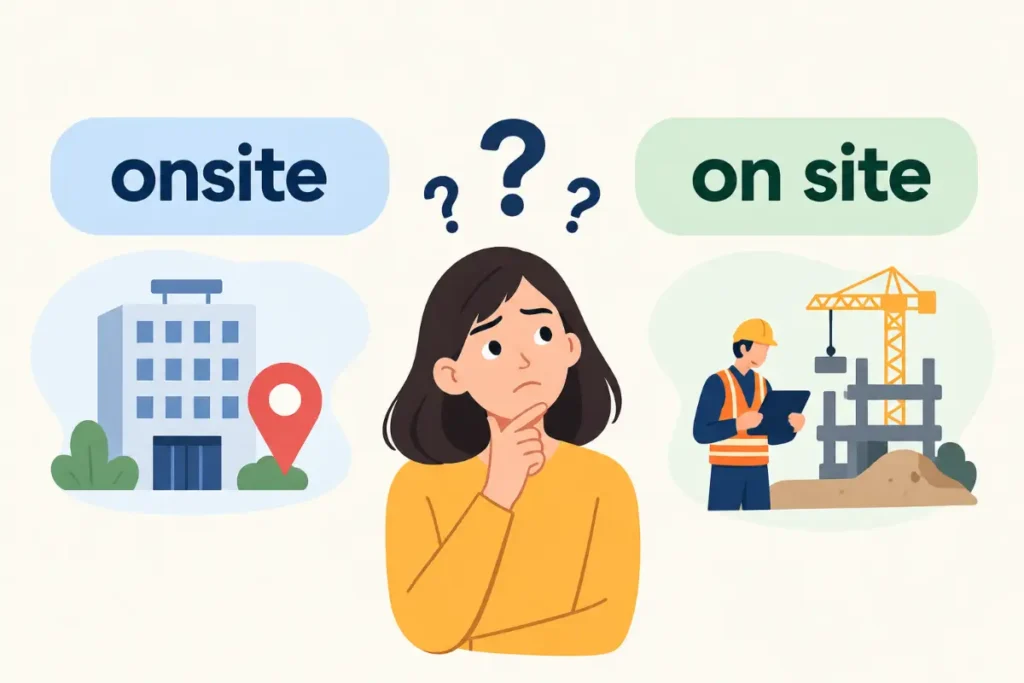
If you’ve ever paused over onsite vs on-site you’re dealing with a small spelling choice that can cause a surprising amount of confusion. Both forms appear in American English. The right choice depends on how you use the term in a sentence.
In most modern US writing onsite works best when the word acts as an adjective or adverb. On site also remains correct in many situations. The hyphenated form on-site appears in older writing and in some style guides but many current US publications prefer the closed form onsite.
The tricky part is that English spelling changes over time. Words that once needed a hyphen often become closed compounds after people use them often enough. That has happened with several terms. Onsite is one of them.
This guide explains the difference between the three forms. You’ll see how to use each one in real sentences. You’ll also learn which form works best for business writing websites emails resumes and everyday American English.
Quick Definition
Onsite means located at or happening at a particular place. It can describe a service employee event repair or activity that takes place at a specific location.
On site has the same basic meaning but uses two separate words. On site often appears when the phrase functions more clearly as a location phrase.
Direct Answer
For most modern American writing onsite is the best choice when you use the term as an adjective or adverb. On site is also correct when you are describing something that happens at a particular location. On-site is still seen but is less common in many modern style guides.
Comparison Table
| Form | Meaning | Example Sentence | When to Use It |
|---|---|---|---|
| Onsite | At or happening at a particular location. | We provide onsite support. | A strong choice for modern US writing. |
| On site | At the location or place being discussed. | The engineer is on site. | Useful as a location phrase. |
| On-site | Same basic meaning as onsite. | The company offers on-site training. | Still accepted in some styles and publications. |
Why This Spelling Causes Confusion
The confusion comes from the way English combines words. A phrase can begin as two separate words. Over time people may use it so often that it becomes a hyphenated compound. Later the hyphen may disappear completely.
That pattern has happened with many familiar words. Online was once commonly written as on-line. Today online is standard. Website also became the common closed form after earlier versions used a space or hyphen.
The same shift has affected onsite. You may still see on-site in older documents or in publications that follow a particular house style. You may also see on site in sentences where the phrase works naturally as a location expression.
That means seeing different versions does not automatically mean one writer made a spelling mistake. Usage depends partly on grammar and partly on style.
For most general American writing the simplest choice is to use onsite when it directly describes a person thing service or activity.
When To Use Onsite
Use onsite when the word describes something that happens at a specific location.
It commonly appears before nouns. In that position it acts as an adjective.
Consider these examples.
- The company provides onsite training.
- We offer onsite computer repair.
- The hospital has an onsite pharmacy.
- Our team provides onsite technical support.
- The school hired an onsite counselor.
- Employees can attend onsite meetings.
- The hotel offers onsite parking.
- The business has an onsite fitness center.
In each sentence onsite tells the reader where something happens or where something is located.
The word can also appear after a verb.
- Our technician is onsite today.
- The repair team is already onsite.
- A manager will be onsite during the event.
- Several staff members will remain onsite overnight.
This use has become common in American business writing. It is short and easy to understand.
Onsite As An Adjective
An adjective describes a person place thing or idea. When onsite comes before a noun and tells you where that noun exists or operates it acts as an adjective.
Look at this example.
We provide onsite training.
The word onsite describes the training. It tells you that the training happens at the location.
Compare that with this sentence.
We provide training onsite.
Here onsite comes after the verb and describes where the training takes place.
Both sentences communicate the same basic idea. The position changes but the meaning stays clear.
More examples can make the pattern easier to see.
- The company hired an onsite technician.
- An onsite technician will inspect the equipment.
- We have an onsite medical team.
- A medical team will be available onsite.
- The school offers onsite classes.
- Students can attend classes onsite.
This flexibility makes the closed form useful in everyday writing.
Onsite As An Adverb
An adverb can tell you where an action happens. Onsite can work this way when it follows a verb.
For example.
Our technician will work onsite tomorrow.
The word tells us where the technician will work.
Another example is:
The manager will be onsite during the inspection.
Here the word tells us where the manager will be.
This usage appears often in workplace communication. You might see it in schedules emails job descriptions service notices and company policies.
Consider these natural examples.
- The doctor will be onsite from 9 a.m. to 3 p.m.
- Our support team is onsite today.
- The contractor will arrive onsite early Monday.
- We can send someone onsite to inspect the issue.
- The technician remained onsite until the repair was complete.
These sentences sound natural to many American readers.
When To Use On Site
On site uses two words. It often works well when you are talking about a particular location in a more literal way.
For example:
The engineer is on site.
The phrase means the engineer is physically at the location being discussed.
You might use it in a conversation like this.
Has the engineer arrived yet?
Yes. She is on site now.
The location has already been established. The phrase simply tells us that she is physically there.
Another example is construction work.
The project manager arrived on site before the crew started.
Here on site clearly means at the project location.
You can use the same structure in many situations.
- The police arrived on site.
- The crew is already on site.
- The doctor is on site today.
- A supervisor must remain on site.
- The technician found the problem on site.
- Workers were injured on site.
This form is especially natural when the location itself matters.
The Difference Between Onsite And On Site
The meaning often overlaps. The main difference comes from how the phrase functions in the sentence.
Use onsite when you want a compact modifier.
The company offers onsite training.
Use on site when you want to emphasize the location.
The instructor will be on site tomorrow.
The difference can feel small because it is small. You don’t need to force a complicated rule onto every sentence.
Think about what you are trying to say.
If you are naming a type of service or facility use onsite.
- onsite support
- onsite training
If you are describing someone’s physical location use on site naturally.
The technician is on site.
The manager is on site.
The crew arrived on site.
Modern writing also allows onsite in many of these location sentences. That is why you’ll see both forms in current American English.
Is On Site Still Correct
Yes. On site remains a valid form.
Some writers assume that the closed spelling has replaced the two word version in every situation. That isn’t quite right. English allows both forms in many contexts.
For example:
The technician is on site.
This sentence is perfectly clear and natural.
You could also write:
The technician is onsite.
Many American readers would accept both.
The choice can depend on the publication or style guide. Some organizations prefer one form across all of their content. Consistency matters more than switching back and forth without a reason.
If you’re writing for a company website and the company consistently uses onsite then follow that style. If a publication uses on site in its editorial guidelines follow the publication’s preference.
For general US writing onsite is a safe modern choice when the word works as a modifier.
Is On Site Or Onsite Better For Business Writing
For most business writing onsite is a practical choice. It looks clean and works well in short phrases.
You might see it in job descriptions such as:
This is an onsite position.
That sentence tells applicants that they work at the company’s location rather than remotely.
You might also see:
The role requires onsite attendance three days a week.
Or:
We provide onsite support for business customers.
The closed spelling keeps these phrases compact.
Still don’t change every instance of on site just because you want a more modern look. A sentence like The manager is on site today reads naturally and does not need fixing.
The goal is clear writing. Don’t turn a simple spelling choice into a bigger problem than it needs to be.
Onsite In Job Descriptions
Job listings often use this term when they explain where employees work.
Common phrases include:
- Onsite position.
- Onsite role.
- Onsite work.
- Onsite employee.
- Onsite interview.
- Onsite training.
- Onsite support.
- Onsite manager.
For example:
This is an onsite position based in Chicago.
The word tells applicants that the job requires them to work at a physical workplace.
You may also see remote and hybrid used alongside it.
A company might describe three work arrangements as remote work hybrid work and onsite work.
These terms help applicants understand the basic expectations before they apply.
If you’re writing a resume you can also use the word naturally.
Provided onsite technical support to more than 200 employees.
That sentence tells a potential employer that the support happened at the workplace.
Onsite And Remote
The word onsite often appears as the opposite of remote.
Remote work happens away from the usual workplace. Onsite work happens at the workplace or another assigned physical location.
For example:
The company offers remote and onsite positions.
You might also write:
Employees can choose between remote work and onsite work.
In job listings the term can help readers quickly understand the work arrangement.
Some employers also use hybrid. Hybrid work combines remote work with time spent at a physical workplace.
For example:
This is a hybrid position with two onsite days each week.
That sentence gives the reader useful information without extra explanation.
Onsite Services
Many companies use onsite to describe services provided at the customer’s location.
Common examples include:
- Onsite repair.
- Onsite installation.
- Onsite maintenance.
- Onsite consultation.
- Onsite inspection.
- Onsite training.
- Onsite support.
- Onsite delivery.
Imagine a computer repair company. Customers may have the option to bring a computer to the shop or ask a technician to come to their location.
The company might say:
We offer onsite computer repair throughout the city.
That means the technician travels to the customer’s location.
The same idea works for many other services.
- Our team provides onsite equipment inspections.
- We offer onsite training for new employees.
- A technician can provide onsite installation.
These phrases are common because they quickly explain where the service happens.
Onsite Facilities
The word can also describe something available at a particular building or property.
- Hotels often use phrases like:
- The hotel has an onsite restaurant.
- Schools may advertise:
- The school provides onsite childcare.
- A workplace might offer:
- Employees have access to an onsite gym.
- A medical center could have:
- The clinic has an onsite laboratory.
In these examples onsite comes directly before a noun. It works as a clear adjective.
The reader immediately understands that the facility exists at the same location.
Common Mistakes With This Term
The biggest mistake is assuming that only one version can ever be correct. The reality is more flexible.
Another common problem is inconsistent style. A website might use onsite in one paragraph and on-site in another. That can make the writing look poorly edited even when readers understand the meaning.
Pick a preferred form and use it consistently.
Mixing All Three Forms
A document might contain these sentences:
- We offer onsite training.
- Our instructors provide on-site support.
- The manager will be on site.
None of these creates a serious meaning problem. Still the mix can look untidy if the document has no reason for the variation.
For general US business content choose onsite as your main form. Keep on site when it sounds natural as a location phrase.
Using A Hyphen Without A Reason
Many writers learned the term as on-site. That spelling is still seen and can be correct under certain style systems.
However modern American usage often prefers onsite.
If you’re writing new content for a general US audience you usually don’t need to add the hyphen.
Treating Onsite As A Noun
Onsite normally works as an adjective or adverb. Don’t use it as a noun by itself.
For example:
Incorrect: The onsite starts at nine.
Instead say:
Correct: The onsite training starts at nine.
Or:
Correct: The onsite session starts at nine.
The noun needs to tell the reader what you’re talking about.
How To Choose The Right Form
You can use a simple test.
First ask if the word directly describes a noun.
- onsite training
- onsite service
If yes then onsite is a strong choice.
Next ask if you’re simply saying someone or something is physically at a location.
The technician is on site.
The crew arrived on site.
In those sentences on site works naturally.
Then consider your style guide. If your workplace publication or client has a preferred form follow it consistently.
For everyday American writing you don’t need to overthink the choice. Clear context matters more than a tiny difference in spelling.
Examples Of Correct Usage
Seeing several examples side by side can make the pattern easier to remember.
Adjective use.
- We provide onsite customer support.
- The company has an onsite medical team.
- The school offers onsite classes.
- The hotel includes onsite parking.
- The business has an onsite cafe.
Location use.
- The technician is on site.
- The crew arrived on site early.
- The manager will be on site during the inspection.
- The doctor was on site when the patient arrived.
- The supervisor stayed on site until the work ended.
Adverb use with the closed form.
- Our technician is onsite today.
- The repair team will be onsite tomorrow.
- A specialist will be onsite during the event.
- Several employees will remain onsite overnight.
The examples show why both forms remain useful.

Onsite Or On Site In A Sentence
Sometimes both versions can work without changing the basic meaning.
- Consider:
- Our technician is onsite today.
- You could also write:
- Our technician is on site today.
- Both tell the reader that the technician is physically at the location.
- Now consider:
- We offer onsite repair services.
The closed form is especially natural because it acts directly as an adjective before repair services.
Writing on site repair services without a hyphen can look awkward because the phrase becomes harder to read as a unit.
This is one reason the closed form has become popular. It keeps common compound phrases simple.
What About On Site Training
This phrase deserves special attention because it appears often in education and business writing.
The preferred modern form is usually:
onsite training
For example:
New employees receive onsite training during their first week.
You can also write:
Training takes place on site during the first week.
The grammar changes slightly between the two sentences.
In the first sentence onsite describes training.
In the second sentence on site tells us where the training takes place.
That distinction gives you a useful way to decide which form feels right.
What About On Site Work
The phrase onsite work is common in modern business writing.
For example:
The contractor handles onsite work for commercial buildings.
Here onsite describes the type of work.
But if you’re talking about a worker’s location you might say:
The contractor is on site today.
The first sentence describes the work. The second describes the contractor’s location.
That small difference explains why both forms can appear in the same article or document.
Onsite And Hyphenated Compound Words
The hyphenated form on-site has not disappeared from English. Some dictionaries and style resources still list or recognize it. Some publications also retain it because their editorial style prefers hyphenated compounds.
A hyphen can help readers see two words as a single modifier. English writers often use hyphens for that reason.
For example:
on-site inspection
The hyphen makes the compound relationship clear.
However common compounds often lose their hyphens over time. Once readers become familiar with a term the closed spelling can become easier and more natural.
That’s why you’ll encounter onsite frequently in modern American writing.
The safest approach for general content is to follow the current style used by your audience and stay consistent throughout the piece.
Why Style Guides Can Disagree
English does not have one single authority that controls every spelling decision. Different dictionaries publications and style guides can make different recommendations.
A newspaper may follow one editorial system. A technology company may follow another. A government agency may have its own internal style guide.
That can explain why you find different versions in reliable sources.
It does not mean the language has become impossible to understand. It simply means English spelling has some variation.
For an everyday US audience onsite is a clear and widely understood choice. If you’re editing a specific publication follow its established house style.
A Simple Memory Trick
Think of onsite as the modern compact form for something located at a place.
You can connect it with words like:
- Online.
- Onscreen.
- Onboard.
- Offsite.
- Offshore.
These words often appear as closed compounds in modern English.
The connection is not a rule that applies to every word beginning with on. It is simply a useful memory aid.
When you see a phrase such as onsite support or onsite training the closed form should feel familiar.
For a location statement remember that on site can work naturally.
The technician is on site.
That simple distinction will handle most everyday writing situations.
FAQs
Is onsite or on-site correct?
Both forms can be correct. Modern American English commonly uses onsite as a closed word while on-site remains accepted in some style systems. For general US writing onsite is usually the cleaner modern choice.
Is onsite one word in American English?
Yes. Onsite is widely used as one word in American English. It commonly works as an adjective or adverb in phrases such as onsite training and onsite support.
Is on site two words or one word?
On site is two words. It often works as a location phrase when you describe someone or something as being at a particular place.
Should I use onsite or on-site in a resume?
Onsite is a good choice for a modern US resume. You might write onsite technical support or onsite training. The most important point is to use one style consistently throughout your resume.
Is onsite hyphenated in American English?
The hyphenated form on-site is still used and can be acceptable. However onsite has become common in modern American writing. Check your preferred style guide if you need to follow a specific editorial standard.
What is the difference between onsite and on site?
The meaning often overlaps. Onsite commonly acts as a modifier before a noun or as an adverb. On site often functions as a phrase that describes a physical location.
Is onsite formal English?
Yes. Onsite is suitable for professional and formal writing. You can use it in business documents job descriptions reports websites emails and other professional content.
What is the opposite of onsite?
The usual opposite is offsite or remote depending on the context. Offsite usually means away from the main location. Remote often refers to working or operating away from a physical workplace.
Conclusion
The choice between onsite vs on-site can look more complicated than it really is. For most modern American writing onsite is the best general choice. It works especially well before nouns such as training support services work and facilities.
On site remains useful when you are describing a physical location. A sentence like The technician is on site sounds natural and clear. You don’t need to replace every two word phrase with the closed form.
The hyphenated on-site form is also still found in American English. Some style guides and organizations prefer it. If you’re writing for a specific publication or company then follow its style rules and keep your spelling consistent.
For everyday US content the easiest approach is simple. Use onsite for common compound terms such as onsite training and onsite support. Use on site naturally when you’re talking about someone or something being at a particular location. Once you see the difference in context the choice becomes much easier.

Sienna Watson is a veteran copywriter and communications coach who has helped startup founders, marketers, and professionals polish their writing for over a decade. Realizing that most people don’t need a degree in linguistics—just clear, impactful communication—Sienna focuses on practical grammar, business writing etiquette, and eliminating wordiness. She advocates for plain language, strong verbs, and persuasive prose that gets results.