
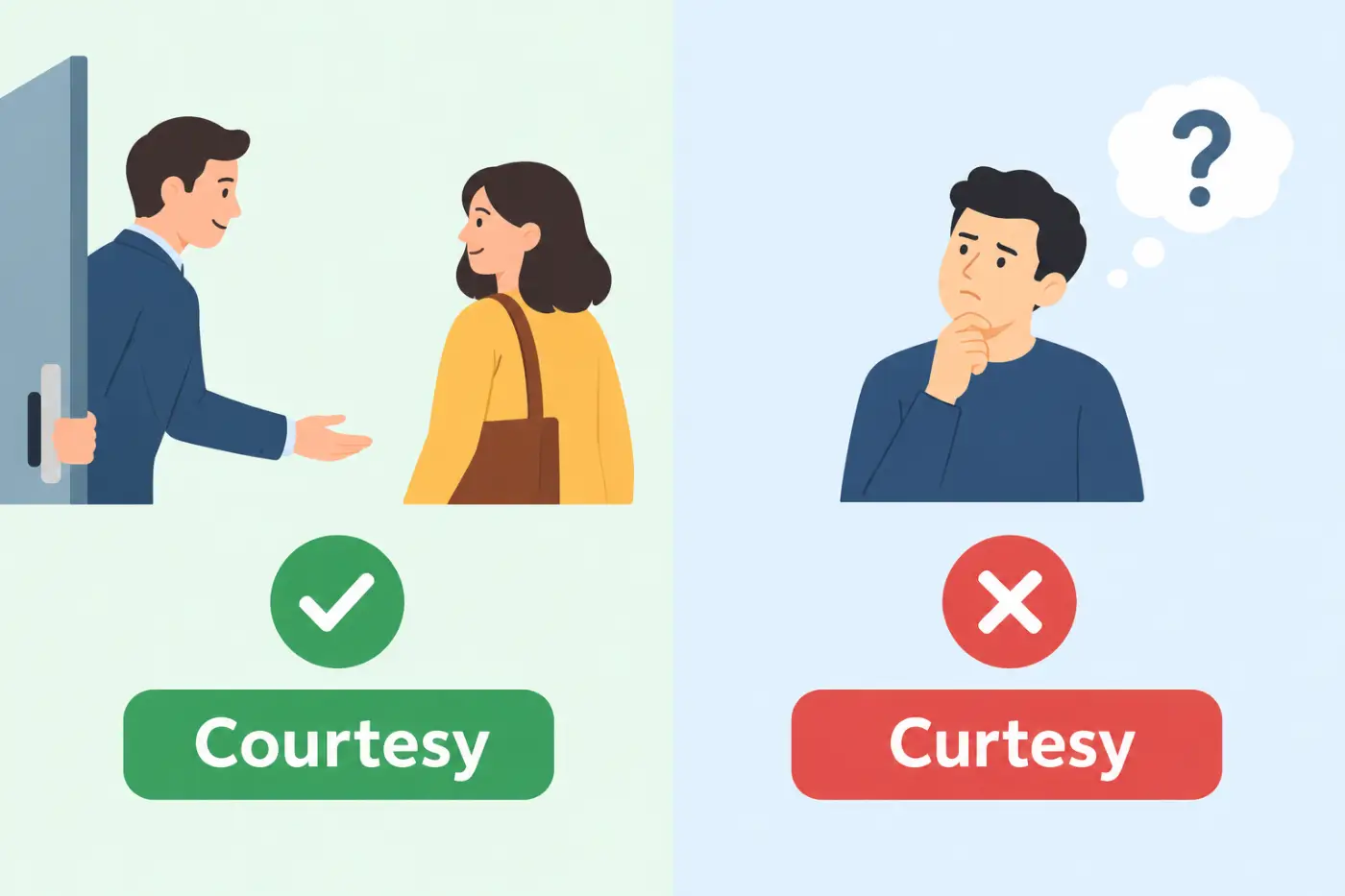
If you are unsure about courtesy vs curtesy you are dealing with a spelling mix up that can be surprisingly easy to make. The two forms look almost identical when you see them quickly. Only one is the standard spelling used in modern English.
The correct spelling is courtesy. It means polite behavior and respect toward other people. You can show courtesy by holding a door open by speaking politely or by giving someone your attention when they are talking.
The spelling curtesy has a different story. It can appear in older English and in some historical or specialized uses. However most people looking for the normal modern word should use courtesy.
This guide explains the difference in plain English. You will learn what courtesy means how to use it in a sentence why the spelling causes confusion and which common phrases use the word. You will also see examples that show how it works in everyday American English.
Quick Definition
Courtesy is the standard modern spelling for polite behavior respect and good manners. It can also refer to a polite act or something provided as a favor.
Curtesy is not the normal spelling for this meaning in modern American English. You may see it in older texts or in specific historical contexts.
Direct Answer
Courtesy is the correct spelling for the modern word that means polite behavior or a polite act. Curtesy is an uncommon historical form and should not replace the standard spelling in everyday writing.
Comparison Table
| Word | Meaning | Example Sentence | When to Use It |
|---|---|---|---|
| Courtesy | Polite behavior respect or a polite act. | She showed courtesy to everyone at the meeting. | Use this spelling in modern English. |
| Curtesy | An older form found mainly in historical writing. | The word may appear in older English texts. | Use it only when a historical context calls for it. |

What Does Courtesy Mean
Courtesy means treating other people with politeness and respect. It often involves small actions that show consideration for someone else.
For example you might hold a door for someone who is walking behind you. You might let another driver merge into traffic. You might listen without interrupting when someone is speaking. These simple actions can all show courtesy.
The word can also describe something given as a favor or provided free of charge. A hotel may offer a courtesy shuttle to its guests. A company may provide a courtesy call before an appointment. In these cases the word still carries the idea of something being offered as a polite service.
Courtesy does not always require a big gesture. In fact it often shows up in small everyday choices. Saying please and thank you can be enough. So can giving someone space or respecting their time.
How To Use Courtesy In A Sentence
The easiest way to understand this word is to see it in normal sentences. The meaning can change slightly based on the situation but the basic idea stays connected to politeness consideration or a favor.
Here are some natural examples.
- Please show courtesy to the other guests.
- He treated the staff with courtesy and respect.
- She thanked him for the courtesy of the invitation.
- As a courtesy we called the customer before sending the order.
- The hotel offers a courtesy shuttle to the airport.
- Basic courtesy can make a difficult conversation much easier.
- He held the door open as a simple courtesy.
- The driver showed courtesy by letting the pedestrian cross first.
These examples show why the word is useful in many settings. It works in casual conversations as well as professional writing.
Courtesy As Polite Behavior
One of the most common meanings of courtesy is good manners. When someone behaves with courtesy they think about how their actions affect other people.
Imagine you are sitting in a crowded waiting room. Someone nearby is talking loudly on the phone. Asking them politely to lower their voice would be an example of a courtesy based request.
The same idea applies at work. If a coworker is speaking during a meeting you can show courtesy by listening instead of talking over them. You do not need to agree with everything they say. You simply give them a fair chance to speak.
Courtesy can also help during disagreements. People can hold very different opinions and still treat each other with respect. A calm tone and thoughtful words often make a conversation much easier.
Courtesy As A Favor
The word can also describe something provided as a favor.
For example a business might offer a courtesy ride to customers. A restaurant might provide a courtesy dessert after a long wait. A hotel might make a courtesy call to confirm a reservation.
In these examples courtesy does not simply mean good manners. It describes something given as a polite gesture or service.
Consider this sentence.
The hotel provided a courtesy shuttle for guests.
The shuttle is not necessarily part of the basic service the guest paid for. The hotel provides it as an extra convenience.
Another example is a courtesy call.
The dentist’s office made a courtesy call to confirm my appointment.
The call helps the customer and shows consideration. That is why courtesy fits naturally in the phrase.
Courtesy And Common Phrases
You will find this word in many familiar expressions. Learning these phrases can help you recognize the correct spelling without having to think about it each time.
Common Courtesy
Common courtesy means basic polite behavior that most people expect from others.
For example saying thank you after someone helps you is a matter of common courtesy. Waiting your turn in a line is another simple example.
You might hear someone say that a person lacks common courtesy. That usually means the person behaves in a way that ignores basic manners.
Courtesy Call
A courtesy call is a phone call made as a polite service or helpful reminder.
For example a medical office may make a courtesy call before an appointment. A repair company may call to let you know that a technician will arrive soon.
The call may not be required but it helps keep the customer informed.
Courtesy Of
The phrase courtesy of can mean provided by someone or with someone’s permission.
For example you might see a photo caption that says it is courtesy of a local organization. That means the organization provided the photo or gave permission for its use.
You can also use the phrase in everyday speech.
The tickets were courtesy of my brother.
This means my brother provided the tickets.
As A Courtesy
The phrase as a courtesy means something is done as a polite gesture.
For example a store might offer a small discount as a courtesy after an inconvenience. A company might send a replacement item as a courtesy.
The action is usually meant to show consideration rather than fulfill a basic obligation.
Why The Spelling Causes Confusion
The spelling problem comes from the fact that the word sounds like it could be written with a u after the first few letters. When people say the word they hear the same pronunciation no matter how they spell it.
English has many words where pronunciation does not clearly reveal spelling. That can make spelling by sound unreliable.
There is another reason this particular mistake can stick in your mind. The letters in courtesy do not look exactly like the way the word sounds when you say it slowly.
The first part is pronounced roughly like court. That connection can help you remember the spelling. Think of court plus esy when you need a quick memory aid.
This does not give you the full history of the word but it gives you a useful visual reminder. When you see the beginning of the word you can connect it with court.
Where The Word Comes From
The history of courtesy helps explain its spelling. The word is related to the idea of behavior expected at a royal or noble court.
It came into English through French and developed from words connected with courtly behavior. In older European culture people associated a court with rules of conduct manners and social behavior.
Over time the meaning became broader. You no longer need to belong to a royal court to show courtesy. Today the word applies to ordinary interactions between friends coworkers customers neighbors and strangers.
That history also helps explain why the spelling may look less obvious than the pronunciation. English has absorbed many words from French and other languages. Their spellings often stayed partly connected to their earlier forms.
You do not need to know this history to spell the word correctly. Still it gives you a useful picture. Think about courtly manners and then connect that idea with courtesy.
Is Curtesy Ever A Word
This is where the question gets more interesting.
You may find curtesy in historical sources or older forms of English. It has been used as an alternative spelling in the past. It can also appear in specialized historical discussions.
That does not make it the normal choice for modern everyday writing.
If you are writing an email to a customer or a school assignment about good manners you should use courtesy. If you are describing a historical document and the original text uses curtesy you may need to preserve that spelling when quoting or discussing the source.
Context matters here. An old spelling can exist without being the spelling you should use today.
For modern American English the practical rule is simple. Use courtesy for the ordinary word meaning politeness respect or a polite favor.
Courtesy In American English
American English uses courtesy in many everyday situations. You might hear the word at a hotel airport office school restaurant or store.
A sign might say Courtesy Phone. A hotel might advertise a courtesy shuttle. A business might offer something as a courtesy after a customer has experienced a problem.
The word also appears in personal conversations.
- Thanks for the courtesy.
- He showed me a lot of courtesy.
- A little common courtesy goes a long way.
These phrases sound natural because courtesy is a familiar part of everyday English.
The word can sound slightly formal in some casual conversations. Still it is not old fashioned. It remains common in both spoken and written American English.
Courtesy And Politeness
Courtesy and politeness are closely related. In many sentences you can use either word without changing the main idea.
For example you can say:
She treated everyone with courtesy.
You can also say:
She treated everyone with politeness.
The first sentence sounds more natural in many situations. Courtesy often suggests an action or behavior that shows respect. Politeness can describe a person’s general manner.
Consider another example.
He held the door open as a courtesy.
You would not normally replace courtesy with politeness here. The sentence describes a specific polite action rather than a general personality trait.
So while the words overlap they do not always work in exactly the same places.
Courtesy And Respect
Courtesy and respect are also connected but they are not identical.
Respect often involves recognizing another person’s value rights experience or position. Courtesy usually focuses more on how you behave toward that person.
You can show courtesy even when you disagree with someone. You might listen to their opinion without interrupting. You might answer calmly instead of becoming rude.
Respect can go deeper than good manners. Courtesy is often one visible way of showing respect.
Think of courtesy as one of the everyday tools people use to treat others well.
Common Mistakes With Courtesy
Spelling mistakes are not the only source of confusion. Writers sometimes use the word in the wrong way or choose a phrase that does not fit the situation.
Using Curtesy In Modern Writing
The most common mistake is simply choosing the uncommon spelling when you mean ordinary politeness.
For modern writing use courtesy.
If your sentence talks about good manners a polite act or a free service provided as a favor this is the spelling you want.
Confusing Courtesy With Courtesy Of
Another mistake happens when people use courtesy of without understanding what it means.
Courtesy of the museum can mean that the museum provided something or allowed something to be used.
For example:
The photograph is courtesy of the city museum.
That tells readers where the photograph came from or who provided it.
It does not simply mean the photograph shows polite behavior.
Using Courtesy When You Mean Kindness
Courtesy and kindness overlap but they are not perfect synonyms.
Kindness often involves caring about another person’s needs or feelings. Courtesy usually refers to polite and respectful behavior.
A stranger who gives you directions may show kindness. A person who waits patiently while you finish speaking is showing courtesy.
A single action can show both.
Examples Of Common Mistakes
Seeing a mistake next to the correct form makes the difference easier to remember.
- Incorrect:
- Thank you for your curtesy.
- Correct:
- Thank you for your courtesy.
- Incorrect:
- The hotel offers a curtesy shuttle.
- Correct:
- The hotel offers a courtesy shuttle.
- Incorrect:
- He showed great curtesy toward the guests.
- Correct:
- He showed great courtesy toward the guests.
- Incorrect:
- As a curtesy the company sent a replacement.
- Correct:
- As a courtesy the company sent a replacement.
The pattern is simple. In modern English the standard spelling is courtesy.
How To Remember The Spelling
A good memory trick can save you from second guessing yourself.
Think Of Court
The easiest trick is to connect the word with court.
The word begins with cour. You can picture a court and then think of the polite behavior that might be expected in a formal setting.
Court can lead you toward courtesy.
This works because the beginning of the word gives you a visual anchor. Instead of trying to remember every letter at once you only need to remember the part that causes the most trouble.
Remember The O
Another useful trick is to remind yourself that the word has an o after the c.
- It is courtesy.
- Not curtesy for the normal modern meaning.
That single letter can make the difference.
Learn The Word In A Phrase
Rather than memorizing the spelling by itself learn a phrase you already use.
- Common courtesy.
- Courtesy call.
- Courtesy shuttle.
- As a courtesy.
When you remember the word as part of a familiar phrase the spelling becomes easier to recall.
Related Words From The Same Family
Learning related words can strengthen your spelling memory. Several words connect with the same idea of polite behavior and social manners.
Courteous
Courteous is an adjective. It describes someone who behaves politely and respectfully.
The receptionist was courteous and helpful.
Courteously
- Courteously is an adverb. It describes an action done in a polite way.
- She courteously answered every question.
Discourteous
Discourteous describes behavior that is rude or lacking in courtesy.
His discourteous response surprised everyone.
These words all connect to the same basic idea. When you know the word family you have more chances to reinforce the correct spelling.
Courtesy In Professional Writing
Courtesy matters in professional communication because small choices can affect how readers see you.
Imagine two emails asking for the same thing. One sounds demanding while the other sounds respectful. The second email may get a better response because it shows consideration for the person receiving it.
You do not need to fill a message with formal language. Simple words often work best.
For example:
Please send the updated file when you have a chance. Thank you for your help.
That message shows courtesy without sounding stiff.
The word itself may also appear in workplace policies and customer service messages.
- Please extend common courtesy to all staff members.
- A courtesy reminder will be sent before your appointment.
- The company offers a courtesy replacement for damaged items.
Each use has a slightly different meaning but the central idea remains the same.

Courtesy In Customer Service
Businesses often use the word when they want to show that an action is being offered as a favor or extra service.
A hotel might give a guest a courtesy upgrade. An airline might provide a courtesy announcement. A company might make a courtesy call before a scheduled visit.
These phrases can make a service sound more considerate. However the actual meaning depends on what the business provides.
If a company says something is offered as a courtesy it usually means the customer is receiving it as a gesture rather than as part of a basic requirement.
For example:
We are offering a replacement as a courtesy.
That sentence suggests the company is choosing to help the customer even if it does not have to do so.
Courtesy In Everyday Conversation
You do not need to work in customer service to use this word. It fits many ordinary situations.
You might say that someone showed courtesy when they waited for you. You might thank a friend for a courtesy they extended. You might complain that a driver showed no courtesy on the road.
Here are a few natural examples.
- She showed courtesy by waiting until everyone had finished speaking.
- He offered me a seat as a courtesy.
- A little courtesy would have prevented the argument.
- The driver showed courtesy and let us merge.
- Thank you for the courtesy of letting me know.
These examples sound natural because the word describes real actions people take every day.
When To Use Courtesy
Use courtesy when you are talking about polite behavior respect good manners or a polite favor.
It works as a noun in sentences such as:
- Courtesy is important when dealing with customers.
- He showed courtesy to everyone in the room.
- She thanked him for the courtesy.
It also appears in common phrases such as:
- common courtesy
- courtesy call
- courtesy shuttle
- courtesy service
- as a courtesy
- courtesy of
If your sentence fits one of these meanings the standard spelling is the one you want.
When Not To Use Curtesy
For normal modern writing there is little reason to choose curtesy.
Do not use it in a school paper simply because it looks familiar. Do not use it in an email because you have seen the spelling somewhere online. Older texts can contain spellings that are no longer standard today.
If you are editing modern American English use courtesy.
The main exception is historical work. If you are studying an old document you may need to discuss or preserve the spelling used in that source. In that case the unusual form belongs to the historical context rather than ordinary modern English.
A Simple Spelling Test
If you are still unsure about the spelling try this quick test.
Ask yourself what the word means.
If you mean polite behavior good manners a polite act or a service offered as a favor then think of court.
The word starts with cour.
Then complete it as courtesy.
You can also put it into a familiar phrase.
Common courtesy.
That phrase makes the spelling much easier to recognize.
More Real World Examples
A word becomes easier to understand when you see it used in different situations. The following examples cover several meanings you are likely to encounter.
At A Hotel
The hotel provides a courtesy shuttle for guests.
Here the word describes an extra service provided for guests.
At A Medical Office
The office made a courtesy call to confirm my appointment.
The call is a polite reminder and a helpful service.
At Work
She showed courtesy by listening to her coworker’s concerns.
Here the word refers to respectful behavior.
In A Store
The manager offered a refund as a courtesy.
The manager is providing the refund as a gesture of goodwill.
In A Conversation
Common courtesy means giving people a chance to speak.
Here the word describes basic good manners.
In A Photo Credit
The image is courtesy of the local library.
In this case the phrase tells readers who provided the image or allowed it to be used.
Why Courtesy Is A Useful Word
Some words describe ideas that are hard to express with one simple term. Courtesy is useful because it can cover both behavior and gestures.
You can show courtesy. You can offer courtesy. You can receive something as a courtesy. You can ask for common courtesy. You can describe a service as a courtesy.
That flexibility explains why the word appears in so many settings.
It also has a useful balance. The word sounds more polished than simply saying nice behavior but it does not feel overly formal. That makes it useful in professional messages as well as everyday writing.
A Quick Difference Between Similar Words
Several words sit close to courtesy in meaning. Knowing the small differences can make your writing more precise.
- Courtesy usually means polite behavior or a polite act.
- Politeness usually means good manners in general.
- Respect often means treating someone as valuable or worthy of consideration.
- Kindness usually means acting with care or goodwill toward someone.
- Manners refers to the accepted ways people behave politely in social situations.
These words can overlap. Still they are not exact copies of one another.
For example a person can show kindness by bringing food to a sick neighbor. A person can show courtesy by keeping their voice down in a shared space. A person can show respect by listening carefully to another person’s opinion.
FAQs
Is courtesy the correct spelling?
Yes. Courtesy is the standard spelling in modern American English. It means polite behavior a polite act or something provided as a favor.
Is curtesy an incorrect word?
For normal modern English curtesy is not the spelling you should use. It can appear as an older or historical form. In everyday writing choose courtesy.
What does courtesy mean?
Courtesy means polite and respectful behavior. It can also describe a favor or extra service provided as a polite gesture.
How do you spell courtesy correctly?
The standard spelling is courtesy. A helpful memory trick is to connect the first part of the word with court.
What is an example of courtesy?
Holding a door open for someone can be an example of courtesy. Offering a customer a free replacement as a goodwill gesture can also be described as a courtesy.
What does courtesy of mean?
Courtesy of usually means that someone provided something or gave permission for it to be used. For example a photo credited as being courtesy of a museum was provided by the museum or used with its permission.
What is a courtesy call?
A courtesy call is a phone call made as a polite service or helpful reminder. A doctor’s office might make one to confirm an appointment.
Is courtesy the same as respect?
They are closely related but they are not exactly the same. Courtesy usually focuses on polite behavior while respect can involve a deeper recognition of another person’s value rights or feelings.
Conclusion
When you see courtesy vs curtesy the practical answer is simple. Use courtesy in modern American English when you mean politeness good manners a polite action or an extra service offered as a favor.
The spelling can feel confusing because the word does not sound exactly like it looks. Remember the beginning of the word by connecting it with court. Then think of familiar phrases such as common courtesy courtesy call and courtesy shuttle.
The form curtesy has appeared in older English and can still show up in historical material. That does not make it the normal spelling for modern writing. Unless you are dealing with a historical source there is no reason to choose it.
The next time you need the word for polite behavior pause for a second and picture court. Then write courtesy. That small memory trick can help you get the spelling right without having to look it up.

Sienna Watson is a veteran copywriter and communications coach who has helped startup founders, marketers, and professionals polish their writing for over a decade. Realizing that most people don’t need a degree in linguistics—just clear, impactful communication—Sienna focuses on practical grammar, business writing etiquette, and eliminating wordiness. She advocates for plain language, strong verbs, and persuasive prose that gets results.