
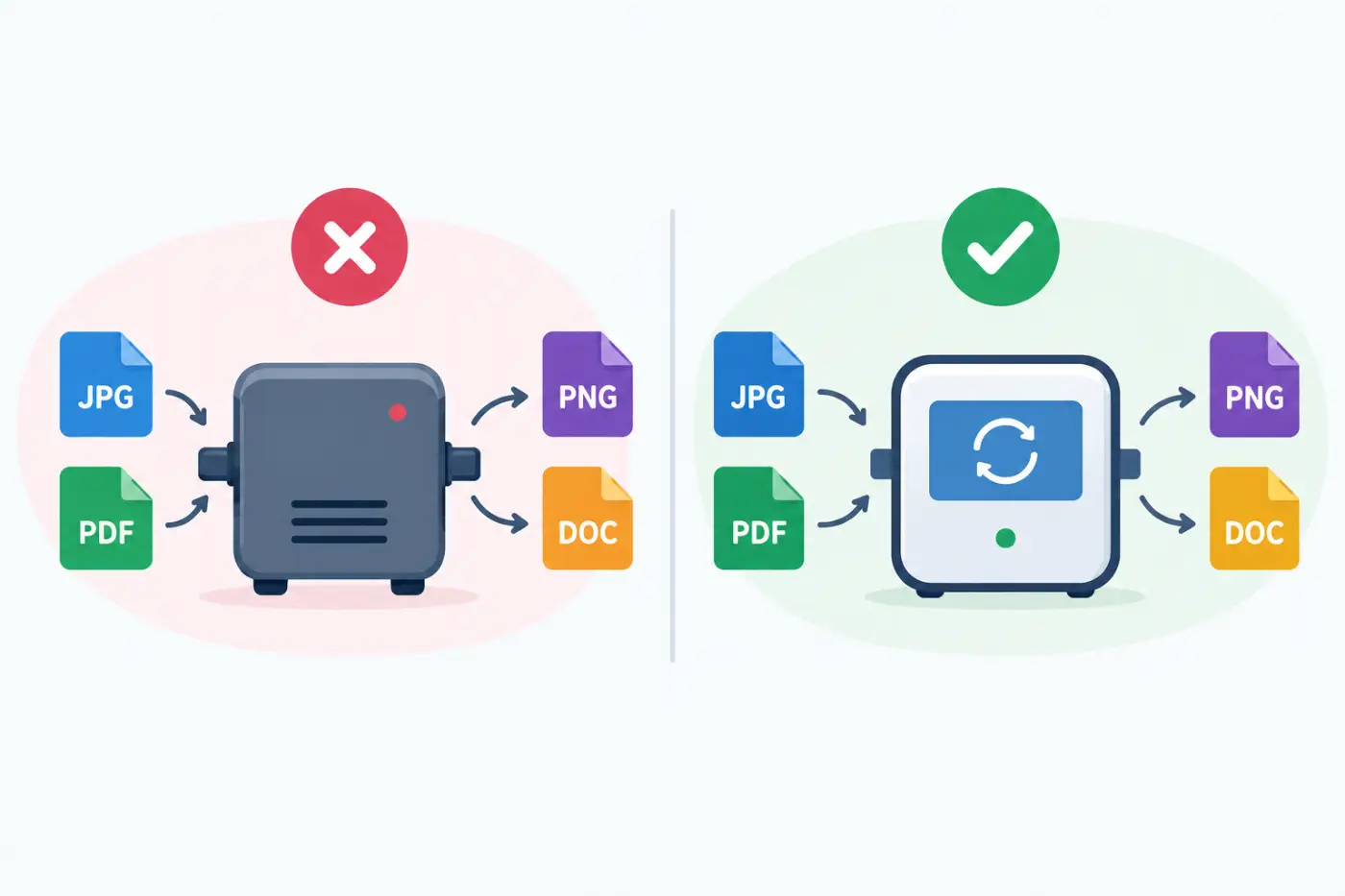
If you’re unsure about convertor vs converter you may be surprised to learn that both spellings appear in English. The difference is not as simple as saying one is always wrong. Converter is the standard form in American English and the spelling you’ll see most often in everyday writing. Convertor is also a recognized variant and appears in some British English usage.
Both words refer to a person or thing that converts something from one form into another. A converter can change a file format change electrical current convert a signal or alter one type of measurement into another. The meaning stays the same even when the spelling changes.
For most US readers the choice is easy. Use converter in regular writing. You’ll see it in familiar terms such as currency converter catalytic converter and digital converter. American dictionaries also list convertor as a variant but converter is the spelling most readers expect.
This guide explains the difference between the two spellings. You’ll learn where each form appears how to use the word in real sentences and why the ending can cause confusion. We’ll also look at common types of converters and some related words that can make the spelling easier to remember.
Quick Definition
A converter is a person device or program that changes something from one form into another. Convertor has the same basic meaning and is recognized as a spelling variant in major dictionaries. Cambridge and Oxford both list convertor alongside converter.
Direct Answer
Converter is the standard spelling to use in American English. Convertor is also a valid variant but it appears less often in US writing.
Comparison Table
| Word | Meaning | Example Sentence | When To Use It |
|---|---|---|---|
| Converter | A person device or program that changes something into another form. | I used a currency converter to check the exchange rate. | Use this as your normal choice in US English. |
| Convertor | A variant spelling with the same basic meaning. | The machine works as a signal convertor. | You may see it in some British English and technical contexts. |
Why Both Spellings Exist
The confusion comes from English word formation. Many nouns that describe a person or thing performing an action end in er. Others end in or. Both endings are common in English and sometimes both forms develop for the same word.
The verb convert means to change something from one form into another. Cambridge gives examples such as converting pounds into kilograms and changing one type of system into another.
When English forms a noun from this verb the ending er produces converter. The ending or produces convertor. Both forms can be found in dictionaries which explains why you may see the two spellings in published writing.
The key point is that this isn’t a case like color and colour where regional spelling clearly separates the two forms. Convertor and converter can both refer to the same kind of person or thing. The main difference for most writers is frequency and regional preference.
Why Converter Is Usually The Better Choice In The US
American English generally favors converter. If you’re writing for an American audience then this spelling will look more familiar and natural.
You can see this preference in common terms used across technology engineering automobiles and finance. People commonly write catalytic converter currency converter and analog to digital converter. Major American dictionary entries also recognize converter as the main form.
That makes converter a safe choice for school assignments websites business documents emails and general writing.
For example:
- I need a currency converter for this calculation.
- The mechanic replaced the catalytic converter.
- This program includes a file converter.
- The device has a built in signal converter.
These sentences sound natural to US readers because converter is the familiar form.
What Does Converter Mean
The basic meaning is simple. A converter changes something from one form into another.
That change can happen in many different ways. A device can change electrical power. A website can change one currency into another. A computer program can change a file from one format to another. A machine can change one type of signal into another.
Oxford defines a converter as a person or thing that converts something. It also gives technical meanings for devices that change electrical current or radio signals and for computer programs that change data from one format to another.
The word therefore has a broad meaning. You don’t need to think of a converter as one specific machine.
Think of it as a bridge between two forms. Something goes in one way and comes out another way.
Common Types Of Converters
The word appears in many areas of everyday life. Once you know the basic meaning it becomes easier to understand the different types.
Currency Converter
A currency converter changes an amount from one currency into another based on an exchange rate.
For example you might use one to see how much 100 US dollars are worth in euros. Travelers often use currency converters before spending money in another country.
Example:
- I checked a currency converter before booking the hotel.
The tool doesn’t change the money itself. It calculates the value of one currency in another.
Catalytic Converter
A catalytic converter is part of a vehicle’s exhaust system. It helps change harmful substances in exhaust gases into less harmful compounds.
This is one of the most familiar uses of the word in the United States. Cambridge gives catalytic converter as a common example and notes its role in reducing the toxicity of vehicle exhaust.
Example:
- The mechanic said the catalytic converter needed to be replaced.
Here the word converter refers to a physical device that changes substances.
File Converter
A file converter changes a digital file from one format into another.
You might convert a document into a PDF. You might turn an image into another file type. A video converter can also change a video from one format into another.
Example:
- I used a file converter to change the document into a PDF.
Oxford lists computer programs that convert data from one format to another as one meaning of converter.
Digital Converter
A digital converter changes information between different forms of digital and analog signals.
A common example is an analog to digital converter. It changes an analog signal into digital data that a computer can process.
Example:
- The device uses a digital converter to process the incoming signal.
The exact type of converter depends on what kind of signal or information is being changed.
Signal Converter
A signal converter changes one type of signal into another. This can help different pieces of equipment communicate or work together.
For example a system may need to change one signal type into another before a device can read it.
Oxford includes devices that change radio signals from one frequency to another under its definition of converter.
Example:
- The technician installed a signal converter to connect the two systems.
The word still follows the same basic idea. Something enters in one form and leaves in another.
Is Convertor Wrong
No. Convertor is not simply a misspelling. Major dictionaries recognize it as a variant of converter. Cambridge lists convertor as an alternative form while Oxford does the same.
That said the spelling you choose still matters because readers have different expectations. In American English converter is the safer everyday choice.
Think about your audience before choosing the less common form. If you’re writing a US website article a school paper or a business email then converter will usually be the natural option.
If you encounter convertor in a British source or a technical document you don’t need to assume it is an error. It can be a legitimate spelling variant.
This distinction is useful because it prevents a common mistake in editing. Not every less familiar spelling is incorrect. Sometimes English allows more than one accepted form.
How To Choose The Right Spelling
If you’re writing for a US audience then converter is the most natural choice. It’s the form most readers will recognize in common terms such as currency converter file converter and catalytic converter.
Convertor isn’t automatically wrong. It has a place in English and can appear in some technical or regional writing. Still using the more familiar form can make your writing easier to read because your audience won’t stop and wonder if you’ve made a spelling mistake.
For most everyday situations the choice is simple. Write converter unless you have a specific reason to follow a source style that uses convertor.
Use Converter In General Writing
Choose converter for websites school assignments emails instructions and general business writing. It works naturally across a wide range of subjects.
For example.
- I need an online currency converter.
- The technician installed a new signal converter.
- This tool works as a PDF converter.
- The car needs a new catalytic converter.
- I downloaded a video converter for the project.
Each sentence uses the spelling most US readers expect.
Use Convertor When A Source Uses It
You may come across convertor in a technical document product name or regional publication. If the spelling belongs to an official name or established term then keeping the original form can make sense.
For example a manufacturer might call a particular product a convertor. In that case changing the spelling could make the product name inaccurate.
The same idea applies when you’re quoting or discussing a source. You don’t need to change every accepted spelling to match your personal preference.
The Difference Between Convertor And Converter
The practical difference is mainly spelling preference rather than meaning. Both forms describe something that converts or changes something from one form into another.
That means you shouldn’t expect a different definition just because the ending changes from er to or. A device described as a convertor can perform the same basic kind of conversion as one described as a converter.
The bigger difference is how familiar each form feels to a particular audience. Converter is the form most US readers will expect. Convertor may appear less often and can have a more specialized or regional feel.
This is why context matters. A spelling can be accepted and still not be the best choice for a particular audience.
Why The Ending Causes Confusion
English uses both er and or endings to create nouns from verbs. That can make it difficult to predict which ending belongs to a particular word.
Consider these examples.
- Teacher.
- Writer.
- Driver.
- Builder.
- Creator.
- Operator.
- Instructor.
The first group uses er while the second group uses or. English does not give writers one simple rule that works for every verb.
The word convert creates an interesting case because both converter and convertor exist. That makes the spelling question more complicated than a basic right or wrong choice.
When you see two accepted forms it helps to look at usage rather than trying to force a spelling rule onto the word.
Converter In Technology
Technology is one area where this word appears constantly. A converter can change digital files signals data or other forms of information.
A file converter might change a Word document into a PDF. An image converter might change one image format into another. A video converter might change a video so that it works on a different device.
For example.
- The file converter changed the document into a PDF.
- I need an image converter for this project.
- The video converter supports several file formats.
The basic idea stays the same. The original item goes in and another usable form comes out.
Analog To Digital Conversion
You may also hear the term analog to digital converter. This is commonly shortened to ADC.
An analog to digital converter changes an analog signal into digital information. Computers and other digital systems can then process that information.
A microphone provides a simple example. Sound creates an analog signal and electronic equipment can convert that signal into digital data.
You don’t need to understand the technical details to understand the word itself. The device is called a converter because it changes one form into another.
Digital To Analog Conversion
The reverse process also exists. A digital to analog converter changes digital information into an analog signal.
This process appears in many types of electronic equipment. Audio systems are a familiar example because digital audio can be converted into signals that speakers can use.
Again the name follows the same basic idea. The device performs a conversion so it is called a converter.
Converter In Cars
Automotive writing uses the word frequently. The catalytic converter is a well known part of a vehicle’s exhaust system.
Its job is to help reduce certain harmful pollutants in exhaust gases. It uses chemical reactions to change some pollutants into less harmful substances.
For example.
- The mechanic checked the catalytic converter during the inspection.
- A damaged catalytic converter can cause vehicle problems.
- The replacement part was installed under the vehicle.
This is one reason converter is so familiar to American readers. People see the term in repair bills vehicle manuals news reports and conversations about cars.
Converter In Finance
A currency converter is another everyday use. It helps people compare the value of one currency with another.
Imagine you’re planning a trip and want to know how much $500 is worth in another currency. A currency converter can provide an estimate based on an exchange rate.
Example sentences include.
- I used a currency converter before planning my travel budget.
- The website has a built in currency converter.
- Check the exchange rate before using the converter.
Keep in mind that exchange rates can change. A converter may also use a different rate from the one offered by a bank or card provider.
The spelling still doesn’t change. In normal US writing the familiar form is converter.
Converter In Everyday Writing
You don’t need a technical subject to use this word. People use converters for simple tasks every day.
You might convert temperatures when checking the weather. You might convert miles into kilometers before a trip. You might convert pounds into kilograms while following a recipe or comparing product information.
These tools are often called converters because they change one measurement into another.
Temperature Converter
A temperature converter can change Fahrenheit into Celsius or Celsius into Fahrenheit.
Example.
- I used a temperature converter to check the forecast in another country.
Measurement Converter
A measurement converter can change units such as inches into centimeters or miles into kilometers.
Example.
- The measurement converter helped me change the dimensions from inches to centimeters.
Weight Converter
A weight converter can change pounds into kilograms or other units.
Example.
- I used a weight converter to check the package weight in kilograms.
These examples show how broad the word can be. A converter isn’t limited to machines or computer programs. It can also describe a simple online tool that performs a calculation.
Common Mistakes To Avoid
The biggest mistake is assuming that convertor must always be wrong simply because converter is more familiar. That isn’t accurate. Both forms have a place in English.
Another mistake is treating the two spellings as if they have completely different meanings. They don’t. The core idea is the same.
A third mistake is choosing the less familiar spelling when writing for a US audience without a clear reason. Even an accepted variant can distract readers if they rarely see it.
Good editing isn’t only about asking if a word exists. It also involves asking which form fits the audience and context.
How To Remember Converter
A simple memory trick can help. Think of common words that end in er when they describe something that performs an action.
A teacher teaches. A writer writes. A driver drives. A converter converts.
This isn’t a rule that applies to every English word. It is simply a useful memory aid for this particular spelling.
You can also connect the word to familiar phrases.
- Currency converter.
- File converter.
- Catalytic converter.
- Unit converter.
The more familiar these phrases become the easier it is to remember the spelling.
Which Form Sounds More Natural
For most American readers converter will sound more natural. That’s especially true in everyday phrases and general purpose writing.
Compare these examples.
- I used a currency converter.
- I used a currency convertor.
The second sentence isn’t necessarily impossible or meaningless. It simply uses a less familiar form for many US readers.
The same pattern appears in technical writing. A specialist audience may already be familiar with a particular spelling used in its field. In that situation context can matter more than general preference.
If you’re writing content for a broad American audience there is little reason to make the reader work harder. Converter is clear familiar and widely understood.
Convertor Vs Converter In British English
Regional English can add another layer to the question. British English sometimes uses convertor as a variant while converter also appears widely.
This means you may encounter both forms when reading British websites books manuals or technical material. Seeing convertor in a British source doesn’t automatically mean the writer made a spelling mistake.
American writers have a simpler practical choice because converter is the familiar form for most general uses.
If you’re editing content for an international audience you can also check the style guide used by the publication. A consistent spelling matters more than switching between forms from sentence to sentence.
Why Consistency Matters
Suppose an article uses converter in one section and convertor in another without any reason. A reader may wonder if the two words have different meanings.
They don’t need that distraction.
Pick the form that fits your audience and use it consistently. For general US content that usually means converter.
Consistency also helps search engines and readers understand your topic. More importantly it makes the article look carefully edited.
Good writing should feel natural. The reader shouldn’t have to stop and think about a spelling choice that doesn’t affect the meaning.
A Simple Rule For Everyday Writing
If you’re still unsure about convertor vs converter use one practical rule. For standard US English choose converter.
You can use it for people devices software tools and systems that change one thing into another. It works across technology automotive finance measurements and many other fields.
Keep convertor in mind as a recognized variant rather than treating it as a simple typo. If you see it in a trusted source you can understand what the writer means without assuming the entire sentence is incorrect.
For your own writing the safer everyday choice remains converter. It is familiar clear and widely accepted.
Related Words And Forms
Understanding related words can make the spelling easier because converter belongs to a larger word family. The main verb is convert. From that verb we get several useful forms that appear in everyday writing.
Convert
Convert is the verb. It means to change something from one form type or use into another.
For example:
- We need to convert the file into a PDF.
- The app can convert miles into kilometers.
- She decided to convert the document into another format.
The action is the conversion itself. The thing or tool that performs the action can be called a converter.
Conversion
Conversion is the noun for the act or process of changing something.
For example:
- The conversion took less than a minute.
- The software handles currency conversion.
- The conversion from Fahrenheit to Celsius is easy.
This word appears often in technology finance science and measurement.
Convertible
Convertible is an adjective that describes something that can be converted or changed. It can also describe something that can change into another form.
For example:
- The file is convertible to several formats.
- The sofa has a convertible design.
The word can also describe a type of car with a roof that can be folded down. That meaning is different but comes from the same basic idea of changing form.
Converted
Converted is the past tense and past participle of convert.
For example:
- I converted the file yesterday.
- The old document was converted into a PDF.
- She converted the measurements before starting the project.
Seeing these related forms together can help you remember the spelling of the noun.
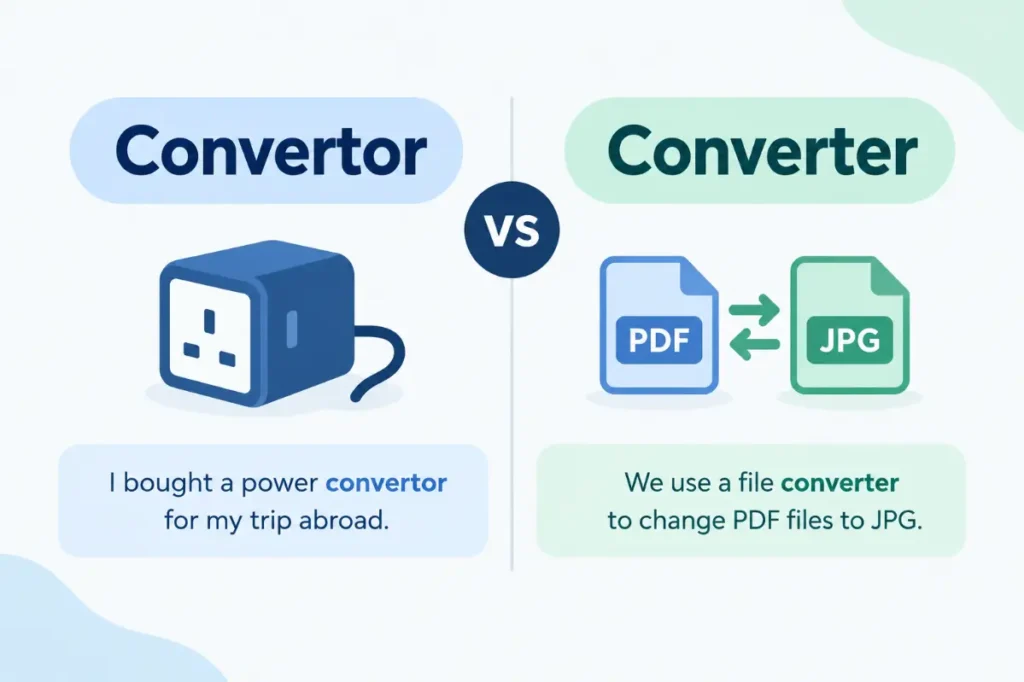
Convertor Vs Converter In Real Sentences
One of the easiest ways to understand the difference in usage is to see both forms in context. The meaning stays closely connected but the frequency and audience can differ.
Examples With Converter
- I used a currency converter before my trip.
- The mechanic replaced the catalytic converter.
- This website has a free unit converter.
- We need a video converter for the new project.
- The technician tested the signal converter.
- I found a useful temperature converter online.
These examples show how widely the standard form is used. It works naturally for tools devices software and systems.
Examples With Convertor
You may also encounter sentences using the variant spelling.
- The device works as a signal convertor.
- The manual refers to the unit as a power convertor.
- The company sells a specialized convertor for the equipment.
These sentences can be understood clearly. The less familiar spelling doesn’t change the basic meaning.
Still if you’re creating general content for a US audience converter will usually be the better fit.
Common Search Questions About This Word
People often search for this spelling question because they have seen both versions online. Search results can make the issue look more confusing than it really is.
A reader might ask if convertor is a typo. In many cases it isn’t. It is a recognized variant.
Another person might wonder if one spelling describes a person while the other describes a machine. That isn’t a reliable distinction. Both forms can refer to a person or thing that converts something.
Someone else might assume that convertor belongs only to British English. Regional usage can explain some examples but it doesn’t provide a complete rule for every source.
The most useful answer for a US writer is simple. Both forms exist but converter is the standard choice for general American English.
Is Converter A Noun
Yes. Converter is a noun because it names a person device program or thing that performs a conversion.
For example:
- The converter changed the file format.
- The technician installed a new converter.
- This online converter handles several units.
The word can describe something physical or something digital. Context tells you what kind of converter the writer means.
A currency converter might be a website or app. A catalytic converter is a physical part of a vehicle. A file converter can be a computer program.
The common idea is always change from one form into another.
Can A Person Be A Converter
Yes. A person who converts something can technically be called a converter. The word can describe an individual who changes something from one form to another.
For example a person who converts someone to a different religion could be described using the noun in the appropriate context. The word can also describe someone involved in changing systems formats or other things.
However in everyday speech people often use a more specific noun. A person who converts a file may simply be called a technician or editor. A person who changes a measurement may be called a calculator or analyst depending on the task.
The word therefore has a broader dictionary meaning than the way people usually use it in conversation.
Is Converter A Technical Word
Not necessarily. The word appears in technical fields but ordinary people use it too.
A person checking currency before a vacation may use a currency converter. Someone changing a recipe measurement may use a unit converter. A driver may hear about a catalytic converter during vehicle maintenance.
Technical writing uses the word in more specialized ways. Electronics engineers may discuss signal converters while software developers may work with file conversion tools.
The meaning becomes more specific based on the field but the central idea remains the same.
When To Use The Word In Professional Writing
Converter works well in professional writing because it is familiar and precise. It can describe software tools technical equipment financial tools and many other products.
For example:
- The converter supports more than 20 file formats.
- Our system uses a signal converter to connect the devices.
- The online currency converter updates exchange rates regularly.
- The technician installed a new power converter.
These sentences tell the reader exactly what the tool does without unnecessary explanation.
If you’re writing product descriptions or technical documentation consistency matters even more. Use the spelling that matches the product name documentation and established terminology.
When A Product Name Changes The Choice
Sometimes a company gives a product a specific name. If the official name uses Convertor then changing it to Converter could make the name inaccurate.
Product names are proper names. They don’t always follow the most common spelling used by the language as a whole.
For example a manufacturer could call a device a Power Convertor. If that is its official product name then an editor should preserve the name when referring to that product.
This is different from choosing a spelling for ordinary prose. When you’re writing your own sentence for a general US audience converter is usually the natural choice.
Common Mistakes With Converter
Spelling isn’t the only issue people run into. The word can also cause problems when writers use it without making the type of conversion clear.
For example this sentence is vague.
- I need a converter.
The reader may wonder what kind. A currency converter. A file converter. A power converter. A catalytic converter.
A clearer sentence gives the reader the missing detail.
- I need a currency converter for my trip.
- I need a file converter for this document.
- The car needs a new catalytic converter.
- We need a power converter for the equipment.
Adding one simple word can make the meaning much clearer.
Confusing Converter With Adapter
A converter and an adapter can sometimes appear similar but they don’t always do the same job.
An adapter usually helps two things connect or work together. A converter changes something from one form into another.
For example a plug adapter may allow a device to connect to a different type of outlet. A power converter may change the electrical characteristics supplied to the device.
The exact difference depends on the technology involved. Still the basic distinction is useful. An adapter helps with compatibility while a converter performs a change.
Confusing Converter With Calculator
A converter may perform a calculation but the terms aren’t identical.
A calculator performs mathematical operations. A converter uses calculations to express something in a different unit or form.
For example a basic calculator can multiply 10 by 2.54. A measurement converter can take 10 inches and show the equivalent value in centimeters.
The second tool is designed around conversion rather than general arithmetic.
How To Proofread The Word
A quick check can prevent this spelling issue from appearing in your final draft.
First look at the ending. For standard US writing you will normally want converter with er.
Next consider the context. Are you talking about a currency tool a file tool a vehicle part or an electronic device. If so the familiar form will usually fit naturally.
Then check the surrounding words. Phrases such as currency converter file converter and catalytic converter are common combinations.
Finally keep your spelling consistent. If your article starts with converter there is usually no reason to switch to convertor later unless you are discussing that specific variant.
A Quick Memory Trick
Think of the verb convert and add er.
Convert plus er equals converter.
The result isn’t just a spelling exercise. The ending also gives you a useful clue about meaning. A converter is something that converts.
You can connect the word with familiar examples such as a currency converter or file converter. These phrases are common enough that repeated exposure can make the spelling stick naturally.
If you prefer a sentence based memory trick try this.
A converter converts.
The repeated convert sound and spelling give you a simple visual connection.
What Editors Should Know
Editors sometimes face a different question from ordinary writers. Instead of asking which spelling is correct they need to decide which spelling best fits the publication.
For a US publication converter is usually the clearest choice. It matches common usage and won’t distract most readers.
If the publication follows a British style guide the editor may encounter convertor more often. The same applies to specialized industries that have established terminology.
An editor should also preserve official names and product terms. A less common spelling can still be correct when it belongs to a specific name or source.
The goal isn’t to force every English word into one spelling. The goal is to make the writing accurate consistent and appropriate for its audience.
What Students Should Use
Students writing essays reports or assignments for an American school should normally choose converter.
It’s simple and familiar. It also works across subjects.
For example:
- The student used a temperature converter.
- The device contains an analog to digital converter.
- The program acts as a file converter.
If a teacher or textbook uses convertor you don’t need to assume the source is wrong. Check the context and follow the spelling style expected by the assignment.
For most general school writing though converter is the straightforward choice.
What Content Writers Should Use
Content writers have another reason to prefer converter. Readers expect familiar language.
If someone searches for a tool that changes currencies they are more likely to recognize currency converter immediately. The same applies to file converters unit converters and other common terms.
Using the familiar form also makes headings and sentences sound natural. You don’t want a reader stopping to question a spelling choice when the meaning is already clear.
For a US focused website converter is therefore a practical default. You can still mention convertor when the article specifically discusses the spelling difference.
The important thing is to explain the distinction accurately instead of presenting the less common variant as an outright error.
FAQs
Is convertor or converter correct?
Both spellings are recognized in English. Converter is the standard choice for general American English while convertor is an accepted variant that appears less often. For most US writing use converter.
Is convertor a misspelling?
No. Convertor is a recognized spelling variant of converter. It isn’t automatically an error when you see it in a dictionary technical source or regional publication.
Which spelling should I use in American English?
Use converter for normal American English writing. It’s the form most US readers expect in phrases such as currency converter file converter and catalytic converter.
What does converter mean?
A converter is a person device or program that changes something from one form into another. It can change a file currency measurement signal or another type of material or information.
What is the difference between convertor and converter?
The main difference is spelling and usage preference rather than meaning. Both words describe something that converts or changes something into another form. Converter is more familiar in US English while convertor appears as a less common variant.
Is converter used in British English?
Yes. British English uses converter as well as convertor. You can encounter both forms in British writing so the presence of convertor doesn’t automatically identify the text as British.
Why does converter end with er?
The word comes from the verb convert and forms a noun with the er ending. The same kind of formation appears in words such as teacher writer and driver. English also uses or endings in many words so this pattern doesn’t work as a universal spelling rule.
Is a catalytic converter the same thing as a convertor?
The terms can refer to the same type of device. A catalytic converter is a vehicle component that helps reduce certain harmful pollutants in exhaust gases. Converter is the standard spelling used in this familiar automotive term.
Conclusion
If you’re deciding between convertor vs converter for US English the practical choice is converter. Both spellings have the same basic meaning but converter is the form most American readers expect in ordinary writing.
The word describes something that changes one thing into another. That could be a currency converter that changes one currency value into another a file converter that changes a digital format or a catalytic converter that helps change harmful exhaust pollutants into less harmful substances.
Convertor isn’t simply a spelling mistake. It is a recognized variant and you may see it in dictionaries technical material or writing from different English speaking regions. Context can explain why a writer chose it.
For your own writing keep things simple. Use converter unless an official product name style guide or source calls for convertor. That choice will sound natural to a US audience and will work across most everyday and professional contexts.

Dr. Elena Vance holds a Ph.D. in Linguistics from Columbia University and has spent over 15 years analyzing the evolution of the English language. A former university professor turned full-time writer and editor, Elena specializes in breaking down high-level grammatical concepts, punctuation nuances, and style guides (APA, Chicago, MLA) into clear, actionable advice. When she isn’t hunting down dangling modifiers, she can be found collecting vintage dictionaries and reading classic literature.