
If you’re searching jynx vs jinx because you aren’t sure which spelling is correct you have found a genuinely confusing pair. Both forms exist in English but they don’t serve the same purpose.
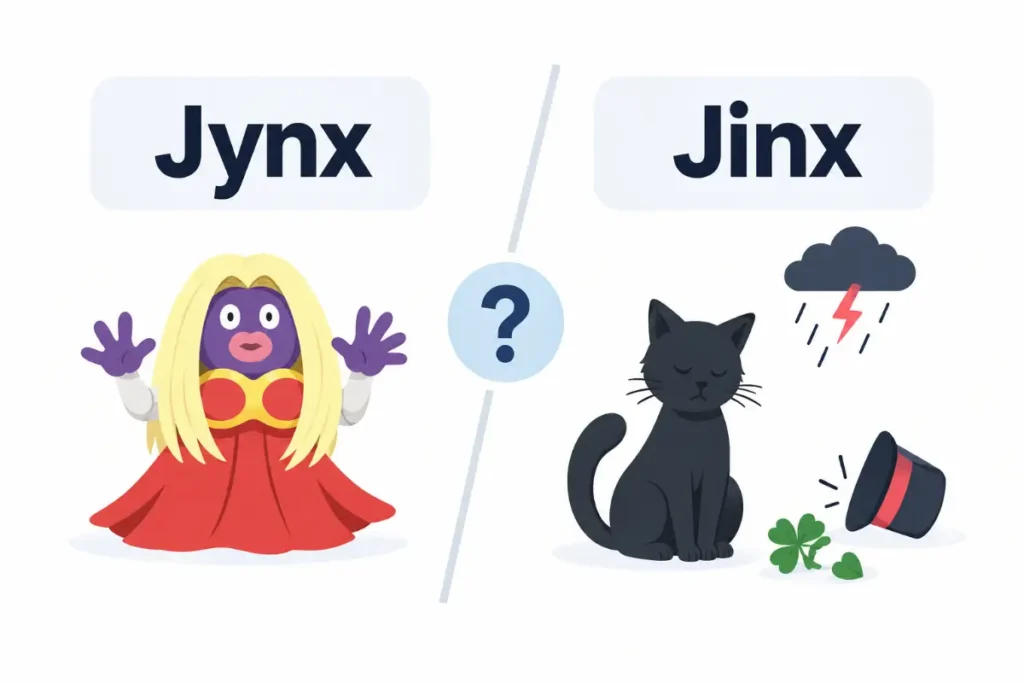
For the common word that means bad luck or something believed to bring bad luck the correct spelling is jinx. The spelling jynx has a separate dictionary meaning connected to a bird called the wryneck. It also appears as a proper name in some contexts.
That small spelling change can completely change the meaning. This guide explains the difference in plain English. You’ll see how each word is used why the confusion exists and how to remember the spelling when you’re writing about bad luck.
Quick Definition
Jinx is the standard word for a person or thing believed to bring bad luck. It can also mean a period or condition of bad luck. Jynx is an older and much less common word for the wryneck bird.
Direct Answer
Use jinx when you mean bad luck or something that brings bad luck. Use jynx only when you mean the bird or a specific name that intentionally uses that spelling.
Comparison Table
| Word | Meaning | Example Sentence | When To Use It |
|---|---|---|---|
| Jinx | Bad luck or something believed to cause bad luck. | I hope I didn’t jinx the game. | Use it for the common word about bad luck. |
| Jynx | A wryneck bird. | The jynx is a small bird related to woodpeckers. | Use it when discussing the bird or a proper name. |
Why The Two Spellings Cause Confusion
The confusion makes sense because the two forms are closely related. The history of jinx reaches back to jynx, which was used for the wryneck bird and later became associated with charms and spells. The modern spelling jinx became established in American English in the early 20th century.
That history explains why the two words look almost identical. They also sound the same in normal English pronunciation. The main difference you see is the letter i in one spelling and y in the other.
For everyday writing the distinction is simple. If you’re talking about bad luck then jinx is the word you want.
For example you might say:
- I hope I don’t jinx our chances.
- Don’t say that or you’ll jinx it.
- That old car seems to be a jinx.
- The team thinks they’ve finally broken the jinx.
In each sentence the word refers to bad luck or the idea that someone or something can cause bad luck. That is the meaning most readers expect when they see this word. Oxford lists jinx as a noun meaning bad luck or someone or something thought to bring bad luck. It also gives examples of the word used with phrases such as a jinx on something.
What Jinx Means
The common word jinx has two closely connected uses. It can describe a person or thing believed to bring bad luck. It can also describe the bad luck itself.
Jinx As A Noun
As a noun jinx can describe someone or something that seems to cause bad luck.
Imagine your friend always sits beside you during important games and your team loses every time. You might jokingly say that your friend is a jinx.
For example:
- My brother is a jinx at baseball games.
- That old car feels like a jinx.
- Everyone thinks the broken watch is a jinx.
- She joked that her red shirt was a jinx after three losses.
The word doesn’t prove that the person or object actually causes bad luck. It often appears in conversations about superstition or coincidence. American Heritage defines jinx as a person or thing believed to bring bad luck and also as a period or condition of bad luck. (American Heritage Dictionary)
Jinx As A Verb
Jinx can also work as a verb. In that form it means to bring bad luck to something or someone.
For example:
- Don’t jinx our winning streak.
- I think I jinxed the team by talking about the perfect season.
- She was afraid to mention the good news because she didn’t want to jinx it.
- We were having a great trip until I joked that nothing could go wrong.
This use is especially common in casual American English. People often say Don’t jinx it when they don’t want someone to talk too confidently about something good that is still happening.
The verb also has related forms such as jinxed and jinxing. American Heritage lists those forms as standard verb forms. (American Heritage Dictionary)
What Jynx Means
The spelling jynx has a real place in English but it isn’t the normal spelling for the bad luck word.
A jynx is a type of bird known as a wryneck. The word is connected with the scientific name Jynx used for the genus that contains wrynecks. Collins lists jynx as a British English noun for a type of woodpecker also called a wryneck. (Collins Dictionary)
This is where context matters.
If you’re writing about superstition and bad luck you almost certainly want jinx. If you’re writing about the bird called a wryneck you may see jynx.
For example:
- The jynx is related to woodpeckers.
- Researchers studied the behavior of the Eurasian wryneck.
- The name Jynx refers to a genus of birds.
The bird meaning is much less common in everyday writing. That’s one reason people may see jynx and assume it’s simply an alternative spelling of jinx.
Where The Word Comes From
The history of these words is surprisingly interesting. The older form jynx referred to the wryneck bird. The bird became associated with magic and divination in ancient traditions. English later used jynx for a charm or spell. (Etymology Online)
The modern word jinx has a more recent history. The spelling is recorded in American English from the early 1900s and was originally used as baseball slang. Over time it spread into general American English and came to mean a person or thing believed to bring bad luck. (Etymology Online)
That history gives us a useful clue. Jynx is the older form connected to the bird while jinx is the familiar modern spelling used for bad luck.
You don’t need to memorize the entire history to spell the word correctly. You only need to remember the meaning you want.
How To Use Jinx In Real Sentences
The easiest way to understand a word is to see it doing real work in a sentence. The examples below show common situations where Americans use jinx naturally.
Talking About Bad Luck
- This house has a jinx on it.
- The team can’t seem to escape its jinx.
- That number has always been a jinx for him.
- They thought the losing streak was caused by a jinx.
These examples treat the word as a noun. It describes a source or period of bad luck.
Talking About A Person
You can call someone a jinx when you jokingly believe that person brings bad luck.
- Every time Jake watches our team we lose. He’s a jinx.
- Don’t invite me to the poker game. I’m a jinx tonight.
- She laughed when her friends called her a jinx.
This use is often playful. It doesn’t necessarily express a serious belief in curses or supernatural forces.
Talking About An Action
The verb gives the word a slightly different role.
- Don’t jinx the interview by assuming you’ve already got the job.
- He jinxed the game by celebrating too early.
- I don’t want to jinx our plans.
- She knocked on wood because she didn’t want to jinx her good luck.
This is common in casual speech because people often use the word when talking about tempting fate.
Saying Don’t Jinx It
Don’t jinx it is one of the most familiar expressions built around this word.
Someone might say it when another person talks about a good result before it has happened.
Imagine your favorite team is leading by one point with only a few seconds left. You say:
- We’re definitely going to win.
Your friend might immediately respond:
- Don’t jinx it.
The phrase is usually lighthearted. It expresses the idea that talking too confidently about good fortune might somehow cause it to disappear.
That idea is part of superstition rather than a proven cause and effect. The expression survives because it’s short familiar and useful in everyday conversation.
Jynx Vs Jinx In Everyday Writing
The biggest difference between these two spellings comes down to meaning. Jinx is the word you’ll normally use when you’re talking about bad luck. Jynx has a much narrower use and usually refers to the bird called a wryneck.
That distinction matters because the words aren’t simply two accepted spellings of the same everyday term. If you write about a bad luck charm and use jynx your reader may see it as a spelling error. If you’re writing about the bird and use jinx you can change the meaning of the sentence.
For most everyday writing the choice is easy. Use jinx for bad luck.
When To Use Jinx
You’ll use jinx in most conversations about luck. It works as both a noun and a verb which gives it several common uses.
As a noun it can describe a person object or situation believed to bring bad luck. It can also refer to a stretch of bad luck itself.
For example:
- That old hat is a jinx.
- The team has been under a jinx all season.
- He thinks his lucky shirt has become a jinx.
- Nobody wants to talk about the winning streak because they don’t want to break the jinx.
As a verb it means to bring bad luck to someone or something. This use is especially common when people worry that talking about a good result too soon might spoil it.
For example:
- Don’t jinx our chances.
- I hope I didn’t jinx the party.
- She thinks talking about the weather will jinx the picnic.
- We were winning until my brother said we couldn’t lose.
The word can sound serious in some contexts but people often use it as a joke. A person might call themselves a jinx after losing several games in a row. That doesn’t mean they truly believe they have supernatural powers.
When To Use Jynx
The spelling jynx belongs to a much less common part of English. It refers to a wryneck which is a small bird related to woodpeckers.
Wrynecks have unusual behavior that helped give them their name and their place in old folklore. They can twist and turn their heads in a striking way. The bird has also been linked with older ideas about magic and charms.
You may come across jynx in bird guides scientific writing historical texts or discussions of word origins. You won’t normally use it when you’re talking about a bad day a losing team or an unlucky object.
For example:
- The jynx has a long bill and a distinctive head shape.
- Birdwatchers spotted a Eurasian jynx in the woodland.
- The jynx belongs to a group of birds related to woodpeckers.
In these examples the spelling refers to the bird. Context makes the meaning clear.
Is Jynx A Misspelling Of Jinx
Not exactly. Calling jynx a simple misspelling would leave out an important part of its history.
The two forms are connected. The older word jynx referred to the wryneck bird and later became associated with magic charms and spells. The modern word jinx developed into the familiar term for bad luck.
That history explains why the spellings look so similar. It also explains why you may occasionally see the older form in historical or specialized writing.
Still, modern everyday English has a clear preference. When you mean bad luck you should spell the word with an i.
Why People Write Jynx By Mistake
A few things can cause this spelling mistake.
First, the letter y appears in many English words that have an unusual or mysterious feel. Some writers may assume that jynx looks more natural because it resembles words such as myth or crypt.
Second, people may encounter Jynx as a name. Seeing the spelling in a proper name can make it seem like a normal alternative spelling of the common word.
Third, the two forms sound the same. When two words share the same pronunciation it becomes harder to rely on sound alone. You have to remember the meaning and spelling instead.
There is also a simple visual problem. Jinx and jynx differ by only one letter. When you’re typing quickly that small difference can slip past you.
Common Sentences With Jinx
The word appears in several familiar sentence patterns. Learning these patterns can help you recognize the correct form without stopping to think about it.
Don’t Jinx It
This is probably the most common casual expression.
- We haven’t won yet so don’t jinx it.
- The cake looks perfect so don’t jinx it.
- You think the flight will be on time. Don’t jinx it.
The phrase expresses a playful fear that talking about good luck might somehow cause a problem.
Jinx The Game
People often use the verb when talking about sports.
- I shouldn’t have said we were going to win because I might have jinxed the game.
- The coach didn’t want to jinx the team before the final.
- Fans joked that the commentator had jinxed the game.
This doesn’t describe a proven effect. It reflects a common superstition and a playful way of talking about an unexpected change in fortune.
Be A Jinx
This pattern describes a person who seems to bring bad luck.
- I can’t go to another game because I’ll be a jinx.
- He joked that his new friend was a jinx after the team lost three games.
- She laughed when her family called her a jinx.
Again the meaning depends on context. Most speakers use this expression casually rather than as a serious claim.
Jinx As A Noun And Verb
Understanding the grammar can make the word much easier to use.
When jinx is a noun it names a person thing or condition connected with bad luck.
For example:
- That broken mirror is a jinx.
- He thinks he is a jinx.
- The team finally broke its jinx.
When jinx is a verb it describes the action of supposedly causing bad luck.
For example:
- Don’t jinx the plan.
- I hope I didn’t jinx our trip.
- She jinxed the game by talking about the easy win.
The same spelling works in both roles. You can usually tell which role it has by looking at the rest of the sentence.
Jinxed And Jinxing
The verb also changes form like other regular English verbs.
The past tense is jinxed.
- I think I jinxed us.
- He jinxed the team by celebrating too early.
The present participle is jinxing.
- You’re jinxing us by saying that.
- I don’t want to be jinxing the whole plan.
Notice the spelling change when jinx becomes jinxing. The final e isn’t involved because the base word already ends in x. You simply add ing.
These forms are common in casual speech and writing.
Is Jinx Always About Supernatural Bad Luck
No. The word often appears in situations where nobody seriously believes in magic.
Suppose you buy a new phone and the screen breaks two days later. Your friend might say that the phone is a jinx. They may simply be joking about your bad luck.
The same thing happens in sports. Fans sometimes blame a shirt a player or a particular seat for a team’s losses. These comments usually describe a superstition rather than an established fact.
The word can also describe an unlucky pattern without suggesting a supernatural cause.
For example:
- The restaurant seems to have a jinx because every new owner closes within a year.
The speaker may simply be pointing out a strange pattern. The word adds a playful sense of bad fortune to the statement.
A Simple Memory Trick
If you’re talking about bad luck remember the short form jinx with an i.
You can connect the i with the idea of ill luck. Both words begin with i.
That isn’t a formal spelling rule. It’s simply a memory trick. The goal is to give your brain an easy connection.
Then reserve jynx for the bird or a name that specifically uses that spelling.
Think of it this way. If your sentence could naturally include the phrase bad luck then jinx is almost certainly the spelling you need.
For example:
- I don’t want to jinx our chances.
You could replace the idea with:
- I don’t want to bring bad luck to our chances.
That quick substitution can help you choose the spelling when you’re unsure.
Common Mistakes To Avoid
One common mistake is treating the two spellings as interchangeable. They aren’t interchangeable in standard everyday usage. The meaning and context should guide your choice.
Another mistake is assuming that a less common spelling must be a more formal version. Jynx isn’t a formal upgrade of jinx. It has its own meaning and history.
Some writers also use jynx when talking about a person who brings bad luck. That is not the standard modern spelling for this meaning. Use jinx instead.
A final mistake is relying only on pronunciation. Since the words sound alike you can’t hear the difference. You need to look at the meaning and choose the spelling that matches it.
Examples That Make The Difference Clear
Compare these sentences side by side.
I hope I don’t jinx the team.
Here the speaker is worried about supposedly causing bad luck. The modern spelling with i is correct.
The jynx is a fascinating bird.
Here the sentence discusses a bird. The spelling with y fits the specialized meaning.
Now compare these.
My friend joked that I was a jinx.
The person is being called unlucky.
The researcher recorded a jynx in the forest.
The sentence is about a bird.
The meanings are far apart even though the words look almost identical. That is why choosing the spelling based on context matters more than simply remembering that both forms exist.
How To Choose The Right Spelling
When you’re unsure about these two forms the meaning of the sentence gives you the answer. Ask yourself what you’re trying to describe.
If you’re talking about bad luck then use jinx. If you’re talking about the wryneck bird then jynx may be the word you need.
This simple meaning check works better than trying to remember a complicated spelling rule. The two words sound the same so pronunciation won’t help you. Context does the job.
Think About The Meaning First
Imagine you’ve just said something positive about your favorite team.
Your friend says:
- Don’t say that. You’ll jinx us.
The word describes the idea of causing bad luck. That’s the everyday meaning most people have in mind.
Now imagine you’re reading a birdwatching guide. You see a description of a small bird that twists its head and belongs to the woodpecker family. In that setting jynx can refer to the bird.
The subject of the sentence makes the choice clear.
Think About The Audience
Your audience can also give you a clue. Most general readers know jinx as a word for bad luck. Far fewer people use jynx in everyday conversation.
If you write about a bad luck charm and spell it jynx many readers may assume you’ve made a typo. If you’re writing about the bird and use jinx readers may misunderstand what you mean.
Good writing makes the meaning easy to recognize. Choosing the familiar spelling for the familiar meaning helps your reader move through the sentence without stopping.
Jinx In American English
The common spelling jinx is firmly established in American English. You’ll find it in casual conversation sports writing entertainment articles and general nonfiction.
Sports provide some of the most familiar examples. Fans talk about a team being jinxed or worry that someone might jinx a winning streak. These expressions have become part of everyday American speech.
For example:
- The team finally broke its jinx.
- Don’t jinx the Yankees before the game is over.
- Everyone thought the losing streak was a jinx.
- I hope I didn’t jinx our chances.
The word also appears outside sports.
- I think this printer is a jinx.
- Don’t jinx our vacation by talking about everything that could go wrong.
- She laughed when her friends called her a jinx.
- He knocked on wood after saying that the project was going perfectly.
These examples show how flexible the word can be. It can describe a person an object a situation or an action connected with supposed bad luck.
Jynx In Bird Names
The less common spelling jynx has a specific connection to wrynecks. Wrynecks are small birds in the woodpecker family.
There are several species in the genus Jynx. One familiar example is the Eurasian wryneck. Another is the red throated wryneck.
This use mostly appears in bird related material. You might see the word in a field guide a scientific article or a discussion about bird classification.
For a general reader this distinction may seem surprising because the spelling looks like a simple variation of the familiar bad luck word. Its history explains the connection.
The old bird name became associated with magic and charms. Over time the spelling and meaning developed along different paths. Modern English now uses jinx for the common bad luck sense while Jynx remains connected to the bird genus.
The Difference Between A Jinx And A Curse
People sometimes use jinx and curse as if they mean exactly the same thing. They overlap but they can have different tones.
A curse usually suggests a stronger or more deliberate act of wishing harm or misfortune on someone. A jinx often has a lighter meaning. People commonly use it to describe bad luck or the belief that someone has caused bad luck.
For example:
- The family believed an old curse had followed them for generations.
- My brother thinks his lucky socks are a jinx.
The first sentence has a serious or supernatural tone. The second sounds playful.
In everyday American English jinx is often used without any serious belief in supernatural forces. Someone can say Don’t jinx it simply because they don’t want to tempt fate.
Jinx And Bad Luck
Bad luck is the central idea behind the common word. A person may call something a jinx after a series of unfortunate events.
Imagine a baseball player wears the same shoes during three losses. He changes shoes and then wins the next game. His teammates might joke that the old shoes were a jinx.
There is no need to believe that the shoes actually caused the losses. The word can describe the superstition surrounding the object.
This is one reason the term works so well in casual conversation. It lets people talk about strange patterns and unlucky moments without making a serious claim about cause and effect.
Jinx And Superstition
A superstition is a belief that an action object event or pattern can affect luck without a clear scientific reason. The idea of a jinx fits naturally into this area.
Common examples include avoiding certain numbers carrying lucky objects or refusing to talk about a positive result too soon.
You might hear someone say:
- Don’t count your chickens yet. You’ll jinx it.
Another person might knock on wood after making a confident statement.
These habits are part of culture and everyday speech. They can be serious for some people and completely playful for others.
The word itself doesn’t tell you how seriously someone believes in the idea. Context and tone do that.
Common Expressions With Jinx
Knowing common expressions can help you recognize the word in natural writing.
Don’t Jinx It
This phrase is used when someone thinks talking about success too soon could bring bad luck.
- We’re only halfway through the project so don’t jinx it.
- The weather looks perfect but don’t jinx it.
- We’re ahead by ten points. Don’t jinx it.
Break The Jinx
This means to end a period of bad luck.
- The team finally broke the jinx with a big win.
- She broke the jinx by passing the test on her next attempt.
Be A Jinx
This describes someone who seems to bring bad luck.
- I must be a jinx because my team loses every time I watch.
- He joked that he was a jinx after two flat tires in one week.
Jinx Something
This uses the word as a verb.
- Don’t jinx the trip.
- I hope I didn’t jinx your plans.
- She thought talking about the promotion might jinx it.
These phrases are common because they fit naturally into casual conversations.
Does Jinx Mean Bad Luck Every Time
Not exactly. The meaning depends on how the word functions in the sentence.
As a noun it can refer to a person or thing thought to bring bad luck. It can also refer to a period of bad luck.
As a verb it means to supposedly cause bad luck.
The basic idea stays connected to luck in all of these uses. The grammar changes but the core meaning remains easy to recognize.
For example:
- That necklace is a jinx.
Here the word is a noun describing the necklace.
- I hope I don’t jinx the trip.
Here it is a verb describing an action.
- The team has suffered a jinx for years.
Here it refers to a continuing period or source of bad luck.
Learning these patterns gives you more control over the word. You won’t just know how to spell it. You’ll know how to use it naturally.
A Quick Test For Writers
If you see yourself typing the less familiar spelling stop for a moment and ask one question.
Are you talking about bad luck or a wryneck?
- If you’re talking about bad luck use jinx.
- If you’re writing about the bird or the scientific genus Jynx may be appropriate.
This test takes only a few seconds. It also works when you’re proofreading someone else’s writing.
For example:
I didn’t want to jynx our chances.
The sentence clearly refers to bad luck. Change the spelling to:
I didn’t want to jinx our chances.
Now the sentence uses the standard modern form.
The same check works with nouns.
That player is a jynx.
If the intended meaning is a person who brings bad luck then change it to:
That player is a jinx.
The key isn’t the sound. The key is the meaning.
A Useful Way To Remember The Difference
Think of jinx as the everyday word. It belongs in conversations about luck games plans mistakes and unexpected problems.
Think of jynx as the specialized word. It belongs mainly in discussions about the wryneck bird and related scientific or historical topics.
You don’t need to memorize a long list of spelling rules. One meaning based memory trick is enough.
- Bad luck gets the i.
- Bird related Jynx gets the y.
That simple contrast can save you from second guessing yourself every time the word comes up.
What To Use In School And Work
For school assignments emails reports and workplace communication use jinx when you mean bad luck.
For example:
- I hope I don’t jinx the presentation.
- The team broke its jinx after several losses.
- Some fans believed the player was a jinx.
If you’re writing a research paper about birds then Jynx can be correct as part of the scientific name.
For example:
- The genus Jynx contains species commonly known as wrynecks.
In scientific writing capitalization can also matter. A genus name is normally capitalized while a common noun is not. So the context can affect more than just the letter after the j.
FAQs
Is jinx or jynx correct?
Both spellings exist but they have different uses. Jinx is the standard modern word for bad luck or something believed to bring bad luck. Jynx refers mainly to the wryneck bird and is also used as the name of its genus.
Is jynx a misspelling of jinx?
No. Jynx has its own history and meaning. It is connected to the wryneck bird while jinx developed as the common modern spelling for the bad luck sense.
Does jinx mean bad luck?
Yes. As a noun jinx can mean bad luck or a person or thing believed to cause bad luck. It can also work as a verb meaning to supposedly bring bad luck to someone or something.
How do you use jinx in a sentence?
You can use jinx as either a noun or a verb. For example you can say The team has a jinx or I hope I don’t jinx the game.
What does jynx mean?
Jynx is a term associated with wrynecks which are small birds in the woodpecker family. It is much less common in everyday English than jinx.
Why do people say don’t jinx it?
People say don’t jinx it when they don’t want someone to talk too confidently about a good result before it happens. The phrase comes from the idea that mentioning good luck too soon might cause it to disappear.
Is jinx a noun or a verb?
It can be both. As a noun it can describe a person thing or situation associated with bad luck. As a verb it means to supposedly cause bad luck.
How can I remember the spelling of jinx?
Connect the i in jinx with ill luck. When you’re talking about bad luck use the spelling with i. Save jynx for the bird or a name that specifically uses that spelling.
Conclusion
When you’re deciding between jynx vs jinx the meaning gives you the answer. Use jinx when you’re talking about bad luck a person believed to bring bad luck or the act of supposedly causing bad luck.
Jynx has a different role. It refers to the wryneck bird and appears in scientific historical or bird related contexts. It isn’t simply a fancy spelling of the everyday bad luck word.
The two forms are connected through their history which helps explain why they look so similar. They also sound the same so pronunciation can’t help you choose between them. Context is your best guide.
If you’re writing about a losing streak a lucky charm or someone who might ruin your good fortune use jinx. If you’re writing about the wryneck bird look for Jynx. That one meaning check will help you choose the right spelling quickly.

Sienna Watson is a veteran copywriter and communications coach who has helped startup founders, marketers, and professionals polish their writing for over a decade. Realizing that most people don’t need a degree in linguistics—just clear, impactful communication—Sienna focuses on practical grammar, business writing etiquette, and eliminating wordiness. She advocates for plain language, strong verbs, and persuasive prose that gets results.