

If you’re stuck on dought vs doubt you’re dealing with two very different words. One is a standard English word that describes uncertainty. The other is not normally used as an English word in modern writing.
The correct spelling for the word meaning uncertainty is doubt. You might see dought in a typo or in an unusual historical or specialized context. For everyday English writing you should use doubt.
The tricky part is the pronunciation. The b in doubt is silent so the word sounds like dout. That can make the spelling harder to remember because what you hear does not match every letter you see.
This guide explains the difference in plain English. You’ll learn what doubt means how to pronounce it why the b is silent how to use it in real sentences and how to avoid the common spelling mistake.
Quick Definition
Doubt is a noun and a verb related to uncertainty. As a noun it means a feeling that makes you unsure about something. As a verb it means to question something or feel that it may not be true.
Dought is not the standard spelling of this word in modern English. If you mean uncertainty or a lack of confidence in something use doubt.
Direct Answer
Doubt is the correct spelling for the word that means uncertainty or a lack of belief. Dought is not the standard modern spelling and should not be used for this meaning.
Comparison Table
| Word | Meaning | Example Sentence | When to Use It |
|---|---|---|---|
| Doubt | Uncertainty or a feeling that something may not be true. | I have no doubt that she told the truth. | Use it when talking about uncertainty or questioning something. |
| Dought | Not the standard modern spelling for uncertainty. | This spelling is incorrect in ordinary English. | Do not use it when you mean doubt. |
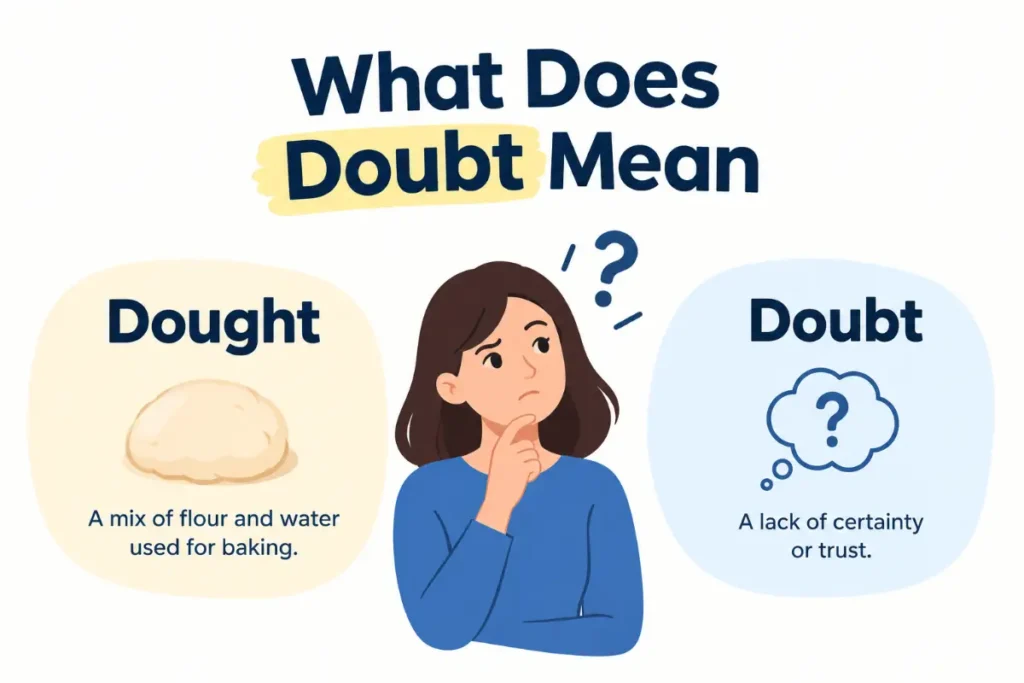
What Does Doubt Mean
Doubt describes uncertainty. It can happen when you don’t know if something is true or when you aren’t sure what will happen.
For example you might doubt that a friend will arrive on time. You might also have doubts about a decision before making it. In both cases you aren’t fully certain.
As a noun the word often refers to the feeling itself.
- I have some doubt about his story.
- Her doubts disappeared after she saw the evidence.
- There is no doubt that the team worked hard.
As a verb it describes the act of questioning something.
- I doubt his story.
- She doubts that the plan will work.
- We never doubted your ability to finish the job.
The basic idea stays the same. Something feels uncertain or unproven.
Why Doubt Is Easy To Misspell
The spelling can feel strange because the pronunciation doesn’t clearly reveal the letters. When you say doubt the b stays silent. The word sounds like dout rather than doubt with a clear b sound.
That silent letter creates a gap between spelling and pronunciation. If you learn the word mainly by hearing it you may naturally try to spell it the way it sounds.
English has many words with silent letters. The silent b in doubt is part of that pattern.
You can see something similar in words such as debt and subtle. In each case at least one written letter does not have its own clear sound in normal pronunciation.
Once you recognize this pattern the spelling becomes less surprising. You don’t need to pronounce every letter to spell the word correctly.
The Silent B In Doubt
The b in doubt is silent. This means you don’t say the b sound when you pronounce the word.
The usual pronunciation is close to dout. The exact vowel sound can vary slightly depending on the speaker and accent but the b remains silent.
This can cause problems for people who spell words based on sound. You hear something like dout and may naturally write d o u t. The correct spelling includes the silent b.
Think of the b as a letter you can see but don’t hear.
That small detail is one of the most useful things to remember about this word.
How To Use Doubt In A Sentence
The word works in many everyday situations. You can use it when you question a fact a person’s statement a plan or even your own decision.
Here are some natural examples.
- I doubt that he knows the answer.
- She had doubts about moving to another city.
- There is no doubt that the weather will affect our plans.
- He began to doubt his decision.
- I have no doubt that you’ll do well.
- They doubted whether the package would arrive on time.
The word can describe a small feeling of uncertainty or a strong lack of belief. Context tells the reader how much uncertainty you mean.
For example I have some doubt suggests mild uncertainty. I have no doubt means you feel completely certain.
Doubt As A Noun
A noun names a person place thing or idea. When doubt acts as a noun it names the feeling or idea of uncertainty.
Consider these examples.
- I have some doubt about the plan.
- His doubts kept him from accepting the offer.
- She expressed doubt about the results.
- The evidence removed all doubt.
In these sentences doubt is something a person can have express or remove. It isn’t describing an action directly.
You will often see it after words such as have express raise and remove.
For example someone can have doubt about a decision. A new fact can raise doubt about a claim. Strong evidence can remove doubt.
Doubt As A Verb
As a verb doubt means to question something or believe that it may not be true.
For example you might say I doubt his explanation if you don’t believe what he told you. You could also say I doubt that we’ll finish today if you think finishing today is unlikely.
The verb can refer to another person’s statement.
- I doubt his excuse.
It can also refer to an event or possibility.
- I doubt that it will rain tonight.
You can even doubt yourself.
- She began to doubt her ability to solve the problem.
That last use is common in everyday speech. People often talk about self doubt when they lose confidence in their own skills or decisions.
Common Expressions With Doubt
Some phrases with doubt appear so often that they are worth learning as complete expressions.
No Doubt
No doubt means you feel certain about something.
- There is no doubt that she worked hard for the promotion.
It can also mean something is very likely.
- He will no doubt call you later.
In Doubt
In doubt means uncertain or undecided.
- The future of the project is still in doubt.
It can also describe something whose truth or value remains uncertain.
- His explanation is now in doubt.
Without A Doubt
Without a doubt means with complete certainty.
- She is without a doubt one of the most dedicated people on the team.
This phrase is common in both conversation and writing.
Beyond A Doubt
Beyond a doubt means with enough certainty that there is little or no reason to question the fact.
- The evidence proved his claim beyond a doubt.
You may also see beyond any doubt in formal writing.
Self Doubt
Self doubt means uncertainty about your own abilities decisions or worth.
- A little self doubt is normal before a big presentation.
This phrase often appears in conversations about confidence and personal growth.
Real Life Examples Of Doubt
The word isn’t limited to formal writing. You can hear and use it in everyday conversations.
Imagine a friend tells you that a restaurant is open until midnight. You might say I doubt it’s open that late if you think the information is wrong.
Suppose you’re deciding if you should take a new job. You might say I have some doubts about moving across the country. Here doubt refers to your uncertainty about the decision.
You can also use the word when you feel completely certain. If someone asks if you trust your closest friend you might say I have no doubt that she will help me.
These examples show how flexible the word can be. It can describe uncertainty about facts decisions plans people and future events.
Doubt And Uncertainty
Doubt and uncertainty are closely related. Both describe a lack of complete confidence but they don’t always work in exactly the same way.
Uncertainty often means you don’t have enough information to know what will happen or what is true.
Doubt can carry a stronger sense of questioning or disbelief.
For example you might say There is uncertainty about tomorrow’s weather because the forecast cannot give a definite answer. You might say I doubt his story because you have a reason to question what he said.
The difference is subtle in some situations. In everyday English the two words can sometimes appear close in meaning. Still doubt often focuses more directly on questioning something.
Common Mistakes With Doubt
The most common mistake is replacing the silent b with nothing and writing the word based on how it sounds. Since doubt sounds like dout many writers accidentally leave out the b. Others may add extra letters and end up with an incorrect form such as dought.
The easiest fix is to remember that the b belongs in the spelling even though you can’t hear it. When you proofread your writing pay special attention to words with silent letters. A quick check can catch the mistake before you send an email or publish an article.
Writing Doubt Without The B
This is a common error because the spoken word gives you no clear reason to include the letter.
Incorrect.
- I have dout about his story.
- I dout that she will come.
Correct.
- I have doubt about his story.
- I doubt that she will come.
The same idea applies to the past tense doubted and the related word doubtful. The silent b remains part of the spelling.
Using Dought Instead Of Doubt
The form dought can appear when someone tries to guess the spelling from pronunciation. It can also look believable because English contains many words with the letter combination ough.
Words such as though thought bought and brought make the spelling pattern familiar. That can cause confusion when you’re trying to spell a word that sounds similar but follows a different pattern.
If you’re talking about uncertainty then doubt is the form you need.
Doubtful And Doubting
Once you know the main word you can easily recognize several related forms.
Doubtful is an adjective. It describes something that seems uncertain or unlikely.
- I’m doubtful that the plan will work.
- The report contains some doubtful claims.
Doubting is the present participle form of the verb.
- She is doubting her decision.
- He kept doubting his ability to finish the project.
Doubted is the past tense.
- I doubted his story at first.
- They doubted that the plan would succeed.
The spelling stays connected across these forms. The b doesn’t disappear just because it isn’t pronounced.
Doubt And Suspicion
Doubt and suspicion can overlap but they aren’t identical.
Doubt means you aren’t fully convinced that something is true. Suspicion often means you have a reason to think something may be wrong or dishonest.
For example you might say I doubt his explanation because it doesn’t sound believable. If you say I suspect he lied you are making a stronger suggestion that he may have deliberately given false information.
The difference matters in careful writing. Doubt can simply reflect uncertainty. Suspicion often points toward a possible problem or hidden motive.
Doubt And Disbelief
Disbelief is usually stronger than doubt.
If you doubt a story you aren’t convinced it is true. You might still be open to the possibility that it is correct.
If you express disbelief you show that you find something very hard to accept as true.
Compare these examples.
- I doubt that he saw the accident.
- I don’t believe his story at all.
The first sentence shows uncertainty. The second expresses a much stronger rejection of the claim.
Doubt And Question
The verb question can sometimes have a similar meaning to doubt. Both can describe a lack of confidence in a claim.
Still they are not always interchangeable.
If you question a decision you are asking if it was correct or sensible.
- She questioned the decision to close the store.
If you doubt a claim you are unsure that it is true.
- She doubted the manager’s explanation.
Question can suggest careful examination. Doubt can suggest uncertainty or disbelief. The right word depends on the situation.
When To Use Doubt In Formal Writing
Doubt works perfectly well in formal writing. You can use it in reports essays professional emails academic work and business communication.
For example.
- The available evidence casts doubt on the original claim.
- There is little doubt that the policy affected the results.
- The researchers expressed doubt about the accuracy of the data.
These sentences sound natural because doubt is a standard English word with a clear meaning.
You don’t need to replace it with a complicated word to sound professional. Simple language often makes your point clearer.
When To Use Doubt In Everyday Speech
The word is just as common in conversation.
A friend might say I doubt he’ll be here on time. Someone might tell you Don’t doubt yourself before an important event. You could also say I have no doubt you’ll do great when encouraging someone.
The word can sound gentle or strong depending on the sentence.
- I have some doubt about the plan sounds cautious.
- I seriously doubt that happened sounds much stronger.
- I have no doubt about it expresses confidence instead of uncertainty.
That range makes the word useful in many kinds of conversations.
How To Remember The Silent B
A simple memory trick can make this spelling much easier.
Think of doubt as a word with a hidden b. You don’t hear the letter but you still write it. The same idea works with other words that contain silent letters.
You can connect doubt with doubted and doubtful. Seeing the family together reinforces the spelling.
Another useful trick is to remember the phrase no doubt. It is one of the most common expressions that contains the word. If you can picture the phrase in your mind you are less likely to drop the silent b.
You can also write a few short sentences when you’re learning the word.
- I have no doubt.
- I doubt his story.
- She doubted the result.
- He is doubtful about the plan.
Repeated exposure makes the spelling familiar without forcing you to memorize a complicated rule.
Why Pronunciation Can Mislead You
English spelling and pronunciation do not always match. Some words contain letters that have no sound. Others use the same letters in different ways depending on the word.
Doubt is a good example because the spelling contains a b but the pronunciation does not.
This is why spelling by sound can be risky. If you wrote every English word exactly as it sounded you’d get many spellings wrong.
Instead learn the visual form of common words as well as their pronunciation. Reading regularly helps because your brain stores the shape of familiar words. After enough exposure doubt simply starts to look right.
Related Words With Silent Letters
Learning a few related words can help you understand why silent letters are not unusual in English.
Consider these examples.
- Debt has a silent b.
- Subtle has a silent b.
- Island has a silent s.
- Listen has a silent t.
- Honest has a silent h.
These words all remind us that pronunciation cannot always tell us how a word should look on the page.
That doesn’t mean you need to memorize every silent letter rule. Many of these spellings become familiar through reading and regular use.
A Quick Proofreading Trick
If you’re unsure about the spelling while writing don’t keep staring at the word and hoping it looks right. Look at the surrounding sentence instead.
For example write the complete thought first.
I have some doubt about the results.
Then check the word separately.
D O U B T.
This works because context helps you remember the meaning while the isolated word helps you check the spelling.
For important writing you can also use a dictionary or trusted spell checker. Tools are useful for checking your work but understanding the spelling gives you more control over your writing.
Examples To Practice
Try reading these sentences aloud and notice how the silent b stays in the written word.
- I doubt that the store is still open.
- There is no doubt about her dedication.
- He began to doubt his original decision.
- The evidence cast doubt on the claim.
- She had serious doubts about the agreement.
- I never doubted that you would succeed.
- The results are still doubtful.
- Don’t let self doubt stop you from trying.
The pronunciation may hide the b but the spelling never does.
The History Behind The Spelling
The unusual spelling of doubt has a long history. The word came into English through French and can be traced further back to Latin. Older forms of the word contained a sound related to the letter b. Over time that sound disappeared from normal pronunciation while the spelling kept the letter.
That history explains why the word looks different from the way it sounds today. The silent b isn’t a random addition. It reflects an older form of the word that changed as English pronunciation developed.
You don’t need to memorize the history to spell the word correctly. Still it can make the spelling feel less mysterious. English has many words that kept older spellings after their pronunciation changed.
Why Dought Looks Like A Real Word
The incorrect form can look convincing because English has many words that contain ough. Think about words such as bought brought thought and though.
These familiar spellings can make dought seem possible. Your brain sees a pattern it already knows and may assume the new word follows it too.
Pronunciation adds to the confusion. Since doubt sounds similar to dout the spelling dought may seem like a reasonable guess. It isn’t the standard spelling for the word meaning uncertainty.
When you mean uncertainty you need doubt. The spelling contains ou followed by a silent b and then t.
Doubt In Different Sentence Patterns
Knowing the definition is useful but knowing the common sentence patterns makes the word much easier to use.
Doubt That Something Is True
Use doubt that when you think something may not be true.
- I doubt that he knows what happened.
- She doubts that the package will arrive today.
- We doubt that the story is accurate.
This structure is very common in everyday English.
Doubt Someone
You can use the verb directly with a person when you don’t believe what they say or do.
- I doubt him.
- She doubted her friend.
- They don’t doubt their coach.
In many situations the sentence becomes clearer when you explain what you doubt.
- I doubt his explanation.
- She doubted his version of events.
Have Doubts About Something
Use have doubts about when you feel uncertain about a person plan choice or idea.
- I have doubts about buying that car.
- She has doubts about moving to another state.
- They had doubts about the new plan.
This phrase often describes uncertainty before a decision.
Cast Doubt On Something
The phrase cast doubt on means to make something seem less certain or believable.
- The new evidence cast doubt on the original report.
- His explanation cast doubt on the entire story.
This expression is common in news reports academic writing and professional discussions.
Leave No Doubt
Leave no doubt means to make something completely clear.
- Her actions left no doubt about her intentions.
- The results left no doubt that the treatment had worked.
This phrase is useful when you want to emphasize certainty.
Doubt In Questions
You can also use the word naturally in questions.
- Do you doubt his story?
- Why do you doubt me?
- Do you have any doubts about the plan?
- What makes you doubt the results?
These questions ask about uncertainty or a lack of belief.
The answer can show different levels of confidence.
- I don’t doubt him at all.
- I have some doubts.
- I seriously doubt it.
- I have no doubt about it.
The meaning becomes clear from the words around doubt.
Is Doubt Always Negative
No. Doubt isn’t automatically a bad thing.
A reasonable amount of doubt can encourage people to check facts before making a decision. If someone makes a surprising claim you might doubt it until you see reliable evidence.
For example a doctor might question an unusual test result and order another test. A student might doubt an answer and check the math again. A customer might have doubts about a product and read the details before buying it.
In these situations doubt can lead to careful thinking. It doesn’t always mean distrust or pessimism.
At the same time too much doubt can make decisions harder. Someone who constantly doubts every choice may struggle to move forward.
Self Doubt And Lack Of Confidence
Self doubt refers to uncertainty about your own abilities decisions or judgment.
You might experience self doubt before a job interview a test a presentation or a major life decision.
For example.
- I had some self doubt before giving my speech.
- Her self doubt made her hesitate.
- He learned to manage his self doubt before important meetings.
Self doubt is different from simply checking your work. Checking a decision can be sensible. Self doubt often focuses on your confidence in yourself.
Doubt And Certainty
Doubt sits on the opposite side of certainty.
If you’re certain about something you feel confident that it is true. If you doubt something you aren’t fully convinced.
Compare these sentences.
- I am certain that she told the truth.
- I doubt that she told the truth.
The first sentence shows strong confidence. The second shows uncertainty.
You can also use phrases that show different levels between the two.
- I have no doubt.
- I have little doubt.
- I have some doubt.
- I have serious doubts.
These expressions let you show exactly how confident you feel.
Doubt And Fear
Doubt and fear can appear together but they describe different feelings.
Doubt focuses on uncertainty. Fear focuses on danger or worry.
Imagine someone is thinking about starting a new business. They might doubt that the business will succeed. They might also fear losing their savings.
The first feeling is about uncertainty. The second is about worry over a possible harmful result.
Understanding this difference helps you choose more precise words when writing.
Doubt And Hesitation
Hesitation means pausing before making a choice or taking action. Doubt can cause hesitation but the two words don’t mean the same thing.
For example a person may hesitate before opening an unfamiliar door. They may not doubt anything in particular. They simply need a moment to decide what to do.
Another person may hesitate because they doubt the safety of what is behind the door.
The distinction is small but useful. Doubt describes uncertainty while hesitation describes delayed action.
Common Spelling Mistakes With Similar Words
The same kind of problem appears with other English words. People often spell words based on their pronunciation or mix up familiar letter patterns.
Here are a few examples.
| Correct Word | Common Mistake | Why It Causes Confusion |
|---|---|---|
| Doubt | Dout | The b is silent. |
| Receive | Recieve | The i and e order is easy to reverse. |
| Separate | Seperate | The middle vowels are often confused. |
| Definitely | Definately | The spelling does not match the way some people say it. |
| Necessary | Neccessary | The repeated consonants can be confusing. |
These mistakes have something in common. The correct spelling isn’t always obvious from pronunciation alone.
The best solution is to build familiarity with the written form. Reading good English regularly gives you repeated exposure to standard spelling without turning every word into a memorization exercise.
A Simple Memory Trick For Doubt
Try this short reminder.
Doubt has a silent b.
You can connect the word with debt because both contain a silent b. You can also remember the phrase no doubt. Since this phrase appears often in everyday English it gives you a useful mental picture of the correct spelling.
Another option is to imagine the word as three parts.
D O U B T.
The silent letter sits right before the final t. Once you learn that shape the spelling becomes much easier to recognize.
How To Teach Doubt To English Learners
If you’re helping someone learn English spelling start with the meaning. Tell the learner that doubt describes uncertainty or questioning. Then introduce the pronunciation and explain that the b is silent.
Next show a few short sentences.
- I doubt it.
- I have no doubt.
- She doubts his story.
- He had some doubts.
After that introduce related forms such as doubted doubtful and doubting. Seeing the same spelling across the word family helps reinforce the pattern.
Avoid giving learners too many rules at once. One clear memory point is often enough. In this case the key idea is simple. The word sounds like dout but the correct spelling includes a silent b.
When To Check A Dictionary
Most people don’t need to check a dictionary every time they use this word. Once the spelling becomes familiar you will recognize it immediately.
A dictionary can still help if you’re unsure about pronunciation meaning word forms or usage. It can also confirm the spelling of less familiar words.
For important work it’s perfectly reasonable to use a spelling tool as a final check. Good writers use reference tools when needed. The goal isn’t to remember every English spelling rule. The goal is to communicate clearly and accurately.
FAQs
Is doubt the correct spelling?
Yes. Doubt is the correct spelling for the word that means uncertainty or a lack of belief. The spelling dought isn’t the standard modern form for this meaning.
Why is the b silent in doubt?
The b is silent because the pronunciation of the word changed over time while the traditional spelling kept the letter. This kind of spelling pattern appears in several English words. You can see a similar silent b in words such as debt and subtle.
Is dought a real English word?
You may find dought in historical texts or older forms of English. It isn’t the standard spelling used in modern everyday English for uncertainty. If you’re writing about uncertainty then doubt is the form you should use.
How do you pronounce doubt?
The word is usually pronounced like dout. The b doesn’t make a sound. This is why the spelling can be confusing when you first learn the word.
What is the difference between doubt and uncertainty?
Both words describe a lack of certainty. Doubt often suggests that you question something or aren’t convinced that it is true. Uncertainty is broader and can simply mean that you don’t have enough information to know what will happen.
What is the past tense of doubt?
The past tense is doubted. The b remains in the spelling even though it stays silent in pronunciation.
For example.
- I doubted his explanation.
- She doubted that the plan would work.
What does no doubt mean?
No doubt means that you feel certain about something or consider it very likely. For example you can say There is no doubt that she worked hard when you feel completely confident about that statement.
Can I use doubt in formal writing?
Yes. Doubt is suitable for formal and informal writing. You can use it in essays reports emails business documents and everyday conversations.
Conclusion
If you’re comparing dought vs doubt because you aren’t sure which spelling to use the answer is simple. Use doubt when you mean uncertainty a lack of belief or the act of questioning something. The spelling dought isn’t the standard modern form for that meaning.
The silent b is the main detail to remember. You hear something close to dout but you write doubt. That same silent letter stays in related forms such as doubted doubtful and doubting.
You can also connect the word with familiar phrases such as no doubt without a doubt and cast doubt on. Seeing the spelling in these common expressions will help make it stick.
When you write the word next time don’t spell it by sound. Remember the five letters D O U B T. The b may be silent when you speak but it still belongs on the page.

Sienna Watson is a veteran copywriter and communications coach who has helped startup founders, marketers, and professionals polish their writing for over a decade. Realizing that most people don’t need a degree in linguistics—just clear, impactful communication—Sienna focuses on practical grammar, business writing etiquette, and eliminating wordiness. She advocates for plain language, strong verbs, and persuasive prose that gets results.