
The correct spelling depends on the type of English you use. Enroll is the standard spelling in American English. Enrol is the standard spelling in British English and other varieties that follow British spelling rules.
Both words have the same meaning. They mean to sign up for a class, join a course, register for a program, or add someone to an official list.
For example, an American student might write, “I want to enroll in a college course.” A British student would usually write, “I want to enrol in a college course.”
The difference is only in the spelling. The meaning, pronunciation, and basic use stay the same.
This guide explains the spelling rule, shows how to use each form in real sentences, and covers related words such as enrollment, enrolment, enrolling, and enrolled. You’ll also learn which spelling to use in school applications, business documents, and everyday writing.
Quick Definition
Enroll means to register or sign up for a course, school, program, or service. American English uses enroll, while British English generally uses enrol. Both spellings are correct in their respective varieties of English.
Direct Answer
Use enroll for American English and enrol for British English. If you’re writing for a US audience, choose enroll and use American spellings for its related forms.
Enrol vs Enroll at a Glance
| Word or Phrase | Meaning | Example Sentence | When to Use It |
|---|---|---|---|
| Enroll | To register or sign up | I plan to enroll in college. | American English |
| Enrol | To register or sign up | I plan to enrol in college. | British English |
| Enrollment | The act of registering or the number of registered people | Student enrollment increased this year. | American English |
| Enrolment | The act of registering or the number of registered people | Student enrolment increased this year. | British English |
| Enrolling | Registering or signing up | She is enrolling in a nursing program. | American English |
| Enrolling | Registering or signing up | She is enrolling in a nursing program. | British English |
| Enrolled | Already registered or signed up | He is enrolled in a math class. | American English |
| Enrolled | Already registered or signed up | He is enrolled in a math class. | British English |
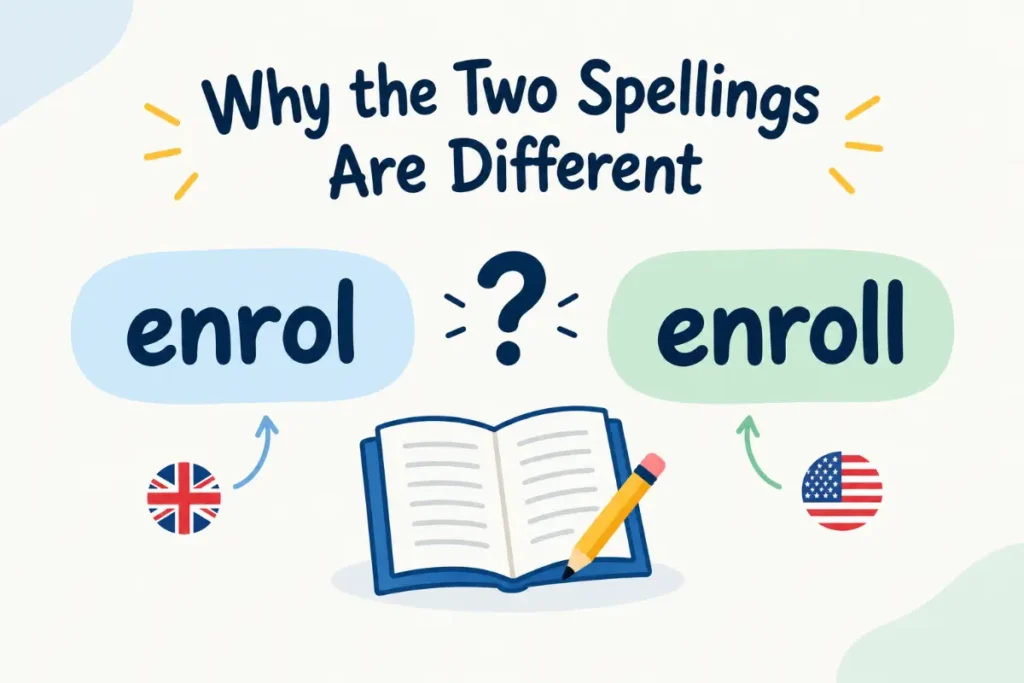
Why the Two Spellings Are Different
The difference between these spellings comes from regional English. American and British English often use different spellings for the same word. The meaning stays the same, but the written form can change.
You may already know some similar examples. Americans write color, while British writers use colour. American English favors center, while British English uses centre. The difference between enroll and enrol follows a similar pattern.
American English Uses Enroll
In the United States, enroll is the standard spelling. It appears in school forms, college websites, business documents, and everyday messages.
Here are some natural examples.
- I want to enroll in a computer science course.
- Parents can enroll their children in the summer program.
- You must enroll before the registration deadline.
- She plans to enroll at a local university.
- The school allows students to enroll online.
Notice that the word has two Ls at the end. This spelling is standard in American English, including in formal writing.
If you live in the United States or write for an American audience, use enroll. This applies to personal messages, school assignments, website content, and professional documents.
British English Uses Enrol
British English generally uses enrol with one L at the end. Writers in the United Kingdom commonly use this form in school materials, official documents, and everyday writing.
For example.
- I want to enrol in a computer science course.
- Parents can enrol their children in the summer program.
- You must enrol before the registration deadline.
- She plans to enrol at a local university.
- The school allows students to enrol online.
These sentences follow British spelling conventions. They express the same ideas as the American examples.
The single L is not a mistake in British English. It is the accepted spelling in that variety of English.
Which Spelling Is More Common Online
You may see enroll more often on American websites and enrol more often on British websites. The spelling usually reflects the website’s intended audience.
For example, a US college will generally use enroll on its admissions pages. A British university will usually use enrol in similar material.
However, spelling alone does not tell you where a writer lives. A person may follow a particular style guide, write for an international audience, or use English learned in another country.
The best choice depends on your readers and the style you need to follow. Do not change between the two forms just to match a spelling you see on another website.
The Main Spelling Rule
The easiest way to remember this difference is to connect it to your audience.
American English generally doubles the final L in enroll. British English usually keeps one L in enrol. The same regional difference appears in several related words.
The American Spelling Pattern
American English uses these forms.
- Enroll.
- Enrolled.
- Enrolling.
- Enrollment.
The spelling changes slightly when you add an ending. The final L doubles in enrolled and enrolling. The noun enrollment also uses two Ls.
For example, consider this sentence.
Maria will enroll in college this fall. She has already completed the enrollment form and is waiting for confirmation.
Both forms follow American spelling rules.
The British Spelling Pattern
British English uses these forms.
- Enrol.
- Enrolled.
- Enrolling.
- Enrolment.
The base verb has one L. However, the L doubles in enrolled and enrolling. The noun uses one L in enrolment.
For example.
Maria will enrol at university this autumn. She has already completed the enrolment form and is waiting for confirmation.
The spelling of enrolled and enrolling does not change between these two varieties. The main difference appears in the base verb and the noun.
Why Does the L Double in Some Words
English spelling rules can seem inconsistent because words come from different sources and follow different patterns. In this case, the spelling of the base verb changes by region, while the common endings follow the usual spelling pattern.
When a verb ends in a single vowel followed by a consonant, the final consonant often doubles before an ending that begins with a vowel. This helps preserve the short vowel sound in many words.
For example.
- Plan becomes planned.
- Stop becomes stopped.
- Admit becomes admitted.
- Enroll becomes enrolled.
This pattern also explains enrolling. The final L doubles before the ending ing.
The regional difference still matters. American English starts with enroll, while British English starts with enrol. Both forms produce enrolled and enrolling.
How to Use Enroll or Enrol in a Sentence
The verb describes the act of signing up or registering. You can use it when someone joins a school, takes a course, enters a training program, or signs up for a service.
The word can describe your own action or the action you take for another person.
Using the Verb for Yourself
Use the verb when you sign up for something.
For example.
- I plan to enroll in an English class.
- He wants to enrol in a cooking course.
- We decided to enroll in a fitness program.
- She hopes to enrol at a university next year.
- They will enroll in the workshop after checking their schedules.
In American writing, use enroll. In British writing, use enrol.
You can also use the verb when you talk about a future plan.
I will enroll in the course once registration opens.
This sentence means the speaker plans to sign up after registration becomes available.
Using the Verb for Another Person
You can use the word when you help someone else register.
For example.
- I enrolled my son in a summer camp.
- She enrolled her daughter in piano lessons.
- The parents enrolled their children in a new school.
- He plans to enrol his younger brother in a language course.
- The manager enrolled three employees in a training program.
In these examples, the person doing the registering appears before the verb. The person being registered appears after it.
This construction is common when parents register children or managers sign up employees for training.
Using the Verb for Schools and Colleges
Schools often use the word when discussing admissions and registration. A student may enroll in a course, while a parent may enroll a child in a school.
Consider these examples.
- New students can enroll at the college in August.
- I want to enroll in two history classes.
- The school will enroll new students next week.
- She enrolled in an online degree program.
- The college lets students enroll in evening classes.
The choice of preposition depends on the sentence. You can enroll in a course or program. You can enroll at a school or institution.
For instance, I enrolled in a nursing course focuses on the course. I enrolled at the university focuses on the institution.
Both are natural English.
Using the Verb for Work and Training
Enrollment is not limited to education. Businesses use it when employees sign up for workplace training, benefit plans, and other programs.
For example.
- The company asked me to enroll in a safety course.
- New employees must enroll in the benefits plan.
- She enrolled in a professional development program.
- The manager will enroll the team in cybersecurity training.
- Staff can enrol in the workshop through the company portal.
The same regional spelling rule applies. American businesses generally use enroll, while British businesses usually use enrol.
Using the Verb for Health Plans and Services
The word also appears in health insurance, government programs, and subscription services.
For example.
- You can enroll in a health insurance plan during the open registration period.
- He enrolled in a local wellness program.
- Eligible families can enroll their children in the service.
- She plans to enrol in a community support program.
- Members must enroll before they can access the online portal.
In these examples, the verb means to register officially. It often suggests that a person has completed a process rather than simply expressed interest.
Keep in mind that the exact steps depend on the program. Some services require an application, proof of eligibility, or payment before registration becomes final.
Enroll vs Enrolled vs Enrolling
These forms look similar, but each one serves a different purpose. The base verb describes the act of registering. The past form describes a completed action. The form ending in ing describes an ongoing action or an activity.
Learning these forms will help you avoid common grammar mistakes.
When to Use Enroll
Use enroll for the base form of the verb in American English. It works with words such as will, can, should, and to.
Examples.
- I want to enroll in the course.
- You can enroll online.
- She will enroll next semester.
- Students should enroll before classes begin.
- We need to enroll in the new program.
The same rule applies to enrol in British English.
- I want to enrol in the course.
- You can enrol online.
- She will enrol next semester.
- Students should enrol before classes begin.
- We need to enrol in the new program.
Notice that the verb stays in its base form after will, can, and should. You would not write will enrolled or can enrolling in these sentences.
When to Use Enrolled
Use enrolled when the action happened in the past or when you describe someone’s current registration status.
For example.
- I enrolled in the course last month.
- She enrolled her son in kindergarten.
- They enrolled in the program before the deadline.
- He is enrolled in three college classes.
- My sister has enrolled in a writing course.
The first three examples describe completed actions. The last two describe a current status or a completed action with a present result.
Both American and British English use enrolled with two Ls.
A common mistake is to write enroled. That spelling is not standard in either variety. Even though British English uses one L in the base verb, the past form doubles the L.
When to Use Enrolling
Use enrolling when you describe the act of registering as it happens or when it serves as part of a longer verb phrase.
Examples.
- I am enrolling in a course this week.
- She is enrolling new students at the front desk.
- They are enrolling in the summer program.
- He enjoys enrolling in short online classes.
- We will be enrolling new members next month.
The spelling is the same in American and British English.
The double L is easy to miss if you start with the British form. Remember that enrol becomes enrolling, not enroling.
A Simple Way to Tell the Forms Apart
Look at the time and purpose of your sentence.
| Form | Main Use | Example |
|---|---|---|
| Enroll | Base verb in American English | I want to enroll today. |
| Enrol | Base verb in British English | I want to enrol today. |
| Enrolled | Past action or current status | I enrolled last week. |
| Enrolling | Ongoing action or activity | I am enrolling now. |
If you are writing about something that already happened, enrolled is often the right choice. If the action is happening now, enrolling may fit better.
Enrollment vs Enrolment
The difference between enrollment and enrolment follows the same regional spelling pattern as the verb.
Enrollment is the standard American spelling. Enrolment is the standard British spelling.
Both nouns refer to the act of registering or to the number of people registered in a school, course, or program.
What Enrollment Means
In American English, enrollment can describe the process of signing up for something. It can also refer to the group of people who have registered.
For example.
- Enrollment for the fall semester begins in May.
- The college reported higher enrollment this year.
- Online enrollment takes only a few minutes.
- The school increased its enrollment after opening a new building.
- You must complete the enrollment process before classes start.
The exact meaning depends on the context. In the first and third examples, the word refers to the registration process. In the second and fourth examples, it refers to the number of students.
What Enrolment Means
British English uses enrolment in the same way.
For example.
- Enrolment for the autumn term begins in May.
- The university reported higher enrolment this year.
- Online enrolment takes only a few minutes.
- The school increased its enrolment after opening a new building.
- You must complete the enrolment process before classes start.
The meaning does not change with the spelling. Only the regional writing convention changes.
Which Noun Should You Use
If your readers are in the United States, write enrollment. If your readers are in the United Kingdom, use enrolment.
This rule matters when you write website pages, school policies, admission notices, and business reports. Using one spelling consistently makes your writing look polished and professional.
The same principle applies to other words that follow regional spelling patterns. Choose the variety that fits your audience and stay consistent throughout the document.
Common Mistakes to Avoid
The basic rule is simple, but a few mistakes can still cause confusion. Most involve mixing regional spellings or using the wrong verb form.
Mixing American and British Spellings
One common mistake is using American spelling in one sentence and British spelling in the next without a good reason.
For example.
The school will enroll new students in September. Enrolment forms are available online.
This sentence mixes the American verb with the British noun. Readers will understand it, but the spelling is inconsistent.
For a US audience, write this instead.
The school will enroll new students in September. Enrollment forms are available online.
For a British audience, use this version.
The school will enrol new students in September. Enrolment forms are available online.
Consistency is the goal. A document should generally follow one regional spelling system unless a specific name or official title requires another form.
Writing Enroled Instead of Enrolled
Some writers assume that the single L in enrol should stay in every form. That leads to the nonstandard spelling enroled.
Use enrolled instead.
Correct examples.
- She enrolled in the program yesterday.
- He has enrolled in a business course.
- They enrolled their child in a new school.
The double L is standard in both American and British English for the past form.
Writing Enroling Instead of Enrolling
The same mistake can happen with the form ending in ing. The standard spelling is enrolling.
Correct examples.
- I am enrolling in a class.
- She is enrolling new members.
- We will be enrolling students next week.
Do not remove an L from these forms. The correct spelling has two Ls.
Confusing Enroll With Apply
Enroll and apply are related, but they do not always mean the same thing.
To apply means to ask for admission, permission, or consideration. To enroll means to register or enter a program.
For example.
I applied to the university in January. I enrolled in my classes after the university accepted me.
The application came first. Enrollment followed after the student gained admission and completed the necessary steps.
However, the process varies. Some courses allow direct enrollment without a separate application. Others require approval before registration.
Using the Wrong Preposition
Writers sometimes struggle to choose between in and at.
Use enroll in when you focus on a course, class, or program.
- I enrolled in a biology course.
- She enrolled in a leadership program.
- They enrolled in an online workshop.
Use enroll at when you focus on the school or institution.
- He enrolled at the state university.
- She enrolled at a local college.
- My cousin enrolled at a technical school.
These patterns are common and natural. The best preposition depends on what follows the verb and what you want to emphasize.
Treating Enrollment as a Countable Person
The noun enrollment usually refers to registration or the number of people registered. It does not normally refer to an individual student.
For example, you can say, The school has an enrollment of 800 students.
You would not usually say, The school has 800 enrollments when you mean 800 students. In that context, students is the clearer word.
In some systems, enrollment may refer to an individual registration record. The meaning depends on the setting, but everyday writing is usually clearer when you name the people or courses directly.
How to Choose the Right Spelling for Your Audience
The best spelling depends on the people who will read your work. You do not need to memorize every regional spelling difference. Start by identifying your audience and following the English style they expect.
For American Readers
Use enroll, enrolled, enrolling, and enrollment.
These forms work well for US school websites, college applications, business content, educational articles, and personal writing.
For example.
Students can enroll in the program by completing the online enrollment form.
This sentence follows American spelling conventions from start to finish.
If you write blog posts for a US audience, keep the same spelling across the title, introduction, headings, examples, and FAQs. Consistency helps readers focus on your message instead of noticing small spelling changes.
For British Readers
Use enrol, enrolled, enrolling, and enrolment.
For example.
Students can enrol in the program by completing the online enrolment form.
This version follows British spelling conventions. The past form and the form ending in ing still use two Ls.
British English also uses the word programme for many organized activities and courses, while American English generally uses program. However, British English commonly uses program for computer software. These differences may appear alongside the spelling of the verb.
For International Readers
An international audience may include people who use different English varieties. In that case, pick one main style and follow it consistently.
For example, a website based in the United States may choose American English even if readers visit from many countries. A British university may follow British spelling on pages intended for international students.
You can also mention the regional difference when it helps readers. A short explanation near the top of an article can answer the question without forcing readers to search elsewhere.
The key is to avoid switching spellings without a clear reason.
Is Enroll or Enrol More Formal
Neither spelling is more formal than the other. Both are accepted forms in their respective varieties of English.
The choice is about regional convention, not quality. A formal American report should use enroll. A formal British report should normally use enrol.
In School Applications
Schools and colleges usually follow their own style guides. If an application form uses enrollment, follow that spelling in related documents unless the institution gives different instructions.
For example.
I am writing to ask about enrollment for the spring semester.
This is appropriate for an American college.
A British institution might use the following wording.
I am writing to ask about enrolment for the spring term.
Both examples sound professional. The regional spelling makes each one suitable for its intended audience.
In Business Writing
Businesses use these words when discussing staff training, benefits, memberships, and other registration processes.
For example.
Employee enrollment opens on Monday.
This is a natural choice for an American company.
A British company might write.
Employee enrolment opens on Monday.
Neither sentence is more professional than the other. The right choice depends on the company’s usual writing style.
In Academic Writing
Academic papers, student assignments, and university materials should follow the spelling rules required by the school or publisher.
Some institutions publish a style guide that covers spelling, punctuation, and formatting. If a teacher or editor asks for American English, use enroll. If the required style is British English, use enrol.
Do not assume that every English language publication follows the same convention. Checking the relevant guide can save time during editing.
Easy Ways to Remember the Difference
A simple memory trick can help you choose the right spelling without checking a dictionary every time.
Connect Enroll With the United States
Remember that American English uses the double L in enroll.
You can also connect it with the American noun enrollment. Both forms have two Ls.
For example.
I will enroll today and complete my enrollment form.
The repeated spelling makes the pattern easy to remember.
Connect Enrol With British English
British English generally uses enrol with one L. The noun enrolment also uses one L.
For example.
I will enrol today and complete my enrolment form.
Once you remember the base verb and noun, the difference becomes easier to spot.
Remember the Forms That Stay the Same
The words enrolled and enrolling use two Ls in both American and British English.
That means you do not need to choose between enroled and enrolled. Use enrolled.
Likewise, use enrolling rather than enroling.
This is useful because the regional spelling difference affects only some forms of the word. Learning the whole pattern is more helpful than memorizing the base verb alone.
Related Words and Their Meanings
The verb belongs to a family of words that describe registration and participation. Understanding these terms helps you choose the most accurate word for your sentence.
Register
Register means to enter information into an official list or record. It is often used in the same situations as enroll.
For example.
Please register for the workshop before Friday.
This sentence asks someone to sign up for an event.
In many situations, register and enroll can be used in similar ways. However, schools often use enroll when discussing a student’s entry into a course or institution.
Sign Up
Sign up is a common and informal way to describe joining an activity or service.
For example.
I want to sign up for a weekend writing class.
This sounds natural in everyday conversation. It is often simpler than enroll when you are speaking casually.
The phrase can also describe the first step in a process. Signing up may not mean that a person has completed every requirement for official enrollment.
Admission
Admission refers to permission to enter a school, college, or program. It is related to enrollment, but the two words describe different stages in many education systems.
For example.
She received admission to the university and enrolled in her first classes.
The first part describes acceptance. The second describes registration.
Some institutions combine these steps. Others handle them separately.
Registration
Registration is the process of recording someone’s details or signing up for a service, course, or event.
For example.
Course registration closes at the end of the month.
The word is often interchangeable with enrollment in educational settings. However, a school may use one term for admission and another for selecting classes.
Check the institution’s wording when the difference affects what you need to do.
Enrollment Status
Enrollment status describes a person’s current position in a school or program. Someone may be fully enrolled, temporarily inactive, or no longer registered.
For example.
Please contact the school to confirm your enrollment status.
This phrase is common in academic and administrative writing. It focuses on the person’s current registration record rather than the act of signing up.
Examples of Enroll and Enrol in Everyday English
Seeing the words in real sentences makes the spelling rule easier to apply. These examples cover common situations at school, at work, and in daily life.
School and College Examples
- I plan to enroll in college next year.
- She enrolled in a nursing course last fall.
- My brother is enrolling in a math class.
- Parents can enroll their children in the local school.
- The university increased its enrollment this year.
For British English, the base verb and noun would normally use enrol and enrolment. The forms enrolled and enrolling stay the same.
Work and Career Examples
- The company will enroll new employees in safety training.
- I enrolled in a course to improve my writing skills.
- Our manager is enrolling the team in a leadership program.
- Employee enrollment begins next week.
- He plans to enrol in a professional training course.
These examples show how the verb applies to workplace learning and development. The spelling follows the same regional rule as it does in education.
Online Services Examples
- You can enroll in the service through the website.
- She enrolled in an online fitness program.
- I am enrolling in a digital marketing course.
- Online enrollment closes at midnight.
- New members can enrol through the company website.
The word is common in online registration systems. However, a website may use sign up or register instead. Those choices are also correct when they fit the meaning.
Past Tense Examples
- I enrolled in the class yesterday.
- She enrolled her daughter in a summer camp.
- They enrolled in the program before applications closed.
- He has enrolled in a course that starts next month.
- We had enrolled before the school changed its schedule.
All five sentences use the same past form. You do not need to change the spelling for a British audience.
Questions and Negative Sentences
You can also use the verb in questions and negative sentences.
- Did you enroll in the class?
- Have you enrolled in the program yet?
- Why did she enroll so late?
- I have not enrolled in the course.
- He did not enroll before the deadline.
After did and did not, use the base form of the verb. For example, write Did you enroll? rather than Did you enrolled?
This grammar rule applies to both regional spellings. A British writer would use Did you enrol?
FAQs
Is enrol or enroll correct in the US?
Enroll is correct in American English. The spelling with two Ls is used in school forms, college websites, business documents, and everyday writing. The related noun is enrollment.
Is enrol wrong in American English?
Enrol is the standard British spelling, so it is not an incorrect English word. However, American readers generally expect enroll. Use the American form when writing for a US audience.
Is enroll correct in British English?
British English generally uses enrol for the base verb. However, enroll is common in American English. British writers should normally follow the spelling used by their institution or style guide.
Is it enrollment or enrolment?
Use enrollment in American English and enrolment in British English. Both nouns describe the act of registering or the number of people registered. The meaning stays the same.
Is it enrolled or enroled?
Enrolled is the standard spelling in both American and British English. The past form uses two Ls, even though British English spells the base verb enrol. Avoid enroled in standard writing.
Is it enrolling or enroling?
Enrolling is the correct spelling in both varieties of English. The L doubles before the ing ending. The spelling enroling is not standard.
Do you enroll in a course or enroll at a school?
Both constructions are correct. Use enroll in for a course, class, or program. Use enroll at when you focus on the school or institution.
What is the difference between enrolling and registering?
Both words can describe signing up for a course, service, or program. Registering often refers to entering information into an official record, while enrolling often emphasizes joining a program or institution. The exact meaning depends on the context.
Conclusion
The choice between enrol or enroll comes down to the type of English you use. American English uses enroll, while British English generally uses enrol. Both spellings are correct, and neither changes the meaning of the word.
Remember the related forms as well. American English uses enrollment, while British English uses enrolment. Both varieties use enrolled and enrolling with two Ls.
If you write for a US audience, stick with enroll and enrollment throughout your content. Use the same approach in your headings, examples, and related explanations. This small detail helps your writing stay clear and consistent.
The next time you face the question enrol or enroll, think about your readers first. Choose the spelling that matches their English variety, check the related words, and keep the same style from beginning to end.

Dr. Elena Vance holds a Ph.D. in Linguistics from Columbia University and has spent over 15 years analyzing the evolution of the English language. A former university professor turned full-time writer and editor, Elena specializes in breaking down high-level grammatical concepts, punctuation nuances, and style guides (APA, Chicago, MLA) into clear, actionable advice. When she isn’t hunting down dangling modifiers, she can be found collecting vintage dictionaries and reading classic literature.