
If you have ever stopped while writing a sentence to wonder if you should write one-third or one third, you are not alone. Both forms appear in books, articles, school assignments, and everyday writing. The difference can seem small, but it matters when you want your writing to look clear and correct.
The good news is that both spellings are correct in American English. The right choice depends on how you use the fraction in a sentence and the style rules you follow.
One-third uses a hyphen and often appears when a fraction works like a single unit or describes a noun. One third uses two separate words and often appears when the fraction stands alone as a quantity. However, these patterns are not absolute rules. Many style guides and publishers use different conventions.
This guide explains the difference between the two forms, shows you how to use them in real sentences, and covers common mistakes. You will also learn how to write fractions with other numbers, handle fractions in formal writing, and choose a consistent style for your work.
Quick Definition
One-third and one third both represent one of three equal parts of a whole. For example, if you divide a pizza into three equal slices, one slice represents one third of the pizza.
The hyphenated form often appears when the fraction describes a noun, as in a one-third share. The open form often appears when the fraction stands alone, as in one third of the class. These are common patterns rather than universal rules.
Direct Answer
Both one-third and one third are correct. Use the form that fits your sentence and follow the style guide used by your school, workplace, publisher, or website. Consistency matters more than treating the hyphen as a strict grammatical requirement.
Comparison Table
| Word or Phrase | Meaning | Example Sentence | When to Use It |
|---|---|---|---|
| One-third | One of three equal parts | She owns a one-third share of the company. | Often used before a noun as a compound modifier. |
| One third | One of three equal parts | One third of the students arrived early. | Often used when the fraction stands alone. |
| One third of | A portion equal to one of three equal parts | One third of the cake remains. | Common when describing a portion of a whole. |
| One-third share | A share equal to one of three equal parts | He received a one-third share of the profits. | Used when the fraction describes the type or size of a share. |
| One-third cup | A cooking measurement | Add one-third cup of milk. | Used in recipes and measurements, depending on the chosen style. |
| One-third full | Filled to one of three equal parts | The bottle was one-third full. | Used to describe the degree or amount of something. |
Why Both Spellings Are Correct
English uses fractions to describe parts of a whole. A fraction has a numerator and a denominator. The numerator tells you how many parts you have, while the denominator tells you how many equal parts make up the whole.
In the fraction one third, the number one is the numerator and the number three is the denominator. Together, they describe one part out of three equal parts.
You can write this fraction as a numeral, as words, or as part of a longer phrase. Each choice serves a different purpose.
For example, consider these sentences.
- One third of the students chose the blue design.
- The student received a one-third share of the prize.
- The recipe calls for ⅓ cup of sugar.
- The bottle is one third full.
Each sentence communicates the same basic idea of a fractional amount. The spelling changes to fit the sentence or the style being used.
How English Treats Fractions
Fractions written in words can behave like nouns, adjectives, or parts of larger phrases. That flexibility explains why writers use different forms.
A fraction can name an amount.
One third of the money went toward rent.
Here, the fraction tells readers how much money went toward rent. It functions as the subject of the sentence.
A fraction can also describe a noun.
The family purchased a one-third share of the land.
In this example, the fraction describes the share. The hyphen connects the words so readers can understand them as one descriptive unit.
A fraction can also describe a state or condition.
The tank was one-third full.
The fraction tells readers how full the tank was. Some style guides prefer the hyphen in this construction, while others may allow an open form.
These differences show why you should consider the entire sentence rather than focus on the spelling alone.
Why Writers Get Confused
The confusion comes from the fact that English uses hyphens to connect words in some expressions but leaves similar expressions open in others.
For example, writers commonly use a hyphen in terms such as a two-thirds majority or a one-half portion. However, they may write two thirds of the voters or one half of the cake.
The meaning stays the same. The sentence structure and editorial style help determine the spelling.
Another source of confusion is the difference between grammar rules and style preferences. Grammar explains how words work together. Style guides help writers make consistent choices about spelling, punctuation, capitalization, and formatting.
A hyphen in a written fraction often reflects a style choice rather than a difference in mathematical meaning.
When to Use One Third Without a Hyphen
The open form works well when you name a fractional amount directly. It is especially common in phrases that begin with the fraction followed by the word of.
When the Fraction Stands Alone
Use the open form when the fraction names an amount and does not need to function as a compound modifier.
Examples include the following.
- One third of the pie is missing.
- One third of the workers voted against the proposal.
- One third of the budget goes toward transportation.
- One third of the land remains undeveloped.
- One third of the water evaporated during the experiment.
In each example, the fraction identifies a portion of a larger whole. The words following the fraction explain what that portion belongs to.
This construction is common in everyday writing, school assignments, news articles, and reports.
When the Fraction Comes Before Of
The phrase one third of is especially useful when you want to describe a part of a group, object, amount, or total.
Consider these examples.
- One third of the guests arrived before noon.
- One third of the chocolate was used to make the frosting.
- One third of the company’s income came from online sales.
- One third of the road needs repairs.
- One third of the available seats remained empty.
The phrase tells readers how much of the whole you mean. It also helps avoid awkward wording.
Instead of writing a long phrase such as one out of every three members of the group, you can often write one third of the group.
That shorter version is clear and easy to read.
When the Fraction Appears After a Verb
Fractions often follow verbs that describe a state, measurement, or change.
For example.
- The field was one third covered in snow.
- The tank remained one third full.
- The project was one third complete.
- The jar is one third empty.
- The road is one third finished.
These forms are understandable and may appear in general writing. However, style guides differ on the use of hyphens in expressions such as one-third full and one-third complete.
If you are writing for a publication, check its style guide. If no guide applies, choose a form that reads naturally and use it consistently.
When Writing Fractions in General Prose
Open fractions are common in explanatory writing because they are easy to read.
For example, a teacher might write the following.
One third of the students chose the first answer, while the remaining students chose other options.
A financial writer might say this.
One third of the monthly payment goes toward interest during the first year.
A health educator might explain the result this way.
One third of the participants reported a change in their daily routine.
These sentences work because the fraction clearly identifies a portion of the whole. The reader does not need a hyphen to understand the meaning.
When to Use One Third With a Hyphen
The hyphenated form often appears when the fraction works as a compound modifier. A compound modifier is a group of words that describes a noun or another part of a sentence as one unit.
For example, in the phrase a one-third share, the fraction describes the word share.
Before a Noun
Use the hyphenated form when your chosen style guide calls for a hyphen in a fraction that directly describes a noun.
Examples include the following.
- She received a one-third share of the inheritance.
- The company reported a one-third increase in sales.
- The team earned a one-third stake in the project.
- The recipe requires a one-third cup of flour.
- The building contains a one-third scale model of the original design.
In each sentence, the fraction describes a noun such as share, increase, stake, cup, or model.
The hyphen helps connect the words so readers can process them as a single descriptive unit.
Still, the exact treatment can vary by style guide. Some guides hyphenate spelled out fractions in these positions, while others have more specific rules for measurements and numbers.
In Compound Descriptions
A fraction can also describe a condition, size, or degree.
For example.
- The bottle was one-third full.
- The report is one-third complete.
- The field remained one-third covered in water.
- The machine operated at one-third capacity.
- The artist created a one-third scale replica.
The hyphen is common in these expressions because the fraction acts as a unit that describes a state or measurement.
Notice the difference between these two sentences.
The bottle was one third full.
The bottle contained one third of its original volume.
The first sentence describes how full the bottle was. The second names a portion of its original volume. Many editors would use the hyphen in the first sentence and leave the fraction open in the second, but the preferred style may vary.
The safest approach is to check the rules for your publication and apply them throughout your work.
In Recipes and Measurements
Fractions appear often in recipes. A cook might need one third of a cup of milk, one third of a teaspoon of salt, or one third of a pound of butter.
Recipes frequently use numerals instead of words because they are quick to scan.
For example.
- Add ⅓ cup of milk.
- Mix in ⅓ teaspoon of salt.
- Cut the cheese into ⅓ inch cubes.
- Bake the dish for ⅓ of the recommended time.
When you spell out the amount, your style guide may favor one-third cup, one-third teaspoon, or one third of a cup. Recipe publishers often have their own formatting rules.
For everyday cooking, clarity matters most. Readers should understand the amount without having to stop and interpret the wording.
If you write recipes regularly, choose a standard format for fractions and use it in every recipe.
How to Write One – Third in Different Types of Writing
The best spelling can depend on the kind of writing you are doing. A school essay, a news story, a recipe, and a scientific report may follow different style rules.
The meaning of the fraction stays the same. What changes is the way the writer presents it.
In School Assignments
For schoolwork, follow your teacher’s instructions first. Some teachers prefer fractions written in words, while others allow numerals or require a particular format.
For example, a student might write the following in an English essay.
One third of the class completed the assignment early.
In a math assignment, the same student might write the fraction as ⅓.
Both forms represent the same value. However, the word form may be more suitable for a sentence, while the numeral is often more convenient in a mathematical equation.
If the assignment follows a style guide, use its rules for spelled out fractions. Do not switch between formats without a reason.
In Business Writing
Business writing often includes fractions when describing money, ownership, sales, costs, and performance.
Consider these examples.
- The investor purchased a one-third share of the company.
- One third of the annual budget goes toward employee training.
- The department reduced its expenses by one third.
- The agreement gives each partner a one-third interest in the property.
- One third of the projected revenue will come from new customers.
These sentences are direct and easy to understand.
In legal and financial documents, precision matters even more. If a fraction describes ownership, payment terms, or a person’s rights, use the format required by the document or organization. Do not rely on spelling alone to make an unclear agreement precise.
For example, a contract should explain exactly what a one-third interest covers. The wording should make clear which assets, payments, or rights the fraction applies to.
In Academic and Scientific Writing
Academic and scientific writing often uses numerals for measurements, calculations, and data. A report may show a fraction as 1/3 or ⅓ instead of spelling it out.
For example.
One third of the samples showed the same result.
In a table, the researcher might use 1/3 to save space. In a mathematical formula, the fraction would usually appear as a numeral.
The choice depends on the discipline and its style guide. Scientific publications often have detailed rules for numbers, units, equations, and statistical results.
When writing for a class or journal, check those requirements before deciding how to format fractions.
In News Articles and Blog Posts
News articles and blog posts need to communicate information quickly. Readers should understand the point without having to reread a sentence.
For example.
One third of the homes in the area lost power during the storm.
That sentence gives the reader a clear picture of the scale of the problem.
A writer might also use a fraction to describe a price change, a survey result, or a share of the population.
The key is consistency. If you spell out fractions in one section, follow the same approach in similar sections unless the context calls for numerals.
For an online article, a direct explanation also helps readers find the answer they need. State the main rule early, then provide examples and exceptions for readers who want more detail.
How to Write Other Fractions Correctly
Understanding this fraction makes it easier to write other fractions. The same basic ideas apply to halves, quarters, and fractions with larger denominators.
However, English does not treat every fraction in exactly the same way. The format can depend on sentence structure, number style, and the rules of your publication.
One Half or One Half With a Hyphen
The fraction one half represents one of two equal parts.
Examples include the following.
- One half of the cake remains.
- She owns a one-half share of the property.
- The bottle is one-half full.
- The recipe calls for one-half cup of oil.
The open form often appears when the fraction names a portion. The hyphenated form often appears when it describes a noun or condition.
As with one third, these are common patterns rather than universal rules.
Two Thirds or Two Thirds With a Hyphen
Two thirds represents two of three equal parts.
Examples include the following.
- Two thirds of the class passed the test.
- The investor purchased a two-thirds interest in the business.
- Two thirds of the land belongs to the family.
- The project is two-thirds complete.
The plural form thirds reflects the fact that the fraction includes two parts. The basic meaning stays the same.
If you are writing for a publication, check its rules for fractions written in words. Some guides use hyphens more often than others.
One Quarter or One Fourth
One quarter and one fourth can both represent one of four equal parts.
For example.
- One quarter of the pizza is left.
- One fourth of the students chose the final answer.
- She owns a one-quarter share of the property.
- The container is one-quarter full.
Quarter is especially common in everyday American English. Fourth is also correct and often appears in math lessons or technical explanations.
Choose the term that fits your audience and context.
Three Quarters and Three Fourths
Three quarters and three fourths both represent three of four equal parts.
Examples include the following.
- Three quarters of the work is complete.
- Three fourths of the students voted in favor.
- The team completed three-quarters of the project.
- The tank was three-quarters full.
The wording and hyphenation may vary by style. In formal writing, consistency is more useful than switching between forms without a clear reason.
Fractions With Larger Denominators
You can also write fractions such as one fifth, two fifths, one eighth, and three eighths.
Examples include the following.
- One fifth of the money went toward supplies.
- Two fifths of the group arrived late.
- One eighth of the cake remained.
- Three eighths of the field flooded after the storm.
These fractions follow the same general principle. The numerator tells you how many parts you have, and the denominator tells you how many equal parts make up the whole.
When you write them as words, use the appropriate singular or plural form. One fifth refers to one part out of five. Two fifths refers to two parts out of five.
Common Mistakes to Avoid
Fractions look simple, but writers can make a few common errors. Most involve confusing the meaning, using inconsistent formatting, or choosing a form that does not fit the sentence.
Treating the Hyphen as a Strict Grammar Rule
One common mistake is assuming that every written fraction must have a hyphen.
That is not correct. Both open and hyphenated forms appear in standard English. The preferred form often depends on the role of the fraction and the style guide.
For example, one third of the class and a one-third share can both be correct.
Do not add a hyphen simply because you think it is always required. Look at how the fraction functions in the sentence.
Changing the Meaning of the Fraction
Another mistake is confusing one third with one of three separate items.
The phrase one third means one of three equal parts of a whole. The parts must be equal for the fraction to describe exactly one third.
Imagine a pizza cut into three slices of different sizes. One slice does not necessarily equal one third of the pizza. The fraction refers to an equal share, not simply one item among three.
This distinction matters in math, cooking, money, and measurements.
Switching Between Styles
Writers sometimes use one-third in one paragraph and one third in the next without a clear reason.
That change may not make the writing grammatically wrong. However, it can make the article look inconsistent.
For example, a writer might use one-third share, one third of the budget, and one-third of the employees in the same section. Depending on the chosen style, the last example may need the open form or a different construction.
Before publishing, scan the article for fractions. Make sure similar expressions follow the same editorial rules.
Using the Wrong Singular or Plural Form
The number of parts affects the wording.
Use one third when referring to a single part out of three equal parts. Use two thirds when referring to two parts out of three.
Examples.
- One third of the cake is gone.
- Two thirds of the cake are gone.
The verb can also depend on the noun that follows the fraction and the way the sentence is structured. When the fraction refers to a singular amount, a singular verb often fits. When it refers to multiple people or separate items, a plural verb may be more natural.
For example.
One third of the water is missing.
One third of the students are absent.
The first sentence treats water as a single amount. The second refers to multiple students.
Assuming Numerals and Words Are Interchangeable Everywhere
The forms ⅓, 1/3, one third, and one-third represent the same fraction. Still, they do not fit every context equally well.
A recipe may use ⅓ cup. A math equation may use 1/3. A paragraph may spell out one third. A descriptive phrase may use one-third share.
Choose the format that readers can understand most easily in the context. If a style guide specifies one format, follow it.
How to Remember the Correct Form
You do not need to memorize a long list of fraction rules. A few simple checks can help you choose the right form.
Look at the Words Around the Fraction
Start by reading the whole sentence.
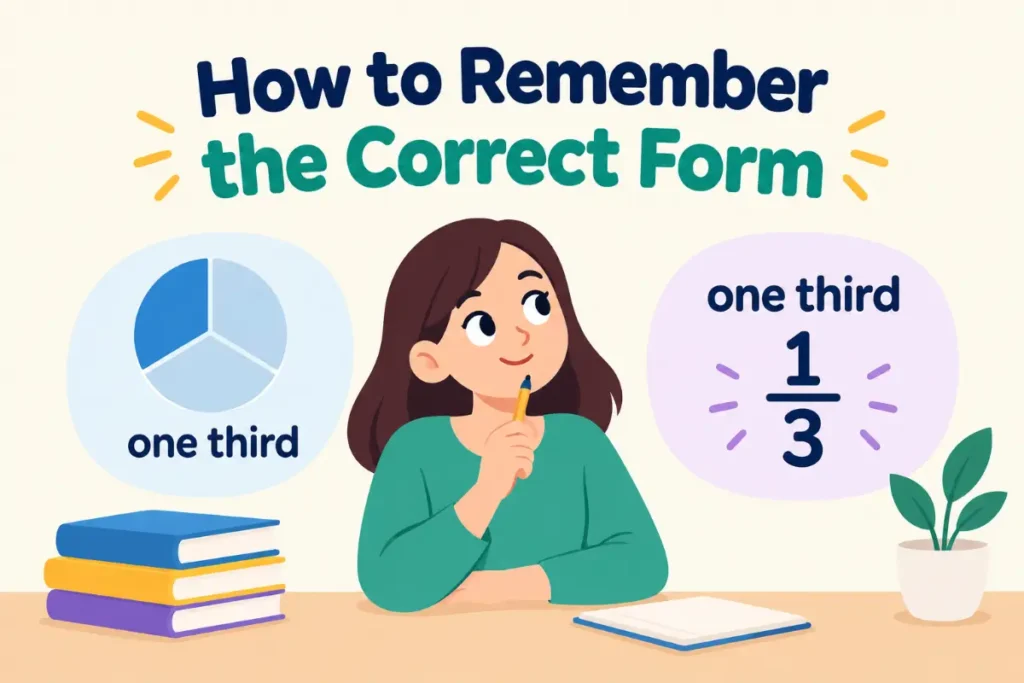
If the fraction names an amount followed by of, the open form often works well.
One third of the budget went toward repairs.
If the fraction describes a noun, the hyphenated form is often a good choice.
The company sold a one-third stake.
This quick check will help you in many everyday situations. Just remember that a style guide may use a different rule for some constructions.
Read the Sentence Aloud
Reading your sentence aloud can help you spot awkward wording.
Compare these examples.
One third of the team arrived early.
The team received a one-third share of the prize.
Both sentences sound natural because each phrase fits its role in the sentence.
Reading aloud also helps you find repeated words, unclear phrases, and sentences that are too long. It is a simple editing habit that works for many types of writing.
Choose a Style and Stick With It
If you write articles, reports, or school assignments regularly, create a simple rule for fractions.
For example, you might use words for common fractions in ordinary sentences and numerals in measurements or equations. You might also follow a published style guide for hyphens.
The specific approach matters less than applying it consistently.
If you edit a website, a short style sheet can save time. Record your preferred form for common fractions, measurements, percentages, and numbers. Then use that guide when you write or review new articles.
One Third or One – Third in a Sentence
The best way to understand a fraction is to see it in context. The following examples show how the two spellings work in common situations.
Examples With One Third
- One third of the students finished the quiz in ten minutes.
- One third of the apple was enough for the child.
- One third of the money went toward household bills.
- One third of the road was closed for repairs.
- One third of the audience left before the show ended.
- One third of the garden needs fresh soil.
- One third of the recipe can serve two people.
- One third of the book covers the author’s early life.
- One third of the water spilled onto the floor.
- One third of the available tickets sold within an hour.
These examples use the fraction to describe a portion of a whole. The phrase one third of makes the relationship clear.
Examples With One Third in a Description
- The bottle was one-third full.
- The company owns a one-third share of the property.
- The team completed a one-third scale model.
- The investor purchased a one-third stake in the project.
- The machine ran at one-third capacity.
- The group received a one-third portion of the total payment.
- The tank was one-third empty.
- The designer built a one-third scale replica of the bridge.
These examples show how the fraction can describe a share, size, state, or amount. The hyphen connects the words in the fraction when they work together as a descriptive unit.
Examples With Numerals
In some settings, numerals are more useful than words.
- Add ⅓ cup of water.
- Divide the total by 3 and then take 1/3 of the result.
- The chart shows that 1/3 of the group chose option A.
- Reduce the recipe to ⅓ of its original size.
- The model measures 1/3 of the original length.
Numerals are common in math, recipes, tables, and technical documents. Use them when they make the information easier to scan or calculate.
FAQs
Is One Third One Word or Two Words?
One third is written as two words when you leave out the hyphen. The hyphenated form connects the same two words into one written unit. Both forms are correct in standard English.
Is One Third Always Hyphenated?
No. Writers often leave the fraction open when it names an amount, as in one third of the pie. They often use a hyphen when the fraction describes a noun or condition, as in a one-third share or one-third full. Follow your chosen style guide for the final decision.
Should I Write One Third of a Cup or One Third Cup?
Both forms appear in English. One third of a cup is a clear and common construction in general writing. Recipes may use one-third cup or the numeral ⅓ cup to keep ingredient lists short. Follow the recipe format you have chosen.
Is One Third Grammatically Correct?
Yes. One third is a standard way to write the fraction in words. It can name a portion of a whole, as in one third of the cake. The hyphenated form is also correct in suitable contexts.
What Is the Difference Between One Third and One Thirds?
One third refers to one of three equal parts. Two thirds refers to two of those equal parts. In standard English, you do not use one thirds to express the fraction 1/3.
Can I Use One Third in Formal Writing?
Yes. The open form is common in formal writing, especially when the fraction names an amount. Academic papers, reports, and business documents may have their own rules for fractions. Check the relevant style guide before publishing.
Is One Third the Same as 33.33 Percent?
One third equals 33⅓ percent exactly. The decimal 33.33 percent is a rounded value, so it is very close but not exactly the same. For precise calculations, use the fraction or a sufficient number of decimal places.
How Do I Write One Third in a Math Problem?
You can write one third as 1/3 or ⅓. Both symbols represent one part out of three equal parts. In a sentence, you can spell it out as one third. Use the format required by your assignment or the type of calculation.
Conclusion
Both one-third and one third are correct ways to write the fraction that represents one of three equal parts. The main difference is the hyphen. It often appears when the fraction describes a noun or condition, while the open form often appears when the fraction names an amount.
For example, you can write one third of the class and a one-third share. Both expressions are clear and natural. The right choice depends on the sentence and the style guide you follow.
When in doubt, read the whole sentence and consider how the fraction works. If it names a portion, the open form is often a good choice. If it describes something, the hyphenated form may fit better. Check your publication’s rules when you need a firm editorial standard.
The easiest way to remember the distinction is to focus on the sentence rather than the fraction alone. Choose the form that fits your meaning, keep your writing consistent, and move on with confidence.

Sienna Watson is a veteran copywriter and communications coach who has helped startup founders, marketers, and professionals polish their writing for over a decade. Realizing that most people don’t need a degree in linguistics—just clear, impactful communication—Sienna focuses on practical grammar, business writing etiquette, and eliminating wordiness. She advocates for plain language, strong verbs, and persuasive prose that gets results.