

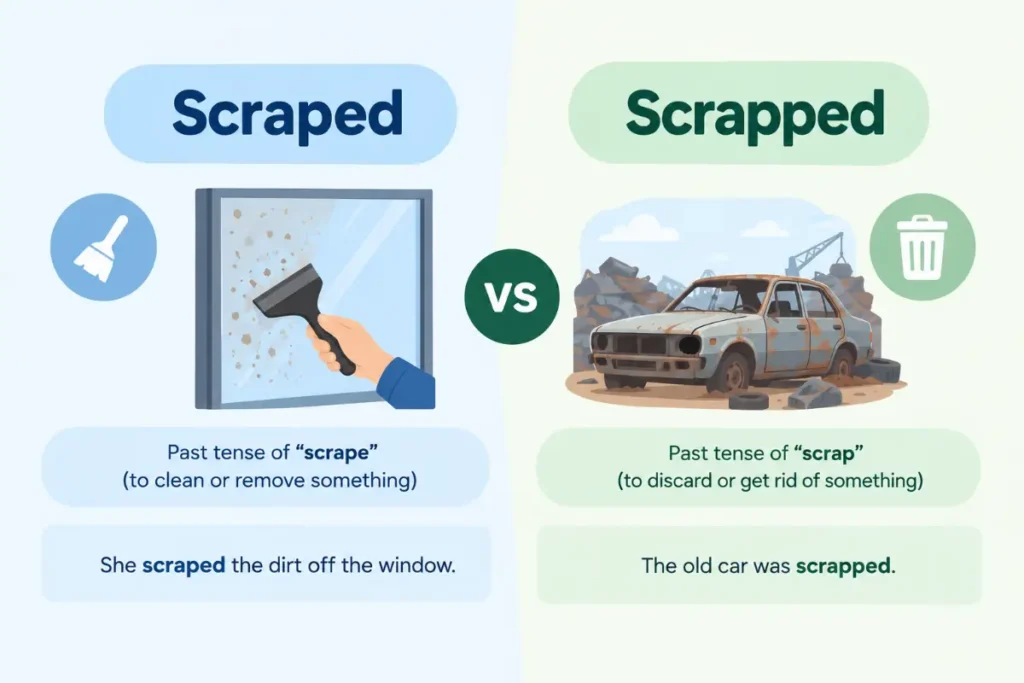
The difference between scraped vs scrapped comes down to meaning. Both are correct spellings, but they describe different actions. Scraped means removing something from a surface or collecting information from a website. Scrapped means throwing something away, canceling a plan, or deciding not to use something.
For example, you scraped ice off your windshield before driving to work. However, your company scrapped its plan to launch a new product.
The two words look almost identical. They also sound the same in most American English speech. That makes it easy to mix them up in writing.
The good news is that a simple spelling rule can help you choose the right word. This guide explains their meanings, spelling rules, everyday uses, and common mistakes. You’ll also learn how to use both words in natural sentences.
Quick Definition
Scraped is the past tense of scrape. It describes rubbing or dragging something across a surface to remove material or gather information.
Scrapped is the past tense of scrap. It means discarded, canceled, or abandoned something. The correct spelling depends on the action you want to describe.
Direct Answer
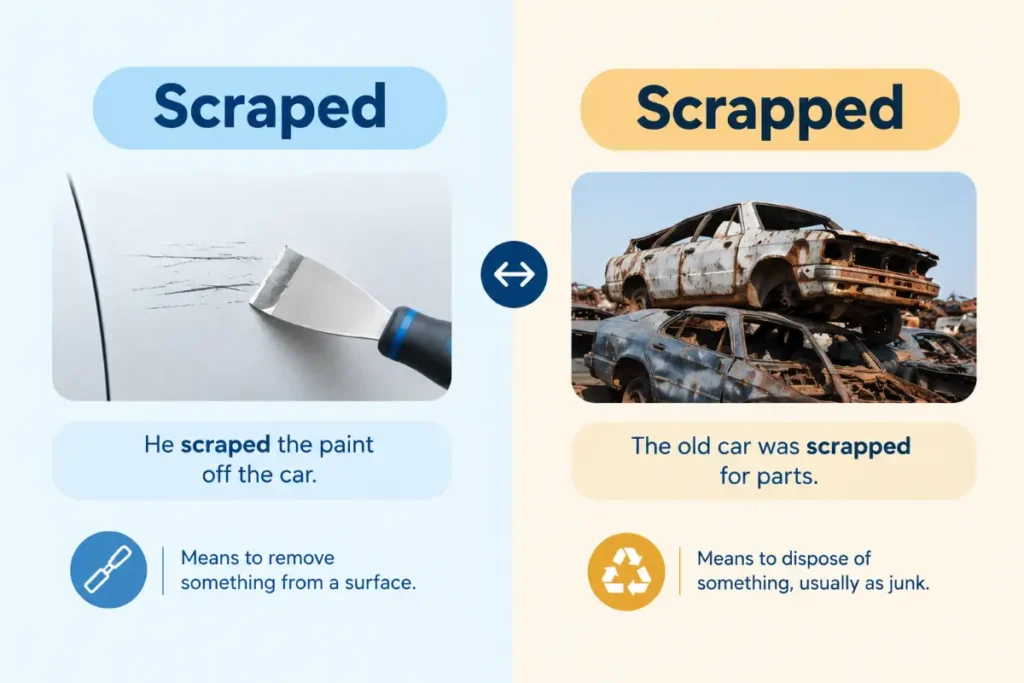
Use scraped when someone removes something from a surface or collects data from a source. Use scrapped when someone throws something away or cancels an idea, plan, or project.
For example, She scraped the paint off the door is correct. She scrapped the plan to repaint the door is also correct.
Comparison Table
| Word | Meaning | Example Sentence | When to Use It |
|---|---|---|---|
| Scraped | Removed material from a surface or collected information | I scraped mud off my boots. | When removing, rubbing, or extracting something. |
| Scrapped | Discarded or canceled something | We scrapped the old design. | When abandoning, rejecting, or getting rid of something. |
Why These Words Are Easy to Confuse
The words scraped and scrapped differ by just one letter. Both come from short verbs, and both end in the letters ed in their past tense forms. They also have similar sounds, so you might not notice the spelling difference when someone says them aloud.
However, their meanings are quite different.
Think about a cook preparing dinner. If the cook scraped burnt food from the bottom of a pan, the cook removed something from a surface. If the cook scrapped the idea of serving that dish, the cook abandoned the plan.
The first action involves removal. The second involves rejection.
The Difference Starts With the Base Word
To understand these spellings, look at the original verbs.
- Scrape means to rub or drag something against a surface. It can also mean to collect information from a source.
- Scrap means to discard something or decide not to use it.
The past tense of scrape is scraped. The past tense of scrap is scrapped.
Here are two more examples.
- I scraped the sticker off my laptop.
- I scrapped my idea for a new laptop design.
In the first sentence, the speaker removes a sticker. In the second, the speaker abandons an idea.
This small difference matters because a spelling mistake can change the meaning of your sentence.
Why the Extra P Matters
English spelling often changes when a verb becomes a past tense form. Some verbs simply take ed. Others double their final consonant before adding the ending.
The verb scrape ends in a silent e. You remove that final e before adding ed, which gives you scraped.
The verb scrap ends in a consonant after a short vowel sound. You double the final p before adding ed, which gives you scrapped.
These changes follow common English spelling patterns. Once you understand the base verbs, the past tense forms become easier to remember.
The Meaning of Scraped
Scraped is the past tense and past participle of scrape. It usually describes removing something from a surface through friction or pressure. It can also describe a surface becoming damaged after rubbing against another object.
In technology, the word has another common use. It can describe collecting information from websites or other digital sources.
Scraped as Removing Something From a Surface
This is one of the most common uses of the word.
You might scrape food from a plate, ice from a windshield, or dried paint from a wall. In each case, you use a tool or another object to remove material.
Consider these examples.
- Maria scraped the mud off her shoes before entering the house.
- Dad scraped the frost from the car windows.
- I scraped the burnt cheese from the baking dish.
- The worker scraped old paint from the wooden door.
- He scraped gum from the bottom of his shoe.
Each sentence describes removing something that sticks to a surface.
The action does not always need to remove every bit of material. You can scrape most of the paint off a wall and leave a few patches behind. The word describes the action rather than guaranteeing a perfect result.
Scraped as Causing a Scratch or Injury
The word can also describe damage caused by rubbing against a rough surface.
For example, a child might scrape a knee after falling on the sidewalk. A chair might scrape the floor when someone pulls it across a room. A car might scrape a wall while turning into a narrow garage.
Notice the difference between scraping something off and scraping against something.
- She scraped the sticker off the bottle.
- She scraped her hand against the rough wall.
In the first example, she removes the sticker. In the second, her hand rubs against the wall and may get hurt.
You can also use the word to describe a surface that gets damaged.
For instance, The side of the car scraped the gate means the car rubbed against the gate. The contact may have left marks on the paint.
Scraped as Collecting Online Data
In computing, scraped often refers to gathering information from websites. The process is called web scraping.
A person or program may collect product names, prices, article titles, or other publicly displayed information from web pages. The collected information can then be sorted, analyzed, or stored in a database.
For example.
- The researcher scraped public data from several websites.
- The shopping tool scraped product prices to compare deals.
- The team scraped article titles for a content analysis project.
- The developer scraped website data to build a searchable catalog.
In these sentences, nobody is physically rubbing a surface. The word refers to extracting information from a digital source.
The meaning still connects to the original idea of removing something from a larger source. Instead of removing paint or dirt, the person gathers selected information.
Web scraping also comes with practical limits. A website may restrict automated collection in its terms of service. Privacy rules, copyright law, and other legal requirements may apply, depending on the information and the method used. The word itself does not mean that the collection was authorized or unauthorized.
Scraped in Everyday Expressions
The verb scrape appears in several common expressions.
One is scraped together. It means gathering enough money or resources through effort, often when supplies are limited.
For example, We scraped together enough money for a weekend trip.
Another is scraped by. It means managing to succeed or survive with very little money, time, or support.
For example, During college, he scraped by on a small part time income.
You may also hear scraped through. This means barely passing a test or achieving a result.
For example, I scraped through the final exam with a passing grade.
These expressions use the same spelling because they come from the verb scrape. The exact meaning depends on the phrase and the surrounding sentence.
The Meaning of Scrapped
Scrapped is the past tense and past participle of scrap. It usually means that someone discarded something, canceled a plan, or decided not to continue with an idea.
The word often appears in conversations about projects, products, rules, plans, and old equipment.
Scrapped as Canceled or Abandoned
People often use scrapped when they decide not to move forward with something.
A business might scrap a product launch. A school might scrap an outdated rule. A family might scrap plans for a vacation after an unexpected expense.
Here are some natural examples.
- The company scrapped its plan to open a new office.
- We scrapped the first draft and started again.
- The school scrapped the old dress code.
- The director scrapped several scenes from the movie.
- The city scrapped its proposal to close the library.
In each sentence, someone decides to stop using or pursuing something.
The word often suggests that a decision has already been made. A plan is not simply delayed. It has been abandoned or canceled.
Still, context matters. If a company scraps one design, it may choose another design instead. If it scraps an entire project, the work may stop completely.
Scrapped as Throwing Something Away
The word can also refer to getting rid of an old or unwanted object.
For example, a mechanic might scrap a car that costs too much to repair. A factory might scrap damaged parts that fail quality checks. A homeowner might scrap a broken lawn mower instead of fixing it.
Consider these examples.
- The owner scrapped the old truck after the engine failed.
- The factory scrapped hundreds of defective parts.
- We scrapped the broken table and bought a new one.
- The repair shop scrapped the machine because replacement parts were unavailable.
In these cases, the object is no longer considered useful enough to keep or repair.
Sometimes the item goes to a scrap yard, where people recover metal or other materials. The object may be discarded as a working item but still have value as recyclable material.
For example, The company scrapped the damaged steel beams and sold the metal for recycling.
The important point is that scrapped describes the decision to discard the item. It does not always mean that every part of the item becomes useless.
Scrapped in Business and Technology
Businesses often use scrapped when describing canceled products, failed ideas, or projects that no longer fit their goals.
A company may scrap a product because customers do not want it. It may abandon a software feature because it causes too many problems. A research team may scrap an early design after testing shows that it does not work.
Examples include the following.
- The startup scrapped its original business model.
- The software team scrapped the feature after several failed tests.
- The manufacturer scrapped the prototype and built a simpler version.
- The publisher scrapped the campaign after the budget was cut.
- The design team scrapped its first concept after receiving customer feedback.
These sentences describe decisions rather than physical removal from a surface.
The word can carry a sense of finality, but it does not always mean that the entire project is gone forever. A team might scrap one version and return to the idea later with a better plan.
For example, The engineers scrapped the first prototype but kept working on the product.
The prototype was abandoned. The broader goal remained.
Scrapped in Sports and Entertainment
You may also see scrapped in news stories about sports, television, film, and public events.
A match might be scrapped because of dangerous weather. A TV show might scrap a planned episode. A concert organizer might scrap an outdoor setup after learning that the venue is unsafe.
For example.
- The organizers scrapped the race because of heavy rain.
- The studio scrapped the original ending of the film.
- The network scrapped the show after its ratings fell.
- The team scrapped its practice session because the field was flooded.
In each case, the planned activity does not go ahead as expected.
Writers sometimes choose canceled instead. Both words can work, but scrapped often emphasizes abandoning the plan itself or deciding that it should no longer be used.
Scraped vs Scrapped and the Spelling Rule
The easiest way to choose the correct spelling is to start with the verb and look at how it changes in the past tense.
The difference comes from two common English spelling rules. One applies to verbs that end in a silent e. The other applies to short verbs that end in a consonant after a short vowel.
How Scraped Follows the Silent E Rule
The verb scrape ends with a silent e. When you add ed to form the past tense, you drop the final e and add d.
The spelling changes like this.
Scrape becomes scraped.
You can see the same pattern in several other verbs.
| Base Verb | Past Tense | Example |
|---|---|---|
| Hope | Hoped | I hoped for good news. |
| Bake | Baked | She baked fresh bread. |
| Dance | Danced | They danced all night. |
| Smile | Smiled | He smiled at the camera. |
| Scrape | Scraped | I scraped the ice off the glass. |
The rule is simple. If the verb ends in a silent e, you usually add d to form the past tense.
That’s why scraped has one p. The original verb already contains the letter p, and there is no need to double it.
How Scrapped Follows the Double Consonant Rule
The verb scrap follows a different pattern. It has one syllable and ends with a consonant after a short vowel sound. When you add ed, you double the final consonant.
The spelling changes like this.
Scrap becomes scrapped.
Several other common verbs follow the same pattern.
| Base Verb | Past Tense | Example |
|---|---|---|
| Stop | Stopped | The bus stopped at the corner. |
| Plan | Planned | We planned a family dinner. |
| Shop | Shopped | She shopped for new shoes. |
| Drop | Dropped | He dropped his keys. |
| Scr ap | Scrapped | They scrapped the old plan. |
The last row illustrates the same spelling rule. The correct base word is scrap, and the past tense has two p letters before ed.
This pattern helps readers see why the two forms differ. Scraped comes from scrape. Scrapped comes from scrap.
Does the Double Consonant Rule Always Apply
No. English spelling has several patterns, and the final consonant does not double in every verb.
For many short verbs that end in a single consonant after a short vowel, the final consonant doubles before ed. Examples include stopped, planned, and dropped.
However, verbs that end in two consonants usually keep their spelling before the ending. For example, help becomes helped, not helpped.
Verbs that end in a silent e also follow a different pattern. For example, hope becomes hoped, not hopped. The word hopped comes from hop and has a different meaning.
These distinctions matter because English spelling depends on the base word. You cannot choose the spelling just by listening to the ending.
Scraped vs Scrapped in Real Sentences
The best way to learn these words is to see how they work in everyday situations. The following examples cover home life, work, school, technology, and other common settings.
Examples With Scraped
Use scraped when something is removed, rubbed against a surface, or collected from a source.
- I scraped the dried paint off the window frame.
- She scraped the last bit of frosting from the bowl.
- The boy scraped his elbow when he fell off his bike.
- We scraped snow from the driveway before leaving.
- The old chair scraped the wooden floor.
- He scraped the label off the glass jar.
- The chef scraped the burnt food from the skillet.
- My suitcase scraped against the wall in the narrow hallway.
- The researcher scraped public information from several web pages.
- I scraped together enough cash to pay for the repair.
Notice that the meaning changes slightly from sentence to sentence. In the first group, the word describes physical removal or contact. In the final sentence, scraped together means gathering enough money despite limited resources.
Examples With Scrapped
Use scrapped when something is abandoned, canceled, or discarded.
- We scrapped the original plan and chose a cheaper option.
- The company scrapped its old logo.
- She scrapped the draft after finding several major errors.
- The city scrapped the plan to build a new parking garage.
- The mechanic scrapped the car after the repair estimate came in.
- The coach scrapped the old training routine.
- The school scrapped its plan for an outdoor event.
- The developer scrapped a feature that confused users.
- The producer scrapped the first version of the script.
- They scrapped the damaged equipment and ordered replacements.
In each example, someone chooses not to keep or use something. The item might be a physical object, a written draft, a business plan, or an activity.
Paired Examples That Show the Difference
Sometimes two sentences use almost the same words but describe very different actions.
| Scraped | Scrapped |
|---|---|
| I scraped the old paint off the fence. | I scrapped my plan to paint the fence. |
| The worker scraped dirt from the machine. | The manager scrapped the damaged machine. |
| She scraped the sticker off her notebook. | She scrapped her idea for a new notebook design. |
| The developer scraped public product prices. | The developer scrapped the price comparison tool. |
| He scraped his knee on the sidewalk. | He scrapped his plan to skateboard that day. |
| We scraped ice from the windshield. | We scrapped our road trip because of the ice. |
These pairs show why the extra p matters.
In the first sentence of each pair, scraped describes an action involving removal, contact, or collection. In the second sentence, scrapped describes a decision to abandon something.
A quick test can help. Ask yourself what happened. Did someone rub, remove, or collect something? Use scraped. Did someone reject, cancel, or discard something? Use scrapped.
Common Mistakes to Avoid
Even confident writers can mix up these words. The mistake often happens when a sentence sounds clear in speech but the spelling does not match the intended meaning.
Using Scrapped When You Mean Removed
Incorrect: I scrapped the mud off my boots.
Correct: I scraped the mud off my boots.
The sentence describes removing mud from a surface. The verb scrape fits the action.
You could use scrapped in a different sentence about the same boots. For example, I scrapped my plan to clean the boots tonight. Here, the speaker abandons a plan.
Using Scraped When You Mean Canceled
Incorrect: The company scraped the new project.
Correct: The company scrapped the new project.
The company did not rub something off a surface. It decided not to continue with the project.
You could use scraped in a sentence about removing information from a project file or a surface. The meaning depends on the action being described.
Adding the Wrong Ending to the Base Verb
Some writers remember that the past tense ends in ed but forget to check the base verb.
The correct forms are:
- Scrape becomes scraped.
- Scrap becomes scrapped.
Don’t write scrapped when you mean the past tense of scrape. Don’t write scraped when you mean the past tense of scrap.
The spelling starts with the verb you intend to use. Once you identify that verb, the past tense becomes much easier to form.
Confusing Scraped With Scrapped in Online Writing
This mistake can be especially confusing in articles about websites and data.
For example, The analyst scraped the website for product prices means the analyst collected information from the site.
However, The analyst scrapped the website project means the analyst abandoned the project.
Both sentences are grammatically correct. They simply describe different actions.
If you write about software, search engines, online stores, or data collection, check the context carefully. A single extra letter can change the meaning of the sentence.
Assuming Scrapped Always Means Destroyed
The word scrapped often means discarded, but it does not always mean physically destroyed.
A company can scrap a proposal without destroying a document. A writer can scrap a paragraph while keeping the rest of the article. A team can scrap a prototype but reuse some of its parts.
For example, The engineers scrapped the first design but kept several useful components.
The design was abandoned. The components remained useful.
This distinction helps you avoid making the meaning stronger than the facts support.
A Simple Trick to Remember the Correct Spelling
You don’t need to memorize a long list of grammar rules to use these words correctly. Focus on the meaning of the base verb.
Remember the E in Scraped
Think of scrape as removing something from a surface.
You might scrape mud off your shoes, scrape ice from a window, or scrape burnt food from a pan. The past tense is scraped because the verb ends in a silent e.
A useful memory clue is the word surface. Both scrape and surface relate to things you can touch or see, although they do not have the same meaning.
When you picture someone removing something from a surface, remember the spelling scraped.
Remember the Extra P in Scrapped
Think of scrapped as a plan being dropped or an object being discarded.
You might scrap an old idea, scrap a failed design, or scrap a broken appliance. The extra p helps you remember the double consonant rule.
You can also connect scrapped with the idea of a scrap yard. A scrap yard receives discarded metal and other materials that may be reused or recycled.
This connection works especially well when you think about throwing away an old car or broken machine.
Use a Quick Meaning Test
Before you write either word, ask yourself one simple question.
Am I describing removal or contact, or am I describing cancellation or disposal?
If the action involves rubbing, removing, or collecting, choose scraped. If it involves rejecting, abandoning, or discarding, choose scrapped.
For example, I scraped the old sticker off the box describes removal. I scrapped the idea of decorating the box describes an abandoned plan.
The difference becomes much clearer once you focus on the action instead of the sound.
Related Words and Expressions
Understanding similar words can help you make better choices in your writing. Some words share a meaning with scraped or scrapped, but they do not work in every sentence.
Scraped and Scratched
Scraped and scratched can both describe surface damage. However, they often suggest different kinds of contact.
Scraped usually suggests rubbing or dragging against a surface. Scratched often suggests a thin mark made by something sharp or rough.
For example, The chair scraped the floor as I pulled it back. This describes the chair rubbing against the floor.
By contrast, The chair scratched the floor and left a thin line in the wood focuses on the mark left behind.
The words can overlap in some situations. A fall might scrape and scratch a person’s skin. Choose the word that best describes the action or result.
Scraped and Shaved
Both words can describe removing material, but they have different uses.
Scraped often means removing a layer or substance by rubbing or dragging a tool across a surface. Shaved usually means cutting off a thin layer or removing hair.
For example, He scraped old glue from the table. The action removes glue from a surface.
In contrast, He shaved the wood to make the edge thinner. The action removes a thin layer of wood.
The right choice depends on the material and the method used.
Scrapped and Canceled
Scrapped and canceled are close in meaning when someone decides not to go ahead with a plan.
For example, The school canceled the field trip and The school scrapped the field trip both tell readers that the trip will not happen as planned.
However, canceled often focuses on stopping a scheduled event, booking, or service. Scrapped can place more emphasis on abandoning the plan or deciding it should no longer be used.
A concert can be canceled because of bad weather. A proposed concert series can be scrapped because organizers decide the idea is not worth pursuing.
Scrapped and Discarded
Both words can describe getting rid of something unwanted.
Discarded is a broad term. You can discard an old receipt, a broken tool, or an idea that no longer makes sense.
Scrapped is often used for unwanted equipment, failed designs, and abandoned plans. It can sound more final when describing a project or proposal.
For example, She discarded the empty bottle sounds natural. She scrapped the plan to buy a new bottle also sounds natural, but it describes abandoning an idea rather than throwing away an object.
These words sometimes overlap. Still, they have different shades of meaning, so choose the one that fits the sentence best.
Scrapped and Scrapped Together
The expression scraped together deserves special attention because it sounds similar to scrapped but has a different meaning.
Scraped together means gathering enough money, supplies, or resources through effort. The word scraped is part of a common expression.
For example, We scraped together enough money to replace the broken refrigerator means the speakers managed to gather the money they needed.
You would not write We scrapped together enough money. The expression uses scraped because it comes from the verb scrape.
This is a good reminder that you should learn common phrases as well as individual words.
How to Choose the Right Word in Different Situations
The right spelling becomes easier to spot when you consider the setting and the action. Here are a few situations that often cause confusion.
At Home
Imagine you’re cleaning your kitchen. You scrape dried sauce from a plate because you want to wash it. Later, you scrap your plan to cook a large dinner because you’re too tired.
Both spellings work because they describe different actions.
At Work
A manager might scrape old labels from storage bins before using them again. The same manager might scrap a proposal that costs too much.
In the first case, the manager removes material. In the second, the manager abandons a plan.
In School
A student might scrape dried glue from a desk after an art project. A teacher might scrap an assignment that no longer fits the lesson.
The setting does not determine the spelling. The action does.
In Technology
A developer might scrape publicly available information from a website for a permitted research task. The developer might later scrap the software tool because it no longer meets the project’s needs.
These examples show why the distinction matters across different subjects. The words are not interchangeable, even though they sound alike.
Scraped vs Scrapped at a Glance
Keep these main points in mind when choosing the right spelling.
- Scraped comes from scrape. Use it for removing material, rubbing against a surface, or collecting information.
- Scrapped comes from scrap. Use it for abandoning plans, canceling projects, or discarding unwanted items.
- Scraped follows the silent e spelling pattern.
- Scrapped doubles the final p before adding ed.
- Both words are correct in American English. The intended meaning determines the correct choice.
If you’re still unsure, replace the word with a simple phrase. If you mean removed from a surface, scraped is likely correct. If you mean thrown away or canceled, scrapped is likely correct.
FAQs
What is the difference between scraped and scrapped?
Scraped means removed something from a surface, rubbed against something, or collected information. Scrapped means discarded an item or abandoned a plan. The extra p in scrapped follows a common English spelling rule.
Is scraped or scrapped correct in American English?
Both spellings are correct in American English. Use scraped when the verb is scrape and scrapped when the verb is scrap. The sentence’s meaning tells you which form to choose.
Is scraped vs scrapped the same as scrape vs scrap?
The distinction is the same, but the first pair uses past tense forms. Scrape becomes scraped, while scrap becomes scrapped. The meanings stay connected to their original verbs.
What does scraped mean in a sentence?
Scraped usually means that someone removed something from a surface or caused friction against an object. For example, I scraped the ice off my windshield. In technology, it can also mean collecting information from a website.
What does scrapped mean in a sentence?
Scrapped means that someone discarded something or decided not to continue with a plan. For example, The company scrapped its original design. It can describe physical objects, business plans, creative work, and scheduled events.
Why does scrapped have two Ps?
The base verb scrap ends in a consonant after a short vowel sound. English spelling commonly doubles the final consonant in this pattern before adding ed. That’s why scrap becomes scrapped.
Is scraped the past tense of scrape?
Yes. Scraped is both the simple past tense and the past participle of scrape. For example, you can say She scraped the paint off the wall or She has scraped the paint off the wall.
Can I use scrapped for removing paint or dirt?
No. When you mean removing paint or dirt from a surface, use scraped. For example, He scraped the mud off his boots. Use scrapped when you mean that he abandoned a plan or discarded an object.
Conclusion
The difference between scraped and scrapped is simple once you know the meaning of each base verb. Scraped comes from scrape and usually describes removing material, rubbing against a surface, or gathering information. Scrapped comes from scrap and means abandoned, canceled, or discarded.
Remember the spelling rule, too. Drop the silent e in scrape to form scraped. Double the final p in scrap to form scrapped.
When you’re writing, focus on the action. If someone removes something from a surface, choose scraped. If someone abandons a plan or throws something away, choose scrapped.
That simple check will help you choose the correct word in emails, school assignments, work documents, and everyday conversations.

Dr. Elena Vance holds a Ph.D. in Linguistics from Columbia University and has spent over 15 years analyzing the evolution of the English language. A former university professor turned full-time writer and editor, Elena specializes in breaking down high-level grammatical concepts, punctuation nuances, and style guides (APA, Chicago, MLA) into clear, actionable advice. When she isn’t hunting down dangling modifiers, she can be found collecting vintage dictionaries and reading classic literature.