
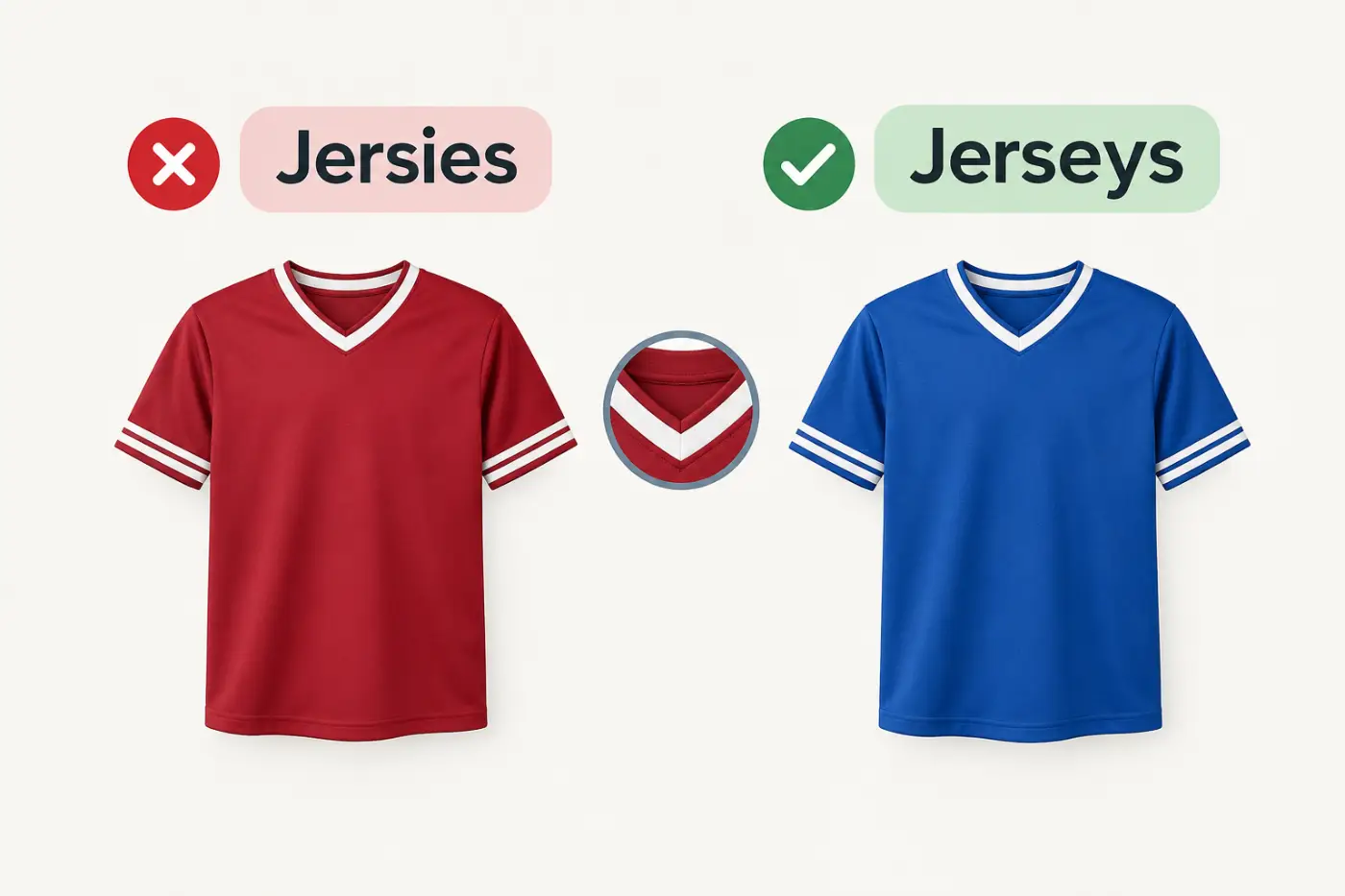
If you’re unsure about jersies or jerseys, the correct spelling is jerseys. It’s the plural form of jersey, which can mean a sports shirt, a type of knitted fabric, or a knitted garment.
The confusion makes sense. Many English words change their spelling when they become plural. Words that end in a consonant followed by y often change the y to ies. However, jersey follows a different pattern because the letter before the y is a vowel.
Once you learn this simple spelling rule, you’ll know how to spell the word in sports articles, school assignments, online shopping listings, and everyday messages.
This guide explains the correct spelling, the plural rule, common mistakes, and easy examples to help you remember it.
Quick Definition
Jersey is a singular noun that refers to a sports shirt or a knitted garment. Jerseys is the correct plural form when you’re talking about more than one. Jersies is a misspelling.
Direct Answer
The correct spelling is jerseys, not jersies. For example, you would write, “The team ordered new jerseys for the season.”
Spelling Comparison
| Word | Meaning | Example Sentence | When to Use It |
|---|---|---|---|
| Jersey | One sports shirt or knitted garment | My jersey is blue. | When referring to one item. |
| Jerseys | More than one jersey | The players wore matching jerseys. | When referring to two or more items. |
| Jersies | Incorrect spelling | The word was misspelled as jersies. | Avoid this spelling in standard English. |
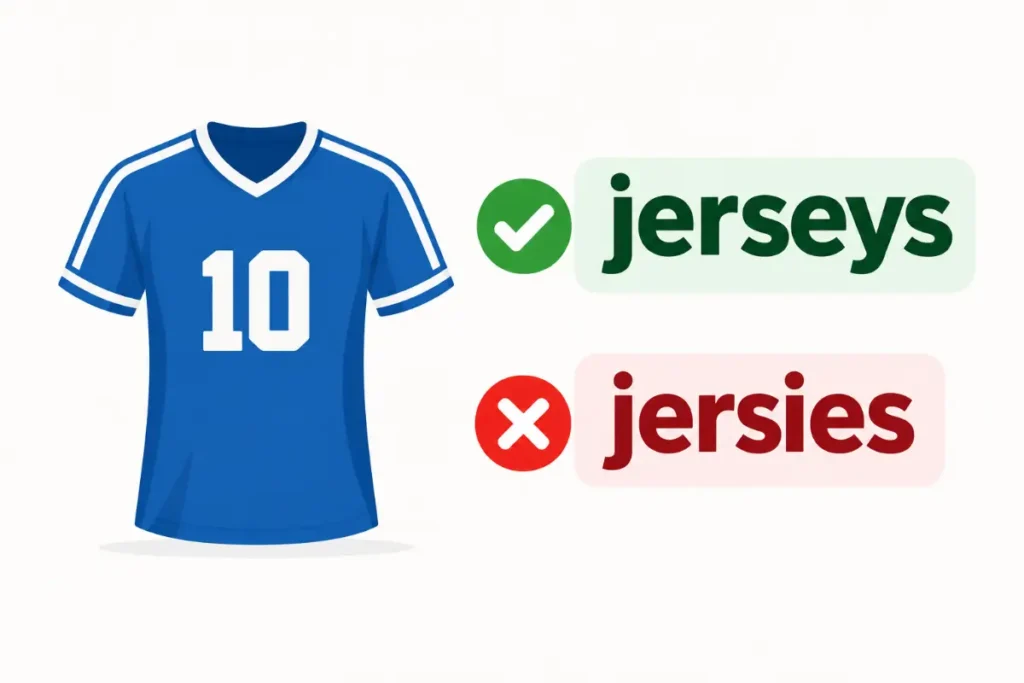
Why Jerseys Is the Correct Spelling
The spelling jerseys follows a common English plural rule. To understand why, you need to look at the last two letters of the singular word.
The word jersey ends in a vowel followed by the letter y. The vowel is e. When a noun ends in a vowel plus y, you usually add s to make it plural.
That gives you this simple change.
- One jersey becomes two jerseys.
- One key becomes two keys.
- One toy becomes two toys.
- One boy becomes two boys.
- One monkey becomes two monkeys.
Notice that the letter y stays in place. You don’t replace it with ies.
This rule explains why jerseys is correct and jersies is not. The incorrect version applies a different spelling pattern to a word that doesn’t follow it.
The Role of the Letter Before Y
The letter right before the final y helps you decide how to form the plural.
If a noun ends in a vowel followed by y, you generally add s. If it ends in a consonant followed by y, you usually change the y to ies.
Here are some examples of both patterns.
| Singular | Plural | Rule |
|---|---|---|
| Jersey | Jerseys | Add s after a vowel and y. |
| Key | Keys | Add s after a vowel and y. |
| Day | Days | Add s after a vowel and y. |
| Baby | Babies | Change y to ies after a consonant. |
| City | Cities | Change y to ies after a consonant. |
| Party | Parties | Change y to ies after a consonant. |
| Country | Countries | Change y to ies after a consonant. |
The difference becomes easier to see when you compare jersey with baby.
In jersey, the letter before y is e. Since e is a vowel, you keep the y and add s.
In baby, the letter before y is b. Since b is a consonant, you change y to ies.
The result is jerseys but babies.
This small spelling detail can save you from many common plural mistakes.
What Does Jersey Mean
The word jersey has several meanings. Its meaning depends on the situation, but the plural spelling stays the same.
Jersey as a Sports Shirt
In American English, a jersey often means a shirt worn by a sports player. These shirts may show a team name, player number, player name, or team logo.
You’ll commonly hear the word in basketball, football, hockey, baseball, and soccer.
For example:
- The basketball team received new jerseys before the tournament.
- I bought a jersey with my favorite player’s number.
- The players wore white jerseys during the home game.
- Our school ordered matching jerseys for the soccer team.
- She keeps her signed jerseys in a glass case.
In each sentence, jerseys refers to more than one sports shirt.
The word can also describe fan clothing. A person who buys a professional basketball jersey may wear it to a game or display it at home.
For instance, “He collects jerseys from his favorite teams.”
Here, the word refers to several pieces of sports clothing rather than just the shirts worn by active players.
Jersey as a Type of Clothing
A jersey can also refer to a knitted garment. Depending on the context, it may describe a sweater, a top, or another piece of clothing made from knitted material.
For example:
- She packed two warm jerseys for the winter trip.
- The store sells wool jerseys in several colors.
- These jerseys feel soft against the skin.
- He wore a thick jersey on the cold morning.
In these examples, the word doesn’t refer to a sports uniform. It describes ordinary clothing.
The exact meaning can vary by region. In the United States, people often use sweater for a knitted upper garment. In other English speaking regions, jersey is more common for that type of clothing.
Still, the plural remains jerseys in standard English.
Jersey as a Fabric
The word jersey can also refer to a type of knitted fabric. This fabric is often soft and flexible. Manufacturers use it to make T shirts, dresses, skirts, and other clothing.
For example:
- The dress is made from cotton jersey.
- The shop sells jerseys in several fabric weights.
- This jersey fabric stretches comfortably.
- The designer chose a lightweight jersey for the summer collection.
In clothing and textile discussions, the word may describe the material rather than a finished garment.
The plural jerseys can refer to different types or pieces of jersey fabric. However, when talking about fabric as a general material, people often use the singular word jersey without making it plural.
For example, “This shirt is made from jersey.”
That sentence is correct because the speaker is describing the material as a whole.
Jersey as a Proper Name
Jersey can also be a proper noun. It may refer to the island of Jersey in the Channel Islands or appear in place names such as New Jersey in the United States.
Proper names follow their own meaning and capitalization rules. The spelling of the place name doesn’t change just because you’re talking about more than one sports shirt.
Compare these sentences.
- My cousin lives in New Jersey.
- The players bought new jerseys.
- Jersey is known for its island history.
- The team sells jerseys with the state name printed on them.
The first and third sentences refer to places. The second and fourth refer to clothing.
Understanding the context helps you recognize the meaning of the word without changing its spelling.
Common Mistakes People Make
English spelling can be tricky because several plural patterns look similar. The mistake often happens when someone remembers one rule but applies it to every word ending in y.
Changing Jersey to Jersies
The most direct mistake is replacing the final y with ies.
For example, someone might write, “The store sells basketball jersies.”
The correct sentence is, “The store sells basketball jerseys.”
The incorrect spelling likely comes from words such as cities, babies, and parties. Those words do change their final y to ies.
However, jersey has a vowel before its final y. That’s why the correct plural keeps the y.
Adding an Extra E
Some writers may try spellings such as jerseys and jerseies while guessing how the word should look.
Only jerseys is the standard plural form.
You don’t need to add another vowel or change the order of the letters. Keep the singular spelling intact and add s.
Using the Singular for Several Items
Another common error involves number rather than spelling.
For example, “The players wore a new jersey” suggests that the players shared one jersey or that the sentence refers to one particular shirt.
If each player has a shirt, write, “The players wore new jerseys.”
The correct choice depends on how many items you’re describing. Use jersey for one and jerseys for more than one.
Mixing Up Jerseys and Uniforms
A jersey is often part of a uniform, but the two words don’t always mean the same thing.
A uniform may include a shirt, pants, socks, a jacket, and other pieces of clothing. A jersey usually refers to the shirt or top.
For example, “The team received new uniforms” may refer to complete sets of clothing. “The team received new jerseys” focuses on the shirts.
This distinction matters when you’re describing sports equipment, writing product listings, or reporting on a team’s new kit.
Trusting Spell Check Without Reviewing the Sentence
Spell check can help you catch mistakes, but it doesn’t replace a basic understanding of spelling.
Some tools may miss an error if the incorrect word resembles a valid word or appears in a context they don’t recognize. An unfamiliar name or a product label may also affect the suggestions you see.
If you’re unsure, check the word against a trusted dictionary or remember the vowel plus y rule.
A quick review can prevent a small spelling mistake from appearing in a school paper, blog post, email, or product description.
How to Remember the Correct Spelling
Remembering the right spelling doesn’t need to be hard. A simple rule and a few familiar examples can help you avoid the mistake every time.
Use the Vowel Plus Y Rule
Think of the last two letters in jersey. The letter e comes right before y. Since e is a vowel, you keep the y when making the word plural.
Your spelling pattern is simple.
Jersey + s = Jerseys.
You can use the same pattern with words such as key, day, and toy.
- One key becomes two keys.
- One day becomes two days.
- One toy becomes two toys.
- One jersey becomes two jerseys.
Say the singular and plural forms aloud. Hearing the small change can help you remember it.
Compare Jersey With Baby
Another useful trick is to compare two words that follow different plural rules.
A baby becomes babies because a consonant comes before the final y. A jersey becomes jerseys because a vowel comes before the final y.
Think of the difference this way.
- Baby changes its ending.
- Jersey keeps its ending and adds s.
This comparison helps you remember the rule instead of memorizing each word on its own.
Write a Few Practice Sentences
Writing the word in a full sentence can make the spelling easier to remember.
Try these examples.
- I washed my jerseys after practice.
- The store sells jerseys for several teams.
- We need three new jerseys for the players.
- His favorite jerseys are hanging in the closet.
- The school ordered jerseys for the entire team.
You can also make your own sentence about sports, shopping, or clothing. The more you use the correct spelling, the more familiar it becomes.
How to Use Jerseys in Everyday Writing
The word appears in many types of writing. You might use it in a school assignment, a sports report, an online store, or a casual message to a friend.
The spelling stays the same in all these situations.
In School Assignments
When writing about a sports team, use jerseys to describe multiple shirts.
- Incorrect: The players wore matching jersies during the game.
- Correct: The players wore matching jerseys during the game.
You can apply the same spelling in essays, class notes, and presentations.
For example, “The school ordered new jerseys for its basketball team.”
The sentence is clear and grammatically correct. It also uses the plural form to show that the school ordered more than one shirt.
In Online Shopping Listings
Online stores often use the word when describing sports clothing. Correct spelling makes a product easier to understand and helps customers find what they’re looking for.
Consider these examples.
- Youth Basketball Jerseys.
- Custom Football Jerseys.
- Affordable Soccer Jerseys.
- Team Jerseys in Multiple Colors.
- Personalized Jerseys With Player Names.
These phrases describe different types of sports shirts. They use the correct plural form when referring to several items or a product category.
If you’re writing a product description for one shirt, use the singular form instead.
For example, “This basketball jersey features a lightweight design and a comfortable fit.”
For a listing that includes several styles, you could write, “Our basketball jerseys come in several colors and sizes.”
In Sports News and Articles
Sports writers use jerseys when discussing team clothing, player numbers, uniform changes, and fan merchandise.
Here are some natural examples.
- “The team unveiled its new jerseys before the season began.”
- “Fans rushed to buy jerseys featuring the rookie’s number.”
- “The club will wear special jerseys for the charity game.”
- “Several players exchanged jerseys after the final whistle.”
Each sentence uses the plural because it refers to multiple shirts or a general group of shirts.
When writing sports content, make sure the spelling stays consistent throughout the article. Correct spelling helps readers focus on the news rather than a distracting error.
In Emails and Everyday Messages
You don’t need formal language to spell a word correctly. The same rule applies to texts, emails, and casual conversations.
For example, you could write:
- “Can you bring the jerseys to practice?”
- “I ordered two new jerseys for the tournament.”
- “Your jerseys are ready to pick up.”
These sentences sound natural and get the message across clearly.
A small spelling check before sending a message can help you avoid confusion, especially when discussing orders or team equipment.

Related Words That Follow the Same Rule
Learning a few related words can help you remember the correct plural pattern. Some end in a vowel plus y, while others end in a consonant plus y.
Words That Add S
These words keep the final y and add s.
| Singular | Plural | Example |
|---|---|---|
| Key | Keys | I lost my keys. |
| Toy | Toys | The children put away their toys. |
| Day | Days | We spent three days at the beach. |
| Boy | Boys | The boys joined the team. |
| Valley | Valleys | The road passes through two valleys. |
| Jersey | Jerseys | The players received new jerseys. |
The word valley is worth a closer look. It ends in ey, so you keep the final y and add s.
This is a helpful reminder that the last letter alone doesn’t determine the plural form. The letter before it matters too.
Words That Change Y to IES
These words usually change the final y to ies because a consonant comes before the y.
| Singular | Plural | Example |
|---|---|---|
| City | Cities | The trip included three cities. |
| Baby | Babies | The hospital cares for newborn babies. |
| Party | Parties | We attended two birthday parties. |
| Story | Stories | She writes short stories. |
| Country | Countries | They visited several countries. |
| Family | Families | Many families attended the event. |
Compare these words with jersey. The difference becomes clear once you check the letter before the final y.
There are exceptions to some English spelling patterns, so a dictionary can help when an unfamiliar word doesn’t follow the usual rule. However, jersey has a regular plural form.
FAQs
Is jersies or jerseys the correct spelling?
Jerseys is correct. The word jersies is a misspelling. Use jerseys when talking about two or more sports shirts or knitted garments.
What is the plural of jersey?
The plural of jersey is jerseys. You form it by keeping the final y and adding s. For example, “The players received new jerseys before the game.”
Why doesn’t jersey become jersies?
The letter before the final y is a vowel. English nouns that end in a vowel followed by y usually form their plurals by adding s. That’s why jersey becomes jerseys.
Is jerseys a real word?
Yes. Jerseys is the standard plural form of jersey. It can refer to sports shirts, knitted garments, or different pieces of jersey fabric.
What is the difference between jersey and jerseys?
Jersey is singular and refers to one item or to a type of fabric. Jerseys is plural and refers to more than one item. You might say, “I bought a jersey” or “I bought two jerseys.”
Is jerseys correct in American English?
Yes. Jerseys is the correct spelling in American English. The same plural spelling is used in standard British English.
How do you spell basketball jerseys?
The correct spelling is basketball jerseys. Use this phrase when referring to two or more basketball shirts. For one shirt, write basketball jersey.
Do all words ending in Y change to IES in the plural?
No. Words ending in a vowel plus y usually add s, as in keys, toys, and jerseys. Words ending in a consonant plus y usually change the y to ies, as in cities and babies.
Conclusion
The correct spelling is jerseys, not jersies. Use jersey for one item and jerseys for two or more. This rule applies to sports shirts, knitted clothing, and other uses of the word.
The easiest way to remember the spelling is to look at the letter before the final y. Since jersey has a vowel before the y, you keep the y and add s. You can use the same pattern with words such as keys, toys, and days.
Next time you’re writing about a team’s uniforms or shopping for sports clothing, remember this simple rule. One jersey becomes two jerseys. Once you know the pattern, there’s no need to second guess the spelling.

Sienna Watson is a veteran copywriter and communications coach who has helped startup founders, marketers, and professionals polish their writing for over a decade. Realizing that most people don’t need a degree in linguistics—just clear, impactful communication—Sienna focuses on practical grammar, business writing etiquette, and eliminating wordiness. She advocates for plain language, strong verbs, and persuasive prose that gets results.