
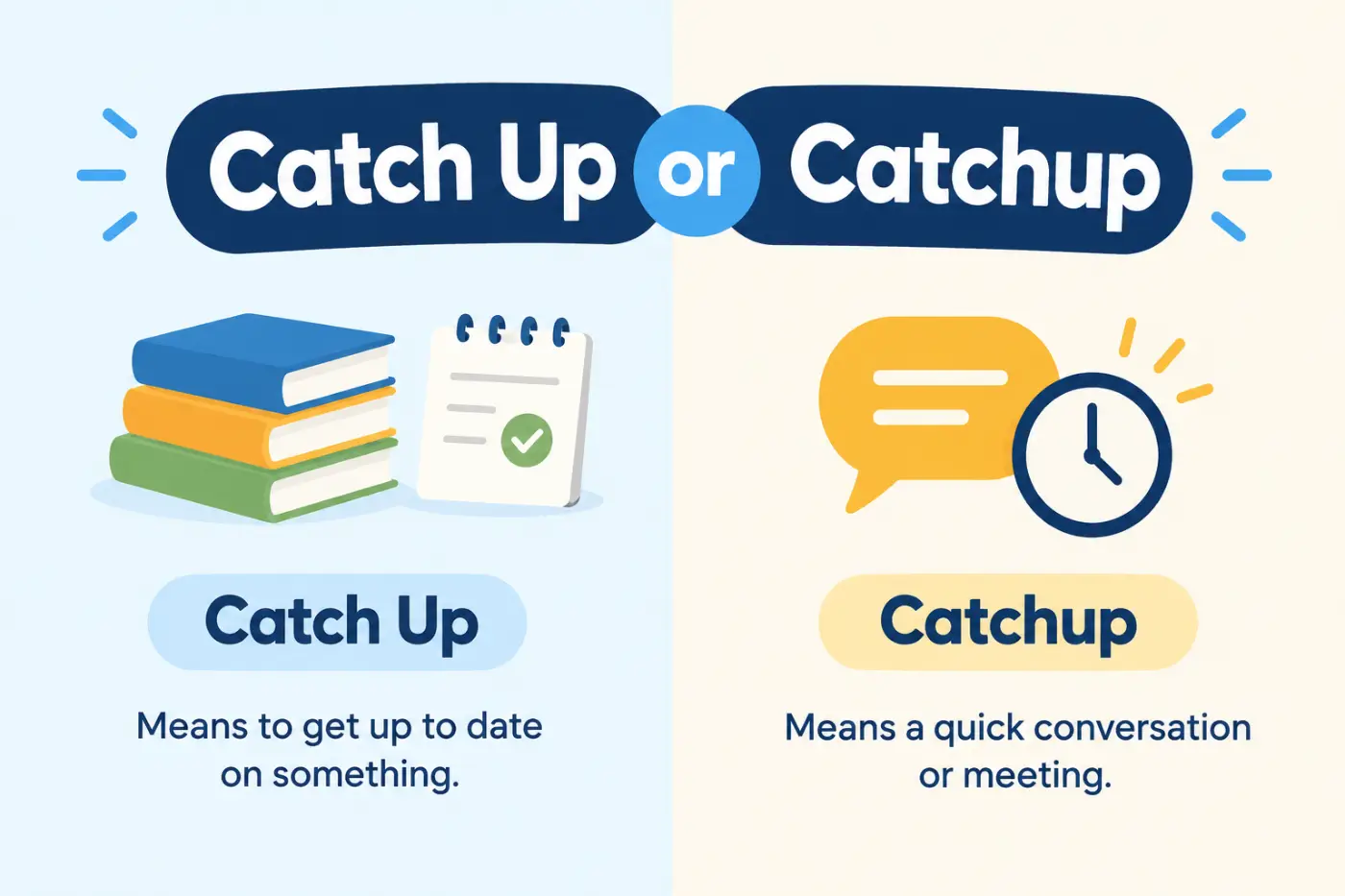
The correct spelling depends on how you use the phrase. Catch up is the standard form when you mean to get up to date or reach the same level as someone else. Catchup is usually a misspelling of the verb phrase, but it can appear as an informal or specialized spelling in certain contexts. For the tomato sauce, the standard American English spelling is ketchup.
The confusion comes from how English combines words. Some word pairs start as separate words and later become one word. However, that change doesn’t happen automatically. Even though people often say catch up quickly, the phrase still takes two words in standard writing.
This guide explains the difference between the two spellings, shows you how to use the phrase in everyday sentences, and covers related forms such as catching up and caught up. You’ll also learn how to avoid common spelling mistakes in emails, school assignments, text messages, and professional writing.
By the end, you’ll know which form to use and how to remember it without looking up the rule every time.
Quick Definition
Catch up is a verb phrase that means to reach the same level as someone or something, get up to date, or do something you haven’t had time to do. For example, you might catch up on emails after a vacation or catch up with a friend you haven’t seen in months.
Catchup is not the standard spelling of this verb phrase in American English. If you mean the tomato sauce, write ketchup.
Direct Answer
Use catch up as two words when you mean to get up to date, reach someone, or make up for lost time. Use ketchup for the tomato sauce. In standard American English, catchup is generally not the correct spelling of the verb phrase.
Catch Up vs Catchup at a Glance
| Word or phrase | Meaning | Example sentence | When to use it |
|---|---|---|---|
| Catch up | To reach the same level or get up to date. | I need to catch up on my reading. | Use it as a verb phrase. |
| Catchup | A nonstandard spelling of the verb phrase in ordinary writing. | Write catch up instead. | Avoid it in standard prose. |
| Ketchup | A tomato based sauce. | Please pass the ketchup. | Use it when talking about the condiment. |
| Catching up | The ongoing action of getting up to date or reconnecting. | I’m catching up with an old friend. | Use it for an action in progress. |
| Caught up | The past tense or past participle of catch up. | She caught up on her work. | Use it for a completed action or a state. |
Why Catch Up Is Written as Two Words
English has many phrases that contain two words but work together to express one idea. Catch up is one of them. The word catch refers to reaching or taking hold of something. The word up can suggest reaching a point or level. Together, they describe the act of reaching someone or something that is ahead of you.
Imagine you’re walking with a friend. Your friend moves ahead while you stop to tie your shoe. When you start walking faster to reach your friend again, you’re trying to catch up.
The same idea applies to work and daily tasks. If you miss three classes because you’re sick, you may need to catch up on your lessons. If you ignore your emails for two days, you may spend the next morning catching up on messages.
The phrase keeps its two word form even when it appears in a longer sentence. You don’t combine the words just because they express a single idea.
The Difference Between a Phrase and a Single Word
A phrase is a group of words that work together in a sentence. The words can have a shared meaning without becoming one word.
For example, consider these common phrases.
- Wake up.
- Pick up.
- Give up.
- Set up.
- Catch up.
Each phrase has its own meaning. However, all five use two separate words when they act as verbs.
You might wake up early, pick up a package, give up a bad habit, set up a meeting, or catch up on your work. The meaning changes with each phrase, but the basic spelling pattern stays the same.
Some phrases eventually become single words in standard English. Makeup is one example when it refers to cosmetics. Setup is another when it acts as a noun. That doesn’t mean every similar phrase should follow the same pattern.
The correct spelling depends on how English uses the specific expression.
Why the Spellings Look Confusing
People often combine words when they write quickly. Speech can add to the confusion because we don’t usually pause between the two words in a phrase.
You may also see catchup in casual messages, online posts, or usernames. Seeing a spelling online doesn’t automatically make it standard English.
Another source of confusion is the word ketchup. It sounds similar to catch up when spoken aloud, especially in quick conversation. However, the words have different meanings and spellings.
The easiest solution is to remember the role of the phrase. If you mean getting up to date or reaching someone, write catch up. If you mean the sauce served with fries, write ketchup.
How to Use Catch Up in a Sentence
The phrase has several common meanings. It can describe reaching someone, finishing delayed work, sharing news, or understanding something that has changed. Learning these uses makes the spelling easier to remember.
Catch Up With Someone
Use catch up with when you want to reach someone who is ahead of you. The phrase can describe physical movement or progress.
For example.
- I walked faster to catch up with my brother.
- The runner tried to catch up with the leader.
- We left early so we could catch up with the rest of the group.
- The children ran down the path to catch up with their parents.
In each sentence, one person moves closer to another person or reaches the same position.
You can also use the phrase when talking about people you haven’t seen for a while. In this case, catching up means sharing news and talking about recent events.
For example.
- I had lunch with Sarah to catch up with her.
- Let’s catch up this weekend.
- We caught up over coffee after years apart.
- She called her cousin to catch up on family news.
These examples don’t involve running or physical movement. Instead, the people reconnect by talking about what has happened in their lives.
Catch Up on Work or Tasks
Use catch up on when you need to complete work or tasks that have fallen behind.
For example.
- I need to catch up on my emails.
- He spent Sunday catching up on his homework.
- We stayed late to catch up on the reports.
- She took a quiet morning to catch up on housework.
- The team worked together to catch up on missed deadlines.
This use is common in offices, schools, and homes. It often suggests that you have more work than usual because you missed time or couldn’t finish everything earlier.
You might catch up on sleep after several late nights. You might catch up on reading after a busy week. You can also catch up on a television show after missing a few episodes.
The preposition on helps explain what you need to complete or review. The spelling of the verb phrase remains the same.
Catch Up With News or Changes
Sometimes, catching up means learning about events that happened while you were away or busy.
For example.
- I need to catch up on the latest news.
- She watched the recorded meetings to catch up with the project.
- He read the class notes to catch up on what he missed.
- We spent an hour catching up on recent changes at work.
This meaning is useful when you return from a trip, take time off, or miss an important conversation.
It can also describe learning about a new topic. Suppose your friends have been discussing a television series for weeks. If you watch the earlier episodes, you can catch up with them and join the conversation.
Catch Up With Someone’s Progress
The phrase can describe reaching the same level as another person in skill, knowledge, or progress.
For example.
- I practiced every day to catch up with my classmates.
- The smaller company is trying to catch up with its competitors.
- He studied hard to catch up with the rest of the class.
- Our technology needs to catch up with current standards.
This use doesn’t always mean someone has done something wrong. People can fall behind for many reasons, including illness, a busy schedule, limited resources, or a change in priorities.
Catching up simply means closing the gap between the current position and the desired level.
Catch Up in Everyday Conversation
People often use the phrase in informal conversations and messages. It can be a friendly way to suggest spending time together.
For example.
- Hey! We haven’t talked in ages. Let’s catch up soon.
- Are you free tonight? I’d love to catch up.
- It was great catching up with everyone yesterday.
- We should catch up over lunch next week.
These sentences sound natural in American English. They work well in texts, emails, and casual conversations.
However, the phrase can also fit professional settings. You might write, “I’ll catch up on the project notes before our meeting.” The wording is direct and easy to understand.
Is Catch Up One Word or Two Words
In standard American English, the verb phrase is written as two words. The spelling doesn’t change just because the phrase appears at the end of a sentence or follows another verb.
Correct examples include the following.
- I need to catch up.
- We should catch up soon.
- She wants to catch up on her work.
- They are trying to catch up with the team.
In each example, catch and up remain separate.
When Catch Up Appears After To
The spelling stays the same when the phrase follows to.
For example.
- I want to catch up with you.
- He plans to catch up on his reading.
- We need to catch up before the exam.
- She hopes to catch up with the other runners.
The word to introduces the verb phrase in these sentences. It doesn’t turn the two words into one.
When Catch Up Appears at the End of a Sentence
You may see the phrase used without an object. The meaning is still clear from the conversation.
For example.
- I have a lot of work to do, so I need to catch up.
- We haven’t spoken in months. Let’s catch up.
- The runner sped up to catch up.
- I’ll call you later when I have time to catch up.
None of these sentences requires the one word spelling.
When Catch Up Appears in a Question
Questions follow the same spelling rule.
For example.
- Can we catch up tomorrow?
- Did you catch up on your assignments?
- How can I catch up with the rest of the class?
- When did you last catch up with your old friends?
The sentence structure may change, but the spelling doesn’t.
Catch Up and Its Other Forms
The phrase can change form to fit the tense or structure of a sentence. The two word spelling remains clear in the examples below.
| Form | Example | Use |
|---|---|---|
| Catch up | I catch up on work every Friday. | Present tense. |
| Catches up | She catches up after class. | Present tense with he, she, or it. |
| Caught up | We caught up last night. | Past tense. |
| Catching up | I’m catching up on my reading. | An action in progress. |
| To catch up | He wants to catch up. | Infinitive form. |
| Has caught up | She has caught up with the group. | Present perfect tense. |
| Had caught up | They had caught up before noon. | Past perfect tense. |
| Will catch up | I’ll catch up tomorrow. | Future meaning. |
Catching Up
Catching up describes an action that is happening now or continuing over a period of time.
For example.
- I’m catching up on my emails.
- She is catching up with her old classmates.
- The team is catching up after a difficult month.
- We’re catching up on the lessons we missed.
The ending ing attaches to catch, not to the whole phrase. You write catching up, not catchuping.
Caught Up
Caught up is the past tense and past participle form of catch up. It describes an action that happened earlier or a state someone has reached.
For example.
- I caught up on my work yesterday.
- She caught up with her friends last weekend.
- We’ve caught up on the latest changes.
- He finally caught up with his classmates.
The phrase can also describe becoming deeply involved in something or being affected by events.
For example.
- I got caught up in the excitement.
- She was caught up in an argument.
- He got caught up in the details and missed the main point.
In these sentences, caught up has a related but different meaning. It can suggest being absorbed in an activity or becoming involved in a situation.
Catch Up With Versus Catch Up On
Both expressions are correct, but they often point to different things.
Use catch up with when you mean reaching a person or group, matching someone’s progress, or reconnecting with someone.
Use catch up on when you mean reviewing information or completing work you missed.
Compare these sentences.
- I need to catch up with Mark.
- I need to catch up on my homework.
The first sentence focuses on Mark. The second focuses on unfinished homework.
There are cases where the meanings overlap. For example, you can catch up with a colleague to hear about a project. You can also catch up on the project by reading its notes. The first describes talking to a person. The second describes reviewing information.
Common Mistakes to Avoid
The easiest way to use this phrase correctly is to pay attention to its meaning and its role in the sentence. A few common mistakes can make your writing look less polished, even when the reader understands what you mean.
Writing Catchup in Place of Catch Up
This is the main spelling mistake people make when they use the verb phrase.
Incorrect: I need to catchup on my assignments.
Correct: I need to catch up on my assignments.
The first version combines the words incorrectly for standard American English. The second version follows the accepted spelling.
You may see the one word form in casual online writing. Still, it’s best to use two words in schoolwork, business emails, articles, and other edited content.
Confusing Catch Up With Ketchup
These words sound alike, but their meanings are different.
Incorrect: Can you pass me the catch up?
Correct: Can you pass me the ketchup?
When you talk about the tomato sauce, use ketchup. When you mean getting up to date or reaching someone, use catch up.
A quick way to remember the difference is to picture the object or action. You can put ketchup on your fries, but you can catch up on your homework.
Forgetting the Preposition
Some sentences need a word after catch up to show what the action involves. Common choices include with and on.
For example.
- Correct: I need to catch up on my reading.
- Correct: I need to catch up with my classmates.
- Incorrect: I need to catch up my reading.
The last sentence sounds incomplete or unnatural in standard American English when the intended meaning is completing missed reading. Use on to connect the action to the work you need to finish.
However, the phrase doesn’t always require a preposition. You can simply say, “I need to catch up.” The surrounding conversation can make the meaning clear.
Using the Wrong Verb Form
Remember that catch changes to caught in the past tense.
Incorrect: I catched up with my friends yesterday.
Correct: I caught up with my friends yesterday.
English has many regular verbs that form the past tense by adding ed. However, catch is irregular. Its past tense is caught, not catched.
The same rule applies to other forms of the phrase.
- Present: I catch up every Friday.
- Past: I caught up last Friday.
- Ongoing: I’m catching up now.
- Future: I’ll catch up tomorrow.
Learning these forms helps you avoid spelling and grammar mistakes at the same time.
How to Remember the Correct Spelling
You don’t need to memorize a long grammar rule to remember this phrase. A few simple tricks can help you choose the right form quickly.
Think of Catch and Up as Separate Actions
Imagine someone walking ahead of you. You speed up to reach that person. You catch up to their position.
This mental picture connects the two words to their meaning. It also reminds you to keep them separate in writing.
You can apply the same idea to work. If your tasks are behind schedule, you work to reach the level you planned to achieve. You’re catching up rather than creating a new word.
Remember the Ketchup Test
Ask yourself what you mean.
If you’re talking about a sauce for burgers or fries, use ketchup.
If you’re talking about work, news, friends, or progress, use catch up.
For example.
- I bought a bottle of ketchup.
- I need to catch up on the news.
- We caught up after the meeting.
- He is catching up with the other students.
This simple test clears up the most common confusion between the spellings.
Use a Sample Sentence
When you’re unsure, build a short sentence around the phrase.
Try saying, “I need to catch up on my work.” The sentence sounds natural, and the two word spelling is easy to see.
You can also use a sentence such as, “Let’s catch up next week.” This works as a reminder that the phrase remains two words even when it describes a casual social plan.
The more you see and use correct examples, the easier the spelling becomes.
Catchup or Catch Up in American English
When people search for catchup or catch up, they usually want to know if the phrase should be written as one word or two. For ordinary American English writing, the answer is simple. Use catch up when it acts as a verb phrase.
There are related cases that can make the spelling seem less clear. English sometimes turns a phrase into a compound word, meaning two or more words that function as one unit. For instance, setup is a noun, while set up is a verb phrase.
Compare these examples.
- I need to set up the meeting.
- The setup took an hour.
- I need to catch up on the meeting notes.
- I caught up with my coworkers after the meeting.
The noun and verb forms of set up show why you shouldn’t assume every phrase follows the same spelling pattern. Each expression has its own accepted usage.
Is Catchup Ever Acceptable
The spelling catchup may appear in brand names, usernames, informal writing, or specialized contexts. A writer might also use it creatively in a headline or as a name for a product or event.
However, those uses don’t make it the standard spelling of the verb phrase. If you’re writing for a general American audience, choose the familiar form that readers expect.
For formal writing, consistency matters. A reader may understand catchup, but that doesn’t mean the spelling is suitable for a school essay, a report, or a published article.
The same principle applies to other phrases that people sometimes combine when typing quickly. Common usage in a few online posts isn’t enough to establish a standard spelling.
What About Catch Up as a Noun
People sometimes use catch up as a noun informally to describe a meeting or conversation where people exchange news. For example, someone might say, “Let’s have a quick catch up.”
In standard American English, catch up is primarily a verb phrase. For a polished noun form, consider catch up conversation, catch up meeting, or simply a chance to catch up.
For example.
- We had a quick catch up after lunch.
- We had a quick catch up conversation after lunch.
- We had a chance to catch up after lunch.
The second and third versions make the intended meaning clearer. In professional writing, a chance to catch up is often the most natural option.
The exact wording can depend on context and style. The key point is that the standard verb phrase remains two words.
Related Phrases That Follow the Same Pattern
Learning a few similar expressions can help you recognize common spelling patterns in English. These phrases contain two words when used as verbs, even though they express a single idea.
| Phrase | Meaning | Example |
|---|---|---|
| Wake up | Stop sleeping. | I wake up at seven. |
| Pick up | Lift or collect something. | I’ll pick up the package. |
| Give up | Stop trying. | Don’t give up too soon. |
| Set up | Arrange or prepare something. | We need to set up the room. |
| Clean up | Make a place clean or tidy. | Please clean up your desk. |
| Follow up | Take another action after an earlier one. | I’ll follow up with an email. |
| Check in | Report or make contact. | I’ll check in after the meeting. |
| Catch up | Reach the same level or get up to date. | I need to catch up on my work. |
These expressions are useful because they show that a phrase can have one shared meaning without being written as a single word.
Still, don’t apply the rule blindly. Some expressions have separate noun forms. For example, setup is a common noun, and follow up is a verb phrase. The correct spelling depends on the word’s function and accepted usage.
If you’re editing an article or writing an email, check the phrase in the sentence instead of relying on how it sounds when spoken.
FAQs
What Is the Correct Spelling of Catch Up or Catchup?
The correct spelling is catch up when you mean to get up to date or reach someone. In standard American English, the verb phrase uses two words. Catchup isn’t the standard spelling for this meaning.
Is Catchup or Catch Up Correct in a Sentence?
Use catch up in sentences such as “I need to catch up on my work.” The two words stay separate because they form a verb phrase. Use ketchup when you mean the tomato sauce.
Is Catch Up One Word or Two Words?
Catch up is two words when used as a verb phrase. For example, “I’ll catch up with you tomorrow.” Don’t combine the words just because they express one idea.
What Is the Difference Between Catch Up and Caught Up?
Catch up is the base form of the phrase. Caught up is its past tense or past participle form. For example, “I need to catch up on my reading” describes a current need, while “I caught up on my reading” describes a completed action.
Is It Catching Up or Catchingup?
The correct spelling is catching up. The ending ing attaches to catch, while up remains a separate word. For example, “I’m catching up on my emails.”
Do You Catch Up With Someone or Catch Up on Something?
Both forms are correct, but they often have different uses. You catch up with someone when you reconnect or reach their level. You catch up on something when you review missed information or finish delayed work.
Can I Use Catch Up in a Professional Email?
Yes. The phrase works well in professional emails when you need to discuss unfinished work or review missed information. For example, you could write, “I’ll catch up on the project notes before our meeting.”
Is Catch Up Informal English?
No. Catch up works in both casual and professional English. You can use it in everyday conversations, school assignments, business emails, and articles. Choose a more specific phrase only when the context calls for it.
Conclusion
The main rule is easy to remember. Write catch up as two words when you mean to reach someone, get up to date, or finish work you’ve fallen behind on. Use caught up for the past tense and catching up for an action in progress.
The confusion between catchup or catch up often comes from how quickly people speak and type. However, the standard spelling stays the same in ordinary American English. Keep the two words separate when you use the phrase as a verb.
Remember the difference between the action and the sauce. You catch up with a friend, catch up on your emails, and put ketchup on your fries. Once you connect each spelling to its meaning, the choice becomes much easier.
Before you send an email or publish an article, read the sentence once. If you’re talking about making progress or getting up to date, use catch up. It’s a simple rule that will keep your writing clear and correct.

Sienna Watson is a veteran copywriter and communications coach who has helped startup founders, marketers, and professionals polish their writing for over a decade. Realizing that most people don’t need a degree in linguistics—just clear, impactful communication—Sienna focuses on practical grammar, business writing etiquette, and eliminating wordiness. She advocates for plain language, strong verbs, and persuasive prose that gets results.