
If you’re wondering how to spell until, the answer is simple. The correct spelling is until. It has one l at the end and no extra l in the middle.
The word causes confusion because English has several words with similar sounds and spelling patterns. Some people write untill by adding an extra letter. Others may confuse it with words such as till or until when they are writing quickly. Once you know the correct form and understand how the word works in a sentence, the spelling becomes easy to remember.
This guide covers the correct spelling, meaning, pronunciation, common mistakes, the difference between until and till, useful sentence patterns, and simple memory tricks. You’ll also see how native English speakers use the word in everyday writing and conversation.
Quick Definition
Until is a preposition or conjunction that shows the time something continues up to a certain point. It can describe an action that continues up to a specific time, date, event, or condition. The correct spelling is until.
Direct Answer
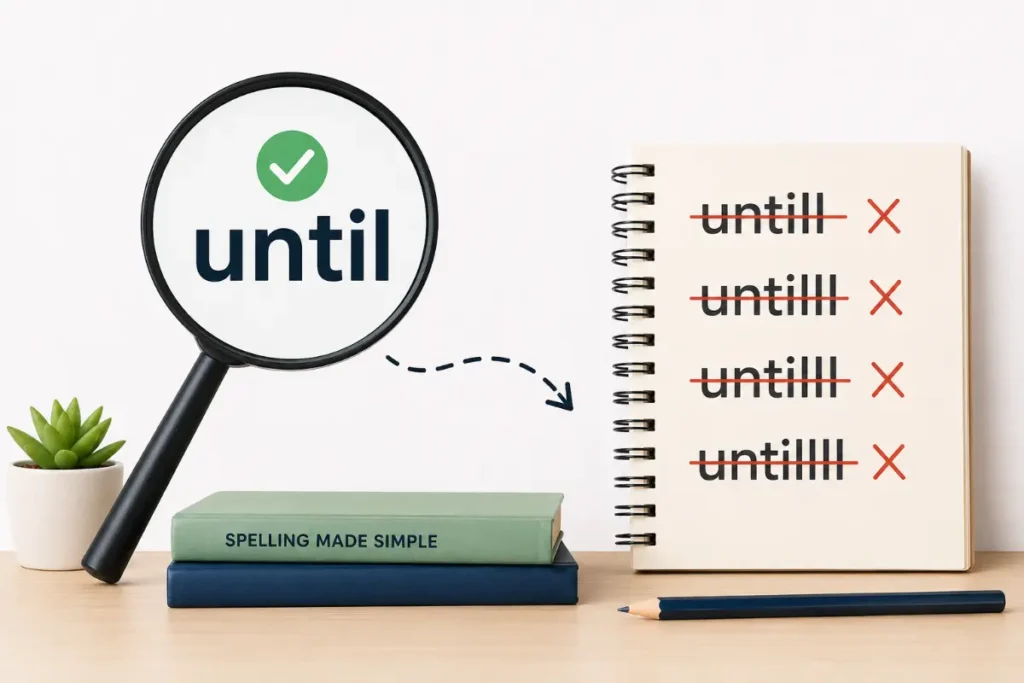
The correct spelling is until. The spelling untill is incorrect because the word ends with one l.
The Correct Spelling Of Until
The word until contains five letters.
U N T I L
There is only one l at the end. That detail is the main thing to remember when spelling the word.
A common mistake is writing untill with two l letters at the end. That version looks believable because many English words contain double consonants. However, untill isn’t the standard spelling in English.
For example, you might write:
- I’ll wait until six.
- She stayed at work until late.
- We won’t know the answer until tomorrow.
- Please keep the door closed until everyone arrives.
Each sentence uses the same spelling. The word always ends with one l.
Why Until Is Easy To Misspell
English spelling often gives writers small traps. A word can look as if it should contain an extra letter even when it doesn’t. Until is a good example.
One reason people add another l is the word till. Since till has two l letters, writers sometimes transfer that spelling pattern to until. The two words have related meanings, so the connection can make the extra letter feel natural.
Another reason is simple typing speed. When you’re writing quickly, you may hear the word in your head without checking each letter. Since until and untill sound the same, pronunciation can’t tell you which spelling is correct.
The best solution is to build visual familiarity. The correct form should start to look natural after you’ve seen it many times. If untill catches your eye later, you’ll be more likely to notice that something looks wrong.
The Meaning Of Until
Until tells us that something continues up to a certain point. That point can be a time, date, event, condition, or action.
Consider this sentence:
- I’ll stay here until five.
The person plans to stay from now up to five o’clock. The word until marks the endpoint.
Now look at another example:
- She lived there until 2020.
The sentence tells us that she lived there up to 2020. The exact meaning can depend on context, but until always points toward an endpoint.
The endpoint doesn’t have to be a clock time. It can be an event.
- Wait until I get home.
- Don’t open the package until Dad arrives.
- We can’t leave until the rain stops.
In each example, something needs to happen before the next action can take place.
How To Use Until In A Sentence
The word appears in everyday English all the time. It can introduce a time phrase or a full clause.
A time phrase gives a specific point.
- I worked until midnight.
- The store is open until nine.
- We stayed until Sunday.
- He slept until noon.
A clause contains a subject and a verb.
- Wait until I call you.
- Stay here until your mother comes back.
- Don’t start until everyone is ready.
- We won’t decide until we hear from them.
This makes until useful in both simple and more detailed sentences.
Until As A Preposition
A preposition can show a relationship between words in a sentence. In this use, until connects an action or state to an endpoint in time.
For example:
- We waited until noon.
- She worked until midnight.
- They stayed until Friday.
- The office will remain open until five.
Here, until comes before a noun or time expression such as noon, midnight, Friday, or five.
You don’t need to memorize complicated grammar terms to use this correctly. Just remember that this pattern often looks like this:
Action + until + time
For example:
- Wait until tomorrow.
- Stay until Monday.
- Work until lunch.
- Sleep until noon.
These are common and natural sentence patterns.
Until As A Conjunction
Until can also connect two parts of a sentence. In this use, it introduces an action or event that marks the endpoint.
For example:
- I won’t leave until you arrive.
- She didn’t understand until she read the instructions.
- We waited until the teacher came back.
- Don’t touch it until I tell you.
The word connects the main idea with another action.
This pattern is especially common when one action depends on another. The first action remains incomplete or doesn’t happen before the second event occurs.
For example, in I won’t leave until you arrive, leaving depends on the other person’s arrival.
Until And Till
One of the most common questions about this word involves till. The two words can often mean the same thing when they refer to time.
For example:
- I’ll wait until five.
- I’ll wait till five.
Both sentences are natural.
Until is more common in formal writing and is a safe choice in almost every situation. Till is also correct and is common in everyday speech.
The important point is that till and until are both standard words. The spelling untill is not a standard alternative.
| Word | Meaning | Example | Common Use |
|---|---|---|---|
| Until | Up to a particular time or event | Wait until noon. | Formal and everyday English |
| Till | Up to a particular time or event | Wait till noon. | Everyday English |
| Untill | Incorrect spelling | Incorrect form | Do not use |
There is no need to avoid till simply because it looks shorter. It is a legitimate English word. The mistake happens when someone combines until with the double l ending from till.
Is Till Short For Until
Many people assume that till is simply a shortened version of until. The history is more interesting than that.
Till is an old English word that has been used for a very long time. Until developed from an older form involving till. So till isn’t just a modern abbreviation created by cutting letters from until.
This history doesn’t change how you write the word today. You can use until or till when the meaning calls for an endpoint in time. Just don’t add another l to the end of until.
For most learners, until is the easiest choice because it works naturally in both casual and formal writing.
Common Spelling Mistakes
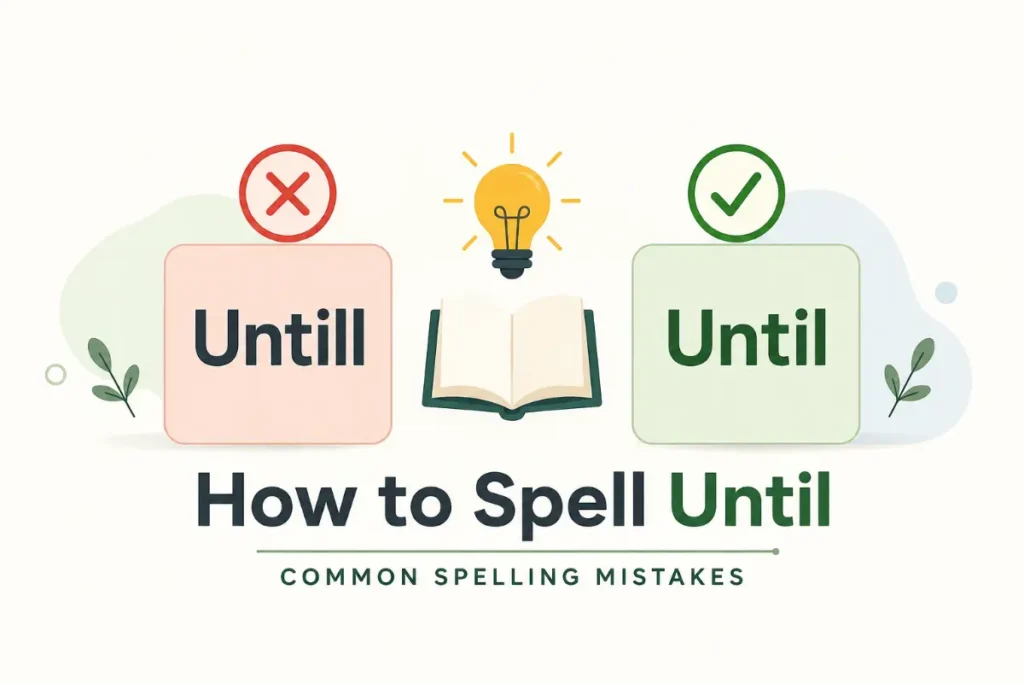
The most common error is untill. It looks close enough to the correct spelling that readers may understand it immediately, but it is still wrong.
Another mistake is adding extra letters because of pronunciation or similar words. Since the word is short, even one extra letter changes the standard spelling.
Here are some examples.
| Incorrect Form | Correct Form |
|---|---|
| Untill | Until |
| Untill tomorrow | Until tomorrow |
| Untill Friday | Until Friday |
| Untill I arrive | Until I arrive |
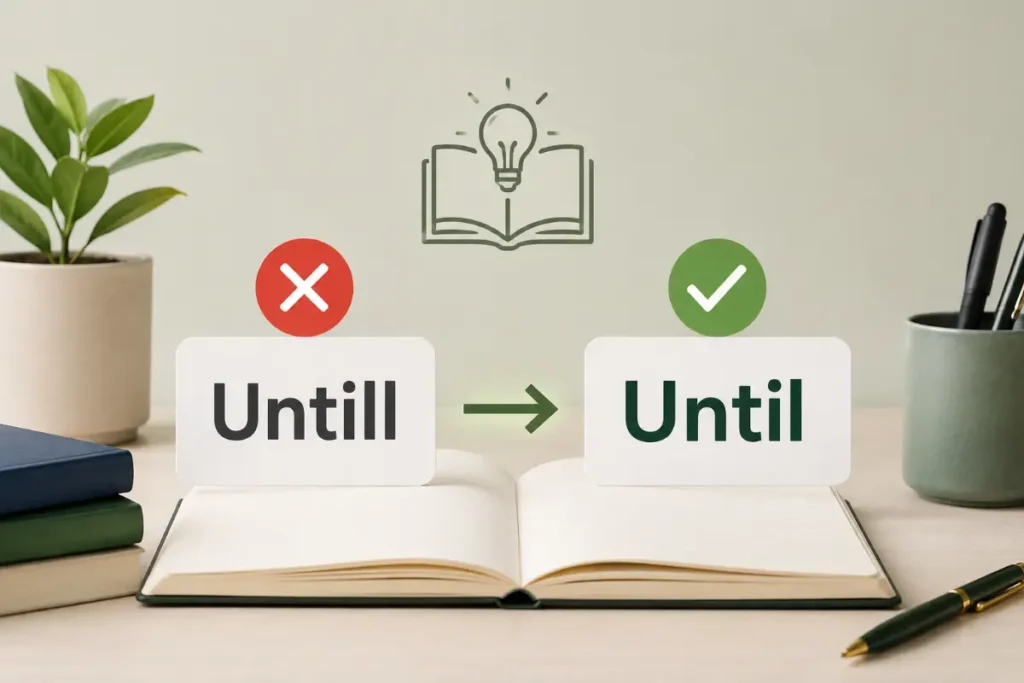
The correction is simple. Remove the second l.
For example:
Incorrect: I’ll wait untill you arrive.
Correct: I’ll wait until you arrive.
Incorrect: The sale runs untill Friday.
Correct: The sale runs until Friday.
Incorrect: Don’t leave untill I call.
Correct: Don’t leave until I call.
Once you see the pattern, the mistake becomes much easier to catch.
How To Remember The Spelling
The easiest memory trick is to think of until as a short word that simply ends in l. Don’t borrow the double l from till.
You can also picture the word in two parts:
UN + TIL
The final part is til, with one l.
Another useful trick is to connect the spelling with familiar phrases.
- Until tomorrow.
- Until Friday.
- Until noon.
- Until later.
- Until next week.
Seeing the same ending in several common phrases helps build visual memory.
You can also remember this simple rule:
Until has one l. Till has two.
That contrast is easy to recall because the shorter word has the longer ending.
Examples With Until
Real examples are often more useful than a grammar definition. These sentences show how the word works in situations you might actually talk about.
Talking About Time
- I’ll be at work until six.
- The library stays open until eight.
- We waited until midnight.
- She slept until noon.
- The meeting lasted until three.
These examples show a clear endpoint in time.
Talking About An Event
- Wait until I get back.
- Don’t eat until everyone arrives.
- We won’t start until the manager comes.
- Stay here until I call your name.
- She didn’t leave until the doctor arrived.
Here, the endpoint is an event rather than a specific time.
Talking About A Condition
- Don’t make a decision until you know the facts.
- We can’t fix the problem until we find the cause.
- You won’t feel better until you get some rest.
- The machine won’t work until the power comes back.
These sentences show that until can connect one action to a condition that needs to happen first.
Until In Negative Sentences
Negative sentences with until are especially common. They can sometimes confuse learners because the meaning isn’t always obvious at first glance.
Consider:
- I didn’t eat until noon.
This doesn’t mean the person ate before noon. It means the person waited and ate at noon or around that point.
Now look at:
- She didn’t call until Friday.
The sentence tells us that the call did not happen before Friday. The call happened on Friday or after the relevant point depending on the context.
Another example is:
- We won’t know until tomorrow.
This means the information isn’t expected to be known before tomorrow.
These structures are very common in everyday English. They are worth learning as complete patterns instead of translating each word separately.
Until With Will
You can use until with future ideas.
For example:
- I’ll wait until you arrive.
- We’ll stay until the meeting ends.
- She’ll work until five.
- They won’t leave until the rain stops.
Notice something useful in these examples. When until introduces a future time clause, English normally uses the present tense for the event after until, even though the meaning refers to the future.
For example:
I’ll wait until you arrive.
Not:
I’ll wait until you will arrive.
The first version is the natural standard form.
This is a common point of confusion for English learners. The word arrive looks like a present tense verb, but the sentence clearly refers to a future event. English uses this structure naturally.
Until With Dates
You can use until with days months years and other dates.
- The offer is available until Friday.
- We have until Monday to finish the project.
- She lived in Chicago until 2018.
- The museum will be closed until June.
- You can submit your application until August 15.
The word marks the point at which the current situation changes or ends.
In some contexts, the exact endpoint can depend on the organization or speaker. For example, a deadline stated as until Friday may need clarification if the exact hour matters. In ordinary conversation, however, the meaning is usually clear from context.
Until With Places And Events
Although until usually deals with time, it can appear with an event that occurs at a place.
For example:
- Stay here until I come back.
- Wait at the station until the train arrives.
- I’ll remain at the office until my meeting ends.
The place itself isn’t the endpoint. The event connected to the place provides the endpoint.
This distinction can help you understand sentences that seem more complicated. Ask yourself what happens at the endpoint. That event often comes after until.
Until And By
Another common confusion involves until and by. They can both refer to time, but they don’t express the same idea.
Until means something continues up to a certain point.
- I’ll work until five.
This means the work continues up to five.
By means something happens no later than a certain point.
- I’ll finish the work by five.
This means the work will be finished at or before five. It doesn’t say that the person will keep working until five.
Compare these sentences:
- Stay here until noon.
- Finish the report by noon.
The first sentence describes how long something continues. The second describes a deadline.
That small difference matters in real communication.
Until And Before
Until and before can also express different ideas.
Consider:
- Wait until six.
- Leave before six.
The first tells someone to wait up to six. The second tells someone to leave at some point earlier than six.
You can think of until as moving toward an endpoint. Before places an action earlier than that endpoint.
This difference becomes clearer when you compare full sentences.
- Don’t open the door until I return.
- Don’t open the door before I return.
These sentences can be close in meaning, but until focuses on the point when the restriction ends. Before focuses on the time that comes earlier than the event.
Until And Through
American English also uses through in some time expressions. The two words can sometimes describe a similar period but they aren’t always interchangeable.
For example:
- The store is open until Friday.
- The store is open through Friday.
The first sentence can suggest that Friday is the endpoint. The second often makes it clearer that Friday itself is included.
This distinction can matter when discussing schedules deadlines and business hours. If the exact endpoint matters, it’s better to state the time clearly.
For example:
- The offer ends at 11:59 p.m. Friday.
That sentence leaves little room for confusion.
Common Phrases With Until
You’ll see this word in many everyday expressions. Learning these phrases can help you use it naturally without stopping to think about grammar.
Until Now
Until now means up to the present time.
- Until now, I had never seen snow.
It suggests that something was not true or had not happened before the present point.
Until Then
Until then refers to the time when something else happens.
- I’ll stay here until then.
The word then points to a time already mentioned or understood from the conversation.
Until Later
Until later is common in casual speech.
- I’ll talk to you later.
- Until later.
The second version can sound more formal or literary depending on the situation.
Until Tomorrow
This phrase simply means up to tomorrow.
- I won’t know the answer until tomorrow.
It appears often in conversations about work school appointments and plans.
Until Further Notice
This phrase means something will continue with no stated end date.
- The office is closed until further notice.
It is common in public announcements and workplace communication.
A Simple Test For Until
If you’re unsure how to use the word, ask yourself one question.
What is the endpoint?
If an action or situation continues up to that endpoint, until may be the right word.
For example:
- I waited until noon.
The endpoint is noon.
- She stayed until Friday.
The endpoint is Friday.
- We won’t know until the test results arrive.
The endpoint is the arrival of the results.
This simple test works in many everyday situations. It also helps you understand the meaning instead of simply memorizing a rule.
How To Spell Until Without Thinking Twice
The best way to remember a common word is to see and use it often. You don’t need a complicated trick.
Write until several times in natural phrases.
- Until tomorrow.
- Until Monday.
- Until noon.
- Until I return.
- Until the rain stops.
Then compare it with till.
Until has one l. Till has two.
That contrast is short enough to remember when you’re writing quickly.
If you’re proofreading your work and see untill, stop for a second. The extra l doesn’t belong there.
Why Correct Spelling Matters
A single spelling mistake doesn’t make someone a bad writer. Everyone makes mistakes, especially when typing quickly. Still, correcting common errors improves the quality of your writing.
Words like until appear frequently in emails school assignments workplace messages and everyday communication. Because the word is so common, a spelling error can stand out more than an unusual mistake.
Correct spelling also makes your writing easier to trust. Readers don’t have to stop and wonder if an unusual form is intentional. They can focus on what you’re saying.
The good news is that until is easy to fix once you know the pattern. There is no need to memorize a long spelling rule. Just remember that the word has one l.
FAQs
How do you spell until correctly?
The correct spelling is until. It has five letters and ends with one l. The spelling untill is incorrect.
Is untill a word?
No. Untill is not the standard English spelling. It is a common misspelling of until.
How to spell until in a sentence?
Write until when you want to show that something continues up to a particular time or event. For example, I’ll wait until you arrive.
Does until have one L or two?
Until has one l. The word till has two l letters, which may be one reason people accidentally add an extra l to until.
Is till the same as until?
Till and until can often have the same meaning when they refer to time. For example, I’ll wait until noon and I’ll wait till noon are both natural sentences.
Which is more formal until or till?
Until is generally the safer choice for formal writing. Till is also a correct English word and is very common in everyday speech.
Can until be used for future time?
Yes. You can use until for future events and times. For example, I’ll stay until Friday and We won’t know until tomorrow are both correct.
What is the difference between until and by?
Until describes something that continues up to a point. By describes something that happens no later than a point. For example, I’ll work until five means the work continues up to five, while I’ll finish by five means the work will be finished no later than five.
Conclusion
If you came here wondering how to spell until, remember one simple fact. The correct spelling is until with one l at the end. Untill is a common mistake and should not be used in standard English.
The word describes something that continues up to a particular time event or condition. You can use it with clock times dates days and actions. You can also use it in negative sentences such as I won’t leave until you arrive.
If the spelling keeps slipping your mind, compare until with till. Until has one l, while till has two. That small contrast is one of the easiest ways to keep the spellings straight.
So the next time you stop and wonder how to spell until, don’t add an extra letter. Write until and move on with confidence. Once that spelling becomes familiar, you’ll probably never have to think about it again.

Sienna Watson is a veteran copywriter and communications coach who has helped startup founders, marketers, and professionals polish their writing for over a decade. Realizing that most people don’t need a degree in linguistics—just clear, impactful communication—Sienna focuses on practical grammar, business writing etiquette, and eliminating wordiness. She advocates for plain language, strong verbs, and persuasive prose that gets results.