

If you’re wondering about busing or bussing you’re looking at two spellings that can both be correct. The difference comes down to meaning and the style of English you’re using. One spelling is common in American English when talking about transportation. The other appears in several uses tied to the word bus.
The confusion usually starts with the extra s. English often doubles a final consonant before adding an ending. That makes bussing look familiar. At the same time busing is a standard American spelling that can look strange if you expect the consonant to double.
The good news is that you don’t need to memorize a complicated rule. Once you know what the word means and how the spelling works you can choose the right form quickly. This guide explains both spellings and shows how they work in real sentences.
Quick Definition
Busing and bussing can both be correct spellings. Busing is especially common in American English for transporting people by bus and for the US school transportation practice called busing. Bussing is also used as the present participle of bus, especially for putting people on a bus or for clearing tables in a restaurant.
Direct Answer
Busing is usually the better choice in American English when you mean transporting people by bus. Bussing is also a valid spelling and is common in some uses and style guides.
Comparison Table
| Word or Phrase | Meaning | Example Sentence | When to Use It |
|---|---|---|---|
| Busing | Transporting people by bus or the practice of using buses for transportation. | The school uses busing to take students home. | Common in American English. |
| Bussing | A spelling of the present participle of bus. It can also refer to restaurant workers clearing tables. | The restaurant hired someone for bussing tables. | Common in some American usage and other English varieties. |
| Bus | A vehicle or the action of transporting people by bus. | We bus students to the museum. | Use the base form. |
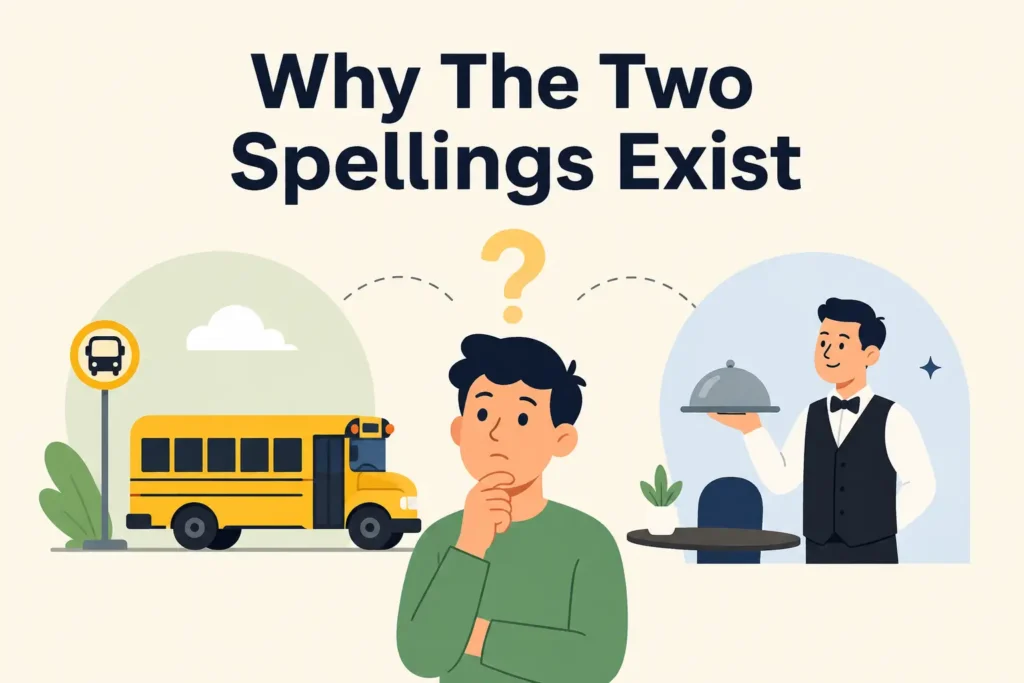
Why The Two Spellings Exist
The confusion comes from a simple spelling question. The base word is bus. When you add ing the spelling can be handled in two ways.
One form is busing. The final s stays single before ing.
The other form is bussing. The final s is doubled before ing.
Both forms have appeared in English for a long time. Usage can also change based on the meaning of the word and the variety of English being used. American dictionaries and style guides commonly recognize busing for transportation. Bussing also appears in dictionaries and is widely used in restaurant language.
This is a good example of why English spelling cannot always be reduced to one simple formula. Rules help but actual usage matters too. When a word has more than one accepted spelling you also need to consider context.
What Busing Means
Busing most often refers to transporting people by bus. The people being transported may be students workers tourists passengers or members of a group.
For example a school might use busing to take children between their homes and school. A company might arrange busing for employees who work at a large event. A hotel could offer busing to take guests to an airport or another location.
Here are a few natural examples.
The district provides busing for students who live far from school.
The company arranged busing for employees during the conference.
The hotel offers free busing to the airport.
The museum uses busing to bring students from nearby schools.
In each example the word describes transportation by bus.
Busing In American Schools
The word has a special meaning in American history and education. Busing can refer to the practice of transporting students by bus to attend schools outside their immediate neighborhoods.
This use became especially important during efforts to desegregate American schools. In many communities students were transported across neighborhood or district boundaries as part of plans designed to reduce racial segregation in public education.
That history gives the word a meaning beyond ordinary bus transportation. When you see busing in a news article or history book about American education the writer may be discussing school desegregation rather than simply talking about a school bus route.
For example:
The city introduced busing as part of its school desegregation plan.
Parents debated changes to the district’s busing system.
The history of school busing remains an important part of discussions about American education.
The context usually makes the intended meaning clear.
What Bussing Means
Bussing is also a recognized spelling. It can describe the action of putting people on a bus or transporting them by bus. It is also common in restaurant settings where bussing tables means clearing used dishes and cleaning tables after customers leave.
That restaurant meaning is especially useful to remember because it has become a familiar part of American workplace language.
For example:
She got a job bussing tables at a local restaurant.
The restaurant needs someone to handle bussing during the dinner rush.
He spent the evening bussing tables and helping the servers.
In these sentences bussing has nothing to do with school transportation. It refers to clearing and resetting tables.
Bussing Tables
If you’ve worked in or visited an American restaurant you may have heard the phrase bussing tables. A busser usually helps servers by collecting dirty plates glasses utensils and other items from tables.
The worker may also wipe down tables replace napkins and prepare the space for the next customers. The exact duties vary from one restaurant to another.
For example:
The busser cleared the table as soon as the guests left.
She spent the weekend bussing tables at a busy restaurant.
The manager asked him to help with bussing during the lunch rush.
This use explains why you may see bussing spelled with two s in restaurant job listings.
Busing As A Transportation Word
When you’re talking about transportation in American English busing is often the clearest spelling. It appears in phrases such as student busing, airport busing, and employee busing.
The word can describe a regular service or a temporary arrangement.
A school district might have a permanent busing program. A company might arrange temporary busing for a large event. A sports organization could provide busing for players and staff.
Consider these examples.
The school expanded busing to rural areas.
The event organizer arranged busing between the hotel and the stadium.
Students depend on busing to get to school each morning.
The team used charter buses instead of its normal busing service.
Here the word connects directly to transportation.
The Difference Between Bus And Busing
The base word bus can work as both a noun and a verb. As a noun it means a vehicle that carries passengers. As a verb it can mean to transport people by bus.
For example:
The bus arrived at seven.
We bus students to several schools.
When you add ing to the verb you get a form that shows an ongoing action.
The district is busing students to another campus.
The company is busing workers to the event.
The restaurant is bussing tables after each group leaves.
The meaning comes from the context. That is why you should look at the whole sentence instead of choosing a spelling based only on how the word looks.

Why The Extra S Causes Confusion
The spelling bussing looks natural because English has many words that double a final consonant before ing. For example we write running from run and sitting from sit.
That pattern can make writers expect bussing automatically. But English spelling depends on the letters at the end of the base word and the rules that apply to that word. The spelling of bus does not always behave in the way learners expect.
There is also a practical reason for the confusion. Both busing and bussing are found in real English writing. That means a search for the less familiar form can still produce legitimate examples.
So seeing bussing does not automatically mean someone made a spelling mistake. You need to check the meaning and the context first.
Examples You Can Use Right Away
If you’re writing about school transportation you can safely use sentences like these.
The district provides busing for students who live outside the walk zone.
Parents received information about changes to the busing schedule.
The school board discussed the cost of student busing.
If you’re writing about restaurant work you may see examples like these.
She works evenings bussing tables at a neighborhood restaurant.
The restaurant is hiring someone for bussing and cleanup.
He learned how to balance bussing duties with other tasks during busy shifts.
These examples show why context matters more than simply counting the letters. The transportation meaning often favors busing in American English while restaurant work commonly uses bussing.
How To Choose The Right Spelling
The easiest way to choose between busing and bussing is to look at the meaning first. If you’re talking about transporting people by bus in American English busing is usually the best choice. If you’re talking about clearing tables in a restaurant bussing is the common form.
This simple distinction covers most situations you’ll meet in everyday writing. It also keeps you from getting stuck on the spelling alone.
For example:
The school provides busing for students who live several miles away.
The restaurant needs help with bussing tables during the evening shift.
Both sentences are correct because the words serve different purposes in context.
When To Use Busing
Use busing when the main idea is transportation by bus. This can involve students employees tourists passengers or any other group that needs transportation.
The word is especially common in American English when writers discuss school transportation. It can also describe transportation services arranged for events workplaces hotels and other organizations.
School Transportation
School transportation is one of the most common uses of this spelling.
The district provides busing for elementary school students.
Free busing is available for children who live outside the attendance area.
The school changed its busing schedule after several new routes were added.
In these sentences the word refers to a system or service that moves students by bus. You aren’t talking about an action happening inside a restaurant. That context strongly points to busing.
Event Transportation
Large events often need transportation for people who are staying at different locations. Organizers may arrange buses to move guests between hotels venues parking areas and other locations.
The conference offers busing between the airport and the main hotel.
Free busing will take guests from the parking lot to the stadium.
The organizers added more busing after attendance increased.
Here the word describes an organized transportation service.
Employee Transportation
Some companies provide buses for workers who travel to large offices factories or special work sites. This can be useful when parking is limited or when many employees need to arrive at the same time.
The company introduced employee busing from several nearby neighborhoods.
Workers can use the morning busing service to reach the plant.
The new busing program reduced the number of cars in the parking lot.
Again the meaning is transportation. That makes busing the natural choice in American English.
When To Use Bussing
Use bussing when you mean clearing tables in a restaurant. This is one of the most common places where the spelling with two s appears.
A busser often collects used plates and glasses from tables. The worker may also wipe tables and prepare them for new guests. These tasks are commonly called bussing tables.
For example:
She started bussing tables during her first week at the restaurant.
The manager asked the staff to help with bussing during the dinner rush.
He works as a busser and spends part of each shift bussing tables.
The spelling fits naturally in restaurant settings because the word has become established in this form.
What A Busser Does
A busser is a restaurant worker who helps keep tables clean and ready for customers. The exact job can vary from one restaurant to another.
A busser may collect dirty dishes. They may refill water glasses. They may wipe tables and reset them with clean utensils and napkins. In some restaurants they also help servers carry food or organize dishes.
For example:
The busser cleared the plates before the next guests arrived.
She works as a busser at a busy downtown restaurant.
The restaurant hired another busser for weekend shifts.
The related forms busser and bussing can help you remember the restaurant meaning.
The Spelling Rule Behind Busing
The spelling question becomes easier when you look at how English forms words ending in ing.
The base verb is bus. Adding ing gives us busing in one accepted form. Another accepted form adds another s and produces bussing.
This is different from words such as run and sit. Those verbs double their final consonant before ing in standard forms such as running and sitting.
With bus the spelling has developed differently. Dictionaries and style references recognize both forms. Usage also depends on the meaning and the variety of English.
That is why you shouldn’t apply a doubling rule automatically and assume that only one spelling can ever be correct.
How Dictionaries Treat The Two Spellings
Major English dictionaries recognize the connection between these forms. Dictionary entries can differ in which spelling they list first or which meanings they emphasize. That doesn’t mean one form is automatically a mistake.
English dictionaries record real usage. They also reflect differences between American English and other varieties.
For writers this creates an important lesson. A word can have more than one accepted spelling without the language being inconsistent. Sometimes the choice depends on meaning. Sometimes it depends on regional style. Sometimes both forms appear in the same variety of English.
When you’re writing for a US audience the safest practical choice is to use busing for transportation and bussing for restaurant table service.
Busing In School Desegregation
The word has another important meaning in American history. Busing can refer to the use of buses to transport students as part of efforts to reduce racial segregation in public schools.
This use became especially prominent during the civil rights era and the decades that followed. Courts and school districts sometimes required students to travel outside their local neighborhoods so schools could become more integrated.
That means the word can carry historical and political context depending on the sentence.
For example:
The city introduced busing as part of its school desegregation plan.
The history of school busing shaped public education in many American communities.
Students traveled across the city under the new busing program.
In a history article the word isn’t simply describing an ordinary school bus route. It may refer to a specific policy connected to desegregation.
Common Mistakes With These Words
One common mistake is assuming that bussing must always be wrong because busing is the standard spelling for transportation. That isn’t true. The doubled form has legitimate uses.
Another mistake is using bussing every time you see the word bus followed by ing. This can create an awkward choice in writing about transportation. For a US audience busing is usually clearer for that meaning.
A third mistake is treating the two spellings as completely interchangeable. They can overlap in some contexts but they don’t always sound equally natural. Meaning and usage matter.
Consider these sentences:
The district provides busing for students.
The district provides bussing for students.
The first sentence is the more natural choice for American readers discussing school transportation. The second may appear in real writing but it is less common in this context.
Now compare the restaurant examples:
She spends weekends busing tables.
She spends weekends bussing tables.
The second version is the more familiar choice for many American readers.
Knowing the context helps you make the better choice without second guessing every letter.
Busing And Bussing In Formal Writing
If you’re writing an essay report article or professional document use the form that matches your meaning and audience. Don’t change the spelling simply because one version looks more familiar.
For transportation in American English busing is a strong choice. It is clear and widely recognized.
For restaurant table service bussing is a natural choice. You may also see table bussing in restaurant job descriptions and training materials.
If you’re following a specific style guide use that guide consistently. Consistency matters in polished writing. A document looks more professional when the same term is spelled the same way throughout.
A Simple Memory Trick
You don’t need a complicated spelling rhyme to remember these words.
Think of a bus moving people when you see busing.
Think of a busser clearing tables when you see bussing.
The extra s can remind you of the extra work happening at a restaurant table. A busser isn’t just transporting someone. They are clearing dishes and getting the table ready for the next group.
This isn’t a formal spelling rule. It’s simply a memory trick. The best memory tricks are often the ones that connect a spelling with a clear image.
Picture a school bus moving down a street. Think busing.
Then picture a restaurant worker carrying a stack of dirty plates. Think bussing.
That small mental connection can make the difference stick.
What About Other English Speaking Countries
English spelling varies across regions. A form that is common in the United States may not always be the most common choice in another English speaking country.
The meaning of the word matters too. Different dictionaries and publications can prefer different spellings based on their audience and editorial style.
For a US focused website busing is the safest choice when you mean transportation by bus. If you’re writing for an international audience you may encounter bussing more often.
The key point is that the doubled form isn’t automatically a spelling error. Context gives you the information you need.
More Examples Of Busing In Real Writing
The word busing appears in many types of writing. You may see it in school notices transportation policies news reports event information and everyday conversations. The meaning usually becomes clear from the words around it.
For example a school notice might say that busing will begin at 7 a.m. A hotel might mention busing between the property and the airport. An event organizer might tell guests that busing is available after the concert.
These uses all point to transportation. The word describes a service or activity that involves moving people by bus.
School Notices
Schools often use this word when discussing transportation for students. It can refer to bus routes schedules costs eligibility and changes to service.
The district announced changes to its busing schedule.
Parents can check the online map to find their child’s busing route.
The new school will offer busing to students who live more than two miles away.
The district plans to expand busing next year.
These sentences sound natural because the word connects directly to student transportation.
Event Information
Large events may use buses to move guests between several locations. This is common at conferences festivals sporting events weddings and other gatherings.
The festival provides busing from the parking area to the main entrance.
Guests can use free busing between the hotel and the convention center.
The organizers added more buses after the first night of the event.
In this context the word describes an organized transportation service rather than a single bus ride.
Business And Workplace Writing
Companies sometimes arrange transportation for employees. This can be useful when a workplace is far from public transportation or when a large number of workers need to reach the same location.
The company offers employee busing from three nearby neighborhoods.
The new busing program gives workers another way to get to the office.
Management is reviewing the cost of employee busing.
This type of wording is common in company policies and transportation plans.
More Examples Of Bussing In Restaurant Writing
The other spelling appears often in restaurant settings. If you’re writing about someone clearing tables you will commonly see bussing.
A restaurant worker may spend part of a shift collecting used dishes. They may also wipe tables and prepare them for the next customers. These tasks are often grouped under the term bussing.
For example:
The restaurant needs extra help with bussing on Friday nights.
She learned the basics of bussing during her first week.
He handles bussing while the servers focus on customers.
The manager moved another employee to bussing during the dinner rush.
These sentences use the word in a way that most American readers will understand immediately.
Restaurant Job Descriptions
You may also encounter the word in employment listings. A restaurant might ask applicants to help with bussing duties.
A job listing could mention tasks such as clearing dishes cleaning tables refilling supplies and helping servers. The exact duties depend on the restaurant.
For example:
The position includes bussing tables and maintaining a clean dining area.
Previous restaurant experience is helpful but not required for this bussing position.
The evening employee will assist with bussing and other dining room tasks.
When you see this kind of wording the context makes the intended meaning clear.
Busing And Bussing As Nouns And Verbs
One reason this topic gets confusing is that the related words can appear in several grammatical forms. Understanding the base word helps.
Bus can be a noun. In that form it means a vehicle that carries passengers.
The bus stopped outside the school.
Bus can also be a verb. It can mean to transport someone by bus.
The district buses students to several schools.
The forms busing and bussing describe an action that is happening or an activity connected to the verb.
The district is busing students to school.
The restaurant is bussing tables after each group leaves.
This distinction matters because the spelling should match the intended use.
What Does Bused Mean
The past tense can create another spelling question. The standard form is bused in American English.
For example:
The school bused students to the museum.
The company bused workers to the new facility.
The hotel bused guests to the airport.
You may also encounter bussed in English writing. That form is recognized in some dictionaries and usage traditions. Regional style can influence which spelling a writer chooses.
For a US audience bused is a clear and familiar choice when referring to transportation.
What Does Busser Mean
A busser is a restaurant worker who clears and resets tables. The word is especially common in American restaurant vocabulary.
A busser may work closely with servers and hosts. They help keep the dining room clean so tables can be used by new guests.
For example:
The restaurant hired a new busser before the holiday season.
The busser cleared the dishes while the server took the next order.
She worked as a busser while attending college.
This word is useful because it creates a clear connection between the restaurant role and the spelling with two s.
Why You May See Both Forms Online
A quick internet search can make this spelling issue look more confusing than it really is. You may find busing in one article and bussing in another. Both may come from reputable sources.
There are several reasons for this. English allows variation in some words. Different dictionaries can record different preferred forms. Regional usage can also influence spelling.
Search results can also mix meanings. One page may discuss school transportation while another discusses restaurant work. If you only compare the spellings without reading the context the difference can seem random.
Instead look at how each source uses the word. Meaning often explains the spelling choice.
Common Questions About The Spelling
Writers sometimes assume that a doubled consonant always signals the correct form before ing. That isn’t a safe assumption. English has many spelling patterns and several words allow more than one accepted form.
Another common mistake is treating dictionary preference as an absolute rule. Dictionaries describe established usage. They don’t always tell writers that every other form is impossible.
Style matters too. A newspaper a school district a restaurant and a language textbook may make different choices. For polished writing the best approach is to match the spelling to your meaning and audience.
How To Proofread This Word
A quick proofreading method can help you catch mistakes without stopping your writing every few seconds.
First look at the meaning. Are you describing transportation or restaurant table service.
Next check the spelling against the meaning. For US transportation writing busing will usually be the natural choice. For restaurant table service bussing is widely used.
Finally check the rest of the sentence. The surrounding words should make the meaning clear.
For example:
The district provides busing for students.
The restaurant needs help with bussing tables.
The two sentences are easy to understand because the context supports the spelling.
A Simple Rule For Everyday Writing
If you need one practical rule to remember from this article keep it simple.
Use busing when you’re writing about transportation by bus for a US audience.
Use bussing when you’re writing about restaurant workers clearing tables.
If you’re discussing another form of English or following a particular style guide check that guide before making a final choice. Consistency matters more than forcing every writer to use the same form in every situation.
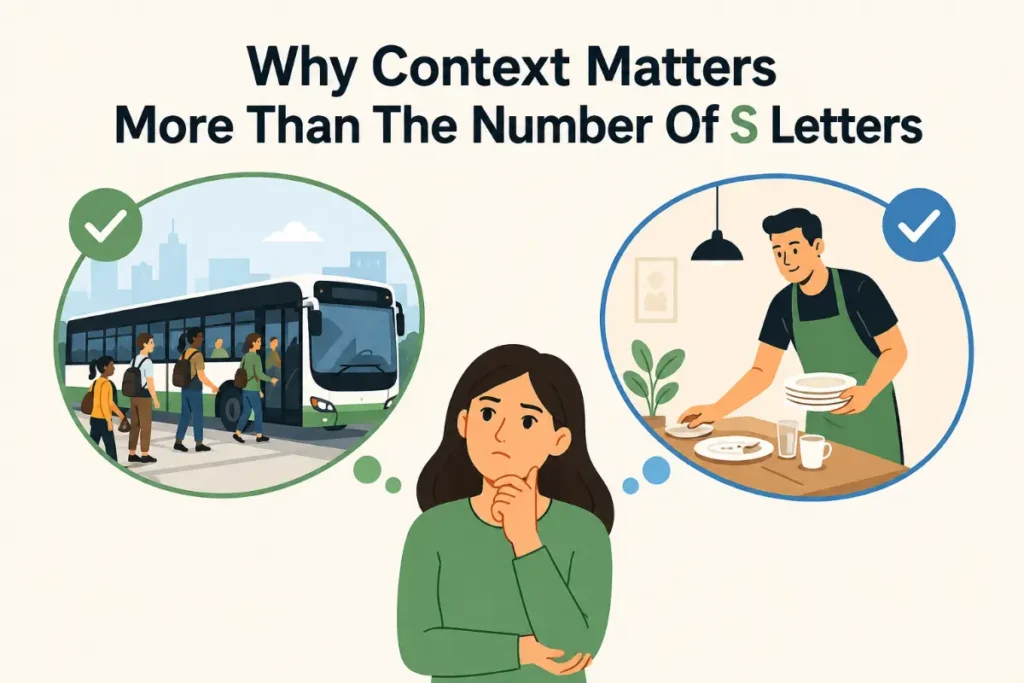
Why Context Matters More Than The Number Of S Letters
It can be tempting to stare at the two spellings and decide that one must be wrong. That approach misses the bigger point.
English spelling often depends on usage. The surrounding words can tell you what the writer means. Once the meaning is clear the preferred spelling becomes much easier to choose.
Compare these examples.
The district is busing students to the new school.
The restaurant is bussing tables before the next guests arrive.
The first sentence is about transportation. The second is about restaurant work. You don’t need to guess because the context does most of the work.
That is the best habit to develop. Don’t memorize the spelling in isolation. Connect the word to the meaning you want to express.
FAQs
Is busing or bussing correct in American English?
Both spellings are accepted in American English, but they aren’t always used in the same way. Busing is the more common choice when you’re talking about transporting people by bus. Bussing is especially common when you mean clearing tables in a restaurant.
Is busing the correct spelling for school transportation?
Yes. Busing is a common and standard spelling for school transportation in the United States. You may see it in phrases such as school busing, student busing, and busing services.
For example, the school district may provide busing for students who live too far away to walk to school.
Is bussing tables spelled with two s letters?
Yes. Bussing tables is a widely used spelling in American English. It means clearing used dishes and cleaning or resetting tables in a restaurant.
A restaurant employee who performs this work is commonly called a busser.
Why does busing have one s?
The spelling busing keeps the single s from the base word bus before the ending ing. This form is especially common when the word refers to transportation by bus.
English spelling does not always follow one simple doubling rule. That’s why it helps to learn the established spelling of this particular word.
Can bussing mean transporting people by bus?
Yes. Bussing can also refer to transporting people by bus. However, busing is generally the more familiar American spelling for transportation.
The meaning and the style of the publication can affect the spelling a writer chooses.
Is bused or bussed correct?
Both bused and bussed can be found in English. In American English, bused is a common choice when referring to transporting people by bus.
For example, you could write that the school bused students to a museum. Restaurant writing can use bussed in contexts connected with bussing tables.
What is the difference between a busser and a bus driver?
A busser usually works in a restaurant and helps clear and reset tables. A bus driver operates a bus that transports passengers.
The two jobs have completely different duties even though both words come from the word bus.
Which spelling should I use for a US audience?
For transportation by bus, busing is usually the safest and clearest choice for a US audience. For restaurant table service, bussing is a natural choice.
If you’re following a particular publication style guide, use its preferred form consistently throughout your work.
Conclusion
The spelling question becomes much easier once you connect each form with its meaning. Busing is commonly used in American English for transporting people by bus, especially in phrases connected with schools, workplaces, events, and other transportation services. Bussing is also a valid form and is especially familiar in restaurant language.
The two spellings aren’t simply a case of one being right and the other being wrong. Context plays a major role. If you’re writing about a school district moving students across town, busing is the natural choice. If you’re describing a restaurant employee clearing dirty plates and preparing tables, bussing is the familiar choice.
The extra s can make the word look confusing, but you don’t need to overthink it. Start with the meaning, then choose the spelling that fits the context and your audience. For most US transportation writing, busing will be the clearest option.
When you’re proofreading your next article, school assignment, job description, or email, use one simple test. Think about what the person is doing. If they’re moving people by bus, use busing. If they’re clearing restaurant tables, bussing is the natural choice.

Dr. Elena Vance holds a Ph.D. in Linguistics from Columbia University and has spent over 15 years analyzing the evolution of the English language. A former university professor turned full-time writer and editor, Elena specializes in breaking down high-level grammatical concepts, punctuation nuances, and style guides (APA, Chicago, MLA) into clear, actionable advice. When she isn’t hunting down dangling modifiers, she can be found collecting vintage dictionaries and reading classic literature.