
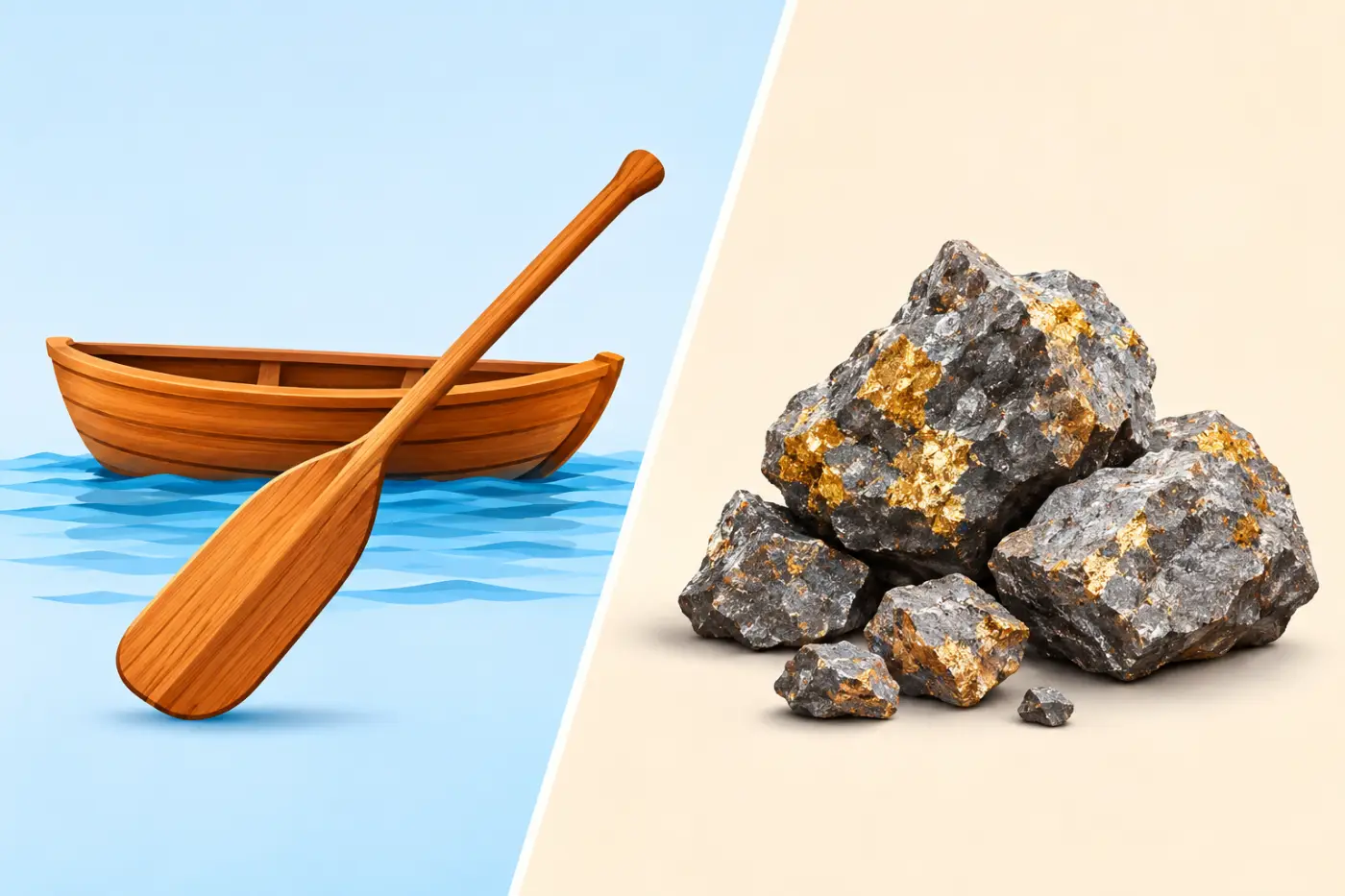
Have you ever stopped while writing because you weren’t sure if the correct word was oar or ore? These two words sound exactly alike, but they have very different meanings. One helps people move a boat through water. The other refers to rock that contains valuable minerals or metals.
The confusion between oar vs ore comes from their pronunciation. Both words have the same sound, so you can’t tell them apart just by listening. However, their spelling and meanings make them easy to distinguish once you understand how to use each one.
An oar is a long pole with a flat blade that a person uses to move or steer a boat. Ore is a natural material found in the ground that contains valuable minerals or metals. For example, a rower uses an oar to move across a lake, while a mining company extracts iron ore from the earth.
In this guide, you’ll learn the meaning of both words, their differences, and how to use them correctly. You’ll also find everyday examples, common mistakes, simple memory tricks, and answers to frequently asked questions.
Quick Definition
Oar is a noun that refers to a long tool with a flat blade used to row or steer a boat through water.
Ore is a noun that refers to rock or other natural material containing valuable minerals or metals that people can extract.
Direct Answer
Oar and ore are both correct English words, but they have different meanings. Use oar when talking about a tool used to move a boat and ore when talking about mineral rich rock found in the earth.
Oar vs Ore Comparison Table
| Word | Meaning | Example Sentence | When to Use It |
|---|---|---|---|
| Oar | A long tool used to row or steer a boat. | Jake picked up an oar and pushed the boat away from the shore. | When discussing boats, rowing, or water activities. |
| Ore | Rock containing valuable minerals or metals. | The miners discovered iron ore deep underground. | When discussing mining, minerals, metals, or natural resources. |
What Does Oar Mean?
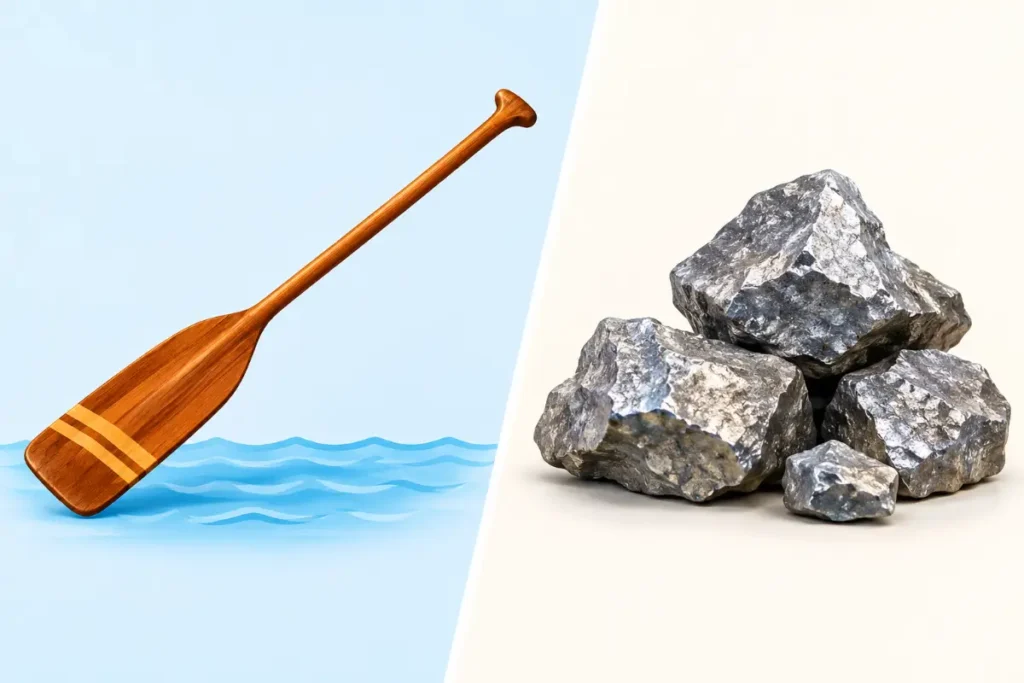
An oar is a tool used to move a boat through water. It usually has a long handle and a wide flat blade at one end. A person holds the handle and pushes or pulls the blade through the water to move the boat.
Oars are common in small boats such as rowboats, canoes, and some racing boats. They help people move across rivers, lakes, and other bodies of water without using an engine.
Think of a person sitting in a small wooden boat on a quiet lake. They hold an oar with both hands and push it against the water. The boat moves forward as the blade travels through the water.
That’s an oar.
The Main Purpose of an Oar
An oar helps a person control the movement of a boat. It can serve several purposes depending on the type of boat and how someone uses it.
Moving a boat forward. A person uses an oar to push water backward. This action moves the boat forward.
Steering a boat. A rower can use an oar to change the direction of a boat. Moving the blade on one side can help turn the boat.
Keeping balance. In some small boats, people use oars to make small adjustments and maintain control while moving through the water.
Moving without an engine. Oars allow people to travel across water without relying on fuel or electricity.
For example:
- The fisherman used an oar to guide his boat toward the riverbank.
- Sarah dropped one oar into the water and started rowing.
- We found an old wooden oar inside the boathouse.
- The rower pulled hard on his oars to reach the finish line.
- Dad showed me how to hold an oar before we left the dock.
Each sentence uses the word to describe a tool or its role in moving a boat.
What Does an Oar Look Like?
An ordinary oar has two main parts.
The handle or shaft. This is the long part that a person holds while rowing. It gives the rower control over the blade.
The blade. This is the wider and flatter part that enters the water. It pushes against the water to help move the boat.
Some oars have a smooth wooden surface. Others use materials such as aluminum or fiberglass. Their size and shape can also vary depending on the boat.
A large boat may need longer and heavier oars. A small rowboat can use shorter ones that are easier to handle.
Oar in Different Types of Boats
Oars appear in several kinds of watercraft. Their design may change, but their basic purpose remains the same.
Rowboats. These small boats often use one or two pairs of oars. A person sits inside and moves the boat by rowing.
Racing boats. Competitive rowing boats use special oars designed for speed and control. Athletes work together to move the boat across the water.
Fishing boats. Some small fishing boats use oars instead of motors. This gives fishermen a quiet way to move through the water.
Rescue boats. Some rescue boats carry oars as backup equipment. They can help rescuers move the boat if its motor stops working.
Here are a few more natural examples:
- The rescue team grabbed the oars before entering the water.
- My grandfather kept two spare oars in his fishing boat.
- The young rower learned how to move an oar without splashing water everywhere.
- A broken oar made it difficult for us to reach the other side of the lake.
Notice that the word always relates to a boat or the act of rowing.
What Does Ore Mean?
Ore is a natural material found in the earth that contains valuable minerals or metals. People mine it because they can remove useful substances from it.
Many important metals come from ores. These include iron, copper, aluminum, and gold. However, not every rock contains enough valuable material to make mining worthwhile.
For example, iron ore contains iron compounds that companies can process to produce iron and steel. Copper ore contains copper minerals that can be extracted and used in electrical wires, pipes, and other products.
Imagine workers digging into a mountain and finding rock that contains copper. They collect the material and send it for processing. Machines and other methods separate the useful copper from the unwanted parts of the rock.
That natural material is called ore.
The Main Purpose of Ore
Ore is valuable because it provides raw materials that people use to make everyday products. Many things around us depend on metals that come from mined materials.
Here are some common uses of metals obtained from ores.
Building materials. Iron ore provides the iron used to make steel. Builders use steel in bridges, buildings, roads, and other structures.
Electrical equipment. Copper comes from copper bearing ores. Manufacturers use it in electrical wiring, motors, and electronic devices.
Jewelry. Gold and silver can come from naturally occurring ores. Jewelers use these metals to make rings, necklaces, bracelets, and other items.
Transportation. Aluminum and steel are important materials in cars, airplanes, trains, and ships. Their production depends on mined mineral resources.
Household products. Many kitchen tools, appliances, and electronic devices contain metals that originally came from ores.
For example:
- The company discovered a large deposit of copper ore.
- Workers extracted iron ore from the mine.
- Gold ore can contain small amounts of valuable gold.
- The factory needs aluminum ore to produce metal for manufacturing.
- Scientists studied the mineral content of the ore sample.
In these sentences, the word describes natural material that contains useful minerals or metals.
What Is Ore Made Of?
Ore is not always a pure metal. It usually contains a mixture of useful minerals and other materials.
For example, iron ore contains iron bearing minerals along with other substances. Mining companies process the material to separate the useful parts from unwanted rock and minerals.
The exact composition depends on the type of ore.
Some ores contain large amounts of valuable minerals. Others contain smaller amounts and require more processing.
This difference matters because mining companies need to consider the cost of extracting and processing the material. A deposit may contain valuable metal but still be too expensive to mine.
Common Types of Ore
Different ores provide different minerals and metals. Here are some familiar examples.
Iron Ore
Iron ore is a major source of iron. Manufacturers use iron to produce steel for buildings, vehicles, tools, and machines.
Example: The mine produces thousands of tons of iron ore every year.
Copper Ore
Copper ore contains minerals that provide copper.
Example: Workers found copper ore near the bottom of the mountain.
Gold Ore
Gold ore contains gold in amounts that may make extraction worthwhile. Mining companies process it to recover the precious metal.
Example: The miners collected gold ore from the underground deposit.
Bauxite Ore
Bauxite is the main natural source of aluminum. It contains aluminum bearing minerals that companies process to produce aluminum.
Example: The factory receives bauxite from a nearby mining operation.
Uranium Ore
Uranium ore contains uranium minerals. Companies can process uranium for use in nuclear energy production under controlled industrial and safety conditions.
Example: Researchers examined the uranium ore samples from the site.
These examples show that ore has a close connection with mining, geology, natural resources, and metal production.
Why Do Oar and Ore Sound the Same?
Oar and ore are homophones. Homophones are words that sound the same but have different meanings and spellings.
English has many homophones. Some share two spellings, while others share three or more. Their pronunciation can be identical even though their meanings have nothing in common.
For example:
- Sea and see.
- Pair and pear.
- Right and write.
- Brake and break.
- Flour and flower.
- Oar and ore.
When you hear someone say either word, you may not know which one they mean without additional information. The surrounding sentence usually gives you the answer.
Consider these two sentences.
- The sailor grabbed an oar before leaving the shore.
- The miners searched for ore beneath the ground.
Both sentences contain words with the same pronunciation. However, the words describe completely different things.
The first sentence discusses a boat. The second sentence discusses mining.
This is why context matters when you write or read homophones. You need to understand the subject of the sentence before choosing the correct spelling.
How Are They Pronounced?
In standard American English, oar and ore are pronounced the same way.
Their pronunciation is commonly represented as /ɔr/ in phonetic writing. The sound may vary slightly across regional accents, but both words still share the same pronunciation in standard American English.
You can hear this sound in words such as:
- More.
- Store.
- Shore.
- Four.
- Roar.
- Core.
The spelling does not change the sound in this word pair. Instead, the meaning tells you which spelling to choose.
For example, a sentence about a rowboat needs the spelling oar. A sentence about a mining operation needs the spelling ore.
What Is the Difference Between Oar and Ore in Writing?
The biggest difference is the subject of your sentence.
Use oar when your sentence discusses rowing, boats, or water travel. Use ore when it discusses minerals, mining, or valuable natural materials.
Compare these examples.
Correct: The boy used an oar to move the boat.
Incorrect: The boy used an ore to move the boat.
The second sentence doesn’t make sense because ore is a natural material found in the ground. It isn’t a rowing tool.
Now consider another example.
Correct: The workers discovered a deposit of iron ore.
Incorrect: The workers discovered a deposit of iron oar.
The second spelling is incorrect because the sentence refers to a mineral resource.
The simplest way to avoid this mistake is to think about the subject before writing the word.
If you’re talking about a boat, choose oar. If you’re talking about a mineral deposit, choose ore.
When to Use Oar in a Sentence
Use oar when you mean a tool that helps move or steer a boat. It works as a noun and can appear in both singular and plural forms.
Oar as a Singular Noun
The singular form refers to one rowing tool.
Examples:
- I found an old oar behind the boathouse.
- The fisherman repaired his broken oar.
- She placed the oar beside her seat.
- He used an oar to push the boat away from the dock.
- The wooden oar had a crack near its handle.
Each sentence refers to one tool used for rowing.
Oars as a Plural Noun
The plural form is oars. Use it when talking about two or more rowing tools.
Examples:
- The boat had four oars.
- We placed the oars inside the storage room.
- The rowing team raised its oars after the race.
- Two oars were missing from the fishing boat.
- The children learned how to use the oars safely.
Remember that oars is the plural of oar. It does not change into ore when you talk about more than one rowing tool.
Common Expressions With Oar
The word also appears in a few familiar expressions.
Pull an oar. This phrase refers to rowing a boat. It can also describe helping with a shared task.
Example: Everyone had to pull an oar to get the boat moving.
Put your oar in. This informal expression means getting involved in a situation or giving an opinion when someone hasn’t asked for it.
Example: I didn’t ask for advice, so please stop putting your oar in.
Up the creek without a paddle. This expression means being in a difficult situation without the help or tools you need. It doesn’t contain the word oar, but it belongs to the same general idea of boating.
Example: When the car broke down in the middle of nowhere, we were up the creek without a paddle.
These expressions show that oar can appear in both literal and figurative language.
When to Use Ore in a Sentence
Use ore when discussing natural materials that contain valuable minerals or metals. The word often appears in writing about mining, geology, industry, and natural resources.
Ore as a Singular Noun
The word ore is generally used as an uncountable noun when referring to material as a whole. However, it can also refer to a particular type or sample of ore.
Examples:
- The mine contains valuable ore.
- Workers transported the ore to a processing plant.
- The scientist examined a sample of ore.
- The company found a new source of copper ore.
- The mountain contains deposits of iron ore.
In these examples, the word refers to material that contains useful minerals or metals.
Talking About Different Types of Ore
You can use ore with the name of a mineral or metal to identify a specific type.
Examples:
- Iron ore is used to produce iron.
- Copper ore provides an important source of copper.
- Gold ore can contain tiny particles of gold.
- Bauxite is the main source of aluminum.
- Uranium ore is used in the production of nuclear fuel.
You can also use ore with words such as deposit, sample, mine, and extraction.
Here are some examples.
- The company discovered a new ore deposit.
- The laboratory tested the ore sample.
- Workers transported the material from the ore mine.
- The mining process separates useful minerals from waste rock.
- The company improved its ore extraction methods.
These word combinations are common in science and industry writing.
Can Ore Be Used in Everyday English?
Yes. You don’t need to work in a mine or study geology to use the word correctly.
Ore appears in news reports, school lessons, documentaries, books, and conversations about natural resources.
For example:
- The country exports iron ore to several other nations.
- My science teacher explained how people extract metals from ore.
- The documentary showed workers digging for gold ore.
- We learned about copper ore during our geology lesson.
- The price of iron ore can affect the steel industry.
The word may sound technical because it often appears in mining and science. However, its meaning is simple once you connect it with minerals and metals.
Common Mistakes People Make With These Words
Even though the difference is simple, people sometimes confuse these spellings. This usually happens because both words sound alike.
Here are some mistakes to avoid.
Using Ore When You Mean a Boat Tool
Incorrect: The fisherman picked up an ore and started rowing.
Correct: The fisherman picked up an oar and started rowing.
The sentence describes a person moving a boat. Therefore, oar is the correct choice.
Using Oar When You Mean a Mineral
Incorrect: The miners found a large deposit of iron oar.
Correct: The miners found a large deposit of iron ore.
The sentence discusses a mineral resource. Therefore, ore is the right spelling.
Assuming Both Words Have the Same Meaning
Some writers think the two spellings are interchangeable because they sound alike. That’s not true.
An oar is a physical tool. Ore is a natural material containing valuable minerals or metals.
You cannot use one in place of the other without changing the meaning of your sentence.
Forgetting the Context
A word can sound correct when spoken but still be wrong in writing.
For example, someone might write, The boat needs a new ore.
The sentence sounds the same as the intended sentence, but the spelling is incorrect.
The correct version is, The boat needs a new oar.
Always check the subject of the sentence. A little attention can prevent a simple spelling mistake.
Confusing Ore With Other Mining Terms
Ore is not the same as every rock or mineral found underground.
A mineral is a naturally occurring substance with a particular chemical composition and structure. A rock is a natural solid made of one or more minerals. Ore is material that contains enough valuable minerals or metals to make extraction worthwhile under suitable conditions.
For example, a rock may contain small amounts of copper. However, that doesn’t automatically make it copper ore. The amount of copper and the cost of extracting it also matter.
Understanding this difference helps you use mining terms more accurately.
Easy Ways to Remember Oar and Ore
You don’t need to memorize long grammar rules to remember these words. A simple mental picture can help you choose the right spelling.
Remember Oar With a Boat
The word oar has three letters. Picture a person sitting in a small boat and holding a long wooden rowing tool.
Whenever your sentence involves rowing or moving a boat, think of that picture.
You can also remember the phrase oar and water. Both relate to boats and water activities.
Example: The rower used an oar to cross the lake.
Remember Ore With the Earth
The word ore also has three letters. Think of a miner digging into the ground and finding valuable rock.
Whenever your sentence discusses gold, iron, copper, or mining, choose ore.
You can remember the phrase ore from the earth.
Example: The miners found gold ore beneath the mountain.
Use a Simple Association
Try these two short reminders.
- Oar means a rowing tool.
- Ore means mineral rich material.
Repeat them a few times. Then try making your own sentences.
For example, you could write, I use an oar to move my boat, and the mine contains iron ore.
This small exercise helps connect each spelling with its meaning.
Read the Whole Sentence
If you still feel unsure, read the complete sentence and ask yourself what you’re trying to describe.
Does the sentence talk about a boat or rowing? Use oar.
Does it talk about a mine or valuable minerals? Use ore.
The surrounding words often provide enough information to make the right choice.
Related Words That Sound Like Oar and Ore
English contains many homophones that can cause similar spelling problems. Learning a few related word pairs can improve your spelling and help you write with confidence.
More and Moor
More refers to a greater amount or number.
Example: I need more time to finish my homework.
Moor refers to an open area of uncultivated land or a type of wet and often open landscape.
Example: The hikers walked across the moor.
Shore and Sure
Shore refers to the land along the edge of a body of water.
Example: We sat on the shore and watched the boats.
Sure means certain or confident.
Example: I’m sure she will arrive soon.
Four and For
Four is the number after three.
Example: We bought four tickets for the show.
For is a preposition that can show purpose, benefit, or direction.
Example: This gift is for my brother.
Sea and See
Sea refers to a large body of salt water.
Example: The children played near the sea.
See means to look at something or notice it.
Example: I can see a boat in the distance.
Pair and Pear
Pair refers to two matching or connected things.
Example: I bought a new pair of shoes.
Pear is a type of fruit.
Example: She ate a ripe pear after lunch.
These pairs follow the same basic idea as oar and ore. Their pronunciation is alike, but their spelling and meanings are different.
Oar vs Ore Examples in Everyday Sentences
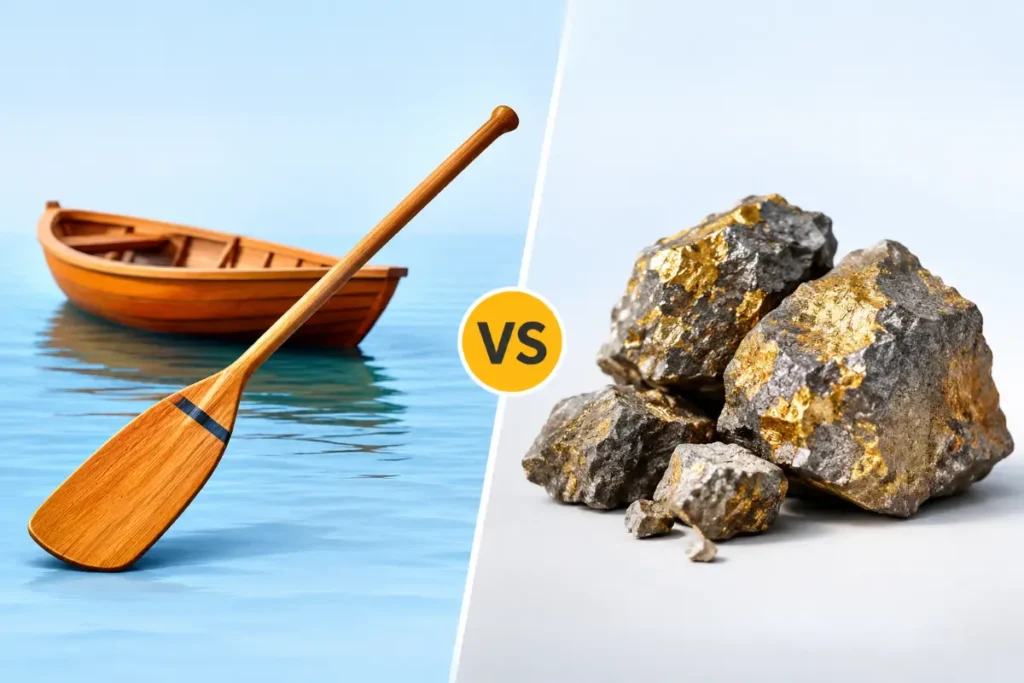
The best way to understand a word is to see how people use it in real situations. The following examples show how both spellings work in everyday English.
Examples Using Oar
- The young boy learned how to use an oar during his first boating lesson.
- My father kept an extra oar inside the fishing boat.
- The rower dropped his oar into the water by mistake.
- We used an oar to guide the small boat toward the dock.
- The old wooden oar had a smooth handle and a wide blade.
- Sarah picked up the oar and began moving the boat across the lake.
- The boat was difficult to control after one oar broke.
- The instructor showed us how to hold an oar properly.
- He placed the oar inside the boat before leaving the shore.
- The rescue team carried two spare oars.
- The children took turns using the oar during their boating trip.
- A strong current made it harder to move the oar through the water.
- The fisherman used his oar to reach a quiet spot on the lake.
- We found a rusty metal bracket attached to the old oar.
- The rower lifted his oar after crossing the finish line.
- Each person in the small boat had an oar to help move it forward.
- The wooden oar slipped from his hands and fell into the river.
- My uncle repaired the damaged oar before our weekend trip.
- She used one oar to turn the boat away from the rocks.
- The guide explained how an oar helps a boat move through water.
Models Using Ore
- The miners discovered a large deposit of iron ore.
- The company transports copper ore to a nearby processing plant.
- Gold ore can contain small amounts of precious metal.
- The scientists examined the ore samples in their laboratory.
- The mine produces valuable ore for the metal industry.
- Workers removed the ore from deep underground.
- The mountain contains deposits of several useful minerals.
- The factory processes iron ore to produce materials for steelmaking.
- The mining company found a new source of copper ore.
- The students learned how people extract metals from ore.
- The workers loaded the ore onto large trucks.
- The scientist studied the mineral content of the ore.
- The gold mine produces ore that requires further processing.
- The company invested in equipment to improve ore extraction.
- The discovery of iron ore helped the local mining industry grow.
- The researchers collected an ore sample for testing.
- The mine contains enough valuable material to support further exploration.
- Copper ore is an important source of copper for electrical products.
- The workers separated useful minerals from the unwanted parts of the ore.
- The documentary explained how ore becomes usable metal.
Examples Using Both Words in One Sentence
You can also use both words in the same sentence. This makes their different meanings easier to understand.
- The fisherman used an oar while the miners searched for ore.
- We learned about oars in our boating lesson and ores in our science class.
- The old oar was made of wood, while the nearby mine produced iron ore.
- A rower needs an oar, but a metal factory needs ore.
- The museum displayed an antique oar beside samples of copper ore.
- My brother studied how people use oars and how companies extract ore.
- The boat carried two oars while the mining truck carried several tons of ore.
- The teacher explained the difference between a rowing tool and mineral rich ore.
- The fisherman repaired his oar while the mining workers examined the ore.
- An oar helps a boat move, while ore provides materials for making metal products.
These examples show why the two words cannot replace each other. Their pronunciation is the same, but their meanings depend on completely different subjects.
How to Choose the Correct Word in Different Situations
Sometimes a single sentence doesn’t give you enough information at first. You may need to look at the words around the confusing spelling.
Here are some common situations that can help.
When Writing About Boating
Choose oar if the sentence includes words such as:
- Boat.
- Rowing.
- Rower.
- Paddle.
- Water.
- Lake.
- River.
- Shore.
- Dock.
- Blade.
For example:
The rower picked up an oar and pushed the boat away from the dock.
The words rower, boat, and dock make the meaning clear.
When Writing About Mining
Choose ore if the sentence includes words such as:
- Mine.
- Mineral.
- Metal.
- Gold.
- Iron.
- Copper.
- Deposit.
- Extraction.
- Rock.
- Processing.
For example:
The workers found copper ore inside the mine.
The words copper, workers, and mine point to a natural mineral resource.
When Writing for School
Students often come across both words in reading and writing assignments.
An English teacher may explain oar as part of a lesson about homophones. A science teacher may use ore when teaching about rocks, minerals, and natural resources.
The subject of the lesson can help you understand the intended meaning.
When Writing for Work
The same rule applies in professional writing.
A boating instructor may use oar in training materials. A mining engineer may use ore in a technical report.
Using the correct spelling makes your writing clear and prevents readers from misunderstanding your message.
A Short Practice Test
Now that you understand the difference, try choosing the correct word in each sentence.
Fill in the blank with oar or ore.
- The fisherman used an _____ to move his boat.
- The workers discovered iron _____ beneath the ground.
- She picked up the _____ and began rowing.
- The mine produces copper _____.
- The broken _____ made it difficult to steer the boat.
- The scientists examined the gold _____ sample.
- My grandfather taught me how to hold an _____.
- The company found a valuable deposit of _____.
- The rower dropped his _____ into the lake.
- The factory needs more iron _____ to produce steel.
Answers
- Oar.
- Ore.
- Oar.
- Ore.
- Oar.
- Ore.
- Oar.
- Ore.
- Oar.
- Ore.
If you answered all ten correctly, you’ve understood the main difference. If you missed a few, remember the simple connection between oar and boats and ore and minerals.
FAQs
What Is the Main Difference Between Oar and Ore?
An oar is a tool used to move or steer a boat through water. Ore is natural material that contains valuable minerals or metals. Both words sound the same, but they have different meanings and spellings.
Are Oar and Ore Homophones?
Yes. Oar and ore are homophones because they share the same pronunciation but have different spellings and meanings. You need to use the surrounding sentence to understand which word is correct.
Is Oar Used for Rowing a Boat?
Yes. An oar is a long tool with a flat blade that helps move or steer a boat. A person uses it by pushing or pulling the blade through the water.
Is Ore a Rock or a Mineral?
Ore is usually a natural rock or material that contains valuable minerals or metals. It isn’t always a pure mineral. People extract and process it to recover useful substances such as iron, copper, and gold.
What Is the Plural of Oar?
The plural of oar is oars. For example, you can say, The boat has two oars. The word ore is generally treated as an uncountable noun when referring to mineral material as a whole.
Can Oar and Ore Be Used Interchangeably?
No. They have different meanings and cannot replace each other. Use oar when discussing a rowing tool and ore when discussing mineral rich material found in the earth.
How Do You Remember the Difference Between Oar and Ore?
Connect oar with a boat and rowing. Connect ore with the earth and mining. These simple associations make it easier to remember the correct spelling.
Are Oar and Ore Pronounced the Same in American English?
Yes. In standard American English, both words have the same pronunciation. Their spelling and meaning are different, but their spoken sound is alike.
Conclusion
The difference between oar vs ore is simple once you connect each word with its meaning. Oar refers to a tool used to move or steer a boat. Ore refers to natural material that contains valuable minerals or metals.
Remember the simple rule. If you’re writing about boats, rowing, or water travel, use oar. If you’re writing about mining, minerals, or metal production, use ore.
Both words sound the same, so pronunciation won’t help you choose the correct spelling. Instead, pay attention to the meaning of your sentence and the words around it.
Keep the two simple associations in mind. An oar moves a boat, and ore comes from the earth. Once you remember that, you’ll have no trouble using these words correctly.

Sienna Watson is a veteran copywriter and communications coach who has helped startup founders, marketers, and professionals polish their writing for over a decade. Realizing that most people don’t need a degree in linguistics—just clear, impactful communication—Sienna focuses on practical grammar, business writing etiquette, and eliminating wordiness. She advocates for plain language, strong verbs, and persuasive prose that gets results.