
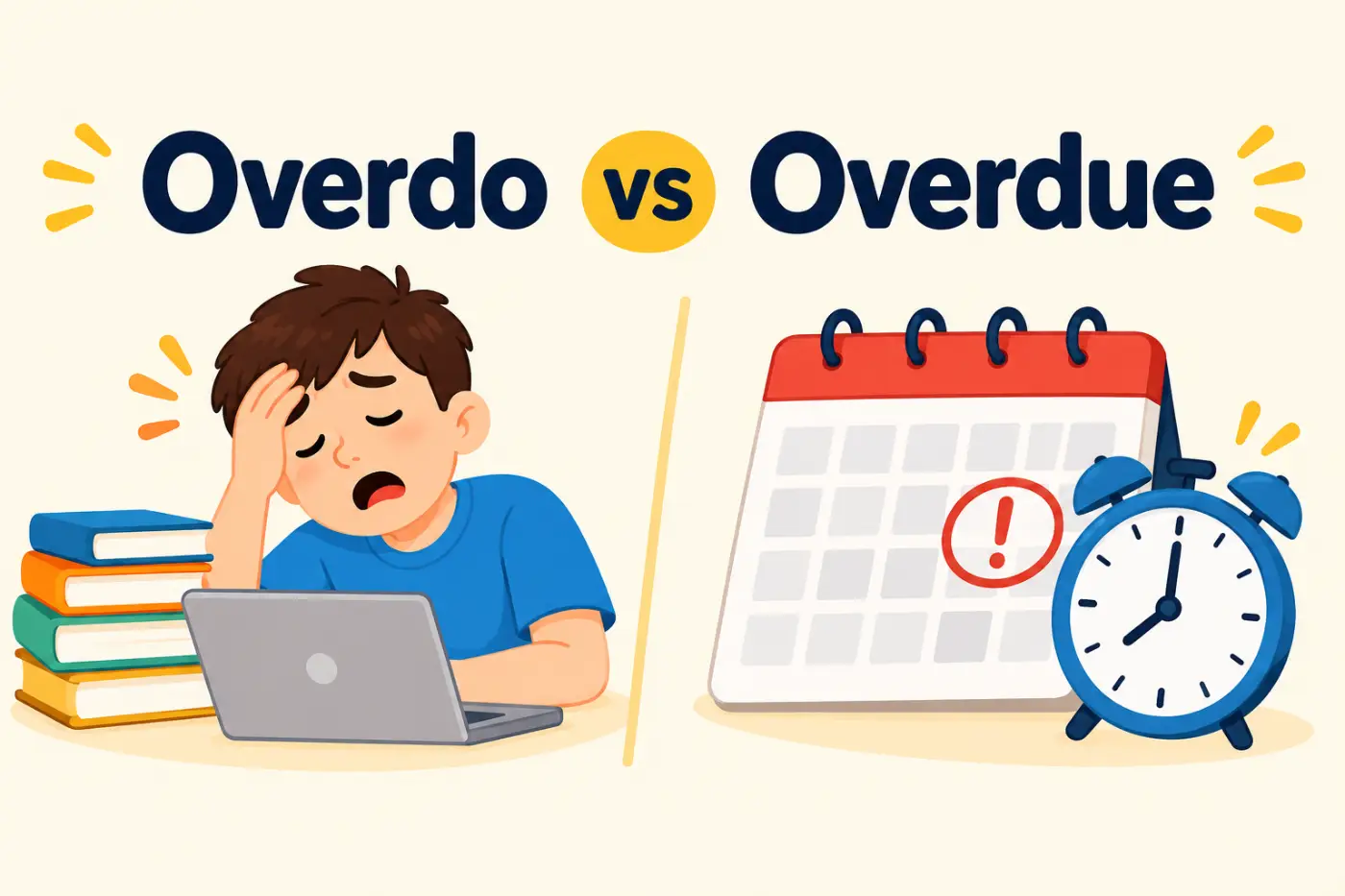
Have you ever stopped while writing because you weren’t sure if you should use overdo vs overdue? You’re not alone. These two words look and sound almost the same. However, they have completely different meanings.
The good news is that the difference is easy to understand. Overdo means to do too much of something. Overdue means something is late or past its expected time.
For example, you might overdo your workout by exercising for too long. On the other hand, you might have an overdue library book because you didn’t return it on time. Both words are correct, but you can’t use them in the same situations.
This small spelling difference can change the meaning of an entire sentence. Using the wrong word may confuse your reader or make your writing look less polished. That’s why it’s worth learning how each word works.
In this guide, you’ll learn the meaning of both words, how to use them in everyday sentences, and how to remember the difference. You’ll also find examples, common mistakes, grammar tips, and answers to frequently asked questions.
Quick Definition
Overdo is a verb that means to do, use, or say too much of something. It often describes excessive effort, activity, emotion, or an amount of something.
Overdue is an adjective that describes something that hasn’t happened, been completed, paid, or returned by the expected time. It can also describe something that should have happened earlier.
Direct Answer
Overdo is the correct word when you mean doing too much. Overdue is the correct word when you mean late or past a deadline.
For example, you can overdo a workout, but you can have an overdue payment.
Overdo vs Overdue at a Glance
Both words contain the letters over and end with the same sound. Still, they serve different purposes in a sentence. The easiest way to choose the right one is to focus on the meaning you want to express.
| Word | Meaning | Example Sentence | When to Use It |
|---|---|---|---|
| Overdo | To do too much or go beyond a reasonable limit. | Don’t overdo the exercise on your first day. | When talking about excessive effort or action. |
| Overdue | Late or past the expected time. | My credit card payment is overdue. | When talking about missed deadlines or something that is late. |
The main difference comes down to action and time.
Use overdo when someone does more than necessary or goes too far with something. Use overdue when something should have happened by now but hasn’t.
For instance, if you add too much salt to your soup, you overdo the seasoning. If you forget to pay your electricity bill by its due date, the bill becomes overdue.
Think of it this way. One word is about doing too much. The other is about being late.
What Does Overdo Mean
Overdo is a verb that means to do something more than you should. It describes an action that goes beyond a sensible or suitable limit.
You can overdo almost anything. You can overdo exercise, food, makeup, decorations, jokes, or even compliments. The word often suggests that a person has gone too far and may need to reduce their effort or change their approach.
For example:
- Don’t overdo the sugar in your coffee.
- She tends to overdo her makeup for casual events.
- I overdid my workout and felt exhausted the next morning.
- You don’t need to overdo the decorations for a small party.
- He overdid his jokes and made the meeting uncomfortable.
In each sentence, the word describes something done in excess.
Overdo as a Verb
The word belongs to the verb family. That means it describes an action rather than a state or condition.
It can appear in different forms depending on the tense and sentence structure.
Here are the main forms:
| Verb Form | Word | Example |
|---|---|---|
| Base form | Overdo | Try not to overdo your workout. |
| Third person singular | Overdoes | He overdoes everything when he gets excited. |
| Present participle | Overdoing | She is overdoing the decorations. |
| Simple past | Overdid | I overdid the exercise yesterday. |
| Past participle | Overdone | The chicken was overdone. |
These forms are useful because the word doesn’t follow the regular pattern of adding ed to make the past tense.
For example, you say I walked and I played. However, you say I overdid it rather than I overdoed it.
Remember that distinction when writing about something that happened in the past.
Common Meanings of Overdo
The word has several uses in everyday English. Although the situations may differ, the central idea stays the same. Something goes beyond the proper amount or level.
1. Doing Too Much Physical Activity
You can use the word when someone works, exercises, or moves more than their body can comfortably handle.
For example:
- I overdid it at the gym yesterday.
- Don’t overdo the walking if your feet hurt.
- He overdid the yard work and needed a long rest.
- She has been overdoing her exercise routine lately.
In these examples, the person puts too much physical effort into an activity.
The word is especially common in the expression overdo it. This phrase means to do more than you can reasonably handle.
For instance, someone recovering from a busy week might say, “I need to take it easy today because I overdid it yesterday.”
The speaker isn’t saying that the activity was wrong. They’re saying they did too much of it.
2. Using Too Much of Something
You can also use this verb when someone adds or uses more of something than needed.
For example:
- Don’t overdo the salt in the soup.
- She overdid the perfume before leaving home.
- I think we overdid the decorations this year.
- He overdoes the sugar in his morning coffee.
Here, the word describes an excessive amount.
Imagine making a sandwich and adding too much sauce. You haven’t made a mistake with the basic ingredients. You simply used more sauce than the sandwich needed.
That’s a good example of overdoing something.
3. Exaggerating an Action or Emotion
The word can also describe behavior that feels too dramatic, forced, or exaggerated.
For example:
- He overdid his reaction to the small mistake.
- The actor overdid the crying scene.
- She tends to overdo her excitement when guests arrive.
- You don’t need to overdo your apology.
This use often appears when someone wants to make an impression but takes things too far.
A simple apology can sound sincere. However, repeating it too many times or making it overly dramatic may have the opposite effect.
That’s when the word fits.
4. Cooking Something for Too Long
In cooking, overdo can mean preparing food for too long or exposing it to too much heat.
For example:
- Don’t overdo the chicken or it will become dry.
- I overdid the vegetables in the oven.
- She overdid the steak and made it tough.
- Be careful not to overdo the fish.
This meaning is close to the word overcook.
If you leave food on the stove or in the oven longer than needed, you may overdo it. The result can be dry, tough, burnt, or unpleasant to eat.
5. Making Something Too Elaborate
Sometimes people add too many details, decorations, or effects to something that should remain simple.
The word can describe that situation too.
For example:
- The designer overdid the colors in the room.
- Don’t overdo the effects in your presentation.
- He overdid the details in his speech.
- I think the restaurant overdid the decorations.
In these situations, the person adds more than the subject needs.
A simple design can look clean and attractive. Too many colors or decorative details can make it look crowded.
The same idea applies to writing, fashion, presentations, and other creative work.
What Does Overdue Mean
Overdue is an adjective that means something is late or hasn’t happened by the time people expected it to happen.
The word often appears in conversations about bills, payments, assignments, library books, appointments, and deadlines.
For example:
- My rent payment is overdue.
- The library book is three days overdue.
- Her school assignment is overdue.
- The company sent me a notice about an overdue invoice.
- The car is overdue for an oil change.
Each example describes something that should have been completed or taken care of earlier.
Unlike the other word, overdue doesn’t describe doing too much. It describes a delay or something that has passed its expected time.
Overdue as an Adjective
An adjective describes a person, place, thing, or condition. Overdue works as an adjective because it tells us the status of something.
It commonly appears before a noun or after a linking verb.
For example:
- I received an overdue notice.
- The payment is overdue.
- We need to return the overdue books.
- Her appointment has become overdue.
- The project is already overdue.
Notice how the word describes the condition of the payment, notice, books, appointment, or project.
You can also use it with time expressions.
For example:
- The bill is two weeks overdue.
- My library books are five days overdue.
- The report is several months overdue.
These expressions tell the reader how long something has been late.
Common Meanings of Overdue
The word appears in many situations. Its meaning remains connected to time, expectations, or an obligation that hasn’t been met.
1. A Late Payment
One of the most common uses appears in financial situations.
A payment becomes overdue when someone doesn’t pay it by the required date.
For example:
- My electricity bill is overdue.
- The customer has an overdue balance.
- The bank sent a reminder about my overdue payment.
- Your monthly subscription fee is now overdue.
This meaning is useful when discussing rent, credit cards, loans, utility bills, invoices, and other financial duties.
An overdue payment may lead to extra charges or reminders from the company. The exact consequences depend on the payment terms.
Remember that a payment isn’t automatically overdue just because you haven’t paid it yet. It becomes overdue after its due date passes.
2. An Assignment or Deadline That Has Passed
You can use the word when someone fails to complete work by the expected date.
For example:
- My science project is overdue.
- The teacher asked me to submit the overdue assignment.
- Several reports are overdue at the office.
- His application became overdue after the deadline passed.
In these examples, the work should have been completed earlier.
Students often use this word when talking about homework, essays, projects, and school assignments.
The same applies to employees who need to finish reports, documents, or other work tasks.
3. A Library Book That Hasn’t Been Returned
Library books are another familiar example.
When you borrow a book, the library gives you a return date. If you keep the book after that date, it becomes overdue.
For example:
- I have two overdue books at the library.
- The librarian reminded me about my overdue book.
- She returned her overdue books this morning.
- The library sent an email about my late return.
This use is easy to understand because borrowed books have a clear deadline.
You can also use the word for borrowed movies, equipment, or other items that must be returned by a certain date.
4. Something That Should Have Happened Earlier
Overdue doesn’t always refer to missed payments or deadlines. It can also describe something that people have expected or needed for a long time.
For example:
- The company finally gave its employees an overdue raise.
- Their neighborhood needs overdue repairs.
- She received an overdue apology.
- The team deserves an overdue break.
Here, the word suggests that something should have happened sooner.
An overdue apology is an apology that someone should have given earlier. An overdue raise is a pay increase that people believe should have arrived before now.
This meaning often carries a sense of delay or long waiting.
5. A Pregnancy That Continues Past the Expected Date
The word also appears in medical conversations about pregnancy.
A pregnancy is described as overdue when it continues beyond the expected delivery date.
For example:
- Her baby is two weeks overdue.
- The doctor checked on the overdue pregnancy.
- She was worried because her due date had passed.
The word refers to the expected timing of the birth.
In everyday conversation, people may say that a baby is late. Overdue is another common way to express the same idea.
The Main Differences Between Overdo and Overdue
Now that you know the basic meanings, it’s worth looking at how these words differ in grammar and everyday use.
The spelling is similar, but their jobs in a sentence are not the same. Understanding these differences will help you choose the right word without stopping to think too hard.
1. They Have Different Parts of Speech
The first major difference is their grammatical role.
Overdo is a verb. It describes an action. You use it when someone does something beyond a reasonable limit.
Overdue is an adjective. It describes the condition of something that is late or past its expected time.
Compare these sentences:
- I tend to overdo my workouts.
- My gym membership payment is overdue.
The first sentence describes an action. The second describes the status of a payment.
This difference gives you a quick way to identify the correct word. If your sentence needs an action word, overdo may fit. If you need to describe something that is late, overdue is the better choice.
2. They Have Different Meanings
The second difference is their meaning.
Overdo focuses on excess. It tells the reader that someone has done, used, or added too much.
Overdue focuses on time. It tells the reader that something hasn’t happened by the expected date.
Look at these examples:
- Don’t overdo the decorations for the birthday party.
- The birthday party invitations are overdue.
In the first sentence, someone may be adding too many decorations. In the second, the invitations should have been sent earlier.
The subject and situation can change, but the difference stays the same.
3. They Have Different Verb Forms
Overdo changes its form when you use it in different tenses.
Here are the main forms again:
- Present: I overdo my work sometimes.
- Past: I overdid my work yesterday.
- Present continuous: I am overdoing my work.
- Past participle: I have overdone my work.
Overdue doesn’t follow this pattern because it is an adjective.
You don’t normally write overdued to describe something that became late. The adjective stays the same.
For example:
- The payment is overdue.
- The payments are overdue.
- The payment was overdue.
- The payments were overdue.
Only the verb in the sentence changes. The adjective remains unchanged.
4. They Appear in Different Sentence Patterns
Overdo often appears with an object. The object tells us what someone is doing too much.
For example:
- She overdid the makeup.
- He overdoes the jokes.
- I overdid the exercise.
It also appears in the common expression overdo it.
For example:
- Don’t overdo it.
- I think I overdid it.
- You’re overdoing it with the decorations.
Overdue usually appears with a linking verb such as is, are, was, or were.
For example:
- The bill is overdue.
- The books are overdue.
- The assignment was overdue.
- The payments were overdue.
It can also come directly before a noun.
For example:
- An overdue payment.
- An overdue assignment.
- An overdue notice.
- An overdue appointment.
These patterns make it easier to recognize the right word when reading or writing.
5. They Can Sound the Same
Another reason people confuse these words is their pronunciation.
In standard American English, both words are pronounced almost identically. They sound like oh ver DOO.
This makes them homophones in American English. Homophones are words that sound the same but have different meanings or spellings.
Other familiar examples include:
- To and too.
- Their and there.
- Right and write.
- Sea and see.
- New and knew.
The same idea applies here. You can’t always tell the correct spelling by listening to someone speak.
You need to understand the meaning of the sentence.
For example, if someone says, “The report is overdo,” you need to consider the intended meaning. If the report missed its deadline, the correct spelling is overdue.
If someone says, “Don’t overdo the report,” the meaning is different. It suggests that the person should avoid adding too much detail or effort.
When to Use Overdo
Use overdo when you want to describe an action that goes beyond a suitable amount or limit.
It works in conversations about health, food, work, fashion, entertainment, and everyday behavior.
The easiest way to understand it is to connect the word with phrases such as do too much, go too far, or use too much.
Overdo in Everyday Conversations
People often use this word when talking about daily activities.
For example:
- Don’t overdo it at the gym today.
- I think I overdid the shopping this weekend.
- She overdoes everything when she gets nervous.
- We shouldn’t overdo the decorations.
- He overdid the salt in his dinner.
These sentences sound natural because they describe familiar situations.
You can use the word in casual conversations with friends, family members, or coworkers.
For example, imagine that your friend plans to spend the entire weekend cleaning the house. You might say, “Take a break and don’t overdo it.”
This is a simple way to tell someone not to push themselves too hard.
Overdo in Professional Writing
The word also works in professional and formal writing.
You can use it when discussing excessive effort, unnecessary details, or an approach that goes beyond what a situation requires.
For example:
- The company shouldn’t overdo its advertising campaign.
- Writers should avoid overdoing technical details.
- The manager overdid the criticism during the meeting.
- The designer overdid the visual effects in the presentation.
These examples show that the word isn’t limited to casual speech.
It can describe an action in business, education, marketing, design, and other professional settings.
However, choose your wording based on the tone of the document. In a highly formal report, phrases such as excessive use or unnecessary emphasis may sometimes sound more suitable.
Overdo in Cooking and Food
Cooking offers some of the clearest examples of this word.
When you cook something for too long, you can overdo it. When you add too much of an ingredient, you can also overdo it.
For example:
- Don’t overdo the butter in the recipe.
- I overdid the pasta and made it too soft.
- You can overdo the spices in this dish.
- She overdid the cooking time and burned the bread.
You can also use the word when talking about flavors.
For example, if a drink has too much sugar, you might say, “They overdid the sweetness.”
In this situation, the word means that the amount is greater than what works well.
Overdo in Health and Fitness
The word is also useful when discussing exercise and physical activity.
For example:
- Don’t overdo your first workout.
- He overdid the running and felt tired all day.
- You can overdo exercise if you don’t give your body enough rest.
- She was overdoing her training before the competition.
It can describe an activity that places too much demand on the body.
However, the word itself doesn’t tell you how much activity is safe. That depends on the person’s health, fitness level, and other factors.
In everyday speech, overdo it is a simple way to tell someone to slow down or avoid doing too much.
When to Use Overdue
Use overdue when something has passed its expected date or should have happened earlier.
The word is especially common in situations involving time limits, responsibilities, payments, and delayed events.
You can connect it with phrases such as past its due date, late, or long delayed.
Overdue in Financial Situations
Financial writing uses the word frequently.
A bill becomes overdue after its payment deadline passes. The same applies to invoices, rent, loan payments, and other financial obligations.
For example:
- My rent is overdue by five days.
- The company has several overdue invoices.
- She received a reminder about her overdue credit card payment.
- The customer paid the overdue balance yesterday.
These sentences make it clear that a required payment hasn’t arrived on time.
You may also see the word in account notices and payment reminders.
For example:
“Your account has an overdue balance.”
This means the account contains an amount that should have been paid earlier.
Keep in mind that overdue and unpaid don’t always mean the same thing.
An unpaid bill may still be within its payment period. An overdue bill has passed the required payment date.
Overdue in Education
Students and teachers use the word when talking about work that hasn’t been submitted on time.
For example:
- My English assignment is overdue.
- The teacher collected all overdue projects.
- He submitted his overdue homework this morning.
- Several students have overdue assignments.
The word can also appear in school notices and emails.
For instance:
“Please submit all overdue assignments by Friday.”
This tells students that their work is already late and needs attention.
Overdue in Business
In the workplace, overdue often describes unfinished tasks, reports, payments, or other responsibilities.
For example:
- The monthly report is overdue.
- We need to review the overdue invoices.
- The client requested an update on the overdue project.
- Several maintenance tasks are overdue.
It can also describe a delay in communication.
For example:
“The customer is still waiting for an overdue response.”
This means the response should have arrived earlier.
Overdue in Everyday Life
You don’t need a bill or formal deadline to use this word.
It can describe anything that should have happened earlier.
For example:
- I’m overdue for a haircut.
- Our house is overdue for a fresh coat of paint.
- He finally took an overdue vacation.
- The old car is overdue for maintenance.
- She received an overdue thank you from her friend.
These examples show how flexible the word can be.
An overdue haircut isn’t a late payment or missed school assignment. It simply means the person should have had a haircut sooner.
Similarly, an overdue vacation is a break that someone has needed or deserved for a long time.
Common Mistakes When Using Overdo and Overdue
Even people who know the meanings of these words sometimes mix them up. The similar spelling and pronunciation can make it easy to choose the wrong one.
Here are some common mistakes to watch for.
1. Using Overdo for Something That Is Late
One common mistake is using the verb when the sentence describes a missed deadline.
Incorrect: My electricity bill is overdo.
Correct: My electricity bill is overdue.
The sentence describes a bill that hasn’t been paid on time. It doesn’t describe someone doing too much.
Another example:
Incorrect: The assignment is overdo.
Correct: The assignment is overdue.
Remember that a late bill, assignment, or payment needs the adjective overdue.
2. Using Overdue for Doing Too Much
The opposite mistake happens when someone uses the adjective to describe an excessive action.
Incorrect: Don’t overdue the exercise.
Correct: Don’t overdo the exercise.
The sentence gives advice about the amount of exercise. It tells someone not to do more than they can handle.
Here are more examples:
Incorrect: I think she overdued the makeup.
Correct: I think she overdid the makeup.
Incorrect: He overdue the decorations.
Correct: He overdid the decorations.
In each case, the sentence describes an action that went too far.
3. Writing Overdoed Instead of Overdid
Overdo has an irregular past tense. You should write overdid rather than overdoed.
For example:
Incorrect: I overdoed the cooking yesterday.
Correct: I overdid the cooking yesterday.
The past participle is overdone.
For example:
Incorrect: The meat was overdid.
Correct: The meat was overdone.
This distinction matters because overdo changes form according to the tense and structure of the sentence.
4. Writing Overdued Instead of Overdue
Overdue is an adjective. You don’t add ed to it to describe something that has become late.
Incorrect: My payment is overdued.
Correct: My payment is overdue.
You can change the tense of the sentence without changing the adjective.
For example:
- The payment is overdue.
- The payment was overdue.
- The payment will be overdue if I miss the deadline.
In all three sentences, the word overdue stays the same.
5. Assuming the Spell Checker Will Catch Every Mistake
A spell checker can help you find many spelling errors. However, it may not catch a wrong word if that word is spelled correctly.
For example, both overdo and overdue are valid English words.
If you write, “My rent is overdo,” a basic spell checker may not recognize the problem. It sees a correctly spelled word but doesn’t always understand the meaning you intended.
That’s why you should read the full sentence before submitting an article, email, or report.
Ask yourself what you’re trying to say. Are you talking about doing too much, or are you describing something that is late?
That small check can prevent an embarrassing mistake.
Easy Ways to Remember the Difference
You don’t need to memorize complicated grammar rules to use these words correctly.
A few simple memory tricks can help you remember the difference.
1. Connect Overdo With Doing Too Much
The word contains do. This gives you a useful clue.
When you overdo something, you do more than necessary.
For example:
- You overdo the makeup.
- You overdo the exercise.
- You overdo the cooking.
- You overdo the decorations.
Think of the phrase do too much whenever you see overdo.
This simple connection works in most everyday situations.
2. Connect Overdue With a Due Date
The word contains due. A due date is the date by which something should be completed or paid.
If you miss that date, the payment or task becomes overdue.
For example:
- A bill becomes overdue after its payment date passes.
- A library book becomes overdue after its return date passes.
- An assignment becomes overdue after its submission deadline passes.
Think of the phrase past its due date whenever you see overdue.
3. Remember Action and Time
Another helpful trick is to connect each word with a different idea.
Overdo means action.
It describes someone doing too much of something.
Overdue means time.
It describes something that should have happened earlier.
For example, you can overdo your work by spending too many hours on it. You can also have an overdue work report if you fail to submit it on time.
Once you understand this difference, the correct spelling becomes much easier to choose.
4. Use a Simple Question
When you’re unsure, ask yourself one question.
Am I talking about doing too much, or am I talking about something being late?
If you’re talking about too much effort, use overdo.
If you’re talking about a missed date or delayed event, use overdue.
This trick works in emails, school assignments, blog posts, and everyday conversations.
More Example Sentences With Overdo and Overdue
Seeing both words in different situations can help you understand how they work.
The following examples cover common situations you may come across in daily life.
Examples With Overdo
- Don’t overdo the sugar when making the cake.
- I overdid my workout and needed a full day of rest.
- She tends to overdo her makeup for family gatherings.
- You shouldn’t overdo the jokes during a serious meeting.
- He overdid the decorations for his birthday party.
- I think we overdid the amount of food we prepared.
- Don’t overdo the perfume before going to work.
- The chef overdid the fish and made it too dry.
- She is overdoing her efforts to impress her new boss.
- You can make your presentation better without overdoing the effects.
- I overdid the cleaning and felt tired afterward.
- He always overdoes things when he gets excited.
- The actor overdid his reaction in the final scene.
- Try not to overdo your training before the race.
- We overdid the decorations and made the room look crowded.
Examples With Overdue
- My electricity bill is overdue.
- The teacher asked us to complete our overdue assignments.
- I need to return my overdue library books.
- Her car is overdue for an oil change.
- The company sent a reminder about the overdue invoice.
- His overdue vacation finally started last Monday.
- The project is already two weeks overdue.
- She received an overdue payment from her client.
- The customer has an overdue balance on the account.
- We are waiting for an overdue response from the manager.
- The old building is overdue for repairs.
- My annual checkup is overdue.
- The overdue rent payment caused a problem for the tenant.
- He finally received an overdue apology from his friend.
- The report became overdue after the deadline passed.
Examples That Show Both Words Together
You can also use both words in the same sentence when the situation calls for it.
For example:
- Don’t overdo your work just because your report is overdue.
- I overdid my exercise because I was trying to finish an overdue fitness challenge.
- She overdid the decorations for the overdue birthday celebration.
- He overdid the cleaning while trying to prepare his overdue apartment for inspection.
- The chef overdid the food preparation while working on an overdue catering order.
These examples show that both words can appear in the same context without sharing the same meaning.
Each word has its own job in the sentence.
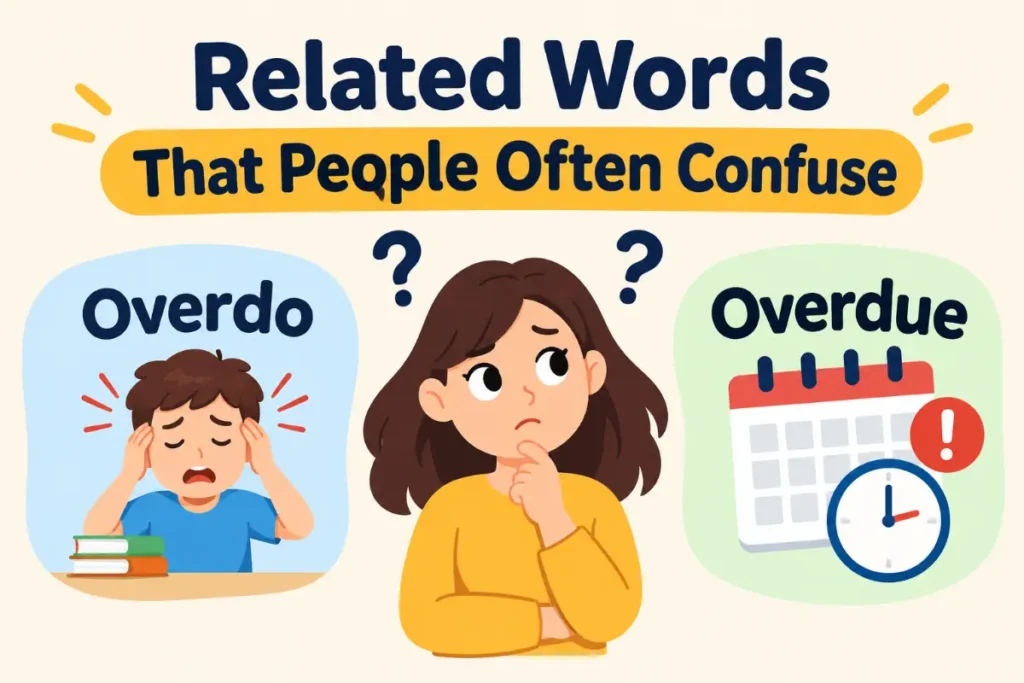
Related Words That People Often Confuse
Learning the difference between similar words can improve your spelling and writing skills.
The following word pairs have different meanings but can cause similar confusion.
Overdo vs Overdone
Overdo is the base form of the verb. Overdone is its past participle and can also work as an adjective.
For example:
- Don’t overdo the cooking.
- The chicken is overdone.
The first sentence gives advice about an action. The second describes food that has been cooked too long.
You can also use overdone to describe something exaggerated or excessive.
For example:
“His speech was a little overdone.”
This means the speech felt too dramatic or exaggerated.
Overdue vs Due
Due describes something expected, required, or scheduled for a particular time.
Overdue describes something that has passed its expected time.
For example:
- My rent is due on the first of the month.
- My rent is overdue because I missed the payment date.
The first sentence refers to the expected payment date. The second tells us that the deadline has passed.
Overdo vs Overwork
Both words can describe excessive effort, but their meanings aren’t exactly the same.
Overdo means to do too much of something.
Overwork means to make someone work too hard or work beyond a reasonable amount.
For example:
- Don’t overdo your exercise routine.
- The manager tends to overwork his employees.
You can overdo exercise, food, decorations, or almost any activity. Overwork usually relates to work or effort.
Overdue vs Late
These words are closely related, but they don’t always fit the same sentence.
Late is a broad word that describes something or someone that isn’t on time.
Overdue often describes something that has passed its expected date or should have happened earlier.
For example:
- The bus is late.
- My payment is overdue.
You can also say that a payment is late. However, overdue is especially common in formal notices and financial communication.
FAQs
What Is the Main Difference Between Overdo and Overdue?
Overdo means to do too much of something. Overdue means something is late or past its expected time. For example, you can overdo exercise, but you can have an overdue payment.
Is Overdo One Word or Two Words?
Overdo is written as one word. It is a verb that means to do something excessively or go beyond a reasonable limit. You shouldn’t separate it into over and do when using it with this meaning.
Is Overdue One Word or Two Words?
Overdue is also written as one word. It is an adjective that describes something late or past its expected date. For example, an overdue bill is a bill that hasn’t been paid by the required date.
Are Overdo and Overdue Pronounced the Same?
Yes. In standard American English, the two words have the same pronunciation. They sound like oh ver DOO. Their similar sound explains why people sometimes confuse their spelling.
Is It Overdue or Overdo for a Late Payment?
Use overdue when talking about a late payment. For example, you should write, “My credit card payment is overdue.” Overdo refers to doing too much and has nothing to do with a missed payment date.
What Is the Past Tense of Overdo?
The past tense of overdo is overdid. For example, you can say, “I overdid the exercise yesterday.” Its past participle is overdone, as in, “I have overdone the exercise.”
Can You Say That Something Is Long Overdue?
Yes. Long overdue is a common expression. It describes something that should have happened much earlier. For example, “The company finally gave its employees a long overdue pay raise.”
Is Overdue a Verb or an Adjective?
Overdue is an adjective. It describes the condition of something that is late or past its expected date. You can use it before a noun or after a linking verb. For example, “The overdue bill arrived today” and “The bill is overdue.”
Conclusion
The difference between these two words is simple once you focus on their meanings. Overdo means to do too much, while overdue means late or past the expected time.
Use overdo when talking about excessive effort, actions, ingredients, or behavior. For example, you can overdo a workout, add too much salt, or exaggerate a performance.
Use overdue when talking about something that should have happened earlier. An overdue payment, assignment, library book, or appointment has passed its expected date.
The easiest way to remember the difference is to connect overdo with doing too much and overdue with a missed due date.
Next time you feel confused about overdo vs overdue, look at the meaning of your sentence before choosing the spelling. If you’re describing too much action, use overdo. If you’re describing something late, use overdue.
That simple rule will help you choose the correct word in everyday conversations, schoolwork, emails, and professional writing.

Dr. Elena Vance holds a Ph.D. in Linguistics from Columbia University and has spent over 15 years analyzing the evolution of the English language. A former university professor turned full-time writer and editor, Elena specializes in breaking down high-level grammatical concepts, punctuation nuances, and style guides (APA, Chicago, MLA) into clear, actionable advice. When she isn’t hunting down dangling modifiers, she can be found collecting vintage dictionaries and reading classic literature.