
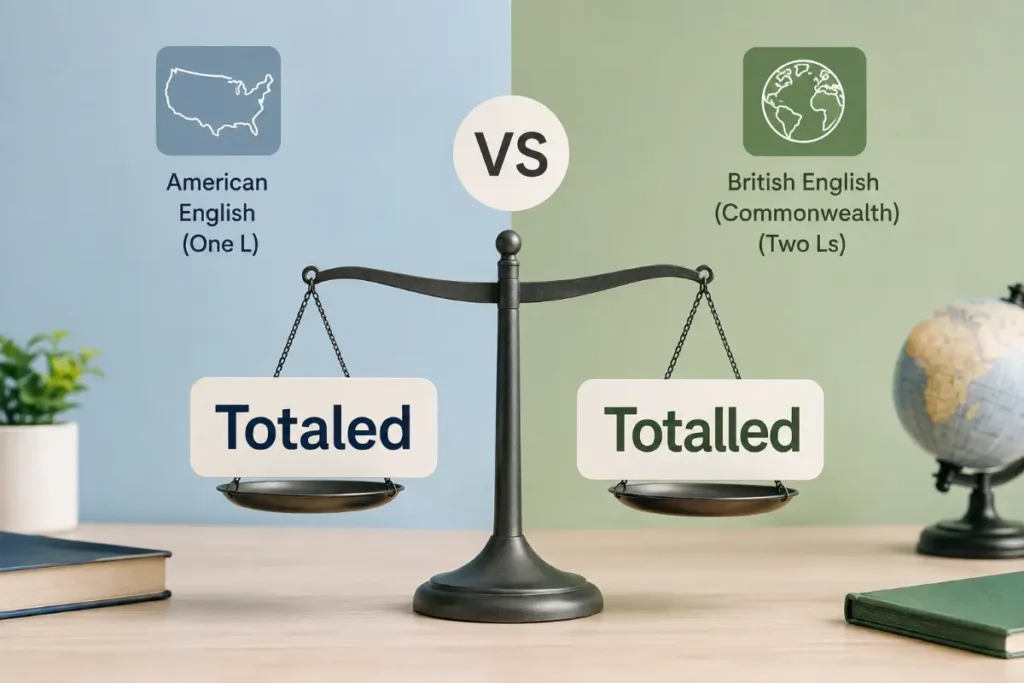
If you’re wondering about totaled or totalled you’re dealing with two spellings that are both used in English. The difference comes down to the variety of English you’re using. Totaled is the standard spelling in American English while totalled is the standard spelling in British English and several other varieties.
For a US audience the choice is simple. Use totaled with one l. The same pattern applies to related forms such as totaling and totaled. British English generally doubles the final l before adding these endings.
This small spelling difference can cause real confusion because both versions appear in books websites newspapers and business writing. In this guide you’ll see why the spellings differ how the rule works and which form you should use in American writing.
Quick Definition
Totaled is the American English spelling of the past tense and past participle of total when an ending is added. Totalled is the British English spelling of the same word.
In American English you write totaled and totaling. In British English you commonly see totalled and totalling.
Direct Answer
Totaled is correct in American English. Totalled is correct in British English and other varieties that follow the British spelling pattern.
Comparison Table
| Word or phrase | Meaning | Example sentence | When to use it |
|---|---|---|---|
| Totaled | American English spelling | The repair costs totaled $4,000. | Use it in US English. |
| Totalled | British English spelling | The repair costs totalled £4,000. | Use it in British English. |
| Total | Base form | The bills total $500. | Use it as the main verb or noun. |
| Totaling | American English present participle | The bills are totaling $500. | Use it in US English. |
| Totalling | British English present participle | The bills are totalling £500. | Use it in British English. |
Why The Two Spellings Exist
The difference isn’t a matter of one spelling being good and the other being bad. Both forms follow established spelling conventions. The key is knowing which version of English you’re writing.
American English usually keeps a single l when a word ends in an unstressed vowel followed by l and takes an ending that begins with a vowel. That’s why American writers use totaled and totaling.
British English often doubles the final l in these forms. That gives us totalled and totalling.
You can see a similar difference in several other common words. American English uses traveled and traveling while British English commonly uses travelled and travelling. American English uses canceled and canceling while British English commonly uses cancelled and cancelling.
The spelling changes but the meaning doesn’t. A person in the United States and a person in the United Kingdom can read both forms without difficulty. The main issue is consistency.
The Correct Spelling In American English
If you’re writing for readers in the United States use totaled. This is the spelling you’ll want in school papers business documents news articles emails reports and most other US English writing.
For example:
- The three invoices totaled $2,850.
- Her expenses totaled more than $1,000 last month.
- The damage totaled nearly $10,000.
- The team totaled 85 points during the season.
- Donations totaled $25,000 by Friday.
In each sentence the word describes a final amount or sum. The spelling stays totaled because these examples follow American English conventions.
The same rule applies when total takes the ing ending.
- The expenses are totaling more than we expected.
- The sales figures are totaling $75,000.
- The points are totaling 120 after five games.
You’ll notice that American English does not add a second l.
The Correct Spelling In British English
British English commonly doubles the final l. So a British writer may use totalled instead of totaled.
For example:
- The three invoices totalled £2,850.
- The costs totalled more than £1,000.
- The damage totalled nearly £10,000.
British English also commonly uses totalling.
- The expenses are totalling more than expected.
- The sales are totalling £75,000.
- The final points are totalling 120.
The meaning remains exactly the same. Only the spelling convention changes.
Why American English Uses One L
The spelling difference becomes easier to understand when you look at a broader pattern in American English.
American spelling often avoids doubling a final l when certain endings are added. This is especially noticeable in words such as cancel, travel, label, and model.
That gives us forms such as:
- Canceled.
- Traveling.
- Labeled.
- Modeled.
British English often doubles the l in these same forms:
- Cancelled.
- Travelling.
- Labelled.
- Modelled.
The pattern isn’t limited to total. Once you notice it in several words the difference becomes much easier to remember.
Total Becomes Totaled
Start with the base word total. Add the ending ed.
In American English the result is totaled.
The final l stays single. You don’t need to add another one.
Total Becomes Totalled
In British English the final l is commonly doubled before the ending.
That produces totalled.
This isn’t a pronunciation difference. Both spellings are pronounced the same way in normal speech. The difference exists on the page.
What Does Totaled Mean
The word totaled can have several closely related meanings. In many situations it means that several amounts were added together to produce a final number.
For example:
- The receipts totaled $450.
- The five purchases totaled $120.
- Our expenses totaled $2,000.
In each case the word tells us the final sum after adding separate amounts.
The word can also mean that something was completely destroyed or badly damaged. This meaning is especially common when talking about cars.
For example:
- The accident totaled my car.
- The insurance company declared the vehicle totaled.
- Her car was totaled after the crash.
Here totaled doesn’t mean added together. It means the damage was so severe that repairing the vehicle was not considered practical or worthwhile.
Context tells you which meaning the writer intends.
Totaled As A Verb
Totaled is the past tense of the verb total. It describes something that happened in the past.
Consider this sentence:
- The restaurant bills totaled $600.
The bills were added together and reached a final amount of $600.
You can also use the verb when a vehicle suffers severe damage.
- The collision totaled the car.
The accident happened in the past and the car was damaged beyond practical repair.
This use is common in American English, especially in conversations about car accidents insurance claims and vehicle repairs.
Totaled As An Adjective
The word can also appear as a past participle that describes a vehicle or another damaged object.
For example:
- The car was totaled in the accident.
- My truck was totaled last winter.
- Their vehicle was declared totaled by the insurance company.
Here totaled describes the condition of the vehicle rather than simply telling us that someone added numbers.
This distinction matters because the word can look the same while doing different jobs in a sentence.
Examples With Money
Money is one of the most common contexts for this word.
When you add several prices together you can say the amounts totaled a certain figure.
For example:
- The groceries totaled $86.
- The hotel charges totaled $740.
- Her medical bills totaled $3,200.
- The monthly expenses totaled $4,500.
- The project costs totaled $18,000.
These sentences all describe a final sum. The word tells the reader that separate amounts were combined.
You can also put the total before the subject.
- The final amount totaled $2,300.
- The expenses totaled less than expected.
- The charges totaled more than $5,000.
The structure is simple and common in everyday American writing.
Examples With Numbers And Scores
The word isn’t limited to money. You can use it whenever separate numbers combine into a final amount.
For example:
- The team totaled 95 points.
- The event totaled 500 attendees over three days.
- The survey totaled 2,000 responses.
- The company totaled 150 new orders by Friday.
Some of these examples may sound more natural with a different verb depending on context. For instance received may work better for orders and attracted may work better for attendees. Still totaled can describe the final number when the focus is on the sum.
That distinction is useful for clear writing. Good word choice isn’t just about grammar. It also depends on what you want the sentence to emphasize.
Why This Spelling Question Causes Confusion
At first glance the choice seems tiny. One spelling has one l and the other has two. Yet this difference often causes uncertainty because English uses different spelling standards in different countries.
A writer may see totalled in a British article and assume that American English uses the same spelling. Another writer may see totaled in an American publication and wonder if the missing l is a typo.
Neither conclusion is correct.
The spelling depends on the English variety. American English and British English have developed different conventions over time. Many of these differences are small but noticeable.
Words such as color and colour are familiar examples. So are favorite and favourite. The same kind of regional difference appears with totaled and totalled.
The important point is simple. Don’t judge the spelling without considering the variety of English being used.
Why Consistency Matters
If you’re writing an article for a US audience use American spelling throughout the piece. Don’t switch between totaled and totalled just because you’ve seen both versions.
The same principle applies to other regional spellings. If you choose American English use forms such as color, favorite, center, and traveled. If you’re writing in British English follow that system consistently.
Consistency makes your writing look polished. It also prevents readers from wondering if a spelling difference is accidental.
For a US grammar website the safest choice is clear. Use totaled.
How To Use Totaled In A Sentence
Once you know the spelling difference the next step is using the word naturally. Totaled usually appears when you talk about a final amount or describe something that was badly damaged.
The word works in several everyday settings. You might see it in a budget report a news story a conversation about a car accident or a sentence about points in a game.
Talking About A Final Amount
Use totaled when separate amounts have been added together and produced one final number.
For example:
- The dinner bills totaled $340.
- Our expenses totaled $2,700 last month.
- The repairs totaled $1,850.
- Her purchases totaled $425.
- The donations totaled $15,000.
In each sentence the subject represents several amounts that were combined. The final figure comes after adding those amounts together.
You can think of the structure like this:
Several amounts plus addition equals one total.
For instance if three purchases cost $20 $35 and $45 the combined amount is $100. You could say that the purchases totaled $100.
Talking About Damage
The word has another common meaning in American English. It can describe a vehicle that has suffered severe damage.
For example:
- The accident totaled my car.
- The storm totaled several vehicles.
- His truck was totaled after the crash.
- The insurance company declared the sedan totaled.
In these sentences totaled means the damage was severe enough for the vehicle to be considered a total loss.
A total loss doesn’t always mean the vehicle has literally been destroyed into pieces. Insurance companies generally use the term when repairing the vehicle isn’t economically practical under the applicable rules and circumstances.
That distinction matters. A car can still look recognizable and even have many usable parts while being classified as a total loss.
Totaled And Totaling
The same spelling difference appears when you use the ing form.
American English uses totaling.
British English commonly uses totalling.
For example an American writer might say:
- The expenses are totaling more than $5,000.
- The project is totaling nearly $20,000.
- The tickets are totaling $750.
However totaling isn’t always the most natural choice in everyday writing. In many cases total or come to sounds cleaner.
Compare these sentences:
- The bills total $750.
- The bills are totaling $750.
The first sentence is usually more direct when you’re simply stating the final amount.
You could also write:
- The bills come to $750.
That sounds natural in casual conversation and everyday writing.
Totaled And Total
The base word total can work as both a noun and a verb. Knowing the difference helps you choose the right form.
As a noun total means the final amount.
- The total was $850.
- What is the total.
- The final total came to $1,200.
As a verb total means to add amounts together or reach a particular amount.
- The bills total $850.
- The three charges total $120.
The past tense changes the verb to totaled in American English.
- The bills totaled $850.
- The three charges totaled $120.
This is a basic grammar pattern. The action happens in the present with total and in the past with totaled.
Totaled And Total Loss
When people talk about cars they often use totaled alongside the phrase total loss.
A total loss generally means an insurer has determined that repairing the vehicle isn’t economically reasonable under its rules and the circumstances of the claim. The exact standard can differ by state and insurance policy.
For example:
- My car was totaled after the accident.
- The insurer treated the vehicle as a total loss.
- The repair estimate was high enough for the car to be considered a total loss.
These sentences all relate to vehicle damage but they aren’t identical.
Totaled describes the vehicle or the action.
Total loss describes the insurance classification or outcome.
That’s why you might hear someone say both:
- My car was totaled.
- My car was declared a total loss.
Both can describe the same situation from slightly different angles.
Totaled And Destroyed Are Not Always The Same
It’s tempting to assume that totaled simply means destroyed. That’s not quite right.
When you say a vehicle was totaled you’re usually talking about its repair value or insurance status. The vehicle may have severe damage but it can still contain many usable parts.
For example:
- The front of the car was badly damaged but the insurance company totaled it.
The sentence doesn’t say the entire car disappeared. It says the damage led to a total loss decision.
This is why totaled has a more specific meaning than destroyed in many car related conversations.
Common Mistakes With Totaled
Most mistakes involve adding the extra l in American English. Writers who are used to British spelling may naturally write totalled even when their audience expects US English.
Another mistake is switching between the two forms in the same piece.
For example:
- The repair costs totaled $6,000.
- The next repair bill totalled $1,500.
If you’re writing in American English the second sentence should use totaled too.
Consistency matters more than trying to make one spelling work everywhere. Pick the English standard that fits your audience and stick with it.
Mistake One
Incorrect for standard US English:
The expenses totalled $4,000.
Correct for standard US English:
The expenses totaled $4,000.
Mistake Two
Incorrect for standard US English:
The car was totalled in the crash.
Correct for standard US English:
The car was totaled in the crash.
Mistake Three
Incorrect for standard US English:
The costs are totalling $10,000.
Correct for standard US English:
The costs are totaling $10,000.
The British forms aren’t random errors. They’re standard spellings in British English. The problem comes when a writer mixes regional spelling systems without realizing it.
Is Totaled A Real Word
Yes. Totaled is a standard English word. It is the American English past tense and past participle form of total.
It appears in dictionaries and established American writing. You can use it in formal reports as well as everyday conversation.
For example:
- The expenses totaled $9,500.
- The vehicle was totaled after the accident.
- The project costs totaled more than expected.
There is nothing informal or incorrect about the word itself.
The spelling question only becomes complicated when you compare American English with British English.
Is Totalled Wrong
No. Totalled isn’t wrong when you’re using British English or another variety that follows the British spelling convention.
A British publication might write:
- The costs totalled £4,000.
- The vehicle was totalled in the collision.
- The expenses are totalling more than expected.
These forms are normal in British writing.
The mistake is assuming that one regional spelling must be correct everywhere. English has several accepted spelling systems. The right choice depends on your audience and the style you’re following.
Totaled Or Totalled In American English
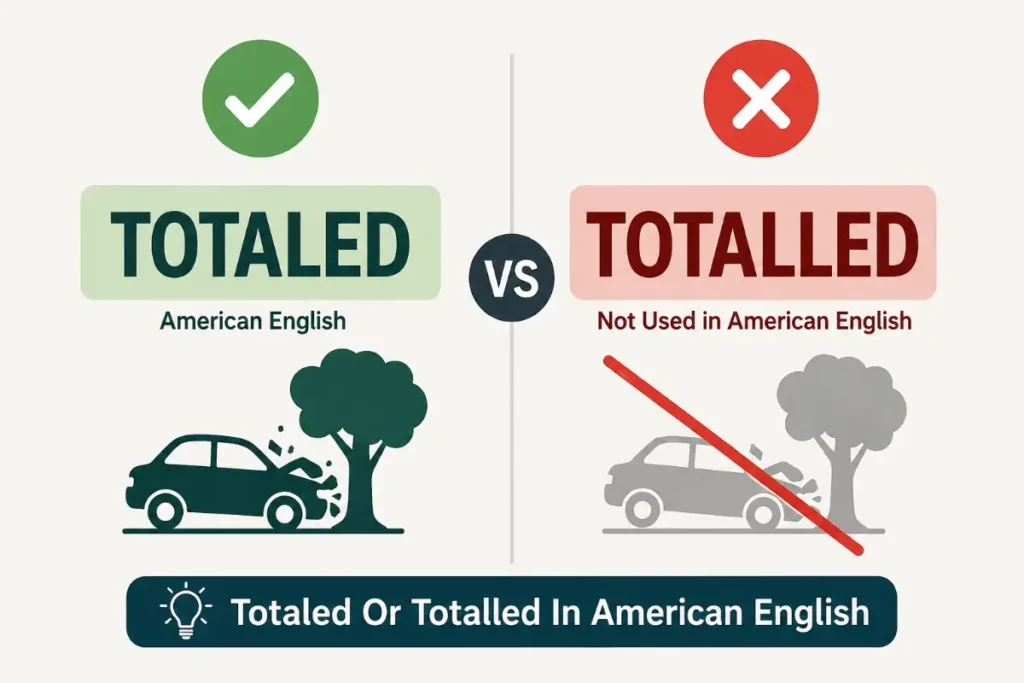
For American readers the preferred form is totaled.
That means US writers should generally use:
- Totaled.
- Totaling.
This applies to school assignments business writing articles reports emails and other forms of American English.
You don’t need to add the second l simply because the base word ends in l. American spelling conventions generally keep the single l in this word when these endings are added.
If you’re writing for a US audience and you see totalled in your draft change it to totaled.
Totaled Or Totalled In British English
British English generally uses:
- Totalled.
- Totalling.
For example:
- The repairs totalled £2,500.
- The costs are totalling more than expected.
If you’re writing for a British audience these spellings are appropriate.
The difference is similar to other common regional spelling pairs.
| American English | British English |
|---|---|
| Totaled | Totalled |
| Totaling | Totalling |
| Canceled | Cancelled |
| Traveling | Travelling |
| Labeled | Labelled |
| Modeled | Modelled |
Seeing these pairs side by side makes the pattern easier to remember. American English often uses one l while British English often doubles it in these forms.
The Difference Between Totaled And Totalled
The difference is spelling rather than meaning. Both forms are past tense and past participle forms of total.
They can both describe the same action.
American English:
- The repairs totaled $5,000.
British English:
- The repairs totalled £5,000.
The sentences communicate the same basic idea. The spelling changes because the two English standards use different conventions.
This is a useful point to remember when reading international content. If you see the double l it doesn’t automatically mean the writer made a mistake. Check the variety of English first.
A Simple Memory Trick
If your writing is for a US audience remember this pair:
Total → totaled.
The final l stays single.
You can connect it with another familiar American spelling pattern:
Travel → traveled.
Cancel → canceled.
Label → labeled.
These words aren’t identical in every detail but they give you a useful visual reminder of the American convention.
If you’re writing in British English remember the doubled l:
Total → totalled.
Travel → travelled.
Cancel → cancelled.
Once you’ve seen the pattern across several words it becomes easier to make the right choice without stopping to think about it.
When You Should Use Each Form
Your audience should guide your choice.
If you’re writing an article for people in the United States use totaled. If you’re completing an American school assignment use totaled. If you’re writing a US business report use totaled.
If you’re writing for a British publication use totalled. The same applies to British school work and other writing that follows British English.
For international content you should choose one style based on your publication’s editorial rules. Don’t switch between forms simply because both appear in your research.
The goal isn’t to prove that one spelling is better. The goal is to make your writing consistent and appropriate for your readers.
How The Spelling Rule Works
The difference between totaled and totalled comes from a broader spelling pattern. American English often uses a single l when a word ending in l takes an ending such as ed or ing. British English often doubles that final letter.
The rule is easier to understand when you compare several familiar words. American writers use traveled, canceled, labeled, and modeled. British writers commonly use travelled, cancelled, labelled, and modelled.
The word total follows this same pattern. American English keeps one l in the past tense and present participle forms. British English commonly doubles it.
The Base Word
Start with the word total. It can work as a noun or a verb.
As a noun it refers to the complete amount.
- The total is $450.
- The final total was higher than expected.
As a verb it means to add amounts together or reach a certain amount.
- The three bills total $450.
- The expenses total more than $2,000.
When the verb describes something that happened in the past American English changes it to totaled.
- The three bills totaled $450.
- The expenses totaled more than $2,000.
British English commonly changes it to totalled instead.
The meaning doesn’t change. Only the spelling convention does.
Totaled And Totalled In Different Countries
English is spoken in many countries and spelling standards aren’t identical everywhere. American and British English are the two varieties most people think about when they see this particular difference.
American English generally favors totaled. British English generally favors totalled. Canadian English often follows British patterns in some areas but also uses American influenced forms in others. Australian and New Zealand English generally follow British spelling conventions.
That means the safest approach isn’t to ask which spelling is universally correct. Ask which English standard your writing follows.
For a US audience the answer is straightforward. Use the single l form.
Why British English Doubles The L
The doubled l can look strange to an American reader but it follows a familiar British spelling pattern.
British English commonly doubles a final l before endings that begin with a vowel. This can happen in words such as travel, cancel, label, and model.
That gives us forms such as:
- Travel becomes travelled.
- Cancel becomes cancelled.
- Label becomes labelled.
- Model becomes modelled.
The same pattern gives us totalled.
American English developed a different convention. It generally avoids that extra l in these forms.
So American writers use:
- Traveled.
- Canceled.
- Labeled.
- Modeled.
- Totaled.
This is one of those spelling differences that becomes much easier once you see it as part of a larger pattern.
Totaled And Totalled In Dictionaries
You may find both spellings in an English dictionary. That doesn’t mean the dictionary is giving two random choices for the same audience.
Modern dictionaries often identify the variety of English associated with a spelling. A dictionary aimed at an American audience will normally give totaled as the standard US form. A British dictionary may list totalled as the standard British form.
This is why checking a dictionary without looking at its regional labels can sometimes add to the confusion. The spelling itself isn’t the only information that matters.
Look for labels such as US, American English, British English, or UK. These labels tell you which spelling standard you’re seeing.
For professional writing you should also follow the style guide used by your publication school workplace or organization. Consistency matters more than trying to make every English speaking country use the same spelling.
Common Sentences With The American Form
The single l form appears naturally in many types of writing.
Business Writing
- The invoices totaled $18,450.
- The company’s sales totaled $2 million last year.
- The expenses totaled less than the original estimate.
Business reports often use this word because they need to describe a final sum clearly.
News Writing
- The storm caused damage that totaled millions of dollars.
- The final number of visitors totaled more than 50,000.
- The project cost totaled $12 million.
News writers often use the verb when reporting a final figure.
School Writing
- The points totaled 95 after the final round.
- Her expenses totaled $300 for the trip.
- The books she bought totaled $125.
The same spelling applies in essays reports and assignments written in American English.
Everyday Conversation
- The groceries totaled about $90.
- Everything totaled less than I expected.
- The repairs totaled almost $2,000.
These examples sound natural in ordinary American speech and writing.
When The Word Means A Damaged Car
One of the most familiar uses of this word in the United States involves cars.
If someone says their car was totaled they usually mean an accident or another event caused enough damage for the vehicle to be treated as a total loss. The exact decision depends on factors such as repair costs the vehicle’s value state rules and the insurer’s standards.
For example:
- My car was totaled last weekend.
- The insurance company said the SUV was totaled.
- The truck was totaled after the collision.
This meaning is especially common in American conversations about auto insurance.
Totaled Does Not Always Mean Completely Destroyed
This point often surprises people.
A vehicle can be called totaled even though much of it remains intact. The term usually relates to the financial decision about repairing the vehicle rather than the literal destruction of every part.
Imagine a car worth $8,000 that suffers $7,500 in damage. An insurer may determine that repairing it doesn’t make financial sense under the applicable rules. The car could then be treated as a total loss.
- So totaled and destroyed aren’t perfect synonyms.
- Destroyed focuses on the physical condition.
- Totaled often focuses on the financial or insurance result.
That distinction makes the word more precise in conversations about accidents.
Totaled As A Past Participle
The form also appears after helping verbs such as was, were, has, and have.
For example:
- The car was totaled in the crash.
- Several vehicles were totaled during the storm.
- The repair costs have totaled more than $10,000.
In these sentences the form has a grammatical role beyond simple past tense.
You don’t need to memorize the grammar label to use it correctly. Just pay attention to the sentence structure. If you’re describing something that happened in the past you may need the past form. If another verb helps carry the tense the same form can still appear as a past participle.
Totaled And Totaling
American English uses totaling with one l.
For example:
- The bills are totaling $900.
- The receipts are totaling more than $1,000.
- The costs are totaling far above our original estimate.
Still, totaling can sometimes sound less natural than a simpler construction. If you’re reporting a final amount there are often cleaner options.
Compare:
- The expenses totaled $2,000.
- The expenses came to $2,000.
- The expenses added up to $2,000.
All three can work depending on the context.
Good writing isn’t just about picking a grammatically correct word. It also means choosing the wording that sounds natural and communicates the idea quickly.
Better Alternatives To Totaled
Sometimes you can replace the word with another expression without changing the basic meaning.
Added Up To
This phrase is common in everyday speech.
- The bills added up to $600.
- All the costs added up to more than $3,000.
It clearly shows that several amounts were combined.
Came To
This is another natural choice.
- The bill came to $85.
- The repairs came to nearly $2,500.
It’s especially common when talking about a final price.
Amounted To
This expression is a little more formal.
- The losses amounted to $2 million.
- The total damages amounted to several thousand dollars.
It works well in reports and formal writing.
Reached
Use this when the focus is on a number that grew until it reached a particular point.
- Sales reached $500,000.
- The fundraiser reached its $25,000 goal.
The meaning is close but not identical. Reached focuses on arriving at a number while totaled focuses more directly on the final sum.
Choosing among these expressions can make your writing more natural and precise.
A Quick Test For Choosing The Right Form
If you’re writing for a US audience and you’re unsure which spelling to use ask yourself one simple question.
Am I following American English.
- If the answer is yes use the single l form.
- If your writing follows British English use the doubled l form.
You don’t need to change the pronunciation. You don’t need to change the meaning. You only need to match the spelling to the English variety you’re using.
A useful memory pair is:
- US English uses totaled.
- British English uses totalled.
Keep that pair in mind and the spelling choice becomes much easier.
Other Words With The Same Regional Difference
Learning one spelling difference can help you understand several others. American and British English differ in many words that follow related patterns.
Here are some common examples.
| American English | British English |
|---|---|
| Traveled | Travelled |
| Canceled | Cancelled |
| Labeled | Labelled |
| Modeled | Modelled |
| Signaled | Signalled |
| Fueled | Fuelled |
| Counseled | Counselled |
| Totaled | Totalled |
You don’t need to memorize the entire table. Instead notice the repeated pattern. American English often keeps one l while British English doubles it in these forms.
There are exceptions and finer details in both spelling systems. Still this pattern gives you a useful starting point for everyday writing.
How To Avoid Mixing Spelling Styles
Mixing American and British spelling is easy if you read content from different countries. You might use color in one paragraph and colour in another. The same thing can happen with the single and double l forms.
The easiest solution is to choose your English variety before you start writing. For a US audience use American spelling throughout the article. That means using forms such as totaled, traveled, and canceled.
If you’re editing an existing document check for regional spelling as part of your final review. A spell checker can help but it may not always tell you which regional standard your publication requires.
A consistent style makes the entire piece feel intentional. Readers may never notice every correct spelling choice but they can notice when a document switches styles without a clear reason.
A Simple Way To Remember The Difference
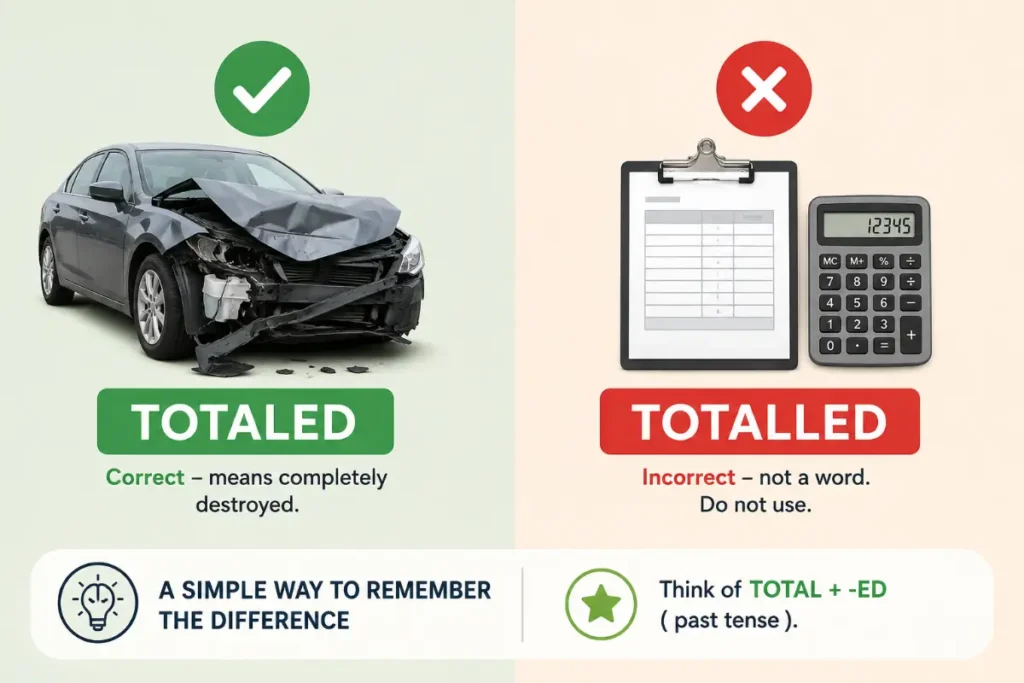
Think of the final l as having two possible treatments.
American English usually says keep it simple.
British English often says double the l.
So if your article is written for Americans remember the shorter form.
Total becomes totaled.
If you’re writing in British English remember the doubled form.
Total becomes totalled.
Then apply the same idea to totaling and totalling.
Once you connect the word to the larger spelling pattern the choice stops feeling like a spelling quiz. You simply recognize which form belongs to your writing style.
FAQs
Is totaled correct in American English?
Yes. Totaled is the standard spelling in American English. Use it when writing for a US audience in school work business writing articles emails and other forms of American English.
Is totalled wrong in American English?
Totalled isn’t the standard US spelling. It is the spelling commonly used in British English and other varieties that follow British spelling conventions. If you’re writing for American readers use totaled instead.
Why does British English have two ls in totalled?
British English commonly doubles the final l before certain endings. That’s why you see totalled and totalling in British writing. American English usually keeps one l in these forms.
Is totaled the past tense of total?
Yes. Totaled is the simple past form of the verb total in American English. For example you can say that the expenses totaled $2,000 after all the costs were added together.
What does totaled mean when talking about a car?
When someone says a car was totaled they usually mean the vehicle suffered enough damage to be treated as a total loss. This often means the cost of repairing it isn’t considered practical compared with the vehicle’s value under the applicable insurance rules.
Is totaled a formal word?
Yes. Totaled is perfectly acceptable in formal American English. You can use it in reports financial documents news articles school assignments and professional emails.
Should I use totaled or totalled for a US audience?
Use totaled for a US audience. The single l matches standard American spelling. If you’re following British English use totalled instead.
Is totaling spelled with one L?
Yes in American English the spelling is totaling with one l. British English commonly uses totalling with two ls. The same regional spelling pattern applies to the past tense forms.
Conclusion
The choice between totaled or totalled depends on the English variety you’re using. American English uses totaled while British English commonly uses totalled. Neither spelling changes the meaning of the word.
For American readers the rule is easy to remember. Use one l in totaled and totaling. British English generally doubles the l in totalled and totalling.
The word itself has several useful meanings. It can describe the final amount after numbers are added together or describe a vehicle that has suffered enough damage to be considered a total loss. Context makes the intended meaning clear.
If you’re writing for a US audience check your spelling before publishing and choose the single l form. Once you connect totaled with American English and totalled with British English you won’t need to second guess the spelling again.

Sienna Watson is a veteran copywriter and communications coach who has helped startup founders, marketers, and professionals polish their writing for over a decade. Realizing that most people don’t need a degree in linguistics—just clear, impactful communication—Sienna focuses on practical grammar, business writing etiquette, and eliminating wordiness. She advocates for plain language, strong verbs, and persuasive prose that gets results.