
If you’re wondering about untill or until the answer is simple. Until is the correct spelling. Untill is a common spelling mistake and isn’t accepted in standard English.
The confusion usually comes from the ending. Many English words use a double consonant in certain forms. For example words such as running and sitting contain double letters. That can make it tempting to write two l letters in this word too.
However the correct spelling has only one l. You should write until in emails school assignments work documents messages and everyday writing.
This guide explains what the word means how to spell it why people add an extra l and how to use it naturally. You’ll also see examples of common phrases and mistakes so you can recognize the correct form without having to stop and think.
Quick Definition
Until is a preposition or conjunction that shows the time when something continues and then stops or changes. It can refer to a specific time or to the point when another event happens.
For example you might say that you’ll wait until six o’clock or stay home until the rain stops. The spelling is always until with one l at the end.
Direct Answer
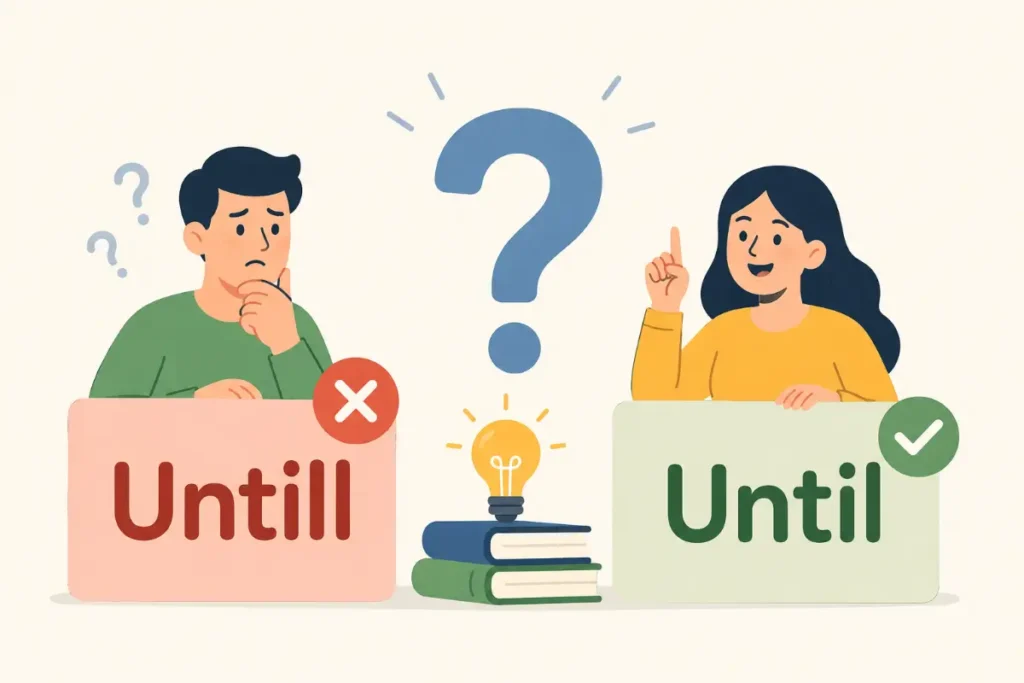
Until is the correct spelling. Untill is incorrect because the standard English spelling has only one l.
Comparison Table
| Word or phrase | Meaning | Example sentence | When to use it |
|---|---|---|---|
| Until | Shows the time when an action continues up to a point | I’ll wait until noon. | Use it in standard English writing and speech. |
| Untill | Incorrect spelling of until | I’ll wait untill noon. | Do not use this spelling. |
Why People Spell Until Wrong
The mistake is easy to understand. The word is short but the final sound can make the spelling feel less obvious than it looks.
When people hear the word spoken quickly they may focus on the sound rather than the letters. The ending can also remind them of words that contain double consonants. That mental connection can lead someone to add another l without realizing it.
Typing habits can make the problem worse. If you have written a certain spelling many times you may type it automatically. Your eyes can also skip over a small spelling error because the rest of the word looks familiar.
English has plenty of words with double consonants. That gives the brain a reason to expect another l. Yet this particular word does not follow that pattern.
The best solution is not to memorize a complicated rule. Simply remember that the word ends with il rather than ill.
Once that detail becomes familiar the spelling becomes much easier.
What Until Means
Until tells us that something continues up to a certain point in time. After that point the action may stop or another situation may begin.
- Consider this sentence.
- I’ll stay here until five.
The sentence tells us that the person plans to stay from now up to five. Five o’clock is the endpoint.
Now consider this example.
Wait until I call you.
Here there is no exact clock time. Instead the action continues until another event happens. The call is the point that ends the waiting period.
That makes the word useful in many kinds of sentences. You can use it with a clock time a day a date an event an action or another condition.
How Until Works In A Sentence
The word can introduce a time phrase or a complete clause. A clause is simply a group of words that contains a subject and a verb.
Look at these examples.
- I’ll work until six.
- We stayed there until sunset.
- She waited until Monday.
- They played until dinner.
- In each sentence the word introduces an endpoint. The activity continues up to that point.
- You can also use it before a complete idea.
- I’ll wait until you arrive.
- We can’t leave until Dad gets home.
- She didn’t know the answer until her teacher explained it.
These sentences show another useful pattern. The event after the word tells us what must happen before the situation changes.
Until As A Preposition
A preposition can show a relationship between words. In this case the word connects an action with a point in time.
For example.
- I’ll be at work until five.
- The store is open until midnight.
- We stayed at the beach until sunset.
- He lived in Chicago until 2022.
The word after until can be a time expression or another noun that represents a point in time.
You can think of it as drawing a line on a calendar. The action continues along that line and stops at the point you mention.
Until As A Conjunction
Until can also connect two parts of a sentence.
For example.
- Wait until I come back.
- Stay here until the teacher arrives.
- We didn’t leave until the rain stopped.
- She practiced until she felt confident.
In these examples the word connects the main action with another event. The second event provides the endpoint.
This use is extremely common in everyday English.
You might tell a child to wait until dinner. A teacher might ask students to stay seated until class ends. A manager might ask an employee to wait until the meeting finishes.
- The structure stays simple.
- Action plus until plus endpoint event.
Until With A Specific Time
One of the easiest ways to use the word is with a specific time.
Examples include:
- I’ll be here until three.
- The office is open until 5 PM.
- We talked until midnight.
- She worked until ten last night.
The meaning is clear. The action continues up to the time you mention.
You can also use dates.
- The sale runs until Friday.
- Applications are open until June 30.
- We’ll be away until next Monday.
This makes the word especially useful for schedules deadlines opening hours and plans.
Until With Another Event
You don’t always need a clock or calendar date. You can use another event as the endpoint.
For example:
- Wait until I get home.
- Don’t open the door until I tell you.
- Keep stirring until the sauce becomes thick.
- Stay inside until the storm passes.
The important idea is that the first action continues before the second event occurs.
This pattern appears constantly in everyday speech. It also makes instructions easier to understand because the reader knows exactly what needs to happen first.
Until And Till
You may have noticed that people sometimes use till instead of until. Both forms can be correct.
For example:
- I’ll wait until you arrive.
- I’ll wait till you arrive.
The meaning is essentially the same.
Until is the more neutral choice. It works well in formal and informal writing. Till is common in conversation and casual writing.
There is also a form called ’til. You may see it in informal writing or song lyrics. It represents a shortened form of until. However it is better to use until in standard writing unless you have a specific reason to use the shorter form.
A common misconception is that till is simply a shortened version of until. In fact till has a long history as a word in English and is not merely a modern shortcut.
For everyday writing you don’t need to worry about that history. If you want the safest and clearest choice simply use until.
Until And By
Another common source of confusion is the difference between until and by. They can both refer to time but they do not express the same idea.
- Until means an action continues up to a particular time.
- By means something happens no later than a particular time.
- Compare these sentences.
- I’ll work until five.
- I’ll finish the report by five.
The first sentence means the person plans to work up to five. The second means the report should be finished no later than five.
Here is another example.
- The library is open until eight.
- Please return the book by eight.
- The library remains open through the time stated. The book must be returned no later than that time.
This difference is small but useful. If you are talking about an action continuing over a period use until. If you are talking about a deadline use by.
Until And Before
Until and before can also look similar in some sentences. Yet they focus on different ideas.
- Consider this sentence.
- I’ll stay until Friday.
- This tells us the person plans to remain there up to Friday.
- Now consider:
- I’ll leave before Friday.
This tells us the person plans to leave at some point earlier than Friday.
The difference matters because until includes the endpoint as part of the time period in many ordinary situations. Before places the action earlier than that point.
You can see the contrast more clearly here.
- Don’t leave until I return.
- Leave before I return.
The first sentence tells someone to stay and wait for the return. The second tells someone to leave earlier.
Changing one word can completely change the instruction.
Until And Unless
Another pair that can confuse learners is until and unless. They do very different jobs.
- Until deals with time or the point at which something changes.
- Unless means if something does not happen.
Compare these examples.
- I’ll wait until you arrive.
- I’ll go unless you ask me to stay.
The first sentence is about time. The second sentence describes a condition.
Here is another example.
- Don’t start until everyone arrives.
- Don’t start unless everyone agrees.
The first means you should wait for a particular event. The second means everyone must agree for the action to happen.
Keeping these meanings separate will make your writing much clearer.
Common Uses Of Until In Daily English
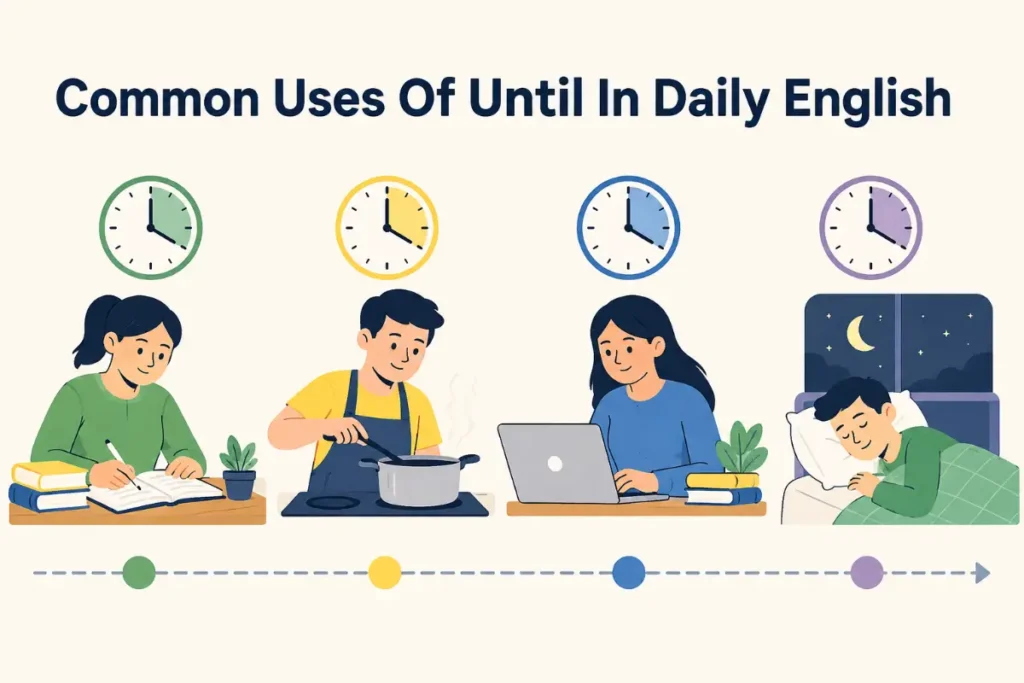
The word appears in many everyday situations. Once you start noticing it you’ll see how useful it is.
Waiting
- I’ll wait until you’re ready.
- She waited until the bus arrived.
- We waited until the store opened.
Work
- I have to work until six today.
- He stayed at the office until everyone left.
- The team worked until the project was finished.
School
- Students must stay in class until the bell rings.
- I studied until midnight for the exam.
- Wait until your teacher gives you permission.
Travel
- The train runs until late at night.
- We stayed in the hotel until Sunday.
- The road will remain closed until the repairs are complete.
Food And Cooking
- Cook the rice until the water is absorbed.
- Stir the soup until it becomes smooth.
- Bake the cake until the top turns golden.
These examples show that the word is not limited to clock times. It can describe a point reached through an event or change.
Common Mistakes With Until
Most mistakes involve adding an extra l. The incorrect spelling can look convincing because many English words contain double letters.
Here are some examples.
- Incorrect: I’ll stay untill dinner.
- Correct: I’ll stay until dinner.
- Incorrect: She waited untill noon.
- Correct: She waited until noon.
- Incorrect: Don’t leave untill I call.
- Correct: Don’t leave until I call.
- Incorrect: The shop is open untill midnight.
- Correct: The shop is open until midnight.
The key difference is easy to spot once you know what to look for. The correct word has one l at the end.
Why The Double L Looks Tempting
English spelling often uses double consonants. Words such as really and finally can make the ending feel familiar. Other words double a final consonant when a suffix is added.
For example:
- run becomes running.
- stop becomes stopped.
- plan becomes planned.
These patterns are real. However they do not apply to every word containing a similar sound.
The word until is simply spelled with one l. There is no spelling change that requires another l.
This is a good example of why trying to create a spelling rule for every word can make things harder. Sometimes the fastest approach is to learn the correct form and recognize it when you see it.
A Simple Memory Trick
A useful memory trick is to picture the final part of the word as til.
Think:
- un plus til equals until.
- The word has only one l.
You can also connect it with the phrase until then. Write that phrase a few times and pay attention to the ending.
- I’ll see you until then.
- We won’t know until then.
- Please wait until then.
The repeated visual pattern can help the correct spelling stick.
Another useful trick is to remember that the word is short. You don’t need to add anything to it. It is simply u n t i l.
How To Use Until Naturally
Good writing depends on more than correct spelling. The word also needs to fit the sentence naturally.
For example:
- I’ll wait until you call.
- This sounds natural because the call gives us the endpoint.
- You can also place the until clause at the beginning.
- Until you call I’ll stay here.
- That sentence is grammatically possible but it sounds less natural in many everyday situations. A more natural version would be:
- I’ll stay here until you call.
This shows an important writing habit. Grammar gives you several possible structures but natural English often favors the simpler one.
Can Until Start A Sentence
Yes. An until clause can appear at the beginning of a sentence.
For example:
- Until the rain stops we’ll stay inside.
- Until the doctor arrives the nurse will help you.
- Until the store opens we can wait in the car.
- When an opening clause comes first it is usually followed by a comma in standard writing.
- Until the rain stops, we’ll stay inside.
- However when the until clause comes after the main clause a comma is usually unnecessary.
- We’ll stay inside until the rain stops.
- This small punctuation difference is useful to remember when you write longer sentences.
Can You Use Until In Negative Sentences
Yes. In fact negative sentences with until are very common.
For example:
- I didn’t understand it until yesterday.
- She didn’t call until late at night.
- We won’t know the answer until tomorrow.
- They didn’t leave until the meeting ended.
These sentences can sometimes confuse learners because the negative word changes how the sentence feels.
Take this example.
- I didn’t eat until noon.
- This does not mean that I ate before noon. It means I waited and then ate at noon or around that point.
- Another example is:
- She didn’t arrive until seven.
- This tells us that she arrived at seven or later than the earlier expected time depending on the context.
- The word until marks the point at which the situation changes.
Until With The Present Tense
When you use until with future meaning English often uses the present tense after until instead of will.
For example:
- I’ll wait until you arrive.
- This is natural.
- You normally would not say:
- I’ll wait until you will arrive.
- The same pattern appears in many sentences.
- We’ll stay here until the rain stops.
- She’ll work until the manager comes back.
- I’ll call you until the problem is fixed.
The first two examples use the present tense after until even though the events refer to the future.
This is a useful grammar pattern for English learners. The main clause can use will while the time clause uses the present tense.
Until And Future Plans
This pattern becomes especially important when talking about plans.
- You might say:
- I’ll stay here until you come back.
- We’ll wait until the store opens.
- They’ll remain at the hotel until their flight leaves.
- The events are in the future but the verb after until is in the present tense.
- That structure sounds natural to native speakers and is worth learning as a complete pattern.
- Instead of memorizing a complicated grammar rule try remembering a few useful sentence frames.
- I’ll wait until you arrive.
- We’ll stay until the meeting ends.
- She’ll call until someone answers.
- The first two are natural examples of future time clauses.
Until And Since
Until and since can both refer to time but they point in different directions.
- Since identifies the starting point of an action or situation.
- Until identifies the ending point.
For example:
- I’ve lived here since 2020.
- I’ll live here until 2030.
The first sentence looks backward from now to the starting point. The second looks forward to the point when the situation ends.
- Another example makes the contrast clear.
- She has been working here since Monday.
- She’ll work here until Friday.
- Since tells us when the period began. Until tells us when it ends.
Until And During
These words also have different meanings.
- During tells us that something happens within a period.
- Until tells us that something continues up to the end point of a period.
For example:
- I read during the afternoon.
- I read until the afternoon ended.
- The first sentence tells us when the reading happened. The second emphasizes the point at which the reading stopped.
- This distinction can help you choose the right word when describing time.
Formal And Informal Uses
Until is perfectly acceptable in both formal and informal English.
- You can use it in a business email.
- Please submit the form until Friday.
However this particular sentence may not express the intended meaning if Friday is a deadline. In that case by Friday is usually better.
- A clearer version would be:
- Please submit the form by Friday.
- You can also use until in casual speech.
- I’ll be here until six.
- Wait until I get back.
So the word itself is not formal or informal. The important issue is using it with the meaning you intend.
How Native Speakers Use Until
Native speakers often use until in simple phrases that learners can memorize as complete chunks.
Common examples include:
- until tomorrow.
- until Monday.
- until later.
- until then.
- until now.
- until now I thought it was true.
- until recently.
- until next time.
- until the end.
- until morning.
Learning these phrases can make everyday English easier. Instead of building every sentence from scratch you start recognizing familiar patterns.
For example:
I didn’t know that until now.
That sentence is extremely common. It means the speaker learned the information only recently.
- Another useful phrase is:
- Until then, take care.
It means take care during the period before the next expected event.
A Quick Test For The Correct Spelling
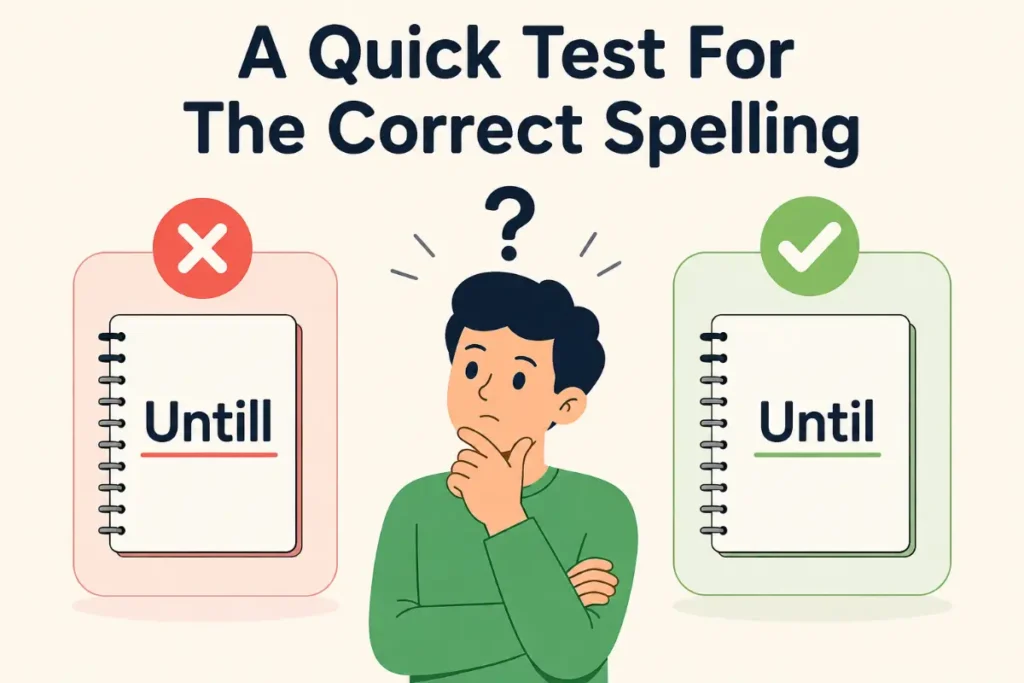
If you are unsure how to spell the word simply ask yourself one question.
- Does it end with one l or two?
- The answer is one l.
- Write:
- until
- Not:
- untill
This simple check is enough for most situations. You don’t need a complicated spelling formula.
If you regularly make this mistake while typing you can also add the correct word to your personal spelling dictionary. Most word processors and browsers let you do this.
FAQs
Is untill or until correct?
Until is correct. The spelling with two l letters is a common mistake and should not be used in standard English.
Why does until have only one l?
The standard English spelling of the word has always been written with one l at the end. There is no spelling rule that requires a second l. The extra letter usually appears because writers associate the word with other words that use double consonants.
Is till the same as until?
Yes. Till can have the same meaning as until. It is common in everyday speech and casual writing. Until is the safer choice when you want a neutral form that works in every type of writing.
Can until be used for future events?
Yes. Until is commonly used when talking about future events. For example you can say I’ll wait until you arrive. Notice that English normally uses the present tense after until in this type of future sentence.
What is the difference between until and by?
Until describes an action that continues up to a point. By describes a deadline or something that happens no later than a specific time. I’ll work until five means the work continues to five while I’ll finish it by five means the task will be complete no later than five.
What is the difference between until and before?
Until describes something that continues up to a point. Before means something happens earlier than that point. I’ll stay until Friday means I plan to remain there up to Friday while I’ll leave before Friday means I plan to leave earlier.
Is until a preposition or a conjunction?
Until can function as both. It acts as a preposition when it comes before a noun or time expression such as until Friday. It can act as a conjunction when it introduces a clause such as until the rain stops.
How can I remember the spelling of until?
Remember that the word ends with one l. You can picture it as un plus til. The simple visual pattern can help you avoid adding an extra l.
Conclusion
If you’ve been unsure about untill or until there’s no need to second guess yourself anymore. The correct spelling is until with one l. The spelling with two l letters is incorrect.
The word itself is useful because it marks an endpoint in time. You can use it with a clock time such as until six with a date such as until Friday or with an event such as until the meeting ends.
It also helps to keep until separate from related words such as by before since and unless. Those words can appear in similar sentences but they express different ideas. Once you understand the difference your writing becomes clearer and more precise.
For spelling the main rule is easy. Write until with one l. If you see yourself typing the extra l stop and remove it. That tiny check will keep this common mistake out of your writing.

Dr. Elena Vance holds a Ph.D. in Linguistics from Columbia University and has spent over 15 years analyzing the evolution of the English language. A former university professor turned full-time writer and editor, Elena specializes in breaking down high-level grammatical concepts, punctuation nuances, and style guides (APA, Chicago, MLA) into clear, actionable advice. When she isn’t hunting down dangling modifiers, she can be found collecting vintage dictionaries and reading classic literature.