

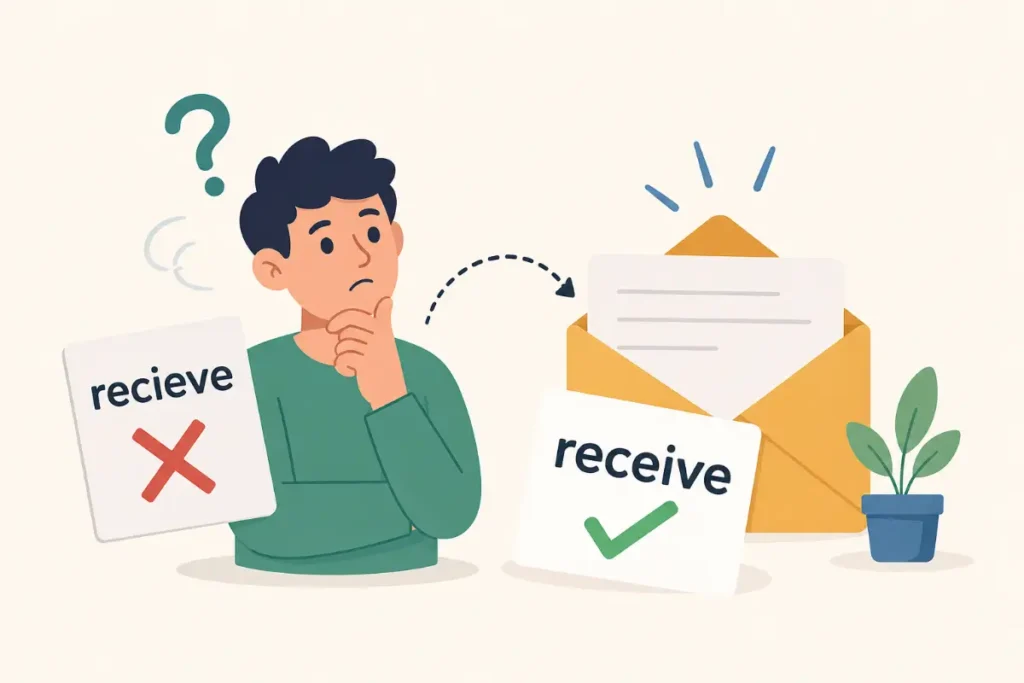
If you’re stuck choosing between recieve or receive you’re not alone. This is one of the most common spelling mistakes in English. The good news is that only one spelling is correct.
The correct spelling is receive. The spelling recieve is always a mistake. People often mix up the letters because the word breaks one of the spelling patterns many of us think we remember.
This guide explains why receive is correct. You’ll also learn why so many people misspell it how to remember the right spelling and how to use it with confidence in everyday writing.
Quick Definition
Receive is a verb. It means to get something that is sent given offered or handed to you. You can receive a letter a gift an email good news or even an award. Recieve is not an English word. It is simply a misspelling of receive.
Direct Answer
Receive is the correct spelling. Recieve is always incorrect and should never be used in formal or informal writing.
Comparison Table
| Word | Meaning | Example Sentence | When to Use It |
|---|---|---|---|
| Receive | To get or accept something. | I received your email this morning. | Always use this spelling. |
| Recieve | Incorrect spelling. | Incorrect. | Never use it. |
Why People Spell Receive Wrong
English spelling isn’t always easy. Some words follow clear patterns while others seem to bend the rules. That’s one reason so many people get confused with this word.
The biggest problem is the order of the letters i and e. Many people pause for a second and ask themselves which letter comes first. That small moment of doubt often leads to the wrong spelling.
Our brains also rely on familiar patterns. If you’ve seen the incorrect version online or in text messages enough times it can start to look normal even though it isn’t.
Typing quickly makes the problem even more common. Many spelling mistakes happen because people write faster than they think. A simple slip of the fingers can turn the correct spelling into one that looks almost right.
For people learning English this mistake is even more understandable. English has many words that look similar but follow different spelling rules. That makes it easy to second guess yourself.
The good news is that once you understand the spelling pattern this word becomes much easier to remember.
The Rule Behind Receive
Many people learn the old rhyme that says I before E except after C. While that rhyme has exceptions it does help with this word.
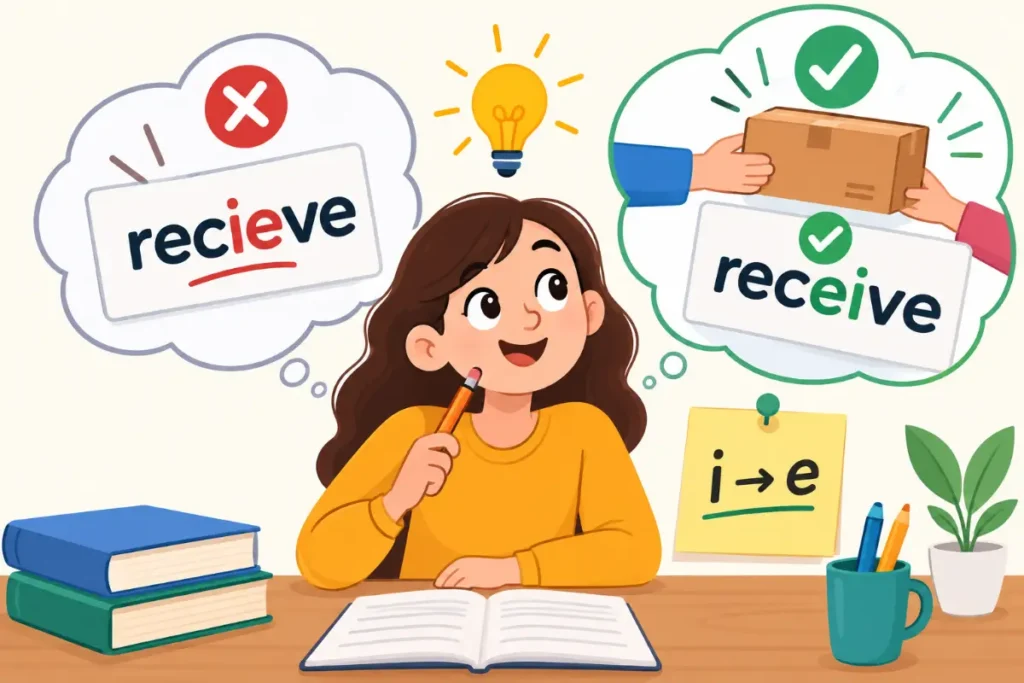
The word receive comes after the letter c. That means the letters appear as ei instead of ie.
Look at the spelling closely.
Rec plus ei plus ve becomes receive.
The same pattern appears in several other common English words.
Words That Follow The Same Pattern
These words also use ei after the letter c.
- Ceiling.
- Deceive.
- Conceive.
- Perceive.
- Receipt.
Learning these words together helps your brain recognize the pattern instead of treating each word as something completely different.
Words That Do Not Follow The Pattern
English also has many exceptions. That is one reason spelling feels tricky.
For example.
- Weird.
- Foreign.
- Science.
- Efficient.
These words remind us that spelling rules are helpful guides instead of perfect laws. Still the rule works perfectly for receive.
What Does Receive Mean
The verb receive simply means to get something from another person place or source.
Sometimes you receive something you can touch.
- She received a birthday present from her grandparents.
- We received the package this afternoon.
Other times you receive something that cannot be held.
- I received some helpful advice.
- They received exciting news yesterday.
- The team received praise for its hard work.
The word can also describe accepting something that is offered. For example someone may receive an invitation receive support receive permission or receive respect. In every case the idea stays the same. Something comes to you from somewhere else.
Different Ways To Use Receive In Daily Life
You probably use this word more often than you realize. It appears in conversations emails school assignments work messages and social media posts every day.
Here are a few common situations.
Receiving Emails
Most people receive dozens of emails every week.
Example.
- Did you receive my message this morning.
Receiving Gifts
Birthdays holidays and celebrations often involve gifts.
Example.
- She received a beautiful watch for her graduation.
Receiving Payments
Businesses receive payments from customers every day.
Example.
- The company received the payment within two business days.
Receiving News
News can be happy sad surprising or unexpected.
Example.
- We received the test results yesterday afternoon.
These examples all use the same core meaning. Someone gets something from another person or source.
Common Mistakes People Make With Receive
Misspelling this word is easy because the letters i and e sit next to each other. Many people type too quickly or rely on memory instead of checking the spelling. That is why the incorrect version shows up so often in emails text messages school assignments and even online articles.
The mistake becomes even more common because spell check does not always catch it right away. Some people also read past the error because their brain recognizes the word from its overall shape instead of looking at every letter.
Here are some examples of incorrect and correct usage.
| Incorrect | Correct |
|---|---|
| I did not recieve your email. | I did not receive your email. |
| She will recieve the award tomorrow. | She will receive the award tomorrow. |
| We recieved the package yesterday. | We received the package yesterday. |
| Did you recieve my message. | Did you receive my message. |
Reading the correct spelling several times helps train your brain to spot the mistake before it reaches the page.
Examples Of Receive In Everyday Sentences
Seeing a word in real situations is one of the fastest ways to remember it. The examples below show how people naturally use receive in daily conversations and writing.
At School
- Students receive report cards at the end of each term.
- I received helpful feedback from my teacher.
- Every participant received a certificate after the workshop.
The Workplace
- We received your job application this morning.
- Our team received positive comments from the client.
- Employees receive their salaries on the last Friday of the month.
At Home
- We received a surprise package from our relatives.
- She received flowers on her birthday.
- Dad received the repair bill yesterday.
Online
- I received your email a few minutes ago.
- You will receive a confirmation message after signing up.
- They received hundreds of comments on their latest post.
Notice that the meaning stays the same in every example. Someone gets something from another person company or source.
Common Phrases That Use Receive
This verb appears in many common expressions. Learning these phrases makes your writing sound more natural and helps you recognize the word faster.
Receive An Email
This phrase means someone gets an email in their inbox.
Example.
I received your email before lunch and replied right away.
Receive A Gift
People often use this phrase during birthdays holidays and celebrations.
Example.
She received a thoughtful gift from her best friend.
Receive An Award
Schools workplaces and organizations often give awards to recognize success.
Example.
He received an award for his outstanding performance.
Receive Support
Support can come from friends family coworkers or a community.
Example.
The family received support from their neighbors after the storm.
Receive Permission
This means someone has been given approval to do something.
Example.
Students must receive permission before leaving campus early.
These phrases appear in everyday conversations news stories books and business writing. The more often you read them the more natural the correct spelling becomes.
Easy Ways To Remember The Correct Spelling
Memorizing a spelling rule works for some people. Others remember words better with simple tricks. Try a few of these methods and stick with the one that feels natural.
Remember The Letter C
The word has the letter c before ei. If you remember that connection you are much less likely to switch the letters.
Think About Similar Words
Several common English words share the same spelling pattern.
- Ceiling.
- Deceive.
- Conceive.
- Perceive.
- Receipt.
Learning them as a group makes the pattern easier to recognize.
Read The Word Out Loud
Although pronunciation does not reveal the spelling it helps you picture the word in your mind. After seeing the correct version enough times it starts to look familiar while the incorrect version stands out immediately.
Practice In Real Sentences
Instead of writing the word by itself use it in complete sentences.
- I received your message this morning.
- We received great news today.
- She received a standing ovation after her speech.
Writing real sentences builds stronger memory than repeating a single word over and over.
Why Spell Check Is Not Enough
Modern devices make writing easier but they are not perfect. Spell check catches many mistakes yet it cannot replace knowing the correct spelling yourself.
For example you might type quickly and ignore the suggested correction. Some apps also miss errors if they appear inside copied text or images. In handwritten work there is no spell checker at all.
Building good spelling habits gives you confidence in every situation. It also helps your writing look more polished and professional without relying on software every time.
Related Words People Often Confuse With Receive
People who misspell receive often struggle with other English words that have similar letter patterns. Learning these words together can make spelling much easier because your brain starts to recognize the pattern instead of memorizing each word on its own.
Receive And Receipt
These two words come from the same word family. They share the same cei letter pattern even though they are used differently.
Receive is a verb. It describes the action of getting something.
- I received my order this morning.
Receipt is a noun. It is a written record that proves you bought or received something.
- Keep your receipt in case you need to return the item.
Many people spell receipt correctly but forget that receive follows the same spelling pattern. Linking the two words in your mind makes both easier to remember.
Receive And Reception
These words also belong to the same family but have different meanings.
Receive means to get something.
- She received an invitation to the event.
Reception usually refers to the act of welcoming someone or the quality of a phone or radio signal.
- They held a warm reception for the new employees.
- My phone has poor reception in this area.
Although the meanings are different they all share the same spelling pattern near the beginning of the word.
Receive And Accept
These words are close in meaning but they are not always interchangeable.
You receive something when it comes to you.
- I received a package this afternoon.
You accept something when you agree to take it.
- I accepted the job offer yesterday.
Imagine someone hands you a gift. You receive it because it reaches you. You accept it because you decide to keep it. Sometimes both actions happen at the same time but they do not mean exactly the same thing.
Words That Follow The Same Spelling Pattern
Once you know the pattern it becomes easier to recognize it in other words. Here are several common examples.
| Word | Meaning | Example Sentence |
|---|---|---|
| Ceiling | The top inside surface of a room. | The ceiling needs fresh paint. |
| Conceive | To form an idea or become pregnant. | She conceived a brilliant plan. |
| Deceive | To trick someone. | He tried to deceive his friends. |
| Perceive | To notice or understand something. | People perceive colors differently. |
| Receipt | Proof that something was bought or received. | Please save your receipt. |
Reading these words together helps reinforce the cei pattern. After a while it becomes something you recognize without thinking.
Why English Makes This Confusing
English has borrowed words from many different languages over hundreds of years. As a result spelling rules are not always consistent. Some words follow familiar patterns while others seem to ignore them completely.
That does not mean the language has no logic. Many spellings make more sense when you look at a word’s history. Receive entered English through French and kept much of its original spelling. That is one reason the letters appear in an order that surprises many learners today.
You do not need to study language history to spell this word correctly. Still it helps explain why the spelling looks different from what you might expect.
Does Pronunciation Help
Not very much.
The words receive and recieve sound exactly the same when spoken. English pronunciation does not tell you which spelling is correct. That is why listening alone cannot help you avoid this mistake.
Instead focus on recognizing the correct letter order. Once you have seen receive enough times it begins to look natural. The incorrect spelling starts to feel out of place.
Tips That Make The Correct Spelling Stick
Everyone remembers things differently. Try a few of these ideas and keep the one that works best for you.
Read books articles and emails regularly. Seeing correctly spelled words again and again trains your memory without extra effort.
Slow down when typing important documents. A quick proofread often catches simple spelling mistakes before someone else sees them.
Write the word in meaningful sentences instead of copying it over and over. Context helps your brain remember far better than repetition alone.
Pay attention when reading. If you notice receive in a book or article pause for a second and look at the letter order. Those small moments add up over time.
If you teach children or English learners encourage them to group similar words together. Learning families of words usually works better than memorizing one word at a time.
Why Correct Spelling Matters
One small spelling mistake does not define your writing skills. Everyone makes typing errors from time to time. Even experienced writers miss letters when they work quickly.
Still correct spelling creates a stronger first impression. It helps teachers employers clients and readers focus on your ideas instead of your mistakes.
Good spelling also builds trust. An email application essay or business proposal feels more polished when common words are spelled correctly. That extra care shows respect for your reader and confidence in your message.
The best part is that this mistake is easy to fix. Once you remember the cei pattern after the letter c you will probably stop making it altogether.
FAQs
Is receive the correct spelling?
Yes. Recieve or receive has one correct answer. The correct spelling is receive. The version with ie is always a spelling mistake.
Why do people spell receive as recieve?
The mistake usually happens because people mix up the order of i and e. English spelling can be confusing and many words do not follow the same pattern. Typing too quickly also leads to this common error.
Is recieve ever correct?
No. Recieve is never correct in standard English. You should always use receive in school work business writing emails and everyday communication.
How do I remember how to spell receive?
A simple trick is to remember that receive has the letter c before ei. You can also connect it with words like receipt deceive and perceive because they follow the same spelling pattern.
Is receive a verb?
Yes. Receive is a verb because it describes an action. It means to get accept or be given something.
What is the past tense of receive?
The past tense is received.
For example.
- I received your email yesterday.
- She received excellent feedback from her manager.
Is receive used in formal and informal writing?
Yes. Receive works in every type of writing. You can use it in text messages emails school assignments business documents and everyday conversations.
Are there other words that people confuse like receive?
Yes. English has many commonly confused spellings. Some examples include their and there affect and effect principal and principle and lose and loose. Learning the meaning and spelling of each pair helps you avoid common mistakes.
Conclusion
If you’ve ever stopped to think about recieve or receive you now know the correct answer. Receive is the only correct spelling. Recieve is simply a common misspelling that comes from mixing up the order of the letters.
The easiest way to remember the correct spelling is to focus on the cei pattern. You will see the same pattern in words like receipt deceive and perceive. The more often you read and write these words the more natural the correct spelling will feel.
Spelling mistakes happen to everyone. The important thing is learning from them and building good habits over time. A quick proofread and a clear understanding of the spelling rule can save you from making the same mistake again.
The next time you pause over recieve or receive you will not have to guess. Choose receive with confidence and keep writing.

Sienna Watson is a veteran copywriter and communications coach who has helped startup founders, marketers, and professionals polish their writing for over a decade. Realizing that most people don’t need a degree in linguistics—just clear, impactful communication—Sienna focuses on practical grammar, business writing etiquette, and eliminating wordiness. She advocates for plain language, strong verbs, and persuasive prose that gets results.