
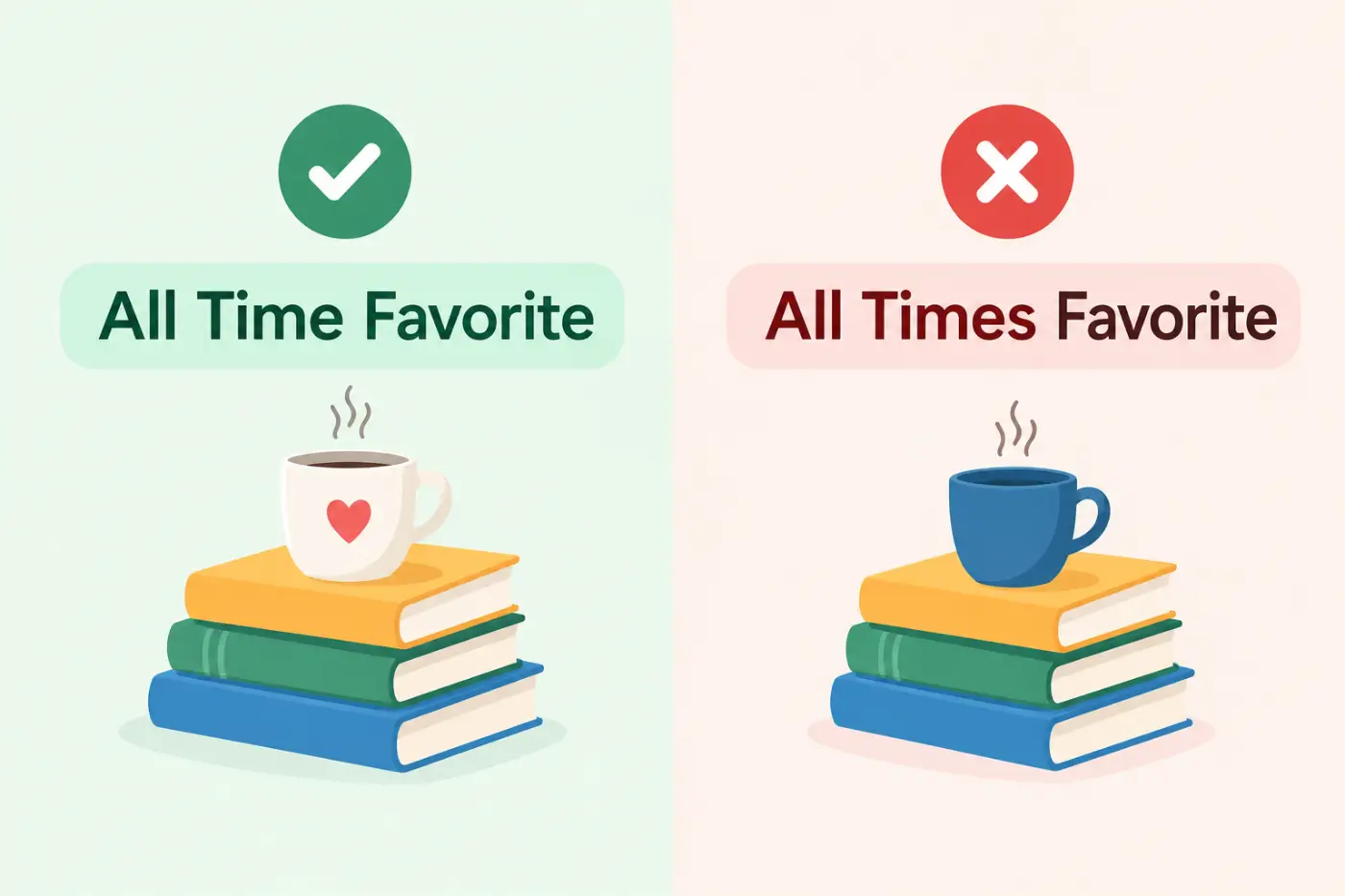
The correct phrase is all time favorite when you mean your most loved person, thing, song, movie, or experience. In standard American English, the usual written form is all time favorite or all time favorite with a hyphen when it comes before a noun as a compound modifier, depending on the style guide. The phrase all times favorite is not the standard expression.
If you’ve ever wondered which version sounds right, the answer comes down to how English uses the word time. The phrase refers to something that remains a favorite across your whole life or across a long period. Adding an s to time changes the phrase and makes it sound unnatural in this context.
You’ll often see this expression in movie reviews, music discussions, sports conversations, and everyday posts. Someone might call a song their all time favorite or describe a classic film as their all time favorite movie. The meaning stays the same: it’s the one they like best of all.
This guide explains the correct form, the reason behind it, how to use it in sentences, and the difference between this phrase and other expressions such as favorite of all time.
Quick Definition
All time favorite means the person or thing someone likes more than any other over their lifetime or within a particular group. In American English, writers commonly use all time favorite in casual writing and all time favorite with a hyphen when it directly describes a noun, as in my all time favorite song. The phrase all times favorite is not standard English.
Direct Answer
Use all time favorite, not all times favorite. In polished writing, use all time favorite as a noun phrase and all time favorite as a modifier only if your chosen style guide permits the open form. Many editors prefer all time favorite without a hyphen in casual use, while others favor all time favorite with a hyphen before a noun. For consistency, the hyphenated form all time favorite is often recommended when it acts as a compound modifier.
Comparison Table
| Word or Phrase | Meaning | Example Sentence | When to Use It |
|---|---|---|---|
| All time favorite | The thing someone likes best of all time. | This is my all-time favorite song. | Use the standard expression to name a top choice. |
| All times favorite | Not a standard English expression. | Incorrect: This is my all-times favorite song. | Avoid this form. |
| Favorite of all time | The most liked choice across all time. | This is my favorite song of all time. | Use it as a natural alternative. |
| All-time best | The best across an entire period or history. | She is one of the all-time best players. | Use it to describe top performance or quality. |
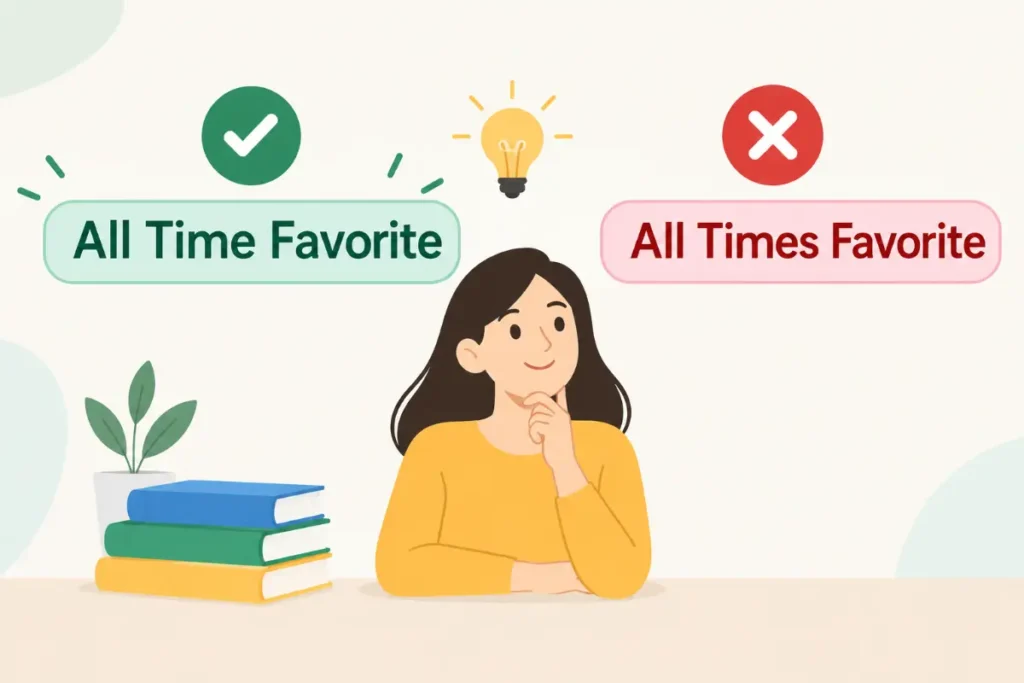
The key point is simple. All-time favorite is the standard form. The word time stays singular because the phrase refers to the whole span of time rather than several separate times.
Why All Time Favorite Is Correct
The expression all-time favorite combines words to describe something that ranks above all other choices. It can refer to a song you never get tired of, a movie you watch every year, or a meal you always want to eat.
The word all points to the full group or span being considered. The word time refers to the whole period. Together they express the idea of a favorite across all time. You do not need to make time plural because the phrase does not refer to several separate occasions.
For example, you might say that a certain book is your all-time favorite. You mean that no other book you have read has become a stronger favorite. You are comparing it with all the other books you know rather than with a list of separate times.
Why Time Stays Singular
English often uses a singular noun in phrases that refer to a broad period or general idea. In all-time favorite, time works as part of a set expression. It does not count separate events or occasions.
Compare these sentences.
- This is my all-time favorite dessert.
- That movie is one of the all-time greats.
- She set an all-time record for sales.
In each example, all-time points to a full period or the entire history being discussed. The plural form times would change the meaning and would not fit this expression.
Why All Times Favorite Sounds Wrong
The phrase all times favorite does not follow the usual English expression. The plural word times often means occasions or instances. For example, you might say, “I visited that restaurant three times last month.” Here, times counts visits.
But when you want to name the thing you like best across your life or across a field, English uses all-time favorite. The phrase has a settled form, so changing time to times makes it sound unnatural.
This is a useful distinction to remember. Use times when you count occasions, such as three times a week. Use all-time when you describe a record, a top ranking, or a favorite that stands above the rest.
How To Use All Time Favorite In A Sentence
The phrase all-time favorite works in many everyday situations. You can use it to talk about music, movies, books, food, sports, places, or people you admire. It tells readers that something stands out from all the other choices.
Here are some natural examples that show how the phrase works in American English.
Talking About Music
Music fans often use this expression to describe a song or album they never get tired of hearing. The song might remind them of a special memory or simply sound better than anything else they have heard.
Examples.
- This is my all-time favorite song.
- That album is still my all-time favorite.
- Her first single remains my all-time favorite track.
- This band has released many great songs, but that one is my all-time favorite.
Notice that the expression stays the same even when the thing being described changes. You do not need to add an s to time just because you are comparing several songs.
Talking About Movies And Television
People also use this phrase when discussing films, shows, and characters. It works well in casual conversations, reviews, and online comments.
Examples.
- The Lion King is my all-time favorite movie.
- That was my all-time favorite episode of the series.
- This actor gave one of my all-time favorite performances.
- Friends is one of my all-time favorite TV shows.
The phrase can describe a single choice or one item from a group of top choices. If you say a movie is your all-time favorite, you are naming your top pick. If you call it one of your all-time favorites, you are placing it among several things you love most.
Talking About Food
Food is another common subject for this expression. You might use it to describe a dish from your childhood, a dessert you order every time you visit a restaurant, or a meal you could happily eat every week.
Examples.
- Chocolate cake is my all-time favorite dessert.
- My grandmother’s apple pie is still my all-time favorite.
- This restaurant serves my all-time favorite burger.
- Of all the dishes on the menu, the pasta is my all-time favorite.
These examples show how the phrase adds a personal touch. It does not simply say that you like a dish. It says that the dish ranks above your other choices.
Talking About Sports And Games
Sports fans often use the expression to describe a player, team, match, or memorable moment. Gamers may use it to name the video game they enjoy most.
Examples.
- Serena Williams is one of my all-time favorite athletes.
- That was my all-time favorite basketball game.
- This is my all-time favorite video game.
- He remains one of the all-time great players in the sport.
There is a small difference between all-time favorite and all-time great. A favorite reflects personal taste. An all-time great usually refers to someone or something considered among the best in history. Your favorite player might not be the most successful player, and that is perfectly fine.
Should You Write All Time Favorite With A Hyphen
Yes. In standard edited American English, all-time favorite is the form to use. The hyphen connects the words and shows that they work together as one expression.
A hyphen joins words that act as a unit. In this case, all-time describes the kind of favorite you mean. It signals that you are talking about a favorite across a whole period rather than something you happen to like right now.
Compare these examples.
- This is my all-time favorite book.
- She is an all-time favorite among her fans.
- That song is an all-time favorite in our family.
The hyphen helps readers recognize the expression quickly. It also makes your writing look consistent and polished.
All Time Favorite Vs Favorite Of All Time
Both expressions communicate the same basic idea. They describe a person or thing that ranks above the others in someone’s opinion. However, all-time favorite is a compact phrase that works well before a noun or as a standalone expression, while favorite of all time often sounds more natural at the end of a sentence.
For example, you can say, “This is my all-time favorite movie.” You can also say, “This is my favorite movie of all time.” Both sentences are correct and express the same preference.
The main difference is sentence structure. The first version puts the description before the noun. The second version places the phrase of all time after the noun it describes.
Examples Of Both Expressions
Here are some examples to show how naturally both forms fit into everyday English.
| All Time Favorite | Favorite Of All Time |
|---|---|
| Pizza is my all-time favorite food. | Pizza is my favorite food of all time. |
| This is my all-time favorite book. | This is my favorite book of all time. |
| That is her all-time favorite song. | That is her favorite song of all time. |
| He is my all-time favorite actor. | He is my favorite actor of all time. |
Both versions work well in conversations, blog posts, reviews, and social media captions. Choose the one that sounds best in your sentence, and keep the spelling consistent.
Which Version Sounds More Natural
In American English, both forms sound natural. The shorter form works especially well when you want a direct statement. The longer form can add emphasis by placing of all time at the end.
For example, imagine a friend asks you to name your favorite book. You could reply, “The Hobbit is my all-time favorite book.” If you want to stress your choice, you might say, “The Hobbit is my favorite book of all time.”
Neither version is more correct than the other. The choice depends on the sentence and the rhythm you want.
All Time Favorite Vs All Time Best
These expressions look similar, but they do not always mean the same thing. An all-time favorite is something a person likes most. All-time best usually refers to the highest level of quality, skill, or achievement across a period.
Personal taste plays a big role in choosing a favorite. You might love a movie that critics dislike. You might consider a singer your favorite even if another singer has sold more records.
The phrase all-time best often makes a stronger claim about quality or performance. People use it when comparing records, results, rankings, and achievements.
Examples Of All Time Favorite
- That comedy is my all-time favorite movie.
- My dad’s homemade pizza is my all-time favorite meal.
- She is one of my all-time favorite writers.
Each sentence shows a personal preference. Another person could choose something completely different.
Examples Of All Time Best
- Many fans consider him one of the all-time best quarterbacks.
- That was one of the all-time best seasons in the team’s history.
- The company recorded its all-time best sales year.
These sentences focus on performance or results rather than personal affection. The expressions can overlap, but they serve different purposes.
Is All Time Favorite One Word Or Multiple Words
The expression is written as separate words, with a hyphen in all-time. It is not normally written as one word.
The standard spelling is all-time favorite. Avoid forms such as alltime favorite, all-times favorite, and all times favorite when you mean a person’s most loved choice.
The hyphen matters because it connects all and time into one modifier. It helps the reader understand that the words belong together.
Correct And Incorrect Forms
| Form | Correct Or Incorrect | Explanation |
|---|---|---|
| All-time favorite | Correct | Standard form in American English. |
| All time favorite | Often seen but less preferred in edited writing | The hyphen is recommended for consistency. |
| All-times favorite | Incorrect | The plural form does not fit the expression. |
| Alltime favorite | Incorrect | The words should not be joined into one word. |
| Favorite of all time | Correct | A natural alternative. |
In casual online writing, you may see the unhyphenated form. People often leave out hyphens in texts and social media posts. Still, if you are writing an article, school assignment, or professional document, all-time favorite is the safer choice.
Common Mistakes To Avoid
Even a familiar expression can cause small writing errors. Most mistakes happen when people add an unnecessary letter, forget the hyphen, or use the phrase in a way that does not fit the sentence.
Using Times Instead Of Time
The most common mistake is writing all-times favorite. The plural form may seem logical if you think of many different occasions, but that is not how this expression works.
Incorrect: This is my all-times favorite song.
Correct: This is my all-time favorite song.
Remember that all-time refers to the entire period being considered. It does not count separate events.
Forgetting The Hyphen
Another common mistake is leaving out the hyphen in formal writing. While readers will usually understand all time favorite, the hyphenated form is clearer and follows common American editorial practice.
Less polished: This is my all time favorite restaurant.
Preferred: This is my all-time favorite restaurant.
A consistent style makes an article easier to read. If you use the hyphenated form once, use it the same way throughout the piece.
Confusing Favorite With Best
People sometimes use favorite and best as if they mean the same thing. They can overlap, but the words express different ideas.
Your favorite book is the one you enjoy most. The best book might refer to one that critics praise for its writing, structure, or influence. You can believe a book is excellent without enjoying it as much as another book.
For example, a film student might consider Citizen Kane one of the greatest movies ever made but still call The Princess Bride their all-time favorite. There is no contradiction. One statement is about critical judgment, and the other is about personal taste.
How to Use the Expression in Formal Writing.
The right wording depends on your audience and purpose. In a personal blog, review, or casual email, this expression sounds natural and friendly. In a research paper or formal report, a more precise description may work better.
For example, a movie review might say, “This remains my favorite film of all time.” That sentence clearly shares a personal opinion. A research report might instead say, “The film received the highest rating in the survey.” The second sentence presents a result that readers can verify.
In School Assignments.
Students can use this expression in personal essays, book reviews, and reflections. It works especially well when an assignment asks them to explain their preferences.
For example.
“My favorite novel of all time is Charlotte’s Web because it explores friendship and kindness in a simple but moving way.”
This sentence does more than name a favorite. It also explains the reason behind the choice and makes the writing more engaging.
In Blog Posts and Reviews.
Writers often use this expression in entertainment articles, food reviews, travel posts, and personal recommendations.
For example.
“After trying several bakeries in town, I still think this shop makes my favorite cinnamon rolls of all time.”
The sentence connects a personal preference to a real experience. Adding a short reason or detail helps readers understand why the item stands out.
In Business Writing.
Use this expression carefully in professional documents. It works well in a casual team message or personal recommendation. However, it may sound too subjective in a report that needs clear facts.
For instance, “This is our favorite design of all time” expresses an opinion. “This design received the highest customer rating” presents a measurable result. Choose the version that best fits the evidence you have.
Real Life Examples of Personal Favorites.
The easiest way to understand an expression is to see how people use it in everyday life. You can describe almost anything you enjoy more than other options. It might be a favorite meal, a special memory, or something you’ve loved for years.
Here are examples from common situations.
In Everyday Conversations.
Friends and family often talk about their favorite things. This expression helps them explain which choice stands above the rest.
- This is my favorite place to get coffee.
- That was my favorite birthday party of all time.
- My brother’s favorite snack is popcorn.
- This is still my favorite way to spend a Sunday.
- That song reminds me of my favorite summer.
Each example expresses a personal opinion. Your favorite doesn’t have to be famous or popular. Even a small everyday pleasure can hold a special place in your life.
In Social Media Captions.
People often share posts about music, travel, food, and special moments. A personal statement can add warmth without requiring a long explanation.
- My favorite view from the mountains.
- Watching my favorite movie for the tenth time.
- Finally visiting my favorite city.
- My favorite dessert with my favorite people.
- A perfect evening with the people I love most.
For a complete sentence, you could write, “This is my favorite view of the city.” A shorter phrase can work as a casual caption. Just remember that a caption fragment isn’t the same as a complete sentence in formal writing.
In Books and Reading.
Readers often form strong connections with certain books. A story might remind them of childhood, introduce a fresh idea, or change how they see the world.
Examples include the following.
- Charlotte’s Web is my favorite children’s book of all time.
- This mystery novel has become one of my favorite reads.
- That author’s latest book isn’t my favorite, but her first novel remains my top choice.
- I reread my favorite book every winter.
You can use this expression for a single book or a type of reading experience. If several books mean the same amount to you, describe them as your favorites.
In Travel and Places.
Your favorite things don’t have to be items you own or buy. You can also describe a place you love visiting.
- New York City is one of my favorite places to visit.
- That quiet beach is my favorite spot for a weekend getaway.
- We returned to our favorite vacation destination.
- The little café near the park is still my favorite place to relax.
These examples work well in personal stories because they show that a place holds special meaning for someone.
Can You Say One of My Favorites.
Yes. You can say one of my favorites when you want to name something you love without claiming it’s your single top choice.
My favorite usually identifies your number one choice. One of my favorites means the item belongs to a group of things you enjoy most.
For example, you might say, “This is my favorite restaurant” if no other restaurant comes close. If you love several restaurants, you could say, “This is one of my favorite restaurants.”
Notice how the noun changes to match the meaning. One restaurant is singular. Several restaurants are plural.
Examples With Singular Nouns.
- This is my favorite song.
- She is my favorite author.
- That was my favorite vacation.
Examples With Plural Nouns.
- These are some of my favorite songs.
- She is one of my favorite authors.
- Those were among my favorite vacations.
The wording stays consistent. The rest of the sentence changes to show how many things you mean.
Is a Personal Favorite the Same as the Greatest of All Time.
Not exactly. A personal favorite reflects individual taste, while the greatest of all time usually refers to a judgment about overall skill, quality, or achievement.
The difference becomes clear in sports. You might call a basketball player your favorite because you grew up watching them. Someone else might call another player the greatest because of their records and achievements.
Both opinions can be reasonable. One describes a personal connection. The other makes a broader claim about greatness.
The same distinction applies to music and movies. Your favorite singer might not have the most awards or highest sales. A movie you love most might not be the one critics rank highest. Personal enjoyment and measured success are two different things.
When to Use Each Expression.
Use a personal favorite when talking about the choice you enjoy most. Use greatest of all time when discussing who or what deserves the highest rank across a field or period.
For example.
“My favorite tennis player is Serena Williams.”
“Many fans consider Serena Williams one of the greatest tennis players of all time.”
The first sentence shares a personal preference. The second makes a broader statement about sporting achievement and reputation.
How to Remember the Correct Form.
You don’t need a long grammar rule to remember this expression. Think of all time as a phrase that refers to an entire period.
When you mean something you love most, use all-time favorite in the appropriate context. Keep time singular when referring to the established expression.
You can also remember the pattern by comparing it with other familiar expressions.
- All-time record.
- All-time high.
- All-time low.
- All-time great.
- All-time favorite.
These expressions use singular time. Once you recognize the pattern, you’re less likely to add an unnecessary s.
Another helpful trick is to replace the expression with favorite of all time. If the sentence still makes sense, you probably want the standard singular form.
For example, “This is my all-time favorite movie” means the same as “This is my favorite movie of all time.” Neither version needs times.

Related Expressions Worth Knowing
English offers several other ways to describe something you love most. Learning these alternatives helps you avoid repetition and makes your writing sound more natural.
Favorite Of All Time
This is the closest alternative to all-time favorite. Both phrases express the same idea, but they place the words in a different order.
Example.
“That is my favorite restaurant of all time.”
This version often sounds natural at the end of a sentence. It also works well in casual speech.
Personal Favorite
A personal favorite is something you particularly like. The phrase doesn’t always suggest that you have compared every possible option across your life.
Example.
“That little bakery is a personal favorite of mine.”
You can use this expression when you want to share a preference without making a strong claim that the item is your number one choice.
Longtime Favorite
A longtime favorite is something you have liked for a long period. It may still be your top choice, but the phrase mainly highlights how long you have enjoyed it.
Example.
“This café has been a longtime favorite of our family.”
The distinction is useful. A longtime favorite has remained popular with you over time. An all-time favorite is the choice you rank above the rest.
All Time Great
An all-time great is a person or thing widely viewed as one of the best in a field. The phrase often appears in sports, music, entertainment, and history.
Example.
“Many fans consider her an all-time great.”
This expression is about excellence rather than personal taste. You can admire an all-time great without calling them your favorite.
Final Writing Tips
When choosing the right expression, consider the meaning you want to convey. If you are talking about your number one choice, use a phrase that clearly expresses your preference. If you want to highlight something you have enjoyed for many years, a term like longtime favorite may be more suitable.
Pay attention to spelling and punctuation in edited American English. The compound expression takes a hyphen, while the alternative favorite song of all time is also correct.
Try not to repeat the same expression too often in one paragraph. In reviews and blog posts, you can use alternatives such as personal favorite, top choice, or favorite of all time. These options make your writing more varied while keeping your meaning clear.
FAQs
Which expression is correct in standard English?
The singular form is the standard choice. The word time remains singular because the expression refers to an entire period. Adding an s to time is not standard in this context.
Should the words be connected with a hyphen?
Yes. In edited American English, a hyphen joins the words to show that they function together as one expression.
What does this expression mean?
It describes a person or thing someone likes more than any other. It can refer to a song, movie, book, meal, athlete, or place. The phrase communicates a strong personal preference.
Can I say favorite of all time instead?
Yes. This is a natural and correct alternative. For example, you can write, “This is my favorite movie of all time” or “This is my top movie choice.”
Is the expression formal or informal?
It works in both casual and formal writing. You can use it in conversations, reviews, blog posts, and personal essays. In formal reports, a more precise description may be better when you need to support a statement with facts.
What is the difference between a top choice and a longtime favorite?
A top choice ranks above other options, while a longtime favorite is something a person has enjoyed for many years. One emphasizes preference, and the other highlights the length of time that preference has lasted.
Can I use the plural form?
Yes. Use the plural when referring to several things you like most. For example, “These are my favorite books” and “Those songs are among my personal favorites” are both correct.
Does a personal favorite mean the same as the greatest of all time?
Not exactly. A personal favorite reflects individual taste, while the greatest of all time usually refers to the highest level of achievement or quality in a particular field. Your favorite athlete may not be the one you consider the greatest.
Conclusion
Choose the singular form when describing the person or thing you like most. Keep the word time singular, and use the hyphen in the standard compound expression.
You can apply this wording to songs, movies, books, special places, and memorable meals. If you prefer a different sentence structure, favorite of all time is an equally natural option.
The key is to match your wording to your intended meaning. A quick review before publishing can help you keep your writing clear, natural, and grammatically correct.

Dr. Elena Vance holds a Ph.D. in Linguistics from Columbia University and has spent over 15 years analyzing the evolution of the English language. A former university professor turned full-time writer and editor, Elena specializes in breaking down high-level grammatical concepts, punctuation nuances, and style guides (APA, Chicago, MLA) into clear, actionable advice. When she isn’t hunting down dangling modifiers, she can be found collecting vintage dictionaries and reading classic literature.