
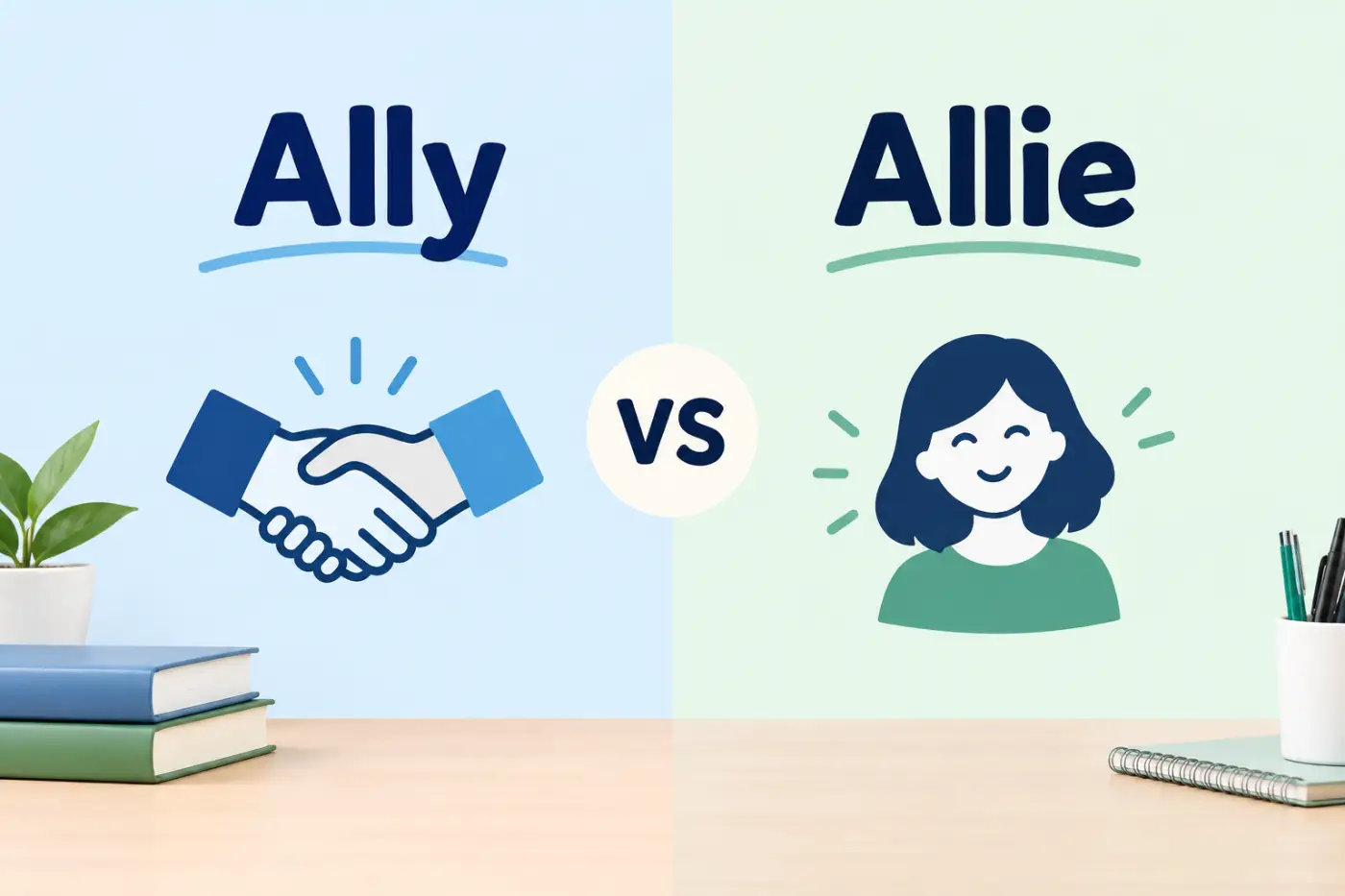
If you’re searching for ally vs allie you may be trying to figure out which spelling is correct. The answer depends on what you mean. Ally is a standard English word. It means a person or group that supports another person or group. Allie is most often used as a personal name or as a nickname for names such as Allison or Alexandra.
That small difference clears up most of the confusion. You wouldn’t normally use Allie when you mean a friend or supporter. You’d use ally. On the other hand if you’re talking about someone whose name is Allie then that spelling is perfectly correct.
The confusion often comes from pronunciation. The two forms can sound alike when spoken. They also look close on the page. This makes it easy to use the wrong spelling when you’re writing quickly.
This guide explains the difference in plain English. You’ll learn what ally means how to use it in a sentence when Allie is correct and how to remember the difference without second guessing yourself.
Quick Definition
Ally is a noun or verb. As a noun it means a person group or country that supports another. As a verb it means to join with someone or something for a shared purpose.
Allie is usually a person’s name. It can also be a nickname for several longer names. It isn’t the standard spelling of the English word that means a supporter or partner.
Direct Answer
Use ally when you mean a person group or country that supports another. Use Allie when you’re referring to someone whose name is spelled Allie.
Comparison Table
| Word | Meaning | Example Sentence | When to Use It |
|---|---|---|---|
| Ally | A person group or country that supports another. | My sister has always been my strongest ally. | Use it for a supporter or partner. |
| Allie | A personal name or nickname. | Allie is meeting us for dinner. | Use it when someone’s name is Allie. |

What Does Ally Mean
An ally is someone who supports you. The person may help you solve a problem defend an idea or reach a shared goal. The relationship can be personal social political or international.
For example you might call a close friend an ally when that friend stands beside you during a difficult time. A worker might have an ally at the office who supports a fair workplace. One country can also be an ally of another country when the two nations cooperate and support each other.
The basic idea stays the same. An ally is on your side.
The word can describe one person or a larger group. You can have a trusted ally at work. A community can have allies who support its goals. Countries can form alliances when they agree to cooperate.
How To Use Ally As A Noun
The most common use of ally is as a noun. In this form it refers to a person group or country that provides support.
Consider these examples.
- Maria became an important ally during the project.
- His brother was his closest ally during the difficult period.
- The organization found several allies who supported its cause.
- The two countries have been strong allies for many years.
In each sentence the ally provides some kind of support. The exact type of support changes with the situation but the main meaning remains clear.
You can also use words such as strongest, closest, trusted, powerful, or important before ally.
For example you might say that someone is a trusted ally because you know that person will stand by you. You could call another person a powerful ally because they have influence or resources that can help.
How To Use Ally As A Verb
Ally can also work as a verb. In this form it means to join with another person or group for a shared purpose.
For example.
- Several groups allied to protect the local park.
- The two companies allied to develop the new service.
- The countries allied against a common threat.
The verb often appears with with.
You can say that one group allied with another group. This means the two sides joined together or formed a partnership.
The noun and verb forms are closely connected. An ally is someone who supports you. To ally with someone means to join with that person or group.
Why Allie Looks Like The Correct Word
The spelling Allie can look familiar because it is a common personal name. If you’ve met someone named Allie you already know that spelling is used in real life.
Names don’t always follow the same rules as ordinary English words. Parents can choose many different spellings for names. You might meet someone named Allie Ally Ali or Alie. Those spellings can all exist as personal names.
That doesn’t mean they are interchangeable in standard English.
When you write about a person named Allie you should use the spelling that person uses. If her name is Allie then write Allie. If her name is Ally then write Ally. A person’s chosen name takes priority over a general spelling rule.
The distinction becomes much easier when you focus on meaning. If you’re describing a supporter use the common English word ally. If you’re writing someone’s name use that person’s actual spelling.
Where The Confusion Comes From
The main source of confusion is that ally and Allie can sound very similar. When you hear the words in conversation you may not know which spelling the speaker means.
Context usually solves the problem.
If someone says that a friend is an ally you know the person means a supporter. If someone says that Allie is coming to dinner you know Allie is being used as a name.
This is similar to other English words that sound alike but have different meanings or spellings. The spoken form alone doesn’t always give you enough information. Writing requires you to look at the meaning and context.
That’s why asking yourself one simple question helps.
Am I talking about a supporter or a person’s name.
If you’re talking about a supporter the standard word is ally. If you’re talking about a person named Allie use Allie.
How To Use Ally In Real Sentences
The word ally works in many settings. You can use it when talking about friendship support teamwork politics history or international relations. The meaning changes slightly with the situation but the central idea stays the same. An ally is someone who stands with another person or group.
Talking About Friendship
You can describe a close friend as an ally when that person supports you during a difficult situation. The word can sound stronger than simply calling someone a friend because it highlights loyalty and support.
For example.
- My best friend has always been an ally when I need honest advice.
- She became an ally when everyone else disagreed with me.
- A good friend can also be a trusted ally.
You don’t need a serious conflict to use the word. It can describe everyday support too.
Talking About Work
Ally is also common in workplace writing and conversation. A coworker may support your ideas help you solve a problem or speak up for you during a meeting.
For example.
- I found an ally on the marketing team who supported my proposal.
- She became an important ally during the company changes.
- Having an ally at work can make a difficult project easier.
The word can also describe someone who supports a cause at work. For example an employee may act as an ally to coworkers who face unfair treatment.
Talking About Social Causes
People often use ally when discussing social issues and communities. In this context an ally is someone who supports a group or cause even though they may not belong to that group themselves.
For example.
- The group thanked its allies for speaking up.
- She works as an ally for people facing discrimination.
- Many community allies volunteered at the event.
The word suggests active support. An ally usually does more than simply agree with an idea.
Ally In Politics And International Relations
The word has a long history in politics and international affairs. Countries can become allies when they agree to cooperate and support one another.
For example.
- The two nations became allies during the conflict.
- Several countries worked together as military allies.
- The president met with leaders from allied nations.
An allied country is a country that has joined with another country for a shared purpose. The countries may cooperate on defense trade security or other goals.
You may also see the related word alliance. An alliance is a relationship or agreement between people groups organizations or countries that choose to work together.
For example.
- The countries formed an alliance for mutual defense.
- The business created an alliance with another company.
- Their alliance lasted for many years.
The connection is simple. An ally is a supporter or partner. An alliance is the partnership itself.
Ally And Alliance
These two words are closely related but they don’t play the same role in a sentence.
- Ally refers to the person group or country that provides support.
- Alliance refers to the relationship or agreement between the sides.
Compare these examples.
- Canada is an ally of the United States.
- Canada and the United States have a strong alliance.
The first sentence identifies a country as a partner. The second describes the partnership.
You can also use alliance in personal or professional settings.
- The two organizations formed an alliance to help local families.
- The companies created a strategic alliance.
- Their alliance helped both groups reach more people.
Knowing this difference can help you avoid another common vocabulary mistake.
Ally And Friend
An ally and a friend can be the same person but the words focus on different things.
- A friend is someone you have a personal relationship with. Friendship often involves affection trust shared experiences and companionship.
- An ally is someone who supports you or works with you toward a shared goal. The relationship may be personal but it doesn’t have to be.
For example you can have an ally at work without being friends outside the office. Two countries can be allies but obviously cannot have a friendship in the same personal sense.
You can also be friends with someone who doesn’t share your goals. That person can still care about you even when they disagree with your plans.
So if you want to highlight personal connection use friend. If you want to highlight support cooperation or shared goals use ally.
Ally And Partner
The word partner can also overlap with ally. Both words can describe people who work together but they carry slightly different ideas.
A partner usually has a direct role in an activity or relationship. Business partners may own a company together. Project partners may work on the same assignment.
An ally may support you without being directly involved in everything you do.
For example.
- My business partner works with me every day.
- My business ally helped me find new customers.
The first sentence suggests a formal working relationship. The second focuses more on support.
The difference isn’t always sharp. English words often overlap in meaning. Context tells the reader what you mean.
Is Allie A Real Word
Yes. Allie is a real spelling when it is used as a personal name.
You might meet someone named Allie at school work or in your community. You may also see Allie used as a nickname for names such as Allison or Alexandra. The exact connection depends on the person and their family.
For example.
- Allie called me after work.
- I met Allie at the bookstore.
- Allie and her sister are coming over tonight.
In these sentences Allie is a name. It doesn’t mean supporter partner or teammate.
This distinction matters because proper names don’t work exactly like ordinary vocabulary. If someone’s name is Allie then changing it to Ally because you think it looks more standard would be incorrect.
Always spell a person’s name the way that person spells it.
Is Ally A Name Too
Yes. Ally can also be used as a personal name.
That creates an interesting situation because ally has two common roles. It can be an ordinary English word or someone’s name.
For example.
- My strongest ally supported me during the meeting.
- Ally is coming over after work.
In the first sentence ally is a common noun. In the second sentence Ally is a person’s name and therefore begins with a capital letter.
The capitalization gives readers an important clue. Common nouns usually stay lowercase. Personal names begin with capital letters.
Still the context matters most. If you write about someone named Ally then use the spelling and capitalization that person uses.
How Capitalization Changes The Meaning
Capitalization can help distinguish a common word from a personal name.
When you mean a supporter you normally write ally with a lowercase a.
- She became my strongest ally.
When Ally is someone’s name you capitalize it.
- Ally became my strongest supporter.
The spelling can therefore carry two different meanings.
The lowercase word describes a relationship based on support or cooperation. The capitalized form identifies a person whose name is Ally.
The same principle applies to many other words that can also appear as names. Context and capitalization work together to guide the reader.
Common Spelling Mistakes
People sometimes write Allie when they mean the English word for a supporter. Others may change someone’s name from Allie to Ally without realizing that names can have different spellings.
Both mistakes come from treating the two forms as if they were interchangeable.
Consider this sentence.
- She has always been my closest Allie.
If the writer means a supporter then the standard form is ally.
Now consider this sentence.
- Allie has always supported me.
If Allie is the person’s name then the spelling is correct.
The meaning changes because the two words have different jobs.
Another mistake is assuming that every person with a similar sounding name spells it the same way. That’s not safe. Some people use Allie. Others use Ally. Some use Ali or another variation.
Names belong to the people who use them. Check the person’s preferred spelling when you need to write their name correctly.
A Simple Test For Choosing The Right Word
When you’re unsure which spelling to use pause and ask what you’re trying to say.
If you mean supporter then use the common English word.
If you mean a person’s name then use the spelling that belongs to that person.
Try this quick comparison.
- My friend became my closest ally.
- My friend Allie called me last night.
The first sentence describes a role. The second identifies a person.
This simple distinction solves most cases without requiring you to memorize a complicated spelling rule.
Ally Vs Allie In Different Situations
The best spelling depends on the job the word is doing in the sentence. If you are describing someone who supports another person then use the common noun ally. If you are naming a person then use the spelling that belongs to that person.
This distinction becomes especially useful in writing because names and common words can look almost identical. A reader may understand your meaning from context but the wrong spelling can still make your sentence look careless.
When You Mean A Supporter
Use ally when someone supports you or works with you toward a shared goal. The person might be a friend a coworker a teammate or even someone you barely know.
For example you could write:
- She became an ally when I needed help.
- His coworkers were strong allies during the dispute.
- We found an ally who understood our concerns.
The word doesn’t require a close personal relationship. An ally can be someone who simply shares your goal and chooses to support it.
When You Mean A Person Named Allie
Use Allie when you’re talking about someone whose name is spelled that way. Since it’s a proper name you normally capitalize the first letter.
For example:
- Allie works at the local library.
- I sent Allie a message this morning.
- Allie helped us plan the party.
In these sentences the word doesn’t describe a type of relationship. It identifies a specific person.
When Someone Is Named Ally
The same idea applies to Ally. Some people use Ally as their personal name. If that’s the spelling they use then you should keep it exactly that way.
For example:
- Ally is joining us for dinner.
- I spoke with Ally after the meeting.
- Ally sent the documents yesterday.
You shouldn’t change Ally to Allie simply because both spellings sound similar. A person’s name is part of their identity and should be written correctly.
The Difference Between Ally And Allie
The clearest difference is meaning.
Ally is a regular English word that describes someone who gives support or works with another person or group. It can also be used as a verb when people or groups join together.
Allie is most commonly a personal name or nickname. It doesn’t normally carry the meaning of supporter.
Think about these two sentences:
- My sister has always been my closest ally.
- My sister’s friend Allie came to visit.
The first sentence describes a relationship. The second sentence gives the name of a person.
This is why the two spellings shouldn’t be treated as simple alternatives. They serve different purposes.
How The Plural Forms Work
The plural of ally is allies. This follows a common English spelling pattern for nouns that end in a consonant followed by y.
Change the y to i and add es.
So:
ally → allies
For example:
- The two countries are close allies.
- She thanked her allies for their support.
- The group gained several new allies.
This spelling is different from the personal name Allie. If you’re talking about several people named Allie you would normally write Allies only if the context calls for a plural name. The capitalization depends on how the name is being used.
What Is The Plural Of Allie
If Allie is a person’s name then the plural form depends on the context. You usually won’t need a plural form because names identify individuals.
If you’re referring to several people who all happen to be named Allie you could write the Allies when the meaning is clear. In normal writing it may be clearer to say people named Allie instead.
For example:
- Three people named Allie attended the event.
That sentence leaves no room for confusion.
This is another reason not to treat personal names like ordinary vocabulary. Names can follow different patterns and the people who use them may have their own preferred spelling.
Can Ally Mean A Friend
Yes. An ally can be a friend but the two words don’t have exactly the same meaning.
Friend describes a personal connection. Ally emphasizes support.
Imagine that you have a coworker who isn’t a close friend. You rarely spend time together outside work but that person supports your ideas during meetings and helps you deal with a difficult situation. You could reasonably call that coworker an ally.
On the other hand a close friend can disagree with your plan and still be your friend. Friendship doesn’t require complete agreement.
For example:
- Jake is my friend but he doesn’t support this plan.
- Sarah isn’t a close friend but she’s been a strong ally.
Both sentences make sense because the words focus on different parts of the relationship.
Can Ally Mean Partner
Yes. Ally can describe someone who works with another person or group toward a shared purpose.
A partner often has a more direct role. An ally may provide support without being involved in every part of the work.
For example a small business might work with another company on a project. The companies could call each other partners. If one company simply supports the other company’s campaign or helps promote its work it might be described as an ally.
The exact line can change depending on the situation. English has many words with overlapping meanings. What matters is the main idea you want to emphasize.
Use partner when the focus is on working together. Use ally when the focus is on support or shared interests.
Ally As A Verb
Many readers know ally as a noun but it can also function as a verb.
To ally with someone means to join with that person or group for a shared purpose. The verb is often followed by with.
For example:
- The two groups allied with local volunteers.
- Several organizations allied to support the campaign.
- The nations allied against a common enemy.
The past tense is allied.
For example:
- The groups allied to protect the historic building.
- Several countries allied during the war.
The spelling changes from ally to allied because the word ends in a consonant followed by y. The y changes to i before ed.
This is the same general spelling pattern you see in words such as carry and carried.
Ally And Allied
The word allied can describe people groups or countries that have joined together or share a connection.
For example:
- The allied forces worked together.
- The two companies are allied on the project.
- Several allied groups supported the proposal.
In these examples allied acts as an adjective. It describes a relationship between groups.
You may also see allied in the phrase allied health professions. This refers to health related fields that support patient care but aren’t usually part of the main medical or nursing professions.
The word still carries the basic idea of connection or cooperation.
Ally And Alliance In A Sentence
Understanding alliance can make the meaning of ally even clearer.
An ally is one of the people groups or countries involved in cooperation. An alliance is the relationship or agreement between them.
Compare these sentences:
- France became an ally of the United States.
- France and the United States formed an alliance.
The first sentence identifies one side of the relationship. The second describes the relationship itself.
You can use the same idea outside international politics.
- The nonprofit became an ally of the local school.
- The two organizations formed an alliance to support students.
This distinction is useful because both words appear often in news reports business writing history books and everyday discussions.

Examples That Show The Difference Clearly
Sometimes the easiest way to understand two similar forms is to place them side by side.
- I need an ally on this project.
- Allie is working on this project with me.
The first sentence describes a supportive person. The second identifies someone by name.
Here is another pair:
- The coach became an ally of the players.
- Ally became the team’s new coach.
In the first sentence ally describes a supportive relationship. In the second sentence Ally is a person’s name.
One more example makes the distinction even clearer:
- We found several allies who supported our plan.
- We invited Allie to join us.
The first sentence talks about supporters. The second talks about a specific person.
How To Avoid The Mistake
You don’t need a complicated memory trick. Start with the meaning.
If you can replace the word with supporter or supportive partner then ally is probably the word you need.
For example:
- She is my strongest supporter.
- She is my strongest ally.
Those sentences have nearly the same basic idea.
If you can replace the word with someone’s name then you may be dealing with a proper name such as Allie.
For example:
- Allie called me after lunch.
You wouldn’t replace Allie with supporter because the sentence is identifying a person.
This simple test works well because it focuses on meaning instead of appearance.
Common Mistakes To Watch For
One common mistake is writing Allie when you mean a supporter. This usually happens because the writer has seen Allie used as a name and assumes it can also represent the regular word.
Another mistake is changing someone’s name because you think another spelling looks more correct. If a person spells their name Allie then Allie is correct for that person. If they spell it Ally then Ally is correct for them.
A third mistake is assuming that pronunciation tells you the spelling. It doesn’t always. Several names and words can sound alike while having different spellings and meanings.
Context is your best guide.
Memory Tricks That Actually Help
A useful way to remember ally is to connect it with the word alliance. Both words relate to people or groups joining together and supporting one another.
Think:
ally → alliance → support
That connection gives the spelling a meaning instead of making it a random collection of letters.
For Allie think of a person’s name. You might picture a friend named Allie or imagine writing the name on a birthday card. The visual connection can help you separate the name from the common noun.
You can also remember that ally has a short y ending while Allie looks like a typical nickname ending in ie.
These tricks aren’t spelling rules. They’re simply ways to make the difference easier to recall.
Is Ally A Common Name
Yes. Ally is also used as a personal name. It may appear as a given name or as a nickname for a longer name.
Allie is also a common nickname style. Different people may choose different spellings even when their names sound almost identical.
For example one person may introduce herself as Ally while another may introduce herself as Allie. Neither spelling should be changed just because another version is more familiar to you.
This matters in emails social media posts invitations school records and other personal writing. A small spelling change can turn someone’s name into a different name.
When To Check A Person’s Name
If you’re writing about someone and you’re not sure how they spell their name check before publishing or sending the message. Look at their email signature profile page business card or other reliable source.
This matters even more in professional writing. A correctly spelled name shows care and avoids an awkward mistake.
For example if someone signs an email Allie Johnson you should use Allie Johnson in your reply. Don’t change the first name to Ally because the two names sound similar.
The same rule applies to other personal names with several common spellings. Use the spelling the person actually uses.
A Quick Way To Check Your Sentence
Read the sentence and ask what the word means.
If it means someone who supports you use ally.
If it names a person use that person’s actual name.
Try these examples:
- My brother is a loyal ally.
- Allie is my brother’s friend.
- The two nations are allies.
- Allie and her family moved to Texas.
The first and third sentences use the common English word. The second and fourth use a person’s name.
Once you focus on meaning the spelling becomes much easier to choose.
FAQs
Is ally or Allie the correct spelling?
The correct spelling depends on what you mean. Ally is the standard English word for someone who supports another person or group. Allie is usually a personal name or nickname.
Is Allie a real name?
Yes. Allie is a common personal name and nickname. It can be used on its own or as a nickname for names such as Allison. If a person’s name is Allie then you should use that spelling when writing their name.
Is Ally also a name?
Yes. Ally can also be used as a personal name. The spelling can represent either a person’s name or the regular English word for a supporter so context helps show which meaning applies.
What is the difference between ally and Allie?
The main difference is their use. Ally is a regular English word that means supporter or partner while Allie is most often a person’s name. They may sound similar but they don’t have the same function in writing.
Can ally mean friend?
Yes but ally and friend don’t mean exactly the same thing. A friend has a personal relationship with you while an ally is someone who supports you or shares a goal with you. A person can be both your friend and your ally.
What is the plural of ally?
The plural of ally is allies. The spelling changes from y to i before es. For example you can say that two countries are allies or that a person has several allies.
Is Allie short for Allison?
Allie can be a nickname for Allison. Some people also use Allie as their given name. The connection depends on the person so you shouldn’t assume that every person named Allie has the full name Allison.
How do I remember the difference between ally and Allie?
Think of ally as a person who supports you and connect it with alliance. Think of Allie as a person’s name. If you mean supporter use the regular word and if you’re writing someone’s name use the spelling that person uses.
Conclusion
The choice between ally vs allie becomes simple once you focus on meaning. Use ally when you mean a supporter a partner or someone who works with another person or group toward a shared goal. Use Allie when you’re referring to someone whose name is spelled Allie.
The word ally can describe personal support workplace cooperation social causes or relationships between countries. It can also work as a verb when people or groups join together. Its related forms include allied allies and alliance.
Allie serves a different purpose. It’s generally a personal name or nickname. Ally can also be someone’s name so you should always use the spelling that person prefers.
When you’re unsure take a second to look at the sentence. If you mean supporter then ally is the word you want. If you’re writing someone’s name check the person’s preferred spelling before you hit send.

Sienna Watson is a veteran copywriter and communications coach who has helped startup founders, marketers, and professionals polish their writing for over a decade. Realizing that most people don’t need a degree in linguistics—just clear, impactful communication—Sienna focuses on practical grammar, business writing etiquette, and eliminating wordiness. She advocates for plain language, strong verbs, and persuasive prose that gets results.