
The correct spelling is bosses when you mean more than one boss. It can also be a verb that describes someone who gives orders or tries to control others. The spelling stays the same in both cases.
The word boss becomes bosses because nouns ending in ss usually take es in the plural form. For example, you can write, “My bosses approved my vacation.”
The phrase Bosses or Bosses shows the same spelling twice. This guide explains the correct spelling, the difference between bosses and boss’s, and how to use each form in everyday American English.
Quick Definition
Bosses is the plural form of boss. It refers to two or more people who manage workers or lead a team. It can also be a verb meaning that someone gives orders in a controlling way.
Direct Answer
Bosses is the correct spelling for the plural of boss. Add es to the singular word boss to talk about more than one manager. The two options in Bosses or Bosses are identical.
A Quick Comparison of Boss and Bosses
| Word | Meaning | Example Sentence |
|---|---|---|
| Boss | One person who manages others. | My boss approved my vacation. |
| Bosses | Two or more managers. | My bosses approved my vacation. |
| Bosses | The action of giving orders in a controlling way. | She bosses her brother around. |
| Boss’s | Something that belongs to one boss. | My boss’s office is upstairs. |
| Bosses’ | Something that belongs to several bosses. | The bosses’ meeting starts at noon. |
Why Boss Becomes Bosses
English has spelling rules for forming plural nouns. Most nouns take s or es at the end. The correct ending depends on how the word ends.
For example, book becomes books and car becomes cars. However, box becomes boxes and dish becomes dishes.
The word boss follows the same pattern as box and dish. Since it ends in ss, you add es to form the plural.
The Rule for Words Ending in S
Regular nouns that end in s, ss, sh, ch, x, or z usually take es in the plural form.
Here are some common examples.
| Singular | Plural |
|---|---|
| Boss | Bosses |
| Class | Classes |
| Glass | Glasses |
| Bus | Buses |
| Dish | Dishes |
| Wish | Wishes |
| Church | Churches |
| Box | Boxes |
| Quiz | Quizzes |
Notice that quiz becomes quizzes. The final consonant doubles before the plural ending. The word boss already ends in double s, so you only need to add es.
Why Bosss Is Incorrect
The spelling bosss is incorrect in standard English. Adding only s to boss does not follow the usual plural spelling rule.
Write bosses instead. The extra vowel sound makes the plural easier to pronounce.
The singular word boss has one syllable. The plural bosses has two syllables and sounds like BOSS iz.
How to Use Bosses in a Sentence
You can use bosses in everyday conversations, workplace emails, and formal writing. The meaning depends on the sentence.
Talking About More Than One Manager
Use bosses when two or more people supervise you or share responsibility for your work.
Examples.
- My bosses are meeting with the new team today.
- Both bosses approved the budget.
- Our bosses expect us to finish the project by Friday.
- The two bosses have different management styles.
- My former bosses still give me helpful career advice.
In these examples, the word refers to multiple people. It works for managers of any gender.
Talking About People Who Share Leadership
Some employees report to more than one manager. For example, you might work with a department manager and a project manager.
You could say, “My bosses agreed to let me work from home on Fridays.”
This sentence shows that more than one person approved the request.
You can also write, “The company has three bosses who oversee different departments.”
In formal writing, managers, supervisors, or executives may fit better if those titles describe the roles more clearly. However, bosses is common and natural in everyday American English.
Talking About Past and Present Bosses.
The word bosses works for people you work for now and people you worked for in the past.
Examples.
- My previous bosses taught me how to handle difficult clients.
- Both of my current bosses are easy to talk to.
- Several former bosses attended the retirement party.
- Her bosses praised her work during the annual review.
The verb in each sentence helps show the time. The noun itself stays the same.
Using Bosses in Everyday Conversation
People often use the word when talking about work schedules, pay, meetings, and workplace rules.
Examples.
- Our bosses are strict about arriving on time.
- The bosses want everyone to attend the meeting.
- My bosses gave us the afternoon off.
- Their bosses are planning a new training program.
The word can appear at the start of a sentence or later in the sentence.
For example, “My bosses called me yesterday” uses bosses as the subject. In “I spoke with my bosses yesterday,” the word comes after the verb.
The spelling does not change.
Bosses as a Verb
The word bosses can also describe an action. As a verb, it is the simple present form used with he, she, or it.
For example, “She bosses her younger brother around.”
Here, bosses does not refer to several managers. It describes how she treats her brother.
What Bosses Around Means
The phrase bosses around means telling someone what to do in a pushy or controlling way. It often suggests that the person acts as if they have authority over others.
Examples.
- He bosses everyone around during group projects.
- My sister bosses me around when we cook together.
- Stop bossing your friends around and let them make their own choices.
- She bosses her teammates around instead of listening to their ideas.
The phrase usually has a negative tone. Giving clear instructions does not always mean someone is bossy. The meaning depends on how the person treats others.
How the Verb Changes
The verb boss follows a regular pattern in the present tense.
| Subject | Correct Form | Example Sentence |
|---|---|---|
| I | Boss | I boss nobody around. |
| You | Boss | You boss your friends around too much. |
| He | Bosses | He bosses his coworkers around. |
| She | Bosses | She bosses her brother around. |
| It | Bosses | The character bosses everyone around. |
| We | Boss | We boss nobody around. |
| They | Boss | They boss the younger players around. |
Use bosses with he, she, or it in the simple present tense. Use boss with I, you, we, and they.
This pattern also appears in verbs such as watch and teach. You write watches and teaches with a singular subject because these verbs need es.
Bosses vs Boss’s vs Bosses’
These three forms look similar, but they have different meanings. Knowing the difference helps you avoid spelling and punctuation mistakes.
Bosses Means More Than One Boss
Use bosses when you are talking about two or more people. Do not add an apostrophe.
Examples.
- The bosses arrived before the meeting started.
- My bosses gave me helpful feedback.
- Both bosses signed the contract.
The word simply shows that you mean more than one boss. It does not show ownership.
Boss’s Shows Ownership by One Boss
Use boss’s when something belongs to one boss. Place the apostrophe before the final s.
Examples.
- My boss’s desk is near the window.
- I followed my boss’s instructions.
- The boss’s decision surprised everyone.
- My boss’s office closes at five.
Each sentence refers to one boss and something connected to that person.
For example, “My boss’s desk is near the window” means that the desk belongs to one boss.
Bosses’ Shows Ownership by Several Bosses
Use bosses’ when something belongs to two or more bosses. Since the plural word already ends in s, place the apostrophe after that letter.
Examples.
- The bosses’ offices are on the second floor.
- We followed the bosses’ instructions.
- The bosses’ decision affected the entire team.
- The bosses’ meeting lasted two hours.
These examples show ownership or a connection to several managers.
How to Remember the Difference.
| Form | Meaning | Example |
|---|---|---|
| Bosses | More than one boss. | The bosses are here. |
| Boss’s | Belonging to one boss. | The boss’s car is outside. |
| Bosses’ | Belonging to several bosses. | The bosses’ cars are outside. |
A simple trick can help. No apostrophe usually means a regular plural noun. An apostrophe before the final s shows ownership by one boss. An apostrophe after the plural s shows ownership by several bosses.
Common Mistakes When Writing Bosses
Even a simple spelling rule can cause confusion. Most mistakes happen when people confuse the plural form with a possessive form.
Writing Bosss Instead of Bosses
The spelling bosss is incorrect.
Incorrect. My bosss approved the request.
Correct. My bosses approved the request.
Remember to add es to form the plural.
Using Boss’s for a Plural
The word boss’s usually shows ownership by one boss. It is not the standard plural form.
Incorrect. The boss’s arrived early.
Correct. The bosses arrived early.
If you mean several managers, leave out the apostrophe.
Using Bosses’ for a Simple Plural
The spelling bosses’ shows ownership by several bosses. It is not the correct choice when you simply mean several managers.
Incorrect. The bosses’ arrived early.
Correct. The bosses arrived early.
Use an apostrophe only when you need to show ownership.
Confusing Bosses With Boss’s in Speech
The words bosses and boss’s can sound alike in everyday speech. The meaning of the sentence helps you tell them apart.
“My boss’s car is red” refers to one boss’s car. “My bosses are here” refers to several managers.
When writing, focus on the meaning instead of relying only on the sound.
Forgetting the Verb Rule
Some writers forget to add the correct ending when the subject is he, she, or it.
Incorrect. She boss her coworkers around.
Correct. She bosses her coworkers around.
The simple present tense uses bosses with a singular third person subject.
How to Remember the Correct Spelling
A memory trick can make the spelling rule easier to recall. Think of bosses alongside classes, glasses, and kisses. These words use es in their plural forms.
You can also remember this sentence.
“My bosses have several classes to attend.”
It gives you two examples of the same plural ending. Once you learn the pattern, you can apply it to other words.
Use the Sound to Help You
Say boss aloud and then say bosses. You’ll hear an extra syllable in the plural form.
- Boss has one syllable.
- Bosses has two syllables.
- Classes has two syllables.
- Glasses has two syllables.
This sound pattern can help you remember the spelling. It works for many words that end in s or ss.
Check the Meaning Before Adding an Apostrophe
Before writing the word, ask yourself what you want to say.
If you mean more than one manager, write bosses. If something belongs to one manager, write boss’s.
For example, “The bosses’ plan changed” refers to a plan connected to several managers. “The bosses changed the plan” simply says that several managers changed it.
Both sentences are correct, but they express different ideas.
Related Words That Follow the Same Rule
Learning the plural form of boss can help you spell many other words. Several common nouns take es instead of only s.
Class and Classes
A class is a group of students or a lesson. Its plural form is classes.
Examples.
- I have three classes today.
- The classes start at nine.
- My English classes help me improve my writing.
Because class ends in ss, you add es.
Bus and Buses
A bus is a vehicle that carries passengers. Its plural form is buses.
Examples.
- Two buses arrived at the station.
- The school buses leave at three.
- We waited for the buses after work.
In standard American English, buses is the usual plural spelling.
Box and Boxes
A box is a container. Its plural form is boxes.
Examples.
- The boxes are near the door.
- She packed six boxes for the move.
- We need more boxes for the supplies.
The final x takes es in the plural form.
Wish and Wishes
A wish can mean a hope or desire. Its plural form is wishes. The verb also becomes wishes with a singular subject in the simple present tense.
Examples.
- Her birthday wishes came true.
- He wishes he had more free time.
- She wishes her bosses would listen to her ideas.
The last sentence uses wishes as a verb and bosses as a plural noun.
Church and Churches
A church is a place of worship. Its plural form is churches.
Examples.
- The town has several churches.
- The churches hosted a community event.
- We visited two churches during our trip.
The ending ch takes es in the plural form. This is another example of the same general spelling pattern.
When to Use Bosses in Different Types of Writing
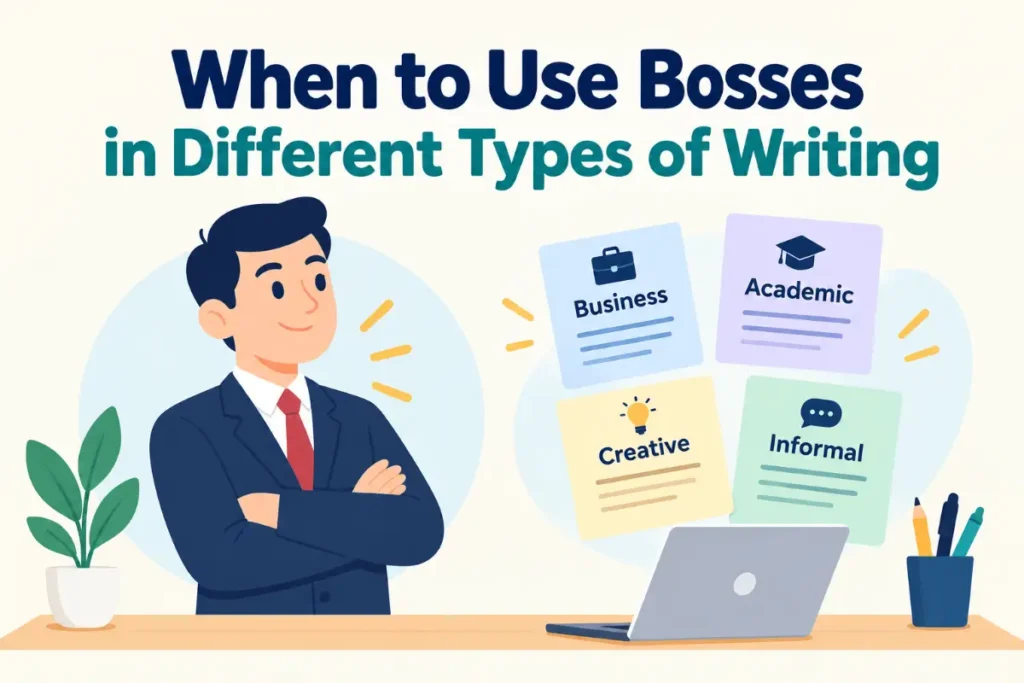
The word bosses works in casual messages, workplace emails, school assignments, and formal writing. Your choice of words depends on the situation.
In Workplace Emails
Use bosses when referring to multiple managers.
Examples.
- My bosses have approved the updated schedule.
- I’ll share the report with both bosses this afternoon.
- The bosses requested a copy of the final proposal.
You can also use managers or supervisors when those terms describe the roles more precisely.
In School Assignments
If you’re writing about leadership or workplace relationships, use bosses when referring to several people who manage others.
For example, “Employees often work with bosses who have different leadership styles.”
In academic writing, managers or employers may be more precise in some situations. An employer hires workers or runs a business, while a boss directs someone’s work. These terms can overlap, but they do not always mean the same thing.
In Text Messages and Casual Writing
The word also fits naturally in everyday messages.
Examples.
- My bosses are out of the office today.
- Both bosses said we could leave early.
- I have two bosses to update before lunch.
You don’t need a different spelling for casual writing. The same standard form works in professional and informal settings.
FAQs
Is Bosses the Correct Plural of Boss?
Yes. Bosses is the standard plural form of boss. Add es because the singular noun ends in ss.
Is Bosses or Bosses the Correct Spelling?
Both options have the same spelling. The phrase does not present two different forms to compare. Use bosses when you mean more than one manager.
What Is the Difference Between Bosses and Boss’s?
Bosses usually means more than one boss. Boss’s shows ownership by one boss. For example, “The bosses are here” refers to several managers, while “My boss’s office is open” refers to one manager’s office.
What Is the Difference Between Bosses and Bosses’?
Bosses is the regular plural form. Bosses’ shows ownership by more than one boss. For example, “The bosses’ decision surprised us” refers to a decision made by several managers.
How Do You Use Bosses in a Sentence?
Use bosses to refer to several managers or to describe the action of one person in the simple present tense. For example, “My bosses are helpful” refers to multiple managers. “She bosses her brother around” describes her behavior.
Is Bosses a Verb?
Yes. Bosses can be a verb when used with he, she, or it in the simple present tense. In the sentence “He bosses his teammates around,” it describes an action rather than a group of managers.
How Many Syllables Does Bosses Have?
Bosses has two syllables. It sounds like BOSS iz. The singular word boss has one syllable.
Is Bosss Ever Correct?
No. Bosss is not the standard spelling of the plural noun. Write bosses when you mean more than one boss.
Conclusion
The correct plural spelling of boss is bosses. Add es because the word ends in ss. This rule also applies to common words such as classes, glasses, and kisses.
Remember that bosses, boss’s, and bosses’ have different uses. Write bosses for several managers, boss’s to show ownership by one manager, and bosses’ to show ownership by several managers.
The phrase Bosses or Bosses contains the same spelling twice. The right choice depends on the meaning you want to express.
When you’re unsure, check the meaning first. If you’re talking about two or more managers, write bosses without an apostrophe. That’s the rule you can use in emails, schoolwork, and everyday writing.

Dr. Elena Vance holds a Ph.D. in Linguistics from Columbia University and has spent over 15 years analyzing the evolution of the English language. A former university professor turned full-time writer and editor, Elena specializes in breaking down high-level grammatical concepts, punctuation nuances, and style guides (APA, Chicago, MLA) into clear, actionable advice. When she isn’t hunting down dangling modifiers, she can be found collecting vintage dictionaries and reading classic literature.