
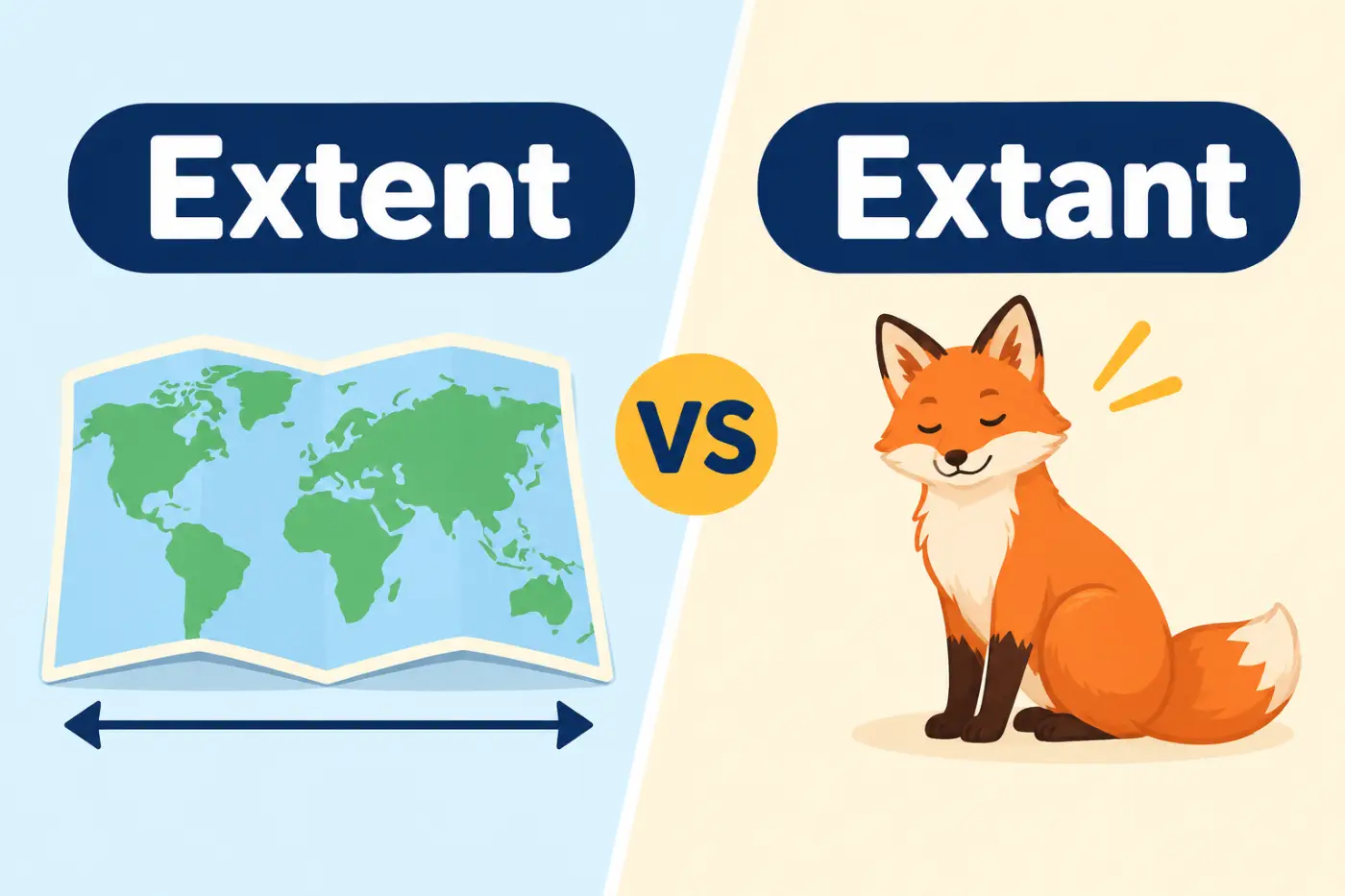
Have you ever confused extent with extant? These two words look almost identical, but they have very different meanings. Using the wrong one can change the meaning of your sentence and leave your reader confused.
The difference between extent vs extant comes down to one simple idea. Extent refers to the size, amount, or degree of something. Extant describes something that still exists, especially something that has survived from the past.
For example, you might ask about the extent of a storm’s damage. You might also read about extant letters written by a famous historical figure. The first sentence refers to how much damage occurred. The second describes letters that still exist today.
Although these words share several letters and sound similar, they don’t serve the same purpose. In this guide, you’ll learn their meanings, see how to use them in everyday sentences, and discover simple ways to remember the difference. You’ll also find answers to common questions about their spelling, pronunciation, and use.
Quick Definition
Extent is a noun that means the size, amount, range, or degree of something. For example, The report explains the extent of the damage.
Extant is an adjective that means still existing or surviving. For example, The museum holds several extant documents from the 18th century.
The Direct Answer
Use extent when you mean how much, how far, or how great something is. Use extant when you mean that something still exists. These words aren’t interchangeable because they describe two different ideas.
Extent and Extant at a Glance
| Word | Meaning | Example Sentence | When to Use It |
|---|---|---|---|
| Extent | Size, amount, degree, or range | We don’t know the full extent of the damage. | When describing how much or how far something reaches. |
| Extant | Still existing or surviving | Only a few extant copies of the book remain. | When describing something that continues to exist. |

What Does Extent Mean
Extent is a noun that describes the size, range, amount, or degree of something. It helps explain how much of something exists, how far it reaches, or how serious a situation is.
You can use it to talk about physical space, damage, knowledge, influence, effort, or many other things. The exact meaning depends on the sentence, but the central idea stays the same. You’re describing the limits or scale of something.
For example, consider this sentence.
The firefighters assessed the extent of the damage.
The word extent tells us that the firefighters examined how much damage the fire caused. It doesn’t tell us that the damage still exists. Instead, it focuses on its size or severity.
Here are a few more examples.
- The full extent of the problem became clear after the inspection.
- Scientists are studying the extent of the pollution in the river.
- She understands the extent of her responsibilities.
- The road was closed because of the extent of the flooding.
- We were surprised by the extent of his knowledge.
In each example, extent describes a degree, amount, or range.
Common Meanings of Extent
The word can take on slightly different shades of meaning depending on the context. Understanding these uses will help you choose it with confidence.
Extent as Size or Range
When you use extent to describe size or range, you’re talking about how far something reaches or how much space it covers.
For example.
The forest’s full extent is visible from the mountain.
This sentence refers to the area covered by the forest. The word can also describe the reach of an activity, an organization, or an idea.
The company expanded the extent of its operations across the country.
Here, the word refers to the range of the company’s activities.
Extent as Amount or Degree
This is one of the most common uses of the word. It describes how much of something is present or how strong a condition or quality is.
For example.
The extent of his injuries surprised the medical team.
The sentence focuses on the seriousness of the injuries. It doesn’t simply tell us that he was injured. It emphasizes how serious the injuries were.
You can use the word in a similar way when discussing success, risk, influence, or responsibility.
The manager underestimated the extent of the financial problem.
This means the manager didn’t realize how serious or large the problem was.
Extent in Formal and Academic Writing
Writers often use extent when they want to measure, explain, or discuss the reach of an idea.
For example.
Researchers examined the extent of the relationship between sleep and memory.
The sentence describes how strong or broad that relationship is. It doesn’t claim that the relationship is fully understood.
You might also see phrases such as to a large extent, to some extent, and to a certain extent. These expressions help writers explain how strongly a statement applies.
For example.
To some extent, exercise can help improve your mood.
This means exercise can improve your mood in certain ways or under certain conditions. It doesn’t mean the statement applies in every situation.
Common Expressions With Extent
Some expressions appear so often that learning them can make your writing sound more natural.
To a large extent. This means mostly or to a great degree.
The project’s success depended to a large extent on teamwork.
To some extent. This means partly or to a certain degree.
I agree with your argument to some extent.
To the extent that. This phrase introduces a limit, condition, or degree.
The team changed its plans to the extent that the budget allowed.
The full extent. This refers to the complete size, amount, or seriousness of something.
The investigators haven’t discovered the full extent of the fraud.
Extent of damage. This phrase describes how much damage has occurred.
The insurance company sent an expert to assess the extent of the damage.
Notice that each expression focuses on amount, degree, range, or limits. None means that something simply continues to exist.
What Does Extant Mean
Extant is an adjective that describes something that still exists. People often use it when discussing old books, historical records, ancient objects, works of art, and other things that have survived over time.
For example.
The library contains the oldest extant copy of the manuscript.
This means the library holds a copy that still exists today. Other copies may have been lost, damaged, or destroyed over the years.
The word often appears in historical and academic writing because it helps distinguish surviving items from things that once existed but no longer remain.
However, extant isn’t limited to ancient objects. You can use it to describe any existing item, record, or work when the context makes that meaning clear.
Consider these examples.
- Few extant records describe the town’s early history.
- The researcher studied every extant version of the poem.
- Several extant buildings date back to the colonial period.
- The museum displays an extant example of the original design.
- Only two extant copies of the first edition have been found.
In all these sentences, extant means that the item still exists.
Common Meanings of Extant
Unlike extent, which describes size or degree, extant focuses on continued existence. Its meaning stays fairly consistent, although writers use it in different settings.
Extant in History
Historians often use extant to describe documents, objects, and records that have survived from an earlier period.
For example.
The historian compared the extant letters with later accounts of the event.
The word tells us that the letters are still available for study. It doesn’t tell us how many letters existed originally or how much information they contain.
Another example.
Few extant records explain how the settlement began.
This means only a small number of records from that period still exist. Other records may have disappeared over time.
The word is useful because historical evidence often becomes lost or damaged. When a writer identifies an item as extant, the writer makes clear that the item has survived.
Extant in Literature
Literary scholars use the word when discussing surviving books, poems, plays, manuscripts, and other written works.
For example.
Several extant plays from the period reveal the themes popular with audiences.
This sentence refers to plays that have survived and can still be studied.
You might also read a sentence such as this.
The scholar examined the extant fragments of the unfinished novel.
Here, the word describes the surviving parts of the novel. The complete work may no longer exist, but some pieces remain.
This use is especially helpful when discussing writers whose works have been lost over the centuries.
Extant in Science and Research
The word can also describe things that continue to exist in the natural world or in a research setting.
For example.
The team documented all extant populations of the rare plant.
This means the researchers documented the populations that still exist.
Another example.
The study focused on extant species rather than extinct ones.
The sentence distinguishes living or existing species from species that have died out.
In scientific writing, the exact meaning depends on the subject. An extant species is one that still exists. An extant record is one that remains available. In both cases, the central idea is continued existence.
Extant in Everyday Writing
Although extant is a real and useful word, it sounds formal. Most people don’t use it in casual conversation.
Instead of saying this.
Several extant copies of the report remain in the office.
You could write this.
Several copies of the report still exist in the office.
Both sentences communicate the same basic idea. The second sounds more natural in everyday English.
Choose extant when you need a precise word and the formal tone suits your audience. Choose still existing or remaining when you want a simpler phrase.
The Main Difference Between Extent and Extant
The easiest way to remember the difference is to focus on the question each word answers.
Extent answers questions such as how much, how far, how large, or how serious.
Extant answers a different question. Does the thing still exist?
Let’s compare the words in a few real situations.
When Talking About Historical Documents
Imagine a historian researching an old town.
The extent of the surviving records is limited.
This sentence focuses on the amount or range of available records. The historian has limited evidence to work with.
Now consider this sentence.
The extant records provide clues about the town’s early years.
This sentence describes records that still exist. It doesn’t directly tell us how many records survive or how much information they contain.
Both sentences could appear in the same report, but they perform different jobs.
When Talking About Damage
Imagine a storm has damaged several homes.
Officials assessed the extent of the damage.
This means officials measured how much damage the storm caused.
Now imagine a report written several months later.
The extant damage to the historic building remains visible.
This means some damage still exists and can still be seen. The sentence uses extant to focus on what remains.
In everyday writing, however, you would usually say the remaining damage or the damage still visible. These phrases sound more natural to most readers.
When Talking About Research
Consider a scientist studying an endangered animal.
The team measured the extent of the animal’s habitat.
The sentence describes the size or range of the habitat.
Now look at this example.
Researchers counted the extant populations of the animal.
This means they counted the populations that still exist.
The first sentence focuses on size or range. The second focuses on continued existence.
Why You Can’t Swap the Words
These words aren’t interchangeable because they describe different properties.
You can’t replace extent with extant in a sentence about the amount of damage without changing its meaning or making the sentence incorrect.
Likewise, you can’t replace extant with extent when describing surviving manuscripts.
Compare these sentences.
- Correct. The extent of the damage was unclear.
- Incorrect. The extant of the damage was unclear.
- Correct. Several extant manuscripts survive today.
- Incorrect. Several extent manuscripts survive today.
The first pair refers to the amount of damage. The second pair refers to manuscripts that still exist.
When you feel unsure, ask yourself one simple question. Am I describing how much something is present, or am I describing something that still exists? That answer will usually point you to the right word.
Extent vs Extant in Real Sentences
Seeing the words in different contexts can make their meanings easier to remember. The examples below cover work, school, history, science, and everyday situations.
Examples Using Extent
Use extent when you want to describe amount, degree, size, or range.
- The company hasn’t measured the full extent of its losses.
- We were shocked by the extent of the flooding.
- The teacher explained the extent of the changes to the school schedule.
- Scientists are studying the extent of plastic pollution in the ocean.
- Her influence extended beyond the local community.
- The investigation revealed the extent of the fraud.
- I didn’t understand the extent of the work until I started the project.
- The map shows the extent of the protected area.
- The doctor explained the extent of the patient’s injuries.
- The team debated the extent of the government’s powers.
- To some extent, the new policy has improved working conditions.
- The report examines the extent of the problem in rural areas.
In each sentence, the word refers to a measurable or understandable degree, amount, or range.
Examples Using Extant
Use extant when you want to describe something that still exists.
- The archive contains several extant letters from the author.
- Few extant examples of the original artwork remain.
- Researchers studied the extant records from the early settlement.
- The museum preserves an extant copy of the ancient map.
- Several extant buildings show how people lived centuries ago.
- The scholar compared the extant versions of the poem.
- The team recorded all extant populations of the species.
- Only a handful of extant documents describe the ceremony.
- The collection includes an extant fragment of the original manuscript.
- Historians examined the extant evidence before drawing conclusions.
- The library owns one of the few extant copies of the book.
- The study focuses on extant species found in the region.
Every sentence describes something that remains in existence.
Paired Examples That Show the Difference
These pairs make the contrast even clearer.
Example One
- The extent of the library’s collection surprised visitors.
- This refers to the size or range of the collection.
- The library holds several extant books from the 16th century.
- This refers to books from that period that still exist.
Example Two
- The researchers measured the extent of the damage.
- This focuses on how much damage occurred.
- The researchers photographed the extant damage.
- This focuses on damage that remains.
Example Three
- The team studied the extent of the species’ habitat.
- This refers to the size or range of the habitat.
- The team studied the extant populations of the species.
- This refers to populations that still exist.
Example Four
- The report describes the extent of the writer’s influence.
- This describes how far the writer’s influence reached.
- The archive contains extant letters written by the author.
- This describes letters that have survived.
These examples show why spelling matters. One word describes a degree or range. The other describes continued existence.
Common Mistakes With Extent and Extant
Even confident writers can mix up these words. Their similar spelling makes it easy to choose the wrong one, especially when writing quickly.
Here are the mistakes to watch for and the simple fixes that will help you avoid them.
Using Extant When You Mean Amount
One common error is using extant to describe the size or seriousness of a problem.
Incorrect.
The extant of the damage was greater than expected.
Correct.
The extent of the damage was greater than expected.
The sentence refers to how much damage occurred. It doesn’t describe something that continues to exist. Therefore, extent is the right choice.
Remember that extant is an adjective. It describes a noun. Extent is a noun that names the size, amount, degree, or range of something.
Using Extent to Describe Something That Survives
Another mistake happens when a writer uses extent to describe an object that still exists.
Incorrect.
The museum displays an extent copy of the original manuscript.
Correct.
The museum displays an extant copy of the original manuscript.
The second sentence means that a copy of the manuscript still exists and is on display.
In everyday English, you could also say a surviving copy. This version is clear and natural for readers who aren’t familiar with the word extant.
Assuming the Words Have the Same Part of Speech
The words also differ in how they work in a sentence.
Extent is a noun. It can follow words such as the, full, great, or limited.
Examples include the full extent, a great extent, and the extent of the damage.
Extant is an adjective. It usually appears before a noun or after a linking verb.
Examples include extant documents, extant species, and the records are extant.
The last example is grammatically correct, but it sounds formal. Most everyday writers would say the records still exist.
Knowing the part of speech can help you catch mistakes before you finish a sentence.
Replacing One Word With the Other During Editing
Spellcheck may not catch every mistake because both words are correctly spelled English words. A grammar tool might also miss the problem if the sentence structure looks acceptable.
For example.
The report explains the extant of the risk.
The intended meaning is clear, but the wrong word appears in the sentence. You need extent because the report explains how great the risk is.
During proofreading, don’t rely on spelling alone. Check the meaning of the word in context.
Ask yourself if the sentence describes the size or degree of something. If it does, extent will usually fit. If it describes something that still exists, extant may be the right choice.
How to Remember the Difference
You don’t need a complicated grammar rule to remember these words. A simple memory trick can help you choose correctly.
Link Extent With Amount
Think of extent as a word that measures something.
You can measure the extent of damage, the extent of a forest, or the extent of someone’s knowledge. You can ask how great the extent is or how far something extends.
The word extend can help you remember the meaning. Both words relate to reach, range, or degree.
For example.
The road extends for several miles.
The extent of the road became clear on the map.
The two words aren’t identical in meaning, but their connection can help you remember that extent concerns range or size.
Link Extant With Existing
Think of extant as meaning existing.
Both words begin with the same three letters. This doesn’t make them identical in meaning, but it offers a useful reminder.
If a document is extant, it still exists. If a species is extant, it hasn’t died out. If a building is extant, it remains standing or otherwise survives as an existing structure.
For example.
The researcher found an extant copy of the original letter.
You can mentally replace extant with still existing. If the sentence keeps its intended meaning, the word is likely correct.
Use Two Simple Questions
When you aren’t sure which word to choose, ask yourself these questions.
Am I describing how much or how far something reaches?
Use extent.
Am I describing something that still exists?
Use extant.
Try this quick practice.
*The report explains the ___ of the damage.*
The answer is extent because the sentence describes the amount of damage.
*The archive preserves an ___ copy of the document.*
The answer is extant because the sentence describes a copy that still exists.
Once you learn this distinction, you’ll find it easier to use both words in your writing.
Related Words That Can Cause Confusion
The difference between these terms becomes easier to understand when you compare them with words that have similar meanings.
Extent vs Extend
Extent is a noun that describes size, amount, degree, or range. Extend is a verb that means to stretch, reach, offer, or make something longer.
For example.
- The extent of the garden surprised us.
- This describes the size of the garden.
- The garden extends behind the house.
- This describes how far the garden reaches.
A useful way to remember the difference is to look at the job each word performs. Extent names a range or degree. Extend describes an action or state of reaching farther.
Extant vs Existing
Extant and existing share a similar meaning. Both describe something that is still present or available.
However, extant is more formal and often appears in historical, scientific, or academic writing.
For example.
The researcher examined all extant records from the period.
You could also write.
The researcher examined all records that still exist from the period.
The second version is longer, but it may be easier for a general audience to understand.
In most everyday situations, existing, surviving, or remaining will sound more natural than extant.
Extant vs Extinct
These words have a useful contrast.
Extant means still existing. Extinct means no longer existing, especially when discussing a species that has died out completely.
For example.
The study compares extant bird species with extinct species.
The sentence compares species that still exist with species that no longer exist.
This contrast can help you remember the meaning of extant. It describes the opposite condition from extinction, although the exact context determines how the word applies.
Extent vs Degree
Extent and degree can sometimes express similar ideas. Both can describe how much, how far, or how strongly something applies.
For example.
The extent of the damage surprised the owner.
The degree of damage surprised the owner.
Both sentences describe the seriousness or amount of damage. The best choice depends on the sentence and the idea you want to emphasize.
Extent often highlights the full range or scale of something. Degree often focuses on its level or intensity.
Extent vs Scope
Scope refers to the range of something, including what it covers or includes. Extent can also describe range, but it often emphasizes how much or how far something reaches.
For example.
- The scope of the research includes three major cities.
- This tells readers what the research covers.
- The extent of the pollution became clear after the tests.
- This tells readers how widespread or serious the pollution was.
The words can overlap in some contexts, but they aren’t always interchangeable. Choose the one that best expresses the idea you want to communicate.

When to Use Extant in Formal Writing
Since extant is relatively uncommon in casual speech, it’s worth thinking about your audience before using it.
The word works well when you need to describe surviving evidence or items in a precise way. It can also save space in a sentence when readers already understand the term.
Good Situations for Extant
Use extant in contexts such as these.
- Historical research about surviving records and objects.
- Literary analysis of manuscripts and written works.
- Scientific studies of species or populations that still exist.
- Museum descriptions of surviving artifacts.
- Academic writing about evidence that remains available for study.
For example.
The researchers compared the extant manuscripts to identify changes in the text.
This sentence is clear to readers familiar with academic writing. It uses one word to express the idea that the manuscripts have survived.
When a Simpler Word Works Better
If you’re writing for a broad audience, a familiar word may communicate your point more clearly.
Instead of writing.
The archive contains several extant records.
You could write.
The archive contains several surviving records.
Or simply.
Several records still exist in the archive.
All three sentences are correct. The best choice depends on your tone and audience.
Clear writing doesn’t mean avoiding formal words. It means choosing words that help readers understand your message without extra effort.
How to Choose the Right Word in Everyday Writing
The best way to choose between these words is to focus on the meaning of your sentence rather than the way the words look.
If you’re writing an email, a school assignment, a report, or a blog post, the same rule applies. Use extent to describe amount or degree. Use extant to describe something that still exists.
In School Assignments
Students often encounter extent in essay questions.
For example.
To what extent did the Industrial Revolution change people’s lives.
This question asks students to explain how much the Industrial Revolution changed people’s lives. It calls for an answer that discusses the scale of the changes and supports the argument with evidence.
The word extant might appear in a history assignment about surviving documents.
The historian used extant letters to study life during the Industrial Revolution.
Here, the word describes letters that remain available for study.
In Workplace Writing
In business writing, extent often appears in reports about risks, costs, responsibilities, or problems.
For example.
The manager assessed the extent of the delay before changing the schedule.
This means the manager assessed how serious or widespread the delay was.
Extant is less common in ordinary workplace communication. If you need to explain that certain records still exist, you can usually write the remaining records or the records still available.
For example.
The team reviewed the remaining records before preparing the report.
This sentence is straightforward and easy to understand.
In News Articles and Online Content
Writers use extent to explain the scale of an event or problem.
For example.
Officials are still assessing the extent of the storm damage.
This tells readers that officials are trying to determine how much damage occurred.
The word extant may appear in articles about history, archaeology, wildlife, or rare collections.
For example.
Researchers discovered an extant example of the ancient tool.
This means an example of the tool still exists.
For online content, clarity should guide your choice. If a common word expresses your meaning accurately, there’s no need to replace it with a more formal alternative.
FAQs
Is extent or extant correct?
Both words are correct, but they have different meanings. Use extent for size, amount, degree, or range. Use extant to describe something that still exists.
What does extent mean in simple words?
Extent means how much, how far, or how great something is. For example, the extent of the damage describes how much damage occurred.
What does extant mean in simple words?
Extant means still existing or surviving. An extant book is a book that still exists and can be found or studied.
Is extant the same as existing?
Yes, the words have similar meanings. Both can describe something that still exists. However, extant sounds more formal and often appears in historical or scientific writing.
Can I use extent and extant in the same sentence?
Yes, you can use both words in one sentence when each expresses a different idea. For example, The report describes the extent of the damage to the extant buildings. Here, extent describes how much damage occurred, while extant describes buildings that still exist.
What is the opposite of extant?
The opposite of extant is often extinct or nonexistent, depending on the context. Extinct commonly describes species that no longer exist. Nonexistent means something does not exist.
How do you pronounce extent and extant?
Extent is pronounced ik STENT. Extant is pronounced EK stunt or ik STANT, depending on the speaker and pronunciation guide. The first syllable can vary, so listening to a trusted US English dictionary can help you learn the pronunciation used in your area.
Why do people confuse extent and extant?
The words look similar because they share most of their letters. Their similar appearance can make them easy to mix up when writing quickly. Remembering that extent describes amount and extant describes continued existence will help you choose the correct word.
Conclusion
The difference between extent vs extant is simple once you focus on what each word means. Extent describes the size, amount, degree, or range of something. Extant describes something that still exists.
Use extent when discussing the extent of damage, the range of a forest, or the degree of someone’s influence. Use extant when describing surviving books, historical records, ancient objects, or species that still exist.
Keep one simple memory trick in mind. Extent relates to how much or how far something reaches. Extant means still existing. This distinction will help you avoid common spelling and usage mistakes.
Before you finish your next sentence, ask yourself what you’re trying to describe. If you mean the size or degree of something, choose extent. If you mean something that has survived and still exists, choose extant. That small check can make your writing clearer and more accurate.

Sienna Watson is a veteran copywriter and communications coach who has helped startup founders, marketers, and professionals polish their writing for over a decade. Realizing that most people don’t need a degree in linguistics—just clear, impactful communication—Sienna focuses on practical grammar, business writing etiquette, and eliminating wordiness. She advocates for plain language, strong verbs, and persuasive prose that gets results.