
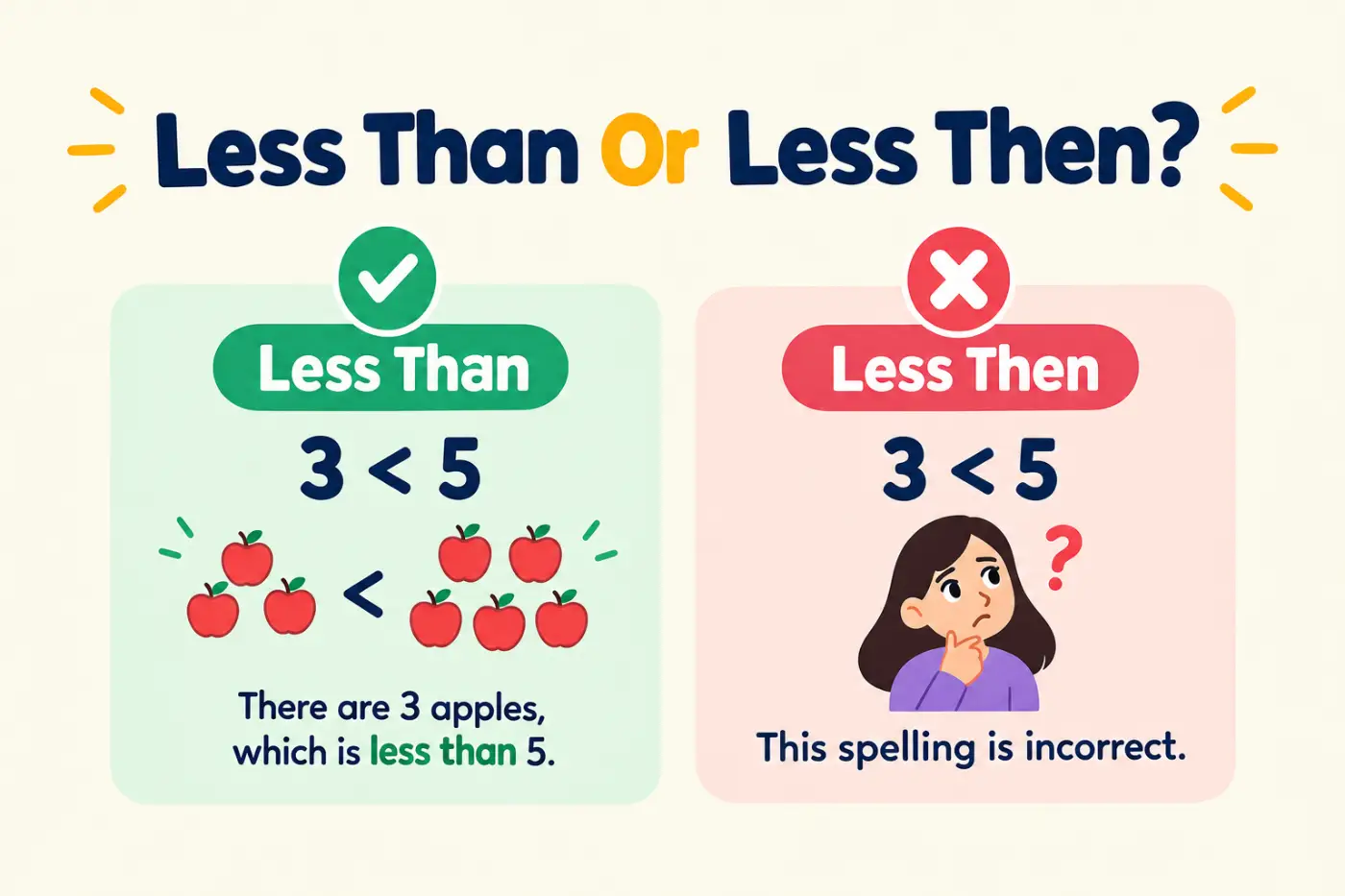
If you’ve searched for less then vs less than you probably want a quick answer. The correct phrase is less than. The word than is used when you compare two amounts, numbers, people, things, or ideas. Then usually relates to time or the order in which something happens.
The confusion is easy to understand because than and then sound very similar when spoken. Their spellings differ by only one letter. Still, they have different jobs in a sentence.
Once you know what each word does, the choice becomes much easier. This guide explains the difference between them, shows how less than works in math and everyday writing, and covers the common mistakes that can trip you up.
Quick Definition
Less than is a comparison phrase. It means that one amount or thing is smaller in number, size, value, degree, or amount than another.
Then usually refers to time or sequence. It can mean at that time, next, or after that. It does not belong in the standard comparison phrase.
Direct Answer
The correct phrase is less than when you are comparing two amounts or values. Use then when you are talking about time or the order of events.
Comparison Table
| Word or phrase | Meaning | Example sentence | When to use it |
|---|---|---|---|
| Less than | Shows a smaller amount or value in a comparison. | The trip took less than two hours. | Use it when comparing amounts or values. |
| Then | Shows time or sequence. | We ate dinner then watched a movie. | Use it to show what happened next or at a certain time. |
Why Less Than Is Correct
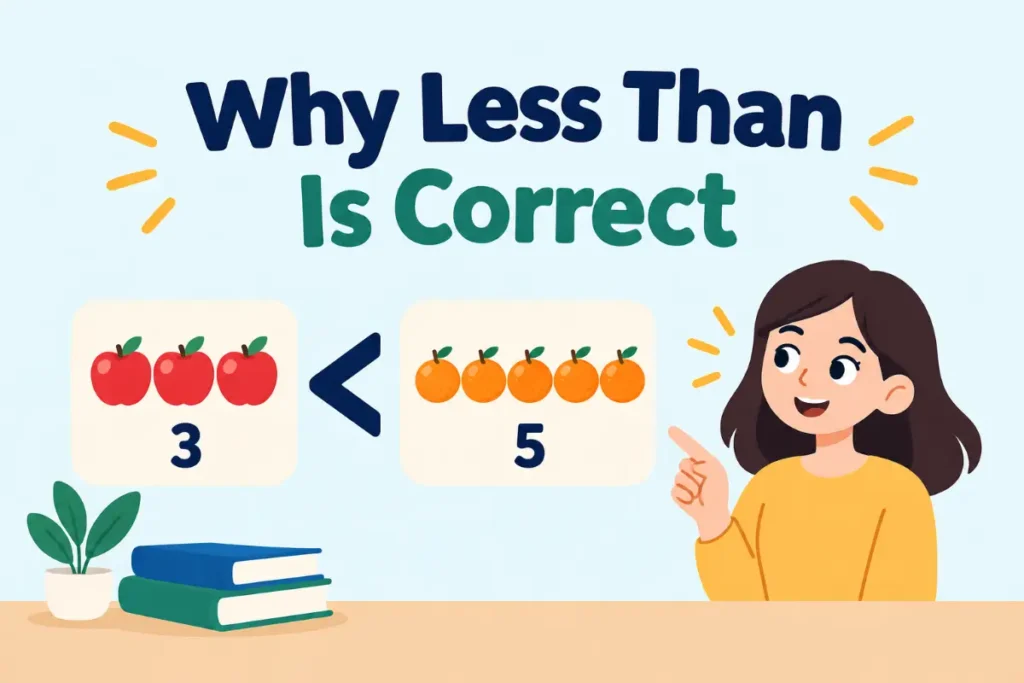
The key is the job each word performs. Than is a comparison word. It connects two things when you say that one has a smaller or greater amount than the other.
For example, you might say that a car costs less than another car. You might say that a meeting lasted less than an hour. You could also say that your new phone weighs less than your old one.
In each sentence, you are comparing two amounts or qualities. That makes than the correct choice.
Then works differently. It usually tells the reader when something happened or what happened next. For example, you might say that you finished your work and then went home. You are not comparing two things in that sentence. You are showing a sequence.
That simple difference can help you choose the right word almost every time. If the sentence compares two things, think than. If the sentence deals with time or order, think then.
What Does Less Than Mean
The phrase less than tells us that one amount is smaller than another. It can describe numbers, prices, measurements, time, age, distance, quantity, or degree.
Consider this sentence.
The package weighs less than five pounds.
The sentence compares the package’s weight with five pounds. The package has a weight below that amount.
You can use the phrase in many other situations.
- The movie lasted less than two hours.
- She spent less than twenty dollars.
- The child is less than six years old.
- We live less than a mile from the store.
- The repair took less than a day.
The comparison doesn’t always involve exact numbers. You can also compare qualities or degrees.
- This option is less expensive than the other one.
- He was less worried than he seemed.
- The second test was less difficult than the first.
- This route is less crowded than the highway.
The basic idea stays the same. One thing has a smaller amount or lower degree than another.
How Than Works In A Comparison
Than is commonly used after comparative words. These words show that something has more or less of a quality than something else.
Common examples include less, more, better, worse, faster, slower, older, and younger.
Look at these examples.
- My car is faster than yours.
- This book is more interesting than the first one.
- The blue jacket is cheaper than the black jacket.
- She is older than her brother.
- Today’s weather is better than yesterday’s.
- The second route is less crowded than the first.
The word than links the two sides of the comparison. It helps the reader understand what you are measuring against.
This is why than belongs after less in a standard comparison. The phrase needs a word that introduces the thing being compared.
How Then Works
Then has a completely different role. It usually tells us about time or sequence.
For example, imagine you are explaining what you did after work.
I went home then made dinner.
Here, then means that making dinner happened after going home. There is no comparison.
You can also use then to refer to a specific time.
- I lived in New York then.
- Back then, we didn’t have smartphones.
- She was working there then.
It can also introduce the next step in a process.
- First, wash the vegetables. Then cut them into small pieces.
- Finish your homework and then you can watch TV.
- We stopped for gas and then continued driving.
These uses have one thing in common. Then deals with time, order, or sequence.
That makes it easy to separate the two words once you stop focusing only on how they sound.
Less Than In Everyday Writing
You don’t need to use the phrase only in formal writing. It appears naturally in conversations, texts, emails, school assignments, news articles, advertisements, and instructions.
Someone might say, “The store is less than five minutes away.” A parent might tell a child, “You have less than ten minutes.” A friend might mention that a movie is less than two hours long.
It also appears often in practical information.
A product description might say that an item weighs less than one pound. A travel website might mention that a hotel is less than a mile from the beach. A recipe might say that the dish takes less than thirty minutes to prepare.
The phrase is useful because it gives readers a clear limit. When you say something takes less than an hour, the reader knows the amount is below sixty minutes.
Less Than In Math
The phrase has a very clear meaning in mathematics. It tells us that one number has a smaller value than another number.
For example.
4 is less than 9.
This means that 4 has a smaller value than 9.
You can also write this comparison with the less than symbol.
4 < 9
The symbol < means less than. The smaller number appears on the open side of the symbol.
Here are a few more examples.
- 3 is less than 8.
- 15 is less than 20.
- 0 is less than 7.
- 25 is less than 100.
This idea becomes useful when working with equations inequalities measurements and data. Students often learn the phrase and symbol together because they express the same basic comparison.
A Simple Way To Read The Symbol
Think of the symbol < as pointing toward the smaller number.
For example.
2 < 6
You can read this as “two is less than six.”
The narrow point faces 2 while the wider opening faces 6. The opening side points toward the larger value.
This visual trick can help students remember the difference between the less than and greater than symbols.
Less Than Versus Fewer Than
Another common question involves less than and fewer than. These phrases are related but they don’t always work with the same nouns.
Use fewer with things you can count as separate items.
- I have fewer than five apples.
- The class has fewer than twenty students.
- She made fewer than ten mistakes.
Use less with amounts that are not normally counted as separate units.
- I have less than five dollars.
- The recipe needs less than one cup of milk.
- We spent less than an hour there.
There are also some common cases where less appears before amounts that contain countable units. For example, people often say less than five years or less than ten miles. These expressions focus on the total amount of time or distance rather than separate objects.
The important point is to understand the meaning instead of trying to force every sentence into one rigid rule.
Common Mistakes With Than And Then
The confusion between than and then often comes from pronunciation. In many accents the two words sound very close. When you’re writing quickly you may know exactly what you want to say but still type the wrong word.
The best way to avoid the mistake is to focus on meaning. Than belongs to comparisons. Then usually relates to time or sequence. Once you identify the purpose of the word in the sentence the correct choice becomes much clearer.
Using Then In A Comparison
One common mistake is using then after a comparative word.
For example.
- This car is cheaper then that one.
- My brother is taller then me.
- The blue shirt is less expensive then the red one.
Each sentence compares two things. That means than is needed.
The corrected versions are.
- This car is cheaper than that one.
- My brother is taller than me.
- The blue shirt is less expensive than the red one.
A useful test is to ask yourself if you’re comparing two things. If you are then than is almost certainly the word you need.
Using Than For Time
The opposite mistake happens when someone uses than to describe what happens next.
For example.
- We had dinner than watched a movie.
- Finish your work than take a break.
- She went home than called her mother.
These sentences don’t compare anything. They describe a sequence of events. The correct word is then.
The corrected versions are.
- We had dinner then watched a movie.
- Finish your work then take a break.
- She went home then called her mother.
This is why meaning matters more than appearance. The words look similar but they perform different jobs.
How To Tell Than And Then Apart
You don’t need a complicated grammar rule to remember the difference. Think about what the sentence is doing.
If you’re comparing two things use than.
If you’re talking about what happens next use then.
You can also use a simple question to check your choice. Ask yourself if the sentence involves a comparison or a sequence. A comparison points you toward than. A sequence points you toward then.
For example.
My new laptop is lighter than my old one.
This compares the weight of two laptops. Use than.
I bought the laptop then installed my programs.
This tells us what happened next. Use then.
That quick check works in most everyday sentences.
Less Than Or Then In Questions
People often type the wrong word when asking about prices amounts ages or measurements. The problem becomes easy to solve once you identify the comparison.
Consider these questions.
- Is the drive less than an hour.
- Does the package weigh less than ten pounds.
- Is the jacket less than fifty dollars.
- Does the course take less than six weeks.
Each question compares an amount with a limit. Than is the correct word.
Now compare them with sentences involving time.
- Did you arrive then.
- What happened then.
- Did she call you then.
- What did you do then.
These sentences refer to a time or sequence. They don’t compare amounts.
This distinction can help you catch errors even when you’re writing quickly.
Less Than In Common Expressions
The phrase appears in many everyday expressions. Learning these patterns can make the correct usage feel natural.
Less Than A Minute
This means the amount of time is below one minute.
- The app opened in less than a minute.
- I finished the task in less than a minute.
Less Than An Hour
This describes an amount of time below sixty minutes.
- The meeting lasted less than an hour.
- We reached the airport in less than an hour.
Less Than A Mile
This describes a distance below one mile.
- The restaurant is less than a mile from our hotel.
- My office is less than a mile from the train station.
Less Than Expected
This means something is below the amount or level that someone expected.
- The repair cost less than expected.
- The event attracted less than expected.
Less Than Perfect
This phrase describes something that has flaws or falls below an ideal standard.
- The first draft was less than perfect.
- The weather was less than perfect during our trip.
These expressions appear naturally in both speech and writing. You don’t need to replace them with more complicated language.
Less Than With Numbers
Numbers are one of the easiest places to understand the comparison. When one number has a smaller value than another number you can use the phrase to describe the relationship.
For example.
- Seven is less than ten.
- Twenty is less than fifty.
- Ninety nine is less than one hundred.
- Five dollars is less than ten dollars.
The phrase can also describe limits.
- Please arrive in less than fifteen minutes.
- The box should weigh less than twenty pounds.
- The child is less than three feet tall.
In each case the reader gets a clear idea of the maximum amount. The actual value could be much smaller.
For example if someone says that a package weighs less than ten pounds the package could weigh nine pounds. It could also weigh five pounds or two pounds. The phrase simply tells you that the weight does not reach ten pounds.
Less Than With Time
Time is another common setting for this phrase. You can use it to describe how long something takes or how much time remains.
Consider these examples.
- The movie is less than two hours long.
- We finished the project in less than a week.
- The doctor saw me in less than thirty minutes.
- The store is less than ten minutes away.
- There were less than five minutes left in the game.
The meaning is straightforward. The amount of time is below the stated number.
This can also make instructions easier to understand. If a recipe says the meal takes less than thirty minutes you know roughly how much time to set aside. If a website says a form takes less than five minutes to complete you know the expected time commitment.
Less Than With Money
Money provides another clear example of comparison.
- The book costs less than twenty dollars.
- I spent less than fifty dollars at the store.
- The repair should cost less than one hundred dollars.
- She found a meal for less than fifteen dollars.
In these sentences the phrase gives the reader a price limit. The exact price may not be known but the upper amount is clear.
You can also compare prices directly.
- This phone costs less than the other model.
- The new plan is less expensive than the old one.
- Buying the tickets online costs less than buying them at the door.
The word than connects the two sides of the comparison.
Less Than With Age
Age is another common use.
- My son is less than ten years old.
- The building is less than twenty years old.
- The puppy is less than six months old.
- She has lived there for less than a year.
These sentences describe an age or period that falls below a certain amount.
You may also see a more natural form with under.
- My son is under ten years old.
- The puppy is under six months old.
Both forms can work in many situations. Less than is especially useful when you’re focusing on a measurable amount or limit.
Less Than And Under
The words less than and under can sometimes express the same idea. This is especially common when talking about numbers amounts ages prices or time.
For example.
- The ticket costs less than twenty dollars.
- The ticket costs under twenty dollars.
Both sentences tell us that the price is below twenty dollars.
You can also say.
- The trip takes less than two hours.
- The trip takes under two hours.
In everyday American English under often sounds shorter and more casual. Less than can sound a little more precise when you’re making a direct comparison.
The best choice depends on the sentence and the tone. Both are useful expressions and neither changes the basic idea that the amount is below a stated point.
When Less Than Means A Lower Degree
The phrase isn’t limited to numbers. It can also describe a lower level of quality strength importance or intensity.
For example.
- This problem is less serious than the first one.
- She seems less nervous than she did yesterday.
- The second option is less complicated than the first.
- His response was less helpful than I expected.
Here there may be no exact number involved. Instead the phrase compares degrees.
The first problem has a higher level of seriousness. The second one has a lower level. The same idea applies to nervousness complexity usefulness and many other qualities.
This is an important point because some learners think less than only works with numbers. It doesn’t. You can use it whenever you need to show that one thing has a smaller amount or lower degree of something than another.
Less Than And More Than
These phrases work as opposites in many comparisons.
More than indicates a greater amount.
Less than indicates a smaller amount.
For example.
- The blue box weighs more than the red box.
- The red box weighs less than the blue box.
Both sentences describe the same comparison from different sides.
You can use this pattern with many qualities.
- She is more experienced than I am.
- I am less experienced than she is.
Or.
- This route is more expensive than the other route.
- The other route is less expensive than this one.
Learning the two patterns together can make comparisons much easier to build.
Less Than And Fewer Than
The difference between less and fewer can cause another spelling and grammar question.
Use fewer with individual items that you can count.
- We have fewer than ten chairs.
- The store received fewer than fifty orders.
- There were fewer than twenty people at the meeting.
Use less when you’re talking about an amount or quantity that isn’t normally treated as separate items.
- We need less than ten gallons of water.
- I have less than five dollars.
- The job took less than three hours.
There are some accepted uses of less with countable units. Time distance money and measurements often work this way because we think about the total amount rather than individual objects.
For example less than five years and less than ten miles are both natural expressions.
The safest approach is to focus on the meaning of the noun and the way the phrase sounds in standard English. If you’re unsure in formal writing you can also restructure the sentence to make the comparison clearer.
A Simple Memory Trick For Than And Then
If these two words keep getting mixed up, you don’t need to memorize a long grammar rule. Give each word a simple job in your mind.
Think of than as the comparison word. Think of then as the time word.
You can remember it with two questions. Are you comparing something? Use than. Are you telling what happened next or talking about a particular time? Use then.
For example, “The blue car costs less than the red car” makes a comparison. “We went to the store then drove home” shows a sequence.
That small distinction handles most everyday situations.
Think Of Than As A Comparison Word
The word than often appears after words such as less, more, better, worse, faster, and slower.
Look at these examples.
- This book is better than the other one.
- My new phone is faster than my old phone.
- The blue dress costs less than the green dress.
- Today’s weather is warmer than yesterday’s.
- The second route is shorter than the first.
Each sentence compares two things. That gives you a strong clue that than is the right word.
Think Of Then As A Sequence Word
The word then often tells you what happens next.
- First, wash your hands. Then prepare the food.
- We finished dinner and then went for a walk.
- She called her sister and then sent an email.
- I packed my bags and then left for the airport.
You can also use then to talk about a particular time.
- I lived in Chicago then.
- Back then, I worked from home.
- Things were different then.
If the sentence has a sense of next, after that, or at that time, then usually fits.
A Quick Test You Can Use
When you’re unsure which word to choose, remove the word from your sentence and ask what kind of idea belongs there.
Take this sentence.
My new laptop costs less ___ my old laptop.
The sentence compares two laptops. You need than.
Now try this one.
I finished my work and ___ went home.
The sentence tells us what happened next. You need then.
This test works because the two words have different meanings. You aren’t trying to remember how they look. You’re checking what the sentence needs.
Common Sentences With Less Than
The phrase appears in many situations. Learning natural examples can help you recognize it without stopping to think about the grammar.
Money
- The shirt costs less than thirty dollars.
- I spent less than fifty dollars at the store.
- We found a better deal for less than expected.
Time
- The meeting lasted less than an hour.
- The package arrived in less than three days.
- You can finish the form in less than ten minutes.
Distance
- The school is less than two miles away.
- The hotel is less than a mile from the beach.
- My office is less than five minutes from the station.
Age
- The child is less than six years old.
- The building is less than ten years old.
- The puppy is less than one year old.
Quantity
- We used less than half a cup of sugar.
- The bottle contains less than one liter of water.
- The project needs less than ten hours of work.
Degree
- The second test was less difficult than the first.
- She seemed less worried than yesterday.
- This problem is less serious than we expected.
These examples show that the phrase has a much wider use than simple number comparisons. It can describe time, money, distance, quantity, age, difficulty, and many other ideas.
When To Use The Less Than Symbol
In math, the words can be replaced with the symbol <.
For example.
3 < 7
You read this as “three is less than seven.”
The symbol tells you that the value on the left is smaller than the value on the right. The narrow point faces the smaller number while the open side faces the larger number.
Here are a few more examples.
2 < 5
Two is less than five.
12 < 20
Twelve is less than twenty.
45 < 100
Forty five is less than one hundred.
This symbol appears in school math, science, statistics, computer programming, and other technical settings. The basic meaning stays the same.
Less Than And Greater Than
The less than symbol is often taught alongside the greater than symbol. The two symbols point in opposite directions.
3 < 8 means three is less than eight.
8 > 3 means eight is greater than three.
Notice that both statements describe the same two numbers. The difference is the direction of the comparison.
A useful memory trick is to think of the symbol as an open mouth. The wider side faces the larger number. The pointed side faces the smaller number.
So when you see 4 < 9 the open side faces 9 because 9 is larger.
When you see 9 > 4 the open side still faces 9.
This trick can be useful for students who often reverse the symbols.
Less Than Or Equal To
You may also see the phrase less than or equal to. It has a slightly different meaning from simple less than.
If a value is less than another value then it must be smaller.
If a value is less than or equal to another value then it can be smaller or exactly the same.
For example.
x < 10
This means x must be below 10. It cannot equal 10.
By contrast.
x ≤ 10
This means x can be 10 or any number below 10.
You might see this in math problems instructions age limits or other rules.
For example a form might say that an applicant must be less than or equal to a certain age. In that case the stated age itself is allowed.
The distinction matters because the two expressions set different limits.
Less Than In Formal Writing
The phrase works perfectly well in formal writing. You don’t need to replace it with a complicated expression just to sound professional.
For example.
- The process takes less than three weeks.
- The study included less than one hundred participants.
- The company spent less than expected.
- The device uses less energy than the previous model.
These sentences are clear and professional. Simple wording often works best because readers don’t have to stop and decode the sentence.
You may also see under in less formal writing.
- The process takes under three weeks.
- The device costs under one hundred dollars.
Both versions can work. Choose the one that fits the tone and sentence naturally.
Less Than In Negative Sentences
The phrase can appear in negative sentences too. The meaning depends on the rest of the sentence.
For example.
- The repair did not cost less than fifty dollars.
- The trip wasn’t less than three hours.
- She didn’t wait less than ten minutes.
These sentences can sometimes sound confusing because the negative word changes the meaning of the comparison.
Take the first example. Saying that the repair did not cost less than fifty dollars means the repair cost fifty dollars or more.
A clearer version might be:
The repair cost at least fifty dollars.
This is a useful writing lesson. Grammatically correct sentences aren’t always the clearest sentences. If a negative comparison feels difficult to understand, rewrite it with simpler words.
When To Use At Least Instead
At least can sometimes replace a negative version of a less than statement.
For example.
The event didn’t attract less than one hundred people.
This is correct but it makes the reader work a little harder.
You could say:
The event attracted at least one hundred people.
The second version is shorter and easier to understand.
Likewise:
The repair didn’t take less than three hours.
can become:
The repair took at least three hours.
The meaning stays the same while the sentence becomes more direct.
Good writing isn’t only about choosing the correct word. It’s also about making the meaning easy to grasp.
When To Use Under Instead
Under is often a natural alternative when you’re talking about an amount, limit, age, price, or time.
For example.
- The jacket costs less than fifty dollars.
- The jacket costs under fifty dollars.
Both sentences communicate the same basic idea.
You might also say:
- Children under twelve need an adult.
- The trip takes under two hours.
- The item weighs under five pounds.
In casual American English, under can sound more relaxed and natural. Less than often puts more attention on the comparison.
Neither choice is automatically better. Look at the sentence as a whole and choose the wording that sounds clear and natural.
Why Then Can Look Right Even When It Is Wrong
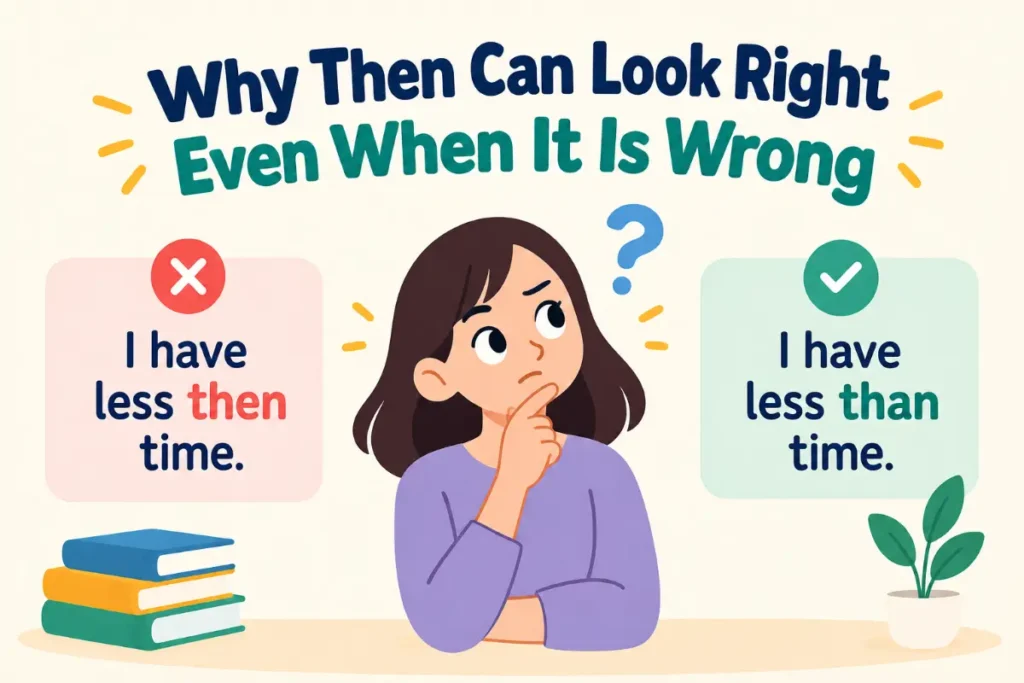
The main reason is sound. When people speak, than and then can sound so similar that your ear doesn’t always catch the difference.
Typing makes this worse. You may already know the rule but still type the wrong word because your brain is working faster than your fingers.
Another problem is visual familiarity. If you’ve seen a misspelling many times online, your brain can become used to it. A wrong form may look normal simply because you’ve encountered it often.
The solution isn’t to overthink every sentence. Instead, build one strong habit.
When you see less in a sentence, stop for a moment and check the next word. If you’re comparing an amount with another amount or limit, use than.
That quick check can prevent a very common mistake.
Related Comparison Words
Learning than alongside other comparison words can make the pattern easier to recognize.
More Than
Use more than when one thing has a greater amount or degree than another.
- She earns more than I do.
- The box weighs more than ten pounds.
- We waited more than an hour.
Less Than
Use less than when one thing has a smaller amount or degree than another.
- She spends less than I do.
- The box weighs less than ten pounds.
- We waited less than an hour.
Better Than
Use better than to compare quality or performance.
- This option is better than the first one.
- He feels better than he did yesterday.
Worse Than
Use worse than when one thing has lower quality or produces a less favorable result.
- The traffic was worse than expected.
- The second storm was worse than the first.
Faster Than
Use faster than to compare speed.
- This train is faster than the bus.
- My new computer runs faster than the old one.
Seeing these patterns together makes the role of than much easier to recognize. It regularly follows a comparative expression and introduces the thing being compared.
FAQs
Is less then or less than correct?
The correct phrase is less than. Use than when you’re comparing two amounts or values. Then is used mainly for time or sequence.
Why do people confuse than and then?
The two words sound very similar in everyday speech. They also have nearly identical spellings. The easiest way to tell them apart is to remember that than is used for comparisons while then usually shows time or order.
Is less than used only with numbers?
No. You can use less than with numbers as well as qualities and degrees. For example, you can say that a trip takes less than two hours or that one option is less expensive than another.
What is the difference between less than and fewer than?
Use fewer with separate items that you can count. For example, you can have fewer than ten books. Use less with amounts such as money, time, distance, or liquid.
Can I use under instead of less than?
Yes, in many everyday sentences. You can say that a jacket costs less than fifty dollars or that it costs under fifty dollars. Both can communicate that the price is below fifty dollars.
What does the less than symbol mean?
The symbol < means that the value on the left is smaller than the value on the right. For example, 4 < 9 means that four is less than nine.
Does less than mean the same as less than or equal to?
No. Less than means the value must be smaller. Less than or equal to allows the value to be smaller or exactly the same.
Is then ever correct after less?
Not when less introduces a comparison. For example, “The trip costs less than $100” uses than because it compares the cost with $100. Then would be correct only when it refers to time or sequence.
Conclusion
If you’ve been unsure about less then or less than, remember one simple rule. Use than for comparisons and then for time or sequence. So when you’re comparing an amount, price, distance, age, degree, or other value, less than is the correct form.
The word then has a different job. It tells readers that something happened next or refers to a particular time. You might finish dinner and then wash the dishes. You might also say that things were different back then.
The two words sound similar, so mixing them up is an easy mistake. The good news is that you don’t need a complicated grammar lesson to fix it. Ask yourself one quick question. Am I comparing something or describing a sequence. If you’re comparing, choose than. If you’re describing what happens next, choose then.
Keep that test in mind when you write emails, school assignments, work documents, or everyday messages. It takes only a second to check and it can keep a very common spelling mistake out of your writing.

Dr. Elena Vance holds a Ph.D. in Linguistics from Columbia University and has spent over 15 years analyzing the evolution of the English language. A former university professor turned full-time writer and editor, Elena specializes in breaking down high-level grammatical concepts, punctuation nuances, and style guides (APA, Chicago, MLA) into clear, actionable advice. When she isn’t hunting down dangling modifiers, she can be found collecting vintage dictionaries and reading classic literature.