
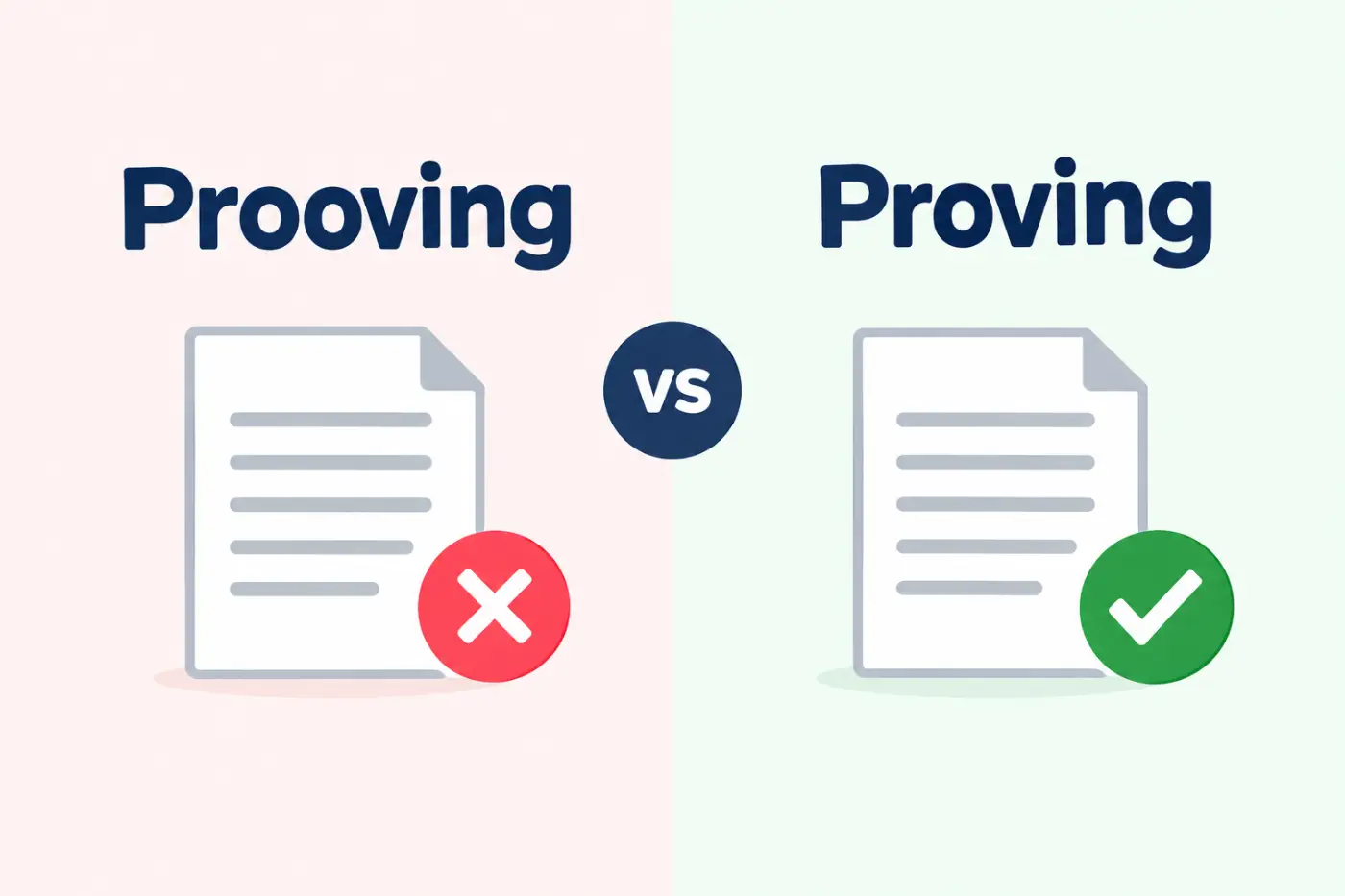
If you’re stuck on prooving vs proving you’re dealing with a very common spelling mistake. Only one of these forms is correct in standard English. The correct word is proving.
The confusion usually comes from the spelling of the base verb prove. When you add ing to some verbs you double the final consonant. That rule can make it tempting to write prooving with two o’s. But prove does not work that way.
In this guide you’ll learn why proving is correct how the word is formed and how to use it in natural sentences. You’ll also see how it differs from prove proved and proof so you can avoid similar mistakes.
Quick Definition
Proving is the present participle or gerund form of the verb prove. It means showing that something is true correct or valid by giving facts evidence or a clear reason.
Prooving is not the standard spelling. The extra o should not appear when you add ing to prove.
Direct Answer
Proving is the correct spelling. Prooving is incorrect because the final e in prove is removed before ing is added.
Comparison Table
| Word | Meaning | Example Sentence | When to Use It |
|---|---|---|---|
| Proving | Showing that something is true or correct. | She is proving her point with strong evidence. | Use it when describing an action in progress or a noun like activity. |
| Prooving | Incorrect spelling of proving. | This spelling is incorrect. | Do not use it. |
Why The Spelling Is Proving
The easiest way to understand the spelling is to start with the base verb prove.
The word prove ends with a silent e. When you add the suffix ing to a verb that ends in a silent e you normally remove that final e first. That gives you prov. Add ing and you get proving.
The spelling works like this.
prove → prov → proving
You don’t keep the final e. You also don’t add another o. The two vowels in prove do not become three vowels when the suffix is added.
This same pattern appears in many other English verbs. For example move becomes moving. write becomes writing. take becomes taking. make becomes making.
The spelling rule is simple once you see what happens to the final e. The base word changes before the suffix is attached.
The Spelling Rule For Verbs Ending In Silent E
Many English verbs end in a silent e. When you add ing the final e usually disappears.
Here are some common examples.
- Make becomes making.
- Take becomes taking.
- Give becomes giving.
- Write becomes writing.
- Move becomes moving.
- Hope becomes hoping.
- Use becomes using.
- Drive becomes driving.
- Save becomes saving.
- Prove becomes proving.
This rule explains the spelling without requiring you to memorize the word by itself.
Notice that the pronunciation can stay familiar even though the spelling changes. The silent e helps shape the sound of the base word but it does not remain when ing is added.
Why Proove Looks Tempting
Some people mentally break the word into prove + ing and try to keep every letter from the original word. That can lead to prooveing or prooving.
English spelling does not work by simply attaching letters to every base word. Some words change when a suffix is added. The silent e is one of the most common letters that gets removed.
Think of the final e as a letter that has a job in the base word but leaves when ing arrives.
That gives you prove for the base form and proving for the form with ing.
What Does Proving Mean
Proving means showing that something is true or correct. The word often involves evidence facts examples results or a clear argument.
For example someone might be proving that a claim is false. A scientist might be proving a theory with test results. A student might be proving the answer to a math problem by showing the steps.
The word can also describe a person demonstrating a skill or ability.
Consider these sentences.
- She is proving that she can handle the job.
- The new evidence is proving his claim correct.
- He spent years proving himself as a skilled designer.
- The experiment is proving that the method works.
- I’m proving my point with the original documents.
In each sentence the person or thing is showing something to be true or valid.
Proving In Everyday English
You don’t have to use this word only in academic or formal writing. It appears in ordinary conversations too.
Imagine a friend says you can’t finish a difficult task. You might respond by saying that you’re proving them wrong. This is a common expression and simply means showing that their belief or prediction was incorrect.
You might also hear someone say that they are proving themselves. This means they are showing other people what they can do through their actions or results.
For example.
- She is proving herself as a strong leader.
- He wants to prove himself to his new team.
- The young player is proving that he belongs in the league.
The word can describe small personal moments as well as serious evidence based arguments.
Common Uses Of Proving
Understanding the common patterns around a word makes it easier to use naturally. Proving often appears after forms of be such as is are was and were.
Proving A Point
When you show that an argument or statement is correct you can say that you are proving a point.
- The data is proving her point.
- He kept calm while proving his point with facts.
The phrase does not mean that someone is trying to win an argument at all costs. It simply means they are giving evidence that supports what they said.
Proving Someone Wrong
This phrase means showing that another person’s belief or prediction was incorrect.
- She is proving everyone wrong with her results.
- The team is proving its critics wrong this season.
This expression is common in both casual speech and written English.
Proving Yourself
To prove yourself means to demonstrate your ability through your actions or achievements.
- He is proving himself to be a reliable employee.
- She worked hard to prove herself in a new role.
People often use this phrase when someone enters a new job joins a team or takes on a difficult challenge.
Proving A Claim
A claim is something a person says is true. Evidence can support or challenge that claim.
- The documents are proving the claim to be accurate.
- Researchers are working on proving the claim with new data.
This use appears more often in academic scientific legal and professional writing.
The Difference Between Prove And Proving
Prove and proving come from the same verb but they do different jobs in a sentence.
Prove is the basic form. You use it after words such as to and after modal verbs like can will may and should.
- I want to prove my point.
- We can prove the answer.
- She will prove that the report is accurate.
Proving is the ing form. It commonly appears after a form of be when an action is happening or continuing.
- She is proving her point.
- They are proving the method works.
- He was proving his ability through hard work.
Choosing the right form depends on the structure of the sentence. The spelling changes because the final silent e drops before ing is added.
Why You Should Not Double The O
The spelling prooving may look reasonable at first glance because the base word contains oo. However the two o’s already belong together in the base word prove. Adding ing does not require another o.
The change happens at the end of the word. Remove the silent e and attach ing.
prove → proving
The spelling does not become proove → prooving.
This distinction is worth remembering because the same kind of mistake can happen with other verbs ending in silent e. If you learn the pattern instead of memorizing only one word you can apply it to many words.
Common Spelling Mistakes With Proving
The most common mistake is adding another o and writing prooving. This happens because the base word prove already contains two o’s. When people add ing they sometimes assume every letter in the original word should stay in place.
That isn’t how this verb changes. The final silent e is removed before ing is added. The two o’s stay exactly where they are.
So the correct pattern is prove, then proving.
A second mistake is keeping the final e and writing proveing. This form is also incorrect. The final e does not stay when ing follows it.
The three forms below make the difference clear.
| Form | Correct | Example |
|---|---|---|
| Prove | Yes | I can prove my answer. |
| Proving | Yes | She is proving her answer. |
| Proove | No | This is not the correct spelling. |
| Prooving | No | This is not the correct spelling. |
| Proveing | No | This is not the correct spelling. |
Once you see the pattern you don’t need to guess. Start with prove. Remove the final e. Then add ing.
Examples In Real Sentences
The best way to understand a spelling rule is to see it in normal writing. These examples show how the word works in different situations.
Proving A Fact
Someone can prove a fact by showing reliable evidence.
- The records are proving that the payment was made.
- The test results are proving the original claim.
- New evidence is proving that the old report was wrong.
In each example the action is happening or developing. That’s why the ing form fits naturally.
Proving A Point
People often use this expression during discussions and debates.
- Maria brought several examples for proving her point.
- He kept the original document for proving his claim.
- The results are proving my point.
The phrase can sound formal in some sentences. In casual speech people often say to prove my point instead.
For example.
- I only showed you the photo to prove my point.
Both forms can be correct. The sentence structure determines which one you need.
Proving Someone Wrong
This is one of the most familiar uses of the word.
- She is proving her critics wrong.
- The student is proving everyone wrong with her results.
- His actions are proving the prediction wrong.
The expression means that someone’s actions or evidence show that another person’s belief was incorrect.
Proving Yourself
The phrase proving yourself means showing people that you have the ability or skill to do something.
- He is proving himself as a capable manager.
- She worked hard to prove herself at the new company.
- The young athlete is proving herself on the national stage.
You might hear this phrase when someone starts a new job joins a new team or takes on a major challenge.
Proving In School And Academic Writing
Students often use this word when they explain answers or support an argument. In math the word can describe a logical demonstration that shows why an answer or statement must be true.
For example.
- The final step is proving that both sides are equal.
- The student is proving the formula with a clear calculation.
- The evidence is proving the main idea.
In essays the word can describe support for an argument.
- The examples help in proving the author’s main point.
- The research is proving that the original assumption was weak.
Still you don’t always need proving. Sometimes showing or demonstrating sounds more natural.
For example.
- The results are showing a clear change.
- The results are demonstrating a clear change.
The best word depends on what you want to say. Prove usually carries the idea of establishing that something is true or correct.
Proving In Science
Science uses evidence to test ideas and support conclusions. You may see proving in discussions about experiments research and scientific claims.
For example.
- The experiment is proving that the process can work at a lower temperature.
- Researchers are studying the results before proving the final claim.
- The new data is helping scientists prove their theory.
There is one point worth keeping clear. Scientists don’t usually treat one experiment as absolute proof of every broad claim. Research builds evidence over time. A finding can support an idea while later evidence may change our understanding.
That distinction also helps explain why prove can sometimes sound stronger than support.
If you say the evidence supports the claim you mean the evidence gives good reason to believe it.
If you say the evidence proves the claim you make a much stronger statement that the evidence establishes it as true.
Proving In Everyday Conversation
You don’t need a formal setting to use this word. People use it in casual speech all the time.
Imagine your friend says you won’t finish a difficult project. You might say that you’ll prove them wrong.
Later you finish the project and show them the result. You could say that you’re proving you can do it.
Here are a few natural examples.
- I’m proving that I can do this on my own.
- You’re proving me wrong.
- The results are proving that we made the right choice.
- He keeps proving himself with every new challenge.
- She’s proving to everyone that she belongs here.
These sentences sound natural because proving describes an action that is taking place or continuing.
Prove And Proved And Proving
These three forms can cause confusion because they come from the same verb.
Prove is the base form.
- I need to prove my point.
- We can prove the answer.
- They will prove their case.
Proved is the past tense and past participle form commonly used in American English.
- She proved her point.
- He proved that the machine worked.
- The test proved useful.
Proving is the ing form.
- She is proving her point.
- He is proving that the method works.
- They are proving their ability.
Think about the time of the action. Prove can describe a basic action or an action that will happen. Proved describes something that happened in the past. Proving often describes something happening now or continuing over a period of time.
Prove And Proof Are Not The Same
Another useful distinction is the difference between prove and proof.
Prove is a verb. It describes the act of showing that something is true.
Proof is usually a noun. It refers to evidence or information that shows something is true.
Compare these sentences.
- The document can prove that she owned the property.
- The document is proof that she owned the property.
The first sentence focuses on the action. The second focuses on the evidence.
You can also use proof in everyday situations.
- Do you have proof of purchase.
- The photo was proof that he had been there.
- We need proof before making a final decision.
Knowing this difference helps you choose the right word instead of simply looking for a different spelling.
Proving And Showing
The words proving and showing can overlap but they don’t always have the same strength.
Showing means making something clear or visible. It doesn’t always establish that something is true.
Proving usually suggests stronger evidence. It means establishing that something is true or correct.
Compare these examples.
- The chart is showing a rise in sales.
- The records are proving that sales increased.
The first sentence says the chart displays the information. The second says the records establish the fact.
In casual writing showing can sound more natural. In an argument or discussion proving may be the better choice when the evidence clearly supports the claim.
Proving And Demonstrating
Demonstrating is another close synonym. It often means showing something clearly through an example action or evidence.
For example.
- The teacher is demonstrating how the machine works.
- The results are demonstrating the value of the new method.
You could sometimes replace demonstrating with proving. But the meaning can change slightly.
A teacher can demonstrate how something works without proving a larger claim. Demonstration focuses on making something clear. Proof focuses on establishing that something is true.
That small difference matters in careful writing.
When Proving Sounds Natural
Use proving when you want to describe an action that is in progress or connected to another activity.
It commonly appears after forms of be.
- I am proving my point.
- She is proving her ability.
- They are proving the system works.
- He was proving his value to the team.
It can also work as a gerund. A gerund is an ing form that acts like a noun.
For example.
- Proving your claim takes time.
- Proving the result requires more testing.
- Proving the theory was harder than expected.
In these sentences the word doesn’t describe an action happening at this exact moment. Instead it names an activity.
That gives proving two useful roles. It can describe an ongoing action and it can act as a noun in a sentence.
When To Use Prove Instead
Use prove when the sentence needs the basic form of the verb.
After to you normally use prove.
- I want to prove my point.
- She hopes to prove her ability.
- They need to prove their claim.
After modal verbs such as can will should and might you also use prove.
- We can prove the answer.
- He will prove his case.
- She should prove her claim with evidence.
- They might prove the theory correct.
Don’t change the word to the ing form just because the sentence talks about proof. The grammar of the sentence decides the form you need.
A Simple Memory Trick
If the spelling keeps slipping your mind use a three step method.
First write the base word prove.
Next remove the final e.
Then add ing.
That gives you proving.
You can also remember the phrase prove without e plus ing. It isn’t a complicated rule and it works well for this word.
The same trick helps with many familiar verbs.
- Hope becomes hoping.
- Move becomes moving.
- Write becomes writing.
- Drive becomes driving.
- Bake becomes baking.
- Smile becomes smiling.
- Save becomes saving.
The final e usually disappears before ing is added. Once you recognize that pattern you can solve many spelling questions without checking a dictionary.
More Spelling Rules For Proving
The spelling of proving becomes easier when you understand what happens to verbs that end in a silent e. In most cases the final e disappears before ing is added. This gives you a clean spelling pattern that you can use with many other verbs.
For example love becomes loving. Dance becomes dancing. Close becomes closing. Change becomes changing. The same idea applies to prove which becomes proving.
The important point is that the spelling change happens at the end of the word. The two o’s in prove stay exactly as they are. Only the final e is removed.
Words That Follow The Same Pattern
You can strengthen your memory by learning similar words together.
| Base Word | Ing Form | Example |
|---|---|---|
| Prove | Proving | She is proving her point. |
| Move | Moving | We are moving next month. |
| Improve | Improving | His writing is improving. |
| Remove | Removing | They are removing the old sign. |
| Approve | Approving | The board is approving the request. |
| Save | Saving | She is saving money for college. |
| Create | Creating | He is creating a new design. |
| Complete | Completing | They are completing the project. |
Notice the pattern. Each base word ends in a silent e. The e disappears before ing is added.
When The Final E Stays
The rule has a useful exception. You don’t remove the final e from every word before every suffix.
Some words keep the e when another ending is added. The reason depends on the suffix and the word.
For example see becomes seeing. The word already ends in two e’s and doesn’t follow the same pattern as prove.
Be becomes being. You don’t write bing.
Agree becomes agreeing. Again the final letters stay because the word has a different structure.
These examples show why it’s better to learn the actual spelling pattern than to rely on a rule without looking at the word itself.
For prove the answer is simple. Remove the final e and add ing.
Why Proving Has Two O’s
One reason this spelling causes trouble is the pair of o’s in the base word. When you see prove you already have two o’s sitting together.
When ing is added the word still has two o’s.
- prove
- proving
The number of o’s does not change.
This may sound obvious when you see the words side by side but that small visual reminder can prevent the most common mistake. You aren’t creating another vowel sound. You’re simply changing the ending of the verb.
So don’t think of the word as proove plus ing. Think of it as prove with the final e removed plus ing.
That small change in how you picture the word can make the spelling much easier to remember.
The Difference Between Proving And Improving
Improving and proving look similar because they share the same ending. They also follow the same spelling rule because both base verbs end in silent e.
- Prove becomes proving.
- Improve becomes improving.
The meanings are completely different.
To prove something means to establish that it is true or correct.
- The evidence is proving his claim.
To improve means to make something better or become better.
- Her writing is improving every week.
Don’t let the similar spelling fool you. The shared ending only tells you how the words are formed. Their meanings depend on the base verbs.
Common Phrases With Proving
Learning common phrases can help you recognize the correct form without having to think about every letter.
Proving A Theory
This phrase often appears in science and academic writing.
- The researchers are testing new evidence for proving the theory.
- The experiment is proving the theory difficult to support.
A theory is an explanation that can be tested. Strong evidence can support a theory and repeated testing can increase confidence in it.
Proving A Case
This phrase can appear in legal and everyday discussions.
- The lawyer is proving the case with official records.
- The documents helped prove the case.
The phrase refers to presenting enough evidence to establish an argument or claim.
Proving Your Worth
This expression means showing through your actions that you have value or ability.
- She is proving her worth through hard work.
- He spent the first few months proving his worth to the team.
The phrase is common in conversations about work sports and personal goals.
Proving A Point
This is probably one of the most common expressions.
- You’re proving my point.
- The results are proving her point.
- He brought the report to prove his point.
The expression means that facts or actions support something a person has already said.
Proving Someone Right
The word can also describe evidence that confirms another person’s opinion or prediction.
For example.
- The results are proving her right.
- His early prediction is proving right.
- The latest figures are proving the experts right.
In these sentences the person was already making a claim. Later evidence supports that claim.
The opposite expression is proving someone wrong.
- The new results are proving the critics wrong.
- She is proving everyone wrong through her performance.
Both expressions are common in everyday American English.
Proving Yourself At Work
People often use this expression when someone starts a new position or takes on greater responsibility.
A new employee may want to show that they can handle the work. An experienced employee may want to show that they are ready for a promotion.
For example.
- He is proving himself as a strong team leader.
- She has spent months proving herself in the new position.
- The intern is proving that she can handle difficult assignments.
Here the word doesn’t mean that the person is proving a mathematical fact. It means they are demonstrating their ability through real results.
Proving Yourself In Sports
The same expression works in sports.
A young player may need to show that they belong on a major team. A returning player may need to show that they still have the skill to compete.
For example.
- The rookie is proving himself during his first season.
- She is proving that she can compete at the highest level.
- The team is proving its critics wrong.
This use is very natural in sports news and everyday conversation.
The Grammar Behind The Ing Form
The ing ending can serve several grammatical purposes. Understanding those uses helps you know when proving belongs in a sentence.
One common use is the present progressive tense.
- She is proving her point.
- They are proving the system works.
- He is proving himself every day.
The form is proving describes an action that is happening or developing.
The word can also appear with was or were.
- She was proving her point when the meeting ended.
- They were proving the method could work.
- He was proving his value to the company.
In these examples the action was in progress at a point in the past.
Proving As A Gerund
The word can also act as a noun. This use is called a gerund.
Consider this sentence.
- Proving the claim took several months.
Here proving the claim names an activity. It isn’t describing something that a person is doing at this exact moment.
Another example is.
- Proving your point requires good evidence.
The sentence talks about the general activity of establishing a point.
This is useful because it shows that proving isn’t limited to sentences with is are was or were. The form can have different grammatical roles depending on how you build the sentence.
Proving And Proved
A common grammar question involves proving and proved.
Use proved when you are talking about an action that has already happened.
- The evidence proved his claim.
- She proved that the machine worked.
- The test proved useful.
Use proving when the action is ongoing or when the ing form acts as a noun.
- The evidence is proving his claim.
- She is proving that the machine works.
- Proving the result took several attempts.
The difference is mostly about sentence structure and time. Look at the verb before the word and ask what the sentence is doing. That will usually make the correct form clear.
Proving And Proofing
This pair deserves attention because proofing is also a real English word. However it does not mean the same thing as proving.
Proving comes from prove. It means showing that something is true or correct.
- The evidence is proving the claim.
Proofing comes from proof and has several meanings. In publishing it can mean checking written material for errors before publication.
- She is proofing the article before it goes online.
In cooking proofing can describe allowing yeast dough to rise.
- The baker is proofing the dough.
So these words may look similar but they describe different actions. If you’re talking about evidence or establishing truth use proving. If you’re checking a document or preparing yeast dough the word may be proofing.
A Quick Way To Check The Spelling
When you’re unsure about the spelling take the word back to its base form.
Ask yourself which verb you are starting with.
If the base word is prove then remove the final e before adding ing.
That gives you proving.
This method works better than trying to remember the entire word from scratch. It also helps you spell related forms correctly.
For example.
Prove becomes proved for the past tense.
Prove becomes proving for the ing form.
Seeing the whole word family together makes the spelling pattern easier to understand.
A Simple Practice Exercise
Try filling in the missing letters in these sentences.
- The results are pro_____ that the method works.
- She is pro_____ her ability every day.
- He wants to pro_____ his claim.
- The evidence pro_____ that the report was false.
- Pro_____ the theory will require more research.
The answers are proving proving prove proved and proving.
The exercise shows why you can’t choose a verb form based only on the meaning. The grammar of the sentence matters too.
How To Avoid The Mistake For Good
The best approach is to stop treating the incorrect form as an alternative spelling. There aren’t two accepted spellings that you need to choose between.
When you see the base word prove remember one simple change. Drop the final e before adding ing.
Then write proving.
It also helps to read your writing once before you send or publish it. Pay extra attention to words you often mistype. A quick check can catch errors that spell check misses.
If you use the word often you won’t need this reminder forever. Repeated exposure builds familiarity. Eventually proving will look right and the extra o in the incorrect version will look obviously wrong.
FAQs
Is proving the correct spelling?
Yes. Prooving vs proving has a clear answer. Proving is the correct spelling and prooving is incorrect. The correct form comes from prove with the final silent e removed before ing is added.
Why is proving spelled with one o after the r?
The base word prove already has two o’s. Adding ing doesn’t add another o. You simply remove the final e and attach ing which gives you proving.
Is prooving a real word?
No. Prooving isn’t a standard English spelling. If you see it in an email article assignment or other text it is almost certainly a spelling error.
What is the difference between prove and proving?
Prove is the base form of the verb. Proving is the ing form and commonly describes an action that is happening or continuing. For example you can say I want to prove my point or I am proving my point.
What is the past tense of prove?
The simple past form is proved. For example you can say The evidence proved his claim. Proven is also commonly used as a past participle especially in phrases such as a proven method.
Why does the final e disappear in proving?
The final e in prove is silent. When many verbs ending in a silent e take the ing ending the final e is dropped. This gives you forms such as move to moving and write to writing.
Is proving the same as showing?
The meanings can overlap but they aren’t always identical. Showing can mean making something clear while proving usually means giving enough evidence to establish that something is true or correct.
Is proofing the same as proving?
No. Proving means showing that something is true or correct. Proofing can mean checking written material for mistakes or allowing yeast dough to rise.
Conclusion
The answer to prooving vs proving is simple. Proving is the correct spelling. The incorrect form adds an extra o and doesn’t follow the spelling pattern used when prove takes the ing ending.
The easiest way to remember it is to start with prove. Remove the final e and add ing. The result is proving. The two o’s remain in place and nothing extra gets added between them.
This same spelling pattern appears in many other verbs. Move becomes moving. Improve becomes improving. Save becomes saving. Write becomes writing. Once you understand the pattern you can use it far beyond this one word.
The next time you type this word stop for a quick second and look at the base form. Start with prove then drop the final e before adding ing. That gives you proving every time.

Dr. Elena Vance holds a Ph.D. in Linguistics from Columbia University and has spent over 15 years analyzing the evolution of the English language. A former university professor turned full-time writer and editor, Elena specializes in breaking down high-level grammatical concepts, punctuation nuances, and style guides (APA, Chicago, MLA) into clear, actionable advice. When she isn’t hunting down dangling modifiers, she can be found collecting vintage dictionaries and reading classic literature.