
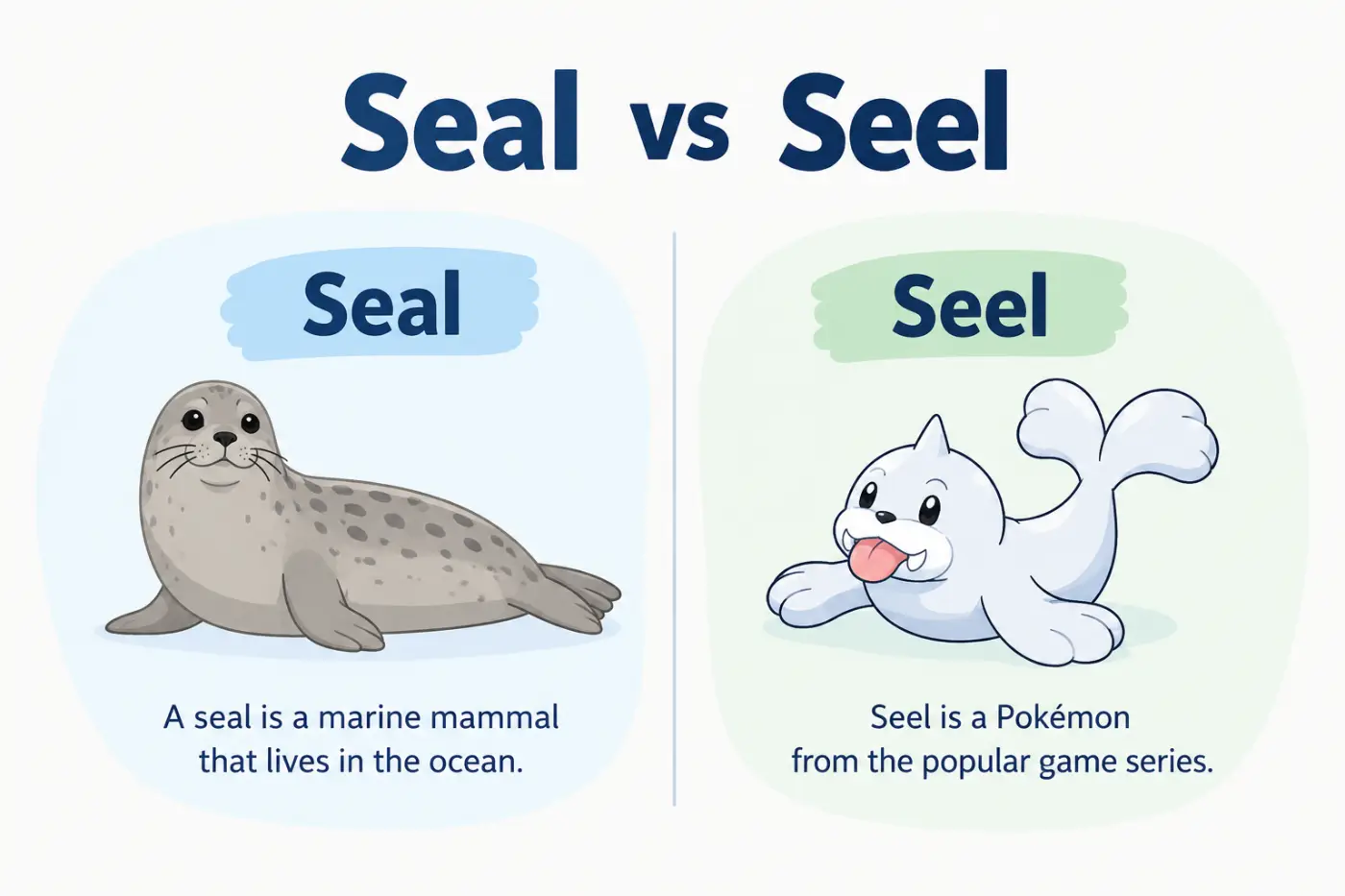
If you’re confused by seal vs seel you’re probably trying to figure out which spelling belongs in your sentence. The answer is usually seal. It is a common English word with several meanings. Seel is also a real word but it has a much narrower use.
You may see seal when talking about closing something tightly. A package can have a seal. A person can seal an envelope. The word can also refer to an animal such as a harbor seal or to an official mark placed on a document.
Seel is much less common. It is mainly an old or specialized verb that means to stitch or close the eyelids of a bird. It can also appear in older writing with a different meaning related to making a bird’s eyes blind or closed. Most people will rarely need this word in everyday English.
This guide explains the difference in plain English. You’ll learn what each word means how to use them in real sentences why they get confused and which spelling you should choose in common situations.
Quick Definition
Seal is a common English word that can mean to close something securely or to confirm or finalize something. It is also the name of a marine mammal and can mean an official mark or emblem.
Seel is a rare word used mainly in historical or specialized writing. It refers to closing or stitching a bird’s eyelids.
Direct Answer
Seal is the word you want in almost all everyday writing. Seel is a rare specialized term connected mainly with the historical practice of closing a bird’s eyelids.
Comparison Table
| Word | Meaning | Example Sentence | When to Use It |
|---|---|---|---|
| Seal | To close securely or make something final. | Please seal the envelope before mailing it. | Use it in everyday English. |
| Seal | A marine mammal. | We saw a seal near the shore. | Use it when talking about the animal. |
| Seal | An official mark or emblem. | The document carried the official seal. | Use it for an official mark. |
| Seel | To close or stitch a bird’s eyelids. | The old text describes how falconers would seel a bird. | Use it mainly in historical or specialized contexts. |
What Does Seal Mean
Seal has several common meanings. The meaning depends on how the word appears in a sentence.
One of the most common uses is as a verb meaning to close something tightly. You might seal a box with tape or seal an envelope before putting it in the mail. The basic idea is that you close something so it stays shut or protected.
For example.
- Please seal the package before you take it to the post office.
- She sealed the envelope and placed it on the desk.
- Make sure you seal the container tightly after opening it.
The word can also mean to make an agreement or decision final. If two sides reach an agreement they may say that the deal has been sealed. This use often appears in business news and everyday conversation.
For example.
- The two companies sealed the agreement on Friday.
- Her final signature sealed the deal.
- The goal in the final minute sealed the team’s victory.
There is another familiar meaning. A seal can be an official mark that shows approval authority or authenticity. Government offices universities and organizations have used seals on important documents for centuries.
For example.
- The certificate has the university seal.
- The official document bears the state seal.
- The envelope was stamped with a red wax seal.
Finally seal can refer to a marine mammal. Seals live in oceans and are known for their smooth bodies flippers and ability to move both in water and on land.
For example.
- We watched a seal swimming near the rocks.
- A young seal rested on the beach.
- The aquarium cares for several rescued seals.
These meanings may seem unrelated at first. They all use the same spelling because they come from different historical uses of the word. Context tells you which meaning applies.
What Does Seel Mean
Seel is a real English word but it is uncommon. You are much more likely to encounter it in historical books or writing about falconry than in an everyday email or conversation.
The word is associated with the old practice of closing or stitching a bird’s eyelids. Falconers historically used this practice on certain birds of prey. The purpose was to keep the bird calm during handling and training.
Because this practice belongs to a specific historical tradition seel has very limited use in modern everyday English.
For example.
- The historical account describes how falconers would seel the bird.
- The old manuscript mentions the use of seeling during training.
You probably won’t need this word in normal writing. If you’re talking about closing a box an envelope a container or a deal seal is the spelling you need.
Why These Words Get Confused
The confusion comes from more than just spelling. Both words contain the same basic sounds and look almost identical on the page. The only difference is the vowel combination in the middle.
That small difference can be easy to miss when you’re reading quickly. It can also create doubt when you’re writing from memory.
There is another reason for the confusion. English has many word pairs that differ by only one letter but have completely different meanings. Some are common spelling mistakes while others are genuine words that have very different uses.
In this case both forms exist. That makes the choice a little trickier. If seel were simply an incorrect spelling then the answer would be easy. Instead it is a legitimate but very rare word.
The practical rule is simple. For normal writing use seal. Save seel for the rare historical meaning involving a bird’s eyelids.
How To Use Seal In Everyday Writing
You can use seal in several everyday situations. It works as both a noun and a verb which gives it a lot of flexibility.
Seal As A Verb
As a verb seal means to close something securely.
You can seal a letter an envelope a package bottle or container.
- I sealed the box with strong packing tape.
- She sealed the letter before leaving for work.
- The jar wasn’t sealed properly.
- Please seal the bag after you use it.
The word can also describe closing something to keep air water or another substance from getting in or out.
- The window needs to be sealed to stop the draft.
- Make sure the lid seals tightly.
- The workers sealed the crack in the wall.
This use is especially common when talking about food packaging construction and repairs.
Seal As A Noun
As a noun seal can refer to the thing that closes or protects something.
- Check the seal on the bottle before opening it.
- The package arrived with a broken seal.
- The new container has a tight rubber seal.
Here the noun refers to a physical barrier or closure. You aren’t describing the action of closing something. You’re naming the part that keeps it closed.
Seal As An Official Mark
A seal can also be an official symbol placed on a document or object.
- The document carries the official seal.
- The school seal appears at the top of the certificate.
- The governor’s office issued the document under its official seal.
This meaning is common in government education law and formal records.
Seal As An Animal
When seal refers to an animal it has nothing to do with closing something.
- We saw a seal swimming close to the boat.
- The seal climbed onto the rocks to rest.
- A group of seals gathered near the shore.
You can often tell this meaning from nearby words. Terms such as ocean beach flippers swim and wildlife usually make the animal meaning clear.
Common Expressions With Seal
The word appears in several familiar phrases. Knowing these expressions can help you recognize the correct spelling without having to stop and think.
Seal The Deal
Seal the deal means to make an agreement final.
- Signing the contract sealed the deal.
You might hear this phrase in business conversations but people also use it in casual speech.
- That last question sealed the deal for me.
Seal Your Fate
Seal your fate means to make a future result certain through an action or decision.
- Missing the final deadline sealed his fate.
This phrase often appears in stories and news writing.
Seal Of Approval
A seal of approval is a sign that someone has officially approved or accepted something.
- The new product received the board’s seal of approval.
People also use the phrase in a casual way.
- Her parents gave the restaurant their seal of approval.
Keep Something Under Seal
Something kept under seal is closed or protected from being opened or accessed.
- The evidence remained under seal during the investigation.
This expression is especially common in legal and official settings.
Seal In Different Types Of Writing
One reason this word matters is its wide range. You may see it in casual conversation one moment and formal documents the next.
In personal writing you might say that you sealed a birthday card or sealed a package.
In business writing you might describe a deal as sealed after both sides sign an agreement.
In science or technical writing you might discuss a seal that prevents air or liquid from escaping.
In government writing you might mention an official seal.
In nature writing you might describe a seal swimming along a coastline.
The meaning changes with the context but the spelling stays the same.
When To Use Each Spelling
The easiest way to choose between seal and seel is to focus on meaning first. If you’re talking about closing something securing something making an agreement final an official mark or a marine animal then seal is the word you need.
The rare spelling seel belongs to a very different area of English. It appears mainly in historical writing about falconry and refers to closing a bird’s eyelids. That meaning is so specialized that most people will never need to use the word.
This difference makes the choice much easier. You don’t need to memorize two complicated spelling rules. Just connect each spelling with its meaning.
Use Seal For Closing Something
Use seal when you mean to close something tightly or securely.
- Seal the envelope before you put it in the mailbox.
- The workers sealed the opening around the pipe.
- Please seal the food container after lunch.
- The bottle has a protective seal under the cap.
In each sentence something is being closed or protected. The spelling stays the same even when the grammar changes.
You can also use the word in different forms.
- Seal.
- Seals.
- Sealed.
- Sealing.
For example.
- She seals each package before shipping it.
- He sealed the box with tape.
- They are sealing the windows before winter.
The spelling changes slightly because of normal verb endings but the main word remains seal.
Use Seal For An Agreement
English speakers also use seal when they talk about making an agreement final.
You might hear someone say that two people or groups sealed an agreement. You might also hear the familiar phrase seal the deal.
- The two sides sealed the agreement after months of talks.
- Her signature sealed the deal.
- The final payment sealed the contract.
This meaning is figurative. Nobody is physically closing a box. The idea is that the agreement has been completed and made firm.
Use Seal For An Official Symbol
A seal can be an official design or emblem connected to a government office school company organization or other institution.
- The certificate has the university seal.
- The document carries the official seal.
- The city seal appears on the front of the building.
This meaning often appears in formal documents. You may also see a seal on certificates diplomas government papers and other official materials.
Use Seal For The Animal
Use seal when you’re talking about the marine animal.
- We saw a seal near the shore.
- The seal disappeared beneath the water.
- Several seals were resting on the rocks.
The context usually makes this meaning obvious. Words connected with beaches oceans swimming wildlife and marine life often appear nearby.
When Seel Is The Right Word
The word seel has a legitimate place in English but it is not a normal everyday spelling. Its main historical use relates to falconry.
Falconry is the practice of training and handling birds of prey. In older falconry traditions the word seel referred to closing or stitching a bird’s eyelids. Historical sources may discuss this practice when describing how birds were handled.
You may encounter sentences such as these in older or specialized writing.
- The falconer would seel the bird during the training process.
- The manuscript describes how the bird was seel ed before transport.
The second example needs an important correction in modern spelling. The past form is seeled. English word forms can look unusual because this is such a rare word.
- The historical text says that the bird was seeled.
- The account describes a seeled falcon.
You should not use this word simply because it sounds like seal. Its meaning is very specific.
Is Seel Still Used Today
Yes but it is rare.
Most modern readers will never encounter seel outside historical books dictionaries academic discussions or specialized writing about falconry. It isn’t a normal replacement for seal.
This matters because rare words can sometimes create confusion for writers. You may find seel in a dictionary and assume that it is another spelling of the common word. It isn’t.
A dictionary can contain words that are technically part of English but are rarely used today. That doesn’t mean those words work as everyday alternatives.
For normal writing the practical choice is simple. Use seal unless you’re specifically referring to the historical falconry term.
Examples That Show The Difference
Context makes the distinction much clearer. Look at these examples and notice how the meaning changes.
Closing A Package
- Please seal the box before shipping it.
- The package was sealed with clear tape.
- Make sure the container is properly sealed.
These sentences all describe closing or protecting something.
Making Something Final
- The final signature sealed the agreement.
- That decision sealed the deal.
- The contract was sealed after both sides agreed to the terms.
Here the word describes a final decision or agreement.
An Official Mark
- The document has the official seal.
- The university placed its seal on the diploma.
- The letter carried the organization’s seal.
Here seal means an official mark or emblem.
A Marine Animal
- We spotted a seal near the dock.
- The seal swam beneath the boat.
- The young seal rested on the beach.
Here the word names an animal.
Historical Falconry
- The old account describes how the falconer would seel the bird.
- The historical text refers to a seeled bird.
These examples use the rare word connected with falconry.
Common Mistakes With Seal
Many mistakes happen because writers know that seel exists but don’t know exactly what it means. They then use it as an alternative spelling for the common word.
That isn’t correct.
For example this sentence is wrong.
- Please seel the envelope before mailing it.
The correct sentence is.
- Please seal the envelope before mailing it.
The same applies to packages containers doors and agreements.
Another common mistake happens when someone sees an old text containing seel and assumes the writer made a spelling error. In some cases the word may be correct because the writer is using its historical meaning.
Context matters.
Seal And Sealed
The word sealed is the past tense and past participle of seal. It describes something that has already been closed secured or finalized.
- I sealed the envelope yesterday.
- The box was sealed before delivery.
- They sealed the agreement last night.
The same form can describe a physical action or a figurative one.
- She sealed the jar tightly.
- The final goal sealed the team’s victory.
The first sentence describes a physical closure. The second describes an outcome becoming certain.
Seal And Sealing
Sealing is the form used for an action that is happening or for the process of closing something.
- Workers are sealing the windows.
- The machine is sealing each package.
- Sealing the container properly helps keep the food fresh.
You’ll often see this form in manufacturing construction food storage and shipping.
The word can also appear in everyday situations.
- I’m sealing the envelope now.
- She spent the afternoon sealing invitations.
Seal And Sealer
A sealer is something or someone that seals.
For example a food sealer is a device used to close food bags. A sealant is a material used to close gaps or prevent water air or another substance from passing through.
These words are related but they have different jobs.
- The vacuum sealer removed most of the air from the bag.
- We used sealant around the window frame.
- The rubber seal keeps water from entering the container.
Understanding these related terms can make the main word easier to use.
Seal Versus Close
Seal and close can sometimes describe the same basic action but they don’t always carry the same meaning.
To close something means to move it into a shut position.
- Close the door behind you.
To seal something usually suggests a stronger or more secure closure.
- Seal the package before sending it.
A closed package might still be easy to open. A sealed package usually has some kind of barrier that keeps it shut or protects what is inside.
The same difference appears with containers.
- Close the jar.
- Seal the jar tightly.
The second sentence puts more focus on preventing air liquid or other material from getting through.
Seal Versus Secure
These words are also related.
To secure something means to make it safe stable or protected. To seal something means to close it in a way that blocks access or prevents something from passing through.
For example.
- Secure the box with a strap.
- Seal the box with tape.
A strap can keep a box from moving or opening. Tape can close the opening and help protect what is inside.
Sometimes you might do both.
- Secure the package and seal all the openings before shipping it.
Seal In And Seal Out
The word seal often appears with small words that change the meaning.
Seal in means to keep something inside.
- The container helps seal in moisture.
- This lid seals in the flavor.
Seal out means to keep something outside.
- The new windows help seal out cold air.
- The cover seals out dust and water.
These expressions are common in product descriptions and everyday speech. They are also useful when describing insulation food storage and protection from the elements.
A Simple Memory Trick
If you only need the everyday word then keep one idea in mind.
Seal closes or protects.
You can seal a letter. You can seal a package. You can seal a container. You can seal an agreement. You can also see a seal swimming in the ocean.
The spelling seel belongs to the rare historical falconry meaning. If you’re writing about ordinary life there is a very good chance that seal is the word you need.
That simple connection saves you from trying to remember a long spelling rule. Think about the meaning first. Then choose the spelling that matches it.
The History Behind These Two Words
The difference between seal and seel makes more sense when you look at their history. English has collected words from many languages over time. Some words that look almost identical developed from completely different sources and kept different meanings.
The common word seal has a long history in English. It has been used for ideas connected with closing something and marking something as official. The animal name also has its own history. These different meanings eventually came together under the same spelling in modern English.
Seel has a much narrower history. It became associated with falconry and the practice of closing a bird’s eyelids. Because that practice is no longer part of ordinary life for most people the word has become uncommon.
You don’t need to memorize the history to spell the word correctly. Still the background explains why you may find both spellings in a dictionary. One isn’t simply an old spelling mistake of the other.
Seal As A Noun And Verb
One useful thing to remember is that seal can work as both a noun and a verb. Its meaning changes slightly depending on how you use it in a sentence.
As a noun it can describe a closure.
- The seal on the bottle was broken.
- Check the seal before using the container.
- The package has a strong plastic seal.
It can also describe an official symbol.
- The document carries the state seal.
- The school seal is printed on the diploma.
And of course it can name the marine animal.
- A seal was resting on the rocks.
As a verb the word describes an action.
- Please seal the envelope.
- They sealed the package before shipping it.
- The workers sealed the crack in the wall.
- The two sides sealed the agreement.
This flexibility is one reason the word appears so often in English. You can use the same spelling in everyday conversations technical writing formal documents and descriptions of wildlife.
How Context Tells You The Meaning
A word with several meanings can seem confusing until you look at the words around it. Context usually gives you the answer quickly.
Consider this sentence.
- The seal was swimming near the boat.
The word swimming tells you that seal means the animal.
Now look at this sentence.
- Check the seal around the lid.
The word lid tells you that the word refers to a closure that helps keep something inside.
Now consider this example.
- The certificate has the official seal.
Here official and certificate point to an emblem or authorized mark.
The spelling never changes in these examples. Only the meaning changes.
This is a useful reading skill. You don’t always need to know every possible definition of a word. Look at the surrounding words and the sentence often gives you enough information.
When Seal Means To Close
The physical meaning of seal is especially common in everyday English. You can seal something to keep it closed or to prevent air water dust or another substance from passing through.
A parent might tell a child to seal a snack bag after opening it. A worker might seal a box before shipping it. A mechanic might seal a leak. A manufacturer might use a machine to seal food packaging.
For example.
- Seal the bag tightly so the chips stay fresh.
- The workers sealed the opening around the pipe.
- The lid seals the container and keeps moisture out.
- The package was sealed before it left the warehouse.
The exact method doesn’t matter. You might use tape glue heat pressure or another method. The main idea is that the opening becomes closed or protected.
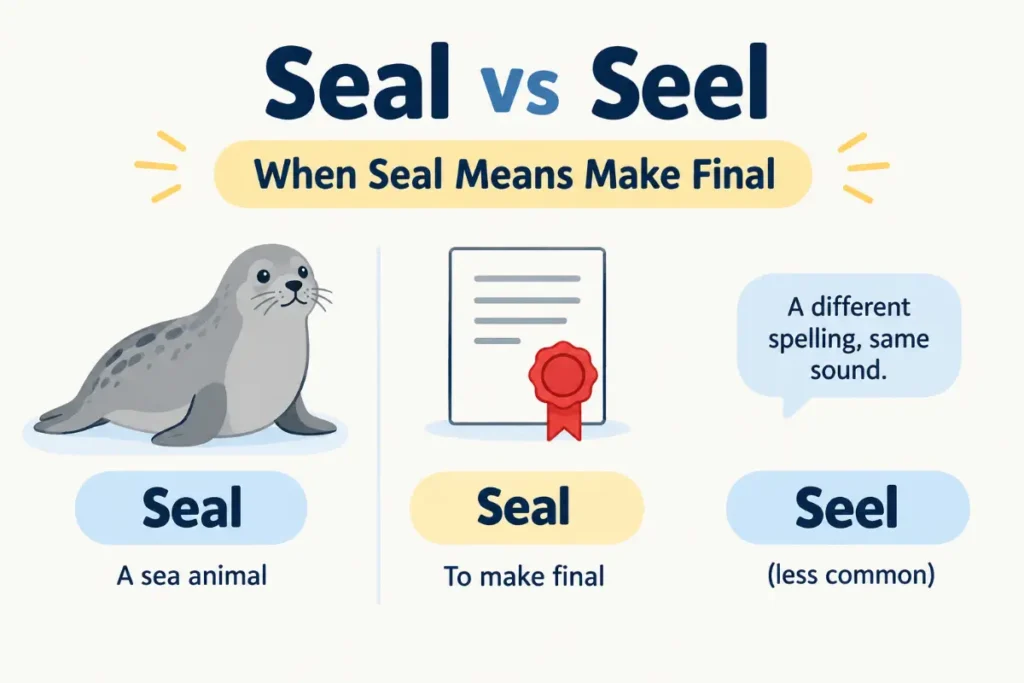
When Seal Means Make Final
The word also has a figurative meaning. In this use it means to make something final or firmly established.
This meaning appears often in phrases such as seal the deal and seal an agreement.
For example.
- The signed contract sealed the agreement.
- Her final answer sealed the deal.
- The last point sealed the team’s victory.
Nobody is physically closing a box in these sentences. The word creates a picture of something being closed and settled. Once a deal is sealed the parties have reached a final point.
This figurative use is common in American English. You’ll see it in news reports business writing sports coverage and everyday conversation.
When Seal Refers To An Official Mark
A seal can also be a symbol that represents a government office school organization or institution.
You may have seen a circular design on a diploma or government document. That design may be an official seal.
For example.
- The university seal appears on the diploma.
- The document bears the official seal.
- The city seal is displayed in the council chamber.
The word can also refer to the physical stamp or impression made by an official seal.
Historically people used wax seals to close letters and show that the document had not been opened. A person pressed a design into warm wax. Once the wax hardened it created a visible mark.
That older practice still influences the way we use the word today. You may hear seal in historical writing even when the item has nothing to do with modern packaging.
When Seal Refers To The Animal
The animal meaning is probably the most familiar meaning outside the idea of closing something.
A seal is a marine mammal. Several kinds of seals live in cold and temperate waters around the world. They have streamlined bodies and flippers that help them move through water.
For example.
- We watched a seal swimming near the pier.
- The seal climbed onto the rocks to rest.
- A group of seals gathered along the coast.
You may also see words such as harbor seal gray seal and elephant seal. These names refer to different types of seals.
The spelling remains seal in each case.
Why Seel Is Rare
The biggest difference between the two words is how often people use them.
- Seal is part of ordinary English. You can use it in a text message a work email a school paper or a conversation without sounding unusual.
- Seel is different. Most people encounter it only in historical or specialized material. A modern reader may not recognize it at all.
That doesn’t make the word incorrect. It simply means the word has a very limited place in modern English.
Rare words can survive for centuries even after their original use becomes uncommon. Dictionaries preserve many such words because they help us understand older texts and specialized subjects.
The same thing happens with words connected to old trades tools customs and practices. You may find them in a dictionary even though you would almost never use them in daily speech.
Seel In Historical Falconry
Falconry has a long history and developed its own specialized vocabulary. Seel belongs to that vocabulary.
In historical falconry the verb referred to closing a bird’s eyelids. Historical accounts describe the practice in connection with birds of prey.
You might therefore find the word in a book about medieval falconry or in an old account of trained hawks and falcons.
For example.
- The old falconry text describes how the bird was seeled.
- The historian explains the use of seeling in early falconry.
These sentences belong to a very specific subject. They aren’t examples of normal modern conversation.
If you’re writing about packages envelopes containers agreements or marine animals then this specialized term isn’t the one you want.
Can Seel Mean Anything Else
Older dictionaries and historical sources can give seel additional meanings or forms. Some are connected to older uses of the word and may not appear in modern general writing.
This is a good reminder that dictionaries contain more than the words people use every day. A word can be valid but still be rare archaic or specialized.
If you find seel while reading an old book don’t automatically assume it is a typo. Check the context. The surrounding passage may show that the writer is using a historical meaning.
Modern writing calls for a different approach. Use the common word that matches your meaning. Don’t choose a rare spelling simply because it appears in a dictionary.
Common Spelling Errors
The most common mistake is using seel when the sentence needs seal.
For example.
- Please seel the envelope before mailing it.
This is incorrect because the sentence describes closing an envelope.
The corrected version is.
- Please seal the envelope before mailing it.
Another example is a package.
- The worker seel ed the box before shipping it.
That spelling doesn’t work. The correct form is sealed.
- The worker sealed the box before shipping it.
The same pattern applies to other forms.
- Seal.
- Seals.
- Sealed.
- Sealing.
These are all forms of the common word.
The rare historical verb has its own forms but you won’t normally need them. If your sentence has nothing to do with historical falconry then seal is almost certainly the form you need.
A Useful Test Before You Write
When you aren’t sure about the spelling pause and ask yourself what you mean.
- If you’re talking about closing something then use seal.
- If you’re talking about an official emblem then use seal.
- If you’re talking about a marine mammal then use seal.
- If you’re talking about making an agreement final then use seal.
- If you’re reading a historical text about falconry and the word refers to closing a bird’s eyelids then seel may be correct.
This meaning based test is much easier than trying to remember every spelling detail. It also works when you’re writing quickly because you only need to identify the idea first.
Examples From Common Situations
Here are some natural examples that show how broad the common word is.
Mail And Shipping
- I need to seal this envelope before I leave.
- The shipping company requires every box to be sealed.
- Make sure the package has a secure seal.
Food And Storage
- Seal the leftovers before putting them in the refrigerator.
- The container has a tight seal.
- This bag seals easily and keeps the food fresh.
Home Repairs
- We need to seal the gap around the window.
- The plumber sealed the small leak.
- A good seal can keep cold air from entering the room.
Business
- Both companies finally sealed the agreement.
- The final signature sealed the deal.
- The new contract was sealed after several meetings.
Government And Education
- The official seal appears on the certificate.
- The university seal is printed at the bottom of the document.
- The state seal is displayed on the government building.
Wildlife
- We saw a seal along the coastline.
- The seal dove into the water when the boat came closer.
- Several seals were resting on the rocks.
The wide range of examples shows why seal is such a useful word. It fits many situations while keeping the same spelling.
How To Remember The Difference
The simplest way to remember the difference is to connect each spelling with its meaning. Seal is the everyday word. You can seal a box seal an envelope seal a container or talk about a seal swimming in the ocean. You can also use it when you mean to make an agreement final or refer to an official mark.
Seel has a much narrower meaning. It belongs mainly to historical writing about falconry and refers to closing a bird’s eyelids. If you’re writing an ordinary email school assignment article or business message you almost certainly don’t need this spelling.
Another helpful trick is to picture the word in a familiar sentence. Think of seal the package or seal the envelope. These common phrases reinforce the spelling naturally. The more often you see the correct form in real sentences the easier it becomes to remember.
Seal Vs Seel In Modern English
The practical difference between seal vs seel comes down to meaning and frequency.
Seal is a common modern English word. It works as a noun and a verb. You can use it in casual conversations formal writing technical descriptions and many other settings.
Seel is a rare historical term. It has a specific connection to falconry and is unlikely to appear in normal modern writing.
This doesn’t mean one spelling is correct and the other is simply wrong. Both words have a place in English. They just don’t have the same job.
Think of them as two tools that look similar but serve completely different purposes. You wouldn’t use a screwdriver when you need a spoon. In the same way you shouldn’t choose seel simply because it looks or sounds close to seal.
FAQs
Is seal or seel the correct spelling?
Seal is the correct spelling for the common meanings of closing something securing something making an agreement final referring to an official mark or naming the marine animal. Seel is a separate and rare word connected mainly with historical falconry.
Is seel a real word?
Yes. Seel is a real English word. It has a specialized historical meaning related to closing a bird’s eyelids and isn’t normally used in everyday American English.
What is the difference between seal and seel?
Seal has several common meanings and appears frequently in modern English. Seel has a rare historical meaning associated with falconry. The words look similar but they aren’t interchangeable.
Should I write seal the envelope or seel the envelope?
You should write seal the envelope. The verb seal means to close something securely. Seel doesn’t have this ordinary modern meaning.
Is a seal an animal?
Yes. A seal is a marine mammal that lives in coastal and ocean environments. The word can also have several unrelated meanings depending on the sentence.
What does seal mean as a verb?
As a verb seal can mean to close something securely. It can also mean to make an agreement final or firmly establish an outcome.
For example you might say that you sealed a package or that a final decision sealed the deal.
What does seel mean in falconry?
In historical falconry seel refers to closing or stitching a bird’s eyelids. The term appears mainly in older or specialized texts and isn’t part of most people’s everyday vocabulary.
Can I use seel instead of seal?
No. The two words aren’t interchangeable. Use seal for common meanings such as closing a package referring to an official mark or talking about the marine animal.
Conclusion
If you’ve been searching for seal vs seel because the two spellings look almost identical the key is to focus on meaning. Seal is the common word you need for closing something making something final referring to an official mark or talking about a marine mammal.
Seel is a real word but it has a very limited use. It mainly appears in historical writing about falconry and refers to closing a bird’s eyelids. That makes it very different from the everyday word.
You don’t need to memorize a complicated spelling rule. Remember one simple connection. Seal is the word for everyday uses. Seel belongs to a rare historical context. If you’re writing about a package an envelope a container an agreement a document or an ocean animal choose seal.
The next time you wonder about seal vs seel look at the meaning before you look at the letters. That quick check will usually give you the answer right away.

Dr. Elena Vance holds a Ph.D. in Linguistics from Columbia University and has spent over 15 years analyzing the evolution of the English language. A former university professor turned full-time writer and editor, Elena specializes in breaking down high-level grammatical concepts, punctuation nuances, and style guides (APA, Chicago, MLA) into clear, actionable advice. When she isn’t hunting down dangling modifiers, she can be found collecting vintage dictionaries and reading classic literature.