
Have you ever struggled to make a choice and wondered how to describe yourself? You might have heard people use both undecisive and indecisive. They look similar and seem to carry the same meaning. However, only one is the standard choice in modern English.
The correct word is indecisive. It describes someone who struggles to make decisions or takes a long time to choose between different options. For example, if you spend 20 minutes deciding what to order at a restaurant, someone might call you indecisive.
The confusion comes from the prefix un and the prefix in. Both can change the meaning of a word, often by making it negative. That’s why the spelling undecisive may look reasonable at first glance. Still, English doesn’t use these prefixes interchangeably in every word.
In this guide, you’ll learn the correct spelling, the meaning of each form, and the reason people confuse them. You’ll also find everyday examples, related words, common mistakes, and simple tricks to remember the correct choice.
Quick Definition
Indecisive is the standard English adjective for someone who struggles to make decisions or has trouble choosing between options.
Undecisive is a rare and nonstandard form in everyday modern English. Use indecisive in normal writing and conversation.
Direct Answer
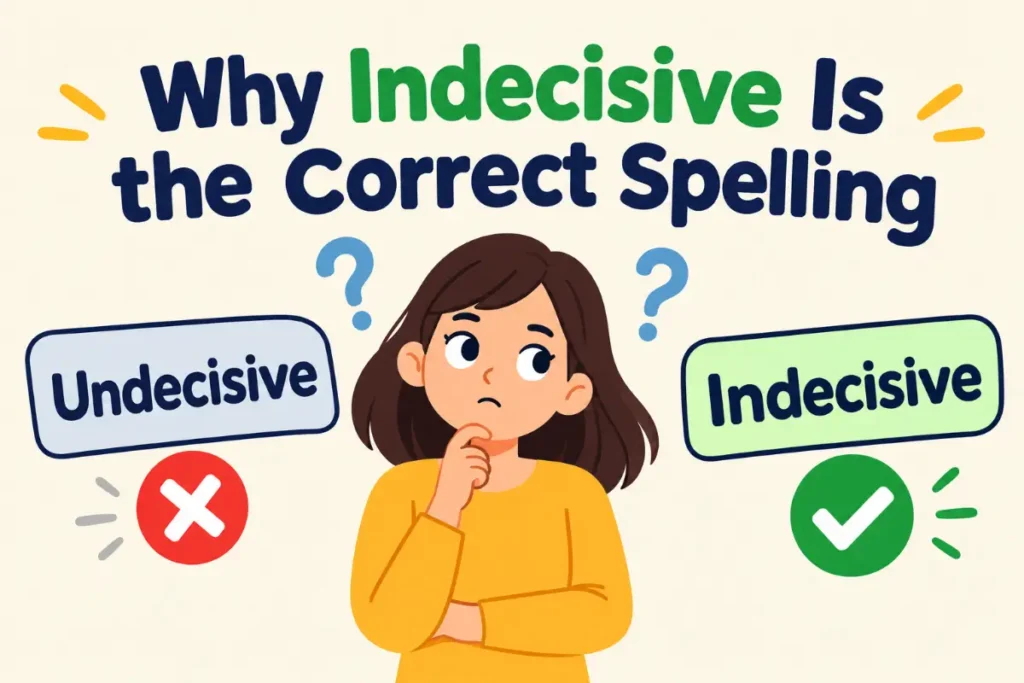
Indecisive is the correct and widely accepted word. Use it to describe someone who has trouble making choices. Avoid undecisive in standard American English.
Comparison Table
| Word | Meaning | Example Sentence | When to Use It |
|---|---|---|---|
| Indecisive | Unable or unwilling to make a choice easily. | I’m indecisive about which car to buy. | Use this standard spelling in speaking and writing. |
| Undecisive | A rare or nonstandard form intended to express a lack of decision. | The word is uncommon in modern everyday English. | Avoid it in standard writing. |
Why Indecisive Is the Correct Spelling
The word indecisive is the established adjective in modern English. Dictionaries use it to describe a person who struggles to make decisions or cannot easily settle on a choice.
Think about someone shopping for a new phone. They compare several models, read reviews, check prices, and ask friends for advice. Even after all that, they still can’t choose one. You could describe that person as indecisive.
The word also applies to situations where someone keeps changing their mind. For example, a person might choose a blue shirt, switch to a black one, and then return to the blue shirt. Their difficulty making a final choice shows indecision.
The spelling undecisive may look logical because the prefix un often means not. However, a word’s spelling doesn’t depend only on what seems logical. English has established forms that speakers and writers recognize through regular use.
That’s why indecisive is the better choice for school assignments, emails, articles, professional documents, and everyday conversations.
What Does Indecisive Mean
An indecisive person has difficulty making a choice. They might feel unsure about the available options, worry about making a mistake, or spend too much time thinking about small details.
For example:
- Sarah is indecisive about choosing a college.
- My brother gets indecisive when he shops for clothes.
- The manager seemed indecisive during the meeting.
- I’m too indecisive to pick a movie tonight.
- He became indecisive after hearing two different opinions.
In each sentence, the word describes someone who cannot settle on a decision quickly or confidently.
However, being indecisive doesn’t always mean someone refuses to make a choice. Sometimes they simply need more time or information before they feel comfortable deciding.
Is Undecisive a Real Word
You may occasionally find undecisive in informal writing or older sources. Some people create it by adding un to decisive. It seems like a natural formation because un often creates the opposite of an adjective.
However, that doesn’t make it the standard spelling.
Modern English speakers generally use indecisive to describe a person who struggles to make decisions. It is the familiar and accepted form in ordinary communication.
If you use undecisive in an essay or professional document, readers may see it as a spelling mistake. They might understand what you mean, but the word can make your writing look less polished.
The safest approach is simple. Choose indecisive whenever you need this meaning.
What Does Indecisive Mean in Everyday English
The word indecisive describes more than someone who takes a long time to pick between two things. It can also describe a person who doubts their choices, changes their mind often, or feels uncomfortable making decisions.
You might notice this behavior in everyday situations.
Indecisive About Food
Imagine going to a restaurant with friends. Everyone else orders within a few minutes, but you keep looking at the menu.
You consider the pasta, then the burger, and finally the chicken sandwich. After the server comes back, you still haven’t made up your mind.
Your friend might laugh and say:
You’re so indecisive about food.
This is a natural use of the word. It describes your difficulty choosing one meal from several options.
Indecisive About Shopping
Some people struggle to buy even simple items. They compare colors, prices, styles, and features for hours.
For example:
- Mark is indecisive when buying new shoes.
- I’m indecisive about which laptop to purchase.
- My sister gets indecisive whenever she shops online.
These examples show how the word describes hesitation during everyday purchases.
Indecisive About Important Life Choices
The word can also describe bigger decisions.
A person might struggle to choose a college, accept a job offer, move to another city, or start a new career.
For example:
Emma felt indecisive about accepting the job offer because both companies offered good benefits.
This sentence shows that the person has two attractive choices and finds it difficult to select one.
Being indecisive about an important decision doesn’t always mean someone lacks confidence. They might simply want to avoid making a choice they could regret later.
Indecisive During Conversations
Some people find it hard to express a clear preference when others ask for their opinion.
For example:
- Jake was indecisive when his friends asked where he wanted to eat.
- She sounded indecisive when discussing the weekend plans.
- Tom remained indecisive during the group discussion.
In these situations, the person doesn’t give a clear answer or struggles to settle on one option.
Understanding the Prefix In
One reason people confuse these spellings is that English uses different prefixes to create negative meanings.
A prefix is a group of letters placed at the beginning of a word. It changes the meaning of the original word.
The prefix in often means not or the opposite of something. You’ll find it in many familiar English words.
For example:
| Word | Meaning |
|---|---|
| Inactive | Not active. |
| Incomplete | Not complete. |
| Incorrect | Not correct. |
| Inaccurate | Not accurate. |
| Inflexible | Not flexible. |
| Indirect | Not direct. |
| Indecisive | Not decisive. |
The prefix in works naturally with decisive to form indecisive.
This is the established spelling. You don’t need to add another prefix or change the word to make its meaning clear.
Why In Does Not Always Become Un
English has several negative prefixes. The most common include un, in, im, ir, and il.
Each prefix appears in different words. Some patterns depend on the first letter or sound of the root word. Others come from the word’s history and established spelling.
For example:
- Unhappy means not happy.
- Impossible means not possible.
- Irregular means not regular.
- Illegal means not legal.
- Incomplete means not complete.
You can see that the same negative idea appears through different spellings.
However, you can’t simply attach un to every adjective and expect to create a standard English word. That’s why undecisive isn’t the normal choice.
The Connection Between Decisive and Indecisive
Understanding the root word makes the spelling easier to remember.
Decisive describes someone who can make decisions quickly and confidently. It can also describe an action that settles an issue clearly.
Indecisive expresses the opposite idea when describing a person’s decision making.
Compare these examples:
- Lisa is decisive and rarely changes her mind.
- Lisa is indecisive and often changes her mind.
- The manager made a decisive choice.
- The manager seemed indecisive during the discussion.
The two adjectives express opposite ideas in these examples.
The relationship is simple. A decisive person can settle on a choice. An indecisive person struggles to do so.
How to Use Indecisive in a Sentence
Knowing the meaning of a word is helpful, but seeing it in real sentences makes it easier to use. The adjective indecisive usually describes a person, but it can also describe behavior, leadership, actions, and situations that fail to produce a clear result.
Let’s look at different ways to use it in everyday American English.
When Someone Cannot Make a Choice
Use the word when a person struggles to choose between two or more options.
Examples:
- I’m indecisive about which restaurant to visit tonight.
- My mother is indecisive when she buys new furniture.
- Peter became indecisive after looking at all the available houses.
- She’s too indecisive to choose a favorite vacation spot.
- My friends know I’m indecisive about ordering food.
- The child looked indecisive when the teacher asked him to pick a book.
- David is indecisive about which college to attend.
- I get indecisive when I have too many choices.
Each example describes a person who has trouble settling on one option.
When Someone Keeps Changing Their Mind
A person may make a choice and then start questioning it. They might change their answer several times before making a final decision.
Examples:
- Mark is indecisive and keeps changing his mind about the new car.
- She looked indecisive after agreeing to join the team.
- My brother is so indecisive that he changes his order every time we visit a restaurant.
- The manager seemed indecisive during the planning meeting.
- He became indecisive after hearing his friends’ suggestions.
These sentences show hesitation and uncertainty. The person might have an idea of what they want, but they struggle to stick with it.
When Someone Struggles With Important Decisions
The adjective also works for serious choices involving work, family, money, and personal goals.
Examples:
- Sarah felt indecisive about accepting the promotion.
- The couple remained indecisive about buying their first home.
- James became indecisive after receiving two job offers.
- My sister is indecisive about moving to another state.
- The young student seemed indecisive about choosing a college major.
- He felt indecisive about starting his own business.
In these situations, the person may have good reasons for taking extra time. A major life decision can affect many parts of someone’s future.
When Someone Shows Weak Leadership
The word can describe a leader who struggles to give clear instructions or make important choices.
Examples:
- The employees lost confidence in their indecisive manager.
- The team struggled under indecisive leadership.
- His indecisive approach delayed the entire project.
- The company needed a clear plan instead of another indecisive response.
- The board criticized the director for being indecisive during the crisis.
Here, the word describes a lack of clear direction. It can suggest that someone needs to take responsibility and make a firm choice.
When a Situation Produces No Clear Result
There is another use worth knowing. Indecisive can describe something that fails to settle an issue or produce a clear outcome.
For example:
- The teams played an indecisive game.
- The debate ended with an indecisive result.
- The evidence produced an indecisive conclusion.
- The first round of negotiations was indecisive.
This meaning is different from describing a person who struggles to choose. In these examples, the result itself is unclear or inconclusive.
The Cambridge Dictionary includes both meanings. It describes a person who is not good at making decisions and something that fails to produce a clear decision. definition in the Cambridge English Dictionary+1
Indecisive vs Decisive
The words indecisive and decisive have opposite meanings when they describe someone’s ability to make choices.
A decisive person can make a choice confidently. An indecisive person often struggles to settle on one option.
Understanding this contrast helps you use both adjectives correctly.
| Word | Meaning | Example |
|---|---|---|
| Decisive | Able to make choices confidently and clearly. | Maria is decisive when making business decisions. |
| Indecisive | Having trouble making choices. | Maria is indecisive when choosing what to wear. |
What Does Decisive Mean
Decisive describes someone who can make decisions quickly and confidently. It can also describe an action or event that has a strong effect on the final result.
For example:
- My boss is decisive and gives clear instructions.
- You need to be decisive when handling an emergency.
- She made a decisive choice about her career.
- The final goal was decisive in winning the game.
A decisive person doesn’t spend too much time going back and forth. They consider the available information and choose a direction.
However, being decisive doesn’t mean making careless decisions. A good decision still requires thought and judgment.
What Does Indecisive Mean
An indecisive person finds it difficult to make a final choice.
For example:
- My cousin is indecisive about choosing a new phone.
- The director seemed indecisive during the meeting.
- I become indecisive when I have several good options.
The person may need more time, feel uncertain, or worry about making the wrong choice.
Decisive and Indecisive in One Conversation
Consider this short conversation:
Alex: Have you picked a restaurant for dinner?
Mia: Not yet. I’ve looked at five places and still can’t decide.
Alex: You’re so indecisive. I already picked mine.
Mia: Really? Where are we going?
Alex: The Italian place near the mall. Their food is great.
This conversation shows the difference naturally. Alex makes a choice without much hesitation. Mia struggles to settle on a restaurant.
Indecisive vs Undecided
These two words are closely related, but they don’t always describe the same thing.
Indecisive usually describes a person’s habit or difficulty when making choices. Undecided describes someone who hasn’t made a particular choice yet.
For example:
- I’m indecisive when choosing clothes.
- I’m undecided about buying this dress.
The first sentence describes a general difficulty. The second tells the reader that a specific decision hasn’t been made.
When to Use Indecisive
Use indecisive when you want to describe someone’s decision making.
Examples:
- My brother is indecisive about almost everything.
- She has an indecisive personality.
- The manager became indecisive during the discussion.
- I’m usually indecisive when shopping online.
The word often describes a repeated behavior or a person’s general tendency.
When to Use Undecided
Use undecided when someone hasn’t settled on a particular choice.
Examples:
- I’m still undecided about my summer vacation.
- She remains undecided about accepting the offer.
- The company is undecided about its next location.
- We haven’t chosen a date because the guests are still undecided.
Someone can be undecided without being an indecisive person.
For example, you might need another day to review two job offers. That doesn’t automatically mean you struggle with decisions. You may simply want to make a careful choice.
The Oxford Learner’s Dictionary defines undecided as not having made a decision about something. It also lists indecisive as a related but distinct word. Oxford Learner’s Dictionaries+1
Indecisive vs Hesitant
Indecisive and hesitant both describe uncertainty, but they focus on slightly different things.
An indecisive person struggles to choose between options. A hesitant person pauses or holds back before taking action.
For example:
- I’m indecisive about which dress to buy.
- I’m hesitant to buy the dress because it’s expensive.
The first sentence focuses on choosing. The second focuses on delaying an action.
Examples of Hesitant
- She was hesitant to speak in front of the class.
- He seemed hesitant about accepting the invitation.
- The driver was hesitant before turning onto the busy road.
- I’m hesitant to share my personal details online.
A person can be hesitant without being indecisive. They might know exactly what they want but feel nervous about taking the next step.
Indecisive vs Insecure
These words can sometimes describe similar behavior, but they have different meanings.
Indecisive refers to difficulty making choices. Insecure describes a lack of confidence or a feeling of uncertainty about yourself or a situation.
For example:
- Jake is indecisive about choosing a college.
- Jake feels insecure about his ability to succeed in college.
In the first sentence, Jake cannot settle on a choice. In the second, he doubts himself.
Sometimes these traits appear together. Someone who lacks confidence might worry so much about making a mistake that they struggle to make decisions.
Still, don’t treat the words as interchangeable.
More Examples
- She is indecisive about changing jobs.
- She feels insecure about her skills.
- My friend is indecisive when choosing an outfit.
- My friend feels insecure about her appearance.
- The manager was indecisive during the meeting.
- The manager felt insecure about leading the team.
Each sentence describes a different issue.
Indecisive vs Indecision
Another useful distinction is the difference between an adjective and a noun.
Indecisive is an adjective. It describes a person or something that doesn’t produce a clear result.
Indecision is a noun. It refers to the inability or difficulty to make a choice.
Look at these examples:
| Word | Part of Speech | Example |
|---|---|---|
| Indecisive | Adjective | My sister is indecisive about her career. |
| Indecision | Noun | Her indecision delayed the project. |
| Indecisively | Adverb | He answered indecisively. |
| Indecisiveness | Noun | His indecisiveness frustrated the team. |
How to Use Indecision
Use indecision when talking about the problem itself.
Examples:
- His indecision made the meeting longer.
- Too much indecision can waste valuable time.
- The manager’s indecision delayed the launch.
- Her indecision about the job offer worried her family.
The word works well when you want to discuss the result or effect of struggling to make choices.
How to Use Indecisively
Indecisively is the adverb form. It explains how someone performs an action.
Examples:
- He nodded indecisively when I asked for his opinion.
- She answered indecisively during the interview.
- The manager spoke indecisively about the new policy.
You don’t need to use this form in every sentence. In everyday conversation, in an unsure way or without making a clear choice may sound more natural.
How to Use Indecisiveness
Indecisiveness is another noun. It describes the quality or habit of struggling to make decisions.
Examples:
- His indecisiveness made simple tasks difficult.
- Her indecisiveness frustrated her coworkers.
- The manager wanted to overcome his indecisiveness.
- Too much indecisiveness can slow down a team.
Remember this simple pattern.
- Indecisive describes a person.
- Indecision describes the difficulty.
- Indecisively describes how someone acts.
- Indecisiveness describes the habit or quality.
Common Mistakes to Avoid
Even people who understand the meaning can make spelling and grammar mistakes. A few simple rules can help you avoid them.
Using Undecisive Instead of Indecisive
This is the main spelling confusion.
Incorrect for standard modern usage: My brother is undecisive about buying a car.
Correct: My brother is indecisive about buying a car.
The first spelling may look reasonable, but the second is the established form for a person who struggles to make choices.
Confusing Indecisive With Undecided
These words are related, but they don’t always fit the same sentence.
Less natural: I am indecisive about my final answer because I haven’t chosen one yet.
More direct: I am undecided about my final answer.
You can use indecisive if you mean that making the choice is difficult for you. Use undecided when you simply haven’t made the choice.
Using Indecisive as a Noun
Indecisive is an adjective. Don’t use it as a noun when you mean the act of struggling to decide.
Incorrect: His indecisive caused a delay.
Correct: His indecision caused a delay.
You can also write:
His indecisiveness caused a delay.
Both indecision and indecisiveness are nouns.
Mixing Up Indecisive and Inconclusive
These words have related meanings in some situations, but they aren’t identical.
Indecisive can describe a person who struggles to make choices. Inconclusive describes evidence, a test, or a result that doesn’t provide a clear answer.
For example:
- The manager was indecisive about the new plan.
- The test results were inconclusive.
The first sentence describes a person. The second describes information that doesn’t settle a question.
Using Too Many Similar Words Together
Sometimes writers repeat the same idea in different words.
For example:
My indecisive and uncertain hesitation made it difficult for me to make a decision.
This sentence feels crowded because several words express nearly the same idea.
A cleaner version is:
My indecision made it difficult to choose.
Good writing doesn’t need three or four words to explain one simple thought. Choose the clearest expression and let it do the work.
How to Remember the Correct Spelling
Spelling becomes easier when you connect a word with its meaning. Instead of memorizing every letter separately, use a few simple tricks to remember the correct form.
Remember the Opposite of Decisive
The easiest trick is to connect indecisive with decisive.
- Decisive means able to make choices confidently.
- Indecisive means having trouble making choices.
The prefix in creates the negative meaning in this established word.
For example:
A decisive shopper knows what to buy. An indecisive shopper spends an hour comparing products.
Think of these two people whenever you need to remember the spelling.
Connect Indecisive With Indecision
Another helpful trick is to remember the noun indecision.
Both words begin with the same letters.
- Indecisive.
- Indecision.
If you already know how to spell indecision, you can use that connection to remember indecisive.
For example:
His indecision made him indecisive during the meeting.
This sentence connects both forms and shows how they work together.
Remember the Common Prefix Pattern
English uses several prefixes to create opposite meanings. The prefix in appears in many familiar words.
Think about these examples:
- Inactive.
- Incorrect.
- Incomplete.
- Inaccurate.
- Indecisive.
You don’t need to learn every prefix rule to spell this particular word correctly. Just remember that indecisive is the established spelling.
Use the Word in Your Own Sentences
Writing a few original sentences can help you remember a spelling.
Try these examples:
- I’m indecisive about buying a new laptop.
- My friend is indecisive when choosing a movie.
- The manager seemed indecisive during the discussion.
- Her indecision delayed the final decision.
You can also say the word aloud. Hearing it and seeing it in context can make it easier to remember.
Synonyms of Indecisive
Sometimes you may want another word to describe someone who struggles to make choices. English has several useful alternatives.
However, each synonym has a slightly different meaning. Choose the one that best fits the situation.
| Synonym | Meaning | Example Sentence |
|---|---|---|
| Hesitant | Slow to act because of doubt or uncertainty. | He was hesitant to accept the offer. |
| Uncertain | Not sure about something. | She felt uncertain about her plans. |
| Undecided | Not having made a choice yet. | I’m undecided about my vacation dates. |
| Irresolute | Unable to make a firm decision. | The leader appeared irresolute during the meeting. |
| Wavering | Frequently changing your mind or opinion. | He remained wavering about the proposal. |
| Vacillating | Moving between different opinions or choices. | Her vacillating attitude confused the team. |
| Ambivalent | Having mixed or conflicting feelings. | I’m ambivalent about moving to a new city. |
| Wishy-washy | Unable to take a clear or firm position. | The committee gave a wishy-washy response. |
Which Synonym Sounds Most Natural
Some alternatives work better in everyday conversations than others.
Hesitant is a good choice when someone pauses before taking action.
Example: I’m hesitant to accept the job because the salary is low.
Uncertain works when someone doesn’t feel sure about a choice or situation.
Example: She feels uncertain about her future career.
Undecided is useful when a person hasn’t selected an option yet.
Example: We are still undecided about our weekend plans.
Wishy-washy is informal. It can sound critical when you describe someone who refuses to take a clear position.
Example: The manager gave us a wishy-washy answer instead of a clear decision.
Ambivalent works when someone has mixed feelings about something.
Example: I’m ambivalent about leaving my hometown.
For most everyday situations, indecisive, hesitant, uncertain, and undecided are easy and natural choices.
Antonyms of Indecisive
An antonym is a word with the opposite meaning.
The most direct antonym of indecisive is decisive. However, several other words can express confidence, certainty, and firmness.
| Antonym | Meaning | Example Sentence |
|---|---|---|
| Decisive | Able to make choices confidently. | She is decisive when managing her team. |
| Confident | Sure of yourself or your choices. | He feels confident about his decision. |
| Determined | Firm about achieving something. | They are determined to finish the project. |
| Resolute | Strong and firm in your decisions. | The leader remained resolute during the crisis. |
| Certain | Having no serious doubt. | I’m certain about my choice. |
| Firm | Not easily changed or influenced. | She took a firm position during the discussion. |
| Assertive | Able to express opinions and needs clearly. | He was assertive when explaining his concerns. |
Decisive Is the Best Opposite
Although these words are useful, decisive is the clearest opposite in most situations.
Compare these sentences:
- My sister is indecisive about her career.
- My sister is decisive about her career.
The first sentence describes someone who struggles to choose a direction. The second describes someone who can make a clear choice.
The Cambridge Dictionary also identifies indecisive as the opposite of decisive. definition in the Cambridge English Dictionary+1

Can Someone Be Indecisive and Still Make Good Decisions
Yes. Being indecisive doesn’t mean someone always makes bad choices.
Some people take extra time because they want to understand all their options. They compare prices, consider possible outcomes, and ask for advice before choosing.
For example, imagine two people buying a house.
The first person visits one property and makes an offer immediately. The second person visits several properties, checks the neighborhood, reviews the costs, and takes a few weeks to decide.
The second person may appear indecisive, but careful thinking can lead to a better choice.
The real problem begins when someone spends so much time thinking that they never take action.
The Difference Between Careful Thinking and Indecision
Careful thinking has a clear purpose. You collect useful information, compare your options, and make a choice.
Indecision often involves repeated doubt without much progress.
Consider these situations:
Careful thinking
- You compare three laptops before buying one.
- You check your budget before accepting a job offer.
- You ask a doctor questions before choosing a treatment.
- You review a contract before signing it.
Indecision
- You compare the same laptops for weeks without making progress.
- You keep changing your mind about the job.
- You ask several people for advice but ignore every suggestion.
- You delay signing a contract even after reviewing all the details.
The difference isn’t the amount of time you spend. It’s the progress you make toward a final choice.
How to Become More Decisive
If you often struggle to make choices, a few practical habits can help.
You don’t need to make every decision instantly. Instead, learn to avoid unnecessary delays and trust your judgment.
Limit Your Options
Too many choices can make decisions harder.
Imagine choosing a movie from a list of 100 titles. You might spend more time scrolling than actually watching something.
Try narrowing your options to three or four.
The same approach works for shopping, restaurants, travel plans, and other everyday choices.
Set a Time Limit
Give yourself a reasonable amount of time to make a decision.
For example:
- Give yourself five minutes to choose lunch.
- Spend one day comparing small purchases.
- Set a deadline for choosing a vacation destination.
- Decide on a job offer before its response deadline.
A time limit can prevent a simple choice from taking up your entire day.
Focus on What Matters Most
Not every detail deserves equal attention.
Before making a decision, identify your main priorities.
For example, if you’re buying a laptop, your priorities might include price, battery life, and performance.
You don’t need to compare every color or minor feature if those details don’t affect your needs.
Focus on the factors that matter most.
Accept That No Choice Is Perfect
Some people struggle with decisions because they want the perfect result.
However, most everyday choices involve tradeoffs. One option might cost less, while another offers better quality. One job might pay more, while another offers a shorter commute.
You can’t always get everything you want from one choice.
Instead of searching for a perfect option, look for one that meets your main needs.
Stop Reopening Every Decision
Once you’ve made a reasonable choice, give yourself permission to move forward.
Constantly questioning a decision can create unnecessary stress.
For example, if you’ve compared several restaurants and chosen one that fits your budget and taste, there’s no need to keep checking every other option.
Learn from your choices, but don’t let endless second guessing control your day.
When Is Indecisive Used in American English
In American English, indecisive is a common and natural adjective. People use it in casual conversations, workplace discussions, personal writing, and formal communication.
You might hear someone say:
- I’m so indecisive when it comes to choosing clothes.
- My dad is indecisive about buying a new truck.
- She’s a little indecisive about her college plans.
- The company needs a decisive leader instead of an indecisive one.
The word works in both casual and professional settings.
However, tone matters. Calling someone indecisive can sound critical because it points out a weakness in their decision making.
For example, saying Your manager is indecisive may sound negative. A softer alternative is Your manager seems unsure about the next step.
Choose your wording based on the situation and the impression you want to create.
Is Undecisive Ever Acceptable
The question deserves a little extra attention because undecisive does appear in some historical dictionary records.
Webster’s 1828 dictionary lists undecisive as an adjective meaning not decisive or not conclusive. In that historical sense, it can describe something that fails to settle an argument or contest. Undecisive
That historical entry doesn’t make it the preferred modern word for a person who struggles to make choices.
For current American English, use these distinctions:
- Use indecisive for a person who struggles to make decisions.
- Use inconclusive for evidence or a result that doesn’t settle an issue.
- Use undecided for someone who hasn’t made a particular choice.
- Use undecisive only when discussing its rare historical use or a source that specifically uses it.
This distinction is useful because it explains why the spelling may appear in older material even though modern readers generally expect indecisive.
If you’re writing an article, school assignment, business email, or social media post, stick with the familiar modern form.
Examples of Indecisive in Different Situations
Here are more examples to show how the word fits different parts of everyday life.
At Home
- My husband is indecisive about which paint color to use.
- I’m indecisive when choosing a new sofa.
- The children became indecisive when I offered them two desserts.
- My mother is indecisive about replacing her old kitchen appliances.
At Work
- The team struggled because of the manager’s indecisive leadership.
- Our director seemed indecisive during the budget meeting.
- An indecisive response caused confusion among the employees.
- The company needs someone who can make clear decisions.
At School
- The student was indecisive about choosing a research topic.
- I became indecisive when selecting my college courses.
- Her indecision delayed the group project.
- The teacher encouraged the student to make a confident choice.
In Relationships
- He was indecisive about planning their anniversary dinner.
- She felt frustrated by her partner’s indecisive behavior.
- They remained indecisive about moving in together.
- My friend is indecisive when planning dates.
While Traveling
- I’m indecisive about choosing a hotel.
- They were indecisive about visiting the beach or the mountains.
- Our group became indecisive when selecting a vacation destination.
- She is indecisive about booking an early morning flight.
These examples show that the adjective works in many situations. The common idea is difficulty making or settling on a choice.
FAQs
Undecisive or indecisive which spelling is correct?
Indecisive is the standard and widely accepted spelling in modern English. It describes someone who struggles to make decisions or choose between options. Avoid undecisive in everyday American English.
Is undecisive a real English word?
The spelling appears in historical dictionary records as an adjective meaning not decisive or inconclusive. However, it isn’t the normal modern word for someone who struggles to make choices. Use indecisive in standard writing.
What is the meaning of indecisive?
Indecisive means having difficulty making decisions or choosing between different options. An indecisive person may take a long time to decide or frequently change their mind. For example, someone who cannot choose a restaurant might be indecisive.
What is the opposite of indecisive?
The opposite of indecisive is decisive. A decisive person can make choices confidently and clearly. For example, a decisive manager can select a plan and give the team clear instructions.
Is indecisive a negative word?
Indecisive often has a negative meaning because it suggests that someone struggles to make choices. However, it isn’t always an insult. You can use it neutrally to describe someone who needs extra time to decide.
What is the difference between indecisive and undecided?
Indecisive describes a person who struggles to make choices. Undecided means someone hasn’t made a particular decision yet. For example, you might be undecided about buying a car without being an indecisive person.
What is the noun form of indecisive?
The main noun form is indecision. It describes the difficulty or inability to make a choice. Indecisiveness is another noun that describes the habit or quality of struggling to decide.
How do you use indecisive in a sentence?
You can use indecisive to describe someone who has trouble making choices. For example, My sister is indecisive about choosing a college. You can also use it to describe leadership or a situation that fails to produce a clear result.
Conclusion
The correct spelling for someone who struggles to make decisions is indecisive. Although undecisive may look like a reasonable alternative, it isn’t the standard choice in modern American English.
Remember the connection between decisive and indecisive. A decisive person makes choices confidently, while an indecisive person struggles to settle on an option. You can also use related words such as indecision, indecisiveness, and indecisively.
So the next time you wonder about undecisive or indecisive, choose indecisive. It’s the familiar spelling that readers expect. Use it in your conversations, emails, schoolwork, and professional writing.

Dr. Elena Vance holds a Ph.D. in Linguistics from Columbia University and has spent over 15 years analyzing the evolution of the English language. A former university professor turned full-time writer and editor, Elena specializes in breaking down high-level grammatical concepts, punctuation nuances, and style guides (APA, Chicago, MLA) into clear, actionable advice. When she isn’t hunting down dangling modifiers, she can be found collecting vintage dictionaries and reading classic literature.