
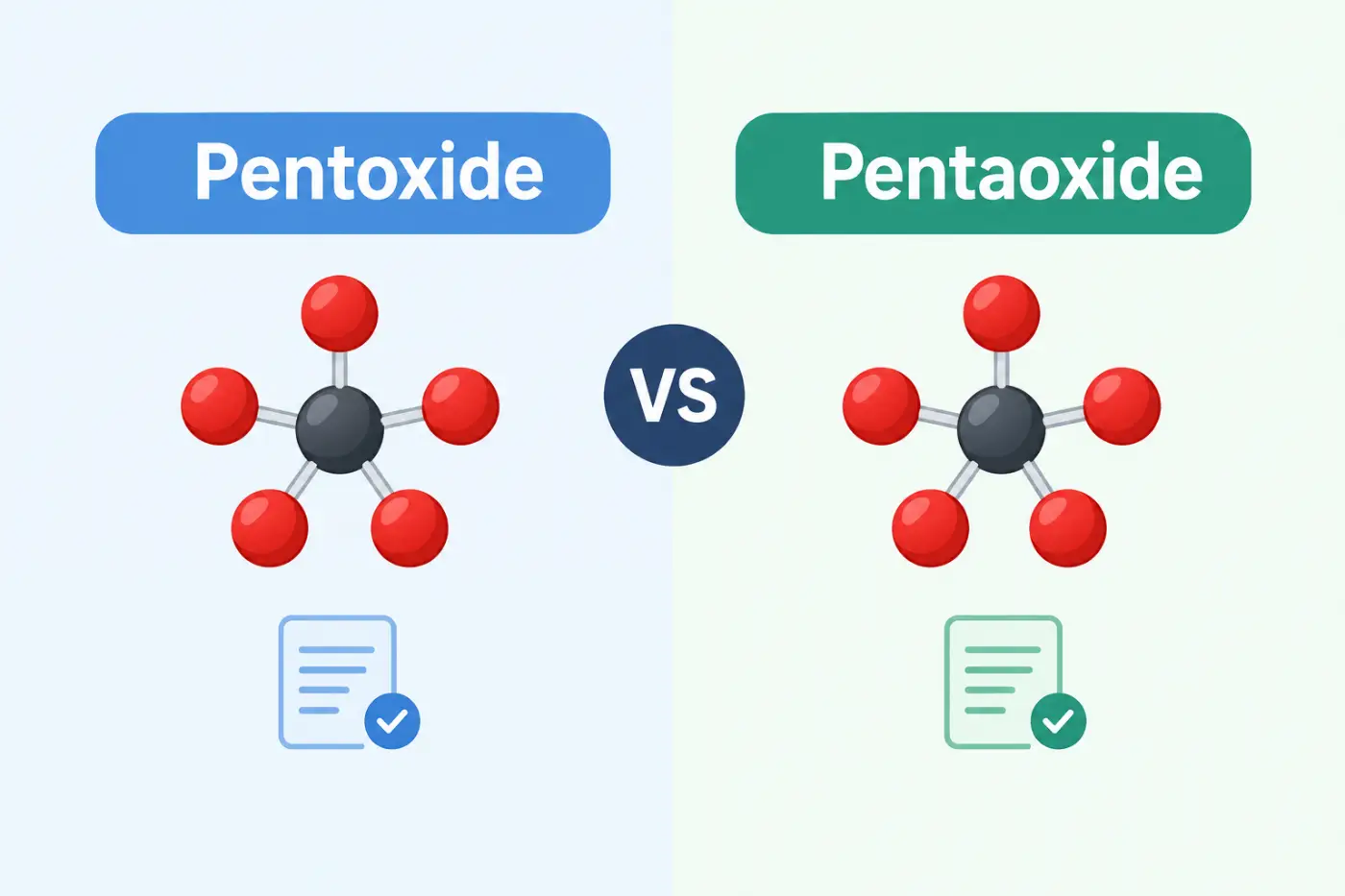
If you’re comparing pentoxide vs pentaoxide and wondering which spelling is correct, the answer depends on the naming system being used. Pentoxide is the familiar form used in general chemistry and many educational resources. Pentaoxide also appears in legitimate chemical names and scientific databases.
That can make this spelling question surprisingly confusing. You may learn that the prefix penta means five and then wonder why the word sometimes appears as pentoxide with the letter a missing. Then you may find a scientific database that uses pentaoxide and wonder if your textbook taught you the wrong form.
It didn’t. The difference comes from chemical naming conventions. Some traditional and introductory naming rules drop the final vowel of a numerical prefix before oxide. Other systematic naming approaches retain the prefix more fully. The result is that both forms can be found in real chemical sources.
The key is knowing the context. This article explains what the two forms mean, why the spelling changes, how chemical prefixes work, where you are likely to see each form, and what to use in school or everyday chemistry writing.
Quick Definition
Pentoxide is a chemical term used for an oxide containing five oxygen atoms in the relevant molecular formula. It appears in familiar names such as phosphorus pentoxide and dinitrogen pentoxide.
Pentaoxide uses the full numerical prefix penta before oxide. It is also found in legitimate scientific names, including entries in the NIST Chemistry WebBook.
Direct Answer
If you’re writing a basic chemistry assignment, pentoxide is usually the expected form. However, pentaoxide is not simply a spelling mistake because it occurs in established chemical nomenclature and scientific database names.
Comparison Table
| Word or form | Basic meaning | Example | Best use |
|---|---|---|---|
| Pentoxide | An oxide name showing five oxygen atoms | Diphosphorus pentoxide | Common general chemistry writing |
| Pentaoxide | A form that keeps the full penta prefix | Diphosphorus pentaoxide | Some systematic or database naming contexts |
| Penta | Numerical prefix meaning five | Penta plus oxide | Used as part of chemical names |
| Oxide | Compound or part of a name involving oxygen | Metal oxide | General chemistry |

Why The Spelling Causes Confusion
The confusion starts with a perfectly reasonable thought. The prefix penta means five. The word oxide refers to oxygen. So it seems natural to combine them directly and write pentaoxide.
That logic isn’t wrong. In fact, modern chemical naming can preserve the full prefix in some systematic names. At the same time, many introductory chemistry naming rules teach students to remove the final vowel of a numerical prefix when it comes before oxide. That gives forms such as monoxide and pentoxide instead of monooxide and pentaoxide.
This is why you may see different forms in different sources. The difference does not necessarily indicate that one source has made a spelling error. It can reflect a difference in nomenclature style.
Think of it as two naming traditions describing the same basic chemical idea. The wording changes slightly, but the chemistry behind the name can remain the same.
What The Prefix Penta Means
Chemical names often use numerical prefixes to tell you how many atoms of an element are present.
These prefixes include:
- Mono means one.
- Di means two.
- Tri means three.
- Tetra means four.
- Penta means five.
- Hexa means six.
- Hepta means seven.
- Octa means eight.
- Nona means nine.
- Deca means ten.
You will see these prefixes often when naming binary molecular compounds. These compounds contain two different nonmetal elements. The prefixes help show how many atoms of each element are present.
For example, dinitrogen pentoxide contains two nitrogen atoms and five oxygen atoms. Its formula is N₂O₅. The prefix di tells you there are two nitrogen atoms. The prefix penta tells you there are five oxygen atoms.
The spelling of the second part is where the confusion begins.
Why Penta Becomes Pent In Many Chemistry Names
Traditional introductory naming rules often remove the final a from penta when it comes before oxide. The reason is largely about how the combined word sounds and looks.
You can think of the traditional pattern like this:
penta plus oxide becomes pentoxide.
The same kind of shortening appears in other chemical names.
- mono plus oxide becomes monoxide.
- tetra plus oxide becomes tetroxide.
Chemistry textbooks commonly teach this pattern because it produces the familiar forms students see in basic molecular nomenclature. Chemistry LibreTexts specifically gives pentoxide rather than pentaoxide as the form used in molecule names under this naming convention.
This explains why pentoxide is so common in school chemistry.
Why Pentaoxide Still Appears
The story doesn’t end there. You can find pentaoxide in reputable scientific sources.
For example, the NIST Chemistry WebBook has entries named diarsenic pentaoxide and diphosphorus pentaoxide.
That matters because it shows that calling the longer form a simple spelling mistake would be too broad. The form exists in scientific usage.
This is one of those cases where a quick spelling rule doesn’t tell the whole story. Chemistry has several naming systems, and scientific names can differ depending on the nomenclature approach being followed.
So if you see pentaoxide in a scientific database, don’t assume someone accidentally added an extra letter. Check the naming system and the source.
Pentoxide In General Chemistry
For students learning basic chemistry, pentoxide is the form you are most likely to encounter.
A common example is diphosphorus pentoxide. Introductory chemistry resources use this name for P₂O₅.
You may also encounter names such as:
- Dinitrogen pentoxide.
- Phosphorus pentoxide.
- Vanadium pentoxide.
- Arsenic pentoxide.
The word tells you that five oxygen atoms are represented in the named composition. The exact compound and formula depend on the other element and the type of substance being named.
For example, N₂O₅ is commonly called dinitrogen pentoxide in introductory chemistry. The name tells you there are two nitrogen atoms and five oxygen atoms.
A Closer Look At Dinitrogen Pentoxide
Dinitrogen pentoxide is a useful example because it shows how the naming system works.
The formula is N₂O₅.
The first element is nitrogen. There are two nitrogen atoms, so the prefix di is used.
The second element is oxygen. There are five oxygen atoms, so the numerical prefix penta supplies the number five. In the traditional shortened form, the final a is removed before oxide. That gives pentoxide.
So the name becomes:
dinitrogen pentoxide.
This is a good example to remember if you’re studying chemical nomenclature. You can work backward from the name to the formula and forward from the formula to the name.
What About Phosphorus Pentoxide
Phosphorus pentoxide is another very common example.
The term is widely used in chemistry education and scientific writing. Introductory sources commonly connect it with P₂O₅.
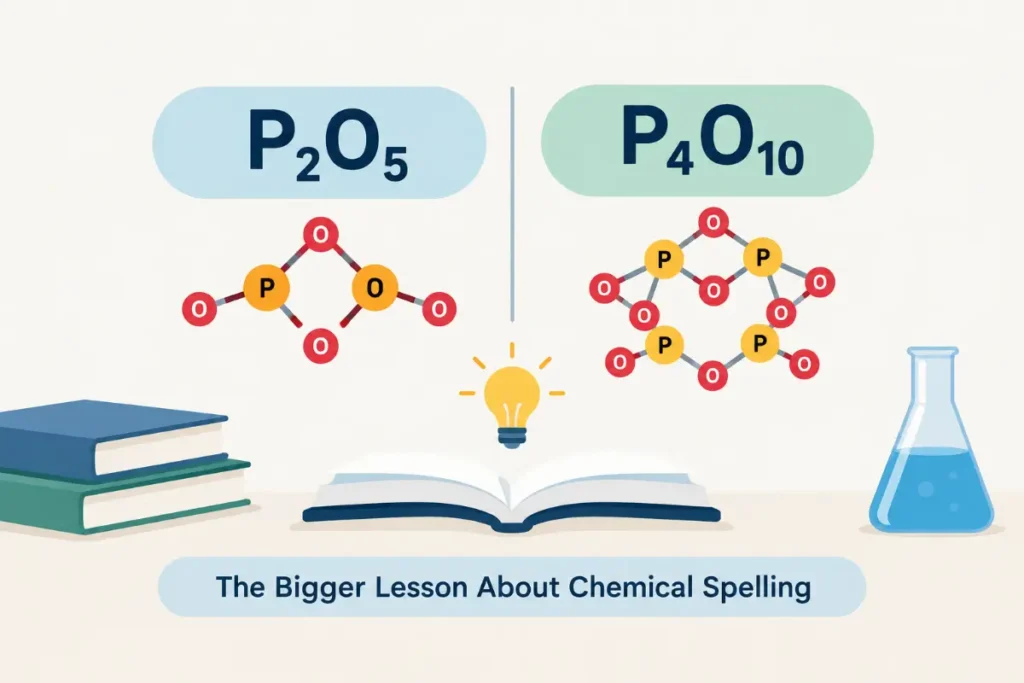
There is one useful detail to keep in mind. The formula P₂O₅ is an empirical formula. The molecular form commonly associated with phosphorus pentoxide is P₄O₁₀. That distinction can matter in more advanced chemistry.
For a basic spelling question, you don’t need to get lost in that detail. The important point is that pentoxide is an established chemical term and is the form most students are expected to recognize.
Pentoxide And Pentaoxide Do Not Mean Two Different Prefixes
It is easy to think the two spellings represent two different chemical ideas. Usually they do not.
Both forms are built around the same numerical idea. The prefix penta indicates five. The difference is mainly in how the prefix is written when it joins with oxide.
That means you shouldn’t assume that changing the spelling automatically creates a different chemical substance.
Chemical identity depends on much more than the spelling of a word. The formula, structure, oxidation state, bonding, and other chemical details all matter.
A single missing letter in a name does not automatically mean the underlying compound has changed.
When Should You Use Pentoxide
If you’re writing a basic chemistry assignment, pentoxide is the safest choice in most cases.
Use it in situations such as:
- High school chemistry assignments.
- Introductory college chemistry.
- Basic chemistry study notes.
- General educational articles.
- Chemistry quizzes.
- Standard molecular naming exercises.
For example:
N₂O₅ is dinitrogen pentoxide.
This is the form commonly taught in introductory molecular compound naming. Pearson’s chemistry material also uses diphosphorus pentoxide for P₂O₅.
If your teacher or textbook follows a specific nomenclature guide, follow that guide. Chemistry courses sometimes use slightly different naming conventions, especially as students move from basic nomenclature into more formal inorganic chemistry.
When Might You See Pentaoxide
You may encounter pentaoxide in scientific databases, chemical records, or sources that retain the full numerical prefix.
NIST provides real examples. Its Chemistry WebBook includes diarsenic pentaoxide and diphosphorus pentaoxide as database entries.
This is a useful reminder that scientific language is not always as simple as one spelling being correct and another being wrong.
A chemistry student might be expected to write pentoxide on an introductory naming exercise. A scientific database may contain a compound under a name using pentaoxide. Both facts can be true at the same time.
When working with research literature or chemical databases, the source’s naming convention matters.
Common Mistakes With These Words
The most common mistake is assuming that the prefix must remain unchanged.
A student learns:
penta means five.
Then the student sees oxygen and writes:
pentaoxide.
That makes sense at first glance. The problem is that introductory nomenclature often uses the shortened form pentoxide.
Another mistake goes in the opposite direction. Someone sees pentoxide and assumes pentaoxide must always be wrong. That conclusion is too strong because legitimate scientific sources use the longer form.
A third mistake is treating the issue as ordinary English spelling. This isn’t really a normal spelling question like choosing between two everyday words. Chemical names follow specialized naming systems.
Once you understand that, the confusion becomes much easier to handle.
The Difference Between A Prefix And A Finished Chemical Name
This distinction can save you a lot of confusion.
Penta is a numerical prefix. It tells you the number five.
Pentoxide is a finished chemical name or part of a chemical name.
Those are not exactly the same thing.
You can see the same idea with other prefixes. Tetra means four, but the familiar compound name tetroxide does not keep the full tetra spelling. Mono means one, but monoxide drops the extra vowel.
So don’t expect every prefix to appear unchanged after it becomes part of a finished chemical name.

Related Words To Know
Understanding related terms can make chemical naming much easier.
Monoxide
Monoxide contains the prefix mono and the word oxide. It indicates one oxygen atom in the relevant molecular name.
Carbon monoxide is a familiar example. Its formula is CO.
Notice that we don’t normally write carbon monooxide in introductory nomenclature. The shorter form is carbon monoxide.
Dioxide
Dioxide uses di to indicate two oxygen atoms.
Carbon dioxide is CO₂. The name tells you there is one carbon atom and two oxygen atoms.
Here there is no final vowel in di to create the same spelling issue.
Tetroxide
Tetroxide comes from tetra plus oxide under the traditional shortened form.
A common example is dinitrogen tetroxide, N₂O₄.
The pattern is similar to the familiar form of pentoxide.
Hexoxide
The prefix hexa indicates six. Chemical names can therefore use forms built from this numerical prefix when the composition calls for six oxygen atoms.
The exact preferred form depends on the nomenclature system and the compound being named.
A Simple Way To Remember The Traditional Form
If you’re studying introductory chemistry, use this memory trick:
Penta plus oxide becomes pentoxide.
Picture the two vowels meeting at the join. The traditional classroom form removes the final a from penta before oxide.
You can connect it with another familiar example:
Tetra plus oxide becomes tetroxide.
Then remember:
Penta plus oxide becomes pentoxide.
This gives you a simple pattern instead of forcing you to memorize one word on its own.
Does The Same Rule Apply To Every Chemical Name
No. This is where you need a little caution.
Chemical nomenclature has different systems and detailed rules. A simple classroom rule can help you name common binary molecular compounds, but it doesn’t cover every chemical name you will encounter.
For basic work, the vowel shortening pattern is useful. Chemistry LibreTexts explicitly teaches forms such as monoxide and pentoxide when a prefix ending in a or o comes before a word beginning with o.
At a more advanced level, formal nomenclature can use different conventions. That is one reason scientific databases may preserve forms such as pentaoxide. NIST’s database provides several real examples of that usage.
So don’t turn a helpful classroom rule into an absolute rule for every chemical name.
Why Scientific Sources Can Look Different
Scientific naming has a practical goal. Scientists need names that communicate clearly and consistently.
But chemistry has developed over a long period. Older names remain in common use. Traditional names can coexist with systematic names. Databases may also use names that differ from the terminology preferred in a particular classroom or textbook.
That’s why a chemistry student can encounter pentoxide in a textbook and later find pentaoxide in a database.
The difference isn’t necessarily an error. It can reflect the naming system being used.
This is especially common when you move from introductory chemistry into more specialized chemical literature. The vocabulary gets more precise and the naming systems become more detailed.
How To Handle The Word In A Chemistry Assignment
If you’re taking an introductory chemistry class, start with your course materials.
If your textbook uses pentoxide, use that form in your assignments. If your instructor has given you a specific nomenclature guide, follow it.
Don’t change a required naming system just because you find another legitimate form online.
For example, if your exercise asks you to name N₂O₅ using the usual prefixes for binary molecular compounds, dinitrogen pentoxide is the expected answer in common introductory materials.
If you’re writing a research paper, use the terminology required by your instructor, journal, database, or style guide.
Consistency matters. A consistent naming system makes your work easier to read and easier to check.
How To Handle The Word In General Writing
If you’re writing for a general audience and don’t need to follow a specialized nomenclature system, pentoxide is usually the clearest choice.
It is familiar to chemistry students and appears in standard educational resources. Major dictionary sources also recognize pentoxide as a chemistry term for an oxide containing five oxygen atoms.
That makes it a good choice for general educational writing.
If your article discusses a specific database record that uses pentaoxide, keep the source’s original terminology when accuracy requires it. You can also explain the naming variation so readers don’t assume you’ve made a spelling error.
What The Formula Can Tell You
Chemical formulas provide a useful check when you’re dealing with these names.
Take N₂O₅.
The subscript 2 tells you there are two nitrogen atoms.
The subscript 5 tells you there are five oxygen atoms.
That is why the name contains dinitrogen and pentoxide in the familiar introductory form.
The same idea applies to P₂O₅.
There are two phosphorus atoms and five oxygen atoms. The common introductory name is diphosphorus pentoxide.
Learning to move between names and formulas is one of the best ways to understand chemical nomenclature. Instead of memorizing words as isolated facts, you begin to see the information built into each name.
Why Pentoxide Is So Common
There is a practical reason you see the shorter form so often.
Introductory chemistry has traditionally taught shortened forms such as monoxide and pentoxide. These forms are familiar to generations of students and appear throughout educational material.
That familiarity matters. A term becomes part of standard classroom language after teachers textbooks and students use it repeatedly.
So if you are searching for the form most likely to appear in a basic chemistry lesson, pentoxide is the one you should expect.
That does not erase the existence of the longer form. It simply tells you which version is more familiar in general chemistry education.
Why Pentaoxide Is Still Worth Recognizing
Even if you normally write pentoxide, you should know what pentaoxide means when you see it.
This is especially useful if you read scientific databases or technical material.
For example, NIST records diphosphorus pentaoxide and diarsenic pentaoxide.
If you only knew the classroom form, you might think the database had made a mistake. Knowing that naming conventions can differ prevents that confusion.
It also helps when searching for chemical information. If you’re looking for a compound and one spelling produces fewer results, try the alternate form. Chemical databases do not always organize names in exactly the same way.
A Practical Rule For Students
If you’re sitting in a chemistry class and need a quick answer, use this rule:
Use pentoxide for the common introductory naming pattern.
That is the form you will usually see in examples such as dinitrogen pentoxide and diphosphorus pentoxide.
If you encounter pentaoxide in a reputable scientific source, don’t immediately mark it as an error. Check the naming convention and the source.
This two step approach is much safer than assuming one spelling is always right and the other is always wrong.
The Bigger Lesson About Chemical Spelling
This question teaches a useful lesson about scientific language.
A scientific word isn’t always governed by ordinary English spelling rules. Chemistry has its own naming conventions. Those conventions have changed and developed over time.
That means you need to consider context.
A school textbook may favor a familiar traditional form. A scientific database may list a systematic or database name. A research paper may follow the naming preferences of a particular field or publication.
The smartest approach isn’t to memorize one rule and reject everything else. Learn the common form first. Then understand why other forms appear.
That habit will serve you well as chemistry becomes more advanced.
FAQs
Is pentoxide or pentaoxide correct?
Both forms can be found in legitimate chemistry usage, but they are not equally common in every context. Pentoxide is the familiar form used in introductory chemistry and many educational resources. Pentaoxide also appears in scientific database names and other chemical naming contexts.
Why is pentoxide spelled without the a?
Traditional introductory chemical nomenclature often drops the final vowel of a numerical prefix before oxide. This gives forms such as monoxide and pentoxide instead of monooxide and pentaoxide.
Is pentaoxide a misspelling?
Not always. Although many introductory chemistry courses expect pentoxide, reputable scientific sources use pentaoxide in actual chemical names. NIST, for example, lists compounds with names such as diphosphorus pentaoxide.
What does pentoxide mean?
Pentoxide refers to an oxide name indicating five oxygen atoms in the relevant composition. The term appears in names such as dinitrogen pentoxide and phosphorus pentoxide.
What is the formula for dinitrogen pentoxide?
The formula is N₂O₅. The prefix di indicates two nitrogen atoms and the pentoxide part indicates five oxygen atoms.
What is the formula for diphosphorus pentoxide?
The empirical formula is P₂O₅. The name tells you that the composition contains two phosphorus atoms and five oxygen atoms in the empirical formula. Introductory chemistry resources use diphosphorus pentoxide for P₂O₅.
Should I use pentoxide in a chemistry exam?
For a typical introductory chemistry exam, pentoxide is the safest choice when your course teaches the standard shortened prefix form. Always follow the naming system your instructor and textbook use.
How can I remember the spelling?
Remember the traditional classroom pattern as penta plus oxide becomes pentoxide. You can also connect it with monoxide and tetroxide. These examples reinforce the idea that some numerical prefixes are shortened before oxide.
Conclusion
The question of pentoxide vs pentaoxide looks like a simple spelling problem, but chemistry gives it a more interesting answer. Pentoxide is the familiar form used in general chemistry education and common molecular naming. Pentaoxide also appears in legitimate scientific sources, so it should not automatically be treated as a spelling error.
For most students, the practical answer is straightforward. If you’re naming a common binary molecular compound in an introductory chemistry class, use pentoxide when your course follows the traditional shortened prefix convention. For example, N₂O₅ is commonly named dinitrogen pentoxide in introductory chemistry materials.
The missing a comes from the way chemical prefixes can be shortened before oxide. That gives familiar forms such as monoxide and pentoxide. At the same time, scientific databases show that pentaoxide also has a place in chemical naming.
So don’t get stuck on one rigid rule. Remember the common classroom form, check the naming system you’re expected to follow, and pay attention to the source when you’re working with advanced chemistry. For a basic chemistry assignment, pentoxide is the practical choice. For scientific research, recognize both forms and follow the nomenclature required by your source.

Dr. Elena Vance holds a Ph.D. in Linguistics from Columbia University and has spent over 15 years analyzing the evolution of the English language. A former university professor turned full-time writer and editor, Elena specializes in breaking down high-level grammatical concepts, punctuation nuances, and style guides (APA, Chicago, MLA) into clear, actionable advice. When she isn’t hunting down dangling modifiers, she can be found collecting vintage dictionaries and reading classic literature.