
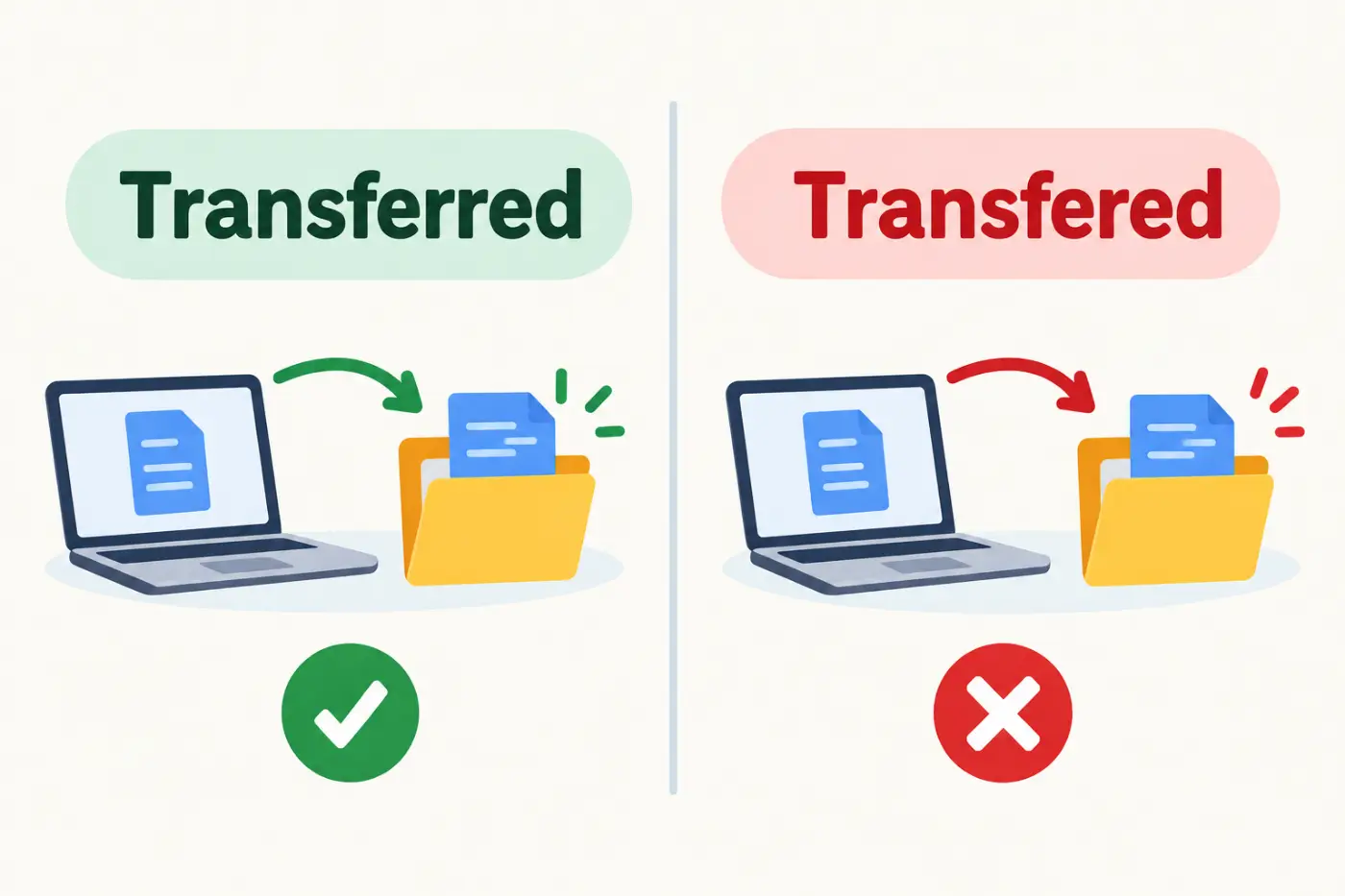
If you’re unsure about transferred or transfered you’re dealing with a very common spelling question. The correct spelling is transferred with two r’s. Transfered with one r is incorrect in standard American English.
The confusion comes from the way English handles words that end in a single consonant before a suffix is added. The base word is transfer. When you add ed to show past tense you double the final r and get transferred.
This rule can feel confusing because not every verb doubles its final consonant. In this guide you’ll see exactly why the extra r appears and how the rule works. You’ll also learn how to use the past tense and past participle naturally in everyday sentences.
Quick Definition
Transferred is the correct past tense and past participle of transfer. It means that someone or something was moved from one person place account group or situation to another.
Transfered is an incorrect spelling. In standard US English the final r is doubled before the ed is added.
Direct Answer
Transferred is correct. Transfered is incorrect because the final r in transfer is doubled before the ending ed is added.
Comparison Table
| Word or Phrase | Meaning | Example Sentence | When to Use It |
|---|---|---|---|
| Transfer | To move someone or something from one place or situation to another. | I need to transfer the files to my laptop. | Use for the base verb. |
| Transferred | The past tense or past participle of transfer. | She transferred the money yesterday. | Use for a completed action. |
| Transfered | Incorrect spelling. | This spelling is incorrect. | Don’t use it in standard English. |

Why The Spelling Is Transferred
The spelling becomes easier once you understand what happens when a suffix is added to a word.
The base verb is transfer. It ends with a single r. When you form the past tense with ed the final consonant is doubled. That gives you transferred.
Think of the change this way.
transfer + ed = transferred
The important part is the doubled r. You don’t remove anything from the base word. You simply add another r before ed.
This same spelling pattern appears in many other English verbs. For example refer becomes referred. Prefer becomes preferred. Occur becomes occurred.
Once you see these words together the pattern becomes much easier to remember.
The Rule For Doubling The Final Consonant
English has a spelling rule that often requires you to double the final consonant before adding an ending such as ed or ing.
The rule usually applies when a one syllable word ends in one vowel followed by one consonant.
For example.
- plan becomes planned.
- stop becomes stopped.
- shop becomes shopped.
The final consonant doubles because of the pattern at the end of the base word.
There is a related rule for longer words. A final consonant is often doubled when the last syllable is stressed.
That is why prefer becomes preferred and admit becomes admitted.
The word transfer follows this pattern when the past tense ending is added. The final syllable receives enough stress to trigger the spelling change in standard American English.
So the correct form isn’t something you simply have to memorize without reason. There is a spelling pattern behind it.
Why One R Looks Tempting
At first glance transfered seems reasonable. You take transfer and add ed. That gives you transfered.
English spelling doesn’t always work that way.
When a word meets a suffix the spelling can change. Sometimes a final consonant doubles. Sometimes a final e disappears.
For example.
- hope becomes hoped.
- make becomes making.
- carry becomes carried.
- stop becomes stopped.
The change depends on the structure of the base word and the ending being added.
With transfer the final r doubles before ed. That gives us transferred.
This is one reason English learners and even native speakers can hesitate over the word. The pronunciation doesn’t clearly tell you that another r belongs in the spelling.
What Does Transferred Mean
Transferred means moved from one person place thing or situation to another.
The word can describe physical movement. It can also describe money information responsibility ownership or people.
For example.
- The patient was transferred to another hospital.
- The files were transferred to a new computer.
- She transferred the money to her savings account.
- The employee was transferred to the Chicago office.
- The student transferred to a different school.
In each sentence something changes from one location or situation to another.
The thing being moved can be very different. A person can be transferred. Money can be transferred. Data can be transferred. A phone call can be transferred. Responsibility can even be transferred from one person to another.
The basic idea stays the same. Something moves from one place or person to another.
How To Use Transferred In A Sentence
The word can appear in several sentence patterns. Understanding these patterns will help you use it naturally instead of simply knowing how to spell it.
Transferred As A Past Tense Verb
Use transferred when the action happened in the past.
For example.
- I transferred the money yesterday.
- She transferred the files last night.
- The manager transferred him to another department.
- We transferred the data to the new system.
The action has already happened. That’s why the past tense form is needed.
Transferred With A Person
You can transfer a person from one place or position to another.
For example.
- The company transferred Maria to its New York office.
- The school transferred the student to another class.
- The hospital transferred the patient to a larger facility.
This use is common in workplaces schools hospitals and other organizations.
Transferred With Money
Financial transfers are another very common use.
For example.
- I transferred $200 to my checking account.
- She transferred the payment this morning.
- We transferred the money through our bank.
- He transferred the funds to a different account.
Here the word describes money moving from one account or person to another.
Transferred With Data
Technology has made this use especially common.
For example.
- I transferred all my photos to my new phone.
- The system transferred the data automatically.
- She transferred the files to an external drive.
The information doesn’t have to move physically in the way a person moves. Digital information can be sent from one device or system to another.
Transferred In Everyday American English
You may hear this word in many ordinary situations. It isn’t limited to formal writing or business language.
Imagine you’re changing banks. You might say that you transferred your money from one account to another.
If you change jobs within the same company you might say that you were transferred to another office.
If you’re buying a new phone you might say that you transferred your contacts and photos.
The word fits all of these situations because they share one basic idea. Something or someone moves from one place or group to another.
Common Examples With Transferred
Here are some natural examples that show the word in different contexts.
Work
- The company transferred James to its Dallas office.
- The manager transferred her to a different department.
- I was transferred to the customer service team last year.
School
- The student transferred to another school during the spring semester.
- She transferred her credits to a four year college.
- The school transferred him to a different class.
Banking
- I transferred the money to my savings account.
- She transferred the payment before the deadline.
- The bank transferred the funds to the new account.
Technology
- We transferred the files to the new computer.
- He transferred all his photos to the cloud.
- The app transferred my data automatically.
Healthcare
- The doctor transferred the patient to a larger hospital.
- She was transferred to another unit for further care.
- The emergency room transferred him to a specialist facility.
Sports
- The club transferred the player to another team.
- The midfielder was transferred during the summer season.
- The team transferred him after reaching an agreement with the other club.
These examples show how flexible the word is. You don’t need a special sentence structure to use it. Just make sure the spelling includes the doubled r.
Transfer And Transferred Are Not The Same
One of the easiest ways to avoid spelling problems is to understand the difference between the base verb and its past form.
Transfer is the base form.
- I want to transfer the files.
Transferred is the past form.
- I transferred the files yesterday.
The difference is small but important. The first sentence describes an action you want to perform. The second tells us that the action already happened.
You can also use transfer after helping verbs.
- I will transfer the money tomorrow.
- We need to transfer the data.
- She wants to transfer to another school.
Notice that you don’t use transferred after will or to in these examples.
The form changes based on the grammar of the sentence.
Transfer And Transferring
The same spelling issue appears when you add ing.
The correct form is transferring with two r’s.
For example.
- She is transferring the files now.
- We are transferring the money to another account.
- He is transferring to a new department.
The final r doubles before ing just as it doubles before ed.
So you have this useful family of forms.
- Transfer
- Transferred
- Transferring
Learning the word family together makes the spelling easier. Instead of remembering three unrelated spellings you can see how they connect.
A Simple Memory Trick
If you often forget the second r try this simple trick.
Think of transfer as a word that keeps its final r and adds another one before ed.
transfe r + r + ed
That gives you transferred.
You can also connect it with referred and preferred. All three words contain the double r before ed.
- Transfer becomes transferred.
- Refer becomes referred.
- Prefer becomes preferred.
Seeing the words as a group can make the spelling stick.
Another useful trick is to remember that the ending sounds like red in the pronunciation of the word. The spelling still contains rr before ed.
You don’t need a complicated memory device. The goal is simply to make the correct form familiar enough that the incorrect version looks strange.
Why Spell Check Should Not Be Your Only Guide
Spell check is useful but it shouldn’t be your only spelling tool. It can catch many errors but good writing still depends on knowing the basic forms of common words.
If you’re writing an important email or report you might type transfered and move on without noticing it. A spelling checker may flag the error. But if you know the doubling rule you’ll catch it yourself.
That matters because spelling isn’t just about passing a software check. Clear spelling helps your reader move through your writing without distractions.
The good news is that this particular mistake is easy to fix. Once you understand why the second r appears you don’t have to rely on guesswork.
What Happens When You Add Different Endings
The base word transfer can take several endings. Each form has its own spelling pattern.
With ed you get transferred.
With ing you get transferring.
For example.
- She transfers money every Friday.
- She transferred money yesterday.
- She is transferring money now.
The first form describes a regular action. The second describes a completed action. The third describes an action that is happening now.
The spelling changes slightly but the core word stays recognizable.
This is a useful way to learn vocabulary. Don’t study only one form. Look at the whole word family and notice how each form works in a real sentence.
The Spelling Rule In More Detail
The spelling of transferred follows a common English pattern. When certain verbs take an ending that begins with a vowel such as ed or ing the final consonant may need to be doubled.
The rule isn’t based on the last letter alone. You also need to look at the letters and stress near the end of the word. That explains why some words double their final consonant while others don’t.
With transfer the final r is doubled before ed.
So the change is:
transfer + ed → transferred
The same thing happens with the ing form.
transfer + ing → transferring
This isn’t a random spelling change. It helps preserve the short vowel sound in the base word when the ending is added.
The Basic Doubling Pattern
A common pattern appears in short words that end in one vowel followed by one consonant. The final consonant is often doubled before an ending such as ed or ing.
Consider these examples.
- stop → stopped → stopping
- plan → planned → planning
- run → ran → running
- shop → shopped → shopping
The doubled consonant helps keep the original vowel sound short.
Longer words can follow a similar pattern when the final syllable is stressed.
For example.
- admit → admitted → admitting
- prefer → preferred → preferring
- refer → referred → referring
- occur → occurred → occurring
- transfer → transferred → transferring
That last group is especially useful because it gives you a clear spelling family to remember.
Why Transfer Doubles The R
The word transfer has two syllables and the stress falls on the first syllable in common American pronunciation. This makes the word slightly different from simple one syllable examples such as stop or plan.
English spelling rules around final consonant doubling can be more complex with two syllable words. Different style guides and varieties of English can also handle some words differently.
For transfer the standard American forms are transferred and transferring. The final r is doubled before both endings.
That gives you a reliable pattern to use in American English writing.
You don’t need to analyze syllables every time you write the word. Once you know the standard forms the easiest approach is to remember the word family.
- Transfer.
- Transferred.
- Transferring.
The double r appears when ed or ing is added.
When The Final Consonant Does Not Double
Knowing the exceptions to the doubling pattern can help you understand why spelling mistakes happen.
A final consonant doesn’t automatically double every time you add ed or ing. The structure of the word matters.
For example.
- open → opened → opening
- We don’t write oppenned or oppening.
The word open has a different stress pattern from transfer. The final syllable isn’t stressed in the same way. Because of that the final consonant isn’t doubled.
Another example is visit.
visit → visited → visiting
We don’t write visitted or visitting in standard American English.
Compare that with admit.
admit → admitted → admitting
The difference comes from the stress pattern and the structure of the final syllable.
These examples show why a simple rule like double the last letter can cause problems. English spelling requires you to look at the whole word.
Transferred In Different Tenses
Understanding tense makes it easier to know when to use the past form.
Present Tense
Use transfer for the base form and transfers for the third person singular.
- I transfer files between my devices.
- We transfer money through the bank.
- She transfers students to another class when needed.
The spelling stays simple because you aren’t adding ed or ing.
Past Tense
Use transferred when the action happened in the past.
- I transferred the files yesterday.
- She transferred the money last Friday.
- The company transferred him to another office.
The double r is required.
Present Continuous
Use transferring when the action is happening now or around the present time.
- I am transferring the files now.
- She is transferring to another department.
- They are transferring the data to a new server.
Again the final r is doubled.
Present Perfect
Use has transferred or have transferred when you want to connect a past action with the present.
- I have transferred the payment.
- She has transferred the files.
- They have transferred the patient to another facility.
The past participle is transferred.
Past Perfect
Use had transferred when one past action happened before another past action.
- We had transferred the money before the bank closed.
- She had transferred the files before the computer stopped working.
The same past participle appears after had.
The spelling doesn’t change based on these tense patterns. Once you know transferred is the past form you can use it in several verb structures.
Transferred As A Past Participle
A past participle is a verb form that often works with helping verbs such as has, have, had, and was.
The word transferred can work this way.
- The money has been transferred.
- The files have been transferred.
- The patient was transferred to another hospital.
- The responsibility had been transferred to a new manager.
Notice that transferred doesn’t always mean that the subject performed the action. Sometimes the subject receives the action.
Compare these two sentences.
- The manager transferred the employee.
- The employee was transferred by the manager.
In the first sentence the manager performs the action. In the second sentence the employee receives the action.
The spelling stays the same.
Active And Passive Sentences
This difference is useful when you’re writing clearly.
An active sentence puts the person doing the action in focus.
- The bank transferred the money.
A passive sentence puts the thing or person affected by the action in focus.
- The money was transferred by the bank.
Both sentences describe the same basic event. The difference is the focus.
You may also see the word without by when the person responsible for the action isn’t important.
- The payment was transferred successfully.
This form is common in business emails banking notices and official documents.
Transferred Money
Financial writing uses this word very often. You might see it in bank messages payment records and personal emails.
For example.
- I transferred the rent this morning.
- She transferred the money to her sister.
- The payment was transferred to the wrong account.
- We have transferred the funds as requested.
When talking about money the word often appears with to.
- Transfer money to an account.
- Transfer funds to another person.
You can also use from when you want to show the starting point.
- I transferred the money from my checking account to my savings account.
Using from and to together makes the direction clear.
Transferred Files And Data
Technology gives us another common use.
You might transfer photos from your phone to your computer. You might transfer files from one folder to another.
Examples include:
- I transferred my photos to my new phone.
- She transferred the documents to a shared folder.
- We transferred the customer data to the new system.
- He transferred the files from his laptop to an external drive.
The word works naturally with both physical devices and digital systems.
You can also use it when talking about ownership or control.
- The company transferred the data to another system.
- The account was transferred to a new owner.
The central meaning remains movement from one place or holder to another.
Transferred At Work
In American workplaces the word often describes a change in location or department.
Someone might be transferred because the company needs help at another office. An employee might also request a transfer to move closer to family or take a new role.
For example.
- Sarah was transferred to the Boston office.
- The company transferred him to the sales department.
- I requested a transfer to another branch.
- She was transferred to a different team last month.
Notice the difference between transfer and transferred.
- I want to transfer to another office.
- I transferred to another office last month.
The first sentence describes a desired or future action. The second describes something that already happened.
Transferred At School
Schools and colleges use this word too.
A student can transfer from one school to another. Credits can also be transferred from one college to another.
For example.
- He transferred to a new high school.
- She transferred to a university in California.
- The college transferred her credits.
- Some of my credits were transferred to the new school.
The phrase transfer credits is especially common in higher education.
If you move from one college to another the new school may review your previous coursework and decide which credits it will accept. Those accepted credits can then be transferred into your new academic record.
Transferred In Healthcare
Hospitals often use transferred when a patient moves from one facility or unit to another.
For example.
- The patient was transferred to another hospital.
- He was transferred to the intensive care unit.
- The doctor transferred her to a specialist.
- The emergency department transferred the patient after the initial examination.
This use can describe a change in hospital location or a move to a different level of care.
The word is also common in medical records and communication between healthcare facilities.
Transferred In Sports
Sports provide another familiar example.
A player can be transferred from one team to another. The word is especially common in soccer and other sports where clubs negotiate player moves.
For example.
- The club transferred the midfielder to another team.
- The player was transferred during the summer window.
- The team transferred him after receiving an offer from another club.
Here transferred describes a change in team membership.
The same spelling rule applies. The final r stays doubled before ed.
Transferable And Other Related Forms
The word transfer has several related forms. Learning them together can strengthen your spelling and vocabulary.
Transfer is the verb and noun.
- I need to transfer the files.
- The transfer took two days.
Transferred is the past tense and past participle.
- She transferred the money yesterday.
- The files were transferred successfully.
Transferring is the present participle and gerund.
- He is transferring the data now.
- Transferring files can take time.
Transferable is an adjective. It describes something that can be moved from one person place or situation to another.
- Some college credits are transferable.
- These skills are transferable to other jobs.
Seeing these related forms together makes the base word easier to recognize. It also gives you more options when writing.
A Quick Test For Your Writing
If you’re unsure about the spelling in the middle of writing stop and return to the base word.
Start with transfer.
Then ask what form the sentence needs.
- If the action happened in the past use transferred.
- If you’re talking about the general action use transfer or transfers based on the subject.
This small habit removes most of the guesswork.
For example.
- Yesterday I transferred the files.
- Today I am transferring the files.
- Tomorrow I will transfer the files.
The time changes. The spelling pattern becomes much easier to see.
The Most Common Spelling Mistake
The biggest error is leaving out the second r.
People sometimes write:
- I transfered the money yesterday.
- She was transfered to another department.
- The files were transfered successfully.
All three sentences need the same correction.
The correct forms are:
- I transferred the money yesterday.
- She was transferred to another department.
- The files were transferred successfully.
The problem isn’t the meaning. Readers can usually understand the sentence. The issue is spelling.
In school work professional emails applications and published content even small spelling errors can distract readers. Learning the correct form takes only a moment and saves you from having to second guess the word later.
A Simple Memory Method
If you struggle to remember the second r try linking transferred with preferred and referred.
All three have the same useful ending pattern.
- preferred
- referred
- transferred
You can think of them as a small spelling group. When you see one of them your brain gets a reminder about the others.
- Another trick is to say the base word first.
- Transfer.
- Then add another r before ed.
- Transferred.
- Then do the same before ing.
- Transferring.
That gives you a simple three word family that covers the forms you’re most likely to use.
The key isn’t finding a clever trick that you’ll forget tomorrow. The best memory trick is one that makes the correct spelling feel familiar.

When You Should Use Transfer Instead
Don’t automatically use the past form just because you’re talking about movement.
The tense of the sentence matters.
If the action hasn’t happened yet use transfer.
- I will transfer the money tomorrow.
If it happens regularly use transfer or transfers.
- I transfer money every month.
- She transfers money every Friday.
This distinction helps you choose the right form based on meaning rather than spelling alone.
A Useful Editing Check
When proofreading your work search for the incorrect one r version. If you see it replace it with the form that has two r’s.
You can also check nearby words such as preferred and referred. These words can remind you of the same consonant doubling pattern.
For important writing don’t rely only on how the word looks. Check the tense too. A sentence can have the correct spelling and still use the wrong verb form.
For example.
- I transferred the money tomorrow.
The spelling is correct but the tense doesn’t fit the time word tomorrow.
A better sentence is:
- I will transfer the money tomorrow.
Good editing checks both spelling and grammar. One without the other isn’t enough.
How To Use Transferred Correctly
Knowing the spelling is only part of the job. You also need to know how the word works in a sentence. Transferred describes an action that has already happened or an action that has been completed as part of a larger verb phrase.
The word can describe people moving between locations. It can describe money moving between accounts. It can describe files moving between devices.
The meaning changes slightly based on the context but the central idea stays the same. Something moves from one place or person to another.
Transferred To A New Place
One of the most common uses describes a person moving to another location.
- My brother was transferred to Denver last year.
- She transferred to a different office after getting a promotion.
- The company transferred several employees to its new branch.
In these sentences the people didn’t simply visit another place. Their work location changed.
The word often appears with to because to shows the new destination.
Transferred From One Place To Another
You can also use from to show the starting point.
- He was transferred from the New York office to the Boston office.
- The patient was transferred from one hospital to another.
- The files were transferred from my old computer to my new laptop.
Using both from and to gives the reader a complete picture. One shows where something started. The other shows where it ended up.
Transferred Between Two Places
The word between can also work when you want to describe movement involving two locations or groups.
- The manager transferred the employee between two departments.
Still the most natural structure depends on the exact meaning. If you’re naming the starting point and destination from and to are usually clearer.
Transferred And Moved
Transferred and moved can have similar meanings but they aren’t always interchangeable.
Moved is a broad everyday word. It can describe almost any change in physical location.
- We moved to a new house.
- She moved the chair closer to the window.
Transferred often suggests an organized or official change from one place person account or system to another.
- The company transferred her to another office.
- The bank transferred the money to my account.
You wouldn’t normally say that you transferred a chair across a room. You’d say you moved it.
On the other hand saying that your bank moved money to another account sounds less precise. Transferred is the natural choice in that setting.
The difference is simple. Move is broad and casual. Transfer often describes an intentional change between defined places or groups.
Transferred And Sent
The words transferred and sent can overlap when you’re talking about information or files.
You might say:
- I sent the document to my manager.
- I transferred the document to another folder.
The first sentence focuses on delivering the document to another person. The second focuses on moving the document from one location or system to another.
You can also send money but transfer is often more precise for financial transactions.
- I sent my sister some money.
- I transferred the money to her bank account.
Both can be correct. The better choice depends on what you want to emphasize.
Transferred And Changed
A transfer usually involves a change but transferred does not simply mean changed.
For example:
- She transferred to another department.
This tells us exactly what kind of change happened. She moved from one department to another. But:
- She changed departments.
This is broader. It doesn’t focus as strongly on the process of moving from one group to another.
The same difference appears in other contexts. A bank account can be transferred to another owner. A responsibility can be transferred to another employee. In each case the word identifies the movement from one holder to another.
Common Grammar Patterns With Transferred
Learning a few sentence patterns can make this word much easier to use.
Subject Plus Transferred Plus Object
Use this pattern when someone actively moves something.
- I transferred the money.
- She transferred the files.
- The bank transferred the funds.
The subject performs the action.
Subject Plus Was Transferred
Use this pattern when someone or something received the action.
- He was transferred to another office.
- The patient was transferred to another hospital.
- The account was transferred to a new owner.
This pattern is common when the person or thing being moved matters more than the person who made the transfer.
Has Or Have Plus Transferred
Use this pattern when a completed transfer matters to the present situation.
- I have transferred the payment.
- We have transferred the files.
- They have transferred the account.
This structure is common in emails and business communication.
Had Plus Transferred
Use this form when one past transfer happened before another past event.
- She had transferred the files before the computer crashed.
- We had transferred the money before the deadline.
The earlier action uses had transferred.
Common Mistakes With Transferred
The missing second r is the most obvious spelling error but it isn’t the only mistake people make.
Some writers also use the wrong tense. Others choose transferred when they need the base form transfer.
Mistake With Future Time
Incorrect:
- I transferred the money tomorrow.
Correct:
- I will transfer the money tomorrow.
The problem here isn’t spelling. The issue is tense. Tomorrow points to the future so the base verb should follow will.
Mistake After Will
Incorrect:
- I will transferred the files later.
Correct:
- I will transfer the files later.
After will use the base form of the verb. Don’t add ed.
Mistake After To
Incorrect:
- She wants to transferred to another office.
Correct:
- She wants to transfer to another office.
The word to in this structure is followed by the base verb.
Mistake With Is Or Are
Incorrect:
- She is transferred the files now.
Correct:
- She is transferring the files now.
If the action is happening now use the ing form after is.
Mistake In Passive Sentences
Incorrect:
- The files were transferring to the new system.
Correct:
- The files were transferred to the new system.
The passive structure uses were transferred.
These grammar patterns are worth learning because spelling and grammar often get mixed together. A writer might spell the word correctly but still use the wrong form.
How The Word Works In Professional Writing
The word appears frequently in business communication because companies often move employees money files accounts and responsibilities.
Consider this email sentence:
- Your request has been transferred to our billing department.
The sentence sounds natural because the request has moved from one department to another.
Another example is:
- Your payment has been transferred successfully.
This tells the reader that the financial movement has been completed.
You might also see:
- Your account has been transferred to our new system.
This means the account information or management has moved from one system to another.
In each example the word gives a clear picture of movement. It doesn’t require complicated language.
How The Word Works In Formal Writing
Transferred works well in formal writing because it is precise. It tells the reader that something moved from one place or holder to another.
For example:
- The records were transferred to the state archive.
- The funds were transferred to the designated account.
- The employee was transferred to another branch.
- The responsibility was transferred to the department manager.
These sentences are direct and easy to understand. You don’t need a more complicated word to replace transferred.
How The Word Works In Casual Writing
The word also works perfectly well in everyday conversation.
You might tell a friend:
- I got transferred to another office.
- I transferred the photos to my phone.
- My call got transferred to the wrong department.
The word doesn’t automatically make a sentence formal. The surrounding language controls the tone.
For casual speech got transferred is especially common.
- I got transferred to the Chicago branch.
For more formal writing you might prefer:
- I was transferred to the Chicago branch.
Both communicate the same basic event.
Transferable Skills And Related Ideas
The word transferable is closely related to transfer. It describes something that can be used in a different setting.
This idea comes up often when people talk about jobs and education.
For example:
- Communication is a transferable skill.
- Her teaching skills are transferable to corporate training.
- Some college credits are transferable to another school.
A transferable skill works in more than one situation. Someone might learn organization skills in one job and use those skills successfully in another.
This connection can help you remember the larger word family.
- Transfer
- Transferred
- Transferring
- Transferable
These forms all come from the same base word.
Related Words With Similar Spelling Patterns
If you’re trying to improve your spelling the best approach is often to notice groups of words instead of isolated words.
Consider these examples:
- Refer becomes referred.
- Prefer becomes preferred.
- Occur becomes occurred.
- Infer becomes inferred.
- Transfer becomes transferred.
The double consonant appears before ed in each case.
These words can help reinforce the pattern. You don’t need to memorize a long technical rule every time. Seeing the same pattern in familiar words builds recognition.
Is The Double R Always Needed
For the standard American spelling of the past tense and past participle the answer is yes.
- Write:
- transferred
- Not:
- transfered
- The same applies to the ing form.
- Write:
- transferring
- Not:
- transfering
The extra r isn’t optional. It is part of the standard spelling.
Why The Incorrect Form Looks Right
There is a simple reason the one r version can fool your eyes. The base word already ends in r and adding ed feels like a straightforward operation.
For many verbs that simple approach works.
For example:
- work becomes worked.
- clean becomes cleaned.
- open becomes opened.
So it can feel natural to write transfered.
But English spelling sometimes changes the final consonant when an ending is added. Once you learn that transfer belongs to the group that doubles the final consonant the spelling becomes easier to predict.
The second r may look strange at first. After you’ve seen transferred enough times it starts to look completely normal.
A Practical Proofreading Trick
When editing your work look at the ending of the word rather than trying to remember the entire spelling at once.
Ask yourself:
- Does the word come from transfer?
- Is it describing a completed action?
- If both answers are yes then write the past form with two r’s.
You can also compare it with transferring. If you know the present participle has two r’s the past form becomes easier to recall.
For example:
- She is transferring the files.
- She transferred the files yesterday.
The two forms sit naturally together.
A Quick Practice Exercise
Try choosing the correct form in each sentence.
- I ___ the money yesterday.
- She was ___ to another department.
- They have ___ the files to the new system.
- We will ___ the account tomorrow.
- He is ___ the data now.
The answers are:
- transferred
- transferred
- transfer
- transferring
Notice how the sentence structure tells you which form to use. The spelling becomes much easier once you first identify the tense.
This is a useful editing habit for many English verbs. Don’t look at the spelling in isolation. Look at what the sentence is saying.
The Best Way To Remember It
If you remember only one thing from this section remember the word family.
- Transfer is the base form.
- Transferred is the past form.
- Transferring is the ing form.
Transferable describes something that can be moved or used in another setting.
The most important spelling point is simple. The final r doubles before ed and ing.
So when you’re writing about something that already moved from one place to another use transferred. When you’re describing an action happening now use transferring.
Once that pattern becomes familiar you’ll stop having to pause over the spelling.
Here is Part 4, continuing the article with the FAQ, final practical guidance, conclusion, and meta description.
Transferred or Transfered In Everyday Writing
The spelling question can seem confusing because the base word is transfer and the past tense adds only a few letters. When you say the word aloud, the extra r is easy to miss. When you write it, though, that second r matters.
The correct form is transferred. The form transfered is not the standard spelling used in American English. If you are writing an email, report, school assignment, resume, business document, or article, use transferred.
This spelling also stays consistent in many common forms of the word. You write transfer, transferred, transferring, and transferable. Learning the pattern makes the whole word family easier to handle.
Transferred or Transfered In Formal Writing
Formal writing often makes spelling mistakes more noticeable. A single missing letter can make an otherwise polished document look rushed. That is especially true when the word appears in a report, application, contract, academic paper, or workplace message.
Use transferred when you need the past tense or past participle of transfer. For example, you can write that an employee was transferred to another office. You can also say that the payment was transferred to the correct account.
The same rule applies in professional communication. A sentence such as “The customer was transferred to the billing department” looks natural and correct. Writing “The customer was transfered to the billing department” creates an avoidable spelling error.
Transferred In Digital Communication
The word appears often in emails, banking messages, software screens, file sharing tools, and other digital settings. You may see it used for money, calls, files, accounts, information, or ownership.
For example, a bank may tell you that money has been transferred. A support agent may say that your call has been transferred to another department. A computer system may report that a file was transferred successfully.
These uses all follow the same spelling rule. The meaning changes based on the object, but the spelling does not.
Transferred In School Writing
Students often use this word when writing about people, schools, money, information, or objects. It can describe an action that happened in the past.
For example, a student might write that they transferred to another school. A history assignment might explain that control of a region was transferred to another government. A science report might describe how energy was transferred from one object to another.
In each case, the correct spelling has two r letters before the ending. Checking this small detail can prevent an easy spelling mistake.
Transferred In Workplace Writing
Workplace writing uses the word in many different ways. An employee can be transferred to another office. A customer can be transferred to another department. A project can be transferred to another team.
Money and records can also be transferred. A company might transfer funds between accounts. It might transfer ownership of an asset. It might transfer files from one system to another.
The sentence structure may change, but the spelling stays the same. Once you know the correct form, you can use it confidently in many professional situations.
Transferred And Transferring
One useful way to remember the spelling is to compare transferred with transferring. Both forms double the final r before the ending.
You write transferred when describing a completed action. You write transferring when describing an action that is happening or continuing.
For example, “The company transferred the employee last month” describes a completed action. “The company is transferring the employee this week” describes an action in progress.
Seeing the two forms together can make the spelling pattern easier to remember. The final r is doubled before both endings.
Transferred And Transferable
The word transferable has a different ending, so it does not follow exactly the same spelling pattern. You do not write transferrable in standard American English when you mean something that can be transferred.
For example, you can say that a skill is transferable. This means the skill can be used in another job or situation.
This distinction is useful because learners sometimes assume that every form of the word must double the r. That is not the case. Different suffixes can create different spelling patterns.
A Final Spelling Check
When you are unsure about the past tense of transfer, look at the base word first. It ends in a single vowel followed by a consonant sound represented by r. The stress pattern supports doubling the final consonant before the past tense ending.
Then add ed after doubling the final r. That gives you transferred.
You can also compare it with transferring. If you remember that the continuous form has two r letters, the past tense becomes easier to recognize.
Another simple check is to say the spelling slowly in your head. Think of it as transfer plus red. You do not need to pronounce the extra r differently. You only need to remember that the letter is written twice.

Why Good Spelling Still Matters
A spelling mistake does not always make a sentence impossible to understand. Most readers will know what you mean when they see transfered. Still, correct spelling makes your writing cleaner and more trustworthy.
Good spelling also helps readers move through your writing without distraction. They do not have to stop and wonder if a word looks right. That matters even more in professional and academic writing.
You do not need to memorize every spelling rule in English. A few useful patterns can handle many common problems. The doubling pattern behind transferred is one of those useful patterns.
A Simple Editing Habit
When proofreading, look closely at words that end in ed or ing. These endings often change the spelling of the base word. Words such as transfer, refer, and prefer can create similar problems.
Do not rely only on how the finished word sounds. English spelling often contains letters that are easy to miss when you speak. Looking at the base word and the added ending gives you a more reliable check.
You can also create a short personal list of words that you often misspell. Add transferred to that list if it causes trouble. After seeing the correct form several times, the spelling usually becomes automatic.
FAQs
Is Transferred The Correct Spelling?
Yes. Transferred is the correct spelling in standard American English. It has two r letters before the ed ending.
Is Transfered Ever Correct?
No. Transfered is generally considered a misspelling in standard American English. Use transferred instead.
Why Does Transferred Have Two Rs?
The final consonant is doubled before the past tense ending because of the spelling pattern used by the word transfer. This gives us transferred rather than transfered.
What Is The Past Tense Of Transfer?
The past tense of transfer is transferred. For example, “She transferred the money yesterday” uses the correct past tense form.
What Is The Difference Between Transfer And Transferred?
Transfer is the base form of the verb. Transferred is the past tense and past participle form. You use the first for actions in their base form and the second for completed actions or passive constructions.
Is Transferring Spelled With Two Rs?
Yes. The correct spelling is transferring with two r letters. The same doubled consonant pattern appears before the ing ending.
Can I Use Transferred For Money?
Yes. You can use transferred when talking about money moved from one account or person to another. For example, “The bank transferred the funds to my account” is correct.
Can I Say Transferred To Another School?
Yes. The phrase is common and grammatically correct. You can say, “She transferred to another school last year” when describing a change from one school to another.
Is Transferred Used In American English?
Yes. Transferred is the standard spelling in American English. It is also widely used in other forms of standard English.
How Can I Remember The Spelling Of Transferred?
Remember the base word transfer and double the final r before ed. Thinking of transferred and transferring together can also help you remember the pattern.
Conclusion
If you have been wondering about transferred or transfered, the answer is simple. Transferred is the correct spelling, and transfered is a misspelling in standard American English.
The extra r is not random. It comes from the spelling pattern used when the word transfer takes the ed ending. The same pattern gives us transferring with two r letters.
Once you recognize the pattern, the word becomes much easier to spell. Use transferred for completed actions involving people, money, files, calls, information, ownership, or anything else that moves from one place or person to another.
A quick spelling check can save you from an easy mistake. When you see transfer, remember that its past tense is transferred, not transfered. Keep that pattern in mind, and you will be much less likely to miss the second r.

Dr. Elena Vance holds a Ph.D. in Linguistics from Columbia University and has spent over 15 years analyzing the evolution of the English language. A former university professor turned full-time writer and editor, Elena specializes in breaking down high-level grammatical concepts, punctuation nuances, and style guides (APA, Chicago, MLA) into clear, actionable advice. When she isn’t hunting down dangling modifiers, she can be found collecting vintage dictionaries and reading classic literature.