

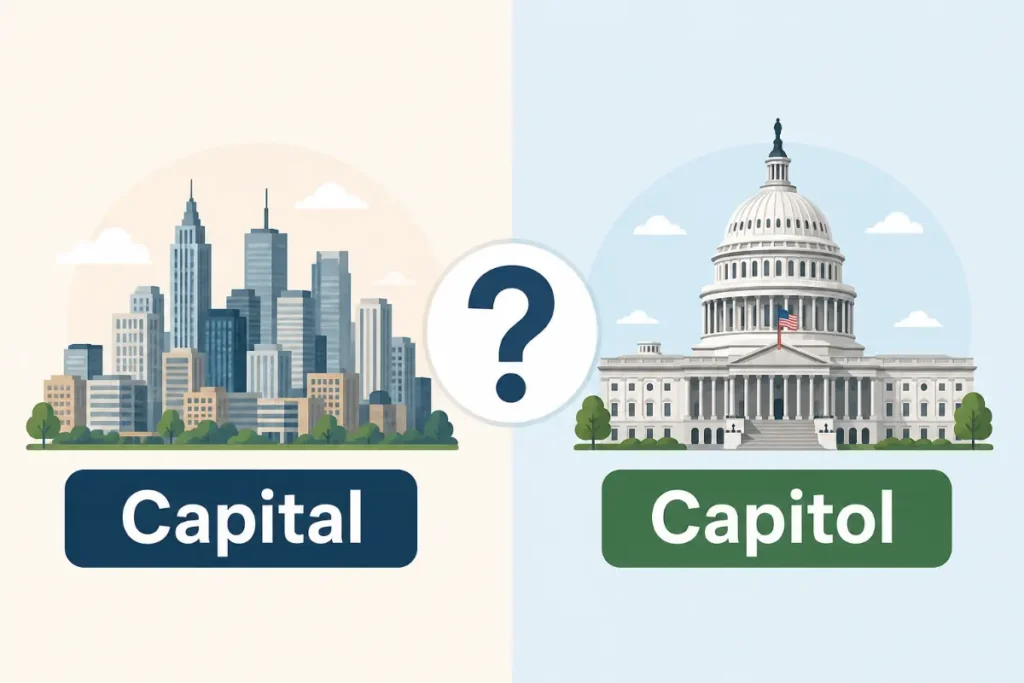
If you’ve ever paused over capital or capitol you’re in good company. These two words sound exactly the same but have very different meanings. Picking the wrong one can change the meaning of your sentence and make your writing look less polished.
The difference is actually simple once you know what each word refers to. One word can describe a city money or uppercase letters. The other refers to a government building where lawmakers meet. Even native English speakers mix them up because the spellings are so similar.
This guide explains the difference in plain English. You’ll learn what each word means how to use it correctly simple memory tricks and plenty of real examples that make the distinction easy to remember.
Quick Definition
- Capital has several meanings. It can refer to the main city of a country or state money or wealth uppercase letters or something that is extremely important.
- Capitol has just one main meaning. It is the building where a legislature meets such as the United States Capitol or a state capitol building.
Direct Answer
Capital is the correct choice in most situations. Use capitol only when you are talking about a government building where lawmakers meet.
Comparison Table
| Word | Meaning | Example Sentence | When To Use It |
|---|---|---|---|
| Capital | A main city money an uppercase letter or something very important. | Austin is the capital of Texas. | Use it for cities finance letters and importance. |
| Capitol | A building where a legislature meets. | Visitors toured the state capitol. | Use it only for government buildings. |
Why People Confuse These Words
The confusion starts with pronunciation. Both words sound exactly the same when spoken so you cannot rely on your ears to tell them apart. Their spellings are almost identical too. The only difference is one letter yet that single letter completely changes the meaning. It is easy to see why people hesitate before typing one of them.
Another reason is that the two words often appear in discussions about government. You might read about a state’s capital city and its capitol building in the same article. Since both words relate to government in different ways many writers accidentally swap them.
The good news is that each word has a clear job. Once you understand that job choosing the correct spelling becomes much easier.
What Does Capital Mean
Capital is one of those English words with several meanings. The correct meaning depends on the sentence but the idea is usually easy to understand from the context.
The most common meaning is the main city where a country’s or state’s government is based. For example.
- Washington is the capital of the United States.
- Sacramento is the capital of California.
- Ottawa is the capital of Canada.
The word also refers to money or financial resources used for business or investment. For example.
- The company raised enough capital to open a new office.
- Small businesses often need extra capital to grow.
Another meaning involves uppercase letters. For example.
- Start every sentence with a capital letter.
- Do not write the whole email in capital letters.
You can also use capital to describe something that is very important or excellent. For example.
- That was a capital idea.
- Safety is of capital importance.
Even though the word has several meanings readers usually understand the correct one from the rest of the sentence.
What Does Capitol Mean
Unlike capital the word capitol has only one main meaning. It refers to the building where lawmakers meet to create debate and pass laws.
In the United States the most famous example is the United States Capitol in Washington where Congress meets. Every state also has its own capitol building where the state legislature carries out its work. Here are a few examples.
- Tourists visited the state capitol during their vacation.
- The governor spoke outside the capitol building.
- Lawmakers returned to the capitol after the holiday.
Notice that capitol always refers to a physical building. It never means a city money or uppercase letters. That simple fact helps remove most of the confusion.
The Biggest Difference Between Capital And Capitol
The easiest way to remember these words is to think about what they represent. A capital can be a place an amount of money a type of letter or something important. It has several different meanings and appears in many kinds of writing. A capitol is always a building. If your sentence is not talking about a legislative building then capital is almost certainly the correct choice.
Most people use capital far more often because it applies to many everyday situations. Capitol has a much narrower meaning and mainly appears in news stories history books government websites and travel guides.
How To Remember The Difference
A simple memory trick can save you from mixing up these words. Look at the letter O in capitol. That round letter can remind you of the dome on top of many capitol buildings. If your sentence is about a building where lawmakers meet think of the dome and choose capitol.
For almost every other situation use capital. It covers cities money uppercase letters and anything described as very important. Since those meanings come up much more often you will probably use capital far more than capitol.
A Simple Way To Check Yourself
- Ask one quick question before you write the word.
- Is the sentence talking about a government building where laws are made.
- If the answer is yes use capitol.
- If it is talking about a city money uppercase letters or importance use capital.
- That quick check works almost every time.
Capital In Everyday Life
Most people use capital in daily conversations without even thinking about it. The word appears in geography business education and regular writing.
Capital As A City
This is the meaning people learn first in school. Examples.
- Paris is the capital of France.
- Tokyo is the capital of Japan.
- The capital of Florida is Tallahassee.
In each example the word refers to the main city where the government is based.
Capital In Business
Business owners investors and economists often use capital when talking about money. Examples.
- The startup needed more capital to expand.
- Investors provided enough capital to launch the project.
- Good planning helps businesses protect their capital.
Here the word means financial resources instead of a city.
Capital Letters
Another common meaning involves writing. Examples.
- Always begin a sentence with a capital letter.
- Proper nouns start with capital letters.
- Do not type every word in capital letters.
This is one of the most common uses of the word in everyday English.
Capital Meaning Very Important
Sometimes capital describes something that has great importance. Examples.
- Trust is of capital importance in a friendship.
- Clean drinking water is of capital importance to every community.
This meaning appears more often in formal writing than casual conversation but it is still useful to know.
Capitol In Everyday Life
- The word capitol has only one job so it is much easier to remember once you learn it.
- It always refers to a building where lawmakers meet to discuss vote on and create laws.
Examples.
- Visitors toured the state capitol during spring break.
- Reporters gathered outside the capitol before the meeting.
- The committee met inside the capitol this morning.
Notice that every sentence involves an actual building. You could point to it on a map or visit it in person.
The United States Capitol
One of the most famous government buildings in the world is the United States Capitol in Washington. It is the meeting place for Congress and serves as a symbol of the American government.
Many people mistakenly call it the United States Capital because Washington is the nation’s capital city. The city is the capital. The government building is the Capitol.
Keeping those two ideas separate makes the distinction much easier.
Common Mistakes People Make
Because these words sound alike people often use one when they mean the other.
Here are some examples.
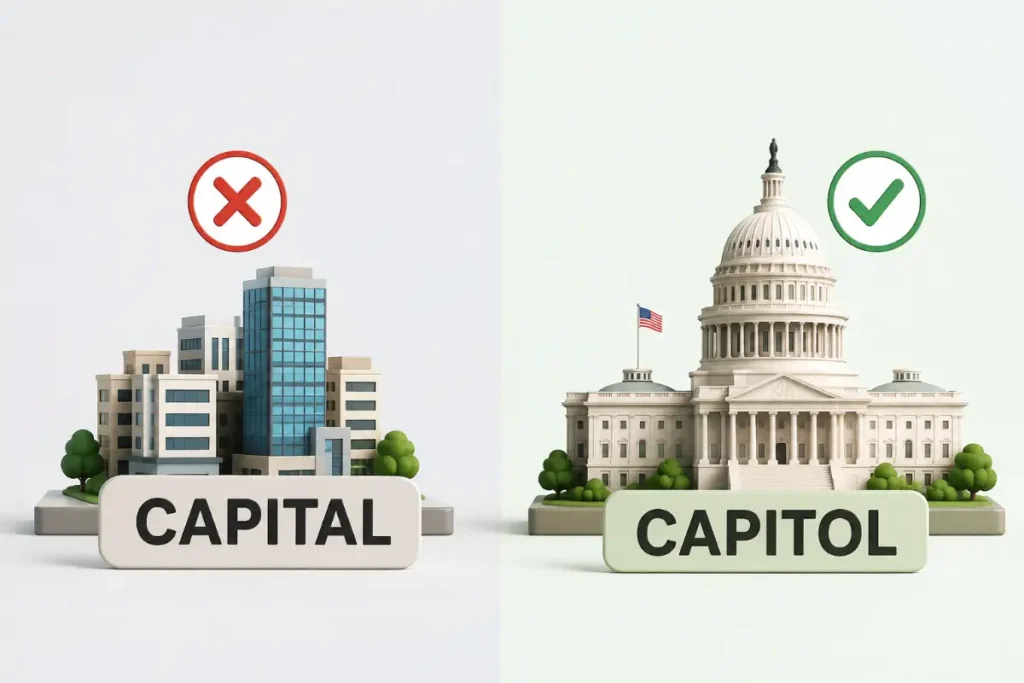
| Incorrect | Correct |
|---|---|
| We visited the capital building. | We visited the capitol building. |
| The capitol of Texas is Austin. | The capital of Texas is Austin. |
| Begin every sentence with a capitol letter. | Begin every sentence with a capital letter. |
| The company needs more capitol to grow. | The company needs more capital to grow. |
Most of these mistakes happen because people remember the sound instead of the meaning. Taking one extra second to think about the context usually solves the problem.
Why Context Matters
English contains many words that sound alike but mean different things. These are called homophones. Capital and capitol are a perfect example.
- The spelling depends entirely on what you are describing.
- If you are talking about a place where a government operates the correct word is usually capital because you mean the city.
- If you are talking about the actual building where lawmakers meet the correct word is capitol.
- Looking at the rest of the sentence almost always gives you the answer. Instead of focusing on the spelling first think about the meaning. The right word usually becomes obvious.
Real World Examples That Show The Difference
Sometimes the easiest way to understand confusing words is to see them in real situations. The examples below show how each word fits naturally into everyday English.
Talking About Countries
When people discuss countries they usually mean the main city where the government is located. Examples.
- Canberra is the capital of Australia.
- Madrid is the capital of Spain.
- Mexico City is the capital of Mexico.
- Cairo is the capital of Egypt.
In every example the word refers to a city instead of a building.
Talking About State Governments
A state has both a capital city and a capitol building. They are connected but they are not the same thing. For example.
- Denver is the capital of Colorado.
- The Colorado State Capitol is located in Denver.
The first sentence names the city. The second names the government building inside that city. Once you separate the city from the building the difference becomes much easier to remember.
The same pattern works for every state.
- Nashville is the capital of Tennessee.
- The Tennessee State Capitol stands in downtown Nashville.
Talking About School Writing
Students see the word capital almost every day in English class. Examples.
- Use a capital letter at the beginning of every sentence.
- Every person’s name starts with a capital letter.
- The teacher reminded us not to write the title in all capital letters.
The word capitol would never be correct in these examples because they are about writing instead of government buildings.
Talking About Business
The financial meaning of capital appears often in business and economics.
Examples.
- The business needs more capital before opening a second store.
- Investors supplied enough capital for the project.
- Good planning helps companies protect their capital.
Again the word has nothing to do with government buildings. It refers to money or resources used to support a business.
Related Word Pairs That Cause Similar Confusion
English has many word pairs that sound alike or look almost the same. Learning them together helps you become a more confident writer.
Principal And Principle
- Principal can mean the head of a school or the main person or amount.
- Principle means a rule belief or basic truth.
Examples.
- The principal welcomed the new students.
- Honesty is an important principle.
Stationary And Stationery
- Stationary means not moving.
- Stationery refers to writing paper envelopes and office supplies.
Examples.
- The car remained stationary.
- She bought new stationery for her office.
Affect And Effect
- Affect is usually a verb that means to influence something.
- Effect is usually a noun that means a result.
Examples.
- Rain can affect travel plans.
- The new rule had a positive effect.
Like capital and capitol these pairs become easier once you connect each word with its meaning instead of its pronunciation.
Tips To Avoid Mixing Them Up
Good writers rarely depend on memory alone. They build habits that help them choose the right word every time. Read your sentence slowly before moving on. Ask yourself what the word is describing. If it is a city use capital. If it is a government building use capitol. Pay attention while reading books newspapers and trusted websites. Every time you notice one of these words take a second to see why that spelling was used. Those small moments strengthen your memory over time.
Practice with complete sentences instead of memorizing definitions. Context makes words easier to remember because your brain links them to real situations. If you are writing about government remember that a state often has both. It has a capital city and a capitol building. They work together but they are not the same thing.
Why Using The Right Word Matters
Some spelling mistakes are easy for readers to ignore. This one can change the meaning of your sentence.
Imagine writing that tourists visited the state’s capital when you really mean they toured the government building. Readers might think you are talking about the city instead of the landmark. Using the correct word also makes your writing look more polished. Teachers employers clients and readers notice when commonly confused words are used correctly.
The good news is that this mistake is easy to fix. Once you remember that capitol is always a building and capital has several different meanings the confusion usually disappears for good.
FAQs
Which is correct capital or capitol?
If you are asking about capital or capitol the correct word depends on what you mean. Use capital for a city money uppercase letters or something very important. Use capitol only for a building where lawmakers meet.
Is Washington the capital or the capitol?
Washington is the capital of the United States because it is the nation’s main city. The United States Capitol is the government building where Congress meets.
Why do capital and capitol sound the same?
They are homophones. That means they have the same pronunciation but different spellings and meanings. English has many word pairs like this so confusion is common.
How can I remember the difference between capital and capitol?
Think about the letter O in capitol. It looks like the dome on many capitol buildings. If your sentence is not about a government building use capital instead.
Is capitol ever used for a city?
No. Capitol never refers to a city. It only refers to a building where a legislature meets.
Can capital mean money?
Yes. In business and finance capital means money or other resources used to start grow or operate a business. It is one of the word’s most common meanings after its use for cities.
What is a capital letter?
A capital letter is an uppercase letter such as A B or C. English sentences begin with a capital letter and proper nouns also use capital letters.
Why do people confuse these words so often?
The words look almost identical and sound exactly the same. Many people remember the pronunciation but forget that one refers to a city or other meanings while the other always refers to a government building.
Conclusion
If you have ever paused over capital or capitol the difference is much easier than it first appears. Capital has several meanings. It can refer to a city’s role in government money uppercase letters or something that is very important. Capitol has only one meaning. It is a government building where lawmakers meet.
A simple memory trick can help you every time. Think of the letter O in capitol as the dome on top of a capitol building. If your sentence is not about that kind of building the correct word is almost always capital.
The more you see these words in real sentences the more natural the distinction becomes. Instead of memorizing definitions focus on the meaning of your sentence first. The correct spelling usually becomes obvious.

Sienna Watson is a veteran copywriter and communications coach who has helped startup founders, marketers, and professionals polish their writing for over a decade. Realizing that most people don’t need a degree in linguistics—just clear, impactful communication—Sienna focuses on practical grammar, business writing etiquette, and eliminating wordiness. She advocates for plain language, strong verbs, and persuasive prose that gets results.