
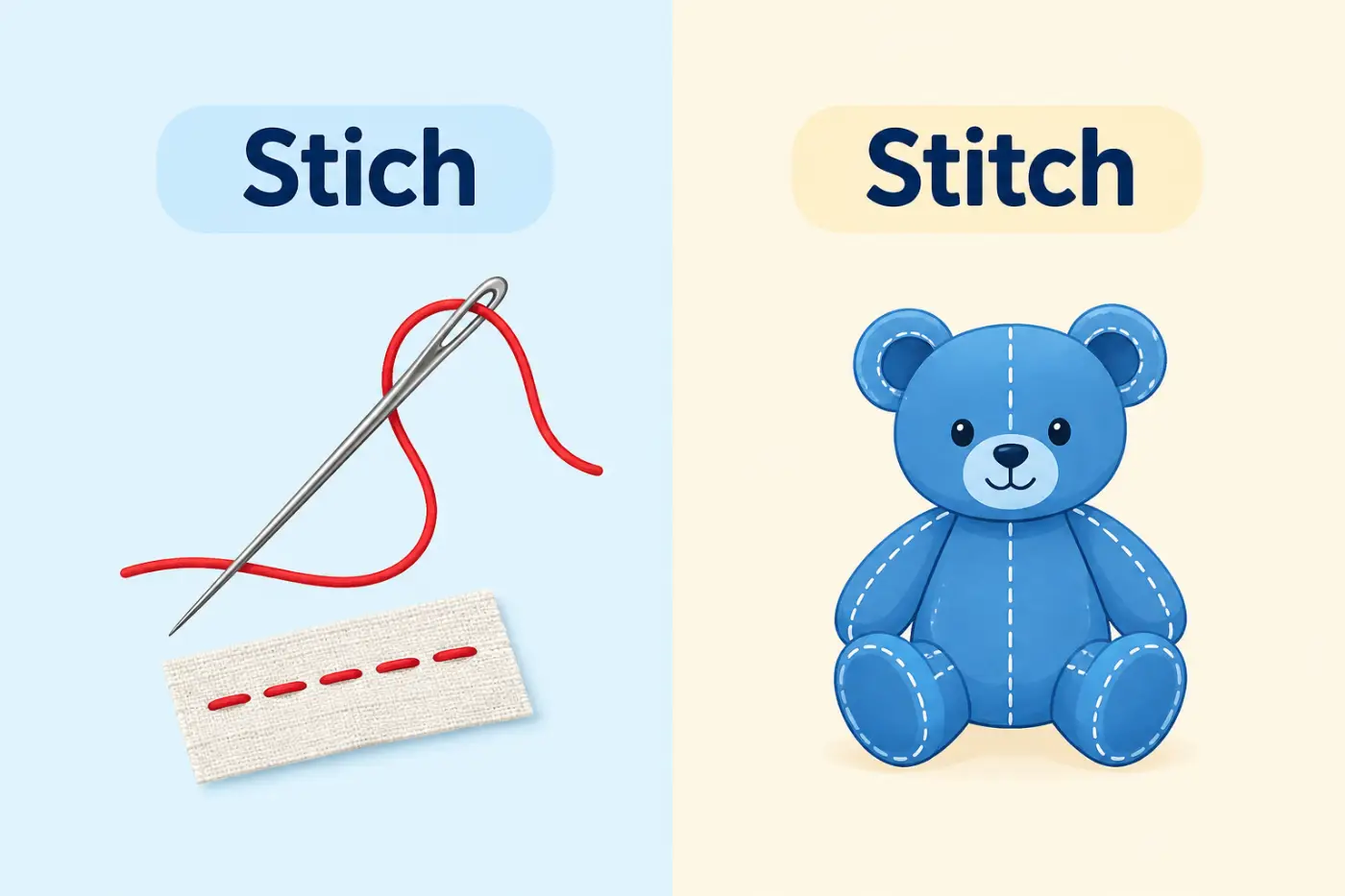
If you’re wondering about stich vs stitch you only need to remember one spelling for the usual word. Stitch is the correct spelling when you mean a loop of thread used to join fabric or a sharp pain in your side. Stich is generally a misspelling in standard English.
The confusion makes sense because the two spellings look almost identical. One has an extra t and that small difference is easy to miss when you’re typing quickly. The correct form has t twice in the middle: stitch.
This guide explains the difference in plain English. You’ll see how stitch works as a noun and a verb. You’ll also learn common phrases such as sewing a stitch and having a stitch in your side. Along the way you’ll get simple examples and memory tricks that can help the correct spelling stick.
Quick Definition
Stitch is the correct English spelling for a loop of thread used in sewing or the action of joining fabric with thread. It can also describe a sharp pain in your side during exercise. Stich is not the standard spelling of this word.
Direct Answer
Stitch is correct. Stich is a misspelling when you mean the common English word for sewing or a sharp side pain.
Comparison Table
| Word | Meaning | Example Sentence | When to Use It |
|---|---|---|---|
| Stitch | A loop of thread or the act of sewing. | She added another stitch to the seam. | Use this spelling for sewing and related meanings. |
| Stitch | A sharp pain in the side. | I got a stitch while running. | Use this spelling for exercise related pain. |
| Stich | Not the standard spelling for these meanings. | The spelling is incorrect. | Do not use it for the common English word. |
Why People Confuse Stitch And Stich
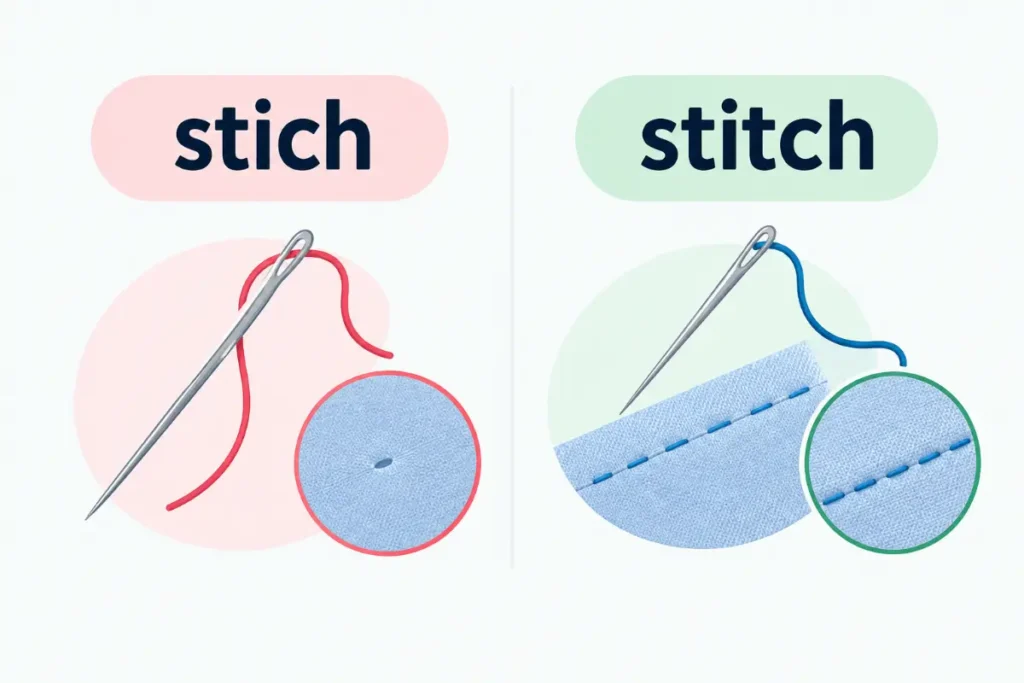
The difference between the two spellings is only one letter. That makes this an easy mistake to make and an easy mistake to overlook.
When people say the word aloud there is no extra sound that tells you the second t belongs there. Both spellings would sound almost the same in ordinary speech. If you learned the word by hearing it before seeing it in writing you may have had no reason to remember the exact letter pattern.
Typing habits can add to the problem. Your fingers may move quickly enough to leave out one of the repeated letters. This happens with many English words that contain double letters.
For example you may already know that little has two t letters. You might also know that butter has two t letters. The same kind of spelling pattern appears in stitch.
The key is to treat the second t as part of the word rather than as an optional extra letter.
The Correct Spelling Of Stitch
The standard spelling is stitch.
You can look at the word in two useful parts.
sti + tch
The word begins with sti and ends with tch. That second t sits right before ch.
This gives you the full spelling.
S T I T C H
A common mistake removes the second t and produces S T I C H. That leaves out a letter that belongs to the standard spelling.
If you have trouble remembering it try saying the word slowly in your head while looking at the letters. Focus on the two t letters. After you have seen the correct form several times it should start to look much more familiar.
What Does Stitch Mean
A stitch is a loop or series of loops made with thread. People use stitches to join pieces of fabric repair clothing decorate material or create embroidery.
The word can also describe the action of sewing something.
For example you can stitch two pieces of cloth together. You can stitch a tear in a shirt. You can also stitch a design onto fabric.
The word has a few other common meanings. A person may get a stitch in their side while running. Doctors may also close a wound with stitches.
These meanings look different at first but they share the same basic word.
Stitch As A Noun
A noun names a person place thing or idea. In many sentences stitch works as a noun because it names a small loop made by sewing.
Consider these examples.
- The tailor made a neat stitch along the edge.
- One loose stitch came undone.
- She used a small stitch to repair the sleeve.
- The dress has a decorative stitch around the collar.
In each sentence the word refers to a part of the sewing work.
You can also use stitch when talking about several loops of thread.
- The pattern requires twenty stitches.
- She counted each stitch before starting the next row.
The plural form is stitches.
Stitch As A Verb
Stitch can also work as a verb. In this use it means to sew something together or to make stitches.
For example.
- I need to stitch this tear before it gets bigger.
- She stitched the two pieces of fabric together.
- He stitched a small design onto the bag.
- The costume was stitched by hand.
The past tense is stitched.
You can say.
- She stitched the button back onto the coat.
- The fabric was stitched along the edge.
The present participle is stitching.
For example.
- She is stitching a pattern onto the cloth.
- I spent the evening stitching a patch onto my jacket.
Knowing these forms can help you recognize the word in different types of writing.
Stitch In Sewing
Sewing is probably the first meaning that comes to mind when you hear this word. A stitch is one of the basic building blocks of sewing.
A needle pulls thread through fabric. The thread forms a loop or line that holds the material together. Many stitches placed next to each other create a seam or a decorative pattern.
Different sewing methods use different kinds of stitches.
Running Stitch
A running stitch is one of the simplest sewing stitches. The thread moves in and out of the fabric in a regular line.
It is often used for basic sewing tasks and simple designs.
Example.
- She used a running stitch to hold the fabric in place.
Backstitch
A backstitch creates a strong continuous line. It is often useful for outlining shapes in embroidery and for sewing seams by hand.
Example.
- He used a backstitch to outline the design.
Cross Stitch
Cross stitch is a popular form of embroidery. The thread forms small X shapes across the fabric.
Example.
- My grandmother taught me how to do cross stitch.
Notice that cross stitch is written as two words when it names the type of embroidery. The spelling of stitch itself does not change.
Decorative Stitch
A decorative stitch adds visual detail to fabric. It may be used on clothing bags blankets or handmade items.
Example.
- The jacket has a decorative stitch around the pockets.
Stitching A Tear In Clothing
One common reason people use this word is to talk about repairing clothing.
Imagine that your shirt catches on a sharp object and develops a small tear. You can use a needle and thread to stitch the damaged area.
You might say.
- I need to stitch this tear before I wear the shirt again.
You could also say.
- She stitched the hole in her son’s jeans.
Here stitch means to sew the damaged fabric together.
The word is especially useful because it can describe both a single sewing loop and the larger action of repairing something with thread.
A Stitch In Your Side
The word has another everyday meaning that has nothing to do with clothing.
A stitch in your side is a sharp pain that can happen during physical activity. People often mention it while running or doing another form of exercise.
For example.
- I got a stitch in my side after running up the hill.
- She had to slow down because she developed a stitch.
- Drinking too much water before the race may have made his side hurt.
People often use this phrase casually. It does not refer to a sewing stitch in this context. Instead it describes a sudden pain felt around the side of the abdomen.
The exact cause of exercise related side pain can vary. It is commonly linked with physical activity and often improves after slowing down or resting.
Stitches Used For Wounds
There is another common medical use of the word.
A doctor may use stitches to close a cut or wound. In this context stitches are pieces of thread or similar material used to hold the edges of damaged skin together while the wound heals.
For example.
- The doctor gave him five stitches.
- She needed stitches after cutting her hand.
- The nurse checked the stitches before the patient went home.
This is different from sewing clothing but the basic idea is similar. In both cases material is held together using a series of stitches.
You may also hear the term sutures in medical settings. A suture is a medical thread or technique used to close a wound. In everyday American English many people simply call them stitches.
Common Expressions With Stitch
English has several familiar phrases that contain stitch. Learning these expressions can make the spelling easier to remember because you start seeing the word in different settings.
A Stitch In Time Saves Nine
This is a well known proverb. It means that fixing a small problem early can prevent a much larger problem later.
For example if a small tear appears in your jacket you can repair it now instead of waiting until the tear becomes much bigger.
The idea is simple. A little work today may save you much more work later.
The expression uses stitch because sewing a small tear early can prevent the fabric from becoming more damaged.
Laughing Your Stitches Out
People may use phrases involving stitches when talking about laughing hard. One common expression is laughing until your sides hurt. You may also hear someone say they were laughing so hard they thought they would get a stitch.
Example.
- That comedy show had me laughing so hard my side hurt.
This is an informal use tied to the physical meaning of the word.
In Stitches
In stitches is an idiom that means laughing very hard.
For example.
- The comedian had the entire audience in stitches.
- Her story had us all in stitches.
The phrase does not mean that anyone is actually being sewn. It is a figurative expression about laughter.
That can seem strange if you’re learning English. Idioms often use ordinary words in ways that aren’t completely literal.
Stitch Or Sew
People sometimes confuse the words stitch and sew because both relate to working with thread.
They are connected but they are not exactly the same.
Sew is the broader verb. It means to join fabric with a needle and thread.
Stitch can describe making individual stitches or sewing something together using stitches.
For example.
- I learned to sew when I was a child.
- I need to stitch this small tear.
You can think of sewing as the overall activity and a stitch as one of the basic actions or units within that activity.
A person can sew a shirt. That shirt contains many stitches. The distinction is small but useful.
Stitch Or Stitches
The singular form is stitch. The plural form is stitches.
Use stitch when you mean one.
- There is one loose stitch on the sleeve.
Use stitches when you mean more than one.
- There are several loose stitches on the sleeve.
The same pattern applies to medical use.
- The doctor put one stitch in the cut.
- The doctor put six stitches in the cut.
The plural spelling adds es because the word ends in the ch sound.
How To Remember The Spelling
A simple memory trick can make this spelling much easier.
Remember that stitch has two t letters.
You can think of the word as having a little pair of t letters in the middle.
STI T CH
The second t is easy to lose when you’re typing. Give it a little attention whenever you write the word.
Another useful trick is to connect the spelling with stitches. The plural form makes the full spelling more noticeable.
- Stitch.
- Stitches.
Once you know the base word you can build the other forms naturally.
You can also connect the word with familiar phrases such as cross stitch and a stitch in time saves nine. Seeing the correct spelling in common phrases gives your memory more than one path back to the word.
Common Spelling Mistakes
The most common error is dropping the second t.
That produces the incorrect form stich.
You may also see other accidental variations when people type quickly. These errors usually happen because the writer knows the word but does not stop to check the letters.
Here are some examples.
Incorrect.
- I learned how to stich a button.
Correct.
- I learned how to stitch a button.
Incorrect.
- She has a stich in her side.
Correct.
- She has a stitch in her side.
Incorrect.
- The doctor used three stichs.
Correct.
- The doctor used three stitches.
The important point is that the spelling stays consistent across the different meanings. You don’t use one spelling for sewing and another for pain or medical treatment.
When To Use Stitch
Use stitch when you are talking about sewing thread into fabric. Use it when describing the act of joining material with thread. Use it when referring to a sharp pain in your side during exercise. You also use it when talking about medical stitches that close a wound.
Here are some quick examples.
- She knows how to stitch by hand.
- I need to stitch the loose seam.
- He got a stitch while jogging.
- The nurse removed the stitches from the wound.
- This design uses a simple cross stitch.
- One stitch came loose from the blanket.
All of these sentences use the same correct spelling.
When Not To Use Stich
In standard American English you should not use stich as the spelling of the common word described in this article.
If you are writing an email a school assignment a work document a product description or a social media post use stitch.
A spell checker may catch the error for you. Still it is better to know the correct spelling yourself. That way you can spot the mistake even when you are writing by hand or using an app that does not flag it.
Is Stich Ever A Word
Stich can appear as a name or surname in some contexts. You may also find it in names from other languages or in specialized references. Those uses do not make it the standard spelling for the English word related to sewing or side pain.
For ordinary American English writing the form you want is stitch.
This distinction matters because a word can exist as a proper name without being the correct spelling of a common English word. If you are writing about sewing or exercise related side pain you should use the standard English spelling.
Why The Extra T Matters
It may seem strange to care about one missing letter. In writing it can make a clear difference.
A missing letter changes the standard spelling of the word. Readers may still understand what you mean but the error can make your writing look rushed or careless.
That matters more in certain situations. A school paper should use standard spelling. A job application should look polished. A product description should be easy to trust. Even a casual message benefits from knowing the basic spelling of common words.
You don’t need perfect spelling to be a good writer. Still learning common words correctly gives your writing a cleaner finish.
Examples In Real Sentences
The best way to understand a word is to see it doing real work in a sentence. These examples cover the main meanings of stitch.
Sewing Examples
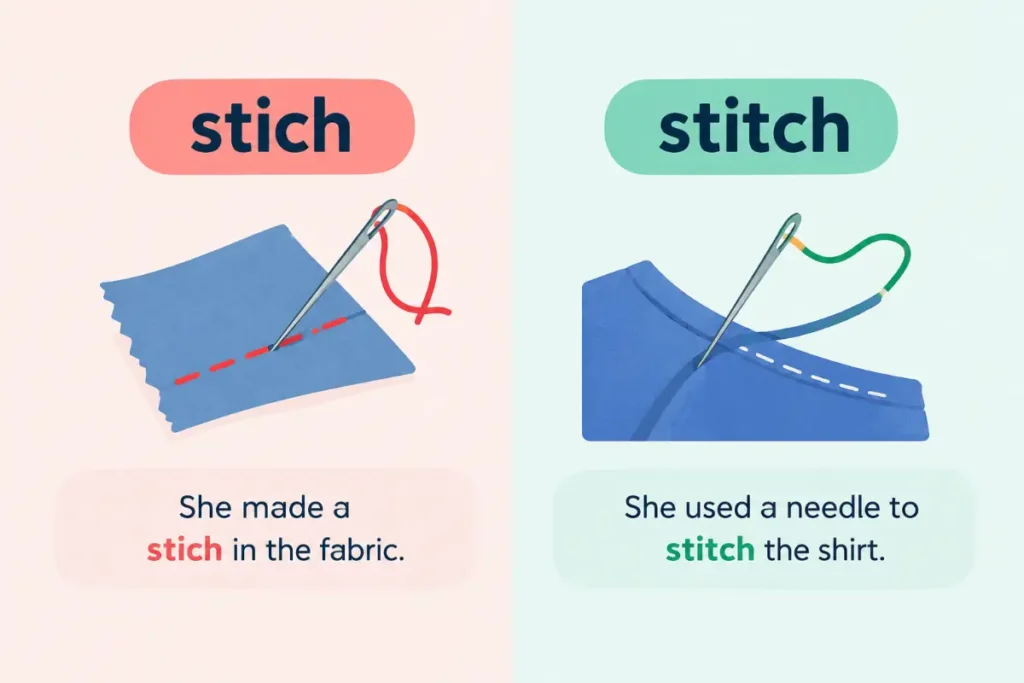
- She used a needle and thread to stitch the torn pocket.
- My aunt taught me how to stitch by hand.
- The tailor added a neat stitch along the collar.
- I noticed a loose stitch near the button.
- She stitched the patch onto her backpack.
- The seam needs another stitch before the dress is finished.
Exercise Examples
- I got a stitch in my side during the last mile.
- He slowed down after feeling a sharp stitch.
- She stopped running because of a painful stitch.
- The pain felt like a stitch under her ribs.
Medical Examples
- The doctor put several stitches in the cut.
- She returned to the clinic to have her stitches checked.
- The nurse explained how to care for the stitches.
- His wound needed stitches after the accident.
Figurative Examples
- The movie had everyone in stitches.
- Her story had us all in stitches.
- That comedian can put an entire room in stitches.
These examples show how flexible the word can be. The spelling remains the same even though the meaning changes with the context.
The Difference Between Stitch And Seam
Another useful distinction is the difference between a stitch and a seam.
A stitch is an individual loop or unit of thread. A seam is the line where two pieces of fabric are joined.
Imagine two pieces of cloth sewn together. The seam is the joined line. The stitches are the individual thread formations that hold the cloth together.
For example.
- The seam came apart because several stitches broke.
This sentence shows the difference clearly. The seam is the larger joined area while the stitches are the smaller parts holding it together.
Knowing this distinction can help if you’re reading sewing instructions or talking about clothing repairs.
The Difference Between Stitch And Embroidery
Embroidery is the art of decorating fabric with thread. A stitch is one of the basic techniques used to create an embroidered design.
For example a person might use a satin stitch to fill a shape or a cross stitch to create a pattern.
So these words belong to the same topic but they do not mean the same thing.
You can think of embroidery as the craft and stitches as some of the methods used in that craft.
This distinction becomes useful when reading instructions for handmade projects. A pattern may tell you what kind of stitch to use and where to place it.
A Simple Spelling Test
If you’re still unsure about the spelling try this quick test.
Ask yourself what you mean.
- If you’re talking about sewing clothing fabric or thread use stitch.
- If you’re talking about a sharp side pain during exercise use stitch.
- If you’re talking about thread used to close a wound use stitch or stitches.
- If you’re writing the word and you have only one t in the middle stop and check it. The standard spelling has two.
That tiny check can prevent the most common mistake.
FAQs
Is stitch the correct spelling?
Yes. Stitch is the correct standard spelling for the common English word related to sewing and sharp side pain. Stich is not the standard spelling for these meanings.
What is the difference between stich vs stitch?
The difference is the second t. Stitch has two t letters while stich has only one. For ordinary American English writing you should use stitch.
Is stich a real word?
It can appear as a name or in some specialized contexts. It is not the standard spelling of the common English word for a sewing loop or exercise related side pain.
How do you spell stitch?
The correct spelling is S T I T C H. Remember the second t before ch.
What does stitch mean in sewing?
A stitch is a loop or formation of thread made by passing a needle through fabric. A series of stitches can join fabric together or create a decorative pattern.
What does getting a stitch mean?
Getting a stitch usually means feeling a sharp pain in the side during physical activity. It often happens during running or similar exercise.
Is stitch a noun or a verb?
Stitch can be both a noun and a verb. As a noun it can mean a loop of thread or a sharp side pain. As a verb it means to sew or join something with stitches.
What is the plural of stitch?
The plural is stitches. For example you can say that a shirt has several loose stitches or that a doctor used stitches to close a wound.
Conclusion
When you’re deciding between stich vs stitch the answer is simple. Stitch is the correct spelling for the common English word. It can describe a sewing loop an act of sewing a sharp side pain during exercise or the thread used to close a wound.
The extra t is the detail worth remembering. Write the word as S T I T C H. The same spelling works for all of its common meanings.
You can also strengthen your memory by connecting the word with familiar phrases such as cross stitch and a stitch in time saves nine. Seeing the word in real sentences will make the spelling feel more natural over time.
So if you’re typing a sentence about repairing a shirt running with a side pain or getting stitches after an injury check the middle of the word. Keep both t letters and you’ll have the standard spelling every time.

Sienna Watson is a veteran copywriter and communications coach who has helped startup founders, marketers, and professionals polish their writing for over a decade. Realizing that most people don’t need a degree in linguistics—just clear, impactful communication—Sienna focuses on practical grammar, business writing etiquette, and eliminating wordiness. She advocates for plain language, strong verbs, and persuasive prose that gets results.