
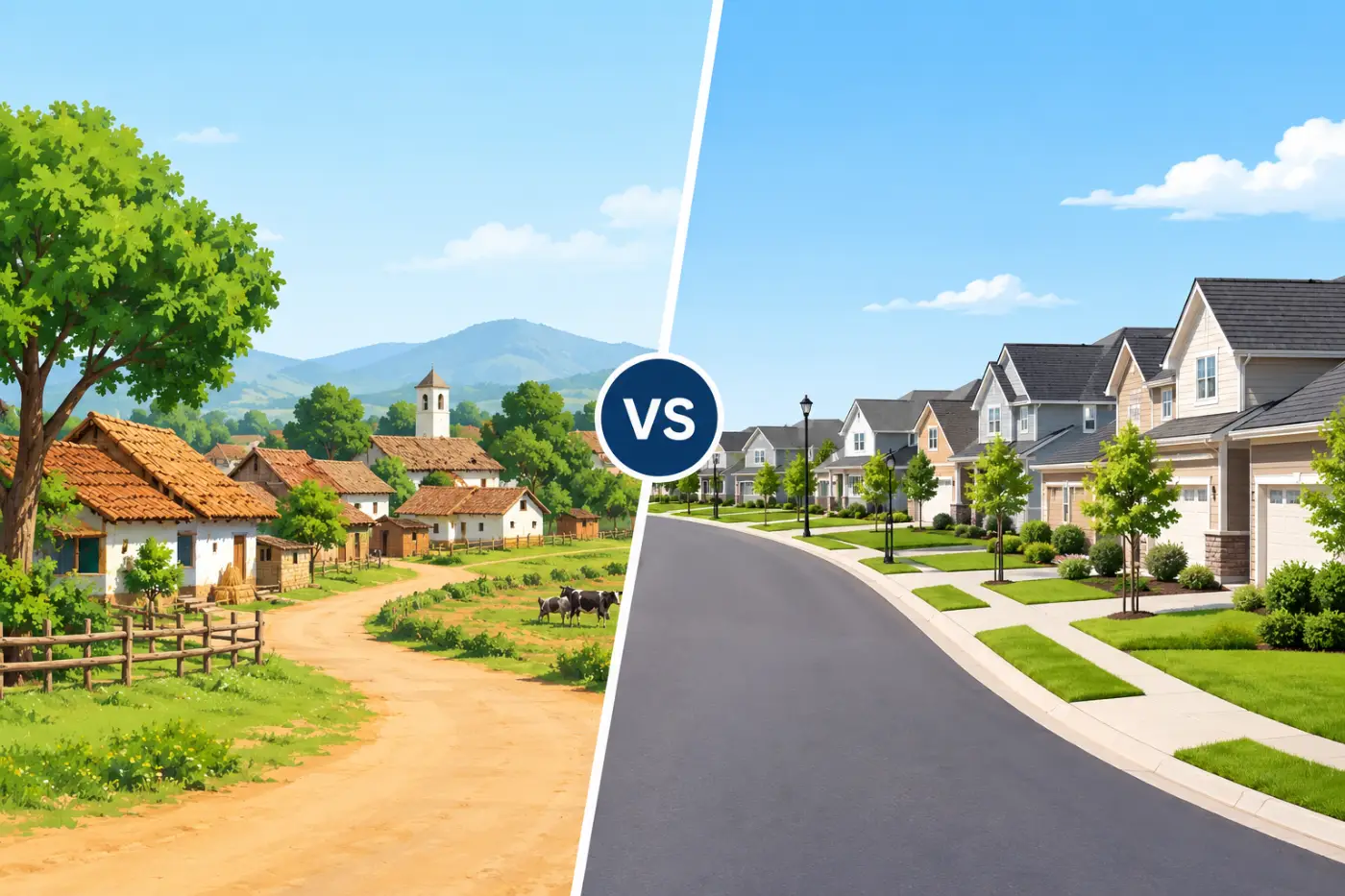
If you’re wondering about village vs subdivision you’re probably trying to figure out if the two terms mean the same thing. They don’t. A village is usually a type of community or local government. A subdivision is usually an area of land that has been divided into smaller lots. The exact meaning can change from one state or local area to another.
The confusion makes sense because both terms can describe places where people live. A village can have houses streets parks stores and schools. A subdivision can have those things too. Still the words describe different ideas. One focuses more on a community or place. The other usually focuses on how land gets divided and developed.
The distinction matters when you’re reading a property listing filling out an address form checking a local government record or simply trying to describe where you live. In this guide you’ll learn what each term means how they differ and why the same word can mean something slightly different in different parts of the United States.
Quick Definition
A village is generally a community or a type of local government. In some states a village is an officially incorporated municipality. In other places people use village as an informal name for a small community.
A subdivision is generally a tract of land that has been divided into smaller parcels or lots. Residential subdivisions often contain homes that were built on those individual lots.
Direct Answer
A village usually describes a community or local government while a subdivision usually describes land that has been divided into smaller lots. A village can contain a subdivision but the two terms are not normally interchangeable.
Comparison Table
| Term | Meaning | Example Sentence | When to Use It |
|---|---|---|---|
| Village | A community or local government that may have its own legal status. | She lives in a small village near the city. | Use it when referring to a community or an officially named village. |
| Subdivision | An area created by dividing land into smaller lots or parcels. | They bought a house in a new subdivision. | Use it when referring to divided land or a residential development. |
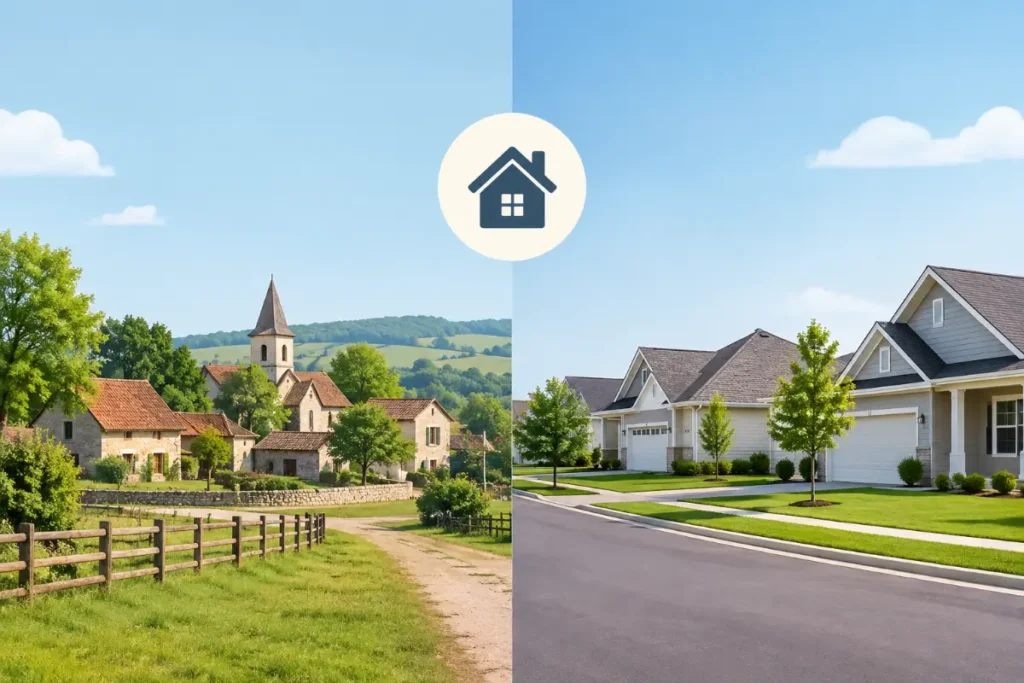
What Is A Village
The word village has a broad meaning in American English. At its simplest it describes a small community where people live. The word can suggest a place that feels smaller than a city or town but it does not always have a fixed population limit.
The legal meaning can be more specific. Some states recognize villages as official forms of local government. Those villages may have elected officials and local services just like other municipalities. The rules depend on state law so you should not assume that every place called a village has the same legal structure.
For example a village in one state might operate as an incorporated municipality. It could have its own government boundaries and local rules. A place called a village somewhere else might simply be a named community within a larger town county or city.
That difference is worth remembering when you see the word on a map or in an address. The name alone does not tell you the legal status of the place.
A Village Can Be A Legal Municipality
In some parts of the United States a village is an official local government unit. The village may have defined boundaries and its own governing body.
Residents might vote in local elections and receive services through village government. Those services can include things such as road maintenance public safety parks or other local programs.
The exact setup depends on the state. American local government does not use one nationwide system for villages. State laws decide how municipalities are formed and what powers they have.
That means you should treat village as a legal term only when the local government officially uses it that way.
A Village Can Also Be A Community Name
People also use village in a more general sense. A small settlement or neighborhood might be known as a village even if it has no separate municipal government.
You might hear someone say that they live in a village outside a larger city. In casual conversation the person may simply be describing the character or size of the community.
This use is common in place names. A community can keep the word village in its name even when its legal structure is more complicated than the name suggests.
So if someone says they live in a village you may need more context to know exactly what they mean.
What Is A Subdivision
A subdivision starts with land. A developer or landowner divides a larger piece of property into smaller lots or parcels. Those lots can then be sold developed or used for different purposes.
Residential subdivisions are especially common in the United States. A large tract of land may be divided into dozens or hundreds of home lots. Streets and other shared features may be planned as part of the development.
Picture a large empty field. Instead of keeping it as one property the owner divides it into many smaller pieces. Roads may be added so each lot has access. Homes can then be built on those lots. That collection of lots is a subdivision.
The word can also apply outside residential neighborhoods. Land may be divided for commercial industrial agricultural or mixed uses. The exact legal process depends on local planning and land use rules.
Residential Subdivisions
When most Americans hear subdivision they often picture a residential neighborhood. You may see rows of houses along planned streets with similar lot sizes and shared features.
Some subdivisions have homeowners associations. An HOA may set rules about landscaping exterior changes parking or shared property. Other subdivisions have no HOA at all.
A subdivision can be large or small. One development might contain only a few lots while another might cover a large area with hundreds of homes.
The presence of houses does not make an area a village. The land division process is what gives a subdivision its basic meaning.
How A Subdivision Is Created
Creating a subdivision usually involves more than drawing lines on a map. Local governments often require plans showing proposed lots roads drainage utilities and other details.
A developer may need approval from a city county or other local authority before dividing the land. The process can include surveys reviews and compliance with zoning or subdivision regulations.
Once the subdivision is approved the individual lots can be recorded according to local requirements. Buyers can then purchase those lots and build or purchase homes on them.
The details vary greatly from one jurisdiction to another. Some places have simple rules for small divisions of land. Larger developments can require a much more detailed approval process.
The Main Difference Between A Village And A Subdivision
The easiest way to remember the difference is to think about community versus land division.
A village usually describes a community. It can also describe an official local government. A subdivision usually describes land that someone has divided into smaller lots.
That distinction explains why the two terms can appear together without meaning the same thing.
A village might contain several subdivisions. One subdivision might sit inside a village. A subdivision could also be located outside any incorporated village and instead fall within a town or county.
For example imagine a village with several residential areas. One neighborhood could be an older part of the community while another could have been built as a planned subdivision decades later. Both areas are within the same village but only one is described as a subdivision.
The reverse situation can happen too. A large residential subdivision can cross or sit within an area that has no village government at all. The residents still live in a subdivision even though their local government comes from another jurisdiction.
Why The Terms Get Confused
The confusion usually comes from everyday use. Both words can appear on maps property websites neighborhood pages and conversations about where people live.
A person might say they live in a village because that is the name of their community. Someone else might describe the same general area as a subdivision because their house sits inside a planned residential development.
There can also be several layers of location. A home might be on a particular street inside a subdivision inside a village inside a county. Each term describes a different part of the location.
This is similar to describing a book by its title author and publisher. Those labels can refer to the same book but they tell you different things about it.
Can A Village Be A Subdivision
A village itself is not normally a subdivision in the basic sense of the word. A village usually refers to a community or government area while a subdivision refers to divided land.
However a village can contain one or more subdivisions. A new housing development may be built inside the boundaries of an existing village. Residents of that development can therefore live in both a subdivision and a village at the same time.
The same idea applies to other types of communities. A subdivision can exist within a city town village or county depending on local boundaries.
This is why asking which term is correct can sometimes miss the point. Both can be correct when they describe different parts of the same location.
Can A Subdivision Be A Village
A subdivision does not automatically become a village just because many people live there. Building homes on divided lots creates a residential development but it does not automatically create a new municipality.
For an area to become an official village the local legal requirements must be met. Those requirements depend on the state and local government system.
A large subdivision can feel like a small town. It might have hundreds of homes streets parks stores and community facilities. Even so the development remains a subdivision unless it has a separate legal status that makes it something else.
That difference between how a place feels and how the law defines it can clear up many location questions.
Where The Word Village Can Mean Different Things
American English uses village in several ways. The legal meaning is one of them. The everyday meaning is another.
In one state a village may be an incorporated municipality. In another state the word may appear in the name of a community that does not operate as a separate municipality.
You can also find the term used for neighborhoods or historic communities. Sometimes the name survives even after the area’s government structure changes.
This means you should look at local records if you need the legal answer. A map label or common name may not tell you how the place is classified under state law.
Where The Word Subdivision Can Mean Different Things
Subdivision also has more than one use. In property and planning matters it often means dividing land into separate lots. In everyday speech it often means a residential neighborhood created through that process.
The term can also appear in legal property records. A recorded subdivision may have a formal name and a map showing individual lots streets easements and other details.
You might therefore see a subdivision name in a property description even when residents use a different neighborhood name in conversation.
For everyday writing you usually don’t need to explain all these legal details. Use subdivision when you mean a planned area of divided lots. Use village when you mean the community or local government.
A Simple Example To Remember
Imagine a farmer owns 100 acres of land. The farmer sells the land to a developer. The developer divides it into 80 home lots and creates streets between them.
Those 80 lots can form a subdivision.
Now imagine the entire development sits inside an incorporated village. The homeowners can live in the subdivision and in the village at the same time.
The two words work because they describe two different things. The subdivision identifies the development. The village identifies the broader community or government area.
That simple picture makes the distinction much easier to remember.
How A Subdivision Differs From A Neighborhood
People often use subdivision and neighborhood as if they mean the same thing. In casual conversation that can work. Technically they describe different ideas.
A neighborhood is a place where people live and identify as a local community. It doesn’t have to result from a formal land division. A neighborhood can develop naturally over many years as homes and businesses grow around one another.
A subdivision usually has a more specific property meaning. It starts with land that gets divided into separate lots. The resulting development may later become known as a neighborhood.
For example a group of older homes near a downtown area can form a neighborhood without being a subdivision. A newer group of homes built on lots created from one large tract of land is more likely to be both a subdivision and a neighborhood.
Why The Distinction Matters
The difference becomes useful when you’re talking about real estate. A listing might describe a home as being in a particular subdivision because that name appears on property records. Locals might call the same area by a broader neighborhood name.
The two labels can overlap but they don’t have to. Think of subdivision as a property and development term. Think of neighborhood as a community term.
Village And Town Are Not Always The Same
Village and town can also cause confusion because Americans don’t use these words in one universal way.
In some states a village and a town are separate types of municipalities. Each can have its own government and legal boundaries. In other states one term may have a different legal meaning or may not be used as an official municipal classification at all.
Population alone doesn’t always settle the question. A place with a small population isn’t automatically a village. Local law determines the legal status when the term has an official meaning.
This is why you shouldn’t assume that village always means small town. The everyday meaning suggests a small community but the legal meaning depends on where the place is located.
A Town Can Contain A Subdivision
A town can have several residential subdivisions within its boundaries. The town provides the broader government area while each subdivision identifies a particular development.
For instance a person might live in a subdivision that sits inside a town. Their mailing address can include the town name even though their neighborhood has its own subdivision name.
That doesn’t create a conflict. The address and property description are simply identifying different layers of the same location.
Village And Community
Community is another broad word that overlaps with village.
A community can mean a group of people who live in the same area. It can also describe people connected by a shared interest or background. Unlike an incorporated municipality community does not necessarily have official boundaries or a local government.
A village can be a community. A subdivision can also form a community. But neither relationship works in only one direction.
For example a subdivision might have a strong sense of community because neighbors organize events and look after one another. That doesn’t make the subdivision a village.
Likewise an unincorporated community may be known locally as a village without having a separate village government.
What Is An Incorporated Village
An incorporated village is a village that has official legal status as a municipality. It has boundaries recognized by law and usually has some form of local government.
The exact powers of an incorporated village depend on state law. Some villages have elected boards or councils. They may provide local services and collect taxes or fees.
The key point is that incorporation changes the meaning from a simple community description to a legal government classification.
You should therefore be careful when describing a place as an incorporated village. If you’re writing about a specific location it’s best to check the local government’s official classification instead of relying only on how residents describe it.
What Is An Unincorporated Community
An unincorporated community does not have its own municipal government. It may still have a recognized name and a strong local identity.
People who live there may receive services from a county or another nearby government. They can still refer to their area by a community name that has been used for generations.
Some communities have names that include village even though they aren’t incorporated villages. The name itself doesn’t always establish legal status.
This is one of the biggest reasons location terms can seem inconsistent across the United States.
How Property Records Use These Terms
Property records often use more precise language than everyday conversation. A deed or subdivision plat can identify the legal description of a property. That description may include the name of a subdivision and the specific lot number.
A plat is a map that shows how land was divided. It can identify lots streets easements and other recorded features.
Suppose a property record says that a home sits on Lot 12 of a named subdivision. That tells you something specific about the parcel. It doesn’t necessarily tell you that the subdivision is a separate municipality.
The property could sit inside a village town city or county area. The subdivision and government jurisdiction can exist at the same time.
Why Legal Records Matter
If you’re buying property selling a home or researching land boundaries you should use official records for precise information. Real estate websites can use neighborhood names for convenience. Those names may not match the legal description.
Local assessor records planning departments county records and recorded subdivision plats can provide more reliable details about a property’s legal location.
That matters most when you’re dealing with taxes ownership boundaries zoning or other property questions.
How Addresses Fit Into The Picture
An address can contain several pieces of location information. These pieces don’t all describe the same type of place.
A typical address might identify a house number and street. It may then include a city or municipality state and ZIP code. A subdivision name might appear elsewhere in property records or a listing even if it isn’t part of the mailing address.
For example a homeowner could say that they live in Pine Ridge subdivision. Their mailing address might use the name of a nearby town instead.
This can feel confusing because people naturally expect every place name to appear in the same way. In reality property boundaries mailing systems and local government boundaries can follow different rules.
Can A Subdivision Have Its Own Name
Yes. Many subdivisions have names chosen by developers or communities.
A developer might call a new development something like Oak Creek Estates or River View. Residents may then use that name when describing where they live.
The subdivision name can become so familiar that people treat it like a neighborhood name. That doesn’t change its basic property meaning.
A named subdivision can have dozens or hundreds of homes. It can also have private roads shared amenities or an HOA. None of those features automatically turn it into a village.
Can A Village Have Several Subdivisions
Yes. This is common in places where a village has grown over time.
An older village may contain established residential streets as well as newer developments. Some neighborhoods may have been created through formal subdivision. Others may have developed gradually without being part of a recorded residential subdivision.
The village is the broader community or government area. Each subdivision is a smaller development within it.
This layered structure explains why someone can accurately give several answers to the question of where they live. They might live in a particular subdivision. That subdivision might sit in a village. The village might be part of a larger county.
Subdivision Versus Development
Development is another term you may see in real estate.
A development generally refers to land that has been improved or planned for a particular use. A residential development can include homes streets utilities parks and other features.
A subdivision focuses more specifically on dividing land into separate lots or parcels. A development can involve subdivision but the terms aren’t always identical.
For example a developer may divide land into 50 lots and then build homes on those lots. The land division creates the subdivision. The construction and planning create the residential development.
In everyday conversation people may use development for the entire project. Property records may focus on the subdivision itself.
Subdivision Versus Estate
Estate can also appear in names for residential areas. A subdivision might be called something that includes the word estates.
That name doesn’t necessarily mean the area has a special legal status. Developers often choose names that sound attractive or memorable.
For example a development could have Estates in its official name even though it consists of ordinary residential lots. The name is not enough to tell you how the property is legally classified.
The same principle applies to words such as gardens heights acres or farms when they appear in community or subdivision names.
Common Mistakes When Using These Terms
One common mistake is assuming that every small community is a village. Size alone doesn’t establish that status.
Another mistake is calling every residential neighborhood a subdivision. Some neighborhoods formed naturally and were never created through one formal land division process.
A third mistake is treating subdivision as a type of local government. It generally isn’t. A subdivision is usually connected to property and land development rather than municipal government.
People also sometimes assume that an HOA makes an area a subdivision. An HOA can operate within a subdivision but an HOA by itself doesn’t define the legal status of the community.
These small distinctions matter when accuracy counts. Casual conversation gives you more freedom. Legal or real estate writing calls for greater care.
Which Term Should You Use
- Use village when you’re talking about a community or an official municipality that local law recognizes as a village.
- Use subdivision when you’re talking about land that has been divided into separate lots or a residential development built from that process.
- Use neighborhood when you’re talking about a local area where people live. It doesn’t need to have a formal legal status.
- Use community when you want a broad term for people or an area connected by location or shared identity.
These choices keep your writing clear without making the subject more complicated than it needs to be.
A Quick Way To Tell Them Apart
Ask yourself what you’re describing.
- If you’re describing the people and place that form a local community then village may fit.
- If you’re describing land divided into individual lots then subdivision is probably the right term.
- If you’re describing a local residential area then neighborhood may be better.
- If you’re describing the government that has legal authority over the area then you need the correct municipal or county term.
That simple test will help you choose the right word in most everyday situations.
How Villages And Subdivisions Work In The US
The meaning of village can change quite a bit from one state to another. That makes this topic harder than it first appears. A person in one part of the country may use village to describe an official municipality. Someone in another area may use it simply as the name of a small community.
Subdivisions have their own local rules too. Cities and counties can set requirements for dividing land. Those rules can cover lot sizes roads drainage utilities access and other details.
So there isn’t one nationwide definition that answers every local question. The basic distinction still holds. A village describes a community or government area. A subdivision describes divided property and the development built on that land.
State Laws Shape Village Status
Local government in the United States comes from state law. States decide how municipalities are organized and what names they use.
Some states recognize villages as official municipalities. Others use different categories such as cities towns boroughs or townships. Some communities may use village in their names without having the same legal structure as an incorporated village in another state.
This means a definition you find for one state may not apply to another. If you’re researching a specific village the state’s laws and the local government’s records provide the best answer.
Local Rules Shape Subdivisions
Land development also depends on local rules. A county or municipality may require approval before an owner can divide a large property into separate lots.
Planning officials may review the proposed layout. They can look at road access drainage water systems sewage and other practical concerns. Zoning rules can also affect how the resulting lots can be used.
Once the required approvals are complete the subdivision can become part of the official property record. The individual lots can then have their own legal descriptions.
The Role Of Zoning
Zoning and subdivision rules often work together but they aren’t the same thing.
Zoning controls how property can be used. A local zoning code might allow homes in one area and businesses in another. It can also set rules for building size lot dimensions setbacks and other features.
Subdivision rules focus on dividing property into separate parcels. A proposed subdivision may need to satisfy both sets of rules.
For example an owner might want to divide a large parcel into ten residential lots. The land may be in a zone that allows homes. Even so the owner may still need approval for the actual division of the property.
Understanding this distinction helps explain why creating a subdivision can take time. The owner isn’t simply drawing lines on a map.
What A Subdivision Plat Shows
A subdivision plat is a recorded map that shows how a piece of land has been divided. It can show individual lots streets easements and other important features.
Think of it as a blueprint for the property layout. It helps identify where each lot sits and how the different parts connect.
A plat can be useful when you’re trying to understand the legal boundaries of a property. It can also help show the relationship between a subdivision and nearby roads or parcels.
The exact information shown on a plat depends on local requirements. Still the basic purpose remains the same. It documents the division and layout of the land.
Lots And Parcels
A lot is a defined piece of land that can be part of a subdivision. A parcel is a broader property term that can describe a distinct piece of land for ownership or tax purposes.
The terms can overlap in some situations. They don’t always mean exactly the same thing.
If a subdivision creates 40 home lots then each lot can have its own legal description. A county assessor may also identify those properties as separate parcels for tax purposes.
This level of detail matters in property transactions. Buyers shouldn’t rely only on a neighborhood name when they need to know the exact legal boundaries of land.
Can You Live In Both Places At Once
Yes. A person can live in a subdivision that sits inside a village.
This isn’t contradictory because the two terms identify different things. One describes the residential development. The other describes the larger community or government area.
Imagine a home on Maple Street. The house sits on Lot 18 in Green Meadow subdivision. Green Meadow sits inside an incorporated village. The homeowner can accurately say they live in the subdivision and the village.
The same home could also have a neighborhood name that locals use in conversation. One property can therefore have several location labels that are all useful for different purposes.
What Happens When A Subdivision Grows
A subdivision can start as a small development and grow into a large residential area. More homes may be built as vacant lots are developed.
Over time residents may create informal names for different sections. A development might also add parks walking paths clubhouses or other shared spaces.
As the area grows people may begin thinking of it as a neighborhood or community. That change in how people talk about the place doesn’t necessarily change its legal status.
A subdivision can become an important part of a community without becoming a municipality.
Can A Subdivision Become Its Own Municipality
A subdivision doesn’t automatically become a village or another municipality when it gets large.
Creating a municipality requires a legal process. The requirements vary by state and may involve petitions elections approvals or other steps.
The fact that hundreds of families live in one development doesn’t give the development its own government. Residents remain under the jurisdiction that legally covers the property unless a new municipality is created.
This distinction matters because people sometimes confuse population with government status. A large residential area can still be part of a city county town or village.
What An HOA Has To Do With It
A homeowners association can manage certain shared interests in a residential development. An HOA may enforce community rules collect assessments and maintain shared property.
An HOA is not the same thing as local government.
For example an HOA might require homeowners to maintain their lawns. The local government may separately enforce zoning or building rules. Both sets of rules can apply to the same home.
Some subdivisions have HOAs while others don’t. An HOA therefore cannot be used as a simple test for deciding if an area is a subdivision.
How Real Estate Listings Use These Words
Real estate listings often use location terms in a practical way. An agent may mention a subdivision because buyers recognize the development name.
The listing might also mention a neighborhood city village or town. Each detail can help buyers understand where the home is located.
For example a listing could describe a home as being in a named subdivision within a particular municipality. That gives the reader both the immediate development and the broader location.
Keep in mind that marketing language isn’t always the same as legal language. If you’re checking ownership boundaries taxes easements or zoning you should look at official records.
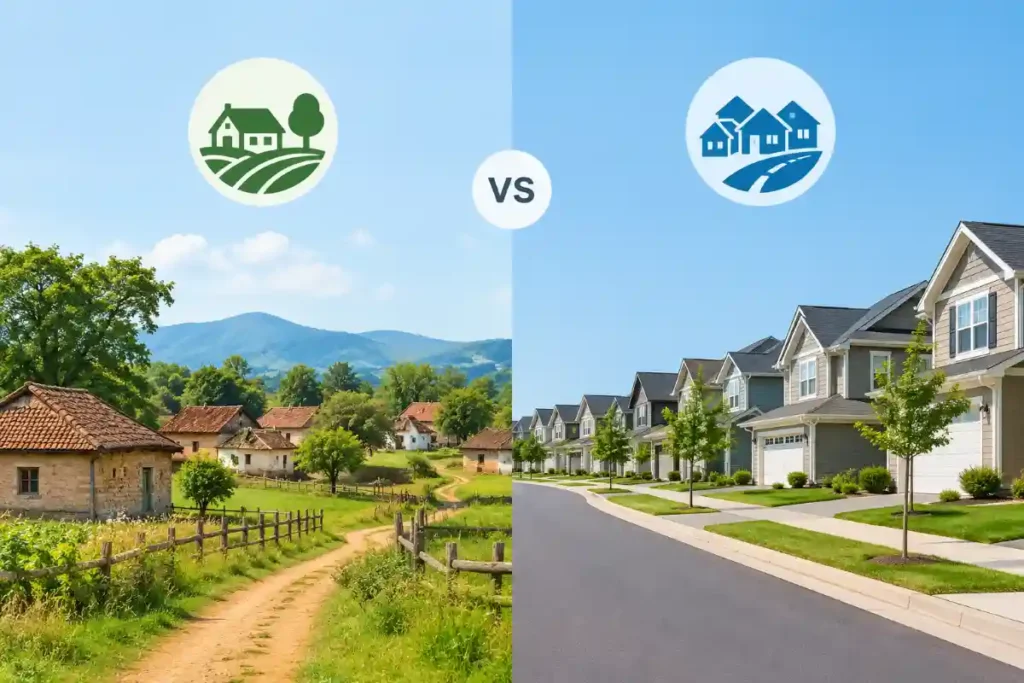
Examples That Show The Difference
The easiest way to understand the terms is to see how they work in ordinary sentences.
Example One
Maria lives in a subdivision outside the center of town.
Here subdivision describes the residential development where her home sits.
Example Two
Maria lives in a village with about 5,000 residents.
Here village describes the broader community.
Example Three
Maria lives in Oak Valley subdivision within the village.
Both terms work because they describe different parts of her location.
Example Four
The county approved plans to divide the property into 30 residential lots.
Here the focus is on the process of creating separate parcels. Subdivision is the natural term for that process.
Example Five
The village council approved funding for a new park.
Here village refers to a local government. The council is acting on behalf of the municipality.
These examples show why context matters. The words aren’t competing labels for exactly the same thing.
How To Describe Your Home Clearly
If someone asks where you live you don’t always need the most technical answer.
In casual conversation you might give the name of your neighborhood or subdivision. If the person doesn’t recognize it you can add the city or village.
For example you could say that you live in Pine Creek subdivision in the village of Cedar Grove.
That answer gives both the specific development and the larger community. It avoids the confusion that can happen when people assume every location name describes the same kind of place.
When The Terms Can Overlap
The words can overlap because a place can have several identities at once.
A village can be a community. A village can also be a municipality. Within that village there can be several subdivisions. Those subdivisions can contain neighborhoods and smaller sections that residents identify by name.
None of these labels has to cancel out another one.
This is especially useful when reading real estate information. A property can have a legal lot description. It can belong to a recorded subdivision. It can sit inside a municipality. It can also be part of a neighborhood that locals know by a different name.
The trick is to ask what each term is describing rather than searching for one label that replaces all the others.
A Useful Memory Trick
Think of a village as the place and community. Think of a subdivision as the land divided into lots.
If you’re talking about local government or the broader community then village may be the better word.
If you’re talking about a planned collection of property lots then subdivision is usually the better choice.
You can picture a large box being divided into smaller boxes. The large property represents the original tract of land. The smaller boxes represent the lots created through subdivision.
Now picture those lots sitting inside a larger circle on a map. That circle can represent the village or another local jurisdiction.
This mental picture makes the difference much easier to remember.
When You Need To Check The Official Definition
For ordinary conversation you can usually rely on the common meanings. Legal and property questions require more care.
Check official sources if you’re researching municipal boundaries property ownership zoning taxes or land records. The local government or county records office can tell you how an area is officially classified.
This matters because names can be misleading. A place may include village in its name without functioning as an incorporated village. A development may have a neighborhood style name without being a separate government unit.
When accuracy matters use the legal classification rather than guessing from the name. That small step can prevent a much bigger mistake.
FAQs
What is the difference between village vs subdivision?
A village usually refers to a community or an official local government area. A subdivision usually refers to land that has been divided into smaller lots for development. A subdivision can exist inside a village so the two terms can describe different parts of the same location.
Is a subdivision the same as a neighborhood?
Not exactly. A subdivision is usually created by dividing land into separate lots while a neighborhood is a broader term for an area where people live. A subdivision can become a neighborhood but not every neighborhood is a subdivision.
Can a village have subdivisions?
Yes. A village can contain several subdivisions. Each development can have its own name while remaining inside the boundaries of the larger village.
Can a subdivision be a village?
A subdivision does not automatically become a village. A village has a specific legal meaning in places where state law recognizes it as a municipality. A residential development would need to go through the required legal process before it could become an independent municipality.
Is a village a city?
Not necessarily. Village and city can represent different types of local government. The exact distinction depends on state law.
Is a subdivision part of a city or town?
It can be. A subdivision may sit inside a city town village or county area. The subdivision describes the property development while the municipality or county provides the broader government jurisdiction.
What does subdivision mean in real estate?
In real estate a subdivision usually means that a larger piece of land has been divided into separate lots or parcels. Those lots can then be sold or developed individually. Residential subdivisions often contain houses built on the newly created lots.
How do I know if my area is officially a village?
Check the official records for your local government. A place name alone doesn’t prove that an area has village status. State and local government records can show the area’s legal classification.
Conclusion
The main difference in village vs subdivision comes down to what you’re describing. A village usually identifies a community or local government area. A subdivision usually identifies land that has been divided into smaller lots for development.
The two terms can describe the same general location without meaning the same thing. Your home could sit in a named subdivision that lies inside an incorporated village. You could also live in a subdivision inside a city or town.
Use village when the focus is on the community or its government. Use subdivision when you’re talking about divided property or a planned residential development. If you’re discussing a specific property then official records are the safest source for the legal details.
When you’re unsure which word fits remember one simple idea. Village describes the broader place. Subdivision describes the divided land and development. That distinction will help you choose the right term in everyday writing and property related conversations.

Dr. Elena Vance holds a Ph.D. in Linguistics from Columbia University and has spent over 15 years analyzing the evolution of the English language. A former university professor turned full-time writer and editor, Elena specializes in breaking down high-level grammatical concepts, punctuation nuances, and style guides (APA, Chicago, MLA) into clear, actionable advice. When she isn’t hunting down dangling modifiers, she can be found collecting vintage dictionaries and reading classic literature.