

If you’ve ever searched channel vs chanel you may have wondered if the two words are different spellings of the same thing. They aren’t. Channel and Chanel are completely different words with different meanings and uses.
Channel is a common English word. It can mean a path for water, a television station, a communication method, or a route used to move something from one place to another. Chanel is mainly a proper name linked to the French fashion house founded by Gabrielle Chanel.
The confusion often comes from pronunciation. Both words can sound very similar in some contexts. Their spelling is different though, and using one in place of the other can change the meaning of a sentence.
This guide explains the difference in simple terms. You’ll see real examples, common mistakes, the meaning of each word, and an easy way to remember which spelling you need.
Quick Definition
Channel is an English noun and verb with several meanings. It can refer to a waterway, a television station, a communication route, or the act of directing something through a particular path.
Chanel is a proper name. It most commonly refers to the French luxury fashion and beauty brand associated with Gabrielle Chanel. It can also appear as a person’s surname.
Direct Answer
Channel is the correct word when you mean a route, passage, communication method, television station, or waterway. Chanel is a proper name most often associated with the fashion and beauty brand founded by Gabrielle Chanel.
Comparison Table
| Word | Meaning | Example Sentence | When to Use It |
|---|---|---|---|
| Channel | A route, passage, television station, or communication method. | Please change the channel on the TV. | Use it for the common English word. |
| Chanel | A proper name linked to Gabrielle Chanel and the luxury brand. | She bought a Chanel handbag. | Use it when referring to the name or brand. |

What Does Channel Mean
Channel has several meanings. The basic idea behind most of them is a path or route that carries something from one place to another.
A physical channel can carry water. A television channel carries programs to viewers. A communication channel carries information between people or groups. A sales channel can describe a way a company sells products to customers.
The meaning depends on the sentence. The spelling stays the same.
For example, you might say, “The river flows through a narrow channel.” Here, channel means a passage through which water moves.
You could also say, “I watched the news on a local channel.” In this sentence, channel refers to a television station or broadcast service.
The word can also work as a verb.
“She channeled her energy into her new project.”
Here, channel means to direct something toward a particular purpose.
The Main Meanings Of Channel
The word appears in many parts of everyday English. Understanding its main meanings will make it easier to recognize the correct spelling.
Channel As A Waterway
A channel can be a natural or man made passage through which water flows.
For example, a river may have a deep central channel. Boats may also travel through a channel in a lake, harbor, or sea.
You might read a sentence such as this.
“The boat stayed inside the marked channel.”
The word refers to a safe or defined route through the water.
A channel can also describe a narrow body of water that connects larger areas. In geography, the term can have a more specific meaning based on the shape and purpose of the waterway.
Channel As A Television Station
In everyday American English, channel often refers to a television station or a specific place on a TV service.
For example.
- “What’s on channel five?”
- “Turn to the sports channel.”
- “That channel has a great cooking show tonight.”
In these sentences, channel has nothing to do with water. It refers to television programming.
The same idea can appear with streaming services and online video platforms. People often use channel to describe a page or account that regularly publishes videos.
For example.
“I found a useful cooking channel on YouTube.”
The meaning still centers on a source that delivers content to an audience.
Channel As A Communication Route
A channel can also be a way to send information from one person or group to another.
Email is a communication channel. A phone call is another. A company may use social media as a channel for customer support.
For example.
- “Email is the best channel for sending the documents.”
- Here, channel means a method or route for communication.
- You may also hear this word in workplace conversations.
- “Please use the proper communication channel for that request.”
The sentence means that the person should use the approved method for sending the information.
Channel As A Sales Method
Businesses use the word channel when they talk about how products or services reach customers.
A company might sell directly through its website. It might also sell through stores, marketplaces, distributors, or other partners. Each route can be called a sales channel.
For example.
“The company added a new online sales channel.”
This means the company created another way for customers to buy its products.
You may also hear terms such as retail channel, digital channel, distribution channel, and marketing channel. These phrases all use the common English spelling channel.
Channel As A Verb
Channel can also describe the act of directing something toward a particular place or purpose.
For example.
“She channeled her frustration into exercise.”
The sentence means she directed her strong feelings toward a physical activity instead of allowing them to control her actions.
Another example is.
“The program channels donations to local schools.”
Here, the verb describes directing money toward a specific destination.
This use is common in both everyday and formal writing.
What Does Chanel Mean
Chanel is different from the common noun channel. It is a proper name and should normally begin with a capital letter.
The name is strongly associated with Gabrielle Chanel and the French luxury brand that bears her name. The company is known for fashion, handbags, fragrances, makeup, jewelry, and other luxury products.
You might see the name in sentences such as these.
- “She wore Chanel perfume.”
- “He gave her a Chanel bag.”
- “Chanel is known for its classic fashion designs.”
In each example, Chanel is a name rather than a general English word.
That distinction matters. You wouldn’t use Chanel to describe a television station, a waterway, or a communication route.
Why Channel And Chanel Get Confused
The confusion is understandable because the two words look almost identical. They contain the same basic letters except for the final arrangement.
Channel has two syllables and ends with nel.
Chanel is the proper name and ends with nel as well. The main visual difference comes from the extra n in channel.
Compare them carefully.
- Channel
- Chanel
The difference may seem small when you’re typing quickly. That single extra letter changes the word completely.
Pronunciation can also add to the confusion. In many everyday accents the words sound close enough that spelling from memory can be difficult.
That is why context is your best clue. Ask yourself what you mean before you choose the spelling.
If you’re talking about television, communication, water, or a route, you need channel.
If you’re talking about the fashion and beauty brand or the surname, you need Chanel.
The Spelling Difference
The easiest way to spot the difference is to look for the second n.
Channel contains two n letters.
Chanel contains only one n.
That small detail gives you a quick visual test.
Think of the common English word as having an extra step in the middle.
Channel
C H A N N E L
The brand name has only one n.
Chanel
C H A N E L
This simple check can help when you’re typing quickly.
If you’re writing about a TV station, for example, you need the longer spelling.
“I changed the channel.”
If you’re writing about the fashion brand, you need the shorter spelling.
“She bought Chanel perfume.”
The meaning tells you which spelling belongs in the sentence.
Channel In Everyday Sentences
The word channel appears often in American English. You probably use it in conversation without thinking about its different meanings.
Here are some natural examples.
- “I can’t find the channel with the game.”
- “Please send the request through the right channel.”
- “The boat moved through the narrow channel.”
- “Our company uses email as its main communication channel.”
- “She channeled her creativity into painting.”
Each sentence uses the same spelling but gives the word a different meaning.
That flexibility is one reason channel can be confusing for English learners. It isn’t tied to one single definition.
Chanel In Everyday Sentences
Chanel is used mainly as a proper name. It should be capitalized when you mean the brand or the surname.
For example.
- “She received a Chanel wallet as a gift.”
- “Chanel launched a new fragrance.”
- “Her Chanel jacket has a classic design.”
The word doesn’t become a general noun just because people use the brand name often. It remains a proper name.
That’s the key difference from channel.
A Simple Test To Choose The Right Word
When you’re unsure which spelling to use, don’t stare at the two words and guess. Think about the meaning first.
Ask yourself what you’re talking about.
If you’re talking about a TV station, use channel.
If you’re talking about a river passage, use channel.
This meaning based approach is much easier than trying to memorize two spellings without context.
Common Mistakes With Channel
One common mistake is using the brand spelling when writing about television.
Incorrect.
“I watched the game on Chanel 7.”
Correct.
“I watched the game on channel 7.”
Another mistake happens when people talk about communication.
Incorrect.
“Please contact us through the proper Chanel.”
Correct.
“Please contact us through the proper channel.”
The reverse mistake can happen too. Someone might write the common English word when referring to the fashion brand.
Incorrect.
“She bought a new channel handbag.”
Correct.
“She bought a new Chanel handbag.”
The difference is only one letter. The meaning is completely different.
When To Use Channel
Use channel when you’re talking about a route or path that carries something. The thing being carried can be water information television programs energy money or products. The meaning changes with the context but the core idea stays similar. Something moves through a channel from one point to another.
This makes the word useful in many everyday situations. You might talk about a TV channel in the morning then use the same word later when discussing a communication channel at work.
Television And Streaming
In American English channel often refers to a television station or a numbered place on a TV service.
For example:
- “The weather is on channel 8.”
- “Which channel is showing the baseball game?”
- “She switched to another channel during the commercial.”
The word also appears in online video. A creator can have a channel on YouTube or another video platform.
For instance:
- “I subscribed to his cooking channel.”
- “Her channel has helpful videos about gardening.”
The meaning is slightly different from traditional television but the spelling remains the same.
Communication
A communication channel is a way for information to move from one person to another. Email phone calls text messages meetings and online platforms can all serve as communication channels.
For example:
- “Email is our main channel for customer questions.”
- “Use the secure channel to send private information.”
- “The team needs a better channel for sharing updates.”
In these sentences the word describes the method used to communicate. It doesn’t refer to a physical passage.
Business And Marketing
Businesses often use channel to describe a route through which they reach customers. A company might sell products in stores through its website or through another retailer.
For example:
- “The company added a new sales channel.”
- “Online stores have become an important marketing channel.”
- “The brand uses several distribution channels.”
These uses are common in business writing. You may also see phrases such as sales channel marketing channel retail channel and distribution channel.
Water And Geography
A channel can describe a passage through which water moves. It may be natural or created by people.
For example:
- “The boat stayed in the deep channel.”
- “The river has changed its channel over the years.”
- “Ships must remain inside the marked channel.”
In geography the word can describe a defined part of a river sea or other body of water. The exact meaning depends on the physical setting.
Directing Something
Channel also works as a verb. In this form it means to direct something toward a particular place purpose or activity.
For example:
- “She channeled her energy into her studies.”
- “He channeled his anger into his artwork.”
- “The organization channels donations to local communities.”
This use is common when talking about emotions effort money or resources. You aren’t saying that something travels through a physical tube. You’re describing the act of directing it toward a goal.
When To Use Chanel
Use Chanel when you’re referring to the name associated with Gabrielle Chanel or the French luxury brand. Since it is a proper name it begins with a capital letter.
For example:
- “She bought a Chanel fragrance.”
- “He gave his wife a Chanel handbag.”
- “The Chanel store was busy during the holiday season.”
You wouldn’t use this spelling for television water communication or business.
The capital letter gives you another useful clue. Chanel is a name. Channel is an ordinary English word.
Chanel As A Brand Name
Chanel is widely associated with luxury fashion and beauty products. The name appears on clothing accessories fragrances cosmetics and other products.
If you’re writing about one of these products use the proper spelling.
For example:
- “She wore a Chanel jacket to the event.”
- “I bought a Chanel fragrance as a gift.”
- “The store sells Chanel makeup.”
Notice that the name stays capitalized in each sentence.
Chanel As A Surname
Chanel can also be a surname. The most famous historical example is Gabrielle Chanel who founded the fashion house associated with the name.
A person’s surname should be capitalized like other proper names.
For example:
“Gabrielle Chanel became an important figure in fashion history.”
You don’t need to use the spelling channel simply because you’re referring to a person. Names have their own spelling and capitalization.
Channel Vs Chanel In Common Phrases
Looking at common phrases can make the difference easier to remember. The word that follows the spelling often gives you a strong clue about what you mean.
TV Channel
Use channel when talking about television.
“What’s your favorite TV channel?”
“The news channel is showing the latest update.”
YouTube Channel
Use channel when talking about a creator’s video page.
“I found a great science channel on YouTube.”
“Her channel has millions of subscribers.”
Communication Channel
Use channel for a method of communication.
“Email is the fastest communication channel for this request.”
“The company opened a new customer service channel.”
Sales Channel
Use channel for a way to sell products.
“The company plans to expand its online sales channel.”
Water Channel
Use channel for a water passage.
“The boat entered a narrow channel.”
Chanel Bag
Use Chanel when referring to the fashion brand.
“She carried a Chanel bag to the dinner.”
Chanel Perfume
Use Chanel for the brand’s fragrance products.
“He gave her Chanel perfume for her birthday.”
These phrases give you a quick practical guide. If the word refers to a route or method then channel is usually the spelling you need. If it names the fashion brand or a person then Chanel is the correct form.
Channel And Chanel Are Not Variations
A common mistake is treating these words as two spellings of the same word. They aren’t.
You can’t choose between them based on personal preference. The meaning decides which one belongs in your sentence.
For example:
“Please change the Chanel.”
That sentence would sound wrong if you’re talking about television.
“Please change the channel.”
That sentence is correct because channel refers to a television station.
Now consider this sentence:
“She bought a channel handbag.”
That doesn’t work if you mean a handbag made by the fashion brand.
“She bought a Chanel handbag.”
That is the correct sentence.
The difference is similar to confusing a person’s name with an ordinary noun. One is a specific name. The other is a general English word.
Why The Extra N Matters
The easiest spelling trick is to focus on the extra n in channel.
Think of it this way.
- Channel has two Ns.
- Chanel has one N.
- If you’re talking about a TV station you need the word with the extra n.
- If you’re talking about the fashion brand you need the shorter name.
You can turn this into a quick memory phrase.
A channel has an extra N. Chanel is the name.
This isn’t a formal spelling rule. It’s simply a memory aid. The goal is to give your brain a quick way to separate two words that look almost identical.
Examples That Show The Difference
The following examples put both words side by side. Reading them together makes the difference easier to see.
- “The sports channel is showing the game.”
- “She wore a Chanel dress to the event.”
- “I changed the channel because the program was boring.”
- “Her Chanel perfume has a strong scent.”
- “We need another communication channel.”
- “She received a Chanel gift from her sister.”
- “The boat moved through the narrow channel.”
- “Chanel has a long history in the fashion industry.”
The context makes the intended word clear. You don’t need to rely on pronunciation alone.
Channel In American English
The word channel is especially common in American conversations about television. People may say “What channel is it on?” or “Change the channel” without giving the word much thought.
It also appears in everyday technology and business language. You might subscribe to a YouTube channel or contact a company through a customer service channel.
This broad use can make the word feel familiar. Still its many meanings are worth knowing because they can change the way you understand a sentence.
For example:
“The company opened a new channel for feedback.”
This doesn’t mean the company built a waterway. It means the company created a new way for people to send feedback.
Context does most of the work.
Chanel In American English
Chanel is used as a proper name in American English. Most readers will associate it with the French luxury fashion and beauty brand.
The spelling should stay the same in English. Don’t change it to channel because you think the words sound alike.
For example:
“She received a Chanel perfume for her birthday.”
The brand name remains Chanel even inside an English sentence.
Proper names often keep their original spelling. This is why you should treat Chanel as a name rather than as an alternative form of channel.
A Quick Spelling Check
If you’re writing and suddenly stop because you can’t remember the spelling, use this three step check.
First ask what you mean. Are you talking about a route method television station waterway or video page? If so use channel.
Next ask if you’re naming the fashion brand or a person. If so use Chanel.
Finally look at the number of n letters. Two Ns means channel. One N means Chanel.
This takes only a few seconds and works in most everyday situations.
Common Sentences To Remember
You don’t need to memorize a long grammar rule. A few familiar sentences can help the distinction stick.
- “Change the channel.”
- “Watch my YouTube channel.”
- “Use another communication channel.”
- “The boat entered the channel.”
- “She bought a Chanel bag.”
- “He wears Chanel cologne.”
These examples cover the most common situations where people mix up the two spellings.
Once you connect the spelling with the meaning the confusion becomes much easier to avoid.
More Common Mistakes With Channel And Chanel
The spelling mistake usually happens when someone knows what they want to say but types the word from memory. Since the two forms look almost identical the eye can miss the extra n.
The best fix is to connect the spelling to the meaning. Don’t ask which version looks right. Ask what the word is doing in the sentence.
Mistake With Television
People sometimes write the brand name when they mean a television station.
Incorrect.
“I watched the game on Chanel 5.”
Correct.
“I watched the game on channel 5.”
The television meaning always takes the common English word. You don’t capitalize it unless it starts a sentence or appears in a title that follows a specific capitalization style.
Mistake With Online Video
The same rule applies to YouTube and other video platforms.
Incorrect.
“I subscribed to her Chanel last week.”
Correct.
“I subscribed to her channel last week.”
The creator’s page is a channel. It isn’t related to the fashion brand.
Mistake With Communication
The same error can appear in business and personal communication.
Incorrect.
“Please send the form through our customer service Chanel.”
Correct.
“Please send the form through our customer service channel.”
The word means a method or route for communication. It has nothing to do with the brand name.
Mistake With Fashion
The opposite mistake happens when someone is talking about the luxury brand.
Incorrect.
“She bought a channel handbag.”
Correct.
“She bought a Chanel handbag.”
The brand name keeps its original spelling. The extra n doesn’t belong there.
Is Channel Ever A Brand Name
Yes. Context matters when a word can appear as part of a name.
A company television station website or organization can use the word Channel in its name. In that case the capitalization may be part of the official name.
For example a media company might include Channel in its name. That doesn’t turn the common word into Chanel.
The important point is that Chanel has its own identity as a proper name. You shouldn’t replace it with channel simply because the two forms look similar.
Is Chanel A Common English Word
No. Chanel is mainly used as a proper name.
The most familiar use is the luxury fashion and beauty brand. The name can also appear as a surname.
That means you shouldn’t use Chanel as a general substitute for words such as route method station passage or pathway.
For example:
“Email is an effective Chanel for communication.”
This is incorrect if you mean a communication method.
The correct sentence is:
“Email is an effective channel for communication.”
Channel As A Noun And Verb
Another useful point is that channel can function as both a noun and a verb.
As a noun it can refer to a route or method.
“Email is our main communication channel.”
As a verb it means to direct something toward a particular purpose.
“She channeled her energy into her studies.”
The verb changes form in different sentences. You might see channel channels channeled or channeling depending on the grammar.
For example:
- “The company channels customer feedback to the product team.”
- “He channeled his frustration into writing.”
- “They are channeling their resources into the new project.”
All of these forms come from the same English word.
Channel Or Chanel For A Person
If you’re referring to a person named Chanel then use Chanel. Names have their own spelling and capitalization.
For example:
- “Chanel called me yesterday.”
- “Chanel joined the meeting at noon.”
You wouldn’t replace the person’s name with channel.
This may sound obvious but names can create confusion when they look like ordinary English words. The key is to treat a person’s name as a proper name rather than trying to apply an English spelling rule to it.
Channel Or Chanel For A Product
The answer depends on the product.
If the product belongs to the Chanel brand then use Chanel.
- “She bought a Chanel handbag.”
- “He gave her Chanel perfume.”
If you’re describing a product sold through a route or method then use channel.
- “The company sells its products through an online channel.”
- “The retailer added another sales channel.”
The noun that follows the word often gives you a strong clue about the intended meaning.
Related Words With Similar Confusion
English has many pairs that look or sound similar but have different meanings. Learning how to separate them can improve your spelling overall.
Station And Stationary
Station can mean a place where buses trains or other services stop.
“The train arrived at the station.”
Stationary means staying still.
“The car remained stationary.”
These words aren’t interchangeable even though they look and sound similar.
Capital And Capitol
Capital has several meanings. It can refer to money or a city that serves as the seat of government.
“Washington is the capital of the United States.”
Capitol usually refers to a building where a legislature meets.
“The Capitol building is in Washington.”
The meaning tells you which spelling you need.
Principal And Principle
A principal can be a school leader or the most important person or thing in a situation.
“The principal spoke to the students.”
A principle is a rule or belief.
“Honesty is an important principle.”
These examples show why checking the meaning is often more useful than relying on sound.
How To Remember The Difference
A simple memory trick can save you from second guessing yourself.
Remember this sentence.
A channel has two Ns. Chanel is a name.
The first part points to the extra letter in channel. The second part reminds you that Chanel is usually a proper name.
You can also connect channel with the idea of a path. A channel can carry water information television programs or products. That gives the word a broader meaning than the brand name.
Chanel is much narrower. It is primarily a name.
The contrast makes the spelling easier to remember.
A Simple Visual Trick
Look at the middle of each word.
Channel
C H A N N E L
Chanel
C H A N E L
The common English word has NN together. The proper name has only one N.
If you’re writing about a television channel imagine the two Ns as two separate lanes carrying a signal.
If you’re writing about Chanel the brand remember that it is a shorter name with one N.
You don’t need to use this trick forever. After enough exposure the correct spelling should become automatic.
How To Proofread For This Mistake
A quick proofread can catch the error easily.
Search your document for chanel if you’re writing about television communication or another common meaning. If you find it in that context check the spelling.
If you’re writing about the fashion brand search for channel and make sure you haven’t accidentally added an extra n.
This is especially useful in long articles product descriptions emails and school assignments. A single letter can change the meaning so a quick search is worth the effort.
When Capitalization Matters
Capitalization gives you another clue.
The common word channel is normally lowercase when it appears in the middle of a sentence.
For example:
“I changed the channel.”
The proper name Chanel starts with a capital C.
For example:
“She bought Chanel perfume.”
There are exceptions based on sentence position and official names. If channel appears as part of a specific name it may also be capitalized.
The spelling still matters. Capitalizing the first letter doesn’t turn channel into Chanel.
Can Channel And Chanel Sound The Same
They can sound very similar in many forms of English. That similarity is one reason people confuse them.
However pronunciation doesn’t change the spelling. You still need to choose the word based on meaning.
This is common in English. Many words sound alike or nearly alike but have different spellings and meanings. Writers usually solve the problem by looking at the context rather than trying to spell the word from its sound.
With these two words the context is especially helpful.
- A TV station points to channel.
- A fashion brand points to Chanel.
- A communication method points to channel.
- A person’s name may be Chanel.
Once you focus on meaning the choice becomes much clearer.
A Few Tricky Examples
Some sentences can look confusing until you understand the context.
“Chanel has a new YouTube channel.”
Both words are correct in this sentence. Chanel is the name of the person or brand. Channel refers to an online video page.
“Chanel changed the channel.”
Again both are correct. The first is a name. The second refers to television.
“The company created a Chanel channel.”
This sentence could mean different things depending on context. If Chanel is a brand name then the phrase could refer to a channel created by or for that brand. If the writer meant a normal communication route then Chanel would be a spelling error.
Context decides the intended meaning.
These examples show why the two words shouldn’t be treated as simple spelling variants. They can even appear together in the same sentence while performing completely different jobs.
What About Chanel In Fashion Writing
Fashion writing often uses the proper name in phrases connected to the brand.
Examples include:
- “Chanel fashion.”
- “Chanel fragrance.”
In each phrase the capital C matters because the word identifies a specific brand.
If you’re writing product descriptions or articles about fashion be careful with this distinction. A spelling error can make a polished sentence look careless.
What About Channel In Technology
Technology writing uses channel in several ways.
A communication channel is a route for sending information. A wireless channel can refer to a defined range used to carry a signal. A video channel can refer to a creator’s online content page.
For example:
- “The router automatically selected a wireless channel.”
- “Use the support channel to report the problem.”
- “The creator started a new video channel.”
These uses have nothing to do with the fashion brand. The spelling is always the common English form.
A Quick Practice Test
Try choosing the correct word in each sentence.
- “Please change the ___ before the next program starts.”
- “She bought a ___ fragrance.”
- “We need a secure communication ___.”
- “His favorite YouTube ___ posts videos every week.”
- “She wore a ___ dress to the event.”
- “The boat moved through a narrow ___.”
The answers are channel, Chanel, channel, channel, Chanel, and channel.
Notice the pattern. Most of the sentences need the common English word because they describe a route method or source of content. The fashion examples use the proper name.
This is the simplest way to approach the difference. Start with meaning and let the meaning guide the spelling.
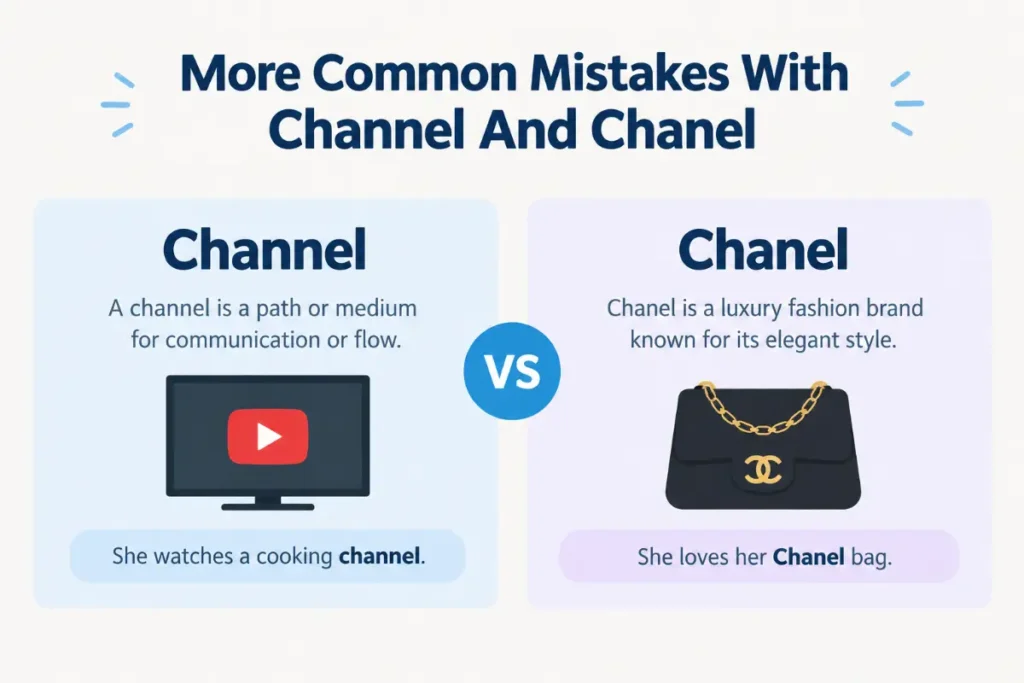
More Common Mistakes With Channel And Chanel
The spelling mistake usually happens when someone knows what they want to say but types the word from memory. Since the two forms look almost identical the eye can miss the extra n.
The best fix is to connect the spelling to the meaning. Don’t ask which version looks right. Ask what the word is doing in the sentence.
Mistake With Television
People sometimes write the brand name when they mean a television station.
Incorrect.
“I watched the game on Chanel 5.”
Correct.
“I watched the game on channel 5.”
The television meaning always takes the common English word. You don’t capitalize it unless it starts a sentence or appears in a title that follows a specific capitalization style.
Mistake With Online Video
The same rule applies to YouTube and other video platforms.
Incorrect.
“I subscribed to her Chanel last week.”
Correct.
“I subscribed to her channel last week.”
The creator’s page is a channel. It isn’t related to the fashion brand.
Mistake With Communication
The same error can appear in business and personal communication.
Incorrect.
“Please send the form through our customer service Chanel.”
Correct.
“Please send the form through our customer service channel.”
The word means a method or route for communication. It has nothing to do with the brand name.
Mistake With Fashion
The opposite mistake happens when someone is talking about the luxury brand.
Incorrect.
“She bought a channel handbag.”
Correct.
“She bought a Chanel handbag.”
The brand name keeps its original spelling. The extra n doesn’t belong there.
Is Channel Ever A Brand Name
Yes. Context matters when a word can appear as part of a name.
A company television station website or organization can use the word Channel in its name. In that case the capitalization may be part of the official name.
For example a media company might include Channel in its name. That doesn’t turn the common word into Chanel.
The important point is that Chanel has its own identity as a proper name. You shouldn’t replace it with channel simply because the two forms look similar.
Is Chanel A Common English Word
No. Chanel is mainly used as a proper name.
The most familiar use is the luxury fashion and beauty brand. The name can also appear as a surname.
That means you shouldn’t use Chanel as a general substitute for words such as route method station passage or pathway.
For example:
“Email is an effective Chanel for communication.”
This is incorrect if you mean a communication method.
The correct sentence is:
“Email is an effective channel for communication.”
Channel As A Noun And Verb
Another useful point is that channel can function as both a noun and a verb.
As a noun it can refer to a route or method.
“Email is our main communication channel.”
As a verb it means to direct something toward a particular purpose.
“She channeled her energy into her studies.”
The verb changes form in different sentences. You might see channel channels channeled or channeling depending on the grammar.
For example:
- “The company channels customer feedback to the product team.”
- “He channeled his frustration into writing.”
- “They are channeling their resources into the new project.”
All of these forms come from the same English word.
Channel Or Chanel For A Person
If you’re referring to a person named Chanel then use Chanel. Names have their own spelling and capitalization.
For example:
- “Chanel called me yesterday.”
- “Chanel joined the meeting at noon.”
You wouldn’t replace the person’s name with channel.
This may sound obvious but names can create confusion when they look like ordinary English words. The key is to treat a person’s name as a proper name rather than trying to apply an English spelling rule to it.
Channel Or Chanel For A Product
The answer depends on the product.
If the product belongs to the Chanel brand then use Chanel.
“She bought a Chanel handbag.”
“He gave her Chanel perfume.”
If you’re describing a product sold through a route or method then use channel.
“The company sells its products through an online channel.”
“The retailer added another sales channel.”
The noun that follows the word often gives you a strong clue about the intended meaning.
Related Words With Similar Confusion
English has many pairs that look or sound similar but have different meanings. Learning how to separate them can improve your spelling overall.
Station And Stationary
Station can mean a place where buses trains or other services stop.
“The train arrived at the station.”
Stationary means staying still.
“The car remained stationary.”
These words aren’t interchangeable even though they look and sound similar.
Capital And Capitol
Capital has several meanings. It can refer to money or a city that serves as the seat of government.
“Washington is the capital of the United States.”
Capitol usually refers to a building where a legislature meets.
“The Capitol building is in Washington.”
The meaning tells you which spelling you need.
Principal And Principle
A principal can be a school leader or the most important person or thing in a situation.
“The principal spoke to the students.”
A principle is a rule or belief.
“Honesty is an important principle.”
These examples show why checking the meaning is often more useful than relying on sound.
How To Remember The Difference
A simple memory trick can save you from second guessing yourself.
Remember this sentence.
A channel has two Ns. Chanel is a name.
The first part points to the extra letter in channel. The second part reminds you that Chanel is usually a proper name.
You can also connect channel with the idea of a path. A channel can carry water information television programs or products. That gives the word a broader meaning than the brand name.
Chanel is much narrower. It is primarily a name.
The contrast makes the spelling easier to remember.
A Simple Visual Trick
Look at the middle of each word.
- Channel
- C H A N N E L
- Chanel
- C H A N E L
The common English word has NN together. The proper name has only one N.
- If you’re writing about a television channel imagine the two Ns as two separate lanes carrying a signal.
- If you’re writing about Chanel the brand remember that it is a shorter name with one N.
You don’t need to use this trick forever. After enough exposure the correct spelling should become automatic.
How To Proofread For This Mistake
A quick proofread can catch the error easily.
Search your document for chanel if you’re writing about television communication or another common meaning. If you find it in that context check the spelling.
If you’re writing about the fashion brand search for channel and make sure you haven’t accidentally added an extra n.
This is especially useful in long articles product descriptions emails and school assignments. A single letter can change the meaning so a quick search is worth the effort.
When Capitalization Matters
Capitalization gives you another clue.
The common word channel is normally lowercase when it appears in the middle of a sentence.
For example:
“I changed the channel.”
The proper name Chanel starts with a capital C.
For example:
“She bought Chanel perfume.”
There are exceptions based on sentence position and official names. If channel appears as part of a specific name it may also be capitalized.
The spelling still matters. Capitalizing the first letter doesn’t turn channel into Chanel.
Can Channel And Chanel Sound The Same
They can sound very similar in many forms of English. That similarity is one reason people confuse them.
However pronunciation doesn’t change the spelling. You still need to choose the word based on meaning.
This is common in English. Many words sound alike or nearly alike but have different spellings and meanings. Writers usually solve the problem by looking at the context rather than trying to spell the word from its sound.
With these two words the context is especially helpful.
- A TV station points to channel.
- A fashion brand points to Chanel.
- A communication method points to channel.
- A person’s name may be Chanel.
Once you focus on meaning the choice becomes much clearer.
A Few Tricky Examples
Some sentences can look confusing until you understand the context.
“Chanel has a new YouTube channel.”
Both words are correct in this sentence. Chanel is the name of the person or brand. Channel refers to an online video page.
“Chanel changed the channel.”
Again both are correct. The first is a name. The second refers to television.
“The company created a Chanel channel.”
This sentence could mean different things depending on context. If Chanel is a brand name then the phrase could refer to a channel created by or for that brand. If the writer meant a normal communication route then Chanel would be a spelling error.
Context decides the intended meaning.
These examples show why the two words shouldn’t be treated as simple spelling variants. They can even appear together in the same sentence while performing completely different jobs.
What About Chanel In Fashion Writing
Fashion writing often uses the proper name in phrases connected to the brand.
Examples include:
- “Chanel fashion.”
- “Chanel fragrance.”
In each phrase the capital C matters because the word identifies a specific brand.
If you’re writing product descriptions or articles about fashion be careful with this distinction. A spelling error can make a polished sentence look careless.
What About Channel In Technology
Technology writing uses channel in several ways.
A communication channel is a route for sending information. A wireless channel can refer to a defined range used to carry a signal. A video channel can refer to a creator’s online content page.
For example:
- “The router automatically selected a wireless channel.”
- “Use the support channel to report the problem.”
- “The creator started a new video channel.”
These uses have nothing to do with the fashion brand. The spelling is always the common English form.
A Quick Practice Test
Try choosing the correct word in each sentence.
- “Please change the ___ before the next program starts.”
- “She bought a ___ fragrance.”
- “We need a secure communication ___.”
- “His favorite YouTube ___ posts videos every week.”
- “She wore a ___ dress to the event.”
- “The boat moved through a narrow ___.”
The answers are channel, Chanel, channel, channel, Chanel, and channel.
Notice the pattern. Most of the sentences need the common English word because they describe a route method or source of content. The fashion examples use the proper name.
This is the simplest way to approach the difference. Start with meaning and let the meaning guide the spelling.
FAQs
Is channel or Chanel correct?
Both words are correct but they have different meanings. Channel is the regular English word for a route a TV station a communication method or a waterway. Chanel is mainly a proper name linked to the fashion and beauty brand or a person’s surname.
What is the difference between channel and Chanel?
The main difference is meaning and spelling. Channel has two Ns and is used for a path method station or passage. Chanel has one N and is used as a proper name.
Is Chanel the same as channel?
No. They aren’t two spellings of the same word. Channel is a common English word while Chanel is a proper name.
Why does channel have two Ns?
The spelling of channel includes two Ns as part of the established English word. The extra N helps distinguish it from the proper name Chanel. A useful memory trick is to remember that channel has two Ns while Chanel has one.
Do you say Chanel or channel for TV?
Use channel when talking about television. For example you can say “What channel is the game on?” Chanel refers to the fashion brand or a person’s name and isn’t the correct word for a TV station.
Is Chanel always capitalized?
Chanel is capitalized when it refers to the brand or a person’s name because it is a proper name. Channel is normally lowercase unless it begins a sentence or forms part of an official name.
Can channel be a verb?
Yes. Channel can work as both a noun and a verb. As a verb it means to direct something toward a particular purpose such as when someone channels their energy into a project.
How can I remember the spelling difference?
Remember the simple phrase A channel has two Ns. Chanel is a name. You can also connect channel with ideas such as television communication water and routes. Chanel is mainly connected with a person or the luxury brand.
Conclusion
The difference in channel vs chanel is simple once you connect each spelling with its meaning. Channel is the common English word for a route a passage a TV station a communication method or a way of directing something. Chanel is a proper name most commonly associated with the fashion and beauty brand or with a person’s surname.
If you’re talking about television say “change the channel.” If you’re talking about a way to communicate say “use this channel.”
When you’re talking about the fashion brand use Chanel with one N. The capital letter also gives you a useful clue because you’re dealing with a proper name.
The easiest memory trick is simple. Channel has two Ns. Chanel is a name. Keep that in mind and you’ll rarely have to stop and guess which spelling belongs in your sentence.

Sienna Watson is a veteran copywriter and communications coach who has helped startup founders, marketers, and professionals polish their writing for over a decade. Realizing that most people don’t need a degree in linguistics—just clear, impactful communication—Sienna focuses on practical grammar, business writing etiquette, and eliminating wordiness. She advocates for plain language, strong verbs, and persuasive prose that gets results.