
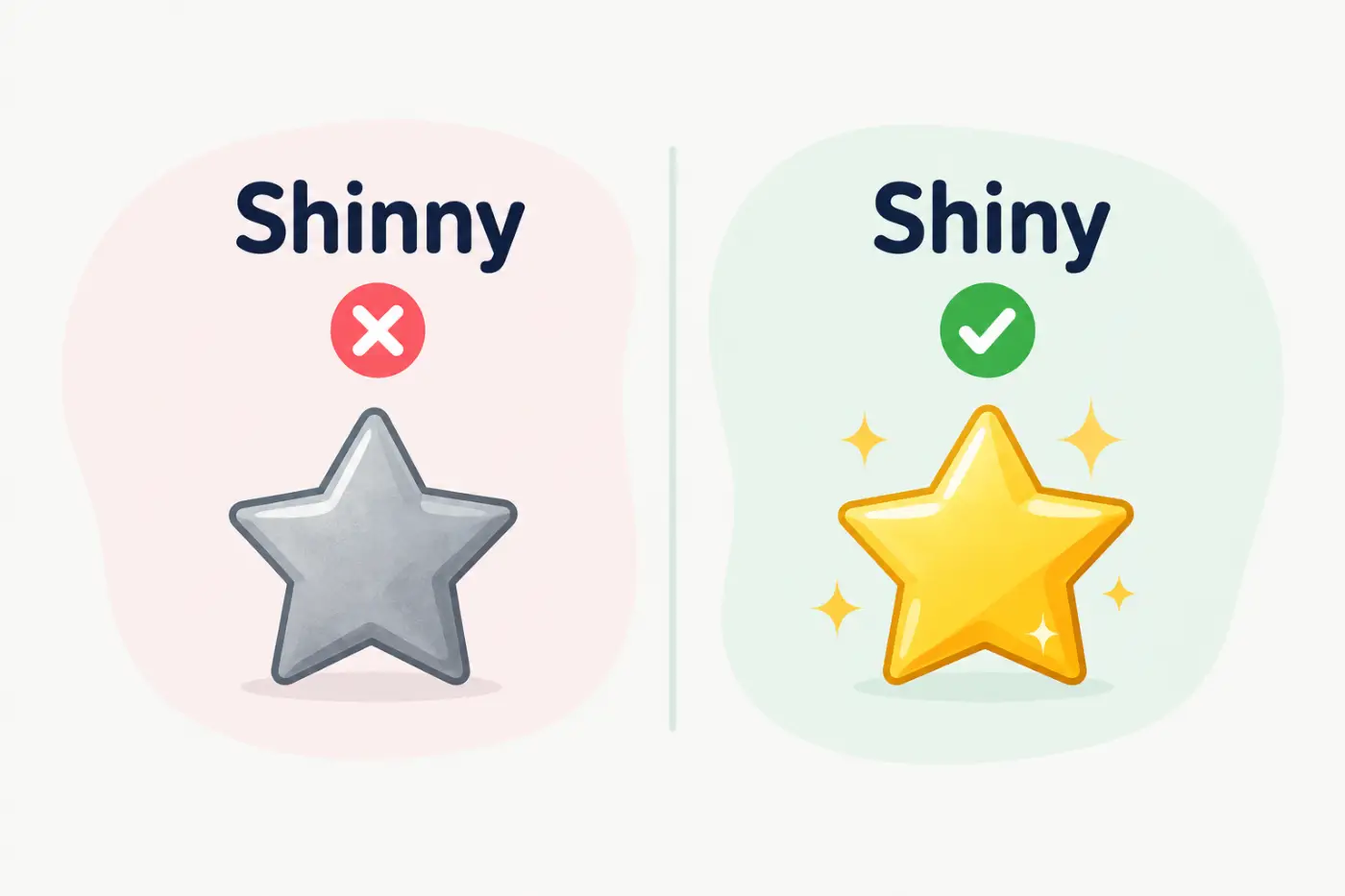
If you’re unsure about shinny vs shiny you’re probably dealing with a simple spelling mix up. The two words look almost identical but they don’t mean the same thing. One describes something that reflects light. The other has a much less common meaning connected to a type of hockey.
For most everyday writing the word you need is shiny. You can use it to describe a clean car a bright piece of jewelry a polished floor or anything that has a smooth surface that reflects light.
Shinny is a real English word too. It isn’t simply a misspelling of shiny. In North American English it can refer to an informal form of ice hockey or street hockey. The word has a specific use and you’ll rarely need it in normal everyday writing.
This guide explains the difference in plain English. You’ll see how each word works in a sentence why people confuse them and a simple way to remember the spelling. We’ll also look at related words and common mistakes so you can choose the right one without stopping to second guess yourself.
Quick Definition
Shiny is an adjective that describes something with a bright or polished surface that reflects light. For example you might have shiny shoes or a shiny new car.
Shinny is a noun or verb connected to an informal form of hockey. In ordinary writing about bright or polished objects use shiny.
Direct Answer
Shiny is the correct word when you mean bright polished or reflective. Shinny is a separate word used mainly for an informal form of hockey.
Comparison Table
| Word | Meaning | Example Sentence | When to Use It |
|---|---|---|---|
| Shiny | Bright or reflective because of a smooth or polished surface. | She bought a shiny new pair of shoes. | Use it when describing something that reflects light. |
| Shinny | An informal form of hockey or the act of playing it. | The kids played shinny on the frozen pond. | Use it when talking about informal hockey. |

What Does Shiny Mean
Shiny describes something that reflects light from its surface. The surface may look smooth polished glossy or bright.
You can use the word for physical objects and surfaces.
For example a freshly washed car can look shiny in the sunlight. A new pair of shoes might have a shiny finish. A clean kitchen counter can also look shiny after you wipe it down.
The word doesn’t always mean something is new. An older object can become shiny after someone cleans or polishes it.
Consider these examples.
- The silver spoon looked shiny after I polished it.
- Her shoes were still shiny after years of careful use.
- The floor looked shiny after it was cleaned.
- He bought a shiny red bicycle.
- Sunlight bounced off the shiny surface of the table.
In each sentence the word describes the appearance of something. It tells the reader that the object reflects light or has a polished surface.
Shiny Is Usually An Adjective
An adjective describes a person place thing or idea. Shiny works this way because it tells us what something looks like.
You can place it before a noun.
- A shiny car.
- A shiny coin.
- A shiny jacket.
- A shiny floor.
- A shiny button.
You can also use it after a linking verb such as looks or seems.
- The car looks shiny.
- The table looks shiny after cleaning.
- Her new shoes seem shiny under the lights.
This makes the word easy to use in everyday speech. If you’re describing the appearance of an object and want to say that it reflects light then shiny is usually the word you’re looking for.
What Does Shinny Mean
Shinny has a completely different meaning. It refers to an informal form of hockey. The game can be played on ice or on another surface depending on the regional use of the word.
The term is especially associated with informal hockey played without the full equipment and structure of organized games. Players may simply gather together and play for fun.
For example.
- The children played shinny on the frozen pond.
- We used to play shinny after school.
- The neighbors organized a game of shinny during the winter.
The word can also be used as a verb.
- They spent the afternoon shinnying on the pond.
This use is much less common than shiny in everyday American English. If you’re writing about an object that looks bright or polished then shinny isn’t the word you want.
Why These Words Get Confused
The confusion comes down to one letter. Shiny has one n while shinny has two.
That small difference changes the word completely. When people type quickly they may add an extra n without noticing. Others may see the two words so rarely that the spelling doesn’t feel familiar.
Pronunciation can also add to the confusion. In some speech patterns the difference may not be very noticeable. That means hearing the word isn’t always enough to know which spelling a writer should use.
Context usually makes the answer much clearer.
If you’re describing a bright object use shiny.
If you’re talking about an informal hockey game use shinny.
Think about the meaning before you think about the letters. Once you know what the sentence means the correct spelling becomes much easier to choose.
The Spelling Difference
The easiest way to see the difference is to look at the middle of each word.
Shiny has one n.
Shinny has two n letters.
That extra letter isn’t optional. It creates a different word.
Compare these sentences.
- The new car is shiny.
- The children played shinny on the ice.
The first sentence describes the appearance of a car. The second describes a game. Changing the number of n letters changes the meaning.
This is a good example of why spelling matters. A single letter can turn one word into another word. It can also make a sentence confusing if the reader expects one meaning and gets another.
When To Use Shiny
Use shiny when you want to describe something that reflects light or has a polished surface.
You might use it to describe metal glass plastic leather shoes furniture paint or other materials.
Shiny Objects
Many everyday objects can be described as shiny.
- The new coins were shiny.
- She wore a shiny bracelet.
- The gift came in a shiny box.
- His new watch has a shiny metal band.
The word gives the reader a quick picture. Instead of simply saying the watch looks nice you can say it has a shiny metal band. That tells the reader something specific about its appearance.
Shiny Surfaces
You can also use shiny for surfaces.
- The kitchen floor looked shiny after it was mopped.
- The polished table had a shiny surface.
- The bathroom tiles were clean and shiny.
Here the word points to the way light reflects from the surface.
Shiny Materials
Some materials naturally have a shiny appearance. Others become shiny after polishing or cleaning.
- The leather shoes had a shiny finish.
- The metal was smooth and shiny.
- The fabric had a shiny appearance under the lights.
The exact amount of shine can vary. Something doesn’t need to look like a mirror to be called shiny. The word simply tells the reader that the surface has a noticeable bright or reflective quality.
When To Use Shinny
Use shinny when you’re talking about the informal hockey game. This meaning is much narrower than the meaning of shiny.
For example.
- The boys played shinny on the pond.
- My grandfather told stories about playing shinny as a child.
- The frozen lake became a popular place for shinny during winter.
You wouldn’t use this word to describe a polished object.
The sentence She bought a shinny new car is incorrect if you mean the car has a bright or polished finish. The correct word in that sentence is shiny.
The difference may seem small but the meaning changes completely.
A Simple Memory Trick
There’s an easy way to remember the spelling.
Think of shiny as the word for something that shines. Both words have the same basic idea of brightness. The spelling uses one n.
For example.
The shiny car shines in the sun.
That connection can help you remember the spelling when you’re writing quickly.
For shinny think about hockey instead. The double n can remind you that this is the less common word with a special meaning.
You don’t need a complicated spelling rule. Just connect each spelling with its meaning.
Shiny means bright or reflective.
Shinny means informal hockey.
Once that distinction becomes familiar you’ll be much less likely to mix them up.
Examples In Real Sentences
Seeing the words in natural sentences makes the difference easier to remember. Notice how the meaning changes based on the spelling.
Examples With Shiny
The new kitchen appliances looked shiny under the lights.
Maria cleaned her shoes until they were shiny.
The child picked up a shiny coin from the sidewalk.
A shiny black car pulled into the driveway.
The floor looked shiny after the cleaner dried.
He gave her a shiny silver necklace for her birthday.
Examples With Shinny
The kids played shinny on the frozen pond.
My dad remembers playing shinny with his friends during winter.
The local rink allowed people to gather for a casual game of shinny.
They spent the afternoon playing shinny outside.
The old story described a group of neighbors enjoying a game of shinny.
The contrast is clear once you see the words in context. One describes appearance. The other refers to a game.
The Most Common Mistake
The most common mistake is using shinny when you mean shiny.
For example.
Incorrect: She bought a shinny dress.
Correct: She bought a shiny dress.
The dress has a bright or reflective appearance so shiny is the right choice.
Another common mistake happens when someone writes shiny while talking about hockey.
Incorrect: The kids played shiny on the pond.
Correct: The kids played shinny on the pond.
The first sentence doesn’t make sense because shiny describes appearance. The second uses the hockey term correctly.
The key is to stop and think about meaning rather than simply looking at the spelling. Ask yourself what you’re trying to describe. If you’re talking about brightness or a polished surface choose the word with one n. If you’re talking about informal hockey choose the spelling with two n letters.
Why Context Makes The Difference
Context gives readers clues about which word you mean. This is especially useful because the two words look and sound similar.
Imagine reading this sentence.
The floor was shiny after the cleaning.
You immediately know the writer is describing the floor’s appearance.
Now compare it with this sentence.
The children played shinny after school.
The words around shinny tell you that the sentence is about an activity.
Good writers use context to make meaning clear. Good readers use context to understand unfamiliar words. When you see a spelling that looks unusual ask what the sentence is actually talking about.
That simple habit can help you avoid many spelling mistakes beyond these two words.
How Shiny Works In A Sentence
The word shiny usually works as an adjective because it describes how something looks. It can appear before a noun or after a linking verb. Both forms are common in everyday English.
When it comes before a noun the adjective gives information about the object. You might talk about a shiny car a shiny floor or a shiny piece of jewelry. When it comes after a verb such as look or seem it still describes the object’s appearance.
For example you might write that the car looks shiny after a wash. You could also say that the car has a shiny finish. Both sentences describe the way the surface reflects light.
The word can describe something that naturally reflects light or something that became reflective after cleaning polishing or painting. That makes it useful in many different situations.
Shiny As A Description
A shiny object usually catches light. It may look bright smooth polished or glossy.
Consider these examples.
- The polished silver looked shiny in the sunlight.
- Her new shoes were shiny and black.
- The kitchen counters looked shiny after they were cleaned.
- He bought a shiny red helmet.
- The children admired the shiny decorations.
The word doesn’t tell you exactly what material the object contains. It only describes its appearance. A metal object can be shiny. So can plastic glass paper fabric or painted wood.
Shiny And Glossy
Shiny and glossy have similar meanings but they aren’t always exact substitutes.
Shiny is a broad everyday word. It simply tells you that something reflects light.
Glossy often suggests a smooth surface with a noticeable polished finish. You might describe a magazine cover as glossy because it has a smooth surface that reflects light.
For example.
- The new car has a shiny finish.
- The magazine has a glossy cover.
Both words describe light reflecting from a surface. The best choice depends on the object and the kind of surface you’re describing.
How Shinny Works In A Sentence
The less common word has a very different job. It can refer to an informal game of hockey. The game usually has fewer rules and less formal equipment than organized hockey.
The word is especially familiar in parts of North America where informal hockey on frozen ponds or outdoor rinks has a long tradition.
You might hear someone say that a group of friends went out to play shinny. The sentence has nothing to do with something looking bright or polished.
For example.
- We played shinny on the pond after school.
- Grandpa used to play shinny with his brothers.
- The neighbors met for a game of shinny on Saturday.
The word can also appear as a verb in the form shinnying. That form refers to taking part in the informal game.
For example.
- The kids spent the afternoon shinnying on the frozen pond.
This usage is much less common than the adjective that describes something bright. Most people who are simply writing about appearance won’t need this word.
Is Shinny A Real Word
Yes. Shinny is a real English word. It isn’t just a spelling error.
This point matters because people sometimes assume that the version with two n letters is always wrong. That’s not true. The word has a legitimate dictionary meaning connected with informal hockey.
The problem comes from using it in the wrong situation.
If you’re describing a polished surface then the spelling with one n is the right choice. If you’re talking about the informal hockey game then the spelling with two n letters can be correct.
Think of them as two separate words rather than two spellings of the same word.
That distinction makes the whole question much easier.
Is Shiny Always About Something Reflecting Light
Not necessarily. The core idea involves brightness or a surface that reflects light but the word can have a broader descriptive use.
For example you might describe someone’s eyes as shiny. That can mean their eyes look bright or wet. It doesn’t necessarily mean the eyes have a polished surface.
You might also describe someone’s hair as shiny. In that case the word suggests that the hair has a healthy bright appearance and reflects light.
Consider these examples.
- Her eyes looked shiny with tears.
- His hair looked shiny after he washed it.
- The leaves were shiny after the rain.
These examples show why context matters. The word still describes appearance but the source of the shine changes.
Shiny Can Describe More Than Objects
You don’t have to use this adjective only for solid objects. It can describe parts of the natural world and even certain visual qualities.
Fresh rain can leave leaves shiny. A wet road can look shiny under streetlights. Ice can appear shiny when sunlight hits its surface.
Here are some natural examples.
- The wet leaves looked shiny in the morning sun.
- The road was shiny after the rain.
- The ice looked shiny under the stadium lights.
- Her eyes were shiny with tears.
These sentences all use the same basic idea. Something has a bright or reflective appearance.
Common Expressions With Shiny
Some combinations with this word appear often in everyday writing. Learning them can help you recognize natural usage.
Shiny New
The phrase shiny new often describes something that is brand new and attractive.
For example.
- He showed everyone his shiny new bicycle.
- She brought her shiny new laptop to class.
- They moved into a shiny new apartment.
The phrase can be completely literal. It can also have a playful tone when someone is excited about a new purchase.
Shiny Surface
This phrase focuses on the way a material reflects light.
- The table has a smooth shiny surface.
- The cleaner left a shiny surface behind.
- Dust made the shiny surface look dull.
Shiny Finish
A shiny finish describes a surface treated to create a reflective appearance.
- The cabinet has a shiny finish.
- I prefer a matte finish instead of a shiny finish.
- The paint dries to a shiny finish.
This phrase appears often when people talk about furniture paint cars cosmetics and other products.
Shiny And Matte
Shiny and matte describe opposite surface effects.
A shiny surface reflects more light and usually looks bright or polished. A matte surface has little reflection and looks softer or flatter.
For example a phone case can have a shiny finish or a matte finish. Paint can also come in shiny and matte varieties.
You might say.
- I like the shiny finish on this table.
- I prefer matte paint because it doesn’t reflect much light.
Knowing this contrast can help you understand the word more clearly. It also gives you another useful term to use when describing surfaces.
Common Spelling Mistakes
The most obvious mistake is adding an extra n when you mean something is bright.
For example.
Incorrect: The floor looks shinny after I cleaned it.
Correct: The floor looks shiny after I cleaned it.
Another mistake is leaving out the second n when you’re talking about the hockey game.
Incorrect: They played shiny on the frozen pond.
Correct: They played shinny on the frozen pond.
The difference may look tiny on the page but the meanings are completely different.
A Mistake With A New Car
Suppose you’re writing about a new car. You want to say that its polished paint reflects the sunlight.
You could write:
The new car has a shiny black finish.
Writing shinny would change the word into the name of a hockey activity. The sentence would no longer communicate the idea you intended.
A Mistake With Hockey
Now imagine you’re writing about children playing hockey on a frozen pond.
You could write:
The children played shinny on the pond.
Using shiny would make the sentence confusing because the adjective describes appearance rather than the game.
The meaning of the sentence should guide your spelling.
When Spell Check Can Mislead You
Spell check can catch many errors but it isn’t a substitute for understanding the word you’re using. Since shiny and shinny are both legitimate words a spelling tool may not flag the wrong one if it fits the grammar of the sentence.
Imagine you write:
The shoes are shinny.
A spell checker may recognize shinny as a real word. It can’t always know that you meant to describe the shoes as reflective.
This is a good example of a mistake that requires human judgment. You need to look at the meaning of the sentence rather than relying only on software.
The same problem happens with many other English word pairs. Two words can both be spelled correctly while only one fits the meaning.
A Simple Test To Choose The Right Word
When you’re unsure which spelling to use ask yourself one question.
Am I describing something that reflects light or am I talking about hockey.
If you’re describing brightness a polished surface or a reflective appearance choose shiny.
If you’re talking about an informal hockey game choose shinny.
This test takes only a second and works in almost every situation.
You can make the trick even easier by connecting the first word with shine.
Shine means to give off or reflect light.
Shiny describes something that shines or reflects light.
That connection makes the single n spelling easier to remember.
Words Related To Shiny
Learning related words can strengthen your vocabulary and make your writing more precise. Several words can describe a bright or reflective surface but each has a slightly different feel.
Bright
Bright can describe something that gives off or reflects a lot of light. It can also describe colors.
- The room was bright.
- She wore a bright yellow dress.
Unlike shiny it doesn’t always suggest a reflective surface.
Glossy
Glossy often describes a smooth surface that reflects light.
- The brochure has a glossy finish.
- She bought glossy black shoes.
Polished
Polished can describe something that has been cleaned or treated until it has a smooth reflective surface.
- The silver was polished until it looked bright.
- He polished the wooden table.
It can also describe someone’s behavior or skills so the context matters.
Sparkling
Sparkling suggests something that shines brightly or appears to flash with light.
- The water looked sparkling in the sunlight.
- She wore a sparkling necklace.
This word often creates a stronger visual image than shiny.
Glossy And Shiny Are Not Always The Same
These words overlap but they can create different impressions. A glossy surface usually has a smooth finish with strong reflection. Something shiny can simply catch the light without having a special finish.
For everyday writing you don’t need to overthink the difference. Use shiny when you want a simple natural word for something that reflects light. Choose glossy when the surface finish matters.
Why Meaning Matters More Than Spelling
Spelling is only one part of clear writing. Choosing the right word for the meaning matters just as much.
The two words in this comparison demonstrate that perfectly. One extra n turns an adjective about appearance into a word connected to hockey.
That’s why memorizing a spelling alone isn’t always enough. You also need to know what the word means and how people use it.
When you learn a new word try to learn three things together.
First learn how it is spelled. Then learn what it means. Finally learn it in a natural sentence.
That approach gives you a much stronger memory than simply copying the word several times.
Quick Practice
Try choosing the correct word in each sentence.
The polished silver looked very ______ under the light.
The answer is shiny because the sentence describes the appearance of the silver.
The children went outside to play ______ on the frozen pond.
The answer is shinny because the sentence refers to informal hockey.
She bought a ______ new purse.
The answer is shiny because the purse has a bright or reflective appearance.
My grandfather told us about playing ______ when he was young.
The answer is shinny because he is talking about a hockey game.
These examples show how quickly context can solve the problem. You don’t need to memorize a long list of rules. You only need to connect each spelling with its meaning.
How To Remember The Difference
A useful memory trick is to connect shiny with shine. Both words describe brightness or reflected light. When you see something bright and polished in your mind picture the word shiny with one n.
For shinny think about a hockey stick and a frozen pond. The extra n can help you remember that you’re dealing with the special hockey term rather than the common adjective.
You can also remember the two meanings as a simple pair.
Shiny means bright.
Shinny means hockey.
That short connection is enough for most everyday writing. Once you’ve used the words a few times the difference should become second nature.
When To Use Each Word
Use shiny when describing a surface appearance.
- Shiny shoes.
- Shiny jewelry.
- Shiny paint.
- Shiny hair.
- Shiny leaves.
- Shiny floors.
Use shinny when talking about informal hockey.
- Play shinny.
- A game of shinny.
- Shinny on a frozen pond.
- A shinny game with friends.
If you keep those two groups separate you’ll rarely have trouble with this pair again.
More Examples Of Shiny In Everyday Writing
The easiest way to understand shiny is to picture something that catches or reflects light. The object doesn’t have to be perfectly polished. It only needs to have a bright or reflective appearance that stands out.
You might describe a new car as shiny because sunlight reflects from its paint. A child might call a new coin shiny because it looks bright compared with an older coin. A person might describe wet leaves as shiny after a rainstorm because water makes their surfaces reflect light.
The word works naturally in many settings.
At Home
- The kitchen floor looks shiny after I mop it.
- The new faucet has a shiny silver finish.
- I cleaned the table until it was shiny.
- The bathroom mirror has a shiny frame.
- The freshly washed windows look shiny in the sunlight.
These examples describe surfaces or objects that reflect light. The word gives the reader a quick visual clue without needing a long explanation.
With Clothing And Accessories
Clothing and accessories can also have a shiny appearance. This often happens with certain fabrics metals coatings and decorative materials.
- She wore a shiny black jacket to the party.
- His shoes had a shiny finish.
- The dress had a shiny fabric that caught the light.
- She bought a shiny silver bracelet.
- The buttons looked shiny and new.
The word can suggest a stylish or eye catching appearance but it doesn’t automatically mean something looks good. A shiny surface can be attractive or distracting depending on the situation.
In Nature
Natural things can look shiny too. Water rain and ice often create reflective surfaces.
- The leaves looked shiny after the rain.
- The lake looked shiny under the afternoon sun.
- The wet pavement was shiny beneath the streetlights.
- The ice had a shiny surface in the morning light.
These examples show that shiny isn’t limited to manufactured products. It can describe anything that appears bright or reflective.
When Shiny Can Have A Different Feeling
The word doesn’t always describe something in a positive way. Context controls the feeling.
A shiny new car may sound exciting. A shiny forehead might suggest excess oil or sweat. A shiny patch on a worn piece of furniture could show that the surface has been rubbed repeatedly.
For example.
- His forehead looked shiny after the long run.
- The old desk had shiny spots where people’s hands had rested for years.
- The shiny paint made the room feel brighter.
The word itself is neutral. The surrounding sentence tells the reader how to interpret the appearance.
Shiny And New Are Not The Same
People sometimes connect these words because new objects often look shiny. Still they don’t mean the same thing.
Something can be new without being shiny.
- She bought a new sweater with a matte finish.
Something can be old and still be shiny.
- The antique vase was carefully polished and still looked shiny.
Something can also be both new and shiny.
- He drove home in a shiny new car.
This distinction matters because shiny describes appearance while new describes age or recent ownership. Keeping those ideas separate makes your writing more precise.
Shiny And Clean Are Not The Same
A clean object may look shiny but the two words describe different things.
A surface can be clean without reflecting much light. A surface can also look shiny because of its material even if it isn’t perfectly clean.
Compare these sentences.
- The floor is clean.
- The floor is shiny.
The first sentence tells you that dirt or unwanted material has been removed. The second tells you about the floor’s appearance.
You can combine them when both ideas matter.
- The clean floor looked shiny under the lights.
That sentence gives the reader two separate pieces of information.
Shiny And Sparkly Are Not The Same
These words are related but they create different images.
Shiny usually describes a surface that reflects light. Sparkly suggests small bright points or flashes of light.
A polished car can be shiny. A dress covered with tiny reflective decorations can be sparkly.
For example.
- The new car had a shiny black finish.
- Her dress was covered with sparkly details.
A diamond can be both shiny and sparkly. The first word describes its reflective surface while the second emphasizes the little flashes of light it produces.

Shiny And Glossy Are Not The Same
The two words overlap enough that people sometimes use them as substitutes. Still they aren’t always identical.
Shiny is the broader everyday term. It can describe almost anything that reflects light.
Glossy often points to a smooth polished finish. The word is common when talking about printed materials paint cosmetics photographs and product surfaces.
For example.
- The car has a shiny finish.
- The magazine has a glossy cover.
- She chose glossy paint for the cabinets.
You can use shiny in many of these situations but glossy may give a more specific picture when you’re talking about a particular finish.
Understanding The Hockey Meaning
The word shinny has a long connection with informal hockey. It can refer to casual hockey played outside a formal league or organized competition.
The exact style of the game can vary by place and tradition. Players may use less equipment and follow simpler rules than they would in an official hockey game.
The word is especially associated with casual games on outdoor ice.
For example.
- The neighbors met for shinny after the pond froze.
- We played shinny until it got too dark to see the puck.
- My uncle remembers playing shinny on outdoor rinks as a kid.
The context makes the meaning clear. Nobody is describing the appearance of the players or the ice. They are talking about a recreational hockey game.
Shinny Can Also Appear As A Verb
The hockey term can function as a verb too. In that use it describes taking part in the informal game.
The form shinnying can appear when the action is happening over a period of time.
For example.
- The children were shinnying on the outdoor rink.
- We spent Saturday afternoon shinnying with our friends.
This use is much less common than the adjective shiny. Most people who are writing about surfaces colors or appearance won’t encounter it very often.
Still it helps to know that shinny isn’t an accidental spelling. It has its own meaning and grammatical uses.
Can Shinny Mean Anything Else
Yes. The word has other dictionary uses and historical senses. Some are rare or regional. In ordinary modern American writing the hockey meaning is the one most readers are likely to recognize.
That means context matters even more if you encounter the word outside a hockey discussion.
If you’re writing for a general audience you probably won’t need the less common senses. If you’re reading older writing regional material or a specialized dictionary you may see additional meanings.
For everyday spelling questions the key distinction remains simple. Use shiny for brightness and reflective appearance. Use shinny for the informal hockey term.
Why The Extra N Changes Everything
Adding an extra letter can seem like a tiny spelling choice. In this case it creates a completely different word.
Compare these examples.
The floor is shiny.
The sentence describes the floor’s appearance.
They played shinny on the floor.
The second sentence refers to hockey and sounds unusual because the setting doesn’t fit the activity. The spelling is still correct if the writer truly means the hockey term.
This is a useful lesson in English spelling. Some errors don’t produce nonsense. Instead they create another real word with a different meaning. That makes them harder for spell checkers to catch.
The same issue occurs with many other word pairs. Brake and break are both real words. So are right and write. Knowing the meaning is just as important as knowing the spelling.
Common Questions About Shinny And Shiny
People often search for this spelling pair because they aren’t sure if one version is a typo or if both words are valid. Both spellings are valid but they serve different purposes.
The important point is that shiny is the everyday adjective for something that reflects light. Shinny has a separate meaning and is mainly associated with informal hockey.
Once you connect each word with its meaning the spelling becomes much easier to remember.
A Quick Editing Check
If you’re proofreading your own writing look at the sentence around the word. Don’t focus only on the letters.
Ask what you’re trying to say.
If you’re describing a bright polished glossy or reflective appearance use shiny.
If you’re describing an informal hockey game use shinny.
Then read the whole sentence once. This helps you catch other mistakes that might sit nearby.
For example.
The shiny new shoes looked great under the lights.
The word fits because the shoes have a reflective appearance.
The boys played shinny at the outdoor rink.
The word fits because the sentence describes a hockey activity.
This quick check takes almost no time and works even when you’re writing quickly.
A Simple Way To Teach The Difference
If you’re helping a child or English learner remember these words don’t start with a complicated spelling rule. Start with the meanings.
Show them a picture of something bright and polished. Connect it with shiny.
Then show them a picture of people playing casual hockey. Connect it with shinny.
After that give them short sentences and ask them to choose the correct spelling.
For example.
The silver coin is ______.
The answer is shiny.
The children played ______ on the ice.
The answer is shinny.
This method works because the learner connects the spelling with an idea. They aren’t simply trying to remember a random sequence of letters.
A Useful Memory Sentence
One short sentence can help keep the two words apart.
Shiny things shine. Shinny is hockey.
The first part connects the single n spelling with brightness. The second part connects the double n spelling with the hockey term.
You can also remember the words visually.
- Picture a bright coin when you see shiny.
- Picture a hockey stick when you see shinny.
Simple associations often work better than complicated rules because you can recall them quickly when you’re writing.
Practice With These Sentences
Try choosing the correct word before reading the answer.
- The polished car looked ______ in the sunlight.
- The correct answer is shiny. The sentence describes the car’s reflective appearance.
- The friends played ______ on the frozen pond.
- The correct answer is shinny. The sentence refers to informal hockey.
- Her new necklace was bright and ______.
- The correct answer is shiny because the necklace reflects light.
- My grandfather enjoyed playing ______ when he was young.
- The correct answer is shinny because the sentence describes the hockey activity.
- The wet sidewalk looked ______ under the streetlights.
- The correct answer is shiny because water can make a surface reflect light.
- The neighborhood hosted a casual game of ______.
- The correct answer is shinny because the sentence refers to the informal hockey game.
These examples show why the meaning should come first. Once you understand the sentence you can usually choose the spelling without much thought.
What To Remember
The distinction is small but clear. Shiny describes something that reflects light or has a bright polished appearance. It is the word you’ll use in most everyday situations involving appearance.
Shinny is a separate word. It is mainly used for an informal form of hockey and related activity.
The extra n isn’t a variation in spelling. It changes the word and its meaning. That is why proofreading for context matters even when both spellings are technically valid words.
If you’re describing shoes a car a floor jewelry wet leaves paint or another reflective surface choose shiny. If you’re talking about casual hockey on ice choose shinny.
FAQs
Is shiny or shinny the correct spelling?
Shiny is correct when you mean bright reflective or polished. Shinny is also a real word but it has a different meaning connected mainly with informal hockey. The correct choice depends on what you want to say.
What is the difference between shinny and shiny?
The main difference is meaning and spelling. Shiny describes something that reflects light while shinny refers to an informal form of hockey. The extra n changes the word completely.
Is shinny a real English word?
Yes. Shinny is a real English word. It can refer to an informal game of hockey that is often played casually on ice. It isn’t a spelling mistake when it is used with that meaning.
Why do people confuse shiny and shinny?
The words look and sound very similar. The only spelling difference is the extra n in shinny. Since both words are real English words spell check may not catch the mistake when someone chooses the wrong word for the sentence.
How do I remember the spelling of shiny?
Connect shiny with shine. Both words relate to brightness and reflected light. If you’re describing something that shines use the spelling with one n.
Can shiny describe a person?
Yes but the meaning depends on the context. You might describe someone’s hair as shiny or say their eyes look shiny. The word describes an appearance rather than directly describing the person’s character.
Can shinny be used as a verb?
Yes. Shinny can be used as a verb for taking part in the informal hockey game. You may also see the form shinnying when describing the activity in progress.
Is shiny the same as glossy?
The meanings overlap but they aren’t always identical. Shiny is a broad everyday word for something that reflects light. Glossy often suggests a smooth polished finish and is common when describing paint paper photographs and other surfaces.
Conclusion
The difference between shinny vs shiny becomes simple once you focus on meaning. Shiny describes something that reflects light or has a bright polished appearance. Shinny is a separate word that mainly refers to an informal form of hockey.
Use shiny when you’re talking about a car a floor a piece of jewelry shoes hair wet leaves paint or another surface that catches the light. You can also use it for things such as eyes when they have a bright or wet appearance.
Use shinny when you’re talking about casual hockey. The extra n isn’t just a spelling variation. It creates a different word with a different meaning.
When you get stuck on these two words remember one simple line. Shiny things shine. Shinny is hockey. That quick connection should help you choose the right word the next time you write.

Sienna Watson is a veteran copywriter and communications coach who has helped startup founders, marketers, and professionals polish their writing for over a decade. Realizing that most people don’t need a degree in linguistics—just clear, impactful communication—Sienna focuses on practical grammar, business writing etiquette, and eliminating wordiness. She advocates for plain language, strong verbs, and persuasive prose that gets results.