
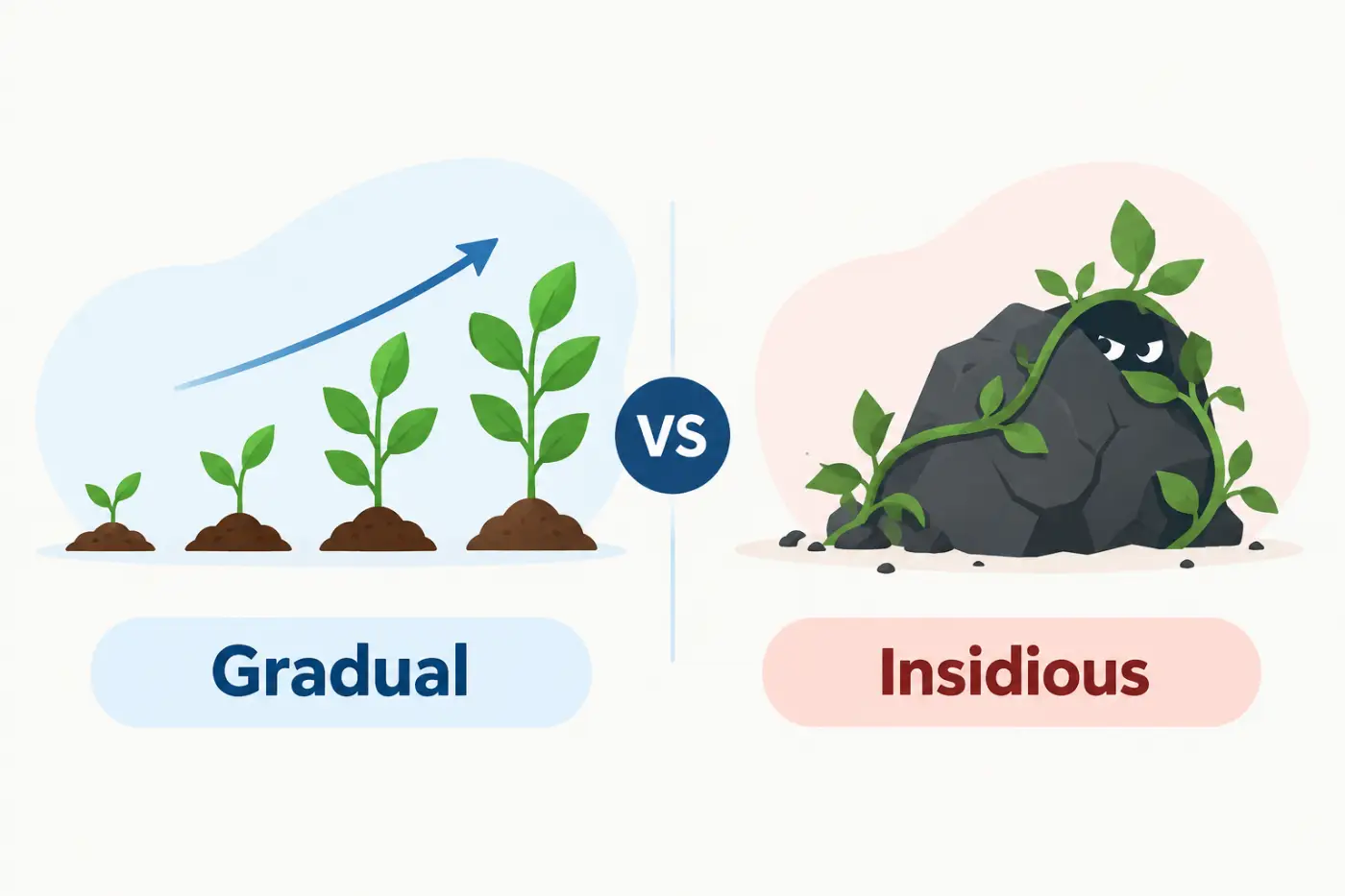
If you’re confused about gradual vs insidious you aren’t alone. Both words can describe something that develops over time. The key difference is that gradual simply means something happens slowly or in stages. Insidious describes something harmful or unpleasant that develops slowly while often going unnoticed.
That difference matters because these words don’t carry the same feeling. A gradual change can be good bad or neutral. An insidious change is usually harmful and hard to notice at first.
For example you might notice a gradual change in the weather as summer turns into fall. An insidious problem may grow quietly until it becomes serious. The first word focuses on speed and progress. The second adds the idea of hidden danger or harm.
This guide explains the meaning of both words in plain English. You’ll see how they differ how native speakers use them and why replacing one with the other can change the meaning of a sentence.
Quick Definition
Gradual means happening slowly over time or taking place in small steps. It doesn’t tell you if the change is good or bad.
Insidious means something harmful that develops slowly and often causes trouble before people notice it. The word usually suggests a hidden or difficult to recognize danger.
Direct Answer
Gradual describes a slow change. Insidious describes a harmful change that develops slowly and often goes unnoticed.
Comparison Table
| Word | Meaning | Example Sentence | When To Use It |
|---|---|---|---|
| Gradual | Happening slowly in stages. | The town saw a gradual increase in population. | Use it for any slow change. |
| Insidious | Harmful or dangerous in a way that develops slowly and is hard to notice. | The disease can have an insidious effect on the body. | Use it for hidden or slowly developing harm. |

What Gradual Means
Gradual describes something that happens little by little. It doesn’t happen all at once. Instead the change takes place over a period of time.
Think about a dimmer switch. When you turn it slowly the room doesn’t become bright in one instant. The light changes bit by bit. That is a gradual change.
The word can describe physical changes emotional changes social trends learning progress and many other things. It can also describe a rise or fall.
For example you might say that a student made gradual progress in reading. The student didn’t become an expert overnight. Their skills improved through small steps.
You could also talk about a gradual decline.
- The patient made a gradual recovery.
- The company saw a gradual drop in sales.
- Her confidence grew through gradual practice.
- The temperature showed a gradual rise during the afternoon.
- We noticed a gradual change in his behavior.
None of these examples automatically suggests danger. The word simply tells you that the change happened slowly.
Gradual Can Describe Positive Changes
A gradual change can be something you welcome.
Suppose you’re trying to build a daily exercise habit. You may start with ten minutes and slowly increase your workout time. That is gradual progress.
You might say:
- His strength improved through gradual training.
- The child made gradual progress with reading.
- She felt a gradual increase in confidence.
The word fits because the change happens over time. Nothing about the word itself suggests that something bad is happening.
Gradual Can Describe Negative Changes
The same word can describe an unwanted change.
A business might experience a gradual loss of customers. A building might show gradual damage after years of exposure to harsh weather. Someone might notice a gradual decline in energy.
For example:
- The old bridge suffered gradual damage over many years.
- The company faced a gradual decline in profits.
- His hearing loss was gradual and difficult to notice at first.
The important point is that gradual stays neutral. The surrounding sentence tells the reader if the change is positive or negative.
What Insidious Means
Insidious has a stronger meaning. It describes something that causes harm in a slow and often hidden way.
Imagine a small leak inside a wall. At first you may see nothing. The water keeps spreading behind the surface. Months later you discover mold and serious damage. The problem developed quietly while the danger stayed out of sight.
That is the basic idea behind insidious.
The word often appears when people talk about disease corruption bad habits social problems harmful beliefs and other dangers that aren’t easy to spot at first.
Consider these examples:
- Stress can have an insidious effect on your health.
- The disease can develop in an insidious way.
- The company faced an insidious threat from inside the organization.
- An insidious rumor slowly damaged her reputation.
- The habit had an insidious effect on his finances.
Each example carries a warning. The problem isn’t simply slow. It is slow and harmful. It may also be difficult to recognize until the damage has already begun.
Insidious Often Suggests Hidden Harm
The idea of hidden harm is one of the most useful clues for understanding this word.
If something is obvious you can usually see the problem and respond to it. An insidious problem works differently. It may appear harmless at first.
A person might start spending a little more money each month. Nothing seems wrong. Over time the debt grows and becomes difficult to manage. You could describe the effect of that habit as insidious if the harm develops quietly and isn’t easy to recognize.
The same idea can apply to a health problem.
A disease may not cause clear symptoms in its early stages. The condition can continue to develop while the person feels fine. In that context doctors and health writers may describe the disease as insidious.
The word doesn’t simply mean slow. It adds a sense of danger that hides beneath the surface.
The Main Difference Between The Two Words
The easiest way to separate these words is to ask what the speaker wants to emphasize.
Gradual focuses on the pace of change.
Insidious focuses on the harmful nature of change and the fact that the harm can develop quietly.
Consider two sentences:
- The town experienced a gradual increase in traffic.
- The town faced an insidious rise in pollution.
The first sentence simply tells you that traffic increased slowly. It doesn’t suggest anything dangerous.
The second sentence suggests a harmful problem. The pollution may have increased slowly enough that people didn’t notice the seriousness of it.
You can think of gradual as a description of movement. It tells you something changes one step at a time.
Think of insidious as a warning sign. It tells you that something harmful is creeping in without drawing much attention.
Can Something Be Gradual And Insidious
Yes. A harmful problem can develop gradually and also be insidious.
For example a harmful habit might start with a small action. That action becomes more common over time. The person doesn’t realize how much the habit is affecting their life until the consequences become clear.
You could describe the development as gradual because it happened slowly. You could call it insidious because the harm developed quietly.
This is why the two words sometimes appear in the same discussion. They can describe different parts of the same situation.
Consider a workplace where poor communication slowly gets worse.
At first employees miss a few messages. Later they stop sharing information. After several months teams don’t trust one another and projects begin to fail.
The decline was gradual because it happened in stages. It could also be called insidious because the damage built up quietly before people recognized the full problem.
The words can work together but they don’t mean the same thing.
Examples That Show The Difference
Looking at paired examples can make the distinction much clearer.
A Gradual Change
- The leaves showed a gradual change from green to yellow.
This sentence describes a slow visual change. There is no hidden threat.
An Insidious Change
- An insidious decline in air quality affected the neighborhood.
The change isn’t simply slow. The sentence suggests a harmful problem that may have developed without attracting enough attention.
Another Gradual Example
- She made gradual progress after starting her new study routine.
The change is positive and happens step by step.
Another Insidious Example
- His insidious gambling habit slowly created serious financial problems.
The habit developed over time but the word also points to the harmful consequences.
When To Use Gradual
Use gradual when you want to describe a slow process without adding a built in judgment about that process.
It works well with words such as change progress increase decrease improvement decline growth and transition.
Common combinations include:
- Gradual change.
- Gradual increase.
- Gradual decrease.
- Gradual improvement.
- Gradual decline.
- Gradual growth.
- Gradual transition.
- Gradual recovery.
For example:
- The company experienced gradual growth during the first five years.
- The patient showed gradual improvement.
- We saw a gradual decline in temperatures.
- The city went through a gradual transformation.
These phrases sound natural because they describe changes that happen over time.
When To Use Insidious
Use insidious when a problem is harmful and develops slowly in a way that can be difficult to detect.
It often appears with words related to harm danger disease damage influence and decline.
Common combinations include:
- Insidious disease.
- Insidious threat.
- Insidious effect.
- Insidious influence.
- Insidious problem.
- Insidious damage.
- Insidious spread.
- Insidious decline.
For example:
- The disease had an insidious beginning.
- The problem had an insidious effect on the community.
- The organization faced an insidious threat.
- Social media can sometimes have an insidious influence on self esteem.
The word works best when the sentence has some sense of danger or harm. Using it for an ordinary slow change can make the sentence sound unnecessarily dramatic.
Why The Words Get Confused
The confusion usually comes from one shared idea. Both words can describe something that doesn’t happen suddenly.
If a problem develops slowly people may reach for gradual. But slow development alone doesn’t make something insidious.
Imagine a plant growing slowly in your backyard. That’s gradual growth.
Now imagine a harmful plant spreading underground and damaging the roots of other plants without being noticed. That could be described as insidious.
The speed is similar in both examples. The meaning isn’t.
This distinction is useful whenever you’re choosing between words that share part of their meaning. Don’t focus on the one word they have in common. Look for the extra idea each word adds.
With gradual the extra idea is very small. The word mainly tells you that something happens slowly.
With insidious the extra idea is much stronger. It suggests harm that develops quietly and may escape notice.
A Simple Memory Trick
Remember this sentence:
Gradual tells you how fast. Insidious tells you how harmful and hidden.
- If you’re describing a change that happens slowly and nothing more needs to be said about it use gradual.
- If you’re describing a harmful problem that creeps in quietly use insidious.
You can also picture two different scenes.
- For gradual imagine a staircase. You move from one step to the next.
- For insidious imagine a crack spreading through a wall. You may not notice it at first but the damage keeps growing.
That mental contrast makes the difference much easier to remember.
More Real World Examples
The difference becomes even clearer when you see both words in situations people talk about every day.
Health
A person may have a gradual recovery after an illness. Their strength returns little by little.
A disease may have an insidious onset if it develops slowly without obvious warning signs.
These meanings are different even though both situations involve time.
Money
Someone may make gradual progress toward saving for a house. Their savings grow month by month.
A hidden spending habit can have an insidious effect on their finances if small purchases slowly create serious debt.
Work
An employee may take on more responsibility through a gradual increase in duties.
A toxic workplace culture can have an insidious influence if unhealthy behavior becomes normal before anyone addresses it.
Environment
A river may experience a gradual drop in water levels during a dry season.
Pollution can have an insidious effect when harmful substances build up over time and the damage isn’t immediately obvious.
Personal Habits
Learning a new skill usually involves gradual improvement. You practice often and get better over time.
A harmful habit can have an insidious effect when it starts small and becomes difficult to control.
The examples show why context matters. Both words deal with change over time but only one carries a strong warning about hidden harm.
Gradual Does Not Mean Harmless
It’s tempting to think that gradual always describes something safe or positive. That’s not true.
A slow change can still cause serious problems.
For example:
- The gradual erosion of the shoreline threatened nearby homes.
- The gradual loss of trust damaged the relationship.
- The gradual decline in water quality worried local residents.
These changes are not pleasant. The word gradual simply describes how they happen.
If you need to emphasize the hidden danger behind one of these changes then insidious may be a better choice.
For example:
- The insidious decline in water quality went unnoticed for years.
Now the sentence gives the reader more than a timeline. It suggests that the problem was harmful and difficult to recognize.
That small change in word choice can make a sentence much more precise.
Insidious Does Not Mean Fast
Another common mistake is assuming that insidious means something happens quickly. It usually suggests the opposite.
An insidious problem often takes time to develop. The danger comes from its quiet progress.
A sudden accident is not usually described as insidious because the danger is obvious and immediate. An illness that slowly worsens without clear early signs fits the word much better.
So if you remember only one thing from this section remember this:
Gradual means slow. Insidious means slowly harmful and often hard to notice.
That distinction will help you choose the right word in most situations.
How Gradual And Insidious Work In Sentences
The best way to choose between these words is to look at the kind of change you’re describing. If you only need to show that something happens slowly then gradual usually does the job. If the slow change also causes harm and stays hard to notice then insidious gives the sentence a stronger and more exact meaning.
That small difference can change the tone of a sentence. Compare these two examples.
- The company saw a gradual decline in sales.
- The company suffered an insidious decline in sales.
The first sentence gives us a simple fact. Sales went down over time. The second sentence suggests something more troubling. The decline may have happened quietly and may have been difficult to spot until it caused serious problems.
Neither word is automatically better. Your choice depends on the meaning you want the reader to get.
Gradual Describes A Process
When you use gradual you’re usually describing a process rather than judging it. The word tells readers that something happens in small steps instead of all at once.
A gradual process can take minutes hours days months or years. The length of time doesn’t decide the word. What matters is the slow pace of the change.
For example a person might gradually become more comfortable speaking in public. At first they may feel nervous. After several presentations they may feel calmer. With more practice they may speak with confidence.
You could write:
- Her confidence grew gradually after several months of practice.
The sentence doesn’t suggest danger. It simply shows that confidence developed over time.
The same pattern works with physical changes.
- The snow gradually melted as the temperature rose.
The snow doesn’t disappear in one instant. It changes little by little.
You can also use the word for larger social or economic changes.
- The neighborhood experienced gradual growth over the next decade.
Again the word gives us information about pace. It doesn’t tell us that the growth was good or bad.
Gradual Can Show Small Steps
Another useful feature of gradual is that it often suggests a series of small changes.
Imagine someone learning to play the guitar. They don’t go from beginner to expert in one afternoon. They learn a few chords. Then they practice simple songs. Later they learn harder techniques.
That is gradual improvement.
A sentence such as this sounds natural:
- His guitar skills improved through gradual practice.
You could also say:
- The child made gradual progress in reading.
- Her pain decreased gradually after treatment.
- The team built trust through gradual cooperation.
- The project moved forward through gradual changes.
Each sentence shows movement from one stage to another.
The word works especially well when you can picture a process unfolding over time.
Insidious Adds A Warning
Insidious does more than describe slow movement. It tells the reader that something is harmful and often difficult to recognize.
That extra meaning is what gives the word its power.
Suppose a person starts missing sleep because of work. At first they lose only an hour or two each night. They feel tired but carry on. Months later their health and mood suffer.
You could describe the harmful effect as insidious because the damage didn’t arrive with a loud warning. It built up quietly.
For example:
- The insidious effects of sleep loss can build over time.
The sentence has a warning that a simple sentence about gradual change may not have.
The same idea applies to harmful habits.
- An insidious habit can become harder to control before a person realizes how much it affects daily life.
Here the word suggests a slow problem that gains power without attracting enough attention.
Insidious Often Appears With Harmful Things
Certain subjects naturally fit the word insidious. Health problems are one common example. So are harmful habits social problems hidden threats and damaging influences.
You may see phrases such as:
- Insidious disease.
- Insidious infection.
- Insidious threat.
- Insidious influence.
- Insidious effect.
- Insidious damage.
- Insidious behavior.
- Insidious spread.
These combinations work because the word adds a sense of danger.
For example:
- The disease had an insidious onset.
This means the disease began in a way that was slow and not easy to recognize.
Another example is:
- The rumor had an insidious effect on the team.
The rumor didn’t simply spread slowly. It caused harm while its effects developed.
The Emotional Tone Is Different
Word choice doesn’t only communicate facts. It also affects how a sentence feels.
Gradual has a calm and neutral tone. It can describe improvement decline growth change or recovery without making the reader feel alarmed.
Insidious has a darker tone. It can make the reader think about danger damage deception or something harmful hiding beneath the surface.
Consider these examples.
- There was a gradual change in the family’s routine.
- There was an insidious change in the family’s routine.
The first sentence sounds ordinary. Maybe everyone started eating dinner later or waking up earlier.
The second sentence makes us wonder what went wrong. It suggests that the change may be damaging in some way.
This difference matters in good writing. You don’t want to use a dramatic word for an ordinary event. Doing so can make your writing sound exaggerated.
At the same time you don’t want to use a weak word when you need to warn readers about a serious hidden problem.
Gradual And Insidious In Health Writing
Health writing provides some of the clearest examples of the difference.
A person may experience a gradual recovery after an injury. Their strength returns slowly. Their pain decreases over time. They slowly return to normal activities.
For example:
- She made a gradual recovery after the accident.
The sentence simply describes the pace of recovery.
Now consider a disease that develops quietly.
- The disease can have an insidious onset.
This tells readers that the condition may develop without obvious early signs.
The two words can also appear in the same passage because they describe different parts of a health issue.
A condition might develop gradually while its effects remain insidious. One word describes the slow process. The other highlights the hidden harm.
This distinction can be useful when reading medical articles. If you see gradual the writer is often describing how something changes over time. If you see insidious the writer is usually warning that the condition or effect can be difficult to recognize and potentially harmful.
Health writers should still use insidious carefully. The word has a strong meaning. It shouldn’t replace a clear description of symptoms or risk.
Gradual And Insidious In Business Writing
Business writing uses both words but for different reasons.
A company may experience gradual growth as it gains customers year after year. It might also see gradual improvement in customer service after employees receive better training.
For example:
- The business experienced gradual growth during its first five years.
This sounds neutral and factual.
Now imagine a company has a hidden problem. Small errors begin to appear in its financial records. Nobody pays much attention. The errors continue and eventually create major losses.
You might describe the pattern as insidious if the problem quietly grows while people fail to recognize its seriousness.
For example:
- The company failed to recognize the insidious effect of poor financial controls.
The sentence suggests that the problem wasn’t simply slow. It was harmful and difficult to see.
That is why insidious can be useful in business analysis. It points attention toward problems that don’t always announce themselves.
Gradual And Insidious In Relationships
These words can also describe changes in relationships.
A friendship may grow gradually. Two people might meet at school or work. They spend more time together. Over months or years they become close friends.
You could say:
- Their friendship developed gradually.
There is nothing negative in that sentence.
But a relationship can also change in a harmful way.
Small acts of disrespect may become common. One person may slowly control the other person’s choices. The behavior may become normal before the person affected realizes how serious it has become.
In that kind of context insidious may describe the harmful pattern.
For example:
- The insidious pattern of control became clear only after several years.
The word tells the reader that the problem didn’t appear suddenly. It grew quietly and caused harm along the way.
Gradual And Insidious In Everyday Conversation
You don’t have to use these words only in formal writing. They can appear in everyday speech too.
People often use gradual in normal conversations.
- The weather is getting gradually warmer.
- He made a gradual return to work.
- The noise gradually faded away.
- Her confidence grew gradually.
These sentences sound natural because the word describes ordinary changes.
Insidious is less common in casual conversation because it has a serious tone. You might hear it when someone is talking about a serious problem or explaining a hidden danger.
For example:
- That kind of stress can have an insidious effect.
The speaker isn’t simply saying that stress builds slowly. They are warning that the harm can sneak up on someone.
Synonyms For Gradual
Understanding related words can help you choose the right term.
Common synonyms for gradual include slow steady step by step progressive and incremental.
These words overlap but they aren’t exact replacements in every sentence.
Slow focuses directly on speed.
- The recovery was slow.
Steady suggests that something continues at a regular pace.
- The company enjoyed steady growth.
Progressive often describes something that develops through stages.
- The condition caused progressive weakness.
Incremental describes small increases or changes that happen in steps. It is common in business and technical writing.
- The team made incremental improvements to the system.
Gradual is often the simplest choice because it describes slow change without adding much extra meaning.
Synonyms For Insidious
Related words for insidious include harmful hidden subtle dangerous deceptive and stealthy. None of these words means exactly the same thing.
- Harmful simply means causing harm.
- Hidden means difficult to see or find.
- Subtle means not obvious or easy to notice.
- Deceptive suggests that something gives a false impression.
- Stealthy suggests movement or action that happens quietly to avoid attention.
- Insidious brings several of these ideas together. It often describes something harmful that develops quietly and is hard to recognize.
That combination makes it more specific than simply saying harmful or hidden.
Common Mistakes With These Words
One common mistake is using insidious whenever something happens slowly. Slow movement alone isn’t enough.
For example:
- The sun gradually disappeared behind the clouds.
That sentence works because the event is simply slow.
Calling the sunset insidious would make little sense unless the sentence were describing some hidden harmful effect connected to it.
Another mistake is using gradual when you want to show hidden danger.
Consider this sentence:
- The harmful influence of the group was gradual.
The sentence tells us that the influence developed slowly. It doesn’t strongly suggest that the influence was difficult to detect.
You could write:
- The harmful influence of the group was insidious.
Now the sentence suggests that the influence worked quietly and caused harm.
A third mistake is assuming that insidious always means intentional. It doesn’t necessarily mean that someone planned the harm.
A disease can be insidious without having any intention at all. A bad habit can be insidious without a person deliberately trying to cause trouble.
The word describes the nature of the development. It doesn’t automatically describe someone’s motives.
Gradual Versus Sudden
One useful way to understand gradual is to compare it with sudden.
A gradual change happens over time.
A sudden change happens quickly and often without much warning.
For example:
- The temperature showed a gradual increase.
- The temperature suddenly dropped.
These words describe the speed of change from different angles.
You can also combine gradual with other time words.
- The change happened gradually.
- The decline was gradual.
- Her recovery was gradual.
- The increase was gradual.
This makes the word useful in many types of writing.
Insidious Versus Obvious
A useful contrast for insidious is obvious.
An obvious problem is easy to see or understand. People can usually recognize it quickly.
An insidious problem can be harder to detect. It may look harmless at first while its harmful effects continue to develop.
Imagine a large crack in a building wall. If everyone can see it and knows it needs attention then the problem is obvious.
Now imagine moisture slowly entering the wall from behind. The outside may look fine for a long time. The damage can continue until mold or structural problems appear.
The second situation better captures the idea behind insidious.
This contrast can help you remember the word. Think of something that quietly causes trouble while hiding in plain sight.
Can Gradual Be Used For Something Dangerous
Yes. Gradual can describe something dangerous or harmful. The word itself doesn’t carry a positive or negative meaning.
For example:
- The gradual loss of clean water became a serious problem.
The loss is harmful but the word gradual only tells us that it happened slowly.
You could use insidious if you also want to stress that the danger developed quietly.
- The insidious decline in water quality went unnoticed for years.
The second sentence gives us more information about the nature of the problem.
This is an important point because writers sometimes think they must choose insidious whenever something is bad. That’s not the rule.
Choose gradual when slow development is the main idea. Choose insidious when hidden and harmful development is the main idea.
Can Insidious Be Positive
In normal English insidious carries a negative meaning. It is strongly associated with harm danger or an unwanted influence.
For that reason it isn’t a natural choice for positive changes.
You wouldn’t normally describe a person’s growing confidence as insidious. You wouldn’t describe a child’s improving reading skills as insidious either.
Use gradual for those situations.
- Her confidence grew gradually.
- His reading skills improved gradually.
If you use insidious in a positive situation the reader may think you mean something harmful. That can create confusion.
A Useful Test For Choosing The Right Word
When you’re unsure which word to use ask yourself two questions.
First ask if the change happens slowly.
If the answer is yes then gradual may work.
Next ask if the change is harmful and difficult to notice.
If the answer is also yes then insidious may be the stronger choice.
For example suppose a problem grows slowly but everyone sees it from the beginning. Gradual is probably enough.
Suppose the problem grows slowly and people don’t recognize the danger until the effects become serious. Insidious is more precise.
This simple test works because it focuses on meaning rather than appearance.
A Quick Memory Trick
Think of gradual as a slow staircase.
You move one step at a time. Nothing about the staircase tells you that the journey is good or bad. It simply shows progress in stages.
Think of insidious as a quiet leak.
At first the leak may seem harmless. Behind the wall it keeps causing damage. By the time someone notices it the problem may have become much bigger.
So remember this simple contrast.
Gradual means slow and step by step. Insidious means slowly harmful and hard to notice.
How To Use Gradual Correctly
The safest way to use gradual is to connect it with a change that happens slowly. The change can move in a positive direction or a negative one. It can also be neutral.
For example you can talk about gradual growth gradual improvement gradual decline or a gradual shift in opinion. The word works because each change takes place over time instead of happening all at once.
- The patient made a gradual recovery.
- The city experienced gradual growth.
- We noticed a gradual change in his attitude.
- The company faced a gradual decline in sales.
- Her fear faded through gradual exposure to new situations.
These examples show why context matters. Gradual doesn’t tell readers how they should feel about the change. It only tells them that the change develops slowly.
Gradual Change
A gradual change usually has several stages. You may notice a small difference first and then see larger changes later.
Imagine a person moving to a new city. They may feel uncomfortable during the first few weeks. They slowly learn the streets and meet new people. After several months the place starts to feel like home.
You could say:
- She went through a gradual adjustment after moving to the city.
The adjustment didn’t happen overnight. It developed through many small experiences.
Gradual Increase
Use gradual increase when something becomes larger or more common over time.
- The store saw a gradual increase in customers.
- There was a gradual increase in temperature during the afternoon.
- He made a gradual increase in his workout time.
The increase may be good bad or neutral. The phrase simply describes the pace.
Gradual Decrease
The same idea works for something that becomes smaller or less common.
- The noise showed a gradual decrease after midnight.
- The medication helped produce a gradual decrease in pain.
- The company saw a gradual decrease in demand.
Again the word doesn’t add a hidden warning. It simply describes a slow decline.

How To Use Insidious Correctly
Use insidious when you want to describe something harmful that develops quietly. The reader should be able to sense that the problem isn’t easy to spot or understand at first.
For example:
- The disease had an insidious onset.
- The habit had an insidious effect on his finances.
- The organization faced an insidious threat.
- The rumor had an insidious influence on public opinion.
The word fits these sentences because each one involves a problem that can grow without attracting enough attention.
You shouldn’t use it simply because something takes a long time. A slow morning isn’t insidious. A gradual sunset isn’t insidious. A slow walk isn’t insidious.
The word needs a darker context.
Insidious Effects
One of the most common uses is insidious effect.
An insidious effect develops quietly and causes harm over time. The person or group affected may not notice the full impact right away.
For example:
- Constant stress can have an insidious effect on daily life.
The sentence suggests that the harm can build slowly instead of appearing all at once.
You could also write:
- The policy had an insidious effect on small businesses.
This suggests that the policy created harm in a way that wasn’t immediately obvious.
Insidious Influence
Insidious influence describes a harmful influence that works quietly.
For example:
- The group had an insidious influence on young members.
The sentence suggests that the influence was damaging and difficult to recognize.
The word influence can describe good or bad effects. Adding insidious makes the negative meaning clear.
Gradual Vs Insidious In Formal Writing
Both words can work well in formal writing but they serve different purposes.
Academic writers often use gradual when discussing changes in behavior data conditions or development.
For example:
- The study found a gradual increase in the number of participants.
The sentence gives a clear description without adding emotion.
Insidious is more common when the writer wants to point out a serious hidden problem.
For example:
- The researchers warned about the insidious effects of prolonged exposure.
The word adds a sense of concern. It tells readers that the effects may be harmful and difficult to recognize.
Because insidious carries strong emotional weight you should use it carefully in professional writing. If the evidence only shows that something happens slowly then gradual may be more accurate.
Good word choice isn’t about choosing the stronger word. It’s about choosing the word that says exactly what you mean.
Gradual Vs Insidious In Essays
Students sometimes struggle with these words because both can describe change. The easiest approach is to identify the main point of the sentence before choosing a word.
If your sentence explains the pace of change then gradual is likely the better option.
If your sentence warns about hidden harm then insidious may fit.
Consider an essay about technology.
- Technology has brought gradual changes to the way people communicate.
This sentence describes a slow transformation.
Now consider a sentence about a harmful online habit.
- Excessive screen use can have an insidious effect on sleep habits.
This sentence highlights a problem that may develop quietly.
The difference becomes even clearer when you remove the descriptive word. Ask yourself what information is missing.
If you need to tell the reader that something happens slowly add gradual.
If you need to tell the reader that something harmful develops quietly add insidious.
Gradual And Insidious Are Not Always Interchangeable
Even though the words overlap in some situations they cannot freely replace each other.
Take this sentence:
- The child showed gradual improvement in reading.
Replacing gradual with insidious would completely change the meaning. The new sentence would suggest that the improvement is harmful and difficult to detect. That isn’t what the writer intends.
Now consider:
- The disease had an insidious effect on the patient.
Replacing insidious with gradual would remove the warning about hidden harm. The sentence would only say that the effect developed slowly.
This shows why synonyms aren’t always perfect substitutes. Two words can share one idea while carrying very different meanings.
Words That Are Close To Gradual
Several words have meanings that overlap with gradual. Understanding these related terms can help you choose the most precise one.
Slowly
Slowly focuses directly on speed.
- The river slowly rose after the storm.
It is simple and common in everyday speech.
Steadily
Steadily suggests that something continues at a fairly regular pace.
- Her grades improved steadily throughout the year.
The word doesn’t always mean very slowly. It focuses more on consistent progress.
Incrementally
Incrementally describes change that happens through small steps.
- The company increased prices incrementally.
This word appears often in business and technical writing. It sounds more formal than gradually.
Progressively
Progressively can describe something that develops or becomes stronger over time.
- The condition became progressively worse.
The word can suggest a continuing movement in one direction.
These terms overlap with gradual but they don’t have exactly the same tone. In simple everyday writing gradual is often the clearest choice.
Words That Are Close To Insidious
Several words can describe hidden or harmful situations but each has its own shade of meaning.
Subtle
Subtle means difficult to notice or understand.
- There was a subtle change in his behavior.
A subtle change isn’t necessarily harmful. That makes subtle weaker than insidious when you need to show danger.
Harmful
Harmful means causing damage or injury.
- The chemicals can be harmful to people.
It clearly shows danger but doesn’t tell readers that the danger develops quietly.
Deceptive
Deceptive means something gives a false impression or causes someone to believe something untrue.
- The simple design was deceptive because the system was difficult to use.
Something can be deceptive without being slow or gradually harmful.
Stealthy
Stealthy suggests that something moves or acts quietly to avoid detection.
- The animal made a stealthy approach.
This word often focuses on deliberate movement. Insidious usually focuses more on harmful effects that develop quietly.
When Gradual And Insidious Can Describe The Same Problem
There are situations where both words make sense because they describe different parts of the same event.
Imagine a community facing a slow rise in pollution.
You might write:
- The community experienced a gradual increase in pollution.
This tells readers that pollution levels rose slowly.
If the pollution was harmful and residents didn’t realize how serious the problem had become you might write:
- The community faced an insidious pollution problem.
Now the focus shifts from speed to hidden harm.
You could even use both ideas in one sentence without forcing the words together.
- The gradual spread of the pollution had an insidious effect on the community.
The first part describes the pace. The second describes the harm.
That kind of sentence works because each word has a separate job.
Examples From Common Situations
Learning
- She made gradual progress in math after practicing every day.
The progress happens slowly and steadily. There is no hidden danger.
Health
- The illness had an insidious beginning.
The illness developed in a way that was difficult to notice and potentially harmful.
Weather
- The temperature showed a gradual rise during the morning.
This is a simple description of slow change.
Money
- Small fees can have an insidious effect on long term savings.
The fees may seem harmless at first but their combined effect can become damaging.
Work
- He made a gradual transition from part time work to full time work.
The change happened in stages.
Social Behavior
- The insidious spread of false information damaged public trust.
The sentence suggests harmful information spreading quietly and creating serious consequences.
Personal Growth
- Her confidence grew gradually as she gained more experience.
The change is positive and develops over time.
These examples show the central difference again. Gradual gives you a timeline. Insidious gives you a warning.
A Common Question About Tone
You may wonder if insidious sounds too strong in some sentences. Often it does.
Imagine writing about a small change in office routines. Calling it an insidious shift would make readers expect some kind of serious problem.
If employees simply started arriving ten minutes earlier then gradual or slow would make much more sense.
Strong words should match strong ideas. Otherwise the writing can sound dramatic rather than precise.
This matters especially in journalism academic work business reports and educational content. Readers need to trust that your word choices match the facts.
Use insidious when you have a real reason to highlight hidden harm. Don’t use it just because it sounds more sophisticated.
How Context Changes The Meaning
A single word can take on a different feel depending on the words around it. That’s especially true with these two terms.
Look at gradual decline.
The phrase tells you that something is becoming worse slowly. It doesn’t tell you why the decline happened or if anyone failed to notice it.
Now look at insidious decline.
This phrase suggests a deeper problem. The decline may be difficult to detect and may cause harm before people realize what is happening.
The difference is small in form but large in meaning.
Good writers pay attention to these small differences. They don’t simply choose a word because it appears in a thesaurus. They choose it because it gives readers the exact idea they need.
A Fast Way To Check Your Choice
Before you use either word read the sentence and ask what you’re trying to emphasize.
- If the answer is slow development use gradual.
- If the answer is hidden harmful development use insidious.
Then try replacing it with harmful and hard to notice. If that captures your intended meaning then insidious may be the better choice.
This simple check takes only a few seconds. It can prevent a word choice from changing the meaning of your sentence.
Why Precise Word Choice Matters
Good vocabulary isn’t about using difficult words. It’s about using the right word.
Gradual is useful because it gives readers a clear sense of time and pace. Insidious is useful because it warns readers about harm that develops quietly.
Neither word replaces the other in every situation.
If you remember the core difference you can make the right choice without overthinking it. Gradual points to slow change. Insidious points to slow hidden harm.
FAQs
What Is The Difference Between Gradual And Insidious?
Gradual describes something that develops slowly over time. Insidious describes something harmful that develops quietly and may be difficult to notice at first. A change can be gradual without being dangerous, while insidious usually carries a negative meaning.
Can Something Be Gradual And Insidious?
Yes, something can be both gradual and insidious. For example, a harmful problem can develop slowly while remaining unnoticed for a long time. Gradual describes the pace of the change, while insidious describes its hidden and harmful nature.
Is Insidious Always A Negative Word?
Yes, insidious almost always has a negative meaning. It is commonly used for something harmful, dangerous, or damaging that develops in a quiet way. You would not normally use it to describe a pleasant or harmless change.
Is Gradual Always A Positive Word?
No, gradual can describe positive, negative, or neutral changes. You can have gradual improvement, gradual decline, gradual growth, or gradual cooling. The word only tells you that the change happens slowly.
Can Gradual Mean Slow?
Yes, gradual commonly means happening slowly over a period of time. It often describes a change that takes place through several small stages instead of happening suddenly.
For example, a gradual increase in temperature means the temperature rises slowly rather than jumping sharply.
What Does Insidious Mean In Simple Words?
Insidious means harmful in a way that develops slowly and is difficult to notice. Something insidious may appear harmless at first but cause problems over time.
A hidden harmful influence is a good example. The danger may become clear only after its effects have grown.
How Can I Remember Gradual Vs Insidious?
Think of gradual as a word about pace. Think of insidious as a word about hidden harm.
If something simply happens slowly, gradual is usually the right choice. If something harmful develops quietly and escapes attention, insidious is more suitable.
Can Insidious Describe A Disease?
Yes, insidious is often used to describe diseases and health problems that develop slowly without obvious early signs. The word emphasizes that the condition can be difficult to recognize while it is developing.
For example, a writer might describe a disease as having an insidious onset when its early effects are subtle and its seriousness becomes clear later.
What Is A Good Synonym For Gradual?
Common alternatives include slowly, steadily, progressively, and incrementally. The best choice depends on the sentence and the exact idea you want to express.
Gradual is often the simplest option when you want to describe a change that happens over time.
What Is A Good Synonym For Insidious?
Possible alternatives include subtle, harmful, deceptive, or stealthy, but none matches the full meaning perfectly. Insidious is especially useful when something harmful develops quietly and remains difficult to recognize.
Conclusion
The easiest way to separate these words is to focus on what each one tells your reader. Gradual tells you about the pace of a change. Insidious tells you that something harmful develops quietly and may not be noticed at first.
A gradual change can be completely harmless. A plant can grow gradually, a person can gradually improve a skill, and temperatures can gradually rise during the day. There is no warning built into the word.
Insidious carries a much stronger message. It suggests danger, damage, or a harmful influence that works in a quiet or difficult to detect way. That is why it often appears in discussions about disease, harmful habits, negative influences, threats, and damaging effects.
The key to choosing the right word is simple. Use gradual when the main idea is slow change. Use insidious when the main idea is hidden or difficult to notice harm. Once you understand that difference, these two words become much easier to use naturally and accurately.

Sienna Watson is a veteran copywriter and communications coach who has helped startup founders, marketers, and professionals polish their writing for over a decade. Realizing that most people don’t need a degree in linguistics—just clear, impactful communication—Sienna focuses on practical grammar, business writing etiquette, and eliminating wordiness. She advocates for plain language, strong verbs, and persuasive prose that gets results.