
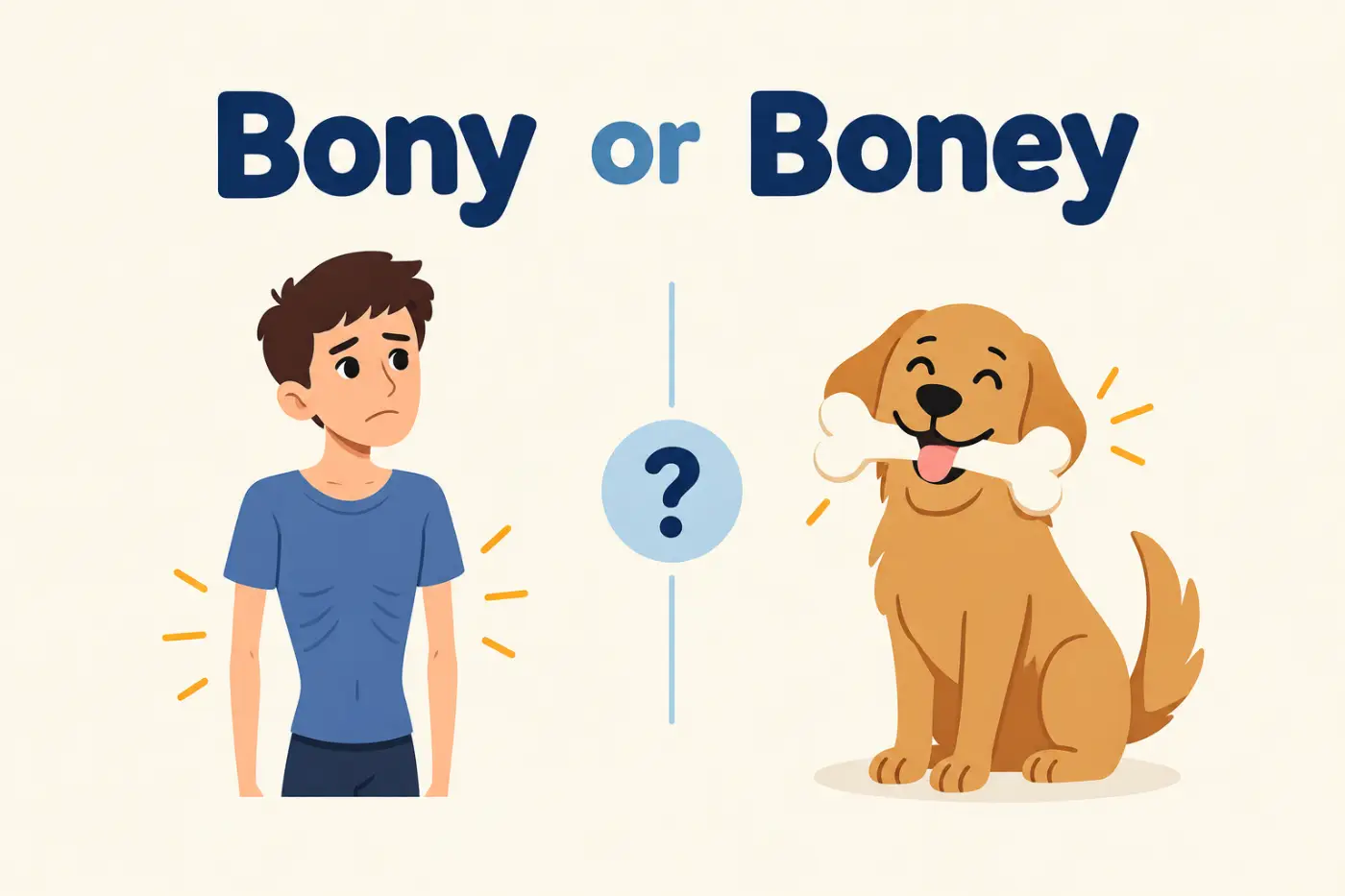
If you’re wondering about bony or boney you aren’t the only one who pauses over these two spellings. Both forms look natural at first glance. However only one is the standard spelling used in modern American English.
The correct spelling is bony. It usually describes something that has a lot of bone or has a thin appearance because the bones are easy to see or feel. You might describe a person’s bony hands or a dog’s bony frame.
The spelling boney does appear in some dictionaries and older forms of English. It can also show up as a name or in informal writing. Still bony is the spelling you should choose for standard American English.
This guide explains the difference between the two forms. You’ll learn what bony means how to use it in a sentence why the spelling drops the final e and how it compares with similar words such as hairy and noisy.
Quick Definition
Bony is an adjective that describes something related to bones or something that has prominent or noticeable bones. It can describe a person’s body part an animal a physical feature or even a structure made mostly of bone.
Boney is a less common spelling. For standard US English writing bony is the safer and more widely accepted choice.
Direct Answer
Bony is the standard spelling in American English. Use boney only when you have a specific reason such as a proper name a quoted source or a particular style that uses that spelling.
Comparison Table
| Word | Meaning | Example Sentence | When to Use It |
|---|---|---|---|
| Bony | Having prominent bones or relating to bones. | The old dog had a bony frame. | Use this spelling in standard English. |
| Boney | An uncommon spelling of bony. | The word appeared in an old text. | Use it only when the context specifically calls for it. |
What Bony Means
The word bony describes something connected with bones. It can also describe a person or animal whose bones are easy to see because there is little flesh covering them.
For example you might say that someone has bony fingers. That means the fingers look thin and the bones are noticeable.
You could also describe an animal as bony.
- The rescued dog looked thin and bony.
- The horse had a bony face after months without enough food.
The word does not always describe a problem. Some people naturally have narrow hands wrists or facial features. In those cases bony simply describes their appearance.
It can also describe parts of the body in a neutral way.
- She rested her chin on her bony hand.
- The doctor examined the bony structure of the foot.
In medical or scientific writing the word often has a more precise meaning. In everyday speech it usually refers to the visible or noticeable shape of bones.
Why Bony Is The Standard Spelling
The spelling becomes easier to understand when you look at how English forms adjectives from nouns.
The base noun is bone. When we add the suffix y to make an adjective the final silent e is dropped.
So the spelling changes like this.
Bone becomes bony.
You can see the same pattern in several other common words.
- Noise becomes noisy.
- Ice becomes icy.
- Spice becomes spicy.
- Grease becomes greasy.
The change keeps the pronunciation and spelling pattern natural. English does this often when a word ending in silent e takes a suffix that begins with a vowel.
That is why bony looks different from the noun bone. The e does not stay in the adjective.
Why Boney Looks Right To Many People
The spelling boney can seem logical because English has many words that keep the final e before adding a suffix. A writer may look at bone and naturally think that adding y should create boney.
That instinct makes sense. The problem is that standard English spelling does not usually keep the silent e in this case.
There is another reason the spelling can cause confusion. English has words such as money and honey that already end in the letters e and y. Seeing those familiar patterns can make boney look perfectly normal.
However familiar does not always mean standard. In modern American English bony is the usual spelling when you mean related to bones or having prominent bones.
The Spelling Rule For Words Ending In E
A useful spelling pattern can help you remember this word.
When a word ends in a silent e and you add a suffix that begins with a vowel the final e often disappears.
For example bone becomes bony. The same idea appears in words such as noise and noisy.
This pattern does not cover every word in English. Spelling has plenty of exceptions. Still it gives you a useful reason for the spelling rather than forcing you to memorize it as a random fact.
You can think of the process this way.
Bone plus y becomes bony.
The final e drops before the y is added.
That simple pattern is enough to settle the spelling in most everyday situations.
Bony In Real Sentences
The best way to understand a word is to see how people actually use it. The following examples show several meanings and situations.
Describing A Person
A person can have a bony face hands fingers shoulders or frame.
- His bony fingers wrapped around the cup.
- She had a narrow face with sharp bony features.
- The child had long bony legs.
The word often creates a picture of a body where the bones stand out clearly. The exact feeling depends on the sentence.
For example bony fingers is mostly descriptive. It tells the reader what the fingers look like. It does not automatically mean the person is unhealthy.
Describing An Animal
Animals can also have bony bodies or features.
- The stray cat looked bony after spending weeks outside.
- The old horse had a bony back.
- The puppy’s bony legs seemed too thin for its large paws.
When talking about an animal that has lost a lot of weight bony can suggest poor health or poor nutrition. Context makes the meaning clear.
Describing Bones In The Body
The word can also have a more direct physical meaning.
- The scan showed the bony structure of the knee.
- The bony parts of the skull protect the brain.
- The doctor checked the bony area around the joint.
Here bony does not mean thin or underweight. It simply means related to bone or made of bone.
This distinction matters because the word has more than one common use.
Bony Can Describe Appearance
When people use bony in everyday conversation they often talk about appearance.
A person with a bony face may have visible cheekbones or a thin face. Someone with bony shoulders may have shoulders where the bones are easy to see. A person with bony hands may have prominent knuckles and thin fingers.
For example you might hear someone say that an actor has a bony face. The speaker is describing the person’s facial structure rather than making a medical claim.
The same word can describe body parts in a neutral or slightly negative way. Tone matters.
Compare these sentences.
- She has delicate hands.
- She has bony hands.
The first sounds softer and more positive. The second gives a sharper picture. It may suggest that the bones are especially noticeable.
That difference is useful when choosing words for personal descriptions. Bony is accurate but it can sound blunt when used to describe someone directly.
Bony Does Not Always Mean Unhealthy
This is an important point because the word can easily be misunderstood.
Someone can have a naturally bony body shape without being sick or underweight. Genetics body structure age and muscle and fat distribution all affect how visible bones appear.
For example a person may naturally have prominent collarbones or narrow wrists. Calling these features bony simply describes their shape.
The context tells readers how to understand the word.
Consider this sentence.
- She has bony hands with long elegant fingers.
The description focuses on appearance and may even sound complimentary.
Now consider this sentence.
- After weeks without enough food the dog became extremely bony.
Here the word suggests serious weight loss and poor health.
The spelling stays the same. Only the context changes the meaning and tone.
Bony As A Scientific And Medical Term
You may also see bony in medical articles anatomy textbooks and health information.
In these settings the word often means related to bone rather than thin or underweight.
For example a medical text might refer to a bony structure. This means a structure made of or connected with bone.
Doctors and health professionals may also describe a bony prominence. This refers to an area where bone naturally sticks out or sits close to the surface of the skin.
Common examples include parts of the wrist elbow ankle and shoulder.
This use is very different from saying that a person looks bony. One describes anatomy. The other describes visible appearance.
Understanding that difference can help you read medical information without assuming the word always refers to body weight.
Bony Or Boney In American English
For everyday American English writing bony is the form you should use.
It is the standard spelling in common dictionaries and general writing. You’ll see it in books articles educational material medical writing and everyday descriptions.
Boney is much less common. It can still appear in historical sources proper names informal writing or older texts. That does not make it the preferred spelling for ordinary modern writing.
If you’re writing an email school assignment article report or social media post and you mean something related to bones choose bony.
That choice is simple and reliable.
Common Mistakes People Make With Bony
Even though bony is a simple word, writers sometimes make mistakes when spelling or using it. Most errors happen because people confuse the adjective with the noun bone or assume that the final e should stay in place.
Here are some common mistakes and how to fix them.
Adding An Extra E
The most common spelling mistake is writing boney instead of bony. People often make this mistake because they want to keep the spelling of the original word bone.
However, the correct form drops the final e before adding y.
Incorrect: She has boney fingers.
Correct: She has bony fingers.
Remember that the adjective follows the same spelling pattern as words like icy and noisy.
Using Bony When You Mean Bone
Another mistake is using the adjective when the noun would make more sense. Although the words are related they serve different purposes.
Bone is a noun. It refers to one of the hard parts that form a person’s or animal’s skeleton.
Bony is an adjective. It describes something related to bones or something with noticeable bones.
Compare these examples.
- The doctor examined the bone in his arm.
- The patient had a bony wrist.
The first sentence talks about an actual bone. The second describes the appearance or structure of the wrist.
Confusing Bony With Skinny
People sometimes use bony and skinny as if they mean exactly the same thing. They are related but have slightly different meanings.
Skinny describes someone or something that has very little body fat. Bony focuses on bones that look or feel prominent.
For example a person can be skinny without having clearly visible bones. Someone with a bony frame usually has noticeable bones around areas such as the wrists shoulders or face.
Consider these sentences.
- The skinny boy wore a loose jacket.
- The bony boy had visible collarbones.
Both words describe a thin appearance but they create different pictures.
Using Bony As A Noun
Bony is mainly an adjective. It describes a person animal body part or structure. It does not normally work as a noun in everyday English.
For example you can say that someone has a bony hand. You wouldn’t normally call the hand a bony.
Use bone when you need a noun and bony when you need an adjective.
Synonyms And Related Words For Bony
Choosing the right synonym can make your writing more natural. However, not every word that describes a thin body has the same meaning.
Some words focus on visible bones. Others describe a lack of body fat or a particular body shape.
Here are some useful alternatives.
| Word | Meaning | Example Sentence |
|---|---|---|
| Skinny | Very thin with little body fat. | The skinny cat squeezed through the gap. |
| Thin | Having little body fat or a narrow shape. | He has thin wrists. |
| Lean | Having little body fat and often a fit appearance. | The runner has a lean build. |
| Gaunt | Looking very thin and often unhealthy. | He looked gaunt after his illness. |
| Skeletal | Resembling a skeleton or having very little flesh. | The animal had a skeletal frame. |
| Angular | Having sharp or noticeable angles and edges. | Her face had sharp angular features. |
| Emaciated | Extremely thin because of severe weight loss or lack of food. | The rescued animal was badly emaciated. |
These words can help you avoid repetition. Just make sure the replacement matches the meaning you want.
For instance lean often has a positive meaning. It can describe an athlete with a strong body and little extra fat. Gaunt and emaciated usually suggest poor health or serious weight loss. Angular focuses on shape rather than weight.
Bony Vs Skinny
Both words can describe a thin person or animal but they don’t paint the same picture.
Bony means the bones are noticeable or prominent. Skinny means someone has a thin body with little body fat.
A person may be skinny without having a clearly visible skeleton. However, someone described as bony usually has noticeable bones in certain areas.
Here are a few examples.
- My grandfather has skinny legs.
- My grandfather has bony knees.
- The skinny dog ran across the yard.
- The bony dog needed proper food and care.
The first and third examples focus on thinness. The second and fourth draw attention to visible bones.
You can use either word in casual writing. However, choose the one that gives readers the clearest picture.
Bony Vs Lean
These words both describe body shape but carry different feelings.
Lean usually describes someone who has a slim body with little extra fat. It often suggests fitness or strength. Bony describes visible or prominent bones and can sometimes suggest that someone looks too thin.
For example, a runner may have a lean body because regular exercise has helped build muscle and reduce body fat. A person with a bony frame may have noticeable shoulders collarbones or wrists.
Compare these sentences.
- The athlete has a lean and muscular body.
- The athlete has bony shoulders and narrow wrists.
The first sentence highlights fitness. The second describes physical features.
Using the right word helps you avoid giving readers the wrong impression.
Bony Vs Skeletal
The words bony and skeletal are closely related. Both can describe visible bones or structures connected with the skeleton.
However, skeletal often sounds stronger. It can describe something that looks extremely thin or resembles a skeleton. It also has a direct scientific meaning related to the skeleton.
For example.
- The old man had a bony face.
- The starving animal had a skeletal appearance.
- The human skeletal system supports the body.
Use bony for ordinary descriptions of noticeable bones. Choose skeletal when you want to describe a skeleton like appearance or discuss the body’s skeleton as a whole.
How To Remember The Correct Spelling
If you keep forgetting the spelling you don’t need to memorize a long list of rules. A few simple tricks can help you remember it.
Drop The Final E
Start with the noun bone. Remove the final e and add y. The result is bony.
This is the easiest way to remember the spelling because it shows exactly how the adjective is formed.
Connect It With Icy
Think about the word ice. When you add y to form an adjective the final e disappears.
Ice becomes icy.
Bone becomes bony.
Both words follow the same spelling pattern. Connecting them can make the correct form easier to remember.
Remember The Shorter Version
The standard adjective has only four letters. You don’t need the extra e at the end.
Whenever you feel unsure remember that bony is shorter than boney. The shorter form is the one used in standard American English.
Write It In A Sentence
Writing a word in context can help you remember it better than simply looking at it.
Try these sentences.
- The old dog had a bony back.
- His bony fingers held the pencil.
- The doctor studied the bony structure of the shoulder.
Read each sentence aloud and pay attention to the spelling. Repeating this practice a few times can help the correct form stick.
Practice Your Understanding Of Bony
A short practice exercise can show you how well you’ve learned the word. Read each sentence and choose the correct spelling.
Choose the correct option.
- The stray cat looked thin and (bony / boney).
- She rested her head on her (bony / boney) hand.
- The doctor examined the (bony / boney) structure of the foot.
- His (bony / boney) fingers were easy to notice.
Answers: Bony is correct in all four sentences.
Notice that the spelling stays the same in every example. The word works as an adjective in all four sentences.
When To Use Bony In Everyday Writing
You can use bony in casual conversations formal writing descriptive articles and even medical discussions. The key is to understand the context and choose a tone that fits your reader.
In creative writing the word can help readers picture a character. For example, describing someone as having bony fingers or a bony face creates a clear image without using a long explanation.
In everyday conversation it can describe a person’s appearance or an animal’s body. However, be thoughtful when using it to describe someone directly. Some people may find comments about their body shape rude or uncomfortable.
In health and science writing the word can describe structures made of bone or areas where bones are prominent. In this setting it has a more neutral and specific meaning.
No matter the situation the spelling stays the same. Use bony for standard English writing.
More Examples Of Bony In Context
A word becomes easier to understand when you see how it works in different situations. The meaning of bony can shift slightly based on context but the central idea stays the same. It can describe visible bones a body part a physical structure or something connected to the skeleton.
Describing Hands And Fingers
Hands and fingers are common places where bones become noticeable. Someone with little flesh around the fingers may have prominent knuckles or thin hands.
For example you could write:
- His bony fingers moved quickly across the keyboard.
- She had long bony hands with narrow wrists.
- The old man’s bony knuckles stood out as he gripped the cane.
These sentences focus on physical appearance. They don’t necessarily suggest that the person is unhealthy.
Describing A Face
A bony face usually has noticeable facial bones. The cheekbones jaw or other parts of the face may appear sharp or prominent.
For example:
- His bony face made him look older than he was.
- She had a narrow bony face and high cheekbones.
- The character’s bony features gave him a serious expression.
Writers often use this description when creating a strong visual image. It can help readers picture a character without giving a long description.
Describing Shoulders
Shoulders can also look bony when the collarbones or shoulder bones are easy to see.
For example:
- Her bony shoulders showed through the thin shirt.
- The swimmer had broad shoulders rather than a bony frame.
- After losing weight his shoulders looked unusually bony.
The surrounding words help readers understand the intended meaning. A sentence about weight loss may suggest a change in health. A sentence about someone’s natural body shape may simply describe appearance.
Describing Knees And Elbows
The knees and elbows naturally have areas where bone sits close to the skin. For that reason they can easily look bony.
For example:
- His bony elbows rested on the table.
- The child had scraped both bony knees.
- The blanket barely covered her bony elbows.
These uses are usually straightforward descriptions of body parts.
Bony In Creative Writing
Writers often choose bony because it creates a strong visual image with very few words. A character with bony hands can seem old fragile tired or mysterious depending on the surrounding details.
Consider this sentence:
- The old woman placed her bony hand on the door.
The word gives the reader an instant picture. You don’t need to explain that her fingers are thin and her bones are easy to see.
A different sentence can create a completely different feeling.
- The dancer had bony shoulders and powerful arms.
Here the description focuses on body structure rather than weakness. The person may be fit and strong even though the shoulders appear prominent.
This is why context matters so much. A descriptive word can suggest different ideas depending on the rest of the sentence.
Bony In Animal Descriptions
The word is especially common when people describe animals that are very thin.
A rescued animal may look bony after going without enough food. A sick animal may also lose weight and develop a noticeably bony appearance.
For example:
- The shelter took in a bony stray dog.
- The cat looked bony after being lost for several weeks.
- The horse’s bony frame showed that it needed better nutrition.
In these cases bony often carries a negative meaning because it suggests that the animal has lost too much weight.
Still, the word itself does not automatically mean sick. A naturally thin animal can also have a bony body.
Bony In Health And Anatomy
You may see the word used differently in health related writing. In this setting bony often describes something that involves bone rather than something that looks unusually thin.
For example:
- The knee has several bony structures.
- The doctor felt for a bony lump near the joint.
- The scan showed the bony parts of the ankle clearly.
The word bony can also appear in phrases such as bony prominence. A bony prominence is an area where a bone naturally sticks out or sits close to the skin.
Common examples include the elbow the heel and parts of the wrist. These areas can be easy to feel because they have less soft tissue covering the bone.
This medical use is more neutral than describing someone as bony. It simply identifies the relationship between a body part and its underlying bone.
Is Boney Ever Used
Yes but it is much less common.
You may encounter boney in older writing historical material names or informal usage. It can also appear when someone deliberately chooses an unusual spelling.
That does not make it the preferred spelling for modern standard American English. If you’re writing an article email school assignment report or other general content you should use bony.
There is one important point to keep in mind. A dictionary may list a less common spelling without recommending it for everyday use. Dictionary entries can record historical or regional forms as well as the forms most people use today.
So seeing boney somewhere does not mean you should switch to that spelling.
Bony As A Compound Word
You may also see bony used as part of a larger term or phrase.
Examples include:
- Bony structure.
- Bony prominence.
- Bony ridge.
- Bony frame.
- Bony tissue.
In each case the word tells you that the following noun relates to bone or has a noticeable bone structure.
For example bony ridge describes a raised area formed by bone. Bony frame describes the bone structure that gives a body its basic shape.
These combinations are useful because they show that the word is not limited to descriptions of thin people or animals.
Bony And Bone Related Words
English has several words built from bone. Knowing how they relate to one another can make the vocabulary easier to understand.
Bone
Bone is the basic noun. It refers to one of the hard structures that form the skeleton.
- The doctor found a small crack in the bone.
Bony
Bony is an adjective. It describes something related to bone or something where bones are noticeable.
- The injury affected the bony part of the wrist.
Boneless
Boneless means something has no bones or has had its bones removed.
- We ordered boneless chicken for dinner.
Bone Like
Bone like describes something that resembles bone in appearance or structure. In standard writing it can also appear as bonelike depending on the style guide being followed.
These words all connect to the same basic idea but they perform different jobs in a sentence.
Why Bony Can Sound Negative
The word is not automatically negative but it can carry a negative tone when used to describe someone’s body.
For example saying someone has bony hands may simply describe their hands. However calling someone bony without any context can make the description sound critical or unkind.
The difference comes from how the word is used.
Compare these examples:
- The artist studied the bony structure of the hand.
- He looked bony after losing a lot of weight.
The first sentence is neutral and anatomical. The second suggests a change in health or body condition.
If you’re describing a real person you don’t know well it may be better to choose a more neutral word such as thin or simply describe the feature you mean.
For example instead of saying someone is bony you might say that they have prominent cheekbones or slender hands. These choices give the reader useful information without making a broad judgment about the person’s body.
Bony And Thin Are Not Exact Synonyms
It can be tempting to replace bony with thin every time. That doesn’t always work.
Thin describes size or body fat. Bony points more directly to visible or prominent bones.
A thin person might have a smooth body shape with no obvious bones. A bony person usually has features where the bones stand out.
Consider this example:
- The model is thin but has soft facial features.
- The model has a bony face with prominent cheekbones.
The first sentence tells you about overall body size. The second gives you a more specific picture of facial structure.
That distinction is useful in descriptive writing because precise words create clearer images.
A Simple Memory Trick
If you’re still unsure about the spelling remember this sentence:
Bone loses its e before it becomes bony.
That one idea can settle the question quickly.
You can also connect it with noise and noisy. The final e disappears when the adjective is formed.
Bone becomes bony.
Noise becomes noisy.
Ice becomes icy.
Spice becomes spicy.
These examples aren’t identical in every part of their word history but they show a familiar spelling pattern. Seeing the pattern repeatedly makes the correct form easier to recall.
More Examples Of Bony In Context
A word becomes easier to understand when you see how it works in different situations. The meaning of bony can shift slightly based on context but the central idea stays the same. It can describe visible bones a body part a physical structure or something connected to the skeleton.
Describing Hands And Fingers
Hands and fingers are common places where bones become noticeable. Someone with little flesh around the fingers may have prominent knuckles or thin hands.
For example you could write:
- His bony fingers moved quickly across the keyboard.
- She had long bony hands with narrow wrists.
- The old man’s bony knuckles stood out as he gripped the cane.
These sentences focus on physical appearance. They don’t necessarily suggest that the person is unhealthy.
Describing A Face
A bony face usually has noticeable facial bones. The cheekbones jaw or other parts of the face may appear sharp or prominent.
For example:
- His bony face made him look older than he was.
- She had a narrow bony face and high cheekbones.
- The character’s bony features gave him a serious expression.
Writers often use this description when creating a strong visual image. It can help readers picture a character without giving a long description.
Describing Shoulders
Shoulders can also look bony when the collarbones or shoulder bones are easy to see.
For example:
- Her bony shoulders showed through the thin shirt.
- The swimmer had broad shoulders rather than a bony frame.
- After losing weight his shoulders looked unusually bony.
The surrounding words help readers understand the intended meaning. A sentence about weight loss may suggest a change in health. A sentence about someone’s natural body shape may simply describe appearance.
Describing Knees And Elbows
The knees and elbows naturally have areas where bone sits close to the skin. For that reason they can easily look bony.
For example:
- His bony elbows rested on the table.
- The child had scraped both bony knees.
- The blanket barely covered her bony elbows.
These uses are usually straightforward descriptions of body parts.
Bony In Creative Writing
Writers often choose bony because it creates a strong visual image with very few words. A character with bony hands can seem old fragile tired or mysterious depending on the surrounding details.
Consider this sentence:
- The old woman placed her bony hand on the door.
The word gives the reader an instant picture. You don’t need to explain that her fingers are thin and her bones are easy to see.
A different sentence can create a completely different feeling.
- The dancer had bony shoulders and powerful arms.
Here the description focuses on body structure rather than weakness. The person may be fit and strong even though the shoulders appear prominent.
This is why context matters so much. A descriptive word can suggest different ideas depending on the rest of the sentence.
Bony In Animal Descriptions
The word is especially common when people describe animals that are very thin.
A rescued animal may look bony after going without enough food. A sick animal may also lose weight and develop a noticeably bony appearance.
For example:
- The shelter took in a bony stray dog.
- The cat looked bony after being lost for several weeks.
- The horse’s bony frame showed that it needed better nutrition.
In these cases bony often carries a negative meaning because it suggests that the animal has lost too much weight.
Still, the word itself does not automatically mean sick. A naturally thin animal can also have a bony body.
Bony In Health And Anatomy
You may see the word used differently in health related writing. In this setting bony often describes something that involves bone rather than something that looks unusually thin.
For example:
- The knee has several bony structures.
- The doctor felt for a bony lump near the joint.
- The scan showed the bony parts of the ankle clearly.
The word bony can also appear in phrases such as bony prominence. A bony prominence is an area where a bone naturally sticks out or sits close to the skin.
Common examples include the elbow the heel and parts of the wrist. These areas can be easy to feel because they have less soft tissue covering the bone.
This medical use is more neutral than describing someone as bony. It simply identifies the relationship between a body part and its underlying bone.
Is Boney Ever Used
Yes but it is much less common.
You may encounter boney in older writing historical material names or informal usage. It can also appear when someone deliberately chooses an unusual spelling.
That does not make it the preferred spelling for modern standard American English. If you’re writing an article email school assignment report or other general content you should use bony.
There is one important point to keep in mind. A dictionary may list a less common spelling without recommending it for everyday use. Dictionary entries can record historical or regional forms as well as the forms most people use today.
So seeing boney somewhere does not mean you should switch to that spelling.
Bony As A Compound Word
You may also see bony used as part of a larger term or phrase.
Examples include:
- Bony structure.
- Bony prominence.
- Bony ridge.
- Bony frame.
- Bony tissue.
In each case the word tells you that the following noun relates to bone or has a noticeable bone structure.
For example bony ridge describes a raised area formed by bone. Bony frame describes the bone structure that gives a body its basic shape.
These combinations are useful because they show that the word is not limited to descriptions of thin people or animals.
Bony And Bone Related Words
English has several words built from bone. Knowing how they relate to one another can make the vocabulary easier to understand.
Bone
Bone is the basic noun. It refers to one of the hard structures that form the skeleton.
- The doctor found a small crack in the bone.
Bony
Bony is an adjective. It describes something related to bone or something where bones are noticeable.
- The injury affected the bony part of the wrist.
Boneless
Boneless means something has no bones or has had its bones removed.
- We ordered boneless chicken for dinner.
Bone Like
Bone like describes something that resembles bone in appearance or structure. In standard writing it can also appear as bonelike depending on the style guide being followed.
These words all connect to the same basic idea but they perform different jobs in a sentence.
Why Bony Can Sound Negative
The word is not automatically negative but it can carry a negative tone when used to describe someone’s body.
For example saying someone has bony hands may simply describe their hands. However calling someone bony without any context can make the description sound critical or unkind.
The difference comes from how the word is used.
Compare these examples:
- The artist studied the bony structure of the hand.
- He looked bony after losing a lot of weight.
The first sentence is neutral and anatomical. The second suggests a change in health or body condition.
If you’re describing a real person you don’t know well it may be better to choose a more neutral word such as thin or simply describe the feature you mean.
For example instead of saying someone is bony you might say that they have prominent cheekbones or slender hands. These choices give the reader useful information without making a broad judgment about the person’s body.
Bony And Thin Are Not Exact Synonyms
It can be tempting to replace bony with thin every time. That doesn’t always work.
Thin describes size or body fat. Bony points more directly to visible or prominent bones.
A thin person might have a smooth body shape with no obvious bones. A bony person usually has features where the bones stand out.
Consider this example:
- The model is thin but has soft facial features.
- The model has a bony face with prominent cheekbones.
The first sentence tells you about overall body size. The second gives you a more specific picture of facial structure.
That distinction is useful in descriptive writing because precise words create clearer images.
A Simple Memory Trick
If you’re still unsure about the spelling remember this sentence:
Bone loses its e before it becomes bony.
That one idea can settle the question quickly.
You can also connect it with noise and noisy. The final e disappears when the adjective is formed.
Bone becomes bony.
Noise becomes noisy.
Ice becomes icy.
Spice becomes spicy.
These examples aren’t identical in every part of their word history but they show a familiar spelling pattern. Seeing the pattern repeatedly makes the correct form easier to recall.
FAQs
Is bony or boney correct?
Bony is the standard spelling in modern American English. It describes something related to bones or something that has noticeable or prominent bones. Boney is a much less common form and isn’t the usual choice for standard writing.
Is boney a real word?
You may find boney in older texts or other special contexts. It can also appear as a proper name or an unusual spelling. For ordinary English writing you should use bony.
Why does bone become bony?
The final silent e in bone drops when the adjective bony is formed. This gives you bone plus y becoming bony. Similar spelling changes appear in words such as ice becoming icy and noise becoming noisy.
What does bony mean?
Bony can mean related to bones or having bones that are easy to see or feel. For example a doctor may describe a bony structure in the body while a writer may describe someone as having bony hands.
Is bony the same as skinny?
Not exactly. Skinny means very thin while bony suggests that the bones are noticeable or prominent. A person can be skinny without having a clearly bony appearance.
Is bony a negative word?
Not always. The word can be neutral when it describes anatomy or a physical feature. However calling someone bony can sound negative if the context suggests that the person is unhealthy or extremely thin.
What is the opposite of bony?
There isn’t one exact opposite in every situation. For body shape fleshy or plump may contrast with bony while soft may contrast with a clearly defined bone structure. The best opposite depends on what you are trying to describe.
How can I remember the spelling of bony?
Think of bone without the final e before adding y. Bone becomes bony. You can also connect it with words such as ice and icy to remember the spelling pattern.
Conclusion
If you’ve been stuck between bony or boney the answer is simple. Bony is the standard spelling you should use in modern American English. It can describe something related to bones or a person or animal whose bones are especially noticeable.
The spelling becomes easier once you connect it to the noun bone. Drop the final silent e and add y. That gives you bony rather than the less common boney.
The word can describe many things. You might talk about bony fingers bony shoulders a bony face or the bony structure of a joint. The meaning depends on the context. It can describe appearance or simply refer to something connected with bone.
When you’re writing an email article school assignment or everyday message choose bony. If you remember that bone loses its final e before becoming bony you’ll have a quick spelling check whenever the question comes up.

Dr. Elena Vance holds a Ph.D. in Linguistics from Columbia University and has spent over 15 years analyzing the evolution of the English language. A former university professor turned full-time writer and editor, Elena specializes in breaking down high-level grammatical concepts, punctuation nuances, and style guides (APA, Chicago, MLA) into clear, actionable advice. When she isn’t hunting down dangling modifiers, she can be found collecting vintage dictionaries and reading classic literature.