
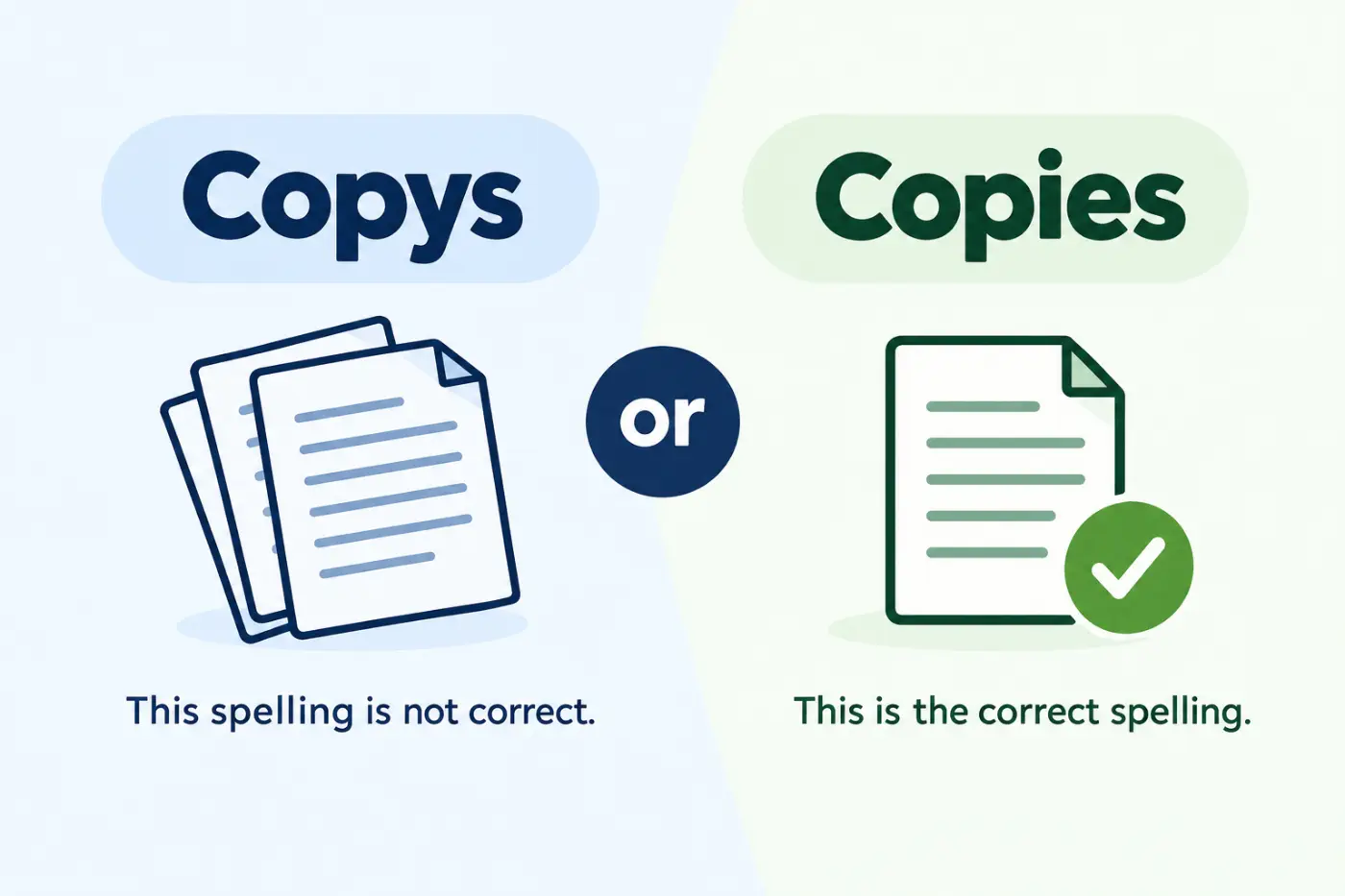
Have you ever wondered if the correct spelling is copys or copies? You’re not alone. Many people get confused when they need to write the plural form of the word copy. The good news is that the spelling rule is simple once you understand it.
Copies is the correct plural spelling of copy. The spelling copys is incorrect in standard English. If you’re talking about several printed pages several files or more than one version of a document then copies is the word you need.
The reason comes down to a common spelling rule. When a noun ends in a consonant followed by the letter y you usually change the y to i and add es to make it plural. This rule also applies to many everyday words such as baby and city.
In this guide you’ll learn why copies is correct how to use it in everyday sentences and how the rule works with other words. You’ll also see common mistakes and learn a simple way to remember the right spelling.
Quick Definition
Copy is a noun or a verb. As a noun it means a duplicate of something such as a document or picture. As a verb it means to make a duplicate or reproduce information.
Copies is the plural form of the noun copy and can also be the verb form used with he she or it in the present tense. Copys is an incorrect spelling in standard English.
Direct Answer
Copies is the correct spelling when you mean more than one copy. Use copies instead of copys because most nouns that end in a consonant followed by y change the y to i and add es.
Comparison Table
| Word | Meaning | Example Sentence | When to Use It |
|---|---|---|---|
| Copy | One duplicate or the act of duplicating something. | Please make a copy of this form. | Use it for one item or as the base verb. |
| Copies | More than one duplicate or the present tense verb used with he she or it. | She made three copies of the report. | Use it for multiple items or with a singular subject performing the action. |
| Copys | An incorrect spelling in standard English. | The spelling copys is incorrect. | Do not use it in standard writing. |
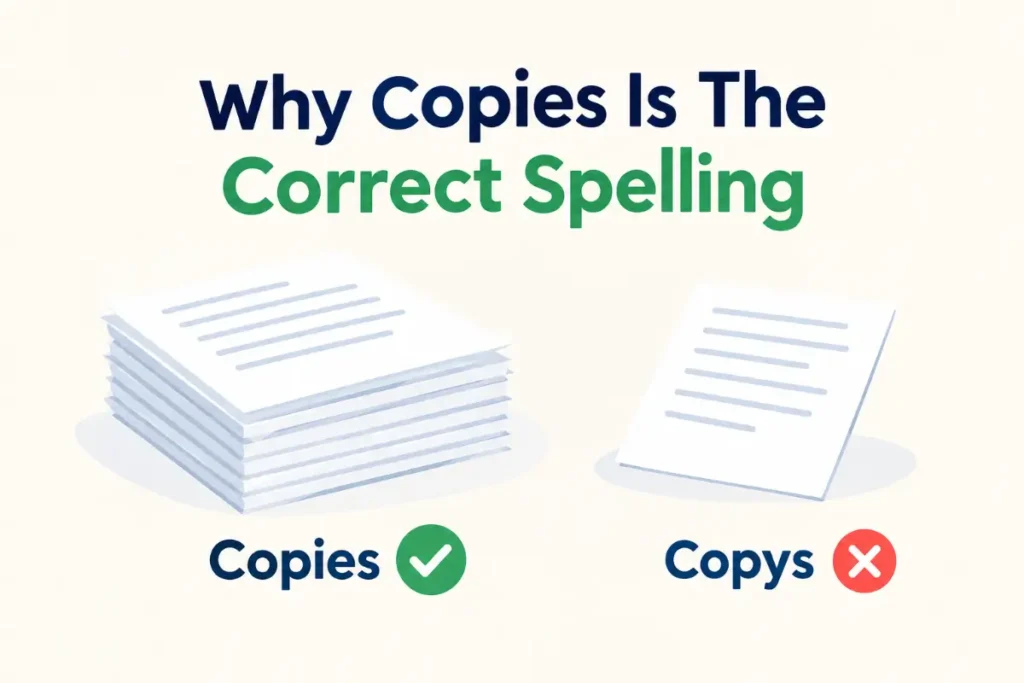
Why Copies Is The Correct Spelling
The spelling of copies follows a common rule for forming plurals in English. When a noun ends in a consonant followed by y you usually change the y to i and add es. This creates the plural form without changing the basic meaning of the word.
For example copy becomes copies. The same pattern appears in words such as puppy and puppies or story and stories. Once you recognize the pattern you can apply it to many other words.
The key is to look at the letter that comes right before the y. In copy the letter before y is p which is a consonant. That means you change the y to i and add es to form copies.
How The Spelling Rule Works
You can remember the process in three simple steps. First find the word that ends in y. Next check the letter just before the y. If that letter is a consonant change the y to i and add es.
Here are a few examples.
| Singular | Plural |
|---|---|
| Copy | Copies |
| Baby | Babies |
| City | Cities |
| Party | Parties |
| Puppy | Puppies |
| Story | Stories |
Each example follows the same pattern. The ending changes but the main part of the word stays easy to recognize.
Why You Add Es Instead Of Just S
If you wrote copys you would be adding only s to the original word. That does not follow the standard spelling rule for nouns that end in a consonant followed by y. The correct form changes the y to i before adding es.
This small change helps keep English spelling consistent across many common words. It also explains why you write babies instead of babys and cities instead of citys. The spelling may look different from the singular form but the rule is easy to apply.
What Happens When A Word Ends In A Vowel And Y
There is one important difference to remember. If a noun ends in a vowel followed by y you usually add s without changing the y. The spelling stays more direct because the letter before y is a vowel rather than a consonant.
For example boy becomes boys and key becomes keys. You also write day and days or toy and toys. You do not change the y to i in these words.
This contrast is useful because it helps you decide the right ending instead of guessing. Copy ends in a consonant and y so it becomes copies. Boy ends in a vowel and y so it becomes boys.
What Does Copies Mean
The word copies has two common uses. It can mean more than one duplicate of something or it can describe an action performed by a person or thing in the present tense. The meaning depends on how the word appears in the sentence.
When used as a plural noun copies refers to separate versions of the same original item. These might be printed documents digital files photographs books or other materials. For example a teacher may ask students to bring two copies of an assignment.
When used as a verb copies means that someone reproduces or imitates something. For example the sentence she copies the notes means that she writes down the same information. In this case copies describes an action rather than naming several objects.
Copies As A Plural Noun
A plural noun names more than one person place thing or idea. In this use copies refers to two or more versions of an original item. You will often see it in schools offices libraries and places that print documents.
Consider these examples.
- I need three copies of the signed form.
- The store received new copies of the book.
- Please keep two copies of the receipt.
- We printed extra copies of the meeting notes.
- The teacher handed out copies of the worksheet.
In each sentence copies names more than one item. The word tells the reader that several versions exist rather than just one.
Copies As A Verb
Copies can also describe what a person or thing does. In the present tense you use copies with he she it or a singular noun. This is different from the plural noun use even though the spelling is the same.
For example you might say she copies the recipe into her notebook. You could also write the student copies the example from the board. In both sentences copies describes an action performed by one person.
Compare that with the sentence the students copy the example from the board. The subject is plural so the verb is copy rather than copies. Understanding the subject helps you choose the right form.
Simple Examples To Help You Remember
The easiest way to learn a spelling rule is to see it in everyday use. Think about the kinds of copies you might make at school work or home. These situations help show how the word fits naturally into a sentence.
At school a teacher might say please bring two copies of your essay. At work a manager might ask for copies of a report before a meeting. At home you might make copies of family photos to share with relatives.
You can also use copies as a verb when describing someone’s actions. A student copies a diagram into a notebook. A child copies a dance move from a video. An employee copies information into a spreadsheet.
These examples show why it helps to understand both uses. The spelling stays the same but the job the word does in the sentence changes. Once you notice that difference you can use copies with confidence.
Common Mistakes People Make With Copies
Even though the spelling rule is simple, people still make mistakes when writing words that end in y. The problem often comes from adding s to the original word without changing its ending. This may seem logical, but it does not work for every noun.
The best way to avoid these errors is to look at the last two letters before making a word plural. If the word ends in a consonant followed by y, you usually change y to i and add es. If a vowel comes before y, you usually keep the y and add s.
Adding S Without Changing The Y
One common mistake is writing copys instead of copies. The writer knows that plural nouns often end in s, so they add s to the original word. However, words that end in a consonant followed by y need a different ending.
Here are some examples of this mistake.
| Incorrect Spelling | Correct Spelling |
|---|---|
| Copys | Copies |
| Babys | Babies |
| Citys | Cities |
| Partys | Parties |
| Storys | Stories |
| Ponys | Ponies |
Notice how the correct spelling changes the ending of each word. You do not need to memorize every example separately. Learning the rule makes it easier to spell many words correctly.
Confusing Nouns With Verbs
Another mistake happens when people confuse a plural noun with a verb. The word copies can name several duplicate items or describe an action performed by one person or thing. These uses follow different grammar rules even though they share the same spelling.
Look at these examples.
Plural noun. She printed five copies of the report.
Verb. She copies the report into her notebook.
In the first sentence copies refers to five separate documents. In the second sentence copies describes what she does. The surrounding words help you understand the difference.
Using Copies With The Wrong Subject
When copies acts as a verb in the present tense, it normally goes with a singular subject such as he she or it. With plural subjects such as they or we, the verb usually takes the base form copy.
For example you would write he copies the notes but they copy the notes. You would also write my sister copies the recipe but my sisters copy the recipe. The subject determines the correct verb form.
This rule can feel confusing because the singular subject takes the verb ending with s while the plural subject does not. Remember that English verbs work differently from plural nouns. A plural noun often takes s or es, but a verb used with he she or it often takes s or es in the present tense.
Forgetting The Difference Between Copy And Copies
The words copy and copies are both correct, but they do not always fit in the same sentence. Use copy for one item or as the base form of the verb. Use copies for several items or when a singular subject performs the action in the present tense.
Consider these examples.
- I need one copy of the contract.
- I need four copies of the contract.
- We copy the details into a file.
- He copies the details into a file.
Each sentence uses the form that fits the meaning and grammar. If you are unsure which form to use, check the number of items or identify the subject performing the action.
Copy Versus Copies In Everyday Writing
The difference between copy and copies appears in many everyday situations. Knowing which form to use helps you write clear emails complete school assignments and give instructions that people can follow.
In School And College
Students often need copies of worksheets essays notes and study guides. Teachers may ask for several copies of an assignment so they can share the material with a class. In these cases copies is a plural noun because it refers to more than one item.
For example you might write please bring two copies of your research paper to class. You could also say the teacher gave us copies of the reading material. Both sentences describe multiple documents.
The verb form appears in a different way. A student copies notes from the board or copies a question into a notebook. If several students perform the action, you would say the students copy the notes from the board.
At Work
Offices use copies of contracts reports forms and other business documents. An employee might print several copies of a proposal before a meeting. A manager might ask for copies of a receipt to complete an expense report.
Here are a few natural examples.
- Please send me two copies of the updated report.
- The assistant made copies of the meeting agenda.
- Our team keeps copies of important records.
- She copies the figures into the monthly spreadsheet.
- The new employee copies the information into the database.
These examples show both forms in a workplace setting. Copies as a noun refers to multiple documents, while copies as a verb describes an action performed by one person.
In Digital Communication
The word copy is not limited to printed pages. People also make copies of digital files photos messages and other information. You might save copies of your work in separate folders or keep copies of important files in cloud storage.
For example you could say I made copies of the photos before deleting the originals. You might also write the program copies the files to another folder. In the first sentence copies is a plural noun, while in the second it is a verb.
Digital tools also use the phrase copy and paste. In this expression copy is a verb that tells you to duplicate text or other content. You might copy a paragraph and paste it into a document, but you would use copies when referring to several saved versions.
At Home
You might use the word when sharing family photos printing recipes or keeping important papers. A parent could make copies of a child’s school forms, while a student might copy a recipe into a notebook.
For example you could say we keep copies of our insurance documents in a safe place. You could also write my brother copies the shopping list before leaving home. Both sentences sound natural because the word matches the meaning.
Words That Follow The Same Spelling Rule
Learning words in groups is a useful way to improve spelling. Once you understand why copy becomes copies, you can apply the same pattern to many other common nouns. This saves time and reduces the need to memorize each plural form separately.
Baby And Babies
The word baby ends in a consonant followed by y. To make it plural, change y to i and add es. The result is babies.
For example you might write the daycare cares for six babies. If you are talking about one child, use baby. If you are talking about several children, use babies.
City And Cities
The word city follows the same pattern. Since t is a consonant, you change the y to i and add es to form cities.
For example you could say the state has several large cities. You would not write citys in standard English. This rule applies to many place names used as common nouns.
Party And Parties
The plural of party is parties. The word ends in a consonant followed by y, so the y changes to i before es is added.
For example the family attended three birthday parties last month. You could also say the school organizes parties for special events. Both sentences use the correct plural form.
Story And Stories
The plural form of story is stories. You use stories when talking about more than one tale or account.
For example the library has many stories for young readers. You might also write she tells funny stories about her childhood. In both cases the word refers to more than one story.
Puppy And Puppies
The same rule applies to puppy. Change the y to i and add es to make puppies.
For example the puppies played in the garden all afternoon. If you are talking about one young dog, use puppy. The spelling change follows the same pattern as copy and copies.
When You Should Keep The Y
Not every word that ends in y changes its spelling in the plural. The letter before y matters. If a vowel comes before y, you usually add s and leave the y in place.
This is the key difference between words such as copy and boy. Copy ends in p followed by y, so it becomes copies. Boy ends in o followed by y, so it becomes boys.
Words With A Vowel Before Y
Here are some common examples.
| Singular | Plural |
|---|---|
| Boy | Boys |
| Toy | Toys |
| Key | Keys |
| Day | Days |
| Monkey | Monkeys |
| Journey | Journeys |
Each word keeps its y when you form the plural. You simply add s at the end.
Why This Difference Matters
The rule helps you avoid guessing. Instead of asking yourself if a word looks right, check the letter before the final y. That small step often gives you the answer.
For example the word key ends in e followed by y. Since e is a vowel, the plural is keys. The word puppy ends in p followed by y, so the plural is puppies.
Remember this simple pattern. A consonant before y usually means change y to i and add es. A vowel before y usually means keep y and add s.
How To Check Your Spelling Before You Submit
A quick review can catch many spelling errors before they reach a teacher an employer or a client. You do not need a long checklist. A few simple habits can make your writing more accurate.
First check the ending of the word. If you are making a plural from a noun that ends in consonant plus y, apply the spelling rule. For copy, that means writing copies.
Next read the whole sentence. Make sure the word fits the meaning and the grammar. If you are naming several documents, copies is likely the right choice. If you are describing an action, check the subject to see if you need copy or copies.
Finally use a spell checker as a backup. A spelling tool can catch many errors, but it may not explain why a form is wrong. Understanding the rule helps you make the right choice even when software is unavailable.
The goal is not to worry about every letter you write. It is to learn a few useful patterns that make everyday writing easier and clearer.
Is Copies Always A Plural Noun
No. The word copies can be a plural noun or a verb in the present tense. Its role depends on how you use it in a sentence.
As a plural noun copies refers to two or more duplicate items. For example you might say the office needs ten copies of the new policy. The word names several documents.
As a verb copies describes an action performed by a singular subject such as he she or it. For example you might say she copies the notes into her planner. The word describes what she does rather than naming a group of items.
How To Tell The Difference
Look at the words around copies to figure out its role. If a number or a word such as many or several comes before it, copies is often a plural noun. If a person or thing performs an action, copies may be a verb.
Compare these sentences.
- The printer made six copies of the letter.
- The student copies the letter into her notebook.
- Several copies are missing from the folder.
- He copies the file to his computer.
In the first and third examples copies is a noun. In the second and fourth examples it is a verb. The sentence gives you the clues you need.
Copying Versus Making Copies
The words copying and copies are related, but they serve different purposes. Copying is the form used for an action that is happening or continuing. Copies can name several duplicate items or describe an action performed by a singular subject in the present tense.
For example you could say I am copying the notes from the board. This tells the reader that the action is in progress. You could also say I made three copies of the notes, which tells the reader how many duplicate versions you created.
Here are a few more examples.
- She is copying the information into her notebook.
- The office made extra copies of the report.
- He copies the same design in every drawing.
- They are copying the files to a new computer.
These forms are not interchangeable in every sentence. Choose the one that matches the action and the meaning you want to express.
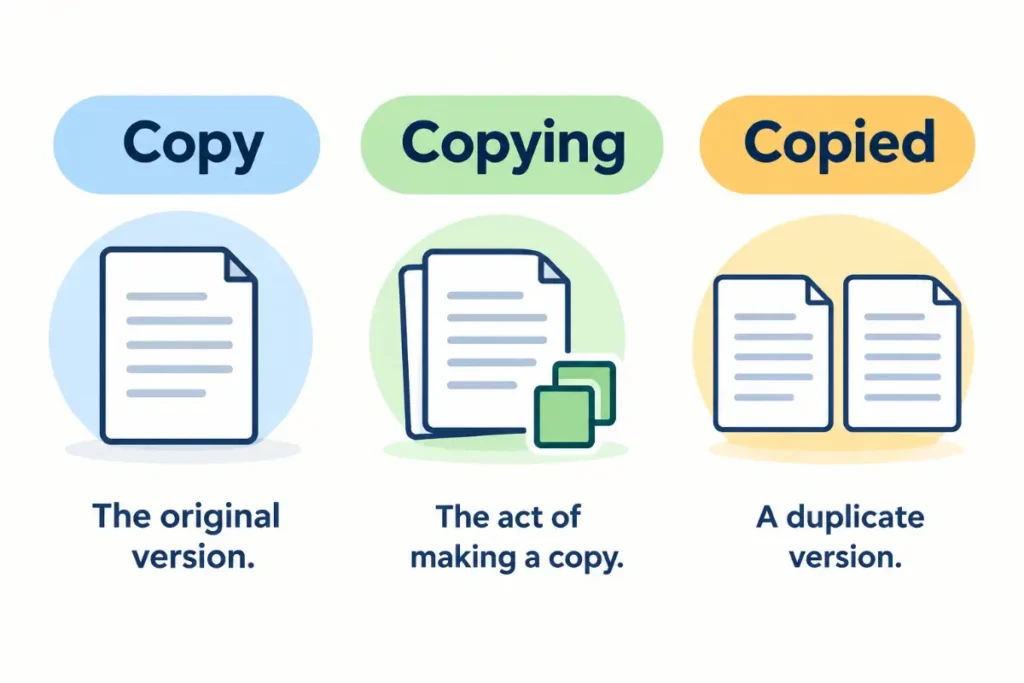
Copy Versus Copying Versus Copied
English verbs change form to show how an action happens and when it takes place. The base verb is copy. The other forms include copies, copying, and copied.
Copy
Use copy with I you we and they in the simple present tense. You also use it after words such as to and can.
For example you might say I copy my notes after class or they copy the answers into their books. You could also say I need to copy this document or she can copy the file.
Copies
Use copies with he she it or a singular noun in the simple present tense. This form describes a regular action or something that happens as a fact.
For example you could write he copies his homework into a planner. You might also say the machine copies both sides of the page.
Copying
Use copying when the action is in progress or after certain verbs and prepositions. For example she is copying the address or he finished copying the document.
The spelling keeps the y and adds ing. You do not change the y to i because the word is not being made plural.
Copied
Use copied for the simple past tense or as a past participle. For example I copied the file yesterday or she has copied the notes into her planner.
The spelling changes the final y to i before adding ed. This follows a common spelling pattern for verbs that end in a consonant followed by y.
Learning these forms together helps you see how one base word can change to fit different sentences.
Common Expressions That Use Copy And Copies
The word copy appears in many common expressions. Knowing these phrases can help you use the word naturally in emails conversations and everyday writing.
Make A Copy
This phrase means to create a duplicate of something. You can make a copy of a document a photo a key or a digital file.
For example you might say please make a copy of the signed agreement before you send it. The phrase is useful when you need one extra version of an item.
Make Copies
Use this phrase when you need more than one duplicate. It is common in offices schools and print shops.
For example the teacher asked the assistant to make copies of the worksheet for the whole class. The plural noun copies tells us that several versions are needed.
Copy And Paste
This expression describes moving duplicated text or other content from one place to another using a computer or phone. Copy creates a duplicate of the selected material, while paste places that material somewhere else.
For example you might say copy the address and paste it into the search box. The word copy acts as a verb in this instruction.
Hard Copy
A hard copy is a printed version of information that you can hold in your hand. It differs from a digital file that you view on a screen.
For example a manager might ask for a hard copy of the report before a meeting. You can have several hard copies of the same report.
Digital Copy
A digital copy is an electronic version of a file document photo or other content. You can store it on a computer phone or online account.
For example I saved a digital copy of the receipt on my phone. If you save several versions, you can refer to them as digital copies.
Common Questions About Copying Documents
People sometimes confuse the spelling of copies because they focus only on the final letters. However, the right choice also depends on the meaning of the sentence. These examples show how the word works in practical situations.
Should You Write Two Copy Or Two Copies
Use two copies because the number two refers to more than one item. The noun must be plural when you are talking about multiple documents.
For example write please print two copies of the form. Do not write please print two copy.
Is It Copies Of The Book Or Copy Of The Book
Use copies of the book when you mean more than one version. Use copy of the book when you mean one version.
For example the library ordered five copies of the book. You might also say I borrowed a copy of the book from my friend.
Is It Copy’s Or Copies
These forms have different uses. Copies is the normal plural form of copy, while copy’s often shows possession or forms a contraction in a suitable sentence.
For example the copy’s cover is torn means the cover belonging to one copy is torn. By contrast the copies are on the desk means there are several copies. An apostrophe does not normally form a plural noun in English.
Can You Use Copies For Digital Files
Yes. Copies can refer to digital files as well as printed items. You might keep copies of photos on your phone or save copies of important documents in cloud storage.
The word still means duplicate versions. The only difference is that the items exist in digital form rather than on paper.
How To Improve Your Spelling Over Time
You do not need to memorize a long list of rules to improve your spelling. Start by learning patterns that apply to common words. The consonant plus y rule is a useful example because it appears in many words you use every day.
Read the words in context instead of studying them only as isolated items. When you see copies in an email or book, notice how the spelling differs from copy. You can also write a few example sentences to reinforce the pattern.
Try making a small practice list with words such as baby, city, party, story, and puppy. Write the singular form beside its plural form. This lets you compare the endings and spot the rule quickly.
It also helps to read your writing aloud before sending it. Reading aloud will not catch every spelling mistake, but it can help you notice missing words and awkward sentences. Combine that habit with a spell checker for a more careful final review.
A Simple Memory Trick For Copies
Here is an easy way to remember the correct form. Think of the word copy and picture the letter y changing into i before es is added. The result is copies.
You can connect the rule to another familiar word such as baby. One baby becomes two babies, just as one copy becomes two copies. The same pattern works for city and cities or party and parties.
If the letter before y is a vowel, remember that you usually keep the y and add s. One boy becomes two boys, and one key becomes two keys. Comparing these examples helps you remember both parts of the rule.
With a little practice, the spelling becomes automatic. You will no longer need to stop and wonder if you should add s or change the ending. You can check the letters before y and choose the form that fits.
FAQs
Is copys or copies correct?
Copies is the correct spelling when you mean more than one copy. The spelling copys is incorrect in standard English. To form the plural, change the final y to i and add es.
Why does copy become copies?
Copy becomes copies because it ends in a consonant followed by y. English spelling rules usually require you to change y to i and add es in this case. The same pattern appears in words such as baby and city.
What is the plural of copy?
The plural of copy is copies. For example you might say I printed three copies of the document. The spelling changes because copy ends in a consonant followed by y.
Is copies a noun or a verb?
Copies can be a noun or a verb. As a noun it means more than one duplicate of something. As a verb it describes an action performed by a singular subject such as he she or it.
Is copy’s the same as copies?
No. Copies is the plural form of copy, while copy’s usually shows possession. For example copies of the book means several books or versions, while the copy’s cover means the cover belonging to one copy.
Do you change y to i in every word that ends in y?
No. You usually change y to i and add es when a consonant comes before the final y. If a vowel comes before y, you usually keep the y and add s, as in boy and boys.
What is the past tense of copy?
The past tense of copy is copied. For example you could write I copied the notes yesterday. The spelling changes y to i before adding ed.
Can copies refer to digital files?
Yes. Copies can refer to printed documents or digital items such as photos and computer files. For example you might save copies of your important documents in a separate folder.
Conclusion
If you’ve been unsure about copys or copies, remember that copies is the correct spelling. Use it when you mean more than one version of a document photo book or other item. The spelling copys is incorrect in standard English.
The rule is simple. When a noun ends in a consonant followed by y, you usually change y to i and add es to form the plural. That is why copy becomes copies, baby becomes babies, and city becomes cities.
Keep in mind that copies can also work as a verb. You use it with a singular subject such as he she or it, as in she copies the notes. When the subject is I you we or they, the simple present verb is usually copy instead.
The next time you need to write the plural form, check the letter before the final y. If it is a consonant, change y to i and add es. This small habit will help you spell copies correctly and handle many similar words with confidence.

Sienna Watson is a veteran copywriter and communications coach who has helped startup founders, marketers, and professionals polish their writing for over a decade. Realizing that most people don’t need a degree in linguistics—just clear, impactful communication—Sienna focuses on practical grammar, business writing etiquette, and eliminating wordiness. She advocates for plain language, strong verbs, and persuasive prose that gets results.