
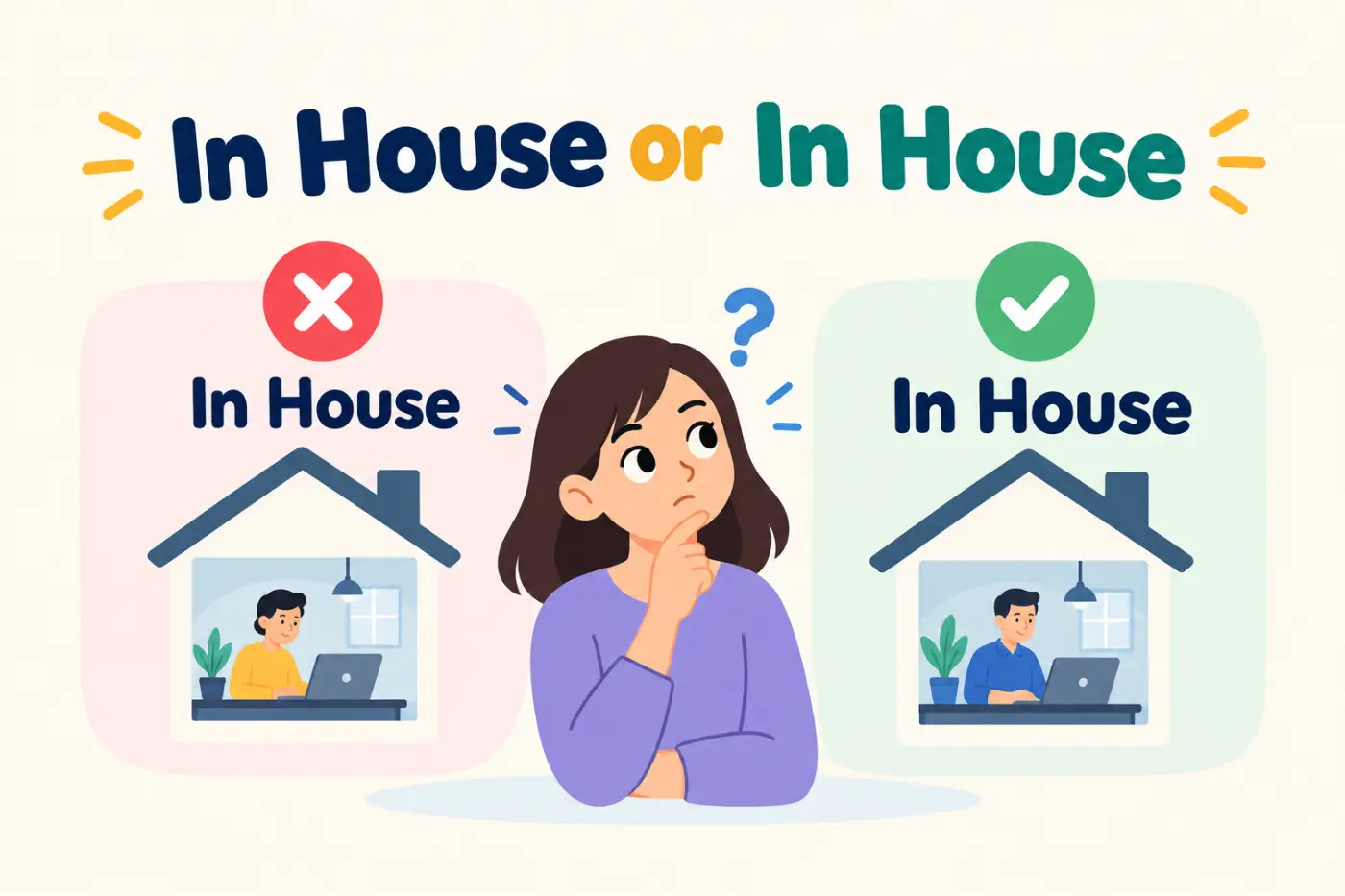
The correct spelling depends on how you use the phrase in a sentence. In American English, in house and in house can appear as two words, but in house is often written as in house without a hyphen when it follows the noun or acts as an adverbial phrase. The hyphenated form in house is also widely used in business writing, especially when it comes before a noun. For example, a company might have an in house team or handle a task in house.
The key is to know the role the phrase plays in your sentence. When it describes a noun, many style guides favor in house with a hyphen, as in an in house designer. When it follows a verb, the open form is common, as in We handle design in house. In American writing, consistency matters because usage varies across dictionaries and style guides.
This guide explains the difference between the open and hyphenated forms, shows you how to use them in everyday sentences, and covers common mistakes in business writing. You’ll also learn how to choose the right form for emails, reports, websites, and other professional documents.
Quick Definition
In-house is the standard American English spelling for work or services done within an organization rather than by an outside company. It can describe a team, employee, service, or task that a business manages itself.
For example, The company has an in-house design team. This means the company employs its own designers instead of hiring an outside design firm.
Direct Answer
Use in-house as the standard spelling in American English. Write it with a hyphen when you mean something handled or provided within an organization. The one-word spelling inhouse is generally nonstandard in edited American English.
Inhouse or In-House Comparison Table.
| Spelling | Meaning | Example sentence | When to use it |
|---|---|---|---|
| In-house | Done or managed within an organization | We hired an in-house accountant. | Use this standard hyphenated form in professional and general writing. |
| In house | Within a company or organization | We handle the work in house. | Some writers use this open form when the phrase follows a verb. However, many dictionaries and style guides prefer the hyphenated form in both positions. |
| Inhouse | Intended to have the same meaning as in-house | We have an inhouse team. | Avoid this spelling in standard American English unless a brand or organization uses it as a proper name. |
The safest choice is to write in-house in business documents, school assignments, emails, articles, and website content. It is widely understood and avoids questions about spelling.

Understanding the Meaning of In House
The phrase refers to something done inside a company or organization using its own staff, resources, or facilities. It often appears in business writing, but people also use it in education, health care, law, technology, and other fields.
Think of a company that needs a new website. It has two main options. It can ask its own employees to build the website, or it can pay an outside agency to do the work.
If the company uses its own employees, it handles the project in-house. If it hires an outside agency, it outsources the project.
This difference is the heart of the phrase. It tells readers who handles the work and where responsibility sits.
What In House Means in Business
In business, in-house work stays within the organization. The company uses its own employees or internal teams instead of relying on an outside service provider.
For example, a small company may have its own marketing team. That team writes website content, plans email campaigns, and manages social media. The company performs these tasks in-house.
A larger business might have an in-house legal department. Its lawyers help review contracts, explain legal risks, and support company leaders. The business may still hire outside lawyers for special cases, but its regular legal work stays inside the organization.
Here are a few more examples.
- The store has an in-house repair team.
- Our in-house accountant manages the monthly reports.
- The company produces its training videos in-house.
- We use an in-house team to answer customer questions.
- The hospital has an in-house pharmacy.
Each sentence shows that the organization manages the service itself rather than handing the entire job to an outside provider.
What In House Means in Everyday English
The phrase doesn’t belong to business alone. It can describe anything that happens within a home, institution, or group.
For example, a family might say they prefer to prepare meals in-house at a care facility rather than buy prepared meals from a supplier. A school might offer in-house tutoring through its own teachers. A hotel might have an in-house laundry service for its sheets and towels.
The exact meaning depends on the setting, but the main idea stays the same. The work takes place within the organization or is handled by its own people.
What In House Does Not Always Mean
The phrase doesn’t always mean that someone performs a task inside a physical building. It often describes who controls the work rather than the exact location.
Imagine a company whose employees work remotely. Its staff members write articles, manage payroll, and create graphics from their homes. The company can still describe those services as in-house because its own employees perform the work.
By contrast, an outside contractor may work inside the company’s office but still provide an outsourced service. The contractor’s physical location doesn’t automatically make the work internal.
This distinction helps prevent a common misunderstanding. In-house usually refers to internal responsibility and control, not simply to a room or building.
Why the Spelling Causes Confusion
English uses different spelling patterns for words that work together. Some phrases use separate words. Others use a hyphen or combine the words into one. This can make it hard to know which form to choose.
You may see different spellings in websites, business documents, job listings, and online articles. One writer might use a hyphen while another leaves it out. Seeing these forms repeatedly can make the spelling rule seem unclear.
English Uses Different Compound Forms
A compound is made of two or more words that work together to express one idea. English has three common compound forms.
- Open compounds use separate words such as high school.
- Hyphenated compounds join words with a hyphen such as well known.
- Closed compounds combine words into one such as notebook.
The correct spelling depends on the specific expression. You can’t assume that every phrase follows the same pattern.
Why Writers Drop the Hyphen
Writers sometimes remove hyphens to make text look simpler or save space. This often happens in headlines, social media posts, internal notes, and informal business messages.
Some companies also use custom spellings in product names or branding. A business might choose a single word as the name of an app or service. That choice can work as a brand name without changing the standard spelling of the general expression.
Autocorrect can add to the confusion. Some writing tools accept different forms without explaining which one fits standard usage. A spelling tool’s approval doesn’t always mean an editor would recommend that form.
When writing for a general American audience, follow standard dictionary usage instead of copying every spelling you see online.
Why the Hyphen Helps Readers
A hyphen can show that two words work together to describe one thing. It helps readers understand the connection between the words and the noun that follows.
Without a hyphen, the meaning may still be clear. However, consistent spelling makes professional writing look more polished and easier to read.
The goal isn’t to add hyphens everywhere. It’s to follow the accepted spelling for each expression and use it consistently.
How to Use the Phrase Correctly in a Sentence
The right spelling becomes easier once you understand how the phrase works in a sentence. Look at its role and the meaning you want to express.
Use the Hyphenated Form Before a Noun
When a phrase describes a noun, it acts as an adjective. An adjective gives readers more information about a person, place, thing, or group.
Examples include the following.
- We hired an in house writer to manage the company blog.
- The business launched an in house training program.
- Our in house team created the new logo.
- She works with an in house legal department.
- The clinic offers in house testing.
- They built an in house system to track orders.
- The company needs an in house customer support team.
- We asked our in house designer to update the website.
In each example, the phrase describes the person, team, service, or system that belongs to the organization. Use the standard hyphenated spelling in edited American English.
Use the Phrase After a Verb
The phrase can also explain how a person or organization performs an action. It tells readers that the work happens within the organization rather than through an outside provider.
Examples include these sentences.
- We develop our software internally.
- The company handles payroll with its own staff.
- Our team manages social media without outside help.
- They produce all their training materials internally.
- The hospital processes some tests at its own facility.
- We prepare the reports with our own team.
- The firm manages its website without an outside agency.
- The school provides tutoring through its own staff.
These alternatives keep the meaning clear without making the spelling distracting. If you use the original expression, follow your chosen style guide consistently.
Use the Same Form in Similar Sentences
Consistency helps readers follow your meaning. Compare these examples.
- We have an in house design team.
- Our design team works internally.
The sentences describe related ideas. One explains who does the work. The other explains where or how the work gets done.
When editing a long article or business document, choose the standard spelling and follow it throughout. This keeps your writing clear and professional.
Which Spelling Should You Use in American English
When readers search for the correct form, they usually want a simple answer they can apply to their own writing. A current American dictionary is a reliable place to check the accepted spelling.
What Dictionaries Can Tell You
American dictionaries provide established spellings and explain how words are used. Check a current dictionary such as Merriam Webster or American Heritage when you need to confirm a compound or hyphenated expression.
You should also follow the style guide used by your employer, publisher, or client. Some organizations have specific rules for compounds and hyphens. If an approved style guide gives a clear instruction, follow it within that project.
For general writing, use the spelling supported by a reliable dictionary and keep it consistent.
Are One Word Forms Ever Correct
You may encounter closed spellings in business names, product names, usernames, and informal messages. A company might choose a single word as the official name of an app or service.
That choice doesn’t automatically make the same spelling correct in ordinary writing. Use the official brand spelling when referring to that product or company. For a general expression, follow standard dictionary usage.
Is the Open Form Always Wrong
Not every compound follows the same rule. Some expressions can appear in more than one form depending on their grammatical role and the style guide being used.
Published writing may also reflect an editor’s preferred style. If two forms appear in reputable sources, check the dictionary entry and the relevant style guide before deciding which one to use.
For a grammar article aimed at American readers, the safest approach is to explain the standard form clearly and avoid switching between spellings without a reason.
Common Examples in Everyday Writing
The phrase becomes easier to understand when you see it in familiar settings. Businesses and other organizations use it to describe their teams, services, products, and work processes.
In Business Writing
Business writing often compares internal work with services provided by outside companies. The wording helps explain who performs a task.
Consider these examples.
Example one. The company hired an internal accountant.
This means the accountant works as part of the company’s team rather than serving only as an outside contractor.
Example two. We handle customer complaints with our own staff.
The company responds to complaints internally instead of sending every case to an external support provider.
Example three. Our team developed the new training course.
The organization used its own staff to create the course rather than hiring an outside training company to do the entire job.
Example four. The business brought its design work back inside the company.
This means the business changed its process and now manages the work internally.
These examples show how a few simple words can explain who performs a task and how the work is organized.
In Technology
Technology companies often discuss software, systems, and product development. They may build tools for their own needs instead of buying a ready made product.
For example, a business may create an internal tool to manage inventory. Its developers build or maintain the tool for the organization’s own use.
This approach can give the business more control over features and updates. However, it may also require extra time, money, and technical skill.
Here are several natural examples.
- Our developers built an internal inventory system.
- The company tests new features with its own team.
- We use internal software to manage employee records.
- The technology team maintains the database.
- The business created a custom tool for tracking orders.
The wording explains how the work is organized. It doesn’t automatically mean the software is better or cheaper.
In Health Care
Health care providers may use their own staff and facilities to deliver certain services. The exact services vary from one facility to another.
For example, a hospital may perform some laboratory tests in its own laboratory rather than sending every sample to an outside provider.
A clinic might also manage billing through its own department.
Examples include the following.
- The hospital offers laboratory testing at its own facility.
- Our clinic has its own billing department.
- The medical center provides several services internally.
- The facility operates its own pharmacy.
These sentences explain how the service is organized. They don’t make claims about the quality of care or medical results.
In Education
Schools and colleges can provide programs through their own staff.
For instance, a school might offer tutoring through its teachers instead of sending students to an outside tutoring center. A college could also arrange training for its employees.
Examples include these sentences.
- The school runs a tutoring program for students.
- Our college offers staff training.
- The district created its own support team.
- Teachers provide extra help after class.
The wording helps parents, students, and staff understand who provides the service. It doesn’t mean every activity takes place in a classroom.
In Law and Finance
Law firms, banks, and other financial organizations use similar language to describe their teams.
A company with an employed lawyer has legal support within the organization. This differs from hiring an independent law firm for a specific matter.
Likewise, an internal finance team may handle budgets, reports, and financial planning.
Examples include the following.
- The company consulted its lawyer.
- Our legal team reviewed the contract.
- The bank has its own compliance department.
- The finance team prepares the reports.
These examples show how the same idea works across different fields. The best wording is the one that expresses the meaning clearly and follows standard spelling rules.
Restore the keyphrase in natural headings.
Common Mistakes to Avoid
Even a simple phrase can cause problems when writers use it in different ways. These mistakes are easy to fix once you know the standard spelling and meaning.
Writing Inhouse as One Word
The most common spelling mistake is removing the hyphen completely.
Incorrect. We have an inhouse marketing team.
Correct. We have an in-house marketing team.
The second sentence follows standard American English usage. The hyphen connects the two words and shows that they work together to describe the team.
Remember that shorter doesn’t always mean better. A familiar spelling is more useful than a shortened form that may distract readers.
Adding a Hyphen in the Wrong Place
A hyphen belongs between in and house. Don’t add spaces around it or use a different punctuation mark.
Correct. The company has an in-house designer.
Incorrect. The company has an in – house designer.
The first version is clean and easy to read. The second version breaks the compound into separate parts and looks like a typing error.
Confusing In-House With Homemade
The two expressions can overlap in some settings, but they don’t mean the same thing.
Homemade usually describes something made at home, often by an individual or family. In-house usually describes work handled within an organization.
For example, a restaurant might prepare homemade desserts in its kitchen. A company might have an in-house design team that creates its advertisements.
The first expression focuses on how something is made. The second focuses on who handles the work and the organization’s role in it.

Assuming In-House Always Means Cheaper
Some businesses keep work in-house to manage costs. However, the phrase itself doesn’t tell readers how much a service costs.
An internal team may save money over time because the company doesn’t pay an outside provider for every task. On the other hand, the business must cover employee salaries, equipment, software, training, and other expenses.
For example, a company may build an in-house software team because it needs regular updates. Another company may find it more practical to hire a software agency for a one-time project.
Both choices can make sense. The phrase describes the arrangement, not the financial result.
Using the Phrase When Another Word Is Clearer
Sometimes, a more specific word makes your meaning easier to understand.
Instead of writing We do our work in-house, you could write Our employees handle the work. The second sentence tells readers exactly who does the job.
Likewise, The company has an in-house training program is useful when you want to emphasize that the program belongs to the organization. If that detail doesn’t matter, The company trains its employees may be simpler.
Good writing doesn’t require repeating the same expression in every paragraph. Use it when it adds useful information.
How to Remember the Correct Spelling
A simple memory trick can help you choose the right form every time.
Think of In-House as One Connected Idea
The phrase combines in and house to describe something managed within an organization. The hyphen connects those words into one idea.
Think of examples such as these.
- In-house team.
- In-house service.
- In-house training.
- In-house software.
- In-house designer.
Once you remember the hyphenated pattern, you can apply it to many common business phrases.
Use the Company Test
Ask yourself one simple question. Does the phrase describe work or a service that an organization handles internally?
If the answer is yes, in-house is likely the expression you need.
For example, a company that uses its own employees to write articles has an in-house content team. If it hires a separate agency to write the articles, it outsources that work.
This test helps you remember the meaning as well as the spelling.
Check the Dictionary When You Need Certainty
English compounds don’t all follow one spelling rule. Some use hyphens, some use spaces, and others form a single word.
When a spelling question matters for publication, check a trusted dictionary. You can also consult your organization’s style guide. These sources help you make decisions based on established usage rather than guesswork.
For this expression, remember the standard American form: in-house.
Related Terms and Expressions
Learning a few related terms can help you write more clearly about business operations. Each term has a slightly different meaning, so choose the one that matches your message.
In-House Versus Outsourced
These terms describe two different ways to manage work.
In-house means an organization uses its own staff or resources to handle a task.
Outsourced means the organization hires an outside person or company to perform work that it could otherwise manage internally.
For example, a business with an in-house payroll team processes employee payments using its own staff. A business that hires an outside payroll provider outsources that task.
Neither option is always better. The right choice depends on the company’s needs, budget, skills, and workload.
In-House Versus Internal
The words in-house and internal often overlap, but they serve different purposes.
In-house usually describes work, services, or people connected to an organization. Internal is a broader term for something that exists or happens within a group or system.
For example, a company may have an in-house design team. It may also have internal rules for approving new designs.
The first phrase describes who provides the service. The second describes rules that operate within the organization.
In-House Versus On-Site
These expressions refer to different ideas.
In-house focuses on the organization’s own staff or resources. On-site focuses on a physical location.
For example, a company may have an in-house accountant who works remotely. Another company may hire an outside technician who visits its office to repair equipment on-site.
The accountant is part of the company’s internal team. The technician works at the company’s location but may still be an outside service provider.
This difference matters when you describe work arrangements or business services.
In-House Versus Homemade
As mentioned earlier, homemade usually refers to something made at home. In-house refers to work or services managed within an organization.
A bakery might sell homemade-style cookies made by its staff. A company might use an in-house design team to create its packaging.
The terms aren’t interchangeable in every sentence. Choose the word that gives readers the right information.
FAQs
Is Inhouse or In-House Correct?
In-house is the standard spelling in American English when you mean something managed or provided within an organization. The one-word form inhouse is generally nonstandard in regular writing. Use the hyphenated form in articles, emails, reports, and business documents.
Is In-House One Word or Two Words?
The standard spelling is two words joined by a hyphen. Write in-house team and in-house service. Avoid writing inhouse as one word in standard American English.
Should I Write In-House or In House?
Use in-house as your default spelling. Some writers use in house without a hyphen when the phrase follows a verb, but style guides vary. Keeping the hyphen in both positions is a clear and consistent choice.
What Does In-House Mean at Work?
At work, in-house means that a company handles a task through its own employees or resources. An in-house accountant, for example, works directly for the organization. The term doesn’t automatically mean the employee works inside the office.
Is In-House Formal or Informal?
The phrase works in both formal and informal writing. You can use it in business reports, professional emails, articles, job descriptions, and everyday conversations. It is a standard expression rather than slang.
What Is the Opposite of In-House?
The most common opposite is outsourced. In-house work stays within an organization, while outsourced work goes to an outside person or company. The exact choice depends on the task and the arrangement.
Can I Use In-House in a Resume?
Yes. You can use the phrase to describe experience working with internal teams or managing company resources. For example, you might write that you collaborated with an in-houses marketing team or developed an in-houses training program.
Does In-House Need a Hyphen Before a Noun?
Yes. The standard American spelling is in-houses when it describes a noun. Examples include in-houses counsel, in-house training, and in-house support. Using the hyphen consistently keeps your writing clear.
Conclusion
The correct spelling is in-house in standard American English. Use it to describe work, services, or people that belong to or operate within an organization. The one-word form inhouse is generally nonstandard, while the open form in houses appears in some writing styles.
The phrase works in many settings. A company can have an in-houses designer, a school can offer in-houses tutoring, and a hospital can provide in-houses testing. In each case, the wording tells readers that the organization handles the service internally.
You can also use the phrase after a verb, as in We manage payroll in-houses. Although some writers omit the hyphen in this position, using the hyphenated form throughout your writing is a practical way to stay consistent.
When you need to choose between inhouse or in-houses, remember one simple rule. Write in-houses unless you’re using a proper name with an official spelling that differs. This choice works well for American English articles, business writing, school assignments, and everyday communication.

Sienna Watson is a veteran copywriter and communications coach who has helped startup founders, marketers, and professionals polish their writing for over a decade. Realizing that most people don’t need a degree in linguistics—just clear, impactful communication—Sienna focuses on practical grammar, business writing etiquette, and eliminating wordiness. She advocates for plain language, strong verbs, and persuasive prose that gets results.